Presentation
This is the complete chapter from Steelhead Fly Fishing, written by Trey Combs and originally published in 1991. It is presented here in its original form.
Desktop only: Right-click any image in this essay and open it in a new tab to view the high-resolution version. Some fly names in the chapter also link to fly plates from the book. Not every fly mentioned appears on a plate.
Wet Fly - Greased Line
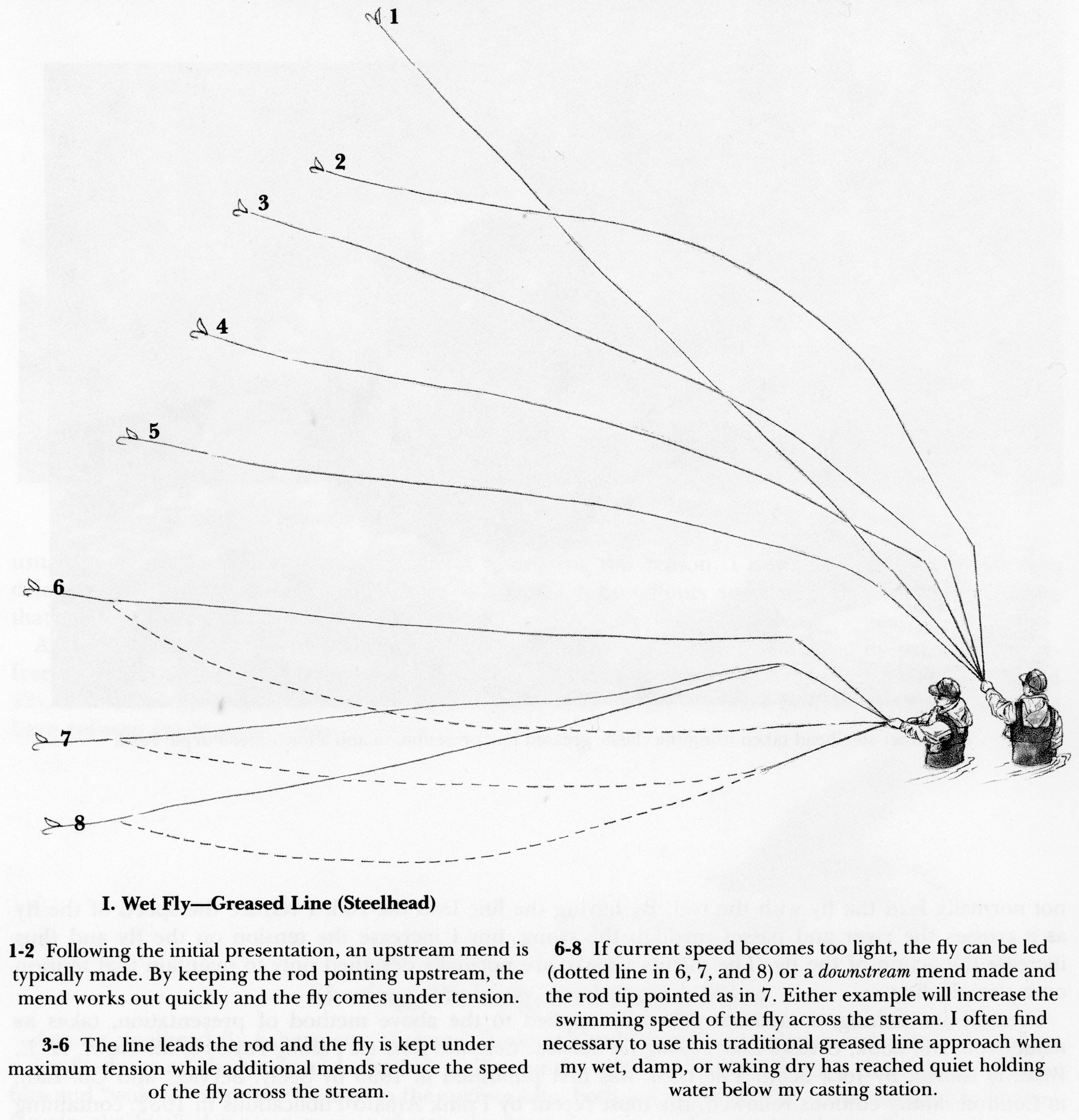
My standard wet-fly presentation is intended to keep the fly swimming just below the surface. To make the necessary mends, I use either a double-taper or a forward-taper long-belly line. I begin by casting across and slightly downstream. I then mend upstream strongly enough to work the mend down the line and turn the fly so that it is facing upstream. This initial mend accomplishes several things at once. The fly line immediately above the fly is pointing upstream. A small amount of slack has been created. As the current takes out the slack, the line will not belly. I keep my rod pointing across and slightly upstream to bring the fly under tension as soon as possible.
Tension, the force of the current against the fly, is what gives it action, whether the fly is surface or subsurface and fished waking, damp, wet, or hitched. By keeping my rod pointed behind the swinging fly, mending as necessary to keep a straight line to the fly, the fly will be under maximum tension as soon as the slack is gone from the initial mend. When the fly is under tension, it is working. However, if I make the initial mend and then point my rod at the fly, that is, drop my rod tip downstream, I create additional slack that delays tension on the line. The fly passing downstream nearly drag free is not working effectively until it again comes under tension. The top part of the swing, often over the very lie holding a steelhead, is wasted and less water is covered effectively. For this reason, my habit when fishing a wet fly barely subsurface is to keep my rod pointed above the swing of the fly. I do not normally lead the fly with the rod. By having the line lead the rod, I reduce the speed of the fly as it crosses the river and passes through the swing, but I increase the tension on the fly and thus increase the action of the fly. The mends I make are normally designed only to maintain that tension on a straight line.
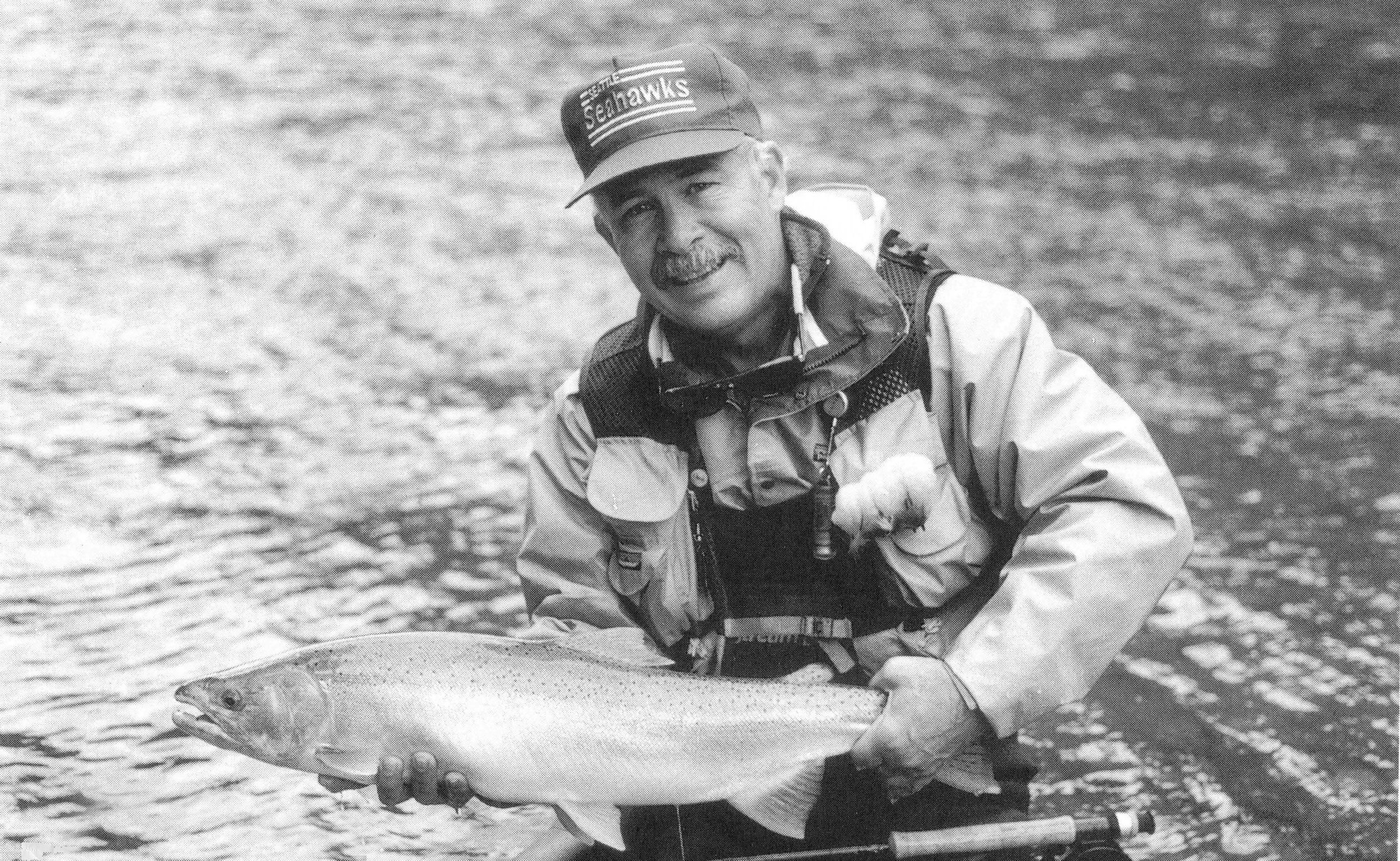
A summer steelhead taken using the classic greased line presentation and a low water Purple Peril.
Greased-line fishing, sometimes generally applied to the above method of presentation, takes its name from the book, Greased Line Fishing for Salmon: Compiled from the Fishing Papers of the late A. H. E. Wood, of Glassel, by Jock Scott. The book was first published in 1935 by Seely, Service, and Co. Ltd., in London. Many editions followed, the most recent by Frank Amato Publications in 1982, containing an introduction by Bill McMillan.
Donald G. Rudd, writing under the pseudonym of Jock Scott, described a method of presenting a fly that Arthur H. E. Wood developed on his lower River Dee beat at Cairnton in Scotland during the early years of this century. Wood had been writing a book on the subject but died before it could be completed. His papers passed to his son, Captain E. G. Wood, who made them available to Rudd.
Whenever possible, Rudd used Wood's own words, including offhand remarks made at streamside. Rudd supported these with his own commentary, an unfortunate mix. Rudd's imperfect knowledge of salmon fishing resulted in semantic ambiguities that plagued the book from the day of its publication. Many expert anglers, salmon and steelhead fly fishers alike, have dithered over passages that defy literal translation.
In Wood's time, the accepted method of presenting a wet fly to salmon was to quarter a cast well downstream and simply hold the rod as the fly completed its swing. The silk lines sank slowly and could not be mended. Currents swept a belly into the line, a fact of life that forced anglers to swim their flies through very conservative arcs. Salmon typically took the fly almost directly below the angler, and in setting the hook, the fly was often either pulled free or took such a light hold at the end of the salmon's mouth that it soon came free.
Arthur Wood kept his line floating by greasing it with animal fat. This enabled him to mend and to maintain control of the swing by removing any belly that currents might set in his line. This simple act permitted him to fish a greater part of the river's salmon lies while keeping his fly barely submerged, a working level Wood felt to be far more effective than the mid-depth fished in a conventional wet fly approach. More importantly, Wood led a thinly dressed fly so that it was somewhat broadside to the salmon, and then he fed slack into the rise. In this manner, the line would drag the fly into the corner of the salmon's mouth and the hinge of its jaw, where the hook penetrated for a most secure hold.
I won't belabor the controversial aspects of Greased Line Fishing, but some elements of this must be addressed to provide a satisfactory understanding of how Wood actually fished and to see how this integrates into current steelhead fly fishing.
Jock Scott writes:
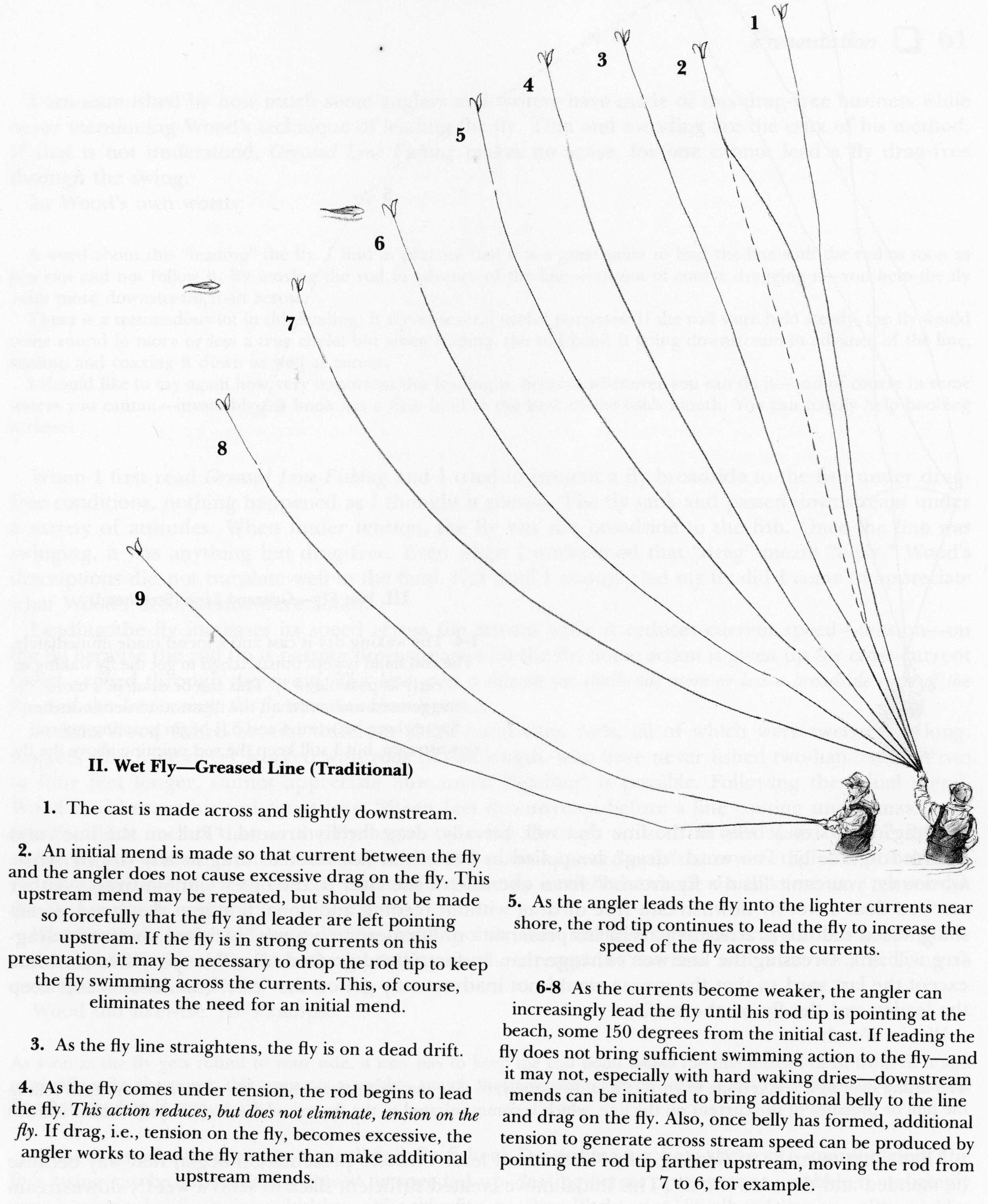
He [Wood] often told me that he liked the fly to float down like a dead leaf. What he regarded as fatal was any pull on it by the action of the stream on the line. When the cast is made and mended, and line floating delightfully without drag, you should lead it around by keeping the rod point in advance of it. This is another matter of importance. You must lead the line, without pulling it, keeping just enough touch on it to feel it, and manoeuvering it so that there is at no point what Wood called a "knuckle," that is a small acute curve caused by the stream. Sometimes when standing by me, he has called out, "You can't get rid of that knuckle by mending; lead the line instead," and it will be realized that such a bend is best put right by moving the top of the rod towards the fishermen's bank, thereby straightening the line.
"Drag" refers to a belly in the line that will, literally, drag the fly around. "Pull on the line" also referred to a belly. The word "drag" as applied by Wood did not refer to drag in any dry-fly sense. Obviously, you can't "lead a fly around" from one side of the river to the other without drag. Neither can you float a wet fly downstream free of drag without feeding additional line into the mend, something Wood did not practice as part of his presentation. Furthermore, a wet fly fished absolutely drag-free will sink. Greasing the line won't change that. In fact, Wood greased all of his thirty-five-yard line except the last yard so that the grease would not inadvertently get on the "cast" (the leader) and keep the leader and the fly on the surface.
Wrote Wood:
The lifting over of a line is done to correct a fault, namely, to take the downstream belly out of the line and thus relieve the pull or pressure of the current on the line, which is communicated to the fly and exhibits itself as drag. (Italics added.)
Then what to make of floating a fly "like a dead leaf?" Wood's presentation began that way because he mended and then led the fly. This initial move created sufficient slack to send a wet fly downstream a short distance without any tension (drag) on the line. Anglers have taken this one reference and assumed that Wood was fishing wet flies entirely drag free. That's as ridiculous as it is ineffective.
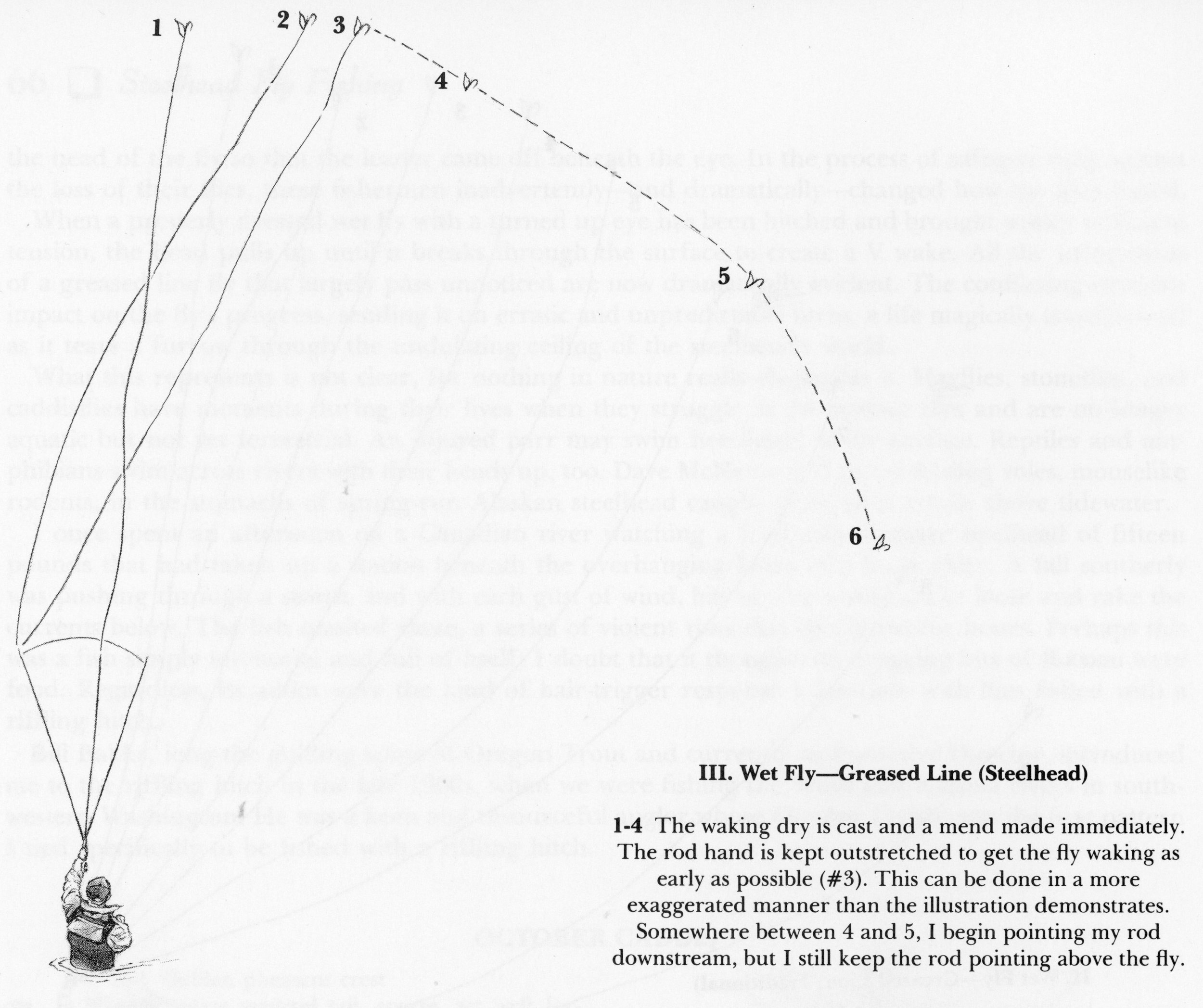
Some anglers try to fish a wet fly completely drag free near the surface and then pick up the line before the fly comes under tension during the swing. That may be an interesting way to fly-fish for steelhead, but it is not greased-line fishing as practiced by Arthur Wood.
I am astonished by how much some anglers and writers have made of this drag-free business while never mentioning Wood's technique of leading the fly. That and mending are the crux of his method. If that is not understood, Greased Line Fishing makes no sense, for one cannot lead a fly drag-free through the swing.
In Wood's own words:
A word about this "leading" the fly. I find in practice that it is a great point to lead the line with the rod as soon as you can and not follow it. By moving the rod in advance of the line-but not of course dragging it-you help the fly swim more downstream than across.
There is a tremendous lot in this leading; it serves several useful purposes. If the rod were held steady, the fly would come round in more or less a true circle; but when leading, the rod-point is going downstream in advance of the line, leading and coaxing it down as well as across.
I should like to say again how very important this leading is, because whenever you can do it-and of course in some waters you cannot-invariably the hook has a firm hold in the back of the fish's mouth. You can hardly help hooking it there!
When I first read Greased Line Fishing and I tried to present a fly broadside to the fish under drag-free conditions, nothing happened as I thought it should. The fly sank and passed downstream under a variety of attitudes. When under tension, the fly was not broadside to the fish. Once the line was swinging, it was anything but drag-free. Even when I understood that "drag" meant "belly," Wood's descriptions did not translate well in the field. Not until I strongly led my fly did I come to appreciate what Wood's descriptions were about.
Leading the fly increases its speed across the stream while it reduces current speed-tension-on the fly because the rod tip is passing downstream with the fly. Some action is given up for cross-current speed-speed through the swing. This lead gives a salmon (or steelhead) more or less a broadside view of the fly. And this lead swings the fly into the salmon's mouth.
Arthur Wood fished several different single-hand cane rods, all of which were twelve feet long. Anglers who have never worked with rods of this length, who have never fished two-handed rods two to four feet longer, cannot appreciate how much "leading" is possible. Following the initial mend, Wood could move his rod tip at least fifteen feet downstream before a line coming under maximum tension. That means that as the fly began to swing through an arc, current speed on the fly was reduced (but certainly not eliminated) as the rod point moved downstream with the swing of the fly. At the same time, current velocity decreased as the fly neared the shore. In this manner, tension on the fly was fairly constant.
Wood was no more hidebound about leading a fly than steelhead fly fishers are about keeping the rod behind the line. We do both depending on the strength of the flow and what we are trying to accomplish with the fly.
Wood did likewise. An example:
As soon as the fly gets round to your side, it may pay to keep the rod point behind the line instead of in front of it and gradually raise the point; this prevents a sudden snatch that sometimes occurs when a fish lying below you takes the fly when the line is taut.
What does all this mean to a steelhead fly fisher? Depending on how the rod is manipulated, the fly's swing can be dramatically slowed or speeded up, darting across open water to wobble tantalizingly over a particular lie before dashing off again for another likely spot. Steelhead lies are often under swift currents and along narrow creases. If one leads his fly through such water strongly enough to give the steelhead anything like a broadside view of the fly, the fly will pass through the lie so abruptly that the steelhead hardly has time to react. At such times, I slow the fly by keeping the rod point behind the swing of the line. If a current is so strong that the fly cannot swim properly, I immediately lead the fly away from the turbulence by dropping the point of the rod. Soft tailouts may have currents that move so slowly that the fly must be led strongly to prevent it from sinking. It may even be necessary to throw a downstream mend so that the speed of the fly through the water increases.
Knowing of Wood's propensity for leading his fly, I wonder if the differing emphasis salmon and steelhead fly fishers place on line manipulation is not due in large measure to the speed of the current above the lies. Summer steelhead take up temporary holding stations in currents far too swift to lead as strongly as Wood's presentation would suggest. I think that slowing the fly near the end of its swing is especially important, because a following steelhead is most likely to take at that time.
I am less than enthralled with this business of getting a fly broadside to the steelhead. I believe that the advantage of presenting a steelhead with a broadside view of the fly has little to do with the fish finding the fly. Regardless of whether or not you lead the fly, it swings into a steelhead lie to give the fish a side view. And whether it is presented somewhat broadside or not, steelhead take the fly from behind. They do not take the fly crosswise like a dog with a bone. However, when we strongly lead the fly, we generate considerable cross-stream speed, even a little downstream belly, that will carry the line past the fly when the fish rises to it. This momentum is sufficient to set the fine-wire hook, if the fish either remains stationary or turns away from the direction of the pull.
By contrast, when the rod is pointed behind the fly and the line is mended to slow its swing, the steelhead takes the fly without the momentum of the line swinging across the currents. If, on the rise, we then drop line, we do so without this momentum. I prefer to drop my rod and give the steelhead a moment to turn and to begin a return to its original station. I don't use slack line to set the hook (an approach I believe has limited application in steelhead fly fishing), but rather to give the fish enough slack so that when it turns, the fly doesn't pull out or take a light hold in the skin at the end of the fish's mouth. Hen steelhead, in particular, often take the fly so rapidly that dropping line to set the hook becomes ludicrous. In a blink, the fish just grabs the fly and races downstream. When Roland Holmberg first fished with me, he couldn't believe how much faster than Atlantic Salmon steelhead accelerated away after the rise.
Regardless of how quick the rise, doing nothing more than letting the steelhead take the rod down will give it time to turn and drag the fly to the corner of its mouth. Female steelhead do this more dependably than males, and for this reason I have always found them easier to hook than large male fish. A buck often comes up directly behind the fly, takes it in its mouth, and settles back into the river without turning. As the line comes under tension, the fly may either slip out or take a light hold at the end of the fish's nose. I don't offer a solution to this problem. Sometimes extreme patience on my part has been sufficient to work a fly deeply into the side of the jaw. If fishing a large heavy-wire hook, dropping line and letting the current set the hook is almost certain to be ineffective.
Low Water Flies
The overdressed steelhead bucktail patterns that proliferated from the 1930s to the 1960s were the starting point for a reduction in dress that continues to this day. A shorter wing and less abundant hackle produced a fly with superior swimming qualities, a necessity with anglers searching surface currents with floating lines. Canada's Maritimes offered a wealth of Atlantic salmon flies sleekly tied with squirrel tail and fox, materials we adopted so readily that "bucktail" soon had only generic application. When our sport embraced Jock Scott's Greased Line Fishing for Salmon, anglers found, to their satisfaction, that the thinly reduced patterns Hardy Brothers had been selling for years as "Wood Low Water Flies" were incomparably beautiful and highly functional when dressed on the heavier hooks often required by our more turbulent waters.
Jock Scott lists ten favorites, but quotes Wood as follows:
As regards pattern, I do not believe that this matters at all. Blue Charm and Silver Blue are my stock, simply on the principle that one is more or less black, and the other white and so give me a choice. I once fished through the whole season with a March Brown only, and got my share, and more, of the fish caught.
This crosscultural melding birthed a steelhead fly more functional and certainly more pleasing to the eye, but a style I think fly fishers too generously describe as "low water."
Arthur Wood's dressing preferences through the season illustrate how very specific are the characteristics of a low water fly.
In February and March I generally use No. I hook with ordinary dressing; as the water gets warmer and clearer I use smaller sizes down to No. 6. As weather and water become still warmer I use smaller flies, No. 6 to No. 12; but as long as the fish will take a No. 6 I do not go any lower. I only reduce the size of the fly as the fish become shy of the larger sizes of small hooks.
In May, and sometimes in April, these flies and hooks are too heavy in iron and dressing for clear water: I then use summer flies tied for me with an extremely sparse dressing, no part of it going beyond the point of the hook. The hooks are made of fine oval wire and have a long shank; they swim well, and, in a stream, do not hold the water. (Italics added.)
Arthur Wood describes an unstable fly. The light wire gave the fly a light keel in proportion both to the dressing and to the hook shank. When dressed on these hooks, even severely reduced dressings would barely sink, but this combination met his needs. When he led the fly and reduced the drag on it, the unstable fly wobbled about and came alive in a manner impossible to achieve with a heavy-wire hook. When a salmon rose to the fly, slack line successfully swept the extremely fine point of the hook into the back corner of the salmon's mouth for a secure hold.
Many years ago, a friend in England sent me some 3X long light-wire Veniard hooks. They were on the order of those used by Wood, and I anxiously tied a number of thin hairwing dressings with them, fishing the flies on low August waters. I found steelhead hooked in the corner of the jaw, but sometimes with the fly set upside down. Occasionally, a steelhead took the fly with a very visible rush and then would not be hooked. This prompted me to have a companion wade out into the riffle I was fishing and watch carefully as my fly passed through its swing. I found that very little tension was needed to set the fly in motion, but when it was swinging hard downstream and under maximum tension, the fly would roll on its side. I assumed that some of the missed rises and unusual holds were due to this, and I realized that when my line was leading the rod in strong currents, the light-wire hooks were merely a fashion statement.
For greased-line summer fishing, I carry flies on heavy-wire and medium-wire hooks in a length of about 2X, and in sizes from 8 to 2/0. My standard tie is somewhat low-water, the wing extending no farther than the bend of the hook and often just to the base of the tail. I reduce the fly still more if bright midday conditions warrant; I won't drop below #8 unless fishing for half-pounders.
Fishing "small" flies for steelhead is only relative to a given area and largely meaningless if only the hook size is described. An overdressed #8 hook can be sizable, a reduced #4 quite small.
The need for a fly of a particular size is governed by the time of day, temperature of the water, and whether the steelhead have pooled up and grown stale. As late afternoon begins creating pockets of deep shade, I fish larger dressings, dark silhouette patterns that will not pass unnoticed. Many anglers choose thinly dressed small flies for their aesthetic appeal and then fish them right through the day. For all their beauty, they lack both size and density and are less likely to trigger a rise. The opposite is true when lies are sun-drenched and their steelhead unresponsive. I then like thin hair-wings, truly reduced greased-line flies that wobble and glint in the bright sun when tied on medium-weight hooks. A fine alternative to these flies is thinly dressed spiders, but only if the currents are not especially strong, for they cannot support themselves upright in the kind of water my other low-water flies can swim through.
This is the same approach I use on stale steelhead if I've chosen to stay in the surface film, though I am then far more likely to supplement the presentation by fishing the fly with a riffle hitch.
I think a good deal of arcane nonsense is made of how anglers manipulate their rods to give flies additional action. Twitching the fly, if rhythmical and conservative, probably doesn't hurt. I know from experience that when a steelhead is about to take the fly, any sudden erratic movement of the fly can send the fish fleeing in panic. A strong mend at the wrong time can put it down to stay. I'll take my chances with the currents bringing the fly to life. Supplementing the river's tension by bobbing the rod tip up and down when fishing long, thin flies; twitching the rod tip; stripping the line back in short retrieves; and stripping line in and immediately letting it back out are methods infrequently practiced by fly fishers.
Pattern Selection
Unlike Arthur Wood, I most definitely believe that low-water fly-pattern selection matters, often greatly. I have watched steelhead remain unmoved by the enticements of a particular fly and then rise to the fly that replaced it. As a general rule, I favor somewhat somber flies for most summer fishing, switching over to bright dressings incorporating traditional steelhead colors when waters become discolored. My list of favorite standards is short: Ken McLeod's Purple Peril, Frank Amato's Night Dancer, Bob Arnold's Spade, and Randall Kaufmann's Ferry Canyon and Signal Light. I don't tie the Spade larger than #2, but routinely fish the other patterns up to 2/0, often tying in a few strands of Krystal Flash in these larger sizes. I like a 1/0 or 2/0 fly in the evening and early morning, particularly on rivers such as the Thompson or Kispiox. I don't usually dress any of these flies on hooks smaller than a #4, but I will reduce the dressing, often tying the leaner result on a Tiemco 7989 or the Alec Jackson Spey.
No doubt purple is a wonderful greased-line color, either used boldly as in the Purple Peril and Ferry Canyon, or mixed subtly as in the Night Dancer. I add it to many other patterns as well, including a Spade with a facing hackle of teal dyed purple.
The Purple Peril fishes better for me when winged with brown bucktail than with fox squirrel tail, often the winging fur of choice with this pattern. It is an old standby, more than a half-century old, but no dressing has produced more crushing strikes for me when a river has a faint tinge of color to it.
I suspect that many dark patterns will satisfy when the day is bright and the water clear, but the Night Dancer has proven so remarkably reliable under these conditions that I dress it on hooks from #8 to 2/0 in a variety of styles, from low water to rather full, even a modified spey, in which the forward half of the body is palmered. As a hairwing I use black squirrel.
To this list I add the Lady Caroline, the Blue Charm, Orange Charm, Black Bear, Coal Car (with a black squirrel-tail wing), Muddler (and its many variations), and the Grey Rat. The bright flies I fish greased line include the Green-Butt Skunk, Skunk, Macks Canyon, and Brad's Brat.
Many patterns approximate this color range, and describing them here serves as a general theme.
Some anglers consider the Skunk a dark fly because it has a black body. The dressing also has a red tail and a white wing. I call such flies bright. Dark flies are primarily brown, grey, wine, purple, black, and so on. They do not have white wings.
The Lady Caroline, a somewhat drab fly, possesses such special powers over difficult fish that I always carry a few in #4. A fly shop blends the olive and brown dubbing of angora goat for me in quant1t1es sufficient to tie them by the gross. I do not dress the pattern with blue heron hackle, a material impossible to obtain commercially. I omit this or substitute grey schlappen or blue-eared pheasant before adding several turns of red golden pheasant, the tail material. Then I tie in a small clump of brown bucktail for the wing and overwrap the wing butts with finely barred pintail, gadwall, or hooded merganser flank. Flat gold tinsel provides both a tip and a rib. I believe the substitutions blend to approximate the original (see below) and create a durable tie. Steelhead seem to find these differences unremarkable and take the fly as faithfully as they do the original.
The Blue Charm wound with rich blue hackle is most attractive to steelhead-and parr. Several times I have hooked parr while removing a wind knot from the leader, the little steelhead throwing themselves at the fly as it washed against my waders. Their attentions often become so bothersome that another pattern must be fished. If not overdone in orange hackle (not fluorescent orange), the Orange Charm produces many rises from steelhead and is not so murderous to parr.
The Muddler Minnow, possibly the most widely used fly pattern in North America, has inspired numerous improved steelhead versions. When tied commercially, it is usually so over-dressed as to be useless for steelhead. It should be dressed on a 2X or 3X long hook with the head spun loosely and the collar cut away severely to give the fly a better streamer-type action.
The Skunk and the Green-Butt Skunk stand together as the two most popular steelhead flies over the past twenty-five years. The flash of white is extremely visible and may draw steelhead from a considerable distance; the black-and-white combination is one of the most reliable in fly fishing (the Black Ghost and Coachman come to mind). Their early reputation was based primarily on their qualities as deeply sunk flies. Today, they are more frequently fished greased-line, which has, if anything, increased their standing. They are arguably the finest white-winged greased-line patterns for steelhead, and on that basis alone the two dressings will likely remain synonymous with the sport. However, where I once used the patterns as the basis for much of my fishing, I now rely on them more as change-of-pace flies to be alternated with more subdued, natural-appearing dressings.
Riffling Hitch
The hitched fly allegedly evolved on Newfoundland's Portland Creek more than a century ago. According to Lee Wulff in The Atlantic Salmon (A. S. Barnes and Company, 1958), British warships anchored off the river so that their officers could come ashore to fish. Salmon flies of the period had gut loops, and when these showed signs of wear, the flies were given to the grateful locals. Not trusting the gut loops, the Portland Creek fishermen tied on the fly and then passed two overhand knots behind the head of the fly so that the leader came off beneath the eye. In the process of safeguarding against the loss of their flies, these fishermen inadvertently-and dramatically-changed how the flies fished.
When a properly dressed wet fly with a turned up eye has been hitched and brought under sufficient tension, the head pulls up until it breaks through the surface to create a V wake. All the movements of a greased line fly that largely pass unnoticed are now dramatically evident. The conflicting currents impact on the fly's progress, sending it on erratic and unpredictable turns, a life magically transformed as it tears a furrow through the undulating ceiling of the steelhead's world.
What this represents is not clear, for nothing in nature really duplicates it. Mayflies, stoneflies, and caddisflies have moments during their lives when they struggle in the surface film and are no longer aquatic but not yet terrestrial. An injured parr may swim heedlessly at the surface. Reptiles and amphibians swim across rivers with their heads up, too. Dave McNeese told me of finding voles, mouselike rodents, in the stomachs of spring-run Alaskan steelhead caught more than a mile above tidewater.
I once spent an afternoon on a Canadian river watching a fresh-run summer steelhead of fifteen pounds that had taken up a station beneath the overhanging limbs of a huge alder. A fall southerly was pushing through a storm, and with each gust of wind, bits of tree would shake loose and rake the currents below. The fish crashed these, a series of violent rises that continued for hours. Perhaps this was a fish simply territorial and full of itself; I doubt that it thought the dragging bits of flotsam were food. Regardless, its antics were the kind of hair-trigger response I associate with flies fished with a riffling hitch.
Bill Bakke, long the guiding spirit of Oregon Trout and currently its Executive Director, introduced me to the riffling hitch in the late 1960s, when we were fishing the Wind and Kalama rivers in southwestern Washington. He was a keen and resourceful angler whose October Caddis was the first pattern I tied specifically to be fished with a riffling hitch.
Where the leader comes off the October Caddis is a pivot point, the fly swinging under tension, wobbling and vibrating from the influence of the currents. The farther back a hitch is made, the more radical the action. But if too mucli material is forward of the hitch, the fly will be dragged along on its side. If the hook is at least 2X long and the wings are sparse, the loops of the riffling hitch may be set between the wing and the hackle.
Setting the hitch directly behind the head of a conventional wet fly may flatten carefully arranged feathers or hair. To avoid this, the head can be tied longer than usual with a low point in the middle so that the hitch doesn't slip forward.
Wet flies, or dry flies with large heads of spun deer hair or large flared clumps of deer hair, usually cannot be hitched between the collar/wing and the head. Once the fly has absorbed some water, it ends up being dragged sideways. If the head is small enough, however, these flies can be hitched in this manner, particularly if the hook is 2X long or longer. A sparsely dressed Muddler, or McMillan's Steelhead Caddis, sends out considerable wakes when hitched.
I prefer a somewhat sparse and drab wet fly to hitch, one that entices rather than startles. The Lady Caroline-and various alternatives on this color theme-is a favorite. But almost any conservatively dressed fly will work if it doesn't have an overly long wing or an abundance of throat hackle that might keep it from riding true.
The amount of current necessary to set a fly waking depends on the design of the dressing. If an angler leads his fly through a presentation on moderate currents, it can pass through all but the end of its swing before waking. Just as with wet flies fished greased-line, to obtain the proper action from the fly over distant lies, it is necessary to bring the fly under hard tension as quickly as possible. After making my initial mend, I often extend my rod arm and keep it pointing upstream. I make sure I don't start following the swing of the fly with the rod tip until the fly has started waking. In this regard, the waking fly is a good teacher, reminding me, when I am fishing a greased line wet without a hitch, that if I'm not paying attention, the fly is likely under insufficient tension.
The erratic action of the waking wet makes the steelhead's rise less sure, its lunges corrective measures employed to nail the fly. Amid this sudden commotion, a strike on the part of the angler becomes involuntary, a tensing that pulls the fly away from a steelhead that does not yet have the fly in its mouth. I fish the fly as I would a waking dry, my rod tip pointed up at a forty-five- to sixty-degree angle, a couple feet of loose line held in my hand. The fish either has the fly or it doesn't, and a sudden splash may not telegraph the truth. To then drop the rod and dump all the line immediately kills the action of the fly. I let the steelhead tense the line for me by taking my rod tip down and pulling my coiled line through my fingers. When the steelhead has run out this slack, it will have turned so that the hook point is pulled into the side of its jaw and not into the end of its mouth.
Dry Flies - Greased Line
I have cast directly upstream with a dry and hooked steelhead of over ten pounds. I have presented a wet in an identical manner and had steelhead take the fly the instant it touched the water. I believe these incidents are more often responses from steelhead, fresh from the ocean, that have not yet been set upon by fishermen or grown stale from long holds in pools. I am also certain that the least effective dry-fly presentation for steelhead is one made upstream and drag-free.
I initiate a drag-free float by making a conservative cast across or slightly down and across, and feed line into the drift with a series of mends. Each mend transfers to the fly and causes it to come alive with a touch of drag. A steelhead may take the fly at any time, but the vast majority of the rises occur just after the fly has come under drag. Since the rise so often occurs just as the fly begins dragging, my conclusion is that the steelhead sees the fly coming for a considerable distance and moves to it decisively only when the fly drags.
Mike Maxwell's method of presentation with a two-handed rod involves a long drag-free float followed by a swing that Mike controls precisely with the long rod. He keeps a careful record of where in the swing the rise occurs. Mike anticipates a steelhead first seeing the dry fly (his own Telkwa Stone), on the drag-free part of the float, but rising to it only after the fly has come under tension. Rises are rare when the fly is entirely free of drag.
I think the best design for a drag-free steelhead dry fly is a hairwing with the wings divided and set well forward and a sparse amount of hackle. A long tail will prevent the fly from tipping over; a body of dubbing, or better yet, of spun deer hair, provides additional flotation. Many patterns satisfy this general description, none more so than Roderick Haig-Brown's Steelhead Bee, the prototypical dry for Northwest steelhead waters. I also like the Royal Wulff or Royal Humpy for their visibility and floating qualities if they're not too generously hackled. I want the fly to ride low if I am fishing it drag-free, for the steelhead is then less likely to push it away with the commotion of its rise.
This is not, however, the best dry-fly design to fish waking, even if it is given a hitch to help keep it up. Under tension, these classic hairwings will drown in riffles, sometimes spinning on their wings or working streamer fashion with the wings folded back. Only a slack line and their natural inclination to float will get them back on top. Even then, picking the fly up and shaking it out on a backcast is usually necessary to get it floating properly again. For this reason, I don't use low riding hairwing dries unless I am going to fish drag-free, or unless I'm on tailouts and flats so free of surface riffles that turbulence will not drown the dragging fly.
As a fly for steelhead, these dries are often fished in sizes 10 to 6, a searching fly presented drag-free or selectively waked. An increasingly popular approach is to use them heavily hackled, in 10s and 12s, as a follow-up "eating" fly skated seductively over steelhead that have been successfully raised but have refused every subsequent offering.
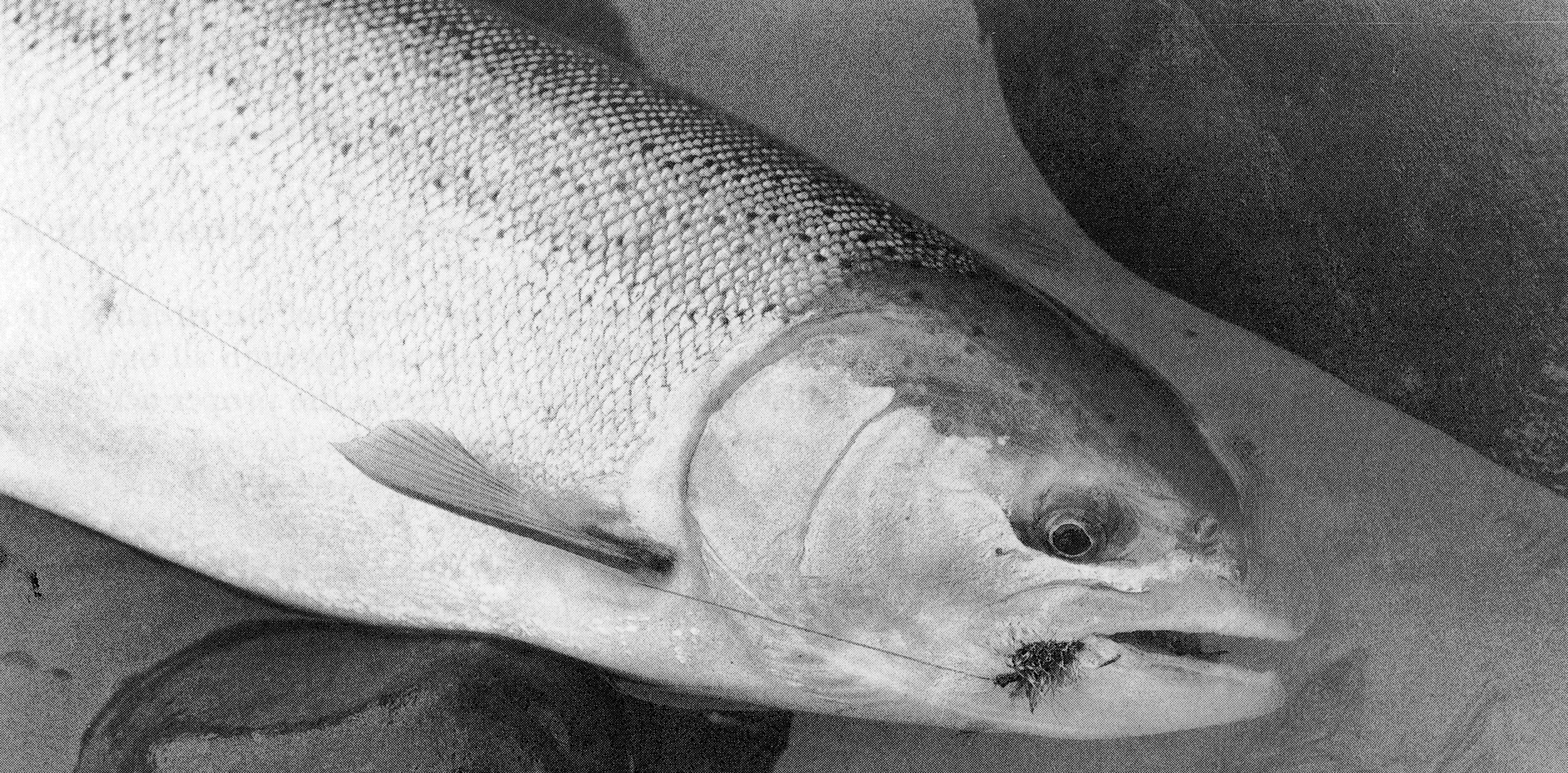
The Kispiox hen took my Black Bomber when it had nearly completed its swing below.
Skating, Waking, and Damp Flies
Among steelhead fly fishermen, "skating," "waking," and "damp" are relative terms describing how a dry fly drags on the water and whether it rides on the water and "skates," drags through the surface film and "wakes," or swims "damp" in the surface film, both wet and dry. The terms are usually applied loosely, the fresh dry often more a skater, the same fly waking after several dozen floats.
The damp fly describes dry flies that naturally ride very low in the water and, under tension, may go wet unless tied with a riffling hitch. Going wet is not considered a failure, but an expected part of the damp fly sequence, for unlike skaters or wakers, the damp fly fishes wet most effectively. Examples of this type of fly include Harry Lemire's Fall Caddis, Thompson River Caddis, and Grease Liner; Bill McMillan's Steelhead Caddis; and the Muddler Minnow.
Bob Wagoner recently introduced the Steelhead Skater, a hairwing dry with the wings inverted so that the fly rides on wing tips and tail. Other pure skaters include all-hackle dries like the Atlantic salmon Bottlewasher, small heavily hackled Wulffs and Humpies, full-palmered Bombers, and Scott Noble's Steelhead Dry and Autumn Sedge.
I haven't used all-hackle locater flies like the Bottlewasher in years. They float marvelously well, but only for a cast or two before drowning and no longer skating, regardless of the false casting. So many better locater flies are available today that I would bother with them only in smaller sizes, as a one-time shot over a difficult fish.
The second generation of steelhead dries includes the leaner Bomber without hackle, the Bulkley Mouse, Mark Pinch's Riffle Dancer, the new Waller Waker, Brian Douglas's Steelhead Bee, and Randy Stetzer's Fluttering Termite, flies that naturally float like corks, with designs that promote their surface activity. For example, Brian Douglas's Bee is tied with wings of moose, the short wings are divided and set forward so that, under tension, the fly wants to climb up on the water and surf. Lani Waller uses the same principle with calf-tail wings stiffened along the lower third with Goop. Mark Pinch bends the forward third of the hook up, gives this a bubble of spun deer hair, and, as added insurance, ties in a small clump of moose on top.
Even without a hitch, a moment of slack is normally all that is necessary to get these flies popping back onto the surface. If a hitch is used, the flies may still go down in turbulent water, but they will be dragged back on top by their design and the hitch. On a hard swing over productive lies, knowing these dry flies won't fold up and stay wet is reassuring!
The "third generation" in the evolution of steelhead dry flies involves waking patterns designed to stay on top as long as they are under tension. Examples are Lani Waller's Waller Waker with a short stubble of calf-tail for a wing; Mark Noble's Fall Caddis and Fall Hopper, both with "bubbleheads"; Judd Wickwire's Riffle Express; John Mintz's Bulkley Moose; and the original Bubblehead. These flies have a flared face of hair stiffened with fly dope or Goop that forces the fly up on the surface as long as it is under tension. For this reason they are nearly unsinkable.
The typical presentation for all of these flies begins with a cast made across and slightly down. But all do not begin working properly under equal amounts of tension. The skaters, riffle-hitched Bombers, the full-hackled little hairwing drys require very little tension to set them skating and waking. If the river's currents are smooth enough to encourage their use, these flies work the largest possible arc. For example, if fishing a Bomber as a general locater fly, I have a hitch behind the wing as I cast slightly downstream and across. After making an initial mend, I hold my rod with my arm fully extended and point it quartering upstream. I even change hands, if necessary, to accomplish this. In this way, I quickly bring the Bomber under tension and start it waking when it is well out in the river. The fly wakes and skates through a huge arc. I don't drop my arm and follow-or lead-the fly through the swing until the fly is fully waking. The ease with which I accomplish this is the primary reason I prefer the Bomber to many other dressings, and why it remains a favorite locater pattern for broad, even-mannered flats.
Bill Bakke's Dragon Fly is a strong rock-and-roll waker, but the wings that give the fly such remarkable action are too much resistance in strong currents. I prefer to fish it down and across on relatively flat runs.
Flies that wake by plowing through water while rocking back and forth, or by pushing up on top of the water, do so only when the current is sufficient to set them in motion and the fly is well into the hard part of its swing. These flies work a smaller arc and are better suited for more turbulent flows.
Some dry flies, such as the best-designed Bombers, the Riffle Dancer, and many damp dressings can be fished in all current flows-flat tailouts as well as boulder-laced riffles. Understanding what conditions bring out the best in the dry fly's design is basic to presenting the fly.
Appreciating the amount of current needed to start a dry fly working helps me to properly fish my greased-line wets. Because the wet fly's action is not nearly so visible, I find it easy to overlead the fly through its swing, reduce the tension, and take away from its action. On occasion, I have tied on a hard-waking dry just to see when the waking occurs and to determine if I am fishing the wet fly under sufficient tension. Sometimes I am dismayed to discover that in my lackadaisical approach I have been swinging a wet fly on entirely too much slack, and it has passed through its swing possessing very little life.
The rise from a "player," a steelhead that fully intends to eat the waking fly, is dramatically matter-of-fact. The steelhead comes up behind the fly, fins itself up until its nose is out of the water, and takes in the fly. If the steelhead misses, the next cast brings it back, or perhaps the cast after that. Changing fly patterns and strategies on a player may or may not be helpful. My approach is to stay with the fly until the steelhead's interest obviously wanes, or it refuses the fly altogether. Then I rest the fish, and try again with the same pattern. If this fails, I switch patterns. I make this change earlier rather than later, if the dry that drew the intitial rise was large, a #4 or #2 Waller Waker or a #4 Bomber. Many anglers fish these large drys as one part of a two-fly approach, a much smaller dry becoming the follow-up "eating" fly.
Unlike Atlantic salmon that can be cast over again and again before they finally take, a steelhead's interest tends to decline with each rise. I believe that repeatedly casting over an unresponsive steelhead intimidates it. This approach reduces one's chances for bringing the steelhead back with alternate patterns and strategies.
Steelhead often follow a wet fly and swirl around it without the angler's knowledge. I've had companions take a vantage, such as a hillside or railroad bridge, and describe for me how this was happening. Their excitement and cries of alarm were hardly matched by the uneventful swing of my fly! But when a steelhead exhibits this same interest in the swing of my waking dry, it is far easier to detect. Perhaps only a dimple in the water or an odd confusion of currents around the fly signals its presence, but the rise more commonly experienced is an explosion of water that never fails to leaves me a little stunned. The general impression is that someone dropped a clear plastic bowling ball in the water, for the splash seems to have nothing in it.
When I was at the Silver Hilton, Judd Wickwire shot video footage of a Babine steelhead rising explosively to his Riffle Express. He played this back in slow motion, revealing a steelhead slashing over on its side from behind and coming down with its mouth open over the top of the fly, an odd angle, and one I would never have suspected. The fish was not hooked, and Judd's Riffle Express bobbed out from the end of the cascade of water like a surfer running before a collapsing wave. I think many rises are of this slashing nature, the erratic behavior of the fly promoting lunges that miss. Other abrupt rises that produce a lot of surface disturbance seem be made more by the fish's tail as it returns to its station, the fly never intentionally taken into the fish's mouth.
My experience has been that the violent type of rise is often a one-time affair. Because these rises are so common, many strategies have been developed to bring the steelhead back. All of them work from time to time. None of them works all the time. But after resting the fish for a few minutes, I think the most effective follow-up fly for this type of rise is a wet spider or thin-hackle fly fished on a dead drift and tensed as it begins swinging through the steelhead's lie. If I intend to stay on top, I try a small well-hackled dry and skate it over the lie. One of LeRoy Hyatt's clipped deer-hair versions of Bob Wagoner's Steelhead Skater is an excellent choice. Another alternative is to fish either a small low-water wet or damp fly with a riffling hitch. Jerry Cebula of Golden, Colorado, told me how he moves below the steelhead located by his Steelhead Bomber so that he can present the fly again, but drag-free. This worked for me the first time I tried it, though I gave the dry a twitch or two.
Pure skaters are also used as locaters, with a smaller low-riding waker as a follow-up. My only problem with this approach is that even great skaters don't skate like thistledown for long, while most waking flies will perform well for hours. Very soon with this approach, the alternative to a large waker is a smaller waker.
Two arguments are commonly used for not fishing dry flies. The first-and most generally accepted-is that below a certain temperature steelhead will not rise to a fly. This is true only if that temperature is thirty-two degrees, the freezing point of water. Many examples support this view. Bob Clay told me of raising a Bulkley River hen steelhead on a dry in the dead of winter, when the water temperature was thirty-three degrees. (Astonishingly, she had one complete gill cover ripped off.) Lani Waller and I fished dries when the Kispiox was a chilly thirty-seven degrees, and neither of us experienced problems raising steelhead to our flies. In fact, the high thirties are considered only slightly marginal by Canadian standards. No one makes a fuss over summer steelhead taking drys during the harshest days of winter any longer. For a handful of dry-fly addicts, keeping guides free of ice is a far greater concern.
We should, however, recognize certain considerations in this aspect of steelhead fly fishing. As the water temperature drops, steelhead become less active and are less prone to move to any type of fly. The swing of the dry fly must be slowed down, the more the better, by repeated mending. Sometimes it is possible to hold the rod out and keep the waking fly almost stationary over the suspected lie. I have kept a fly waking in place for a full minute before the steelhead came up for it. Lies should be chosen for their optimum depth, three to five feet, and for the reduced speed of their flow. Late-season steelhead are moving less and will often hold the same stations for days. They won't select lies that require exertion, and I don't look for them at the top of a run, water I fished with such anticipation in September.
I am convinced that low temperature is less a factor among northern races of summer steelhead than in U.S. rivers where surface currents in the thirties pretty much keep the fish tied to the bottom. My dry-fly experiences on domestic rivers have only been productive when temperatures were in the high forties. My experiences are hardly quantitative, but my hunch is that the difference between Skeena steelhead and Puget Sound or Snake River or coastal Oregon summer-runs rising to a dry fly is at least five degrees, and may be as much as ten degrees.
The second argument against the use of dry flies is that they limit the size of the steelhead. I think this claim has an element of truth to it, because the largest steelhead are the less-active males, and these fish take up the deeper, least-strenuous lies, factors multiplied by frigid late-season water. Earlier in the season, when the steelhead are more active and holding in shallow lies, the very largest steelhead can be brought to a dry, particularly if the swing is slowed down. Two enormous steelhead come to mind-and help the rest of us maintain the faith. Bubba Wood of Dallas, Texas, took a forty-two-inch by twenty-two-inch male from the Bulkley River using a Bulkley Mouse. Ed Exum of Denver, Colorado, also using a Mouse, beached a 44½-inch by 23½-inch Kispiox steelhead in September, 1987. This carefully measured fish, estimated at between thirty-three and a half and thirty-four pounds, is probably the largest steelhead ever caught on a dry.
If I could choose one method of presentation to securely hook a steelhead, I would choose a wet fly fished greased-line. If I want to employ the most certain way to locate a steelhead, I would put a riffling hitch on a dry and wake it greased-line.
Wet Fly - Floating Line
The quickest way to get a large fly or a weighted fly deep is to quarter a cast across and upstream with a floating line and long leader, a strong upstream mend giving the fly time to sink on the slack. Additional mends are made to remove belly from the line while the rod point leads the fly and reduces tension on the fly during the swing. The fly passes downstream on a dead drift, probably riding butt-end down. The fish may take the fly any time during this sequence, but very modest tension on the line while still leading the fly imparts some swimming life into it. I find that steelhead most often take the fly early into the swing, as it comes under tension.
I use this method often when casting weighted leech patterns of marabou or rabbit on a leader of twelve to fourteen feet. These are not much fun to cast, but with barbell lead eyes, the fly rides upside down and is nearly weedless, the dead drift getting the fly down, rolling it along the bottom, and bringing it to life with a minimum of tension. Steelhead pick up the fly so confidently that they do not bolt away on the take, and the hook must be set. The angler must concentrate, for the take may be very soft.
Sometimes summer waters get quite discolored, and sinking a fly closer to holding steelhead is desirable. Rather than go to a sink-tip line, one can lengthen the leader and tie on a larger fly that will sink quickly and then be led to swim through holding water. (I have no illusions regarding the difference between my looking down into the water and a steelhead picking up my fly against the backdrop of the surface.) Nevertheless, getting my fly down a couple of feet has proven effective.
Arthur Wood said, "I therefore aim at keeping the fly at the surface, or sink it right down to the stones; and I have entirely forsaken the ordinary practice, which causes the fly to swim at mid-water." Other anglers give this same advice, but I don't agree. Steelhead usually hold a station a foot or more above the stones, not flat on the bottom. If I am casting to water five feet deep with visibility reduced to two feet, and I'm able to swim my fly a foot or more below the surface, my chances have improved.
Bill McMillan has written eloquently about the virtues of a double-taper floating line, ten-foot leader, and flies up to 6/0 for winter steelhead. An upstream cast followed by back-mends gets the fly down. The dead drift becomes a slow, controlled swing, the fly led to reduce tension, the considerable weight of the large hook helping to swim the fly deep.
Bill admits that hooking steelhead on the dead-drift part of the presentation takes great concentration. I could add that salmon hooks in sizes larger than 2/0 or 3/0 are very hard to find, and when barbless, their penetration of a midsize steelhead may be life-threatening. Also, they require a heavier line than I routinely like to cast with a single-hand rod. Nevertheless, working the big irons through holds with a floating line is a classic achievement.
I prefer casting the large flies with a two-handed rod and hybrid sink-tip line, either double-taper or long belly. For me, this fishing is immensely satisfying. Only hitching dries and low-water wets on the greased line is equal to it.
Wet Fly-Sink Tip
Other than floating lines, I find sink tips the most versatile of all steelhead fly lines, regardless of the season. They are the basis for my winter fishing, having eliminated my former reliance on shooting tapers. The reason is line control, particularly when the belly section has sufficient mass when mended to move around the sink tip.
If casting either commercially manufactured or custom-made sink-tip lines in a forward taper of forty feet or so, the line is mended only by raising the rod tip and lifting the running line when the line is quartering downstream. In this manner belly is removed and the sink tip squared around so that the fly passes downstream first. If a very short cast is made, an outside mend is made with the belly section to provide enough slack so the sink tip has a chance to sink. To manage a long-range deep sink, additional running line must be fed into the swing as the rod gently leads the fly. Slipping additional line also helps to reduce tension on the fly any time during the swing.
The sink rate and length of the sink tip are not the only criteria determining the depth the fly can reach for a given current. Many commercially manufactured lines have a very modest floating belly section behind the sinking tip. The line hinges on the cast and is carried down by the sink tip on the dead drift. Assuming a short cast, an additional stack cast, in which additional line is cast into the mend, allows the sink tip to pull additional running line into the drift. Custom lines usually cast better and are more easily mended because of their much heavier belly sections, but all that flotation is not so easily carried down, and although the fly can be fished more positively, for the same length of sink tip it doesn't run as deep.
Either my custom sink tip long belly lines, or Mike Maxwell's double-taper sink-tip lines are the ultimate wet-fly line when fished with two-handed rods. They can be cast without hinging and possess ample mass in the floating section both to spey cast and to mend at long distances. But it is how the lines can be manipulated after completing the cast that makes the pairing of line and rod so ideal.
Upon making my cast across and slightly down, I execute a very strong outside mend, which straightens out the sink tip and drives a belly of line upstream so that the line hooks. This shortens up the cast and sets the depth of the line. The greater the initial mend, the greater the depth, and the longer my sink tip. The considerable slack is gone when the fly has reached fishing depth. During this time my rod is still pointed quartering upstream. If I do not change the position of the rod, the line will come under maximum tension and the fly will begin moving toward the surface. I concentrate to feel for the slight pull signaling that all slack is out and the fly is working. I wait a second or two before moving the rod point downstream, continuing to do so until I am leading the fly. The rod tip continues to move before the fly to reduce current tension, to keep the fly swinging, and to prevent the fly from rising toward the surface. Some experimentation is necessary to get a feel for this, but I have remarkable control, given that the rod's length is a radius of fifteen feet and a diameter of twice that. The rod will never be pointed straight upstream after the initial mend, but it definitely will end up pointing straight downstream or even toward shore at the completion of the swing. At this point the rod tip has described an arc of at least twenty feet. Thus, a cast of ninety feet that would end with the fly ninety feet below the rod tip if the rod were not moved in the slightest (thus describing a perfect quarter of a circle) sees the fly move ninety feet downstream and across while my rod tip is simultaneously moving twenty feet downstream.
This series of rod and line manipulations is imperfect greased-line, but a practical application of Wood's methods because of the soft lies holding winter steelhead. I find the quiet water near shore, the broad tailouts, the guts below the central sweep of the river ideal water on which to practice this approach. Were the lies in faster currents, they would be fished with much greater difficulty, for strongly leading the fly to reduce tension would send it across the river too quickly to catch the interest of winter steelhead. To slow the swing enough to attract the steelhead would so increase tension that the fly would no longer run deep. Winter steelhead lies, long rods, and those special sink-tip lines are fly fishing at its classic best.
With the floating line at an angle to the sink tip, some slack in the swing is certain. This line is also penetrating a variety of current speeds, which subjects the sink-tip portion of the line to additional and less obvious belly. For these reasons, it is necessary to tighten early when the steelhead takes the fly. That may be all that is necessary when the hot fish turns and races away, but many steelhead simply stop the fly, and it becomes necessary to strike forcefully. This is not a case of driving the hook in so much as removing slack from a deep running line quickly enough to set the hook.
Wet Fly - Shooting Taper
In the hands of experienced fly fishers, fast-sinking shooting tapers- "heads"-are very useful extensions of the fly-line assortment. Long distances can be cast and the greatest possible depth reached, especially when monofilament is used as a running line. But these anglers do not simply fish the river for steelhead, they evaluate each pool in terms of their shooting head, and they know almost instinctively how to apply the line's few attributes.
Immediately after the line is cast quartering down and across, the head is mended by raising the rod tip and swinging the butt end of the head around so that, as it passes below the angler, it is pointing upstream and on a reasonably straight track to the fly. This mend takes something out of the distance cast, but failure to set the line in this attitude results in a head that fishes out of control, often coming down with the heavier diameter and faster sinking butt section leading the way. The line then tenses and whips around the head, a presentation largely worthless and unseen.
If the line is sinking properly, reducing tension on it is achieved by slipping additional line into the drift and modestly leading the fly.
If water is discolored, the swing must be slowed down as much as possible so that the steelhead has a moment to respond to the fly. This, of course, increases tension on the line, the currents forcing the fly toward the surface. Casts are then shortened considerably, the fly led with the rod, the angler more sensitive to how the fly is behaving during the swing. At such times, the thirty feet of sinking line is a disadvantage; anglers are better served with a sink-tip line. But again, the head may be the only line capable of reaching lies near the bottoms of deep pools.
As with any sinking lines, if the steelhead takes the fly during the dead drift part of the presentation or early in the swing, it must be struck. I always hold my rod in one hand and line in the other, my line hand able to remove additional slack from the line on the strike. If the line is straight to the steelhead and passing through a hard swing, the fish will be felt immediately, and tightening of the line may be all that is necessary to set the hook.
Managing Hooked Steelhead
I may fish for days to hook a steelhead. When I finally succeed in doing so, I want to manage the fish in a manner that efficiently brings it to hand without injury. To accomplish this, I must keep my head when the steelhead panics.
Although I will strip in a half-pounder or a parr to expedite its release, I always play an adult steelhead from the reel. Usually, as the steelhead takes the fly down, I raise my rod and let slip the slack I normally maintain (whether the fish is taking line directly from the reel or holding a position in the pool). Occasionally, a steelhead will follow a fly as it is being stripped back and then unexpectedly take the fly with a rush. I fished a Canadian river where this happened, sometimes with the striking steelhead only twenty feet away. With fifty or sixty feet of line coiled up, there was an immedi-ate danger of a huge tangle and a lost fish. I found the easiest solution was dumping the line off onto the water and keeping careful track of it, not the fish. If the fish runs, it will take line dragging in the river. If it doesn't, a minimum amount of tension to the fish will give me a moment to reel line through the rod hand and back onto the reel.
For all the stories of incredibly long runs by out-of-control steelhead, the vast majority of these fish don't leave the pool, particularly the males. They run downstream, often for a considerable distance, but they usually stop before exiting the tailout. Even when the rise occurs right at the tailout and the downstream run immediately takes the steelhead into heavy water below, I still look for pauses between dashes. I've had steelhead exit a pool by leaping into a torrent of white water and suddenly stop in some faint pocket in the middle of it all. They hold this position until jogged again into flight by tension from my upstream position. But these pauses are a clear invitation for me not to press the steelhead, so that I can work down to its new hold where control can be more easily maintained. Dropping below the fish may then be possible, the slight tension from the rod and the current quickly taxing it. The fish will try to swim away from the resistance and move upstream. After a few minutes of this, the steelhead is exhausted.
The steelhead's downstream flight from the initial hookup, complete with jumps and cartwheels, exhausts it more than any rod pressure I can bring to bear. I only want to stay connected, to prevent overruns of my reel, to drop my rod each time the steelhead jumps so that it will not fall on a taut leader. When the steelhead stops to catch its breath, I will regain control and press my advantage. I don't want the steelhead to recover from its runs and jumps. I do want the hookup to interfere with its breathing, for the pressure to cause additional stress. I don't want a sulking fish and a ragged struggle.
Hot steelhead often race down a pool, jump several times, run again, and stop almost in a faint. I have been able to put my rod over my shoulder and march up the pool, the steelhead obediently following along. If, however, I am near the steelhead at the end of such a run, I can beach it almost immediately. That is rarely the case, and more than anything else, it is why bringing a steelhead to the beach takes time-"a minute to the pound," says the oldtime rule of thumb, often a much too generous assessment.
Anglers are either unable or unwilling to react boldly to pauses in the steelhead's frantic oxygen-burning efforts to rid itself of the fly. Too often I have observed anglers applying light tension on a steelhead that has settled into recovering from its exertions. They never take control, but hang on until the steelhead has regained its strength sufficiently to jump again. The process is repeated several times until the steelhead becomes so feeble its recovery is threatened. Some inexperienced fly fishers don't even stop then. Once, I watched the sad spectacle of a Deschutes fly fisherman playing a seven-pound steelhead until it died. Then he beached it. My advice fell on deaf ears-as it usually does at such times.
The dash of most hens and many spirited bucks provides the kind of action that makes steelhead such wonderful gamefish. These fish explode into my consciousness with predictable violence, and they carry the burden of the struggle. I rely upon finesse and timing, picking my openings, pressing my advantage. In several minutes, I've had large steelhead on their sides in the shallows. I don't make a race of this, but if I hurry to reach them and slip out the hook without ever touching them I'm enormously pleased with myself. This rush of exhilaration, a reaction from a quick and violent encounter, leaves the steelhead none the worse and gives me much to dwell upon.
The large male steelhead that does not jump gives me my worst moments. They are often lightly hooked, which I sometimes see on the greased line rise when it does not turn after taking the fly. They shake their heads, make short runs, turn and twist, conserving their energy and prolonging the struggle. A hook that has only caught the skin of the mouth will soon tear free. But not to press them results in a messy, almost interminable struggle.
Some anglers hold their rods parallel to the water with the rod first to one side and then to the other side of the steelhead. This is a saltwater technique designed to keep the fish off-balance and moving, but it must be used with discrimination. A river, unlike the open ocean, has currents that can be used to advantage or disadvantage, and I don't want to find myself pressuring a steelhead by pulling it upstream. Also, saltwater hooks are usually short-shanked, fished with barbs, and are more likely to hold regardless of the fish's position. This is not the same as a long-shanked barbless hook. Pressur-ing a steelhead when the barbless hook is on the far side of the fish is a fine way to make an early release. Some anglers welcome this. I'm not one of them, at least not yet.
I've had steelhead make a run out into the main current nearly to the tailout before rolling on their sides nearly unconscious, their pectoral fins waving in the air. If the fish is exceptionally large-in the high teens or more-and well below the angler, it becomes very difficult or impossible to pull to the safety of a quiet eddy. The force exerted by the current on such a disabled steelhead is considerable, nearly impossible to deal with if it has washed out of the tailout. I try desperately to keep the steelhead under some sort of tension while racing to get slightly below it. This chase after a nearly dead fish is not an altogether glorious enterprise. With luck, however, I eventually draw my trophy from the heavy current for its release.