Klamath River
This is the complete chapter from Steelhead Fly Fishing, written by Trey Combs and originally published in 1991. It is presented here in its original form. Desktop only: Right-click any image in this essay to open it in a new tab to view the high-resolution version. This feature is not available on mobile.
Before the Kispiox or the Thompson, the Clearwater or the Skagit anchored our yearnings to fish a fly for steelhead, the Klamath River flowed with unlimited virtue. Its annual runs of steelhead, hundreds of thousands of sea-bright trout representing many discrete races, sought dozens of spawning tributaries. Some fish were as small as ten inches, others as large as ten pounds, rarely more, though their ultimate size was no barrier to legend. When anglers cast flies and hooked steelhead they could not hold, they said the fish were fifteen pounds or twenty pounds, and their friends did not believe them, but they were telling the truth.
The Klamath remains faithful to that memory. The reputation of its steelhead survives in a much greater context, and I think that has changed our perception of it, but it is a great river still, unspoiled and bountiful.
The river's fame came to us principally along two lines, the first being its steelhead, trout that typically smolt, migrate to sea, and return several months later only slightly larger than when they left. Though they join older, sexually mature steelhead that are on a spawning migration, the little half-pounder steelhead are sexually immature, and they will not spawn. They migrate as far as 100 miles upriver, remaining throughout the fall and often well into winter before making their return to the ocean. When they ascend the Klamath again the next fall, they are mature steelhead of eighteen or nineteen inches, far more modest in size than steelhead of comparable age on almost all other rivers. Their small size is directly attributable to their considerable time in fresh water and their lack of "foraging time, of rapid growth time, in salt water. Given this life history, "large" steelhead of six or seven pounds have either survived many spawning migrations, are atypical steelhead that remained at sea for a full year after a half-pounder migration or made an initial ocean migration of one or two years before returning to spawn the first time.
The steelhead of the upper Klamath River share these life history traits with several other races of steelhead in northern California and southern Oregon, most notably those of the Rogue River.
Unusually small steelhead would hardly make for a great sport fishery were it not for their incredible numbers. Whereas a single steelhead per day must be considered excellent fly fishing on the very best of our rivers, twenty or even thirty steelhead in a day on the Klamath was once routine and still happens today. On no other river in North America can one catch such numbers of rainbow trout, whether sea-run or residential, that are so large, for Klamath steelhead commonly exceed twenty inches in length.
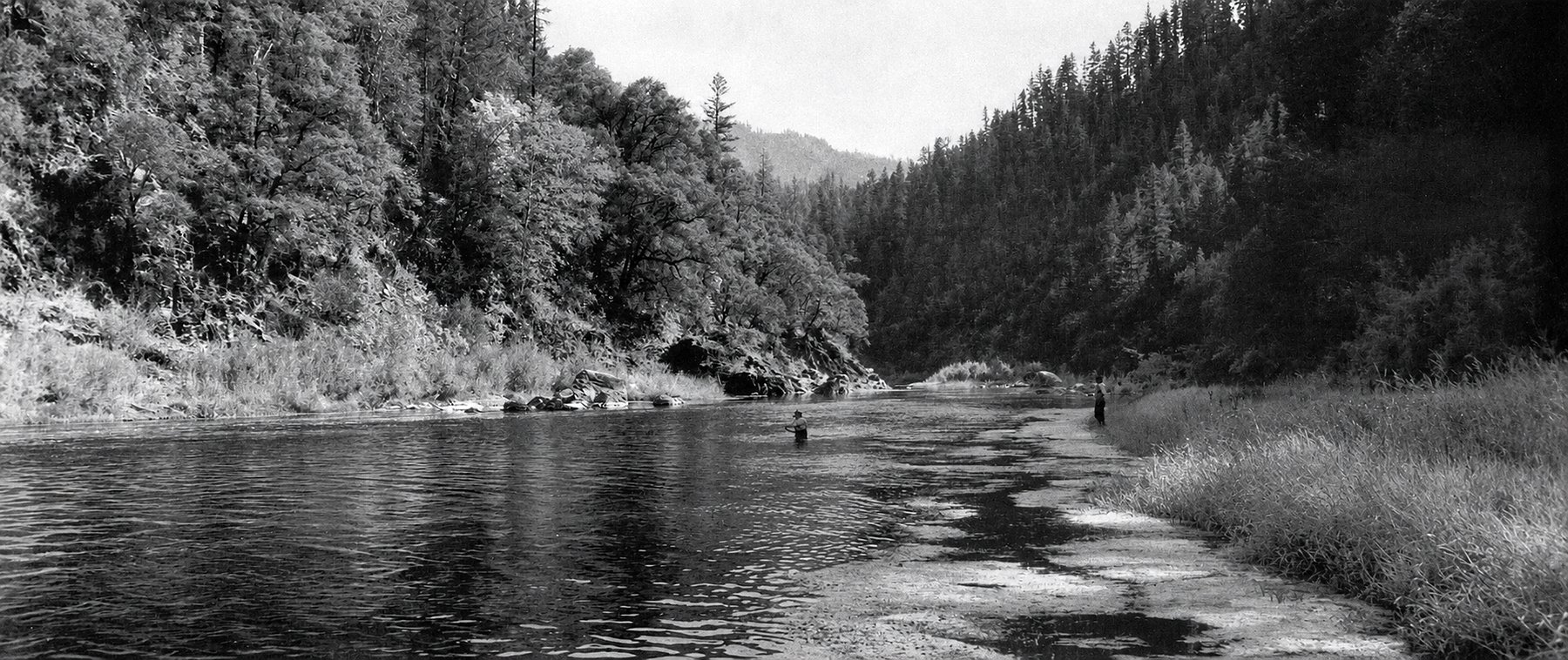
Down through Cade Canyon with my 2-weight
The second reason for the Klamath's fame is how much of its water lends itself to the fly. I have always felt that the river's reputation was based as much on how its waters could be fished as on what its waters contained.
The Klamath drainage is two large rivers, the Klamath and the Trinity; several major tributaries, the Shasta, Scott, and Salmon rivers; and numerous small tributaries that drain an area of more than twenty-five thousand square miles in northern California and southern Oregon. This volume represents more than one-third of the runoff for the entire state of California. While the sum of the parts is most impressive, it is the parts that are fished; and the pools above where the Klamath and Trinity rivers join at Weitchpec can be long and shallow, and as gracious to steelhead fly fishermen as any in angling.
The Klamath never belonged solely to fly fishing, though for three generations its steelhead have been most frequently extolled in that light. Claude Krieder waxed euphoric in chapter after chapter of Steelhead (G. P. Putnam's Sons, 1948). His writings about his time on the Klamath are easily the best documentation we have about the river and its steelhead a half-century ago.
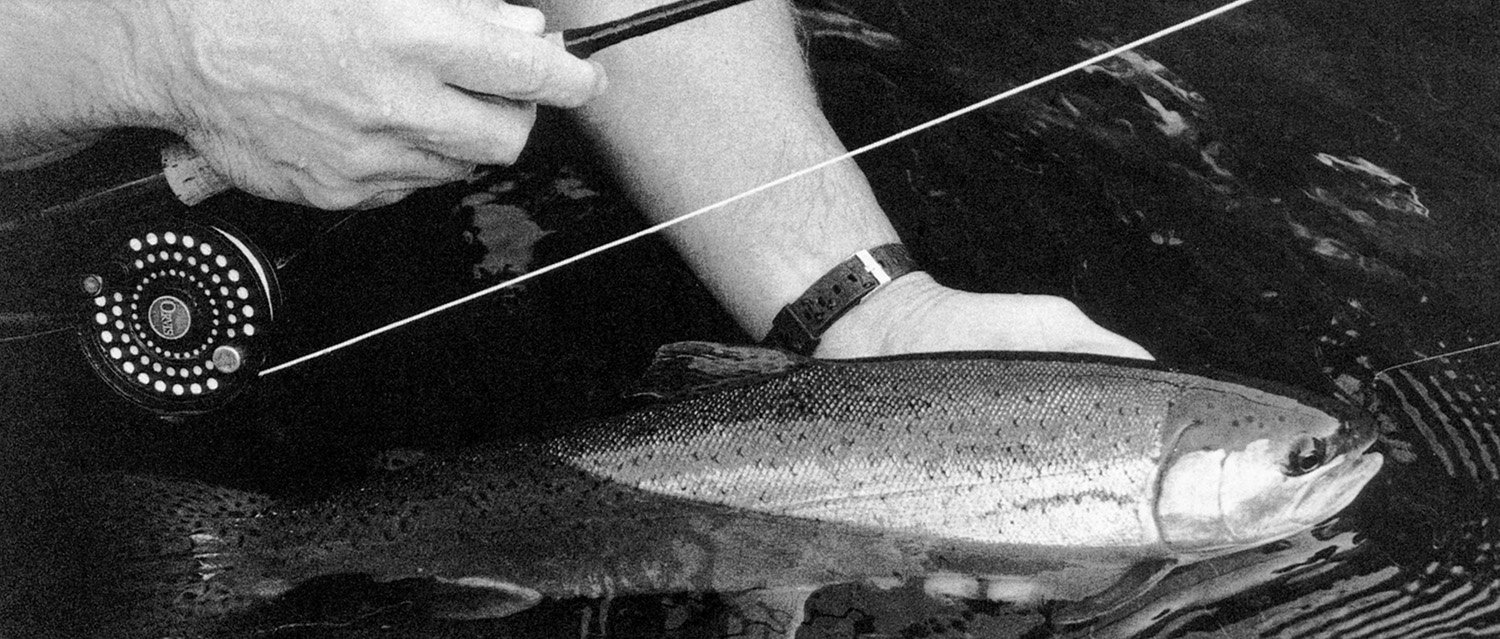
A mature, first-spawning Klamath River Steelhead
“All winter we talk or dream of those divine conditions on our river when the big bruisers simply wore us out, charging up and down the riffles. That particularly deep, foaming run where it took a long cast of ninety feet to reach the spot and where I lost that certain fifteen pounder. You bet I'm going back! And I'll use a heavier leader there this year. Why, that might have been a record steelhead.”
Krieder and his longtime friend, Roy Donnelly, fished "Shangri-La" water, and "Indian Frank's Secret Riffle," and they called the Klamath a "Steelhead Paradise." Donnelly's best from Shangri-La was nearly fourteen pounds, Krieder's a couple of pounds less, wonderful steelhead on any river. Their fly patterns were longtime favorites even then, the Jock Scott, Royal Coachman, Carson, and Thor, all in #4s and #6s.
Peter Schwab found in the Klamath the very essence of steelhead fly fishing. The famous outdoor writer's wire-bodied bucktail patterns were developed for this, his favorite river, and the Queen Bess, Paint Brush, Brass Hat, Bobbie Dunn, and Bellamy remained popular steelhead dressings for years. Late in his angling life, often ill and depressed, he saw the Klamath moved off center stage as increasing attention was paid to the new steelhead rivers being discovered in Washington, Idaho, and British Columbia. He seemed to take the rejection personally. In a letter to Ralph Wahl, he said:
“What was that about a thirty-pound steelhead? Taken on a fly? Does the guy know the difference between a nice fresh-run silver or chinook and a steelhead? I’m not skeptical, of course. I was called a liar, screwball, horsethief, wife beater, everything for having once estimated a steelhead dragged out of the lower Klamath by a Native fisherman to have weighed a good 25 pounds—steelhead, not the fisherman.”
Many steelhead patterns have Klamath origins, and some are still in frequent use: Silver Hilton, Orleans Barber, Weitchpec Witch, Trinity, Brindle Bug (and Mossback, its alternate), Burlap, Green Drake, Brown Drake, and the Chappie.
The list of anglers who fished these dressings and frequented the Klamath in more recent years would be a long one. A few who should be mentioned specifically: Outdoor Franklin and Lloyd Silvius who gave us, in turn, the Chappie and the Brindle Bug; Bill Schaadt, a chinook salmon fly fisherman of international renown; Walton Powell, of rod-making fame; outdoor writers Ted Trueblood, Larry Green, and Jim Freeman.
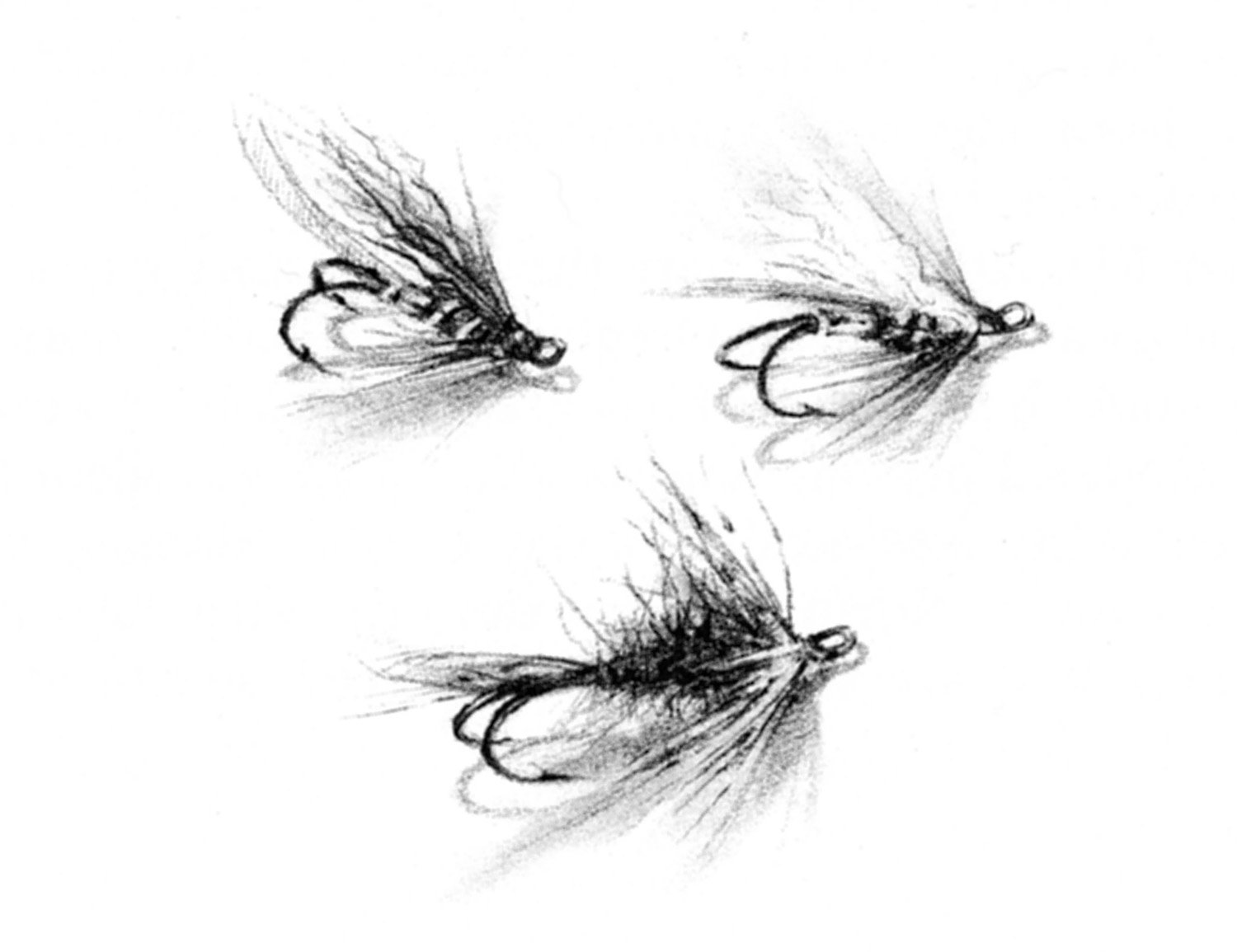
When I set out to visit the Klamath after an absence of many years, I had decided I would fish the river in the classic greased line manner with tackle in keeping with its steelhead. I would avoid the lower river, which could only be adequately covered by 7- or 8-weight rods, and concentrate on the more intimate confines upriver, where a long 2-weight outfit would put most, if not all, of the water within my reach. A 3-weight forward-taper line quickly loaded my Orvis eight-and-a-half-foot rod and easily carried the burden of wet flies in sizes 8, 10, and 12. Just for the fun of it, I would fish traditional British patterns, sometimes on double hooks if the little flies could not penetrate currents without laying over. In this way I traveled to the Klamath confident that I would be discovering a new river. I needed only a mentor and companion.
Tim Grenvik was my good fortune. The pleasant young man was a fishing guide in Happy Camp, a tiny logging community 100 Klamath River miles from the Pacific. He certainly knew something about the steelhead runs, how they might proceed, and where individual fish were likely to hold. His clients usually did not fly fish, and Tim would pull plugs. This was not a special pleasure for him, but neither was it an indignity to be suffered. He sometimes provided the same service for fly fishermen, working their flies through canyon water that could be fished in no other way, and through easily waded riffles that ran beside long gravel bars.
Of course, the occasional fly fisherman who disdained this approach would wade for his fish and cast from an anchored boat on exceptionally difficult water. Tim did not find these clients especially liberating. He liked to row, and his personal interest in fly fishing was as yet without hubris. The fly outfit he cached in his boat was an 8-weight with a full-sinking forward-taper line, and he never fished it unless a client invited him to do so.
Like so many young guides today, he was knowledgeable about the social and environmental issues that affected his region. Gold mining and Indian fishing, senate bills and house bills, dams and irrigation projects became alternate topics of discussion. During the off season he bossed a three-man helicopter crew that fought forest fires, surveyed timber reserves, and kept track of peregrine falcon aeries.
That Tim found the companionship of his clients important and the angling methods they employed unimportant seemed curious to me at first. This wasn't a case of his business sense ruling his heart. His lack of prejudice was genuine. He enjoyed fly fishing, but he had recently written an article on fishing spinners. He fished plugs, and he also fished bait. I had no sense that he considered one method more refined than the other. I knew he was not fully aware of the richness of the steelhead fly-fishing traditions born on the Klamath, but I thought that was symptomatic of the area. As if to reinforce that opinion, I encountered just one other fly fisherman during my days at Happy Camp. He, like Tim, cast a full sinking line on a powerful rod.
Cliff Hunter, a friend of mine from Aloha, Oregon, shared the river with me. The first of our days together began with Tim downshifting his truck through the tight turns on the dirt road that led to Cade Canyon. Over the din of the engine and the aluminum drift boat clanging behind, he called our attention to the natural history of the area. Cliff and I were eager students, ready with a new question for every answer.
"Alaska yellow cedar is little more than a big shrub here-we're at the southern end of its range. We also have one of the northernmost stands of coastal redwoods."
"But these are oaks," I hastened to point out.
"Yes, tan and black. We'll see others on the float. And lots of pines."
Tim explained that the area can be as moist as mixed stands of Port Orford cedar and Brewer's spruce, and as arid as live oaks. We would see it all from one bend of the river to another.
The Klamath still carried the light somnolent buzzings of deep summer on this first week of fall. Tailout currents were muffled, bird songs desultory and infrequent by midmorning. Bright green algae were abundant on the rocks, and as we wrestled with the boat I was thankful for the metal studs set in my felts. Tendrils of free-floating algae made soup of the currents. At times this would prove troublesome by fouling my double hook flies. "We need a big rain to get rid of the algae," Tim said.
"That would scour out the river."
I asked about the foam that had collected to form drift-lines along the grassy shores and completely fill the quiet eddies. "Photosynthesis," he said, and gave the McKenzie boat a final push into the river. Algae was again the culprit. Wading would be especially difficult with the bottom completely obscured.
Tim's advice on the best riffles started with a deadly serious admonition. "See that mound of gravel out in the river? That was caused by a gold-mining dredge. We'll see a number of the contraptions before the day is out. The dredge sucks gravel off the river bottom, sends it through a sluice, and dumps the gravel back into the river. Just upstream of that mound is a hell of a hole. Sometimes they're hard to see, and sometimes they're impossible to see. Beware the dreaded dredge holes!"
Thus oriented and warned, we set off to find steelhead with the lightest of fly tackle and English flies. Only occasionally would Tim have us fish from the boat, and then to cast to pocket water that, from his plug-pulling experiences, he knew held steelhead. When we beached the boat and Cliff and I began wading through the first run, it was late morning, and the river sparkled by without so much as a touch of shade. Cliff started below me, and in a flash he was gone with scarcely a ripple. I noticed nine feet of 4-weight rod and a hand working downstream.
"The dredge hole!" I exclaimed, as Cliff came sputtering up from the depths.
"He located it for us," said Tim.
"What a guy! Our dredge hole detector!" I called downriver. Cliff staggered to shore, bent over to ship a few gallons from his waders, and came back to the boat.
As my friend stripped down, I began fishing a # 10 Blue Charm sparsely tied on a double hook so sticky sharp that even the lightest take would be the steelhead's undoing. I was worrying about a salmon or steelhead parr throwing itself at the fly, or a steelhead taking it deeply, when a bright half-pounder struck the fly sharply and shot into the air. The rod managed the foot-long trout in delightful fashion, and the release was completed without undue damage.
As the afternoon wore on, seven more of the immature steelhead caught the Blue Charm and left me wondering where the adults might be. When Cliff returned to swimming a #8 Spade through the best riffles, he too found only half-pounders. I knew they came in waves, but we were near the upstream range of these immature steelhead. The season was well advanced, and mature steelhead should be about.
I first guessed that Cock Rock Run honored the drumming site of a love-starved ruffed grouse. Tim dashed these romantic notions and directed my attention to the end of the run where an enormous stone phallus stood. "Rock hard and erect," he said. Casting before this imposing monolith would provide us with memorable fishing in the days to come. A hint of this occurred when Tim rose a fine steelhead that pushed up a rooster tail of spray as it came down off the top end of the run. The fly soon came away, but we were encouraged.
We came upon our first gold dredge, a Rube Goldberg affair atop a raft that was anchored to one side of the river. Two men in neoprene suits gave Tim a wave of recognition. The sound of machinery turning the stream bottom upside down made polite conversation impossible.
"Modern day gold rush! Started about three, four years ago!" yelled Tim.
"You'd think the gold would be long gone!" I called back.
"Oh no. A man can make a thousand dollars a day doing this!" We drifted by and around a bend.
"Doesn't this absolutely ruin the river bottom for spawning fish?" I asked.
Tim smiled. "Well, they get their permits from our Department of Fish and Game!"
We pulled out for afternoon coffee beneath a shale hillside of olive green live oak. This was a startling contrast to the neighboring slopes of pine. Tim noticed my gaze. "Rude ground. Always reminds me of Mordor."
"That forest of twisted, gnarled trees belongs in Tolkien's netherworld," I replied to his reference to The Hobbit. "It's easy to imagine brave little Bilbo leading his friends safely through its dangers."
Tim showed me that it was the south-facing slopes that held the ponderosa and sugar pines. The north-facing slopes were dressed with Douglas firs and, at four thousand feet, red cedars. White pine and jeffrey pine and knobcone pine were there also, each with its own special requirements in this land of microclimates.
Late in the day, we anchored in the Allen Ranch water, a big run with a reputation for producing some of the largest steelhead found in the upper river. Cliff and I, right- and left-handed, cast from opposite ends of the boat and rose a steelhead each before a buck of nearly five pounds solidly took his Spade fished greased-line in the surface film.
When we pulled anchor, we drifted down to the cliff that looms above the tailout of the run. I have been fascinated with raptors all my life and the cliff face prompted me to ask Tim if he had ever found peregrine falcons nesting here. He answered my question with a story.
"I received a notice from the U.S. Forest Service that our helicopter was to fly no closer than a thousand feet from nesting peregrine falcons. I wrote back and asked how we were to do this without knowing where the nest sites were located. They finally gave me a map showing the locations. I found two additional nest sites and added them to the map." Tim went on to explain that the bird's rarity and extraordinary black market value require that these locations remain closely guarded secrets.
As we came through the bottom of the run, an adult peregrine falcon was perched on a bleached snag. "Did you arrange this?" I asked.
"Certainly!" With a look of smug delight he held the boat in the current, while Cliff got off a series of telephoto shots.
Just above our take-out at Gordon's Ferry, Tim shipped the oars and made the following bronze-plaque statement: "Here Tim Grenvik caught a twelve-and-a-half-pound steelhead!" This was a plug-caught winter-run male, he explained, so remarkable for the Klamath that he killed the fish and sent it to a taxidermist. He knew of another steelhead of fifteen pounds. Rumors of steelhead still larger persisted, including one of nineteen pounds. Tim speculated that such fish may be part of a "ghost run," a little understood February run of exceptionally large winter steelhead that spawn somewhere in the vast watershed.
Cliff and I came to know Cade Canyon well. We delighted in our new knowledge and savored our time on familiar water with ever-increasing pleasure. A heron rookery, osprey, and a family of eight otters that raised unbelievable hell with the crayfish stitched together our days. We fished the English patterns I had promised myself, and gradually integrated a #10 Green Butt Skunk, and then, late one day, a #8 Night Dancer on a single light-wire hook for an hour of grand fishing.
I had worked down Cock Rock Run until I could go no farther. The long glide below reminded me of winter steelhead water where a dead-slow swing matched chilled metabolisms. To get the necessary distance with the 2-weight, I had been cleaning and dressing my line several times a day. Now I also dressed the leader in order to keep the fly riding in the surface film. Careful not to overcast, I laid out forty feet of line on the downstream quarter. The fly broke through the surface film once or twice as it came alive on the swing. I tensed as a large bulge cleaved the water just below it. An instant later, the steelhead was racing downriver, jumping in panic from the drag of the line. I palmed the reel and held the fish with fifty feet of backing on the water. The rod flexed into the cork handle, yet I was free of worry that the fly would tear out. The steelhead, a twenty-three-inch male, was soon cradled in my hand.
So great had been the commotion that I did not expect a second steelhead from this water. On progressively longer casts, however, a second, third, and fourth steelhead charged up to take the Night Dancer. All were nearly identical in size and spirit.
Several weeks after I returned home, Tim wrote to tell about Dan Hynes, a client who caught an eight-pound hen on a #10 Woolly Worm. The steelhead was the largest Hynes had taken from the Klamath in twenty-five years of fishing, and the largest ever caught from Tim's boat on the fly. This exciting news-the ostensible reason for the letter had a proud epilogue. After congratulations all around, the once-in-a-lifetime steelhead was carefully revived and released.
Notes
Klamath steelhead are "trouty" by nature, a free rising race that may actively feed both as half-pounders and as adults of all ages. Dry flies can be skated or waked, traditional wet flies presented greased-line, or dark stonefly nymphs, Ugly Bugs, and Woolly Worms fished weighted or unweighted on floating or sinking lines.
I think the effectiveness of the low-water Night Dancer and Spade was due to their very nymphlike character when given a dubbed, picked-out body.
A straight 2-weight outfit is not completely suitable for the Klamath. It severely limits the weight of flies and the distance they can be cast. The rare large steelhead might be troublesome, though I would value that consideration least of all. One cannot obtain a full complement of fly lines in weights 2 or 3, and many anglers would find this a disadvantage.
I found the eight-and-a-half-foot 2-weight rod quite up to handling a 4-weight forward-taper line. This was important to me, because I could fish a ten-foot sink-tip line-the lightest manufactured-and get a small weighted nymph down quite deep. However, if a longer sink tip had been desirable, or a fast-sinking shooting taper needed to put the fly flat on the bottom, a nine- or nine-and-a-half-foot 4- or 5-weight rod would have been a better choice.
Life History
No dams or weirs block the Klamath or Trinity rivers below their headwaters. Steelhead spawn below Iron Gate Dam on the Klamath and Lewiston Dam on the Trinity, principally in streams tributary to the main stems. The lack of collection points in this vast system of rivers has made life-history information difficult to obtain and mostly piecemeal in nature. Escapement figures have been only general estimates based on sport-fishing success or on the commercial gill-net harvest of winter steelhead stocks on the Hoopa Valley Indian Reservation.
The reliable information that is currently available is contained almost entirely in James S. HopeIain's study for the California Department of Fish and Game, Age, Growth, and Life History of Klamath River Basin Steelhead (Salmo gairdnerii) As Determined From Scale Analysis. (The preliminary data was assembled in 1987, but was still unpublished in 1989.) Scale samples were obtained by electrofishing and angling, from steelhead trapped at the Iron Gate Hatchery, and from winter-run steelhead caught in Indian gill nets.
Three distinct seasonal runs of steelhead were identified. The winter run, including a small half-pounder component, was thought to vary from ten thousand to thirty thousand. The spring run, also containing a half-pounder component, only numbered five hundred to three thousand. The fall run of steelhead contained 55,000 to 75,000 adults and 150,000 to 225,000 nonspawning half-pounders.
The Klamath and Trinity rivers proved to support somewhat dissimilar steelhead stocks. Main-stem Klamath River tributaries (Shasta, Scott, and Salmon rivers) had an average half-pounder incidence of 95.2 percent, that is, approximately nineteen of every twenty steelhead migrated to sea and returned several months later as sexually immature steelhead. The average incidence of half-pounders dropped to 54.4 percent for Trinity River summer-runs, 22.2 percent for North Fork Trinity spring-runs, and 23.2 percent for the Klamath River's winter run.
Freshwater ages, the period of premigrant residency, was consistent throughout the Klamath-Trinity system: one-year 4.5 percent, two-year 90.8 percent, three-year 4.6 percent.
Average lengths for maiden fall-run spawners were 19.5 inches (upper Klamath) and 21.6 (Trinity River). Average length increased to 23.2 inches for maiden spring-run steelhead (North Fork Trinity), and 25.5 inches for the lower Klamath's maiden winter run.
The destination of the Klamath's winter run is unknown. This is the so-called ghost run Tim Grenvik described. These steelhead are remarkably similar to the North Fork Trinity's spring run in half-pounder occurrence, incidence of second-time spawners (30.8 percent), and lengths at various life history stages.
Almost all steelhead in the Klamath's Shasta River have a half-pounder component in their life histories (98.3 percent). This is fairly typical of all steelhead in streams tributary to the upper Klamath. The average adult steelhead measured 21.7 inches and ranged from 16.9 to 27.6 inches.
Bogus Creek and Shasta River stocks are essentially the same. Bogus Creek steelhead have a higher mortality rate. They uncommonly survive to spawn a second time, while no steelhead were evident in the sampling (sixty-eight) returning to spawn a third time. They averaged 19.7 inches and ranged from 16.1 to 26 inches.
The North Fork Trinity steelhead is atypical within the Klamath-Trinity system, but has life histories consistent with steelhead stocks in many other California and Oregon rivers. The most common life history exhibited, 38.5 percent, was a two-year ocean steelhead spawning for the first time. This would suggest considerable size, but the steelhead ranged from approximately 19.5 to 26 inches.
The forty-three winter-run steelhead removed from Indian gill nets in the lower Klamath during February and March ranged from approximately 21 5/8 to 32 5/8 inches. Nearly half of these steelhead were spawning for the first time after spending two years at sea. Repeat spawners comprised 30.2 percent of the sample; no steelhead survived to spawn more than twice in the sampling.
Where in these samplings are the great steelhead Claude Krieder described in Steelhead? The number of steelhead in the Hopelain study was very small compared to the total escapement of the Klamath-Trinity drainage. Certainly fall-run steelhead that are larger than any found in the sampling are caught each year. According to Larry Simpson, a fly-fishing guide on the Klamath and Trinity, the largest steelhead taken by fly fishermen are likely to be in the eight- to nine-pound class. But Norman Ploss took a perfectly proportioned fifteen-pound buck in October 1988 near the Tectah Riffle. And Gary Tucker reportedly caught late fall-run steelhead of 18 and 20½ pounds on the lower Klamath near the mouth of Blue Creek.
There is still much to learn about the many races of steelhead we collectively call "Klamath" steelhead. Searching through the escapements and sorting out the mysteries during all the seasons is an exciting prospect for the next generation of steelhead fly fishermen
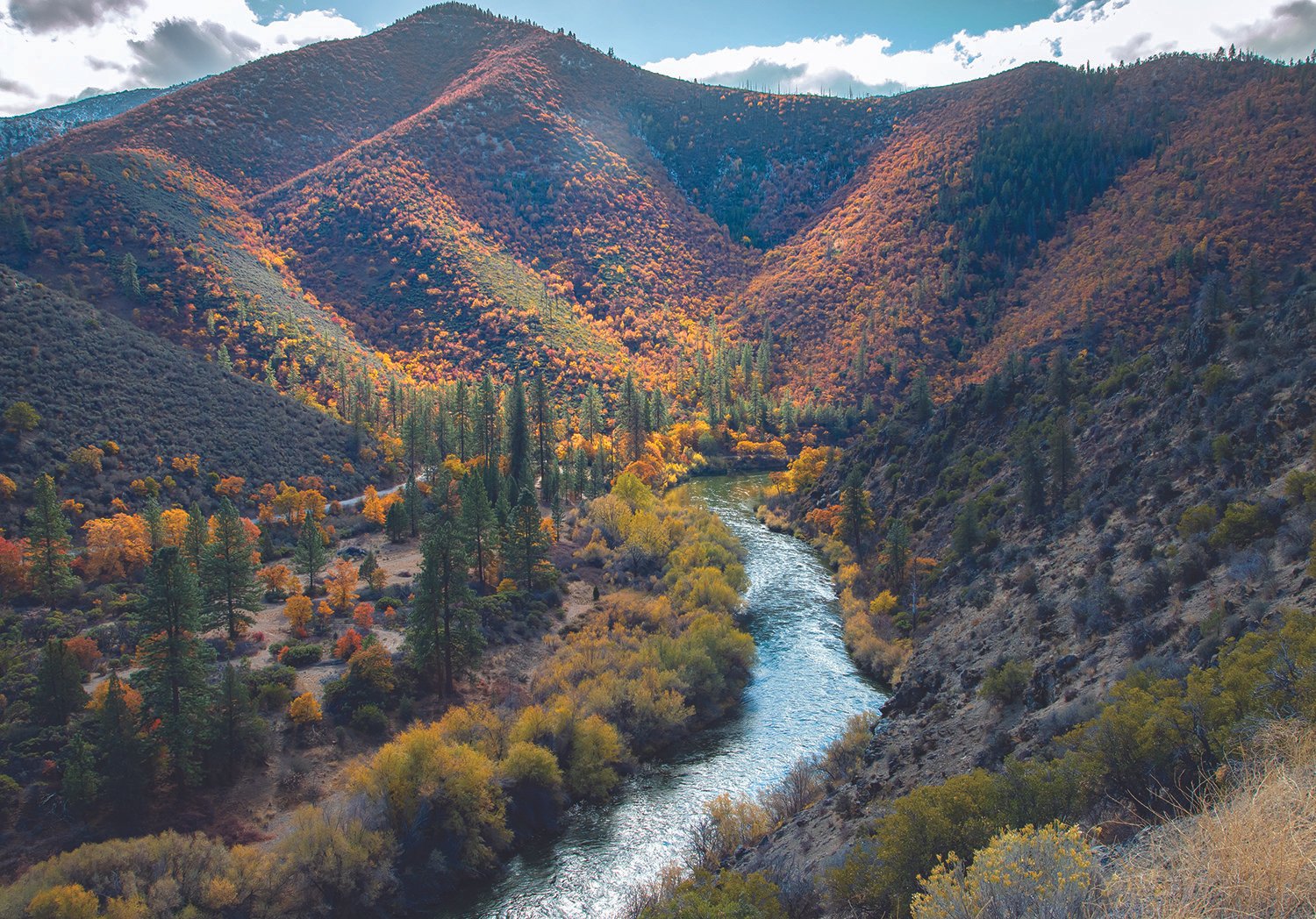
Recent image of the Klamath River in northern California, where steelhead tend to be more “trouty,” played an important role in the evolution of wet flies to more somber designs such as the Burlap, first tied by Arnold Arana of Dunsmuir in 1945.
Want to read more from Steelhead Fly Fishing? Visit the book index, where you’ll find links to all chapters currently available online.