The Judge: A Pattern in Three Forms
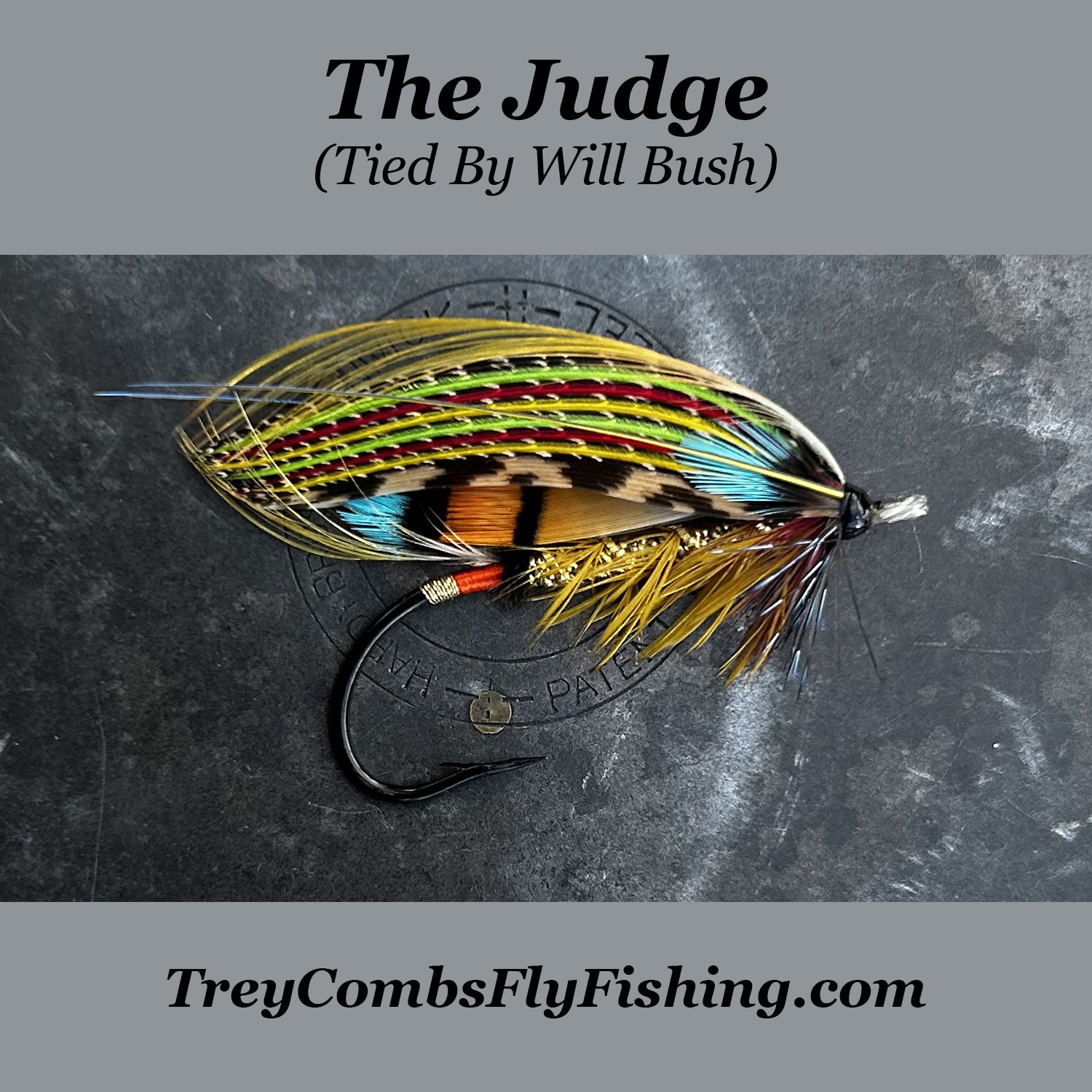
The Judge is one of those patterns that shows up more than once in the old books, but never quite the same way. It appears in A Book on Angling by Francis Francis, The Salmon Fly by George M. Kelson, and How to Tie Salmon Flies by Captain Hale. Each version is close, but not identical.
The earliest version comes from Francis. He didn’t invent it. He got it from a fly dresser named Brady, who worked for the firm Wm. Doherty & Son. That tells you what kind of fly this was to start with—a practical Irish pattern, tied to fish, not to show.
That version uses silver and orange, with a topping tail, herl butt, and a mixed wing. It’s a straightforward fly. Francis also mentions a gold-bodied variation, which suggests the pattern was already being adjusted.
By the time it shows up in Kelson, the gold version has taken over. Kelson doesn’t really keep the silver-bodied form. Instead, he gives a gold-bodied Judge and links it to G. S. Turnbull. That’s another sign the pattern was already being passed around rather than coming from one place.
In Hale, the pattern tightens up even more. He includes the Judge as one of his standard flies, and by this point it’s firmly a gold-bodied pattern. He also credits it to Mr. O’Fee, adding yet another name to the mix.
The fly shown here follows that Hale version. It’s tied by Will Bush, and it reflects that late Victorian approach. The gold body, the clean married wing, the throat—everything is built with intention.
At the same time, this isn’t the original Judge. It’s a later form of it. What started as a working Irish fly has been refined and tightened over time.
What’s interesting is that all three versions still feel like the same fly. Change the body from silver to gold, adjust a few materials, and it’s still the Judge. That tells you how these patterns developed—they weren’t fixed, and they didn’t belong to one person.
So the Judge isn’t really a single pattern. It’s a small line of related flies that changed as it moved from tier to tier.
And it’s why the Judge is still worth tying.
Here are the three dressing versions:
A Book on Angling, Francis Francis, 1867
Tag: Silver thread and light orange floss silk.
Tail: A topping.
Butt: Peacock herl.
Hackle: A golden-olive or yellow-orange cock’s hackle.
Throat: A red-orange hackle with blue jay over.
Wing: Mixed, from peacock wing, bustard with a few fibres of tippet, and two toppings over.
Horns: Blue macaw.
Head: Peacock herl.
The Salmon Fly, George M. Kelson, 1895
Tag: Gold twist and yellow silk.
Tail: A topping and blue chatterer.
Butt: Peacock herl.
Body: Gold tinsel.
Ribs: Gold tinsel (oval).
Hackle: Olive green, from second turn.
Throat: Fiery brown and jay.
Wings: Cinnamon turkey, pintail, swan dyed yellow and red; summer duck, and two toppings.
Horns: Blue macaw.
Head: Black herl.
How to Tie Salmon Flies, Captain Hale, 1892
Tag: Gold twist and orange floss.
Tail: Topping and two chatterer.
Butt: Green peacock herl.
Body: Silver tinsel ribbed with gold lace.
Hackle: Rich golden olive.
Throat: Bright fiery brown, then jay.
Wings: Strips of bustard, and swan dyed deep yellow, strands of tippet, powdered blue macaw, green and red parrot; two toppings over.
Cheeks: Chatterer.
Horns: Blue macaw.
Head: Peacock herl.
Other Flies In The Fly Pattern Dictionary Tied By Will Bush
Carnegie
Una