Why Steelhead Keep Returning to the Same Runs
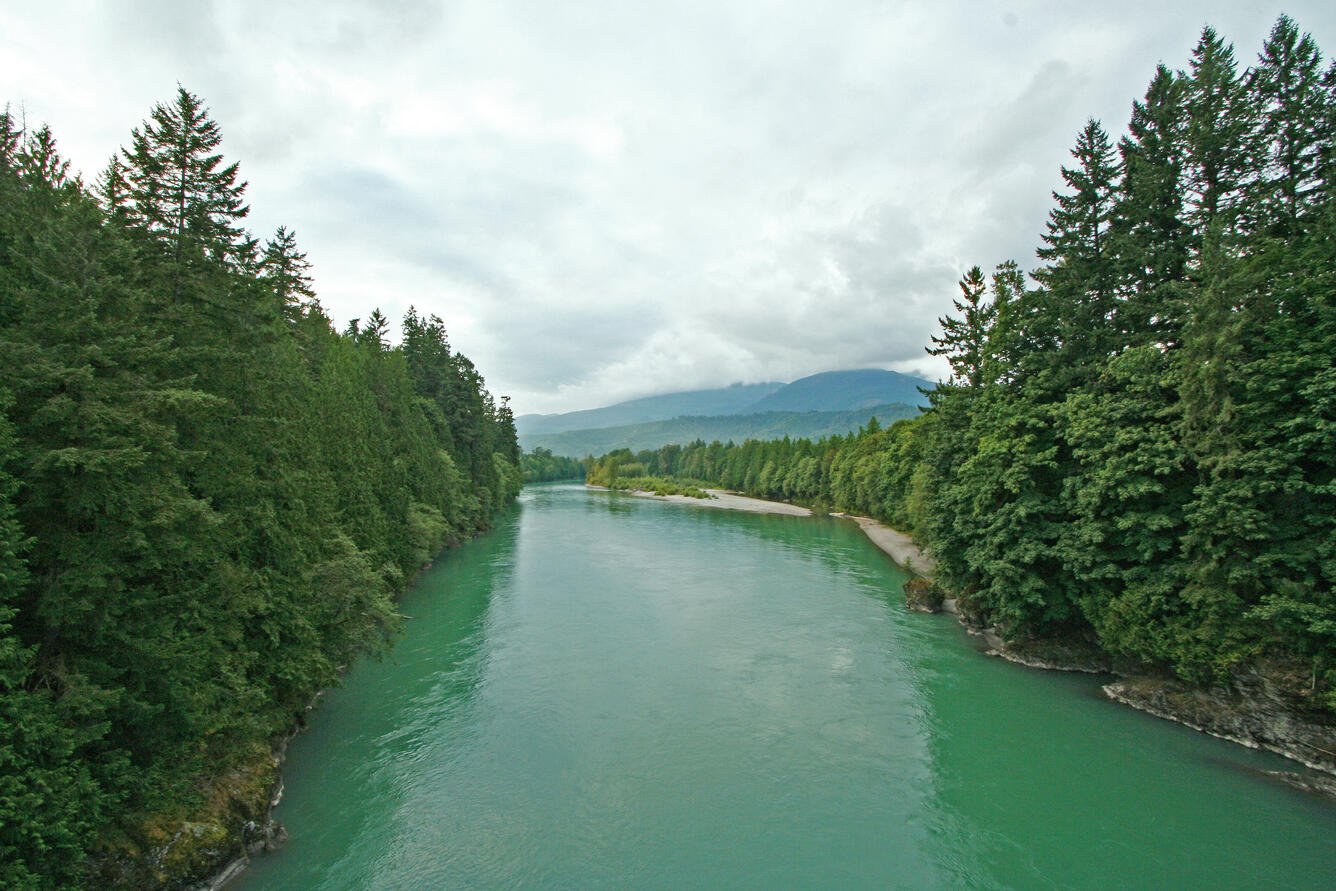
Skagit River: Why Steelhead Keep Returning to the Same Runs
This article is a synthesis of research titled “Dispersal of Fry and Distribution of Redds Interact to Shape Density Dependence in Winter Steelhead of the Skagit River.” It draws on the study’s findings to present a clear, angler-focused explanation of how spawning location and limited fry movement influence where steelhead are found within a river.
Why Steelhead Keep Showing Up in the Same Water
If you’ve spent enough time on a steelhead river, you’ve probably noticed a pattern. Certain runs always seem to hold fish. Year after year, even when returns are down, those same pieces of water produce. At the same time, other stretches—water that looks just as good on the surface—can feel empty no matter how hard you fish them.
Most anglers explain this in simple terms. Some water is just “fishy.” Some runs just have the right look or feel. There’s truth in that, but it doesn’t fully explain why the pattern is so consistent over time. The real answer starts much earlier in the fish’s life than most people think. It begins when steelhead are only a few inches long.
It All Begins with the Redd
Steelhead don’t spawn randomly across a river. The female selects a specific spot—usually clean gravel with the right depth and current—and digs a redd, which is where the eggs are deposited. Once fertilized, those eggs remain buried in the gravel until they hatch.
When the fry emerge, they don’t drift far downstream or spread out across the river in a broad sense. Instead, they stay relatively close to where they were born. Most remain within a few hundred meters of their natal redd during the early part of their lives. That means the location of spawning doesn’t just matter for reproduction—it largely determines where the next generation of fish begins and spends its earliest stage.
Even the timing of that emergence can matter. In one year of the study, a cold spring delayed emergence, with fry remaining in the gravel for weeks longer than expected before conditions improved. That suggests the “clock” for where fish end up doesn’t just start when they hatch—it starts when they actually emerge into the river, and that timing can shift depending on conditions.
Fish Don’t Spread Out the Way We Assume
It’s easy to assume that young fish distribute themselves evenly across available habitat. After all, rivers offer miles of potential holding water, and it seems logical that fish would spread out to make use of it. In reality, that’s not what happens.
Because fry stay close to their origin, their distribution reflects where spawning occurred, not where the best habitat might be across the entire river. When multiple fish spawn in one area, you end up with a dense concentration of fry there.
Meanwhile, stretches of river that didn’t receive spawning activity may hold very few fish, even if they appear ideal. The result is a patchwork of use rather than an even spread—some areas crowded, others lightly used, and some largely empty.
Why Steelhead Stack in the Same Runs
This pattern may help explain something anglers have seen for years: steelhead tend to stack in the same places. If spawning repeatedly occurs in certain parts of the river, those areas continue to produce fish generation after generation. Over time, these locations become core zones—areas that consistently contribute to the population.
The study also found that spawning locations overlapped from year to year far more than would happen by chance, indicating that fish repeatedly use many of the same areas rather than spreading out randomly.
So when you return to a run that has held fish year after year, you’re not just fishing good-looking water—you’re fishing within a part of the river that is consistently producing fish.
The Problem With “Perfect Water”
Every angler has encountered water that looks ideal but fails to produce. The depth is right, the flow is right, and the structure checks all the boxes, yet the run feels empty. This can be frustrating, especially when there’s no obvious reason why fish wouldn’t be there.
The explanation often comes back to distribution. If spawning hasn’t occurred in or near that stretch of river, there may not be many fish using it, regardless of how suitable it appears. Good habitat alone is only part of the equation. For it to matter, fish need to actually occupy it, and that occupancy is strongly influenced by where they originate. In that sense, “perfect water” is only perfect if it is connected to the system that is producing fish.
More Habitat Doesn’t Always Mean More Fish
Habitat restoration is often framed as a straightforward solution: improve habitat, and fish numbers will increase. While restoration is important, this study highlights a limitation that isn’t always discussed. If fish are not spreading into available habitat, then simply increasing the amount of habitat may not lead to a proportional increase in fish.
Because fry remain close to where they hatch, large portions of a river can remain underused if spawning is concentrated in a few areas. Even when new habitat is created or restored, it may not be utilized unless enough spawners are present to expand into those areas. This means that the effectiveness of restoration depends not just on habitat quality, but on whether fish are distributed in a way that allows them to use it.
Density Matters—Even When Numbers Are Low
Another important point is that density-dependent effects can occur at a local level, even when overall population numbers are relatively low. If fish are clustered into a small number of core areas, those areas can become crowded quickly. Competition for space and resources can increase, which can affect growth and survival.
At the same time, other parts of the river may remain lightly populated or unused. This creates a situation where the system appears to have unused capacity, but in practice, the areas that fish rely on most are already experiencing the effects of crowding. In other words, the population can be limited not because the entire river is full, but because the fish are not evenly distributed within it.
Why This Matters for Steelhead
Steelhead populations are influenced by many factors, including ocean conditions, harvest, and habitat quality. What this adds is a clearer understanding of how early life stages shape what happens later. If fry are concentrated in certain areas and do not disperse widely, then early survival is tied closely to local conditions in those areas.
This makes the system more sensitive to what happens in a relatively small portion of the river. It also means that increasing overall numbers may not be enough if fish remain clustered. For populations to fully benefit from available habitat, fish need to expand into it, and that expansion depends on spawning distribution as much as it does on total abundance.
A Better Way to Think About Rivers
Rather than thinking of a river as a continuous stretch of evenly usable habitat, it may be more accurate to think of it as a series of connected zones. Some areas are used heavily and consistently, while others are used only occasionally or not at all.
This perspective shifts the focus from total habitat to functional habitat—the portion of the river that fish actually use. It also highlights the importance of spatial structure, meaning where fish are located within the system, not just how many there are. Understanding that structure provides a more realistic view of how populations operate.
What Anglers Already Know
In many ways, this aligns with what experienced anglers have observed all along. Certain runs produce fish consistently, while others rarely do, even when conditions seem similar. Over time, patterns emerge, and anglers learn to trust them.
What this research does is provide a biological explanation for those patterns. It connects what is seen on the water with how fish behave during their earliest stages of life. The consistency anglers observe is not accidental—it reflects underlying processes that shape where fish are produced and how they are distributed.
Final Thought
Steelhead do not use rivers evenly. Their distribution is shaped by where they spawn and how far their young move in the early stages of life. Because fry remain close to their origin, patterns established at spawning can persist and influence the population over time.
This helps explain why some water consistently holds fish while other water does not, and why increasing habitat alone does not always lead to more fish. In the end, where fish begin their lives plays a central role in how they use a river, and understanding that changes how we think about both fishing and conservation.
By Mark Combs
Source: Chambers, N. (2025). Dispersal of Fry and Distribution of Redds Interact to Shape Density Dependence in Winter Steelhead of the Skagit River. University of Washington. Original Study
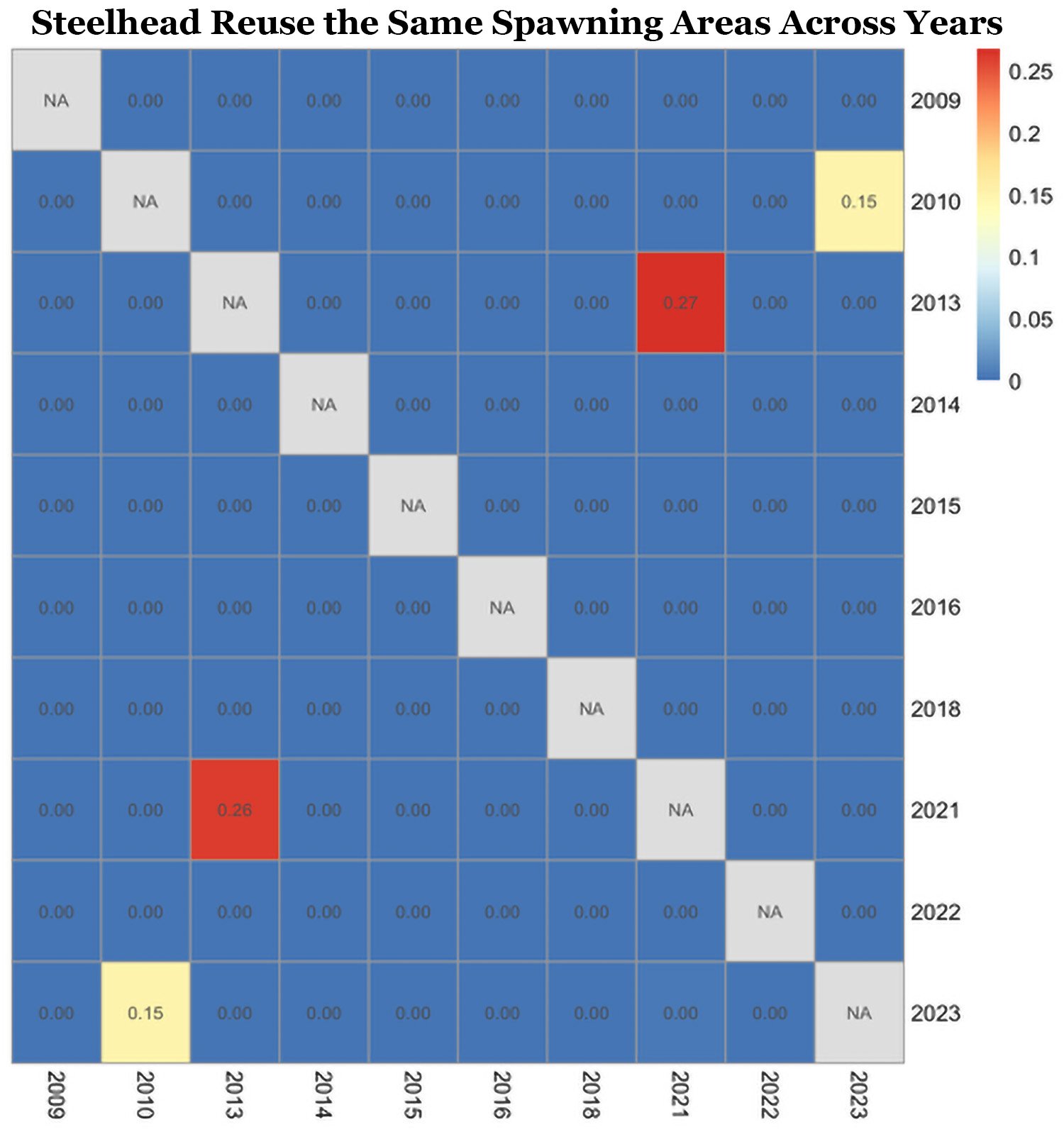
This study shows that Skagit River steelhead consistently spawn in the same locations year after year, rather than spreading out evenly across the river, leading to repeated use of specific areas over time.