Quinault River Steelhead: Now & Then
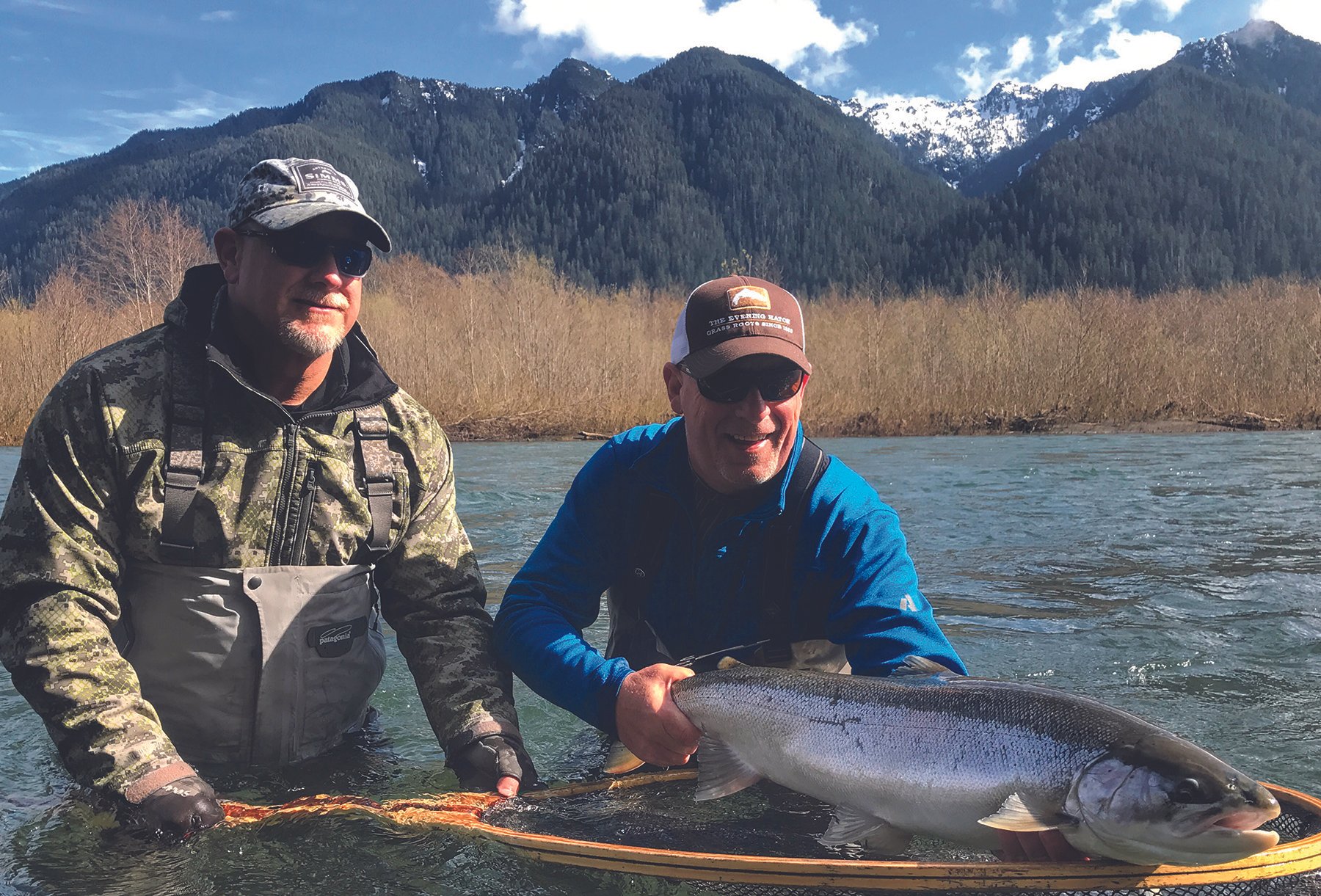
Now that’s a net—and a splendid Quinault steelhead from the upper river, with Jack Mitchell (left) doing the honors for his angler.
Author Note
In the early 1960s, I had just begun my first teaching job. Living in California, I made trips to the Quinault River, which became my first “favorite river” and has held a special place in my heart ever since. The following article was originally drafted around 2009, capturing a period of significant transition for the river and its native steelhead. Because the status of these fish continues to evolve, I have included a new section at the end of this piece to address federal findings and management updates that bring the story up to the present day.
Throughout this article, you will see steelhead age classifications noted in a standard biological format (e.g., 2/2 or 3/3. For the straightforward angler, these numbers represent the two distinct phases of a steelhead's life:
First Number (River Years): How many years the fish lived in the river as a resident before migrating to the sea.
Second Number (Ocean Years): How many full years the fish spent feeding in the ocean before returning to the Quinault to spawn.
For example, a steelhead spent two years in freshwater and two years in saltwater. Generally, the higher the second number, the larger and more "mythical" the fish.
Quinault River Steelhead - 2009
The Quinault River's native steelhead is as robust, massive, and large as any winter-run race in the world. The greatest of these steelhead bordered on the mythical. I first heard about these fish a half century ago, word of mouth tales that told of bucks over 30 pounds, sometimes a lot over. Forty pounds? Nothing documented, but Quinault Indian families with ancestral netting rights would say these fish were an integral part of their culture, a source of Quinault pride, and bragging rights between coastal tribes. While net-caught giants never became iconic pictures in sport fishing brochures, their legend drew anglers to the lower Quinault from all over the world.
Tribal law required that these fishermen would first need to employ an enrolled Quinault tribal member to guide them.
A person might expect the steelhead of folklore to be diminished by real steelhead and real anglers, but the opposite occurred. Fishermen found steelhead only a few hours from the ocean. Strength had not been diminished by long river migrations, or passage over multiple dams and endless fish ladders. They were natural born steelhead, and they were incredibly strong. At their largest, they became the source for epic stories told and retold about "the one that got away." A 25-pound steelhead dripping with sea lice took fly fishers to the edge of what could be landed.
Historically the winter-run was atypically late in their spawning migration and "spring-run" better described them. Steelhead numbers built slowly in December and January. By February steelhead were being caught regularly in gill nets set near the mouth of the Quinault, and in the sport fishery both on the lower river, and on upper Quinault above Lake Quinault. The run peaked in March and April, and extended into May. The sport fishing season closed April 30 on the Washington managed upper Quinault.
Within Olympic National Park, the East and North forks were open on a catch and release basis for all wild steelhead from June 1 to October 31. (Closure the remaining months protected spawning steelhead and salmon.) The Quinault main stem inside the Park and below the upper bridge remained open to sport fishing, also on a catch and release basis, from June 1 to March 31. The lower Quinault, under Quinault Indian Nation (QIN) management, remained open for sport fishing all year.
Native Quinault steelhead spawned in the lower Quinault, and in the upper Quinault's branches and tributaries as far up as they were able to a find a suitable spawning habitat within Olympic National Park.
If anglers didn't find the one steelhead of their dreams, they still found a fishery comparable to the very best that the world offered, be it for steelhead, Atlantic salmon, or Pacific salmon.
The typical Quinault steelhead, making up as much as 50% of the annual return, had a classic life history, having spent two years as a resident in the river before smolting, migrating to the ocean, and then spending two full years in the ocean before returning to their natal river to spawn. These wild fish were typically 32 to 33 inches long and weighed 11-14 pounds. Compare the steelhead to hatchery fish of six to seven pounds with the same ocean years.
To put a fine point on this physically gifted population, the natural spawning steelhead, making up as much as 40% of the annual run, measured 27 to 28-inches and would weigh 8-pounds.
The Quinault's steelhead contributed 5-8% of the run, while the steelhead comprised 1% or less of the total run. Both age classes, represented by small samplings, averaged 34-inches and weighed 15 pounds with some exceeding 20 pounds.
Two rare life histories, and , are undoubtedly present in archival tribal records. I mention this because steelhead with three pre-migrant river years and returning to spawn after three or four continuous years of ocean growth will typically be age compositions found in winter steelhead weighing over 25 pounds.
Female steelhead dominated the small number of the population spawning for a second time. They ascend the river, spawn once, and immediately return to the ocean to possibly survive and spawn again.
Polygamous bucks dramatically suffer the life sapping wear of spawning and combat with competing males. The trophy males with three or four ocean years of growth may not survive on their initial spawning migration to even return to the ocean. Regardless, they never return to the Quinault to spawn again.
A dozen different age classes can be identified among wild Quinault steelhead, a genetic diversification that no hatchery protocol can duplicate.
Among those giant bucks of tribal and angling lore, ALL were wild, natural born steelhead.
During the 1960's, the Quinault Indian Nation (QIN) recognized a long-term decline in their salmon and steelhead runs due to habitat degradation and corresponding loss of spawning habitat. Equally ominous, an increasing foreign ocean fishery was taking salmonid stocks, both legally and illegally.
But the QIN was also seeing a decline in the number of their giant bucks. These fish represented a rare age group, and for both tribal members and non-tribal anglers, they were the very soul of wild steelhead. Their rarity made them critically sensitive to both overharvest and non-selective gill netting. The loss of these fish, the loss of even a single 30-pound male steelhead reduced the overall wealth of the gene pool for ultimate strength and size.
At first glance, loss of spawning habitat is difficult to appreciate in a river basin protected by a national park and national forest. But early homesteaders cleared land to the water of those tributaries three species of salmon and steelhead depended upon for spawning success. (Chums, the fourth salmon species, spawn in the lower river.) These farms extended from Lake Quinault to far within Olympic National Park's current boundary.
Clear cutting was particularly devastating for runs of sockeye, called "bluebacks" by the Quinaults. These spring-run salmon held in Lake Quinault for months while they sexually matured and then migrated upriver in the fall to spawn in the degraded tributaries.
As mitigation for these losses the QIN, in agreement with the U.S. Fish and Wildlife Service, built the federally funded Quinault National Fish Hatchery (QNFH). This elaborate facility was sited five miles up Cook Creek, a tributary midway between Lake Quinault and the mouth of the Quinault, approximately 18 river miles. The first releases began in 1968 for fall Chinook, coho (silver), and chum salmon.
The Quinault Department of Fisheries initiated their steelhead hatchery program at the QNFH in 1972. Quinault fishery personnel collected stock in two ways. Led by tribal biologists and Marty Figg, current manager of the Lake Quinault Facility, they sport caught steelhead from the river and stored them temporarily in live boxes or ventilated PVC tubes. They were collected by tribal members and taken to the QNFH holding tanks.
When nets with smaller mesh size were employed in the commercial fishery, exceptionally large steelhead got tangled in the nylon mesh, but weren't gilled and killed. These steelhead fish could be safely removed, put in a holding box, and taken upriver to the hatchery.
Scales were removed and read for their life history. Only steelhead showing at least two full ocean years of growth were selected as brood stock. The steelhead were spawned, the eggs hatched, and fry reared at the hatchery. All releases were made into Cook Creek at QNFH in order to develop a commercial run that would return to the hatchery. In this manner, hatchery stocks would naturally confine themselves almost entirely to the lower 18 miles of the Quinault.
This new run immediately became an important commercial component to the natural spawning wild Quinault steelhead.
But when hatchery born adults returned to the hatchery, they weren't simply recycled. Breeding protocols initially used were repeated, with wild steelhead again mated with QNFH steelhead. In this manner, mating hatchery stock to hatchery stock was avoided. Since 1979, at least 200,000 smolts per year have been released.
The Lake Quinault Facility (LQF) was built in 1972 on a small bay off the southwest shore of Lake Quinault. Initially, this was to be an economic development project to pen rear pan-size salmonids. But it shortly became an important hatchery production facility to pen rear both salmon and steelhead. As with the QNFH, wild Quinault steelhead were collected and used as breeding stock, a selective mating regime "to counter selection for domestication," according to Dr. Larry Gilbertson, Senior Scientist for the Quinault Department of Fisheries. The fertilized eggs were transported to the QNFH to be hatched and reared in hatchery tanks.
When the steelhead had reached 3 to 4-inches in length, they were transported back to the LQF to grow in net pens until reaching about eight inches in length and ready to smolt and migrate to the ocean.
When adult steelhead returned to the LQF, they were mated to natural born wild stock, a management practice that maintained a more genetically diverse run, with greater size and vitality. This protocol has continued and remains in place today. Releases began in 1975. Since 1978, the LQF has released 200,000 to 250,000 steelhead smolts per year.
Marty Figg, manager of the LQF for many years, detailed for me his unique operation.
Steelhead returning to the LQF are blocked by a net about the length of a football field. The steelhead get tangled in the net, and are cut loose, collected, and examined. Over 70% of those steelhead that will be mated to wild fish, as determined by scale examination, must have three complete years of ocean growth. Most of the three-year steelhead selected will be females. Extra large female two-year ocean may also be used. Large, three year ocean males may also be collected at the hatchery.
The wild steelhead are generally collected at Tahola, where they are selectively chosen for size, removed from the gill nets, stored temporarily in transportable water tanks, and taken to the LQF. Figg described this as breeding "large to large."
The most remarkable mating occurred a few years ago when a 35-pound wild steelhead was repeatedly mated to three-year ocean hatchery females before being returned to Lake Quinault to continue its migration.
Steelhead are collected and mated monthly from January through March. Smolt releases are also made during these months. These practices have spread out the return to such an extent that it nearly masks wild returns. Only about 250 hatchery fish are selected annually to be mated to wild steelhead.
The long term results of Figg's breeding program are the largest hatchery steelhead in the world. The largest LQF steelhead documented so far weighed -pounds. The largest taken in 2013 was 27 1/2-pounds.
Far more dramatic than the single huge steelhead is the overall population shift to much larger steelhead as the result of longer ocean residencies. Anglers are seeing a wealth of 13 to 17-pound hatchery steelhead. This was my experience when fishing the lower Quinault in 2013. I described this briefly at the end of this article.
Some of the steelhead killed at the LQF are donated to charities.
Healthy hatchery fish may be collected and taken to the lower Quinault and released to be fished for again.
But some pass on through Lake Quinault to the upper Quinault River where they have been caught and released or killed by fishermen. They are identified by their nubby dorsal fin.
Figg has received first hand reports about these catches, some in the 25 to 29-pound range.
Though not yet documented, a few steelhead of LQF stock likely spawn with wild steelhead. Some fishermen, particularly fly fishers, will find such matings highly problematic. And they raise the question as to how wild is a wild natural born Quinault steelhead. If a 30 or 35-pound natural born Quinault steelhead can trace its genealogy back to the LQF, is the steelhead wild?
In the early 1990's, the U. S. Fish and Wildlife Service dramatically changed its breeding protocol at the QNFH. Instead of mating selected wild stock to hatchery stock, managers introduced a random mating policy whereby hatchery stock was bred to hatchery stock. Regardless of the mating protocols, hatchery steelhead are raised to smolting age and released in one year. The practice of pellet feeding and maxing out growth rates typically set smolts for an earlier and more concentrated return in their migratory cycle. The steelhead is also more constant in their size, and this size is smaller than wild steelhead, the so called "cookie cutter" syndrome.
Given that 100% of the hatchery steelhead had a pre-migrant age of "1," the majority of the returning steelhead will have life histories of 1/1 and 1/2 . This trend is accentuated when hatchery steelhead are mated to other hatchery steelhead. Adults get progressively smaller and younger; adult steelhead become more than half the total run, and average only 60-70% of the size of wild, natural born Quinault steelhead with same single year of ocean growth.
Why would the QIN sign on to this hatchery practice if the results seem so counter productive?
The QNFH is primarily a commercial facility with the maximum production of steelhead at the least cost the objective. The hatchery return is extremely concentrated, the majority of the run harvested within six weeks. For the QIN, there is economy in this run timing, steelhead caught first in gill nets at Tahola, and then taken in a terminal fishery at the QNFH rack. Here steelhead become part of the commercial harvest, or are recycled as breeding stock.
In short, those steelhead not taken in nets above tidewater make a beeline for Cook Creek and the QNFH. Only a few of these steelhead have been discovered straying above Cook Creek, and none have been discovered spawning in the Quinault or in its tributaries.
There is considerable debate currently going on in the QIN about changing the QNFH's steelhead breeding program to one more in keeping with practices long employed at the LQF. I sense these changes are coming. The QIN sport fishermen distain these "dinks," or "donut holes," steelhead so small they can swim through a donut, being produced at their federal hatchery. More realistically, the steelhead weigh six to nine pounds. Nevertheless, one need only compare these fish to wild or LQF steelhead to appreciate their prejudice.
The LQF steelhead run is months long, December into April, with the run now peaking in late February. Size and run timing can only be considered a direct result of the selective breeding program. If science and the angling public and hatchery science ever needed to appreciate outcomes from two different hatchery programs, these two QIN hatcheries must be considered a classic in contrasts.
The three winter-run populations, QNFH, LQF, and natural born populations, show three different periods of peak migration into the Quinault River.
QNFH: The run peaking from December 15 to January 1, the numbers building dramatically in December and declining dramatically in January and early February (a sprinkling of Cook Creek steelhead enter the Quinault in March).
LQF: As above. Wild steelhead: Peaking from March to April 15, nearly a constant during that period, but entering the Quinault from late November to early May.
Annual hatchery run sizes vary from year to year even when hatchery releases are a constant. Over the past 10 years this number has ranged from as small as just over 5,000 to as much as 15,000, with 6,000 to 7,000 the norm. The natural born run has generally been 5,000 to 6,000. But many factors influence these numbers, from escapement and natural spawning success in the Quinault basin to mortalities suffered during their years as ocean residents.
Gill nets obviously don't distinguish between QNFH stock and wild steelhead.
However, once past the nets, hatchery steelhead will make a right turn at Cook Creek, and the native fish will not.
With near 100% certainty, Cook Creek steelhead will be caught either in gill nets set five to six days per week at Tahola, or at the QNFH.
Both Quinault hatcheries identify pre-smolts for life by inserting a tiny binary coded-wire tag in their nose.
At the QNFH, 80% of the pre-smolts are adipose fin clipped, and can be easily distinguished from the much smaller number of wild steelhead returning to the Quinault during December and January.
Quinault biologists survey redds and can locate nose tagged steelhead with a small, hand held detector, nicknamed a wand. This practice determines to what degree hatchery stocks mate with wild stocks.
Currently no hatchery fish have been detected spawning in the lower Quinault River. A few QNFH steelhead have been detected straying above Cook Creek. But they invariably drop back down and ascend Cook Creek.
Straying, the migration of adult steelhead into non-natal waters, is likely a genetic component of wild steelhead. I discussed this trait with Sam Brenkman, Senior Fishery Biologist for Olympic National Park. He suggested that this trait could be the reason why Hoh River (including South Fork Hoh River), Bogachiel, Calawah, and Sol Duc steelhead were not genetically differentiated. The steelhead have likely been straying into each other's rivers for thousands of years. Today, a few Queets and Quinault wild steelhead are assumed to annually trade spawning destinations.
The Queets' Salmon River Hatchery has become a management concern for the QIN as these steelhead, identified by a fin clip, have strayed into Olympic National Park (ONP) and presumably mate with wild stock. ONP fishing regulations allow anglers to kill two of these fin clipped steelhead per season.
Dr. Larry Gilbertson, Senior Fishery Biologist for the QIN, believes that LQF steelhead stray less than wild steelhead, and that QNFH (Cook Creek) steelhead stray the least of all. If so, this suggest that the practice of mating hatchery steelhead to other hatchery steelhead could over time eliminate the trait for straying and produce a steelhead population that will return straightaway to the hatchery, potentially offering protection for wild stocks.
But this can be a two edged sword.
More than 25 years ago Bob Hooton and I met at British Columbia's Stamp River hatchery. Steelhead were migrating up the Stamp so rapidly, so genetically programmed to reach the hatchery, that they were largely lost to sport fishing. When hundreds had schooled up below the hatchery, they were transferred to a hatchery truck, and driven down to the mouth of the Stamp and released. We ruefully joked about the steelhead beating the truck back to the hatchery.
Hatchery technicians at the LQF also identify pre-smolts by adipose clipping approximately 30,000 before release, or 15% or less of the total.
During the course of creel and license checks, Washington's Department of Fish & Game didn't find adipose clipped steelhead in the upper Quinault that would document this straying. However, given that such a small percentage of LQF hatchery steelhead are fin clipped, this creel census is hardly diagnostic.
There is a second method to determine LQH hatchery stock.
Whether in hatchery tanks or hatchery pens, fry and fingerlings nip on each other's dorsal fins, a result of containment stress. Adults display a nubby dorsal fin, or even a dorsal fin missing altogether.
This may be changing. Hatchery managers recognize the cause for the disfiguration. It is much less an issue at the QNFH where greater room is afforded fry and fingerlings in tanks. At the LQF, nets pens have been nearly doubled in size in 2013 for the same number of pre-smolts. This management change may eliminate the disfiguration altogether. Unless 100% of the LQF pre-smolts are adipose clipped, future anglers won't be able to distinguish between a wild fish they wish to release, and a hatchery steelhead they might kill.
The Quinault River Fish Committee sets a creel limit of 3 steelhead per day. No distinction is made between wild fish and hatchery fish. Anglers can theoretically kill three wild winter steelhead a day, December through April. And then return the next day to repeat the take of wild fish. Because LQF stock can currently be distinguished by a missing or nubby fin, these hatchery steelhead can and do bare a larger portion of the creel limit set by the Quinault River Fish Committee (QRFC). The QRFC annually meets their escapement quotas set for wild steelhead, and run size has remained fairly constant.
On the upper Quinault, Washington's Department of Fish & Game established a steelhead season from December 1 to April 30. The 2013 creel limit was one steelhead per season per person. Many anglers and nearly all fly fishers found this wrongheaded and preferred that anglers fished the upper Quinault solely on a catch and release basis. The reason for this is simple: Runs of pure wild steelhead are increasingly rare and threatened throughout their range in the western U.S.
The commercial harvest of hatchery steelhead, a combination of the QNFH and the LQF facilities, averaged 50% of the total run at the nets over the past 20 years. About 35% of natural spawning, wild stock, are also harvested in gill nets. Currently, QIN's international sport fishing reputation depends on both wild and LQF steelhead.
Ruben Estavillo, my Quinault guide in March 2013, showed me a picture of a wild buck steelhead that had recently been caught in a gill net at Tahola. The fish weighed 29 pounds and became part of the commercial catch sold at $2.50 per pound.
I believe that a wild steelhead of such size generates vastly more dollars to the QIN when it's caught and released to spawn, and then talked about, and written about, than killed as part of a commercial catch.
A way must be found to grant these few giants free passage from the ocean to their spawning grounds, mostly on those Quinault River sections state and federally administered. There are ways to accomplish this. Getting them safely around the nets by employing a mesh size that wouldn't gill and kill the steelhead may well be the easiest part of the equation. The alternative, the loss of this world famous steelhead, forever steals from humanity. No one holds that view more strongly than the Quinault people.
Summer-Run Steelhead
The Quinault's summer-run steelhead remains a small natural born population. The run isn't genetically compromised by hatchery support. Morphologically, these fish are as massive as native winter-run fish. No studies have been conducted on the size of this run, a combination of the small number killed in nets combined with poorly known escapement numbers.
In August 2009, Olympic National Park biologists conducted a snorkel survey from the headwaters of the East Fork Quinault downstream to Lake Quinault, mile 68 to 37.5. Divers counted 114 summer steelhead. QIN fishery biologists estimated the entire run to be as much as 1,000, but this can possibly be a lot less.
The QIN creel limit remains 3 summer-run steelhead per day, a liberal limit given the overall fragility of this run.
Breaking this run down by month, by week, and by day, tribal nets may take only a few summer steelhead on a good day, really an incidental catch and a small part of the very valuable run of sockeye salmon in May, June, and July, and the silver (coho) and Chinook (king) runs from September through November.
A year after I hooked my first steelhead above the Quinault's Pony Bridge, I returned with a fly rod and again stared into the currents from the vantage of Pony Bridge. As I expected, the pool was full of spring-run Chinook salmon, but two steelhead held off the main flow in water almost without current. Both fish were ghostly pale, fresh-run summer fish. I guessed the hen at 8-pounds. The buck was so huge I could barely process what I was seeing. I kept looking at the Chinook salmon, the hen, the buck, over and over to put the great steelhead's size in perspective. I went down to the river's edge, made a few casts, and returned to the bridge. The pair hadn't moved. I repeated this several times, and when I last returned to the bridge and looked into the currents, both steelhead were gone. I knew with certainty that the buck was over 40-inches long and weighed at least 25 pounds.
Quinault River Steelhead - 2026
It has been over 15 years since I last put these notes together, and while the Quinault still holds that mythical pull, the reality for its native steelhead has grown more complex. In January 2026, the federal government finally issued their verdict on the health of these Olympic Peninsula runs. They decided a formal endangered listing wasn’t warranted, but that doesn’t mean the river is in the clear. The biologists confirmed what many of us have sensed on the water: these fish face a "moderate risk of extinction," with a 42% decline in abundance since the early 1990s.
The Quinault Indian Nation is still out front on this, moving forward with their 2026 Lake Quinault Management Plan. Their focus is where it needs to be—on habitat restoration and preparing the river for the shifts in climate that threaten the "blueback" and the steelhead alike. For the modern fly fisher, this has meant even tighter restrictions, including "No Retention" periods to ensure that the largest wild bucks—the giants I’ve described—reach their spawning beds safely.
We are also seeing science try to answer that old question of mine—what truly makes a fish "wild." Advanced DNA testing is now being used to look at the genetics of hatchery-origin fish to see which ones should be protected as part of the river’s legacy. The technology has changed, but the goal remains the same: ensuring these giants aren’t stolen from the future of the river.
– Trey Combs
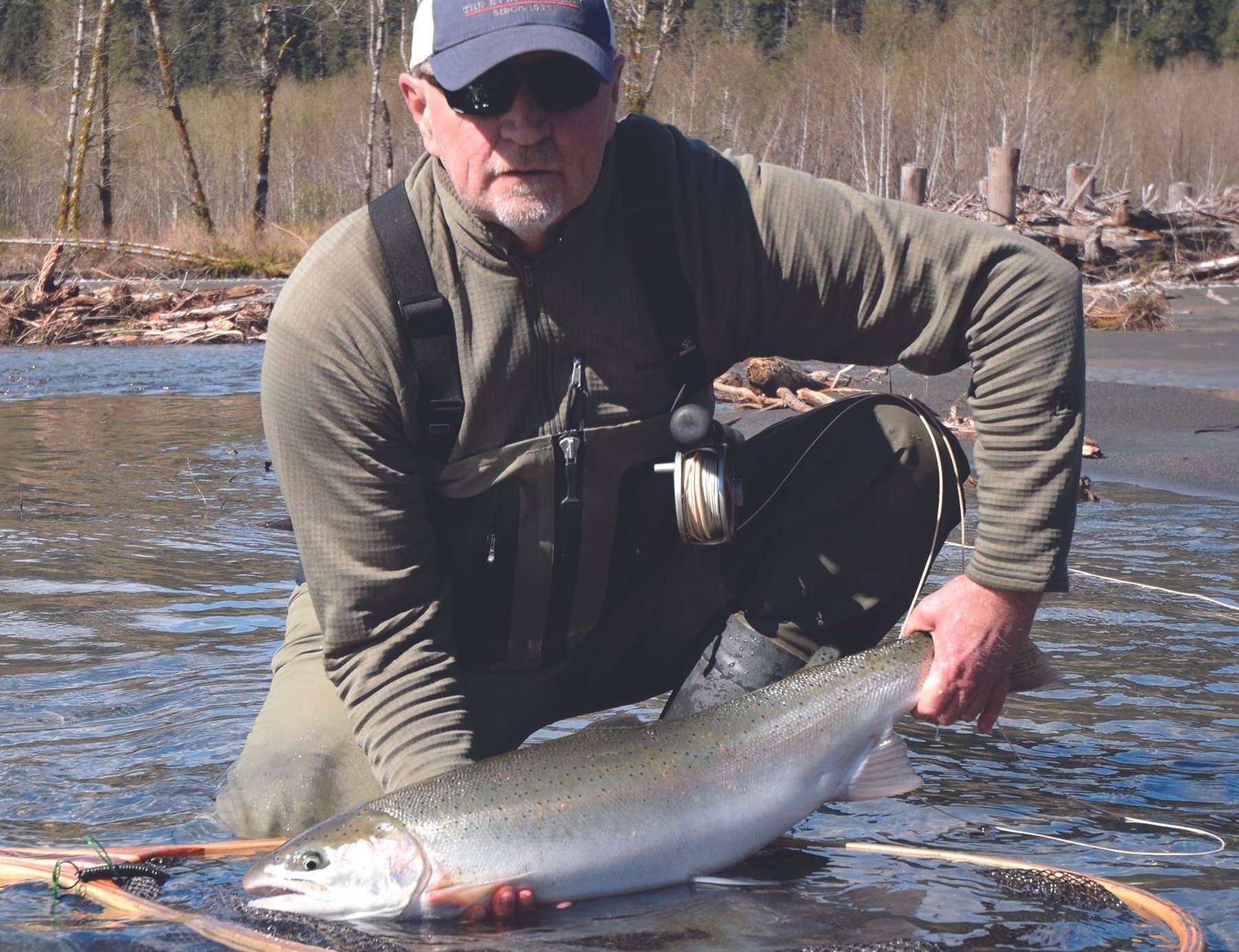
My neighbor and good friend Jeff with a spring steelhead on the upper Quinault River.
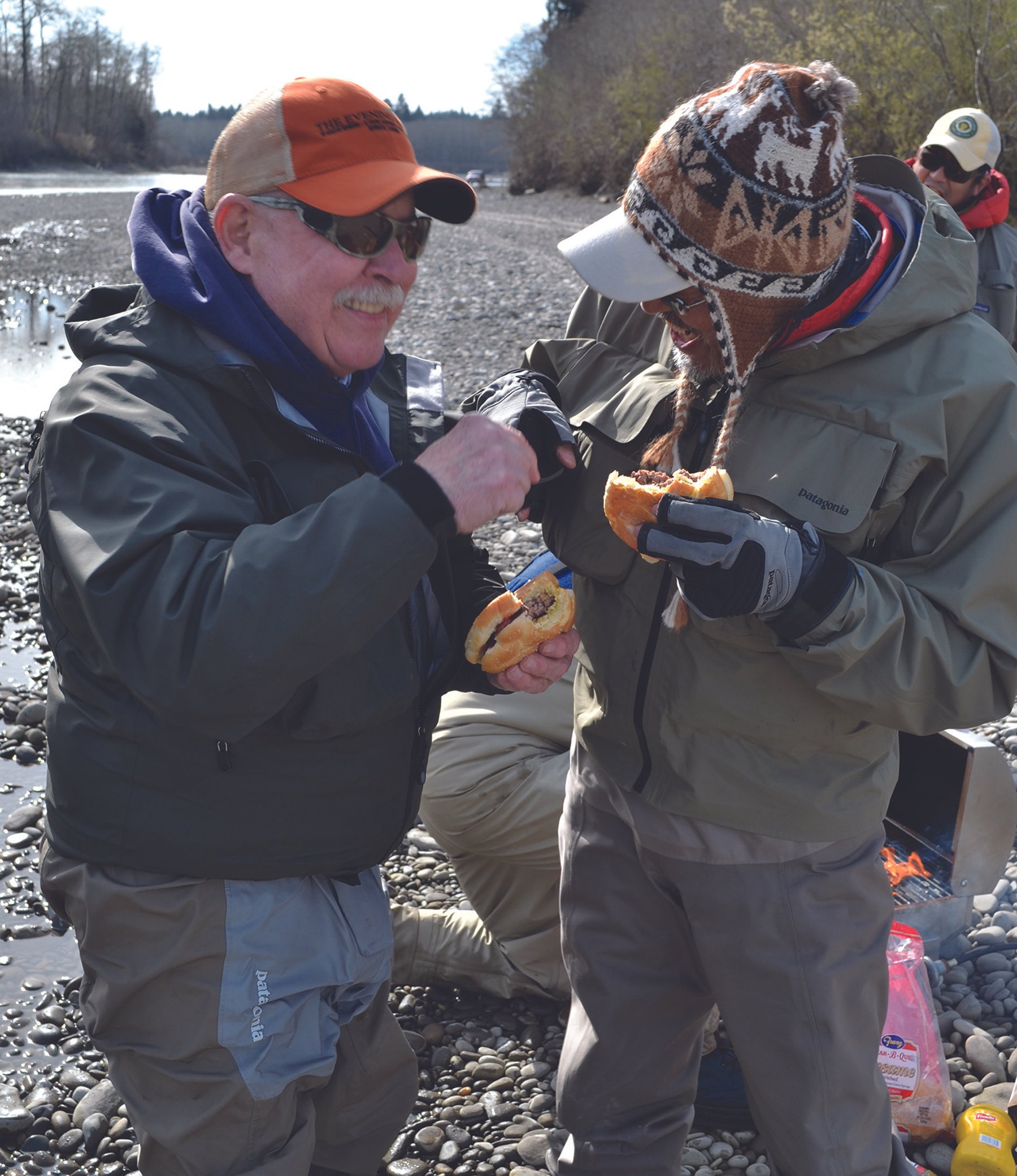
Koetsu Kanaya and I share fishing stories over elk burgers that Richie Underwood has prepared on the Quinault River’s rocky shore. Koetsu lives on Shikoku Island, the smallest of the four main islands that make up Japan.