Bluewater Fly Fishing: Dorado
This is an excerpt from Bluewater Fly Fishing by Trey Combs. Originally published in 1995. Presented here in its original chapter format. Desktop only: Right-click any image in this chapter to open it in a new tab to view the high-resolution version. This feature is not available on mobile.
DORADO - Loreto, Baja California Sur, Mexico
When I first fly fished the Sea of Cortez off Loreto, Mexico, the airport terminal was a thatched hut with a Coke machine, most panga captains had never heard of a fly fishermen, and those few who had thoroughly despised them, calling them las plumas, "the feathers," the feminine gender intentional. This was a time when no limits existed in sport fishing, in either size or numbers, and no one gave a second glance to a 40-pound dorado. Gringos got drunk on Cuervo Gold and cases of Pacifico, visited unbelievable hell on the local populace, and filled casket-sized coolers with frozen fillets. These commitments to fish hoggery and bacchanalian pleasures did not please the residents, but they did not displease them either. If gringos on holiday were pigs, they were rich pigs, and that counted for a lot in a village so poor.
Ticon was my first panga captain. Hook-nosed and hatchet-faced with flashing black eyes and a wildly insolent disposition, he reminded me of an Aztec warrior ready to eat the still-beating heart of a vanquished foe. He considered me his unfortunate lot, the worst kind of luck, an attitude that disappointed me, for I was determined not to be his Ugly American. I would be courteous, pleasant, and sober. I would also fish the fly-all in all, a gentleman angler. After one day with me, Ticon may have thought I possessed all these traits, but he thought me an idiot besides, for while he could find dorado for me, I couldn't catch them. On the second morning, he greeted me with contempt, morbidly despaired, and threw my fly rods, gold reels and all, ten feet through the air into the bow of the boat. Then we went fishing.
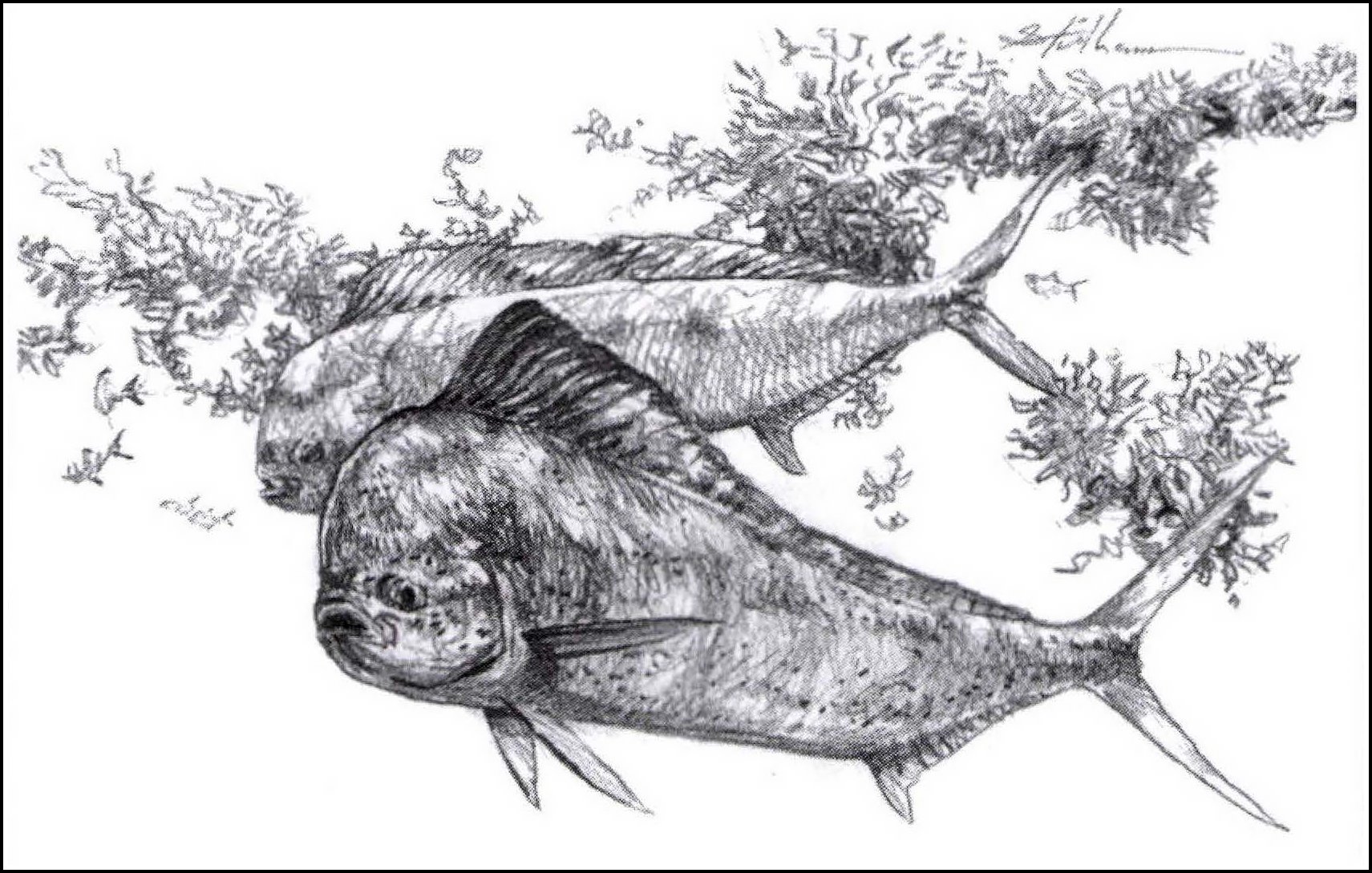
The object of these cultural transgressions was the dorado, Spanish for "golden," a name perfectly describing a fish that often seems gilded. Hawaiians call it "mahimahi," while on the east coast of the United States it becomes the dolphin-or "dolphinfish," to distinguish it from the sea mammal of the same name. I'd been assured that by any name, this gamefish, which inhabited tropical and temperate seas worldwide, represented bluewater fly fishing better than any other. Few gamefish were faster or more acrobatic and none, my friends insisted, would demonstrate a greater eagerness to eat my flies and poppers.
Loreto's panga captains all had identical routines. They left before dawn and ran eight miles north of town for the southern end of Coronado Island, where they and their anglers jigged for mackerel, often catching two or three at a time and storing them beneath the athwart seat, a primitive but effective live bait well. Ticon had to get all the baits because I couldn't jig with a fly rod, further evidence that las plumas were a brotherhood of wimps. I asked to relieve him of this chore, but Ticon, his martyrdom complete, disdainfully waved me off.
We would motor slowly along looking for patches of "weed," rafts of sargasso that might shelter school dorado in the 6- to 15-pound class, or an occasional bull of 20 pounds or more. Without polarized glasses to filter dawn's oily shadows, Ticon still saw dorado I could not, and he would throw a couple of mackerel over the side to stampede them into striking the huge flies I fished on 60-pound, hard nylon shock tippets. The mackerel immediately sounded for their lives, taking the dorado with them, and leaving me staring into a lot of empty water. At the end of the day, when Ticon's peers were hauling great dorado from their pangas, and saw that his boat was empty, they felt pity for him, and damned la mosca, "the fly," and any angler demented enough to fish it. The fishermen often gave a few dorado to the panga captains who were free to eat them or to sell them to boost their meager wages. Fly fishing hurt Ticon's pride, and his pocketbook. As the other captains collected their filleting knives and gathered at the fish-cleaning station, Ticon glared at me. I knew what he was thinking, and I was thankful that his knife was still in the panga.
Ticon began fishing for me by running a huge hook through the nose of a mackerel and casting it at the dorado. Sometimes I would see a huge bull come from a considerable distance for the mackerel, attack it crosswise, and run for 50 yards before Ticon struck, either to be fast to the fish or to spit out a string of Spanish curses when the dorado leaped and the mackerel came sailing out of its mouth. When a hooked dorado attracted others, Ticon sometimes held a dozen by the boat so I could cast frantically to them, but they would not take my fly. Ticon would go back to catching dorado and leave me to glumly search through my pile of huge bucktails and Deceivers. Dorado were supposed to eat anything in sight and my flies, buzzing with tinsels in a dozen electric colors, were a reflection of everything I had found to read on the subject. The low point of my descent into self-pity occurred when I cast a red-and yellow 4/0 Deceiver into a school of 8- to 10-pound dorado, and watched several turn blotchy with shock before they fled in panic. An hour later, Ticon hooked a bull dorado as big as a door and insisted that I take the rod, a fiberglass broomstick anchored at one end by a 6/0 reel that gave out unlubricated, fingernails-down-the-blackboard screeches as the fish tore off a 100 yards of 80-pound line. I was nearly pulled from the panga before gaining my footing and feeling the weight of the fish. I gasped, first at its strength, and then at where my hubristic passion for the fly had led me: Regardless of whether I could or could not hook such a fish on a fly, I could not land it, a depressing realization to come to after five days of casting and sweating in 100-degree heat with a man who could not imagine the source of my stupidity. When I derricked the 50-pound dorado to the boat, Ticon gaffed it and smiled, satisfied that I had grown wiser from the experience.
I had not, for the next day Ticon found me waiting in the predawn darkness again clutching my fly rod. We made short work of the mackerel. I had proven to him that using them did not help me, and after he collected only enough for himself, we set out in near darkness to hunt for dorado. When he saw a single dorado under the first patch of sargasso, I cast and he hissed, "Grande!" The fish did not take the fly, and Ticon motioned for me to cast again. This time, when the bucktail landed at the very edge of the sargasso, the bull took it without hesitation. I struck, and the dorado executed the longest run I had ever witnessed, 700 feet across the Sea of Cortez stitched by a series of golden leaps, a dorado so far away so quickly that I wondered whether the miniature on the horizon was indeed my fish. It was, 30 pounds, and when brought aboard I howled and embraced Ticon, who could only laugh and shake his head at a gringo so possessed.
I returned to Loreto again and again; to Baja's "first city," the capital of Baja California for 132 years, to the site of Junipero Serra's first mission in 1769, to Caesar's restaurant and my dinner of lobster and margaritas, and to where, as its merchants proclaim on T-shirts, "the mountains meet the sea." They do, and despite the centuries of human endeavor, I think that nowhere else on this temperate planet do the riches of the sea so contrast to the poverty of the land. The Sierra Giganta forms the east coast of the Baja Peninsula by plunging directly into the sea. Conversely, the western slopes drop gradually across Baja to the Llano de Magdalena and the Pacific. The clouds of late summer moisture that sweep in from the ocean are wrung dry by the time they reach this spine of great mountains. Loreto remains so in the lee of the weather pattern that years may go by without measurable precipitation, a fact registered on the faces of these moonscape mountains that silicate-bearing winds have left eternally wet with desert varnish.
Looking into those mountains, I could believe that sometime in the long ago germinal life returned to the sea to be nurtured to its current state of biodiversity. Beneath my panga, from the aquamarines of white sand shallows to the blue-black depths hundreds of feet below, thrived every imaginable marine organism, from copepod, to 100-pound squid, to the tuna by the shoals and the sailfish, and the striped, blue, and black marlin that hunted them. Dorado lurked under seaweed paddies, and roosterfish raced across the headland flats. Bottomfish filled the ledges and grottoes in dizzying variety. Hammerhead sharks hounded my fly-hooked fish even as manta rays entertained me with high, somersaulting leaps. Porpoises, sea lions, and great baleen whales became daily companions. Frigate birds, boobies, shearwaters, gulls, and terns pursued flying fish, mackerel, anchovies, mullet, and sardines. Coming to understand how these parts related to one another, and thus learning how the dorado and the many other gamefish could best be caught on flies, would take many years. For the most part, I was unable to think of a more useful way to spend my time.
Dorado normally move north into the Sea of Cortez in early June, when water temperatures first break into the eighties. This temperature is insufficient to bring about the rapid growth of sargasso, the mustard-colored weed that gathers in school-sized dorado like a mother hen, and the fish search hard for other types of cover. Dorado will hold under anything: pieces of plastic, newspaper, cardboard, driftwood, even dead turtles and dead whales. Once on a November long-range fly-fishing trip down the Baja Peninsula, our company of anglers aboard Royal Star found an estimated 2,000 dorado under a single dead seal. During one Loreto June, an upcountry sawmill dumped tons of coarse sawdust in the ocean. This blew out to sea, formed a drift a mile long, and for a week held some immense dorado. I watched with fascination as terrified flying fish, a favorite food of dorado, spread their huge pectoral fins and eased themselves out on top of the sawdust while huge bulls shouldered their way through the cover.
A generation of anglers considered July the dorado month, a time when numbers, size, and sargasso cover all came together, a peak season that had every hotel and panga booked months in advance. August, extremely hot and humid, and susceptible to chubasco storms that in only a few hours can sweep the sea clean of sargasso and dorado, has gained a loyal following in more recent years because the fishing can be so extraordinary. I recall one morning in early August when, at dawn, the dorsals of hundreds of cruising dorado could be seen to the horizon. My partner and I together hooked forty dorado that morning. Nearly dead with exhaustion and dehydration, we ordered the panga back to the beach at 11 o'clock.
I call the time between the first light and the moment the sun sends shafts of light deep into the water-about eight o'clock during Loreto's July "Golden Time," for dorado move freely, are much less wary, and can thus be approached more easily. Large bulls, especially, are more likely to smash a popper at this time. Overcast or coastal fog can extend this time, and I consider either condition a blessing.
I fish two outfits when hunting dorado from a panga. I choose a 9- or 10- weight rod when casting 1/0 to 2/0 Sea Habits, whether Bucktails, Deceivers, or Tubes, and a 10- or 11-weight rod when casting poppers and 4/0 flies, especially at first light. I cast the flies with a monocore running line looped to 28 feet of shooting taper, sink rate IV. The poppers, either a 2/0 cork-bodied Gaines popper or a 2/0 Edgewater rubber popper, are covered with Mylar piping, and coated with epoxy. Like the flies, the poppers cast like bullets, enabling me to get the extra distance I want. I fish them with either a shooting taper, sink rate III or IV, or a Scientific Anglers Mastery Series sinking monocore tarpon line.
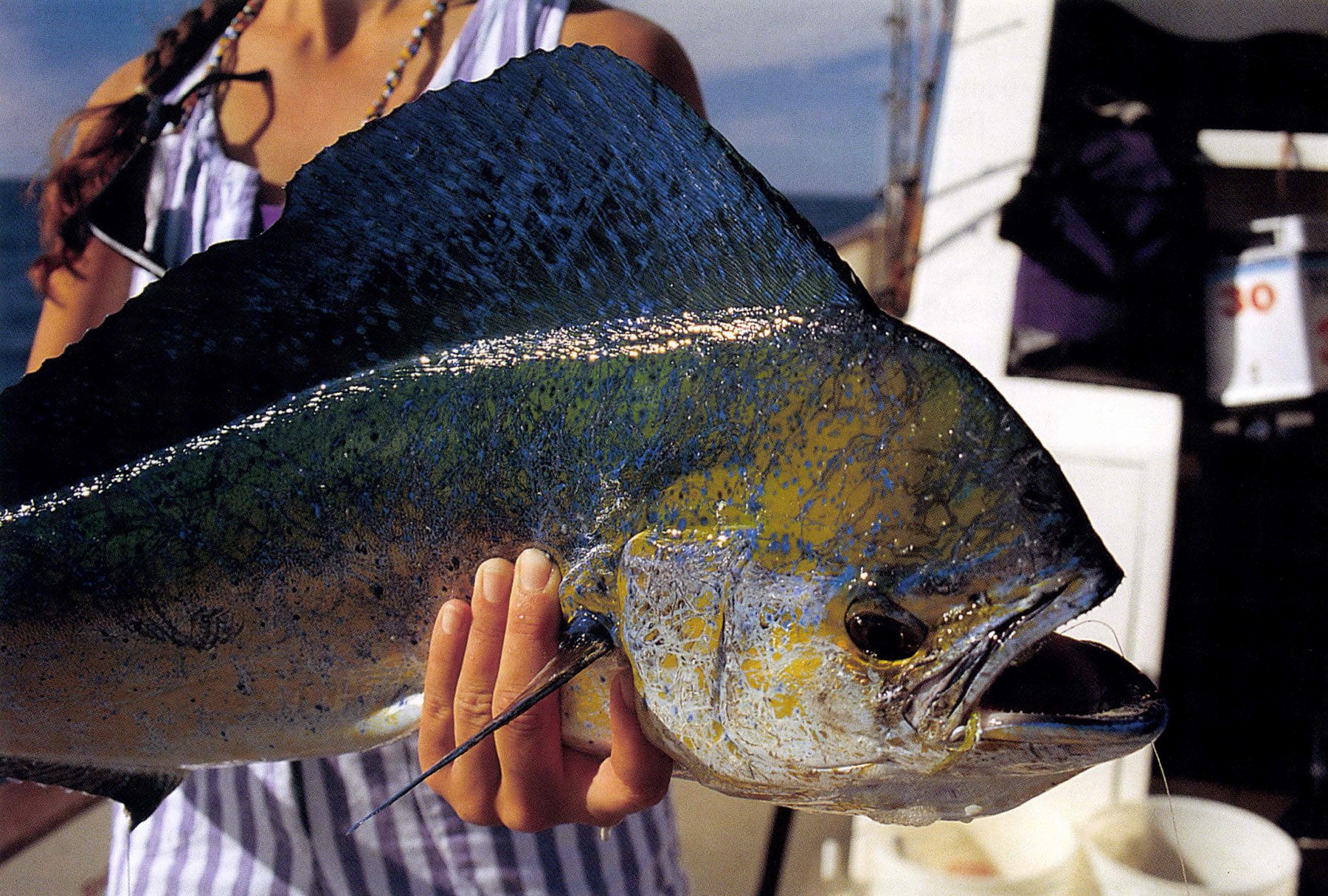
A bull dorado caught off Thetis Bank, Baja California. Note the light leader without a shock. When fly fishing for school-size dorado in the 5- to 15-pound range, a hard nylon leader testing only 15 pounds can be safely used. Photograph by Trey Combs.
The development of my flies for dorado has gone on for years, and has led me to produce even more lifelike creations. I believe these flies and poppers, more than anything else, have placed dorado among the easiest of all saltwater gamefish for me to take.
As my flies have grown more lifelike-and smaller-my tippets have grown lighter, and now I've generally ceased using shock tippets altogether, simply tapering my hard nylon leaders down to 15-or 20-pound test. Even when casting poppers for the largest bull dorado, I rarely bother with anything heavier than a 30-pound hard nylon shock that I quickly connect to the class tippet with a surgeon's knot. A dorado has a hard pad of short, needlelike teeth on its tongue and on its palate, and a single row of small teeth on its upper and lower jaws. When a dorado takes a fly or popper deeply, the leader wears directly against these teeth, and as a result I lose a few large fish on the light tippets and shocks. But I hook many more than I would otherwise, a trade-off I'll take anytime.
The single greatest mistake fly fishers make when searching for dorado is casting only one size fly, and that one size large-five inches or longer-on a 4/0 hook. How many times have I seen an angler's stretcher box full of these huge, overly gaudy flies all carefully tied to shock tippets! I only bother with such flies at first light, when big bulls tail boldly on the hunt, because once the sun is hard upon the sea, large flies don't get much attention. I begin downsizing from midmorning on, usually fishing thinly dressed, three- to four-inch 1/0 and 2/0 flies during midday.
Dorado of both sexes weighing 4 to 12 pounds are often found hunting together in schools of 6 to 30 or more. As they get larger, the bulls especially become less social and often swim singly. These dorado, from 15 to over 50 pounds, may be found holding under sargasso by themselves, or with one or two smaller bull or cow dorado. On numerous occasions I have seen a single large bull warily holding below a school of much smaller dorado. Nevertheless, my first-light strategy centers on finding single large bull dorado holding under some cover and waiting to pounce on a passing baitfish. For these fish, I'll first cast a popper.
Years ago, a panga captain would drive his boat up on a patch of sargasso, throw a mackerel over the side, and wait for you to cast. This close approach drove the dorado either away or down. If any hung around, the mackerel over the side sent them in pursuit. Either way, the approach was dead wrong for fly fishers. I now ask my panga captain to try to keep the boat about 60 feet from the grass. If I detect a morning breeze-and light winds often blow from land early in the morning-I work to keep the panga upwind, but not so directly that the boat begins drifting down over the sargasso and the dorado. I want the panga to drift by, never getting closer than about 60 feet. This means that my initial cast will be more like 80 feet, with subsequent casts shorter until I've drifted past the area.
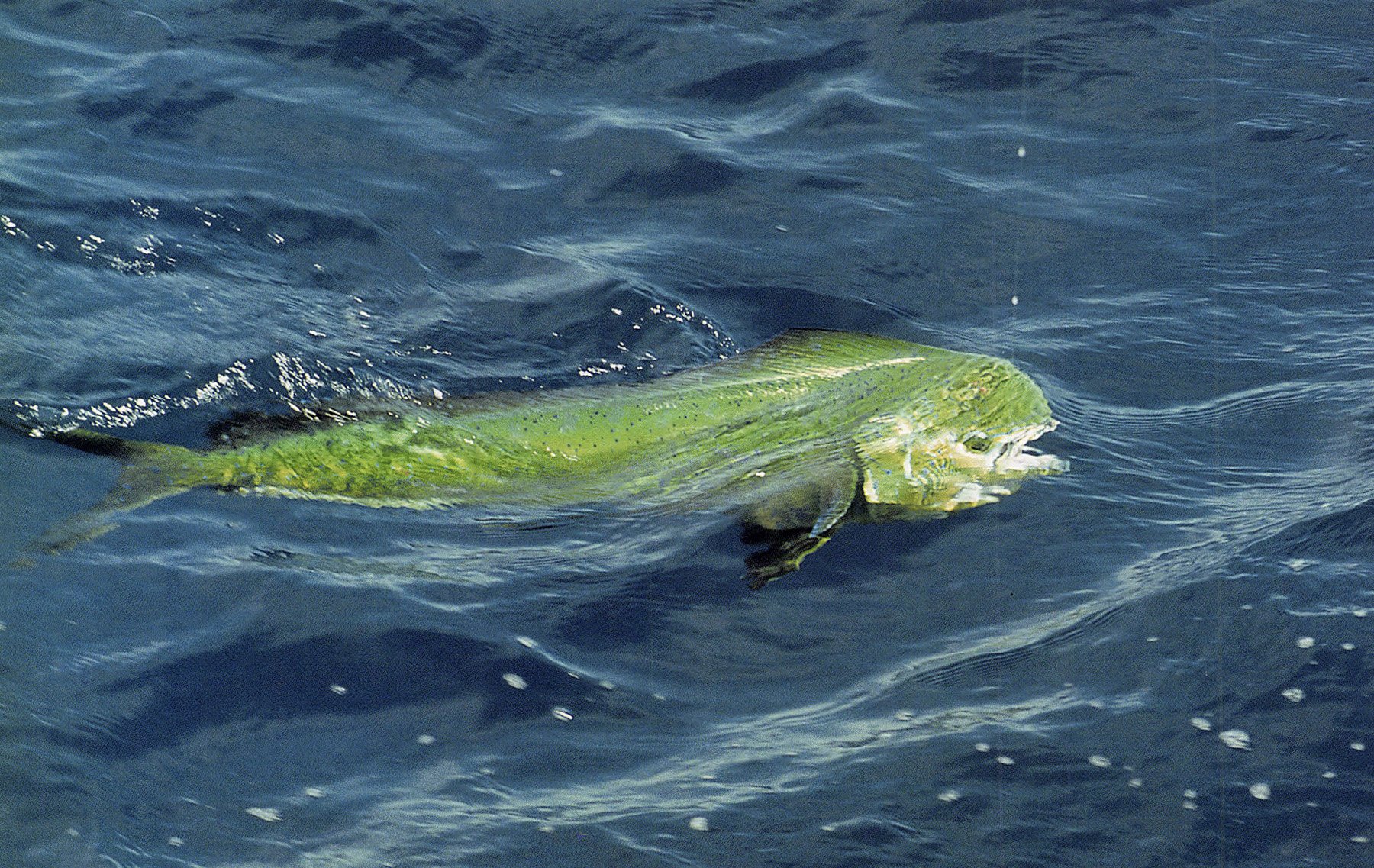
This Mexican “schoolie” bull dorado took a size 2/0 Sea Habit Bucktail in the Anchovy Blue pattern. Photograph by Trey Combs.
Usually a dorado takes a popper on the first or second cast. I believe it helps to wait a second after the popper has landed before making the first strip and pop. I've had bulls rocket out the instant the popper landed, only to miss it because I'd already started a strip. For the same reason-and I believe this to be especially important when using flies-once the dorado is streaking for the popper, I give it a final pop and then stop. The dorado will come to the popper, pause for a split second to line it up, and then open its mouth and swallow it. As a result, I often find the popper down its throat. I believe this behavior, this confidence, is the direct result of very lifelike poppers.
I use the exact same approach when fishing flies, always working to see the taking dorado, and stopping my strip just before impact.
If I go by the weed cover without a take, and I'm certain that dorado are present but I've had refusals using the popper, I have the captain return to the original starting point, and I repeat the approach using a fly. I've had many dorado, even those obviously distracted by my presence, take the fly after the popper had failed.
Less frequently, I reverse the process, starting with a fly and, if getting refusals, changing to a popper. This works when dorado mill about the boat and see the fly repeatedly. I cast beyond them as far as I'm able, and strip the pop per quickly. This technique often sends one of the dorado streaking after the incoming "baitfish."
A hooked dorado holds other dorado, a trait with many fly-fishing implications. If a number of schooled-up dorado are being cast to, it prolongs the fishing if one angler keeps his or her fish in the water until another angler has hooked up. Eventually, though, all dorado grow stale, and the strikes become less frequent, even when poppers are exchanged with flies or flies are exchanged with smaller flies in different patterns. Ultimately the fish lose interest altogether, refusing anything cast at them, and disappear. Chum, live or dead, can immediately reverse this, recharging the dorado's interest in your flies.
Often the easiest chum to secure-and surely the most convenient to use-is a chunk of giant squid, or calamari. The captain cuts this into small pieces and throws a handful on the water. If the angler immediately casts a fly into the center of the calamari, a dorado will take it while the schooled-up fish dash about for the bits of bait. If not overdone, this chumming should extend the fishing for an hour or more. If several pangas are working the same school of dorado, the volume of chum can leave the fish sated, less and less responsive, and swimming ever deeper. At these times I make a long, downwind cast and let the fly sink, either on a complete dead drift, or accompanied by only the occasional twitch on the way down. The take-soft, sometimes nearly imperceptible-occurs after the fly can no longer be seen from the surface. The strike must be made quickly. Long after surface action ends, additional dorado can be hooked in this manner.
Almost any dead fish, if fresh, can be used to chum dorado. On several occasions, when down to one or two live mackerel, I have killed a single bait, chopped it into many small pieces, and used this chum to keep the dorado chasing my flies for a few more minutes.
Live chum works magic on dorado, setting them off into an instant feeding frenzy. Mackerel, if first blinded on one side, will swim on the surface in circles, or dive in a series of spirals. Either behavior slows their descent, and draws dorado to the surface. Sardines often school along a rocky breakwater, and if your panga captain is handy with a throw net, a dozen can be caught quickly. Sardines are worth any delay required to obtain them. A sardine thrown at a cruising bull is immediately consumed. Follow it with a second. The fly or popper goes in on the third go-around. (A friend of mine once likened the sequence to throwing hand grenades.) Unless I've been able to fill the panga's live bait well with dozens of sardines, I use them only to bring in large singles; I don't waste these hard-to-get baits on school dorado.
East Cape lies well to the south of Loreto, where the Sea of Cortez meets the Pacific Ocean. Strong afternoon winds and the resulting wave action prevent the accumulation of a weed line, or even small patches of sargasso. However, a dozen crude buoys, each trailing a large, baited hook for sharks, and spaced a mile or so apart, run from near the Palmas de Cortez resort to Punta Colorado. All are likely to hold dorado (and sometimes 6- to 8-pound yellowfin tuna). A few enterprising panga captains net thousands of sardines on the flats and sell these live baits to captains whose pangas have aerated wells. Knowing this in advance, I only fish from super pangas or cruisers that have wells and dependable pumps to keep the sardines alive. By special arrangement, my fishing begins at first light, or nearly two hours before the rest of the fishing fleet departs. For a couple of hours I'll have my captain run down the coast, stopping at each buoy so that I can cast. If I suspect dorado are present, but none are showing, a couple of sardines thrown at the buoy will provide an answer. Generally, however, I save the sardines until later in the day when they become vital to my continued good fishing. One afternoon, my son, Travis, and I used live chum during several hours of incredible midday fishing. We hooked and released more than thirty dorado, ranging from 6 to 18 pounds, at a single shark buoy. The sardines made all the difference.
In Loreto, when the full heat of the day is on the water, fishing becomes more sporadic, the dorado more difficult to locate. Captains search for places where wind, tide, and currents have produced long drift lines relatively free of wave action. Such breaks afford a good view of flotsam that might hold dorado. Small patches of sargasso, many only the size of pie tins, also hold dorado. They would be very difficult to locate were it not for phalaropes, small sandpipers that migrate from the Arctic across the Sea of Cortez in late July and August. They have already changed into their winter plumage, mostly white and gray, and in this dress they can be seen for hundreds of yards as they paddle about searching the sargasso for flying-fish eggs. Panga captains motor from one group of pajaros-"birds"-to another, stopping by each little patch of weeds for a few casts.
At any time of the day, captains watch the sky and the behavior of the ever present frigate birds. These graceful, buoyant, and remarkably agile feathered sailplanes pirate catches from gulls and boobies. Frigate birds are also skilled at using hunting dorado to secure flying fish. When in hot pursuit, dorado send flying fish into the air to glide on their enormous pectoral fins while keeping the wind generally abeam. They gain altitude by turning into the wind, doing so at the expense of flight time. Long, seemingly endless flights from one wavetop to another are completed only by the periodic sculling of the extremely elongated ventral half of their tail fin in the water. During these maneuvers, dorado will track them, racing just below the surface while the flying fish frantically try to stay airborne. At such times, frigate birds will swoop down and snatch the flying fish from the air. Having seen this thousands of times, panga captains watch to see whether the birds are riding thermals and searching, or kiting along, as if following compass coordinates, to keep track of a single often large-dorado. Captains process this information so skillfully that they are often able to intercept the targeted dorado with live chum.
By late in the morning, dorado may still hold under sargasso paddies, but so far below the surface that an angler standing in a panga presumes the cover to be empty. I have snorkeled around various organic flotsam as far as 30 miles offshore and watched dorado swimming around more than 60 feet below me. Gear fishers know of these dorado, and troll lures by their cover. Each year they catch thousands in this manner. But that is not fly fishing. Several fly-fishing approaches follow.
If chum is not available, I use an extra-fast-sinking shooting taper, such as Scientific Anglers Deep Water Express, that I've connected to monofilament running line. I cast the fly upwind well past the cover. As I drift away from the cover, I strip additional shooting line off the reel while the line sinks. I retrieve with short strips and occasional twitches, bringing the fly right through the dorado's suspected hold.
Another midday method involves trolling by patches of sargasso or other types of cover with small billfish teasers. Dorado are difficult to tease, in part because of their nervous, high-strung temperaments, and in part because of the manner in which they take their prey. Dorado flash in on live chum and teasers and crash them from the side, holding them firmly in their mouths much as a dog holds a bone-as they race back to the shelter of their cover. A dorado rarely comes back to a teaser after it has been ripped from its mouth. If one tracks a teaser, it does so for only a few seconds before either nailing it, or dashing away to hunt for something else. But with the mate physically on the teaser rod and ready to reel, and the captain acting as lookout from an elevated position, and 30 feet of fly line and a fly or popper trailing behind the boat, a dorado can be cast to so quickly that a hookup is possible. At the very least, a dorado will show itself. This may either hold promise for a go-around later in the day under low light, or promote the immediate use of precious chum, alive or dead.
When I am fly fishing for billfish, and trolling teasers to attract them, I always have a 10- or 11-weight rod with a popper ready to go. Rarely does a day pass without my seeing some sort of basuro, "trash”, that might provide cover for lurking dorado. When I do, the captain pulls in the teasers and daisy chain and I get ready to cast. Some of my best dorado fishing has occurred using this technique.
It often happens that a concentration of dorado repeatedly tears into billfish teasers, shredding the carefully stitched mullet or belly strips so relentlessly that in a short time an entire day's supply of baits can be lost. When this occurs, I ask the captain to remove the teasers and troll a skirted lure with a hook. Within a few minutes, the mate has hooked a dorado, and other dorado are nervously following the captive fish back to the boat where I wait with my fly rod. A fly then will get far fewer refusals than a popper, perhaps because the popper relies more on surprise and instant reaction than does the fly. Whatever the reasons, though, these opportunities have provided me with some of the largest dorado and best bluewater fly fishing I've experienced.
Sometimes while searching well offshore for billfish, I have encountered a long drift line that contains all sorts of debris. Unless billfish are evident, I ask my captain to run along this line-which may extend for miles-and search for dorado. I once encountered just such a drift line 70 miles off Cabo Marzo and Bahia de Humboldt on the frontier between Colombia and Panama. High tides had floated entire trees out of the jungle, each a roost for masked boobies, their large size and nearly all white coloration making them visible for great distances. Steve Jensen and I motored from bird to bird, casting flies and poppers to dorado and boating five, from 18 to well over 40 pounds. We also saw larger dorado, losing a bull the captain thought would hit 60 pounds. When I'd fished those waters the year before, a gear fisherman trolling for marlin had hooked a dorado the captain swore would weigh 80 pounds, an estimate very much in keeping with the maximum size that bull dorado are known to reach.
A short run north of Cabo Marzo is Panama's Pinas Bay, where in 1964 Stu Apte took a 58-pound dorado, on 12-pound tippet, that remains the largest ever taken on a fly. Nearly thirty years later, he told me about this dorado when we fished together on the long-range boat, Royal Star.
"I saw three dorado holding under this mahogany tree and made a cast with a white 2/0 popper. The smallest of the three got to the popper first. One of the dorado must have weighed over 70 pounds. I think the largest of the three would have weighed at least 90 pounds."
Like Apte's record-the longest standing in saltwater fly fishing-the all-tackle record dorado, Manuel Salazar's 87-pound giant taken in 1976 from Costa Rica's Gulf of Papagayo, may never be beaten. Most other dorado records are equally ancient: 83 pounds, 6 ounces, Mazatlan, Mexico, in 1972; 73 pounds, 11 ounces, Cabo San Lucas, Mexico, in 1962; 77 pounds, 2 ounces, Islamorada, Florida, in 1982; 80 pounds, Walker Cay, Bahamas, in 1989.
I've never read studies that give an age for such dorado. But these record fish likely aren't old, not when a dorado can grow to 20 pounds in only three years. Several years ago, on a November long-range, fly-fishing trip, a crew member, while scooping up baitfish with a fine mesh net, captured some month-old dorado, each about four inches long, heavily barred, already pugnacious, and sexually distinct. They were put in a secure corner of the live bait well and fed bits of mackerel. The baby dorado grew so rapidly I could almost watch it happen.
I have taken dorado on flies and poppers in the Pacific, Atlantic, and Indian Oceans, including both coasts of South America and Africa. Each new experience increases my admiration for the species, and my concern for its future as a fly-rod gamefish. The dorado remains one of the premier food fishes and its commercial importance increases each year everywhere in its range. Despite its extraordinary growth rate, this fishing pressure is bringing its average size down. In Loreto, where it all began for me, I have seen two dorado that I am certain would have weighed 60 pounds, fish over six feet long that on the jump produced the kind of long, low-decibel rush of water I associate with tonnage and broaching whales. Memories of 40-pound dorado, even 30-pound dorado, grow less current each year as local commercial fishermen pirate the Sea of Cortez for its shellfish, sardines, dorado, and bottomfish, and as longliners compete to take the last marlin and sailfish. Many panga captains now smile at the prospect of catch-and-release, wear gloves to assure that they do this properly, cheerfully remind you that the daily limit in Mexico is three dorado, and become disgusted with fishers who believe these dorado belong only to their generation. Hopefully these captains' attitude is not a case of too little too late.
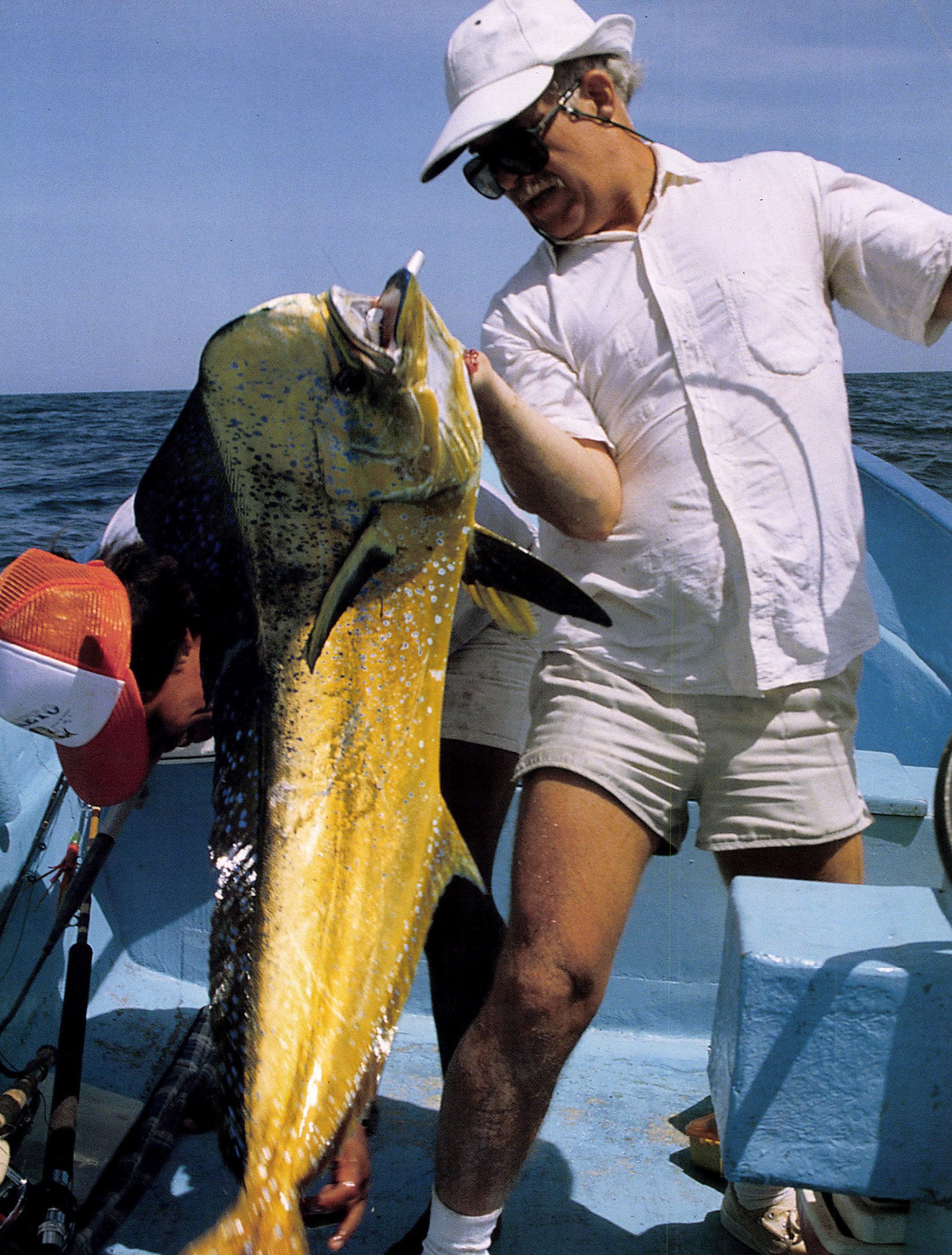
The author with a 30-pound bull dorado caught off Loreto, Mexico, which ran off 700 feet of line. The fish took a homemade balsa popper painted to imitate a flying fish, a favorite prey of dorado.
Read More from Bluewater Fly Fishing
Additional chapters from Bluewater Fly Fishing are available in the Bluewater Fly Fishing archive. The complete original edition will also be available as a free downloadable PDF here soon.