Holding Water
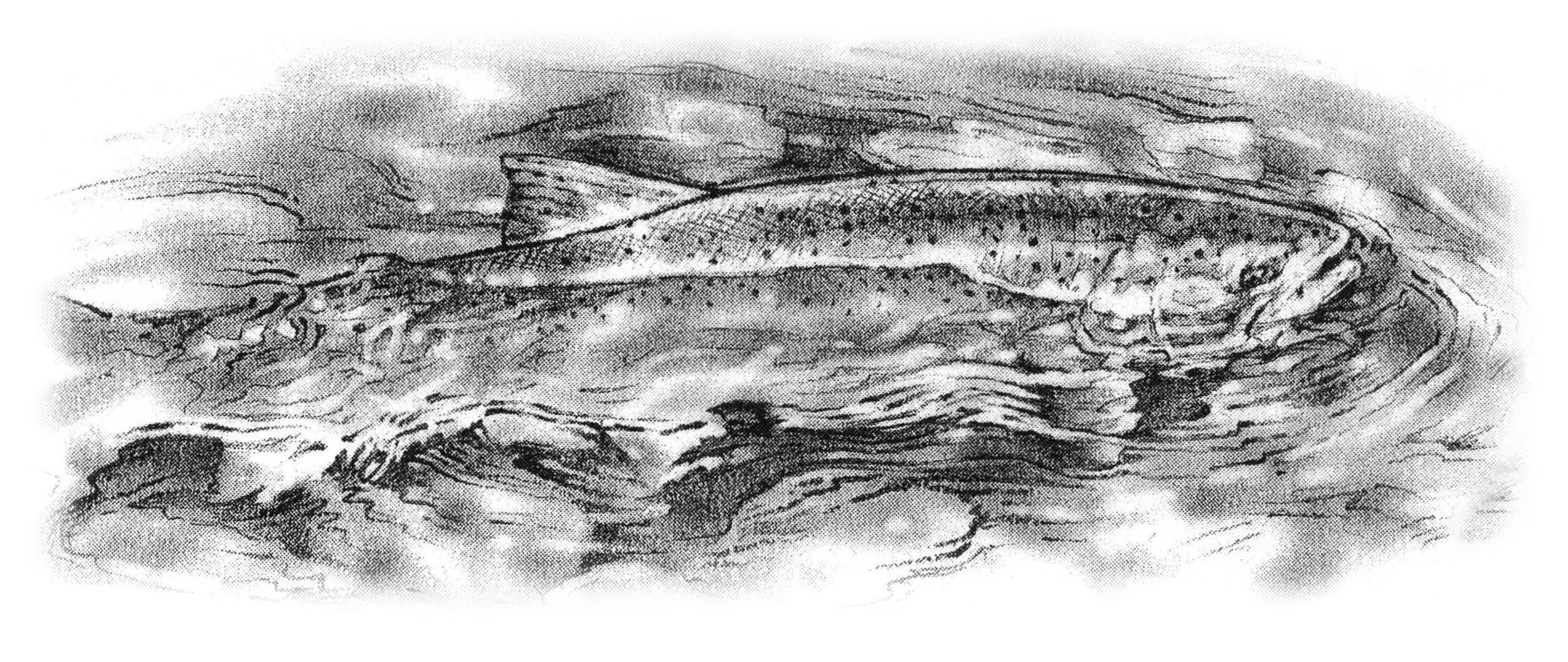
This is the complete chapter from Steelhead Fly Fishing, written by Trey Combs and originally published in 1991. It is presented here in its original form.
Steelhead do not give up their lives of wandering when they seek out a river to ascend. Waters foreign to their homing instincts can exercise a strong influence on their behavior. Each fall, thousands of Idaho steelhead travel as far as 100 miles up Oregon's Deschutes. Nicola River steelhead often winter over in the Thompson River, fifty miles above the confluence of the two rivers. When Washington's Toutle River was devastated by the explosion of Mount St. Helens, its steelhead still at sea adopted other rivers for spawning. Kalama and Washougal steelhead are known to pass up the fishways of the Columbia River's Bonneville and The Dalles dams to breathe in the smells of a dozen rivers before returning to their natal waters. By late September, steelhead hold in forty miles of the Methow River, but when snow fills the Methow Valley, they migrate downriver to pass back over Wells Dam and winter in the warmer Columbia.
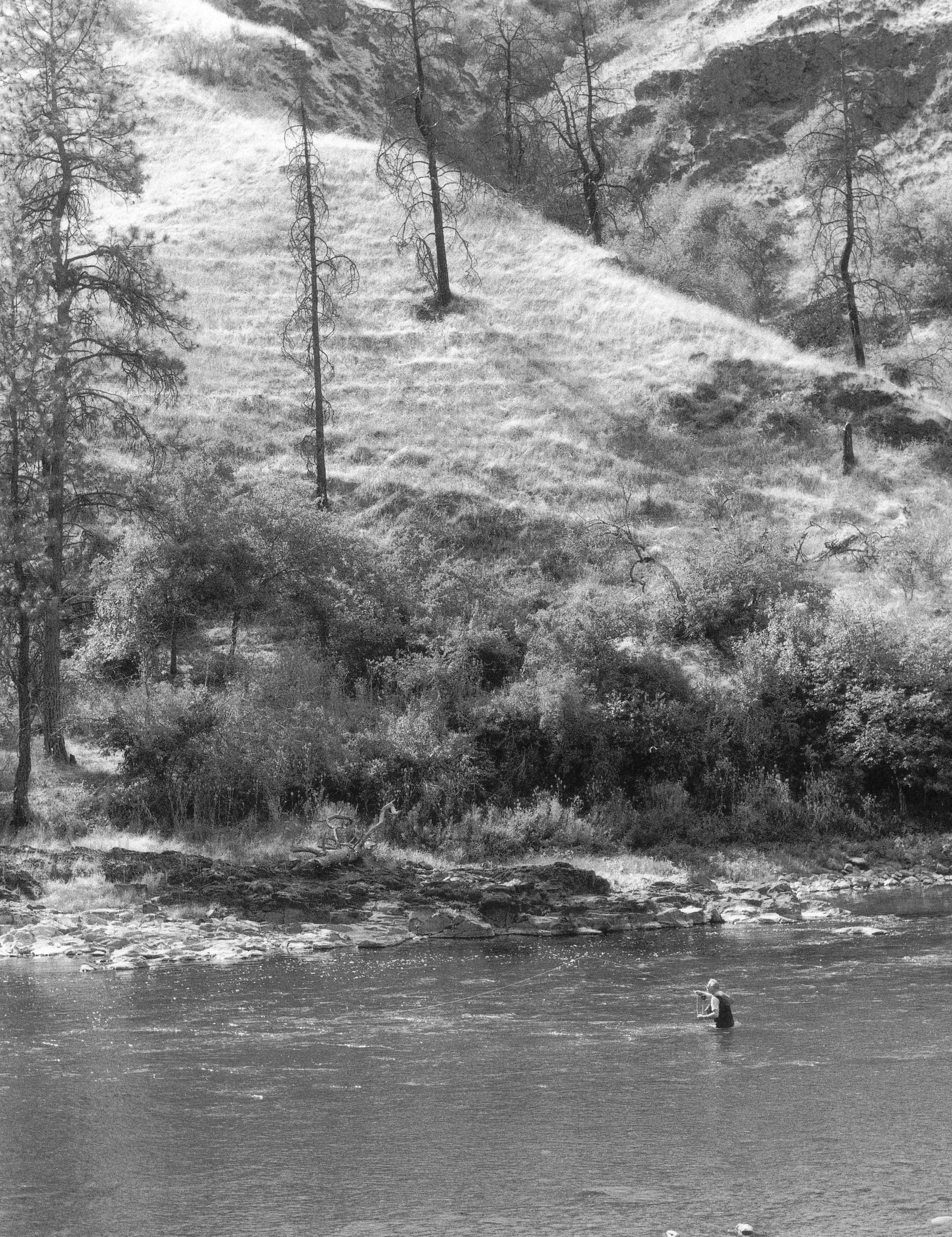
LeRoy Hyatt's line leads his rod to keep the dry-fly waking over the lie.
Pondering this, I ascribe the movements to water temperature, imperfect hatchery imprinting, and strong survival instincts. But outside my reasoned explanations is a fish that may travel downstream as well as upstream, or up tributary creeks and back, doing so with no apparent reason other than curiosity. That, however, does not obscure the overriding fact that steelhead finesse, rather than confront, their rivers, their route being the less strenuous travel lanes along the edges of the central currents, those "creases" that fly fishermen look for. They maintain their bearings by keeping in touch with the shore, resting along quiet beaches for a night, sometimes for days, before continuing on in the safety of summer's early morning and late evening shadows. Winter fish may hold until the sun has been directly on the water and warmed surface currents. The steelhead stop for weeks, and they stop for nothing, storming through miles of river and a dozen long pools in a single day. Loners at sea, they travel the rivers singly and they travel in pairs. They enter an estuary otherwise empty of steelhead and stop in pools filled with steelhead, a group of individuals passing for a school. When they break out of a pool and porpoise past, I stop fishing to watch them for the enjoyment they provide, no longer bothered by the lack of attention they give to my fly.
Rain, or the lack of it, can speed them on their journeys or delay their upstream movements. A river low and clear with every freestone pebble exposed to the unremitting glare of eighteen-hour days finds steelhead retreating to the cool safety of deep pools. Enough rain to raise the river, a touch of frost in the night air, and cold fog that lies heavy on the water can all energize steelhead and pull them into the oxygen-rich turbulence of shallow lies where greased-line flies will attract them.
When none of these conditions prevails, there is first light, those few minutes no longer night and not nearly day, when surface currents are at their coolest. Then, even under very low water conditions, steelhead ease out of deep water to move furtively into the thin riffles at the very top end of pools. At such times I have observed them in less than a foot of water with their noses literally beneath the froth. They are hair-trigger nervous, and to raise them to a fly requires a careful approach from well upstream.
Unfishable rivers, "out" with muddy water, do not discourage migrating steelhead. The fish slowly pick their way along whatever new shore is available, even when this takes them through stands of shoreline willows. A river remaining in this condition for days becomes choked with steelhead, a bonanza for fly fishermen when pools first drop and clear. The steelhead's instinct to move on is temporarily suppressed, but they are fresh, very in touch with their surroundings, and aggressive.
A river "going out" from rain, a river "coming in," clearing and dropping from the lack of rain and high-country snowmelt, is an afternoon last week or a morning next week, a few hours when steelhead are fresh fish that have never seen a fly. The most successful steelhead fly fishers I know live for these moments, bend their work schedules accordingly, and know where to find these fish.
Some pools are classic, accessible, and famous; others are difficult to reach, troublesome to fish, and known to a small brotherhood of anglers who cordially share their ways. These are the public and private waters of steelhead fly fishing, the pools introduced to beginners and those held in secret by experts.
Friends who share with me the tying recipes for their favorite flies or the formulas of their most exotic hybrid lines become vague when the subject of their holding water comes up. I try to be circumspect, for I don't want to give the appearance of panhandling for this information, and I don't expect it to be given. Their knowledge is too hard won, the result of years, and seasons, and many fishless days. If they are experts on the rivers they fish, it is not because they can cast farther or wade deeper, but because of their knowledge of holding water. They do not prospect. They go where they know steelhead were, and where they will be again. Their holding water is the reason they can average a winter steelhead a day on a fly. To give away this knowledge is tantamount to inviting the public to their private fishing hole, for as surely as there'll be a fish in the lie, there'll be a fisherman, a stranger who is your friend's friend. These strangers will ask, "How did you find out about this spot?"
A few years ago, on a float down a winter river, I drifted quietly around a bend and came upon two well-known Northwest fly fishermen spey-casting along a bank slot of holding water. I had passed this obscure piece of water many times, obviously failing to appreciate its potential, for I had never cared to fish it. It soon became evident the anglers had seen me first, for they were hotfooting through the woods long before I reached their water. I laughed at this before realizing I had come upon one of their secret pieces of holding water. Later that day, I visited the pair at their campsite, and we talked of many things, but this incident was not one of them. They knew I could act upon what I had seen, if I could make sense of the water and fish it properly, and that a day might come when they would have to share this pool with me. They would not begrudge me that opportunity, for I gained my knowledge fairly, and possibly this observant pair of fishermen happened upon this water in the same manner.
Because steelhead are given to frequent and sometimes erratic movements, finding them suggests a methodical approach. You start at the top end of a pool and systematically work through, making a cast, taking a half-step when the flow is turgid, a small step in winter, or two large steps in summer, and casting again. When the pool has been covered, you move to another pool and repeat the process. Custom and streamside also dictate this courtesy. Like golf, it's considered bad form to dawdle while others wait to get on with their sport. You take your turn, work through the pool, and get out. This is neither a good nor a terribly wrong way to fish a pool; it is often the only one possible, given what little is known of the water.
But steelhead do not distribute themselves in a pool—much less a river—in any orderly fashion. A beginner watching experts learns that the water being fished isn't being covered methodically. Parts of the pool are fished through rapidly, other parts quite carefully. Casts vary in length, flies are changed to achieve various sink rates, sink tips are changed to reach specific parts of the pool: the head; the edges of runs; the clearly defined gut, bucket, or honey hole that so often holds a steelhead; and the broad tailout. How do the steelhead pass through this particular pool? Where do they hold just before exiting the pool? How do they distribute themselves when they rest? The answers are far more complicated than we imagine.
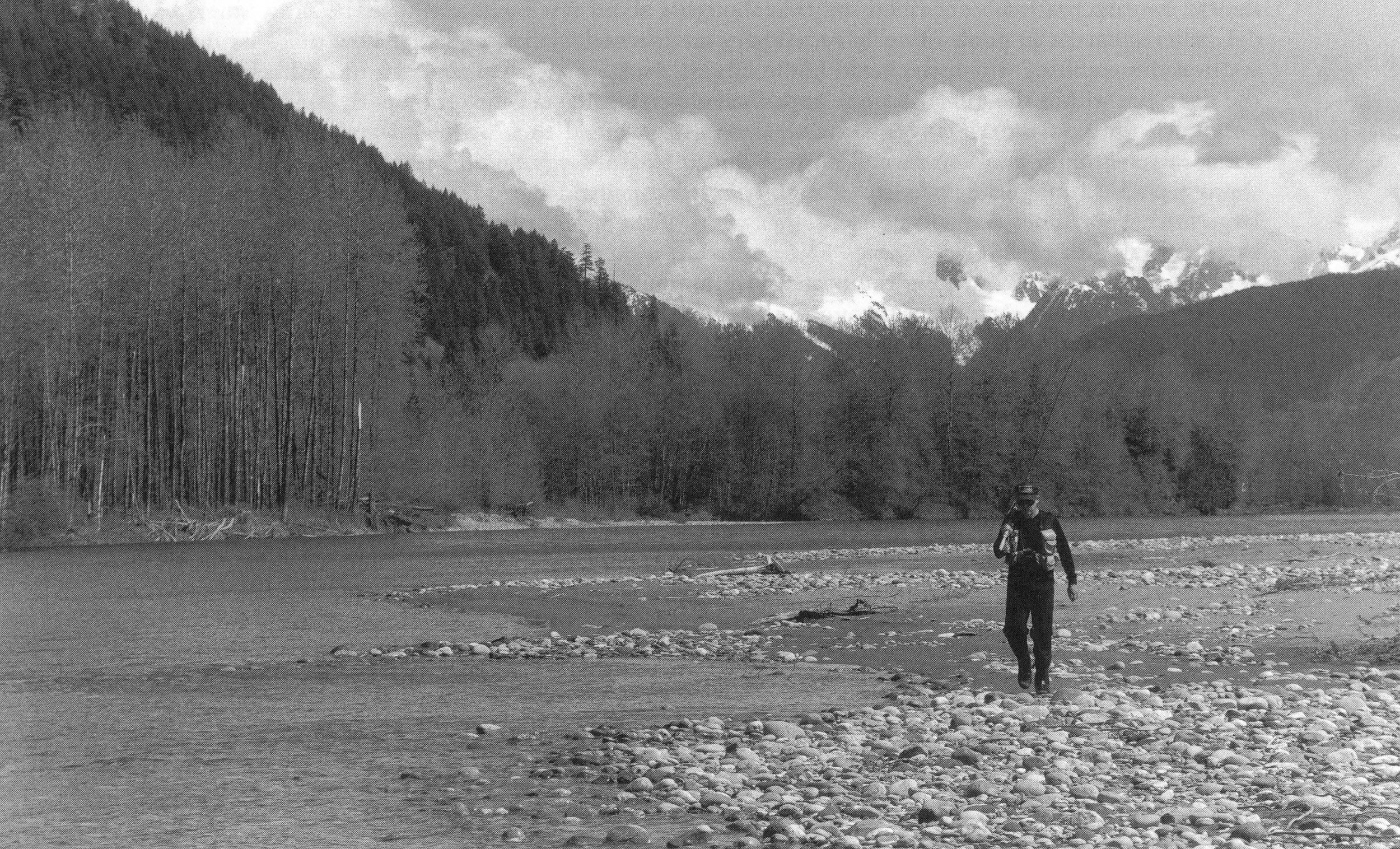
High water scallops the long gravel bar into small parcels of holding water. I walk along, stopping to fish the soft winter lies below each point.
Years ago, I realized that some lies typically harbored large male steelhead. Or that large steelhead were often found in lies that demanded the least exertion of them. If this were true, I wondered if some sort of pecking order existed, and if it did, whether size, or sex, or both, established it. I knew this sort of thing existed where chinook salmon and steelhead occupied the same pool, the salmon holding where they pleased, the steelhead warily holding below them. Whenever possible, I discussed this with steelhead guides, for they repeatedly fished the same water and presumably would note such a pattern. These discussions were interesting but often inconclusive, because the guides noted holding water on many pools, but they rarely bothered with any comparative analysis of what kind of steelhead came from the lies. That fact doesn't call into question their powers of observation. On some rivers the steelhead are essentially one size and one age group; aggressiveness, not size, may be the factor deciding which fish takes which lie. During very hot weather, when stream temperatures reach nearly seventy degrees, a large pool well upriver becomes a cool oasis for dozens of steelhead. They collect here to survive, and it would be nearly impossible to know, in such a confined area and unnatural setting, if there were any pattern to their distribution.
When I first fished for steelhead with Roland Holmberg, an Atlantic salmon guide on Norway's Gaula and Aa rivers, I brought up this line of speculation. We were camped on a Canadian river, and I wished to see if he found my views had application on the camp pool we would be fishing, or whether his experiences with Atlantic salmon would challenge my convictions. Roland didn't find me sophisticated in the least, something of a disappointment. He explained that in Norway, a guide is responsible for a short length of river, a beat that may be no more than 200 meters long. The fortunes of his clients often depend upon his understanding a single pool, for they do not have the luxury of moving on if they cannot find fish or are unable to get the salmon in view to take a fly. "Everything a salmon does means something," said Roland. "When a large salmon comes up and slaps the water with its tail, it isn't doing that for nothing. It's telling other salmon that this is his pool."
Do the largest salmon in the pool have a certain lie, one that ultimately is filled by another big salmon? Roland was certain of it, and he described how a cock fish will drive off smaller males that run the risk of being killed if they are not hasty in their retreat.
"Some seasons a pool will fish extremely well. Other seasons there are no salmon in the pool. When salmon come in the river, they won't stop in pools that are empty of salmon. Salmon trickle from a pool as others fill it, and in this manner the water holds salmon all season. But if the first salmon to enter the river passes up a certain pool, it may not hold fish for weeks, and it will be poor the whole season."
Much of Roland's guiding took place on pools close to the sea, the movements of these salmon doubtless more dramatic than if they had been filling the miles of holding water farther inland. Nevertheless, his observations confirmed my own thoughts about steelhead and their holding water.
I believe that large pools often have primary and secondary lies, and that how these lies are filled is often the result of which steelhead is the largest. Large male steelhead are more likely to take up the deep lies within the gut of a pool, and smaller hen steelhead more frequently hold at the top and bottom of the pool where currents are stronger. I explained this to Roland and described to him a memorable summer-run lie, a small narrow slot just off a large boulder that was a third of the way down a pool a full quarter of a mile long. The lie never held more than a single steelhead, always a large buck, sometimes twenty pounds. Other parts of the pool below this lie held many steelhead, but rarely a male fish of this size.
Roland and I fished our long camp pool several times each day, usually dividing the water between us and not following each other through. All this took one to two hours, rarely more, until rain discolored the river and reduced visibility to a foot. We rose approximately forty steelhead in five days and noted the size and sex of each fish whenever possible. After two days, we had searched all the nooks and crannies we could reach with our flies. Six major lies emerged. Just below the top end, a part I sometimes call the throat, the water was swift but with consistent hydraulics, and a fly fished well. Though this was a fairly large area, it was never good for more than a single fish, always a hen, and usually during morning light. We thought the bucks were exiting the pool in a different manner, probably along the far shore, which we could not reach. Farther down the pool were two nearly opposite lies, one off our shore and the other flat against the sheer rock wall of the opposite bank. Each of these gave up steelhead of both sexes, hens to fourteen pounds and bucks to perhaps twelve pounds except for a very hot sixteen-pound buck Roland took from against the opposite bank. Nearly halfway through the long pool, and dead in the middle of the river, was a narrow lie we discovered only because we caught steelhead there. The river possessed hardly any current, and nothing on the surface served to distinguish the lie from the acre of water around it. This small lie held only large bucks of sixteen to over twenty pounds. For a few days it was so dependable that I called it Hog Heaven and shook when my fly began the first swing through. Well below this lie, and just above the tailout, was a much larger, but equally soft, piece of water. Roland waded to his armpits and found only hen steelhead, ten pounds or so, and one evening he beached four. I rowed across the pool to fish the other side of the tailout. I knew that many steelhead were caught here, but now there were only spawning salmon, huge chinook so territorial that steelhead dare not take up the lie. Though I fair-hooked a twenty-pound male chinook, I didn't raise a single steelhead.
As the days passed, Roland and I could predict where the fish would take, conforming so completely to our expectations that we could "see" the steelhead in the pool. What emerged was not only a keen understanding of this holding water, but an appreciation of arrivals and departures, of fresh fish and residents of some weeks, and learning how each was determining our angling fortunes.
A pool so remarkably blessed is rare, but I find smaller pools no less challenging. Although the travel lanes may be narrower and the holding slots shorter, the dynamics are the same. Steelhead move in, pass through, and exit the pool, the more condensed nature of the water making it harder to read and, once read, placing a greater premium on proper placement of the fly.
Several years ago I watched a fly fisher take one or two winter steelhead a day from the very top end of a pool. He did this in an hour before going to work, hooking his fish after other anglers had pounded the pool with their flies. What made his success curious was his choice of water. Whenever possible, he fished the very top of the run—fast, relatively shallow currents. Halfway down the pool the river slowed for thirty feet before picking up speed again. Like most anglers, I was always anxious to work down and swing my fly through this gut; on a hundred trips through the pool, most of my steelhead had been hooked here.
One day I had the opportunity to stand at the head of the pool and watch closely as the angler began down with his spey rod. His casts were far shorter than mine, the small black marabou fly he fished coming under such light tension as to be nearly dead-drifted. I realized he had discovered how the steelhead were leaving the pool, and was sliding a fly right down this lane. Other anglers, myself included, overcast the water and entirely missed the lie. This was a mistake I wouldn't repeat. Two days later I hooked my first steelhead from the top end of the pool.
On this same water, well into the tailout, I saw a steelhead roll 100 feet from where I cast. After this happened several times, I reached the spot with my double-handed rod, and in a week I rose five steelhead. When a friend rowed me to the lie, I discovered a sizable ledge. Evidently steelhead would come up into the pool and for a time hang just off this ledge. I was delighted with my discovery and swore my friend to secrecy. "Private water on a public pool," I said, and wondered how many other secrets were mine to discover