This is the complete chapter from Steelhead Fly Fishing, written by Trey Combs and originally published in 1991. It is presented here in its original form.
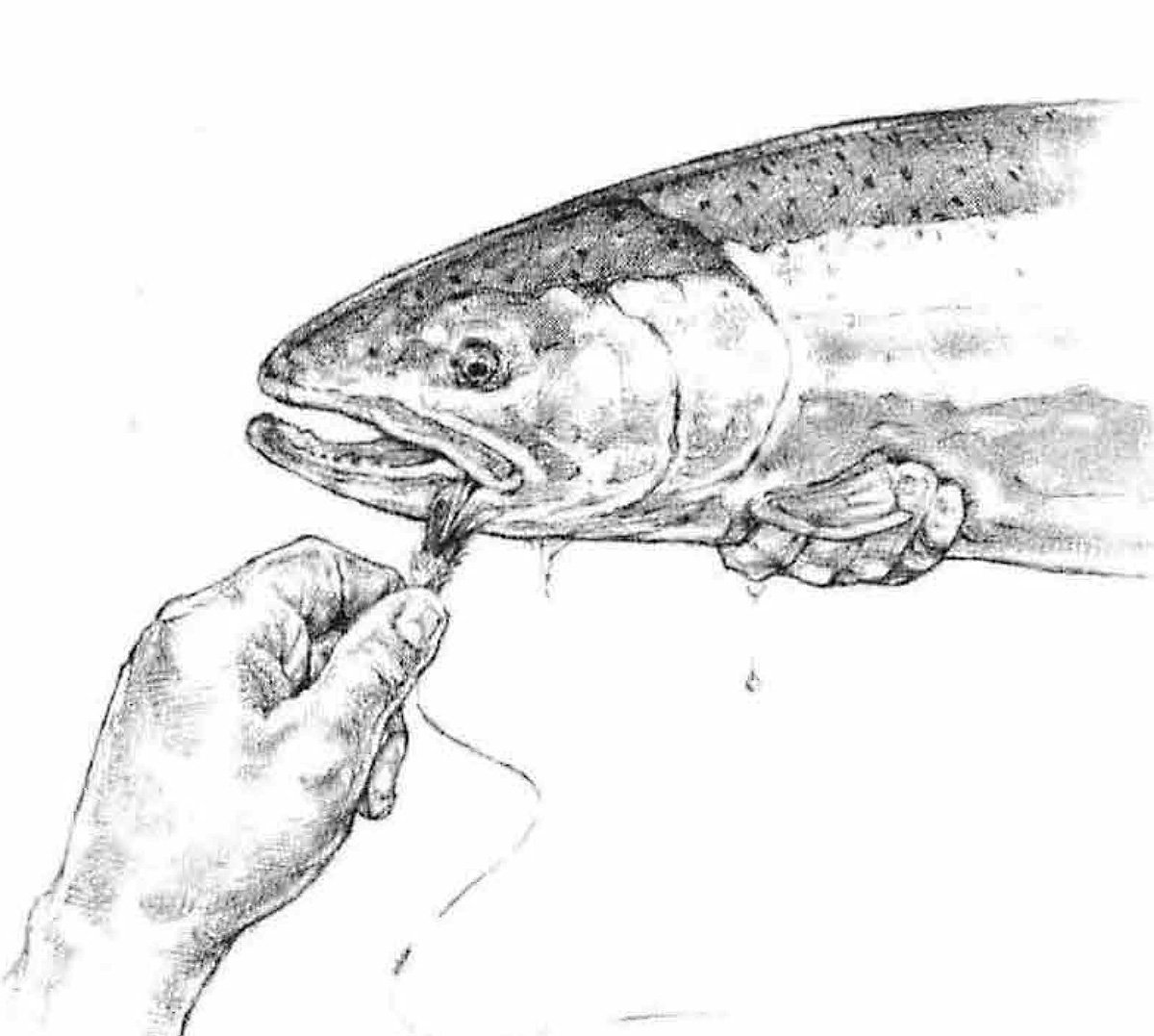
I hold the steelhead as firmly as I dare, a hand around the wrist of her tail, while my fingers, stiff with cold, free the Winter Orange of its hold. Thickly silvered gill plates rise and fall as she gasps and flushes the faint currents. Plainly, she is stressed, but shock does not cloud her brilliance. I judge that in a minute her recovery will be complete, and her focus will turn to escape. To restrain her then would be a threat to her survival. I must hurry about my business.
"Where have you been?" I ask, curiosity mixed with wonderment. What collaboration of instincts, what fusion of natural forces sends a hundred smolts to sea and returns to me this single adult? Beyond her own good fortune, what special traits for survival has she brought back for the next generation? Her ocean world is alien to me, and she carries few messages hinting of her past. But these have grown into the small understandings that fill me with admiration for her spirit and wandering ways—characteristics at the core of my romance with this gamefish, and why I am jubilant on this dreary winter day.
She is in magnificent condition. But what else? I spread my arms. A tape measure isn't necessary to know that they span at least twelve pounds. Hatchery steelhead have clipped adipose fins, but hers is pristine and documents her wild origins. Her robust size strongly suggests three years of ocean growth beginning with a first summer moving ever farther north and west from the coast of Washington and into the Gulf of Alaska. Late the following spring, she migrated north to the Aleutians and at least as far west as the Hawaiian Islands, 160° west longitude. But how much farther? Across the International Date Line, 180°? To the very shores of Russia's Kamchatka Peninsula, 165° east longitude? Other American steelhead have traveled this far. In 1983, at 42°51' north latitude, 167°32' east longitude, a Japanese research vessel caught a hatchery steelhead, in its second high seas summer, that had been reared at Dworshak, on Idaho's Clearwater River, and released as a smolt below Bonneville Dam.
The ocean cooled in the fall and drove my steelhead south, until by winter she was feeding hundreds of miles off the Oregon coast. She passed most of her third winter beyond the continental shelf before leaving the ocean for the Strait of Juan de Fuca and Puget Sound. Then, amid conflicting smells from dozens of rivers and Washington's industrial sweat, she found the Skykomish, the river of her birth.
Though she is now sixty miles from salt water, her fins still possess the clear translucence of an ocean steelhead. A slight blush to her silver-grey flanks and an opaque darkening to the ventral edge of her tail testify to advancing sexual maturity. For ten days during early March, almost no measurable rain has fallen, and the few warm days did not raise the river with snowmelt. I think she held in various downriver lies for several weeks, moving along a few miles each day, perhaps five miles on an overcast morning. I look closely at her mouth, and the slight tear from my fly is the only mark. I note a thin, barely perceptible scarring forward of her dorsal fin. I turn her over and find the line continuing on the other side. Taiwanese high seas squid net? Possibly. Ocean steelhead have been found in water ranging in temperature from 38°F to 60°F, but rarely do they frequent ocean currents warmer than 53°F—water too cold to support squid. In recent years there has been disturbing evidence that some squid fleets are not even targeting squid but are running north to pirate the far more valuable stocks of salmon and steelhead. What of the Japanese mother-ship salmon fishery? According to catch records compiled by the North Pacific Fisheries Commission, nine thousand North American steelhead perished in their nets in 1989. Tens of thousands were caught in Canadian seine nets and gill nets the same year. Alaska and Washington fishermen find steelhead in their nets, too, though the law prevents them from admitting that fact. Perhaps on her maiden spawning run, she escaped from one of the Tulalip Indian gill nets set at tidewater on the lower river, the Snohomish. A scale sample would tell if she had ever spawned before, but that would not necessarily explain this old wound. I know that she is an international traveler whose survival at sea becomes less certain each year.
The flank now turned to me reveals a pectoral fin slightly nubbed. A bite from an estuary sculpin when she was a smolt? A more recent attack from a seal? When I carefully turn her over, both pectoral fins row about for equilibrium, a sure sign that she is ready to be upright and on her way. Her eyes roll up, roll down, and look back at me. She remains docile, but she has collected herself. She seems to say, "Get on with it!" I have a few seconds left.
This steelhead and I met when she rose to my fly from a soft lie below me. She took my line and a hundred feet of backing to the far side of the river, jumped twice, and then turned downriver with the heavy currents that swept below the blackberry-covered bank. I panted along behind, letting her have her head, palming the reel only hard enough to prevent an overrun, and when she stopped I began moving her across the river with the two-handed rod. She came easily at first, but turned and moved well out into the river each time I tried to bring her into the shallows. When she could no longer maintain her balance, I eased her in until her flanks barely brushed the submerged gravel bar and then ran to her side while stripping line from the reel.
We met because she crossed thousands of ocean miles to negotiate this narrow corridor of freshwater currents. In four to six weeks she would spawn, but the odds of any three-year ocean steelhead returning to spawn a second time are remote. These few minutes become our first and only meeting, and I always find in that bittersweet fact the ultimate wildness of these remarkable creatures. Once you have caught a steelhead you can't go back to the river and say, "This is where my steelhead lives," for the fish of your memory may be ten miles upstream or thousands of miles offshore, near lands you'll never know. That she can live out her life in the ocean so tugs at my imagination that I could never consciously be an impediment to it. I turn her out into the river and open my hands. She swims off easily, holds for a moment to get her bearings, and then steadily blends with the stream bottom. I am still straining to make her out when I realize she is gone and the mystery of her whereabouts has been resumed.
To make polite conversation, acquaintances who know of my interest in steelhead fly fishing sometimes ask me, "What exactly is a steelhead?" To help them conceptualize the basic elements of the fish's life, I give a dishonest answer. I explain that a steelhead is a rainbow trout that goes to sea, but that it comes back to the river of its birth to spawn. This usually satisfies, because only a goldfish is better known to the public than a "rainbow trout". I have occasionally tried to be more truthful and said that a rainbow trout is actually a resident steelhead, but this explanation can't stand on its own. I must go on to explain that the steelhead is more or less marine, and that resident rainbows will not migrate to sea even if they have the access to do so. They are the same species, but different forms of that same species. I cite examples until my listener can no longer make sense of it.
Trying to "make sense of it," trying to group the earth's plants and animals by associated characteristics is a science called taxonomy, while the rules that decide what a life is to be named are embodied in the international code of zoological nomenclature. Each species of animal and plant known to science has a genus and species name, a system of binomial nomenclature always expressed in Latin. Humans, for example, are Homo sapiens.
When I was memorizing classification in college, kingdom to species, my biology professor explained that taxonomists could be divided into two groups, the "splitters," who found in the most insignificant differences reasons to name new species, and the "lumpers," who often supplanted several species names with a single name. A former species might become a subspecies, or be dropped altogether, and a subspecies might be elevated to species status. Because the discoverer of a new species could attach his own name as the species, and thus gain some degree of scientific immortality, no little professional jealousy attended the wars between the two groups.
When I began reading about trout and salmon, I realized that the late nineteenth century was the Golden Age of splitters, for a new species of trout was thought to inhabit nearly every major watershed and more than a few lakes. In David Starr Jordan and Barton Warren Evermann's American Food and Game Fishes (Doubleday, Page and Company, 1923), thirty-three species of trout are described under "The Trout of Western America". A few of these were remarkably esoteric. The "spotted trout of Lake Southerland," (Salmo jordani), the "salmon trout of Lake Southerland," (Salmo declivifrons), and the "speckled trout of Crescent Lake," (Salmo crescentis) are three examples from Lake Sutherland and Lake Crescent in Washington's Olympic Peninsula. I have caught all three "species." The "spotted trout" is a race of cutthroat, while the other two are rainbow trout, locally called blueback trout and Beardsley trout, and look very much like steelhead.
These three trout illustrate the confusion that resulted when numerous local names became part of the angler's lexicon. "Spotted," "speckled," "blueback," "brook," and "silver" were indiscriminately applied to several species of trout and char.
Insofar as the steelhead trout is concerned, the taxonomists were on shaky ground from the very beginning. Sir John Richardson described for science the first new species of trout in western North America. This discovery was based on a premigrant steelhead sent to him in 1833 by Dr. Gairdner, a physician with the Hudson's Bay Company at Fort Vancouver, on the Columbia River. When Richardson published Fauna Boreali Americana in 1836, he placed the trout in the genus Salmo and honored its discoverer by naming the species gairdneri, giving it the common name, Gairdner's salmon. In 1855, Dr. William P. Gibbons, founder of the California Academy of Sciences, identified a "new" species of trout, based on premigrant steelhead secured from San Leandro Creek. These trout were given the scientific name Salmo iridea (later irideus), literally "rainbow trout". Many other species of rainbow trout followed, most notably those trout of the Shasta River (Salmo shasta), and trout in the lakes tributary to the Fraser and upper Columbia rivers, the Kamloops trout (Salmo kamloops).
The lumpers soon weighed in against this proliferation of trout species. Early on, they understood that Dr. Gairdner and Dr. Gibbons had described the same species. One of the rules of nomenclature is the rule of priority, in which whoever adequately describes the species first will be granted the only scientifically valid name. Because Dr. Gairdner's discovery preceded Dr. Gibbons's by nineteen years, the steelhead became known as Salmo gairdneri.
The residential races of rainbow proved more troublesome. Because of their physical appearance and residential habits, they were easily separated from steelhead. Furthermore, many lived in reproductive isolation, not spawning with steelhead, even when the two fish occupied the same river. But the reduction of species generally increased the range of Salmo irideus, the rainbow trout, again because of the rule of priority. What began as a pecking away at less-than-earth-shattering discoveries of new species of trout and a cleaning up of obvious ambiguities, ended more than a generation ago with the elimination of all species of rainbow trout except one, Salmo gairdneri (some populations were granted subspecies status). Two common names survived and pretty much meant the same thing to fly fishermen. "Steelhead" referred to anadromous populations, and "rainbow" to resident populations, whether residing in lakes or streams. Anglers said they were fishing for Kamloops rainbows, Shasta rainbows, Deschutes redside rainbows, and so forth, and never strayed far from the scientific nomenclature.
Concurrently, stricter guidelines were applied to "species" of brown and cutthroat trout. The members of Salmo with full species citizenship suddenly decreased in number, most notably from the standpoint of North American anglers, the Atlantic salmon, and the brown, cutthroat, rainbow, and golden trout.
About this time, steelhead and salmon stocks from the Pacific Coast were successfully transplanted to rivers tributary to the Great Lakes. The forage-rich lakes became the fish's ocean, and their spawning runs up Michigan, New York, and Canadian rivers became heralded events. Anglers adopted West Coast steelheading customs and jargon with equal zeal. Suddenly, "steelhead" were everywhere. The question, "What is a steelhead?" now had different implications.
I have no experience with Great Lakes steelhead. I've caught lake-run rainbows from rivers tributary to Alaska's Lake Iliamna and from the waters of Chile's Lake District. To my eye, the trout were very similar to ocean steelhead. I have no quarrel with calling these, or any other lake-dwelling rainbow trout, steelhead. For me, a steelhead will always be a creature of the ocean that returns to its natal rivers to spawn. If "steelhead" is to be applied to steelhead stocks that have only a freshwater life history, then "land-locked steelhead" would, I feel, be more appropriate.
However its individual membership has been made known, Salmo was salmon and trout in sea-run and landlocked forms, Old World and New, gamefish and habitat of variety sufficient to satisfy every angling passion. It had given birth to a wealth of literature that grounded my fly fishing and civilized it with a measure of rules. Arthur Wood, George Kelson, Roderick Haig-Brown, and a hundred others are in my tackle, in the pattern I knot on, in the very tempo of my fishing. Without this tradition, my steelhead fly fishing would be little more than exercise without recreation, a sport without mystique.
My belief that we all worshipped at the same altar, Salmo, was knocked asunder in 1989, when I read an announcement by the American Fisheries Society's Committee on Names of Fishes. The trout species naturally indigenous to western North America and the northern Pacific Ocean drainages—the rainbow, cutthroat, golden, Apache, Mexican golden, and Gila—would no longer have the generic name of Salmo. Henceforth, these species would be classed as Oncorhynchus, the genera of Pacific salmon. The Atlantic salmon and brown trout remained Salmo. My steelhead, Salmo gairdneri, a name fixed in Northwest history, became the incomprehensible and largely unpronounceable Oncorhynchus mykiss.
I greeted this with disbelief and consternation. Pacific salmon died after spawning. The United States and British Columbia managed salmon as a food fish. A steelhead and an Atlantic salmon were closely related in literature. I saw them as cousins, a romantic notion doubtless imbued by the cross-pollination of fly dressings and methods of presentation invited by the two gamefish. My favorite resident trout, rainbow and brown, lived together in angling harmony in rivers far from their native origins. To link a golden trout with a chinook salmon seemed hopelessly misguided. Of course, none of this mattered to the taxonomists.
They based their decision on a more complete discovery and interpretation of fossil records. The common ancestor of today's trout and salmon lived some 20 million years ago. A major branching split this family into a North Atlantic population that led directly to the Atlantic salmon and the brown trout, and a Pacific population. The Pacific group split again about 10 million years ago, one group becoming western trout, the other Pacific salmon. Because taxonomists seek evolutionary relationships upon which to base their classifications, the decision to place western trout with Pacific salmon was logical. Other lines of comparative scientific investigation such as chromosome counts, DNA, and electrophoretic analysis of proteins support the findings of the paleoichthyologists. Outward habits and general appearance aside, the trout of western North America and eastern Russia have more physical characteristics in common with Pacific salmon than with Atlantic trout and salmon.
In 1792, Johann Walbaum described five species of North Pacific salmon, the Dolly Varden char, and the rainbow trout found in Russia's Kamchatka Peninsula. He named the rainbow Salmo mykiss, the species a transliteration of the Russian. Investigators have now clearly established that S. mykiss and S. gairdneri are identical. When the generic name was changed to Oncorhynchus, the species name mykiss was retained because it predated gairdneri and thus had priority.
If nothing else, the tempest in this nomenclatorial teapot has focused attention on the eastern coast of Russia's Kamchatka Peninsula, where steelhead are locally abundant from the Penzhina to the Bol'shaya rivers. (Steelhead are also known to ascend rivers on the west coast of the Kamchatka, south of the Ozernaya River, and a few continental rivers that enter the Okhotsk Sea.) I am not alone in hoping to visit the area and cast a fly to these Asian steelhead. The Russians know about their steelhead, though not as a gamefish. That is sure to change. Sophisticated studies contrast the physical differences of steelhead in the various watersheds. Steelhead are known to reach a length of at least ninety centimeters, or about thirty-five and a half inches. In the next decade, rivers such as the Kamchatka, the Yuka, and the Bol'shaya may become as well known as the Dean and the Babine, while the clan of steelhead fly fishers will include members who extol the virtues of the Purple Peril and Green-Butt Skunk with a Slavic accent. Thoughts of waking a "Bol'shaya Bomber" down a Kamchatka river makes Oncorhynchus seem much more fraternal and the loss of Salmo a little more palatable!
The steelhead of western North America ascend cold water rivers from Cook Inlet off Anchorage, Alaska, to the Big Sur coast south of San Francisco. Their range once extended south to rivers in Baja California del Norte. Loss of Mexican and southern California steelhead was due to the partial-to-complete loss of their spawning rivers to myriad urban and rural uses.
This range contains hundreds of rivers and thousands of spawning tributaries, the steelhead dividing into two seasonal populations. The summer-run return from March until November and do not spawn until the following winter, while the more common winter-run steelhead ascend rivers from November and December, when they are still quite immature sexually, to April and May, when they are ready to spawn almost immediately. An overlap of the two seasonal races on the same river is uncommon, but does occur. An example is Washington's North Fork of the Stillaguamish, where each May a few fresh winter steelhead join a strong run of summer fish with Skamania hatchery origins. The majority of rivers have only summer-run or only winter-run, but many have both, while a very few rivers, such as Washington's Kalama and Oregon's Siletz, have fresh steelhead ascending every month of the year.
In California, newly hatched steelhead fry remain stream residents for at least a year, sometimes two years. In the northern reaches of the steelhead's spawning range, the rivers are colder and less fertile, and growth rates are slower. Young steelhead, the parr, typically occupy a stream for three, four, and even five years before smolting and migrating to sea.
Adult steelhead remain at sea for one to five years before returning to the rivers of their birth to spawn for the first time. The exception is the so-called half-pounders of northern California and southern Oregon that smolt in the spring, migrate to sea, and return that fall—but not to spawn. On successive spawning migrations to their rivers, these little steelhead will have remained at sea for only a few months. They are more nearly residential than any other steelhead and contrast sharply with Washington's spring-run winter steelhead, which are almost entirely marine.
Where steelhead go while at sea has been the subject of increasing concern by state and federal agencies, the little information available compiled by the International North Pacific Fisheries Commission for member nations: Japan, the United States, Canada, and the Soviet Union.
Kate Meyers is the Project Leader of the High Seas Salmon Study that was funded by the National Marine Fisheries Service. Two published studies have resulted from this research: High Seas Distribution of North American Steelhead as Evidenced by Recoveries of Marked or Tagged Fish, Jeffrey T. Light, Susan Fowler, and Michael L. Dahlberg, September, 1988; and Ocean Distribution and Migration of Steelhead, Jeffrey T. Light, Colin K. Harris, and Robert L. Burgner, September, 1989. These studies had been submitted to the International North Pacific Fisheries Commission when I spoke with Kate Meyers in July, 1990. Information gathered on the distribution of steelhead stocks on the high seas was based on the recovery of coded plastic tags from steelhead tagged on the high seas and later caught in inland waters, and from smolts fin-clipped or carrying a microscopic coded wire tag in their heads. Investigators determined that U.S. and Canadian steelhead stocks mix as far west as 165° east longitude, waters on the Soviet doorstep. No steelhead tagged on the high seas were recovered in a Kamchatka River. No conclusions were drawn from this information, but investigators thought that Asian steelhead may not be so wide-ranging as their North American counterparts. Neither have high seas research vessels recovered any steelhead known to possess a half-pounder cycle. Kate Meyers felt that in North America, these steelhead must remain on continental shelf waters during those few months they are marine fish. At least, three months is inadequate for them to enter into the north-south, east-west migratory cycle that would take them to the Aleutians and back to the coasts of California and Oregon. Even less is known of the Asian half-pounder. It is now thought that their ocean migration is localized, very much on the order of sea-run cutthroat, and probably similar to American half-pounders. I asked Meyers whether she had noted any separation of migratory habits based on watershed origins. Specifically, do the huge steelhead of the Skeena watershed migrate to a particular forage-rich part of the ocean that promotes rapid growth? She thought not. "We have looked at it from all sorts of angles, and there just seems to be a general mixing from all rivers".
Over the millennia, rivers generate environmental stresses sufficiently severe to produce "races" or populations of steelhead with physical characteristics easily as contrasting as the many resident races of rainbow trout. Whether this process of natural selection is ongoing or reflects conditions that existed long ago remains, of course, speculation. But anyone who has looked into the Fraser River canyon or the great falls on the lower Dean knows why the steelhead that ascend these barriers are so extraordinarily strong.
Most physical characteristics are less celebrated but equally sublime. Klamath half-pounders number in the tens of thousands and may be little more than a foot long. A few miles north, steelhead of twenty pounds are caught each season in the Smith. Kispiox steelhead are famous for their mass and weight; males average nearly twenty pounds. Morice River steelhead occupy the same watershed and are quite average in size. Oregon's Rogue steelhead spend most of their lives migrating up and down the river. Some of Washington's Skagit steelhead are gone for five years before returning to spawn but once. Winter steelhead ascending in late spring may immediately spawn just above tidewater. Salmon River steelhead migrate over eight dams and through great mountain ranges, climb six thousand feet, and travel nine hundred miles to reach their Idaho spawning grounds, an odyssey that takes months.
Thus the question, "What is a steelhead?" has many answers. A taxonomist would answer one way, a fishery biologist another. To a fly fisherman, the answer would reflect a certain time of year on a favorite river with a race of steelhead that for reasons of personal prejudice are presented a fly in a specific manner. As often as not, the dressing will be unique, a creation divined by the angler himself, and when a steelhead rises to the offering, the fly takes on a life and a reputation. This is such a spiritual bonding that a river's steelhead cannot long be discussed without describing the fly that attracted them.
I have fished for steelhead on the Navarro, a valley cathedral in the California redwoods, and picked out my lies through blazing shafts of light. I have cast my flies into the gloom of an early morning rain forest deep in the Olympic Peninsula. I have seen steelhead race for my low-water Night Dancer on Oregon's Deschutes when the desert shimmered in hundred-degree heat and the water temperature was 68°F. I have taken comfort in my neoprenes during a Skykomish winter when ice rimed the shore, the water temperature dipped to 37°F, and a steelhead came hard to my Admiral Spey. I have flown into the Dean and the Sustut by helicopter and fought great Thompson steelhead just below the exhaust level of passing cars and trucks. I have reached favorite pools by bush plane, rubber raft, jet boat, McKenzie boat, and on foot. My companions have been bighorn sheep, black and grizzly bears, moose, elk, and deer. I've shared many pools with osprey and eagles. I tell friends that I've never seen a steelhead river that wasn't beautiful, and I've never seen two that were alike. I make the same claim for their steelhead, and take pains to appreciate the distinctions and share my understandings.
My friends may see steelhead differently. Some are dry-fly specialists who refuse any other approach. A few will not fish a fly with a hook beyond a certain size. Others refuse to deal with any fly line that does not float. An increasing number of friends only fish two-handed rods. Seeing who can fish the shortest sink tip in the winter is a game that appeals to some. Trying to fish the smallest possible fly—and usually a dry at that—commands the attention of a handful of anglers. I have friends who will not fish tippets above a certain fine diameter. Other friends successfully fish little spring creek rods, but disdain light tippets. A half-dozen friends communicate in hushed tones about the glories of their cane rods, and they will tell you that steelhead deserve nothing less. They are related to steelheading's master tyers, who present extraordinarily crafted flies to steelhead, their fishing but a fine excuse to tie.
I do not argue with the opinions and methods of these fly fishers, because they do not necessarily represent something better so much as something different. When they make a rule for themselves and raise a steelhead because of it or in spite of it, I want them to settle in with the pleasure. I like to hear about the joy of their fishing life, not about the rightness of their discoveries.
Among the hundreds of steelhead rivers, a few are famous as fly-fishing rivers. Rarely is an entire river suitable for the fly. The riffles and glides we most cherish are usually but a few miles in length and often below a major spawning tributary. Most are summer rivers. More each year are winter rivers. Many depend upon hatchery steelhead to maintain their angling reputations. Too many have endured a century of heedless exploitation.
My friends, who see steelhead in so many different ways, join together for the right to continue to do so. They are the court cases and public hearings, the fight against streamside clear-cuts, erosion into spawning beds, upcountry dewatering, and the insidious nature of mining tailings. They are the ad hoc organizations, the "friends of" a river with a dam that shouldn't be relicensed, a fishway that doesn't function, or an irrigation canal that hasn't been screened. They are Oregon Trout, Cal Trout, and Washington Trout. They are Trout Unlimited, the Federation of Fly Fishers, the Association of Northwest Steelheaders, and The Steelhead Society of British Columbia. They are a Bill McMillan who works to save the few remaining native steelhead in the Washougal, a Frank Amato who has the lower Deschutes set aside for the public good, an Alec Jackson who works tirelessly so that one day we will see the North Fork of the Stillaguamish again fill with Deer Creek steelhead, an Olga Walker, Gary Miltenberger and a Bob Clay who become outspoken critics of British Columbia's commercial fishing industry and its devastating impact on steelhead stocks.
These fly fishers, and hundreds like them, create the stories of the great rivers and their steelhead.
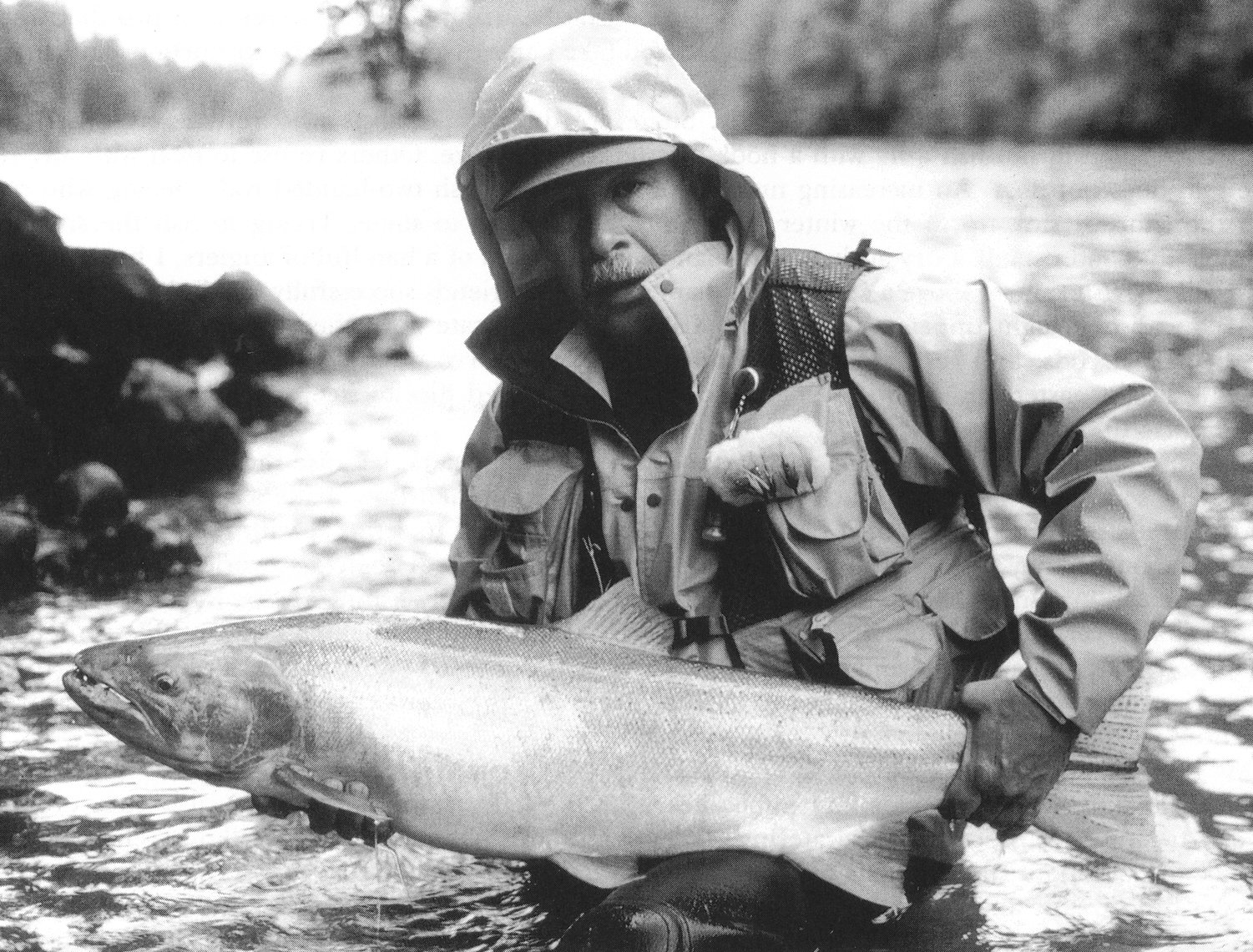
This summer-run buck rose to a spey-fly I presented with a two-handed rod and custom sink-tip line.