The Fly Dresser: Satoshi Yamamoto
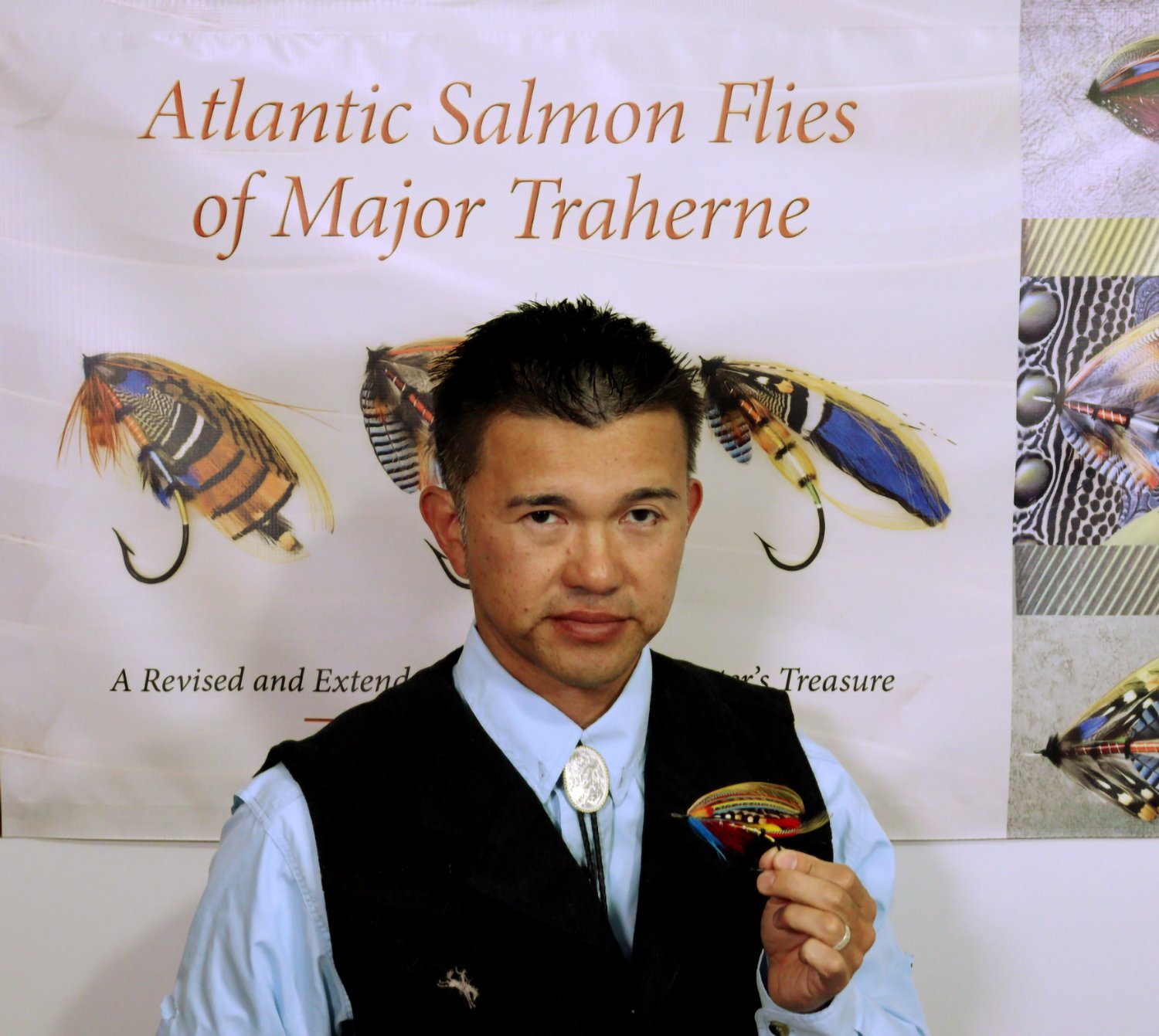
This is the second installment in The Fly Dresser, an ongoing series profiling the people behind some of the finest flies in the Trey Combs Fly Pattern Dictionary. Desktop only: Right-click any image in this essay to open it in a new tab to view the high-resolution version. This feature is not available on mobile.
You’re on the Late Freight
As I’ve been building the Trey Combs Fly Pattern Dictionary, I find myself following a path remarkably similar to the one my father traveled during the 1970s. Trey was constantly searching for influential fly dressers whose work deserved to be described and photographed. Nearly fifty years later, I have been doing much the same thing, although the search now often begins online.
That was how I came across the flies of Satoshi Yamamoto.
I was so impressed by what I found that I immediately emailed several images from Satoshi’s Instagram profile to my father. Trey usually replies to my emails with a sentence or two, but this time the phone rang almost immediately.
I was expecting a little praise for discovering such an extraordinary fly dresser. Even at eighty-six, however, very little gets past Trey.
“You’re on the late freight,” he told me.
Trey already knew Satoshi’s work. In 2022, publisher Tom Pero asked Satoshi to create the framed presentation offered with the limited edition of Trey’s book, Flies for Atlantic Salmon & Steelhead. Each set held ten flies dressed by some of the finest salmon and steelhead fly dressers in the world, with a custom fly dressed by Will Bush as the centerpiece. Tom contacted Satoshi because of his skill in designing and assembling framed fly presentations, and Satoshi created the museum-quality display that held the flies. The edition was limited to ten framed sets, offered through the publisher’s website for $5,000 each.
As I am currently putting a kid through college, there was never any discussion between Trey and me about buying one. This was the high-rent district, a ZIP code beyond my means.
So much for my discovery.
Trey laughed, but he confirmed that I had found someone whose work belonged in the Fly Pattern Dictionary. I continued looking through Satoshi’s flies, expecting primarily to find material for individual pattern entries. Instead, I discovered a much larger story that made it obvious he belonged in our Fly Dresser series, which began with Will Bush.
The first impression I got while going through his website, Lefty Angler & Flies, was of a tireless Montana guide with a genuine love for trout fishing. There are pages devoted to the Livingston spring creeks, guided trips, custom flies, and the books he has published. The longer I explored the site, however, the more his other talents began to emerge.
Behind the guide service was a researcher. Behind the trout flies was a designer who had spent years studying insects, trout behavior, and the individual stages of a hatch. Behind the classic salmon flies was a student of nineteenth-century fly-dressing literature who wanted to understand not only how the old patterns were tied, but why their creators had constructed them in a particular way.
Satoshi’s work now extends across many parts of fly fishing. He is a professional guide, fly designer, author, historian, and internationally recognized dresser of classic Atlantic salmon flies. He has written books about the insects and patterns of the Livingston spring creeks, reconstructed flies associated with George M. Kelson and Major John Popkin Traherne, and created framed presentations for private clients that combine fly-fishing history with his skill as both a fly dresser and designer of framed fly presentations.
Very few people become accomplished in even one of those areas. Satoshi has moved comfortably among all of them.
When he sent me five photographs to include with this profile, the images reflected the unusual range of his work. One was a recent portrait, taken for this article and for the international fly-fishing fairs he attends. Another showed a Pale Morning Dun variation of George Marryat’s Spent Gnat, dressed for the cover of Satoshi’s book about the Livingston spring creeks. Two photographs featured classic Atlantic salmon flies: the Shannon, shown in two sizes, and Satoshi’s 2025 interpretation of an unnamed nineteenth-century pattern. The final image showed a special framed presentation created to accompany his book about Major Traherne.
Personally, I cannot wait to add one of Satoshi’s framed flies to my own collection.
From Tokyo to Montana
There are easier ways to become a Montana fly-fishing guide than starting in Tokyo.
Satoshi Yamamoto grew up in Japan and came to the United States in 2000 to attend Montana State University in Bozeman. He was not chasing a guiding job or trying to break into the fly-fishing business. He came to study animal science and complete graduate work. As a former graduate student myself, I understand how hard it is to finish a graduate degree, let alone do it in another country.
That part of his story caught my attention. It would be easy to look at his life today and assume he arrived in Montana with a plan: guide the famous rivers, build a fly-tying business, write books, and eventually become known around the world for dressing classic Atlantic salmon flies. That was not the case. The fly-fishing career came later.
First came graduate school.
I have a Ph.D., so I understand the grind. Graduate work can beat you up even when you are studying in your own country, speaking your first language, and already familiar with the academic system. Satoshi was doing it after moving halfway around the world. He had to adjust to a new language, a different culture, and a place that could hardly have been more different from Tokyo.
Montana was not entirely unfamiliar to him; he had long been interested in ranching and the American West, and animal science gave him a reason to be there. After his university work, he was involved in the cattle-breeding field before fly fishing became his full-time profession.
Still, the move from Tokyo to Bozeman was a major jump. One is among the largest cities in the world. The other sits in wide-open ranch country, surrounded by mountains and some of the most famous trout water in North America.
The Madison, Gallatin, Jefferson, and Yellowstone rivers were all nearby, along with Yellowstone National Park and the spring creeks of Paradise Valley. But during graduate school, they remained out of reach in a practical sense. Satoshi had neither the time nor the money for fly fishing.
Montana also fit the way he learned. Satoshi did not appear interested in quick answers or shortcuts. He watched, read, tested ideas, and put in the time. That approach probably came naturally from his academic background, but it would become even more obvious once he began fishing the Livingston spring creeks.
Before that happened, however, there was the Montana image that pulled an entire generation of anglers west, including my family.
A River Runs Through It
When Satoshi is asked why he came to Montana, he gives a simple answer: “I always wanted to be a cowboy.” The fuller answer begins with the animal science program at Montana State University. Satoshi also knew that A River Runs Through It had been filmed in the Bozeman area before he arrived in 2000. He was interested in Montana and the American West, but he had come to earn his graduate degree.
I have always loved Montana and the movie as well. For much of my life, my family owned the historic Diamond J Ranch near Ennis. The 160-acre guest ranch was established in 1929 and operated by three generations of the Combs family from 1959 until it was sold in 2024. I visited often as a kid, so Montana was familiar territory long before the film reached the screen. There is an early scene—the first time Brad Pitt is shown fly fishing—that reminds me of the first time I watched Trey fly fish. I was young, but I remember being so proud of him—I knew that he was doing something special.
But Satoshi’s experience in Montana was less cinematic. He continued working on his English, wrote his master’s thesis, and graduated in December 2002. Money was tight, and he could not afford hobbies. He was living near some of the most famous trout water in the country, but fly fishing had to be put on hold. Graduate school had first call.
After graduation, he took a short ranch job in northeastern Montana and later worked in cattle breeding in Nevada, California, and Washington. It was not until he settled in Prosser, Washington, that he finally had enough time and money to begin fly fishing again. He fished eastern Washington streams, resumed tying his own flies, and eventually began thinking about the Montana trout fishing he had missed while attending graduate school.
In September 2007, he returned to Montana, hired a guide in West Yellowstone, and caught the brown trout he had been dreaming about. Over the next several years, he made repeated trips to West Yellowstone and Livingston, fishing the Madison, Yellowstone, Firehole, and Gibbon rivers, along with DePuy’s, Armstrong’s, and Nelson’s spring creeks.
Once Satoshi resumed fishing and began making trips back to Montana, he again started tying his own trout flies. Before trips to Yellowstone National Park or the Madison River, he liked stopping at Blue Ribbon Flies in West Yellowstone. He would make a list of the materials he needed, visit the shop, and stock up for the patterns he planned to fish.
At that point, the flies were tools. They needed to imitate insects, float or sink properly, and catch trout. He was not yet trying to rebuild Victorian salmon flies from old books or produce something that would end up behind glass. He was tying for the next fishing trip.
That practical beginning matters because Satoshi never lost it. Even after he moved into the highly technical world of classic salmon flies, he remained a working guide and trout angler. He understood that a fly can look great in a photograph and still be useless once it hits the water.
So it was Montana’s fishing that eventually gave him a reason to return for good. In 2010, he left the cattle industry and moved to Livingston without a job. He had some savings, a few ideas, and enough confidence in his fishing to consider becoming a guide.
The Spring Creek Classroom
Satoshi did not move to Livingston and immediately begin guiding the spring creeks. During the winter of 2011–2012, he bought a winter pass at DePuy Spring Creek and treated the place like a classroom. He fished it from top to bottom, learning the individual runs, the different types of water, and which methods worked in each section. He was not just returning to the same productive hole and pounding on the same fish. He wanted to understand the entire creek. Over five winters, he made more than 300 outings.
The Livingston spring creeks are not forgiving water. The trout see plenty of anglers, the currents can be difficult to read, and the fish often have enough time to inspect a fly before making a decision. A pattern that is close may not be close enough. The wrong size, stage, position in the water, or amount of drag can end the discussion quickly.
Satoshi responded by paying attention to details. He collected insects from the creeks, examined the stomach contents of trout, and compared what he found with the flies he was tying. He studied not only the major hatches, but the individual stages of those hatches and the way trout responded to them.
Then he went back to the vise.
The core patterns grew from insects he had collected, prototypes he tied, and repeated testing on the water.
That approach became the foundation of his guiding. By the time Satoshi began taking clients onto the spring creeks, he knew far more than where a few good trout usually held. He understood the water, the hatches, and the small adjustments that can turn a frustrating day into a successful one.
There is no shortcut to that kind of knowledge. You cannot buy it at a fly shop, pick it up during a weekend clinic, or claim it because you printed “guide” on a business card. Satoshi earned it one winter day at a time.
By 2013, he had developed a large group of patterns for the Livingston spring creeks, Yellowstone National Park, and the other waters he fished and guided. He had solved many of the problems that first drew him deeper into fly design.
Then he hit a wall.
Reaching the Wall
By the spring of 2013, Satoshi had developed a strong collection of patterns for the Livingston spring creeks, Yellowstone National Park, and the other waters he fished and guided. He continued adding flies, but the foundation of his trout-fly system was already in place.
That accomplishment created an unexpected problem.
Satoshi felt that he had reached a wall, both creatively and technically. He had spent years studying trout, insects, and the different stages of a hatch. He had collected samples, tied prototypes, tested them on the water, and refined the patterns until they did what he needed them to do. He had not learned everything about trout fishing—nobody ever does—but he was no longer sure where his tying should go next.
Then three things happened during the spring and summer of 2013.
First, he read an article in Fly Tyer about classic Atlantic salmon flies. These were nothing like the practical trout patterns he had been tying for the spring creeks. They involved married wings, complicated bodies, difficult materials, and proportions that left very little room for error.
Around the same time, a sporting-goods store was clearing out fly-tying materials. Satoshi bought some of the feathers and supplies used for salmon flies, even though he did not yet know exactly what he would do with them. Most fly dressers will understand this part of the story. Sometimes the materials come first, and the explanation follows later.
The third event was the most important: he met Marvin Nolte.
Nolte was already a highly respected dresser of classic Atlantic salmon flies. Satoshi recognized that learning this style would require more than watching a few videos and taking a run at the patterns on his own. He asked Marvin to teach him.
In the fall of 2013, Satoshi began dressing classic salmon flies.
The timing was right. Trout flies had taught him observation, proportion, and the value of testing every detail. Classic salmon flies would demand those same qualities, but at a much higher level. A poorly shaped head, an uneven body, or a wing set at the wrong angle could spoil the entire fly.
Satoshi had reached the wall with trout flies. Classic salmon flies gave him an exciting new path to explore. Fly tyers and fly-fishing historians like myself understand the pull—the beauty of Victorian flies is hard to resist.
Learning from Marvin Nolte
Marvin did more than show Satoshi where to place the materials. Classic salmon flies may look decorative, but the best examples are carefully built. Many people who don’t know the history see a Victorian salmon fly and think of it only as an art object—a pretty fly. But flies like the Jock Scott and Green Highlander, while spectacular to look at, were sold for decades in Hardy catalogs for nearly 100 years. They clearly fished extremely well. So fishing utility transcends beauty.
A body can be technically correct and still look wrong. A married wing can contain all the proper colors and still refuse to sit correctly. The topping can overpower the wing. A few extra turns of thread can create a problem that follows the tyer all the way to the eye.
There is nowhere to hide.
That was probably part of the attraction for Satoshi. Dressing trout flies had already given him the experience to notice small differences in size, shape, and position. Classic salmon flies gave him an entirely new set of materials and problems, along with nearly two centuries of fly-fishing history to explore.
Marvin gave him a credible place to begin. That remains central to the advice Satoshi gives anyone interested in learning classic salmon flies: find a mentor whose work deserves respect.
That sounds obvious, but the internet has made everyone with a vise and a camera an instructor. Confidence, followers, and a long video do not necessarily mean someone knows what they are doing.
There is plenty of excellent fly-tying instruction online. Some of it will also send you down the wrong bank.
Satoshi had found the right teacher.
Books Before the Internet
When I asked Satoshi what advice he would give someone who wanted to learn classic salmon flies, his answer began with books.
Not Instagram. Not forums. Not short videos promising an easy way to dress a difficult fly.
Books.
He recommends beginning with the historic works of George M. Kelson, T. E. Pryce-Tannatt, and J. H. Hale. For modern instruction, he points to Michael Radencich and Terry Griffiths. As a fly-pattern historian myself, I agree. However, once you begin to dress flies, I believe a book like Hardy’s Salmon Flies: Patterns from the Fly Tying Department 1883–1969 is the gold standard. Kelson and Pryce-Tannatt provide illustrated plates of finished flies. By contrast, the Hardy book contains more than 800 color photographs of actual flies associated with the Hardy fly-tying department and documents more than 1,000 dressings. Hardy relied on apprenticeships, pattern boxes, and shop notes to maintain a consistent standard.
So the old books are not always easy. Satoshi confirms this. Dressing instructions can be short, terminology changes from one author to another, and the writer may assume the reader already understands techniques that are rarely practiced today. Different authors also give different dressings for the same fly.
That is part of the fun. It’s arcane, but something that fascinates me as well.
The books force a fly tyer to slow down, compare sources, and make decisions. What did the author mean? Which version came first? Was the wing married, mixed, or built in strips? Is the later dressing really the same fly, or did another tyer take a few liberties?
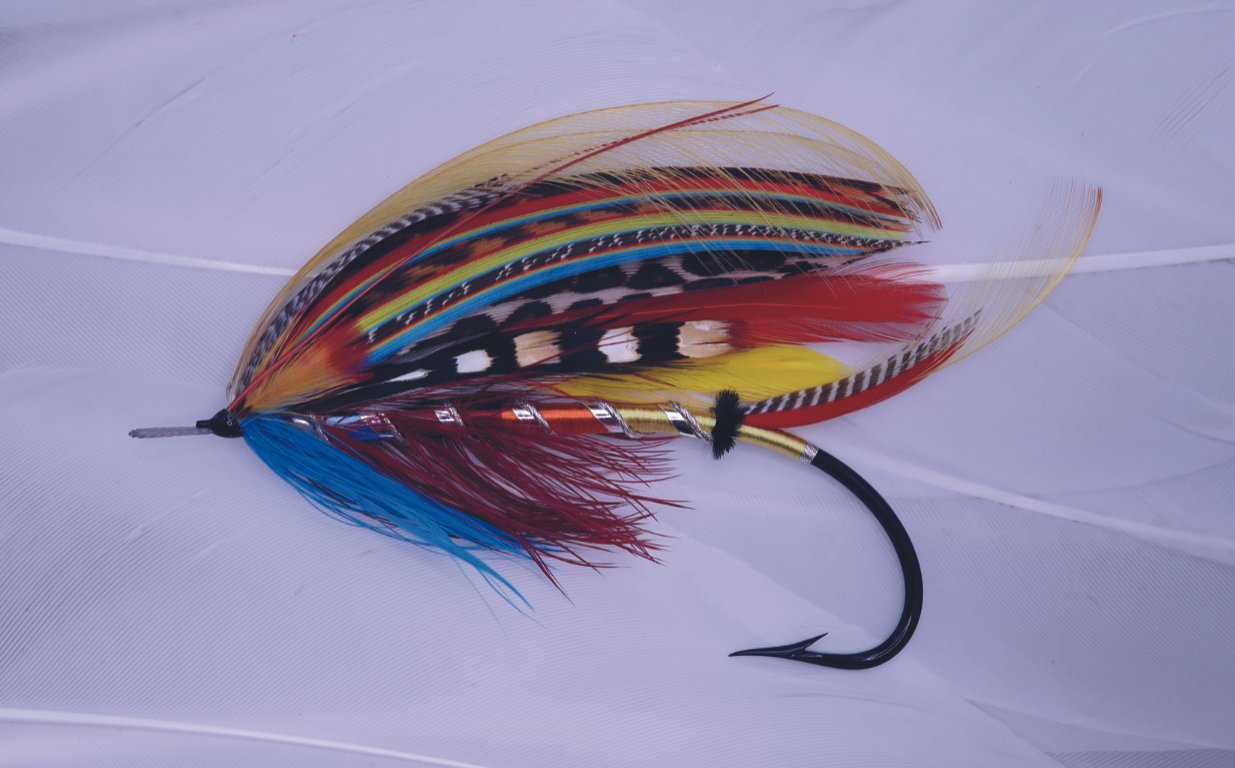
An Unnamed Fly Pattern from the 19th Century introduced by Albert Cohen in Judith Dunham's Atlantic Salmon Flies - Tyers and Their Art (1991). This is Satoshi’s 2025 version.
This is where fly tying starts to cross into fly-fishing history.
Satoshi does not simply pull an old dressing from a book and start wrapping materials on a hook. He studies the pattern, its author, other known versions, and the work of respected dressers who have tied it before him.
He also does not spend his time tying the same familiar patterns over and over. He chooses a group or series from a book, studies the work of accomplished dressers, and then builds his own interpretation. The flies also share one recognizable feature: they point to the left. Satoshi is left-handed, and that is the natural direction in which he ties and mounts them.
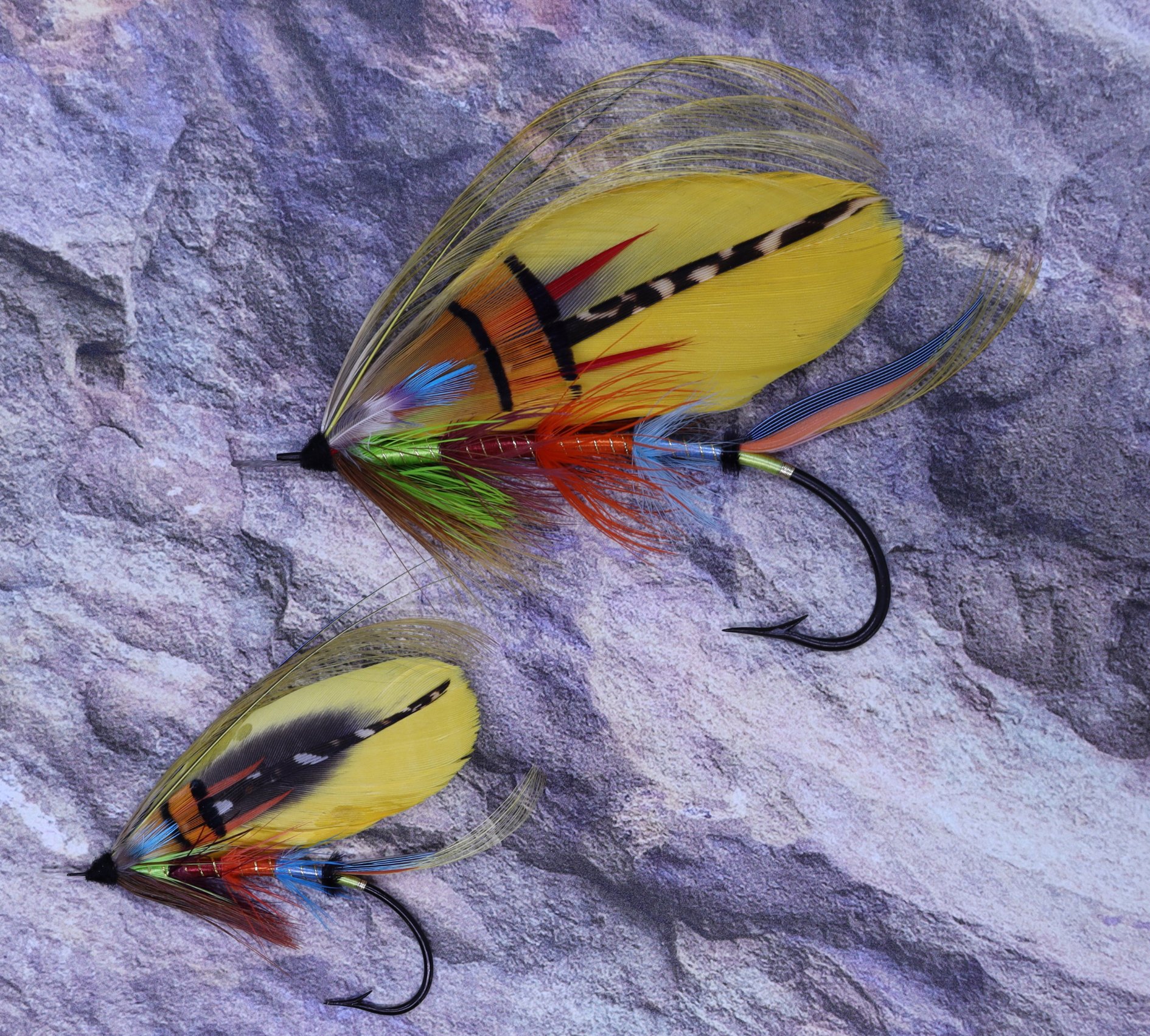
A beautiful and rare image of large and small versions of the Shannon, tied by Satoshi. Designed by William Blacker and described by Francis Francis in A Book on Angling, the Shannon is among the most elaborate classic salmon flies and demands considerable time and skill at the vise due to the elaborate body construction. Its original wing is especially difficult to reproduce because it calls for unusual parrot feathers—yellow with a distinct black center stripe—that occur only rarely.
That consistency may sound minor, but it tells you something about how he thinks. The flies are not random products coming off the vise. They belong to a larger body of work.
Satoshi is also clear that there is no quick path. A tyer can learn the basic order of a salmon fly fairly quickly. Producing consistently good flies takes years at the bench.
Most people are immediately drawn to the married wings, bright colors, and rare feathers. Satoshi looks closely at the head.
A small, smooth, conical head is difficult to produce. It shows how well the tyer controlled the thread and materials throughout the entire fly. By the time the head is formed, most of the mistakes have already been made. A large head is often just the final bill coming due.
The glamorous feathers get the attention. The head tells you who can tie.
Kelson and Traherne
As Satoshi moved deeper into classic salmon flies, George M. Kelson and Major John Popkin Traherne became especially important.
Kelson’s The Salmon Fly remains one of the central books in the history of Victorian salmon flies. It is also enough to keep a serious fly tyer busy for the rest of his life. The patterns are complicated, the materials can be difficult to locate, and Kelson’s instructions do not always answer every question.
For Satoshi, that uncertainty was not a problem. It gave him something to investigate.
Beginning in 2015, he set himself the challenge of dressing all 52 flies shown across the eight color plates in The Salmon Fly. The project took six winters. He later added six more patterns from Kelson’s Tips.
The work eventually became Satoshi’s book Dear Mr. Kelson.
He studied the original dressing notes, compared other interpretations, and looked closely at how respected dressers had approached the same flies. He was not only asking how a pattern could be tied. He wanted to understand how Kelson may have intended it to look.
Traherne’s flies presented an even tougher set of problems.
The Major’s patterns are among the most distinctive and difficult flies of the Victorian period. Many use complicated married wings, unusual combinations of color, and materials that are now rare, protected, or simply unavailable.
Even when all the materials can be found, there is no guarantee the fly will cooperate.
Satoshi considers Traherne patterns among the most difficult flies he has dressed. The Lapwing may be the toughest.
He also identified three unnamed nineteenth-century patterns introduced by Albert Cohen in Judith Dunham’s 1991 book as particularly difficult. These were not Traherne flies, but they presented the same basic problem: limited information and no simple answer for how the original patterns had been constructed.
That is where research, experience, and judgment take over.
Material substitution is also part of the work. Indian crow can be represented by dyed white neck feathers from a ringneck pheasant. Dyed Argus secondary feathers can provide material for large married wings. White turkey may offer a substitute for Florican.
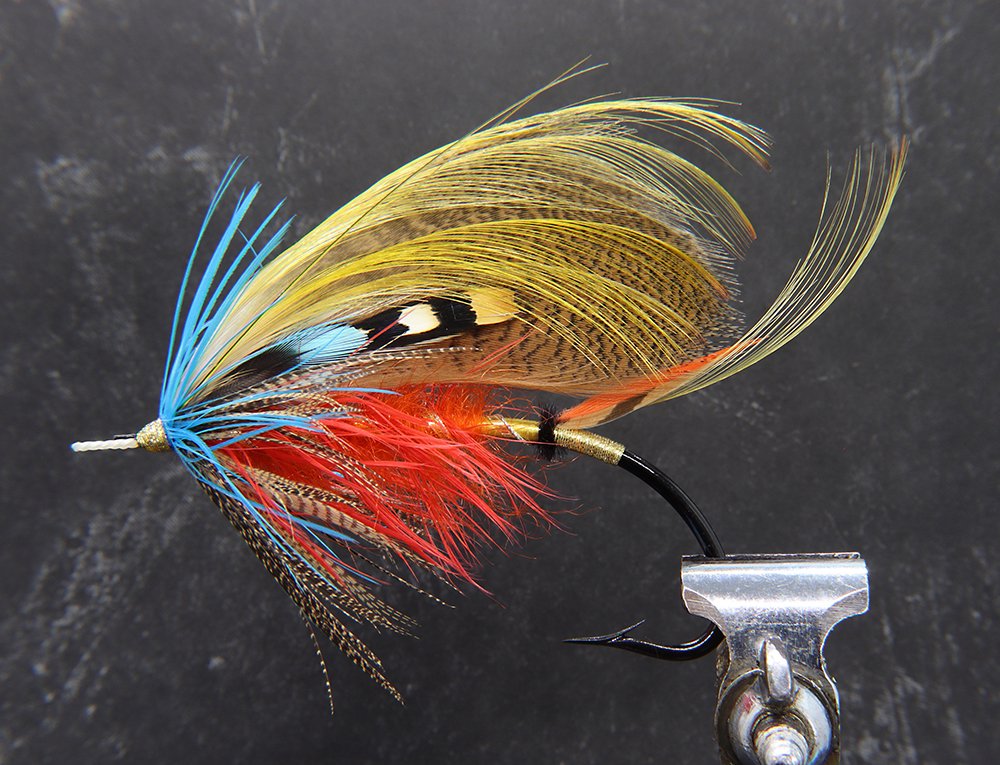
A stunning Britannia and a terrific example of Satoshi’s work. He dressed it on a special blind-eye hook made by the late Ronn Lucas Sr. and used an excellent pair of shoveller duck feathers, a feature common to all variations of the pattern. As Satoshi studied the three historical dressings by Francis Francis, Fitzgibbon, and Kelson, he began considering whether he could combine their most distinctive elements into a single fly—one that would still be recognized immediately as the Britannia. Some descriptions call for one ribbing material, while others specify two: oval and flat tinsel. He chose both. The number of toppings also varies from one dressing to another, so Satoshi used multiple toppings in his interpretation.
The substitute still has to do the job. A feather is not useful simply because the color is close. It also needs the correct shape, length, texture, and position within the fly.
Satoshi’s Traherne research eventually became Atlantic Salmon Flies of Major Traherne, a reference built around the patterns, dressing recipes, bibliography, and photographs of the completed flies.
At that point, he was doing more than learning to dress Victorian flies.
He was helping keep them alive.
Beyond the Vise
Satoshi’s work does not end when the fly comes out of the vise.
He also designs and assembles framed presentations.
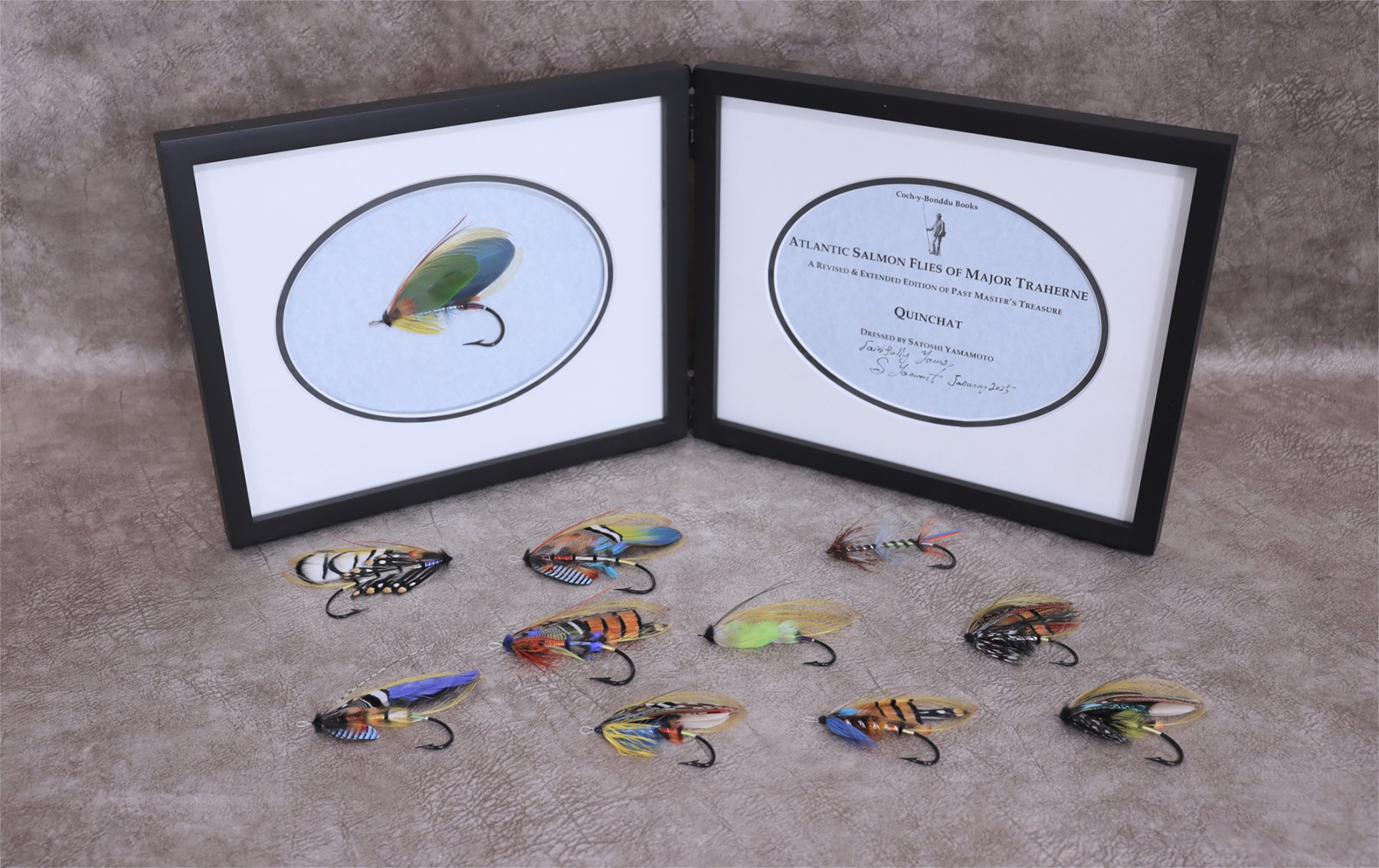
An example of Satoshi’s framed atlantic salmon flies
That may sound like a separate craft, but it fits naturally with the way he presents his flies. A classic salmon fly is small. Without the proper spacing, background, labels, and frame, even a beautiful fly can disappear inside the presentation.
Satoshi treats the presentation as part of the finished work.
He has developed his own methods for mounting the flies so they appear to float inside a shadowbox. His framed sets may be based on a historical dresser, a book, or a selected series of patterns. He does not simply crowd as many flies as possible behind glass. Each fly needs room, and the entire presentation has to work from across the room as well as up close.
For fully custom wooden frames, Satoshi works with a professional framer in Livingston. He then mounts the flies and assembles the presentation.
The special presentation for his Major Traherne book is made to order. One of the flies shown in the presentation, the Jungle Don, is now in Wales with the publisher, Coch-y-Bonddu Books. Satoshi has dressed additional Traherne flies connected with the book and presentation.
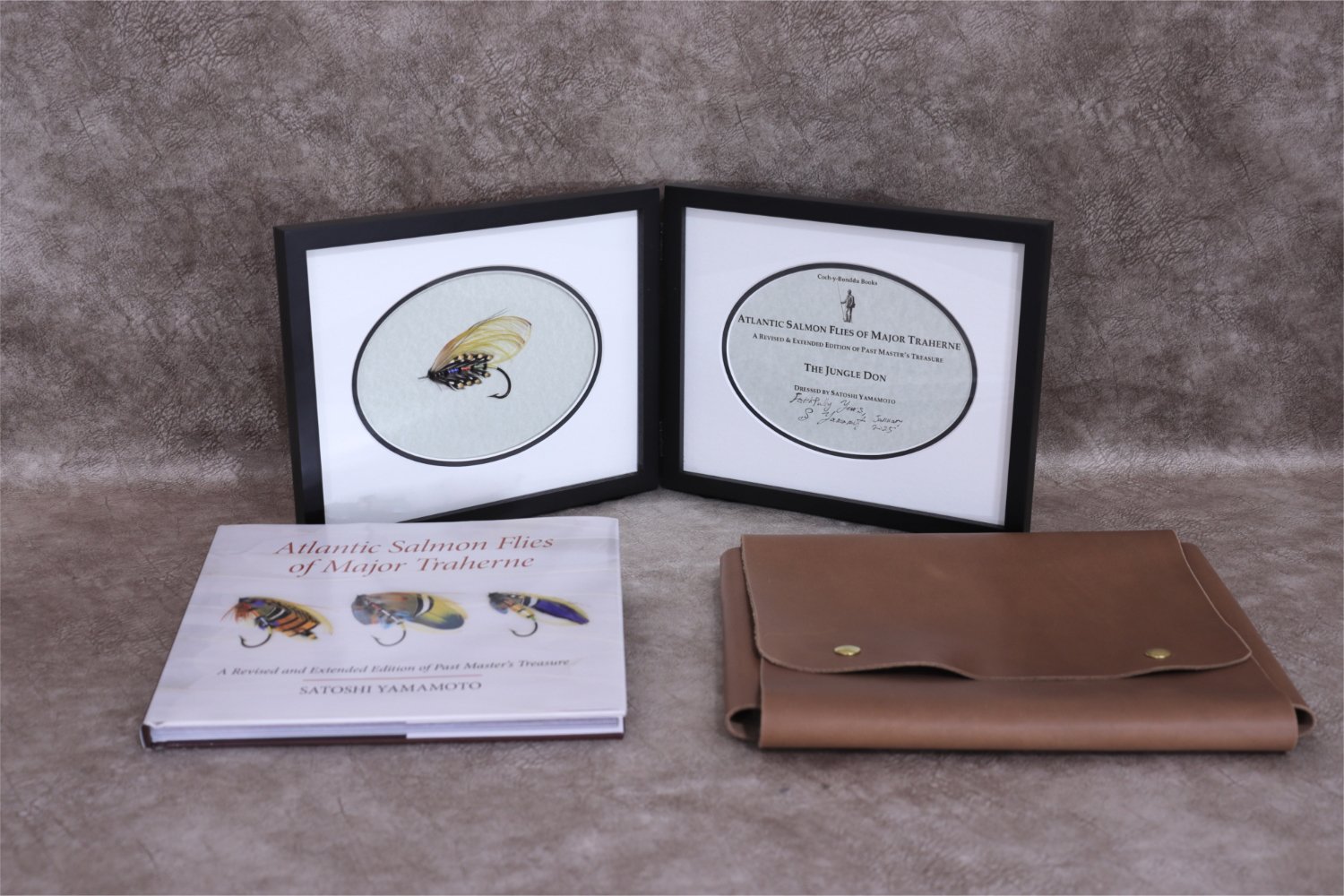
An accompanying special frame set for Satoshi’s Major Traherne book is made to order. The Jungle Don shown here is actually in Wales with his publisher Coch-y-Bonddu Books.
Satoshi can research and interpret a pattern, select the substitutes, dress the fly, mount it, and assemble the final presentation.
Most people would be happy to do one of those jobs well.
Satoshi appears to see five separate jobs and think he has found a good way to spend the winter.
Satoshi and the Fly Pattern Dictionary
The Fly Pattern Dictionary began as a way to organize dressing notes and make them easier to find. It has become something larger.
An entry may now include the original dressing notes, a historical fly plate, a separate image credited to the dresser, and a full pattern-history essay. The point is no longer just to list materials. It is to preserve the flies and connect them with some of the best dressers in the world.
Satoshi’s work belongs in that project.
He connects several parts of fly-fishing history that are often treated separately. He is a working Montana guide who developed trout flies through direct observation and testing. He is also a classic salmon fly dresser who studies nineteenth-century books and reconstructs difficult Victorian patterns.
His Pale Morning Dun variation of George Marryat’s Spent Gnat brings those two sides together. Satoshi dressed it for the cover of his spring-creek book, although it is not a fly he regularly fishes. It is based on a historic pattern, adapted to a Montana insect, and dressed with the same attention he gives his classic salmon flies.
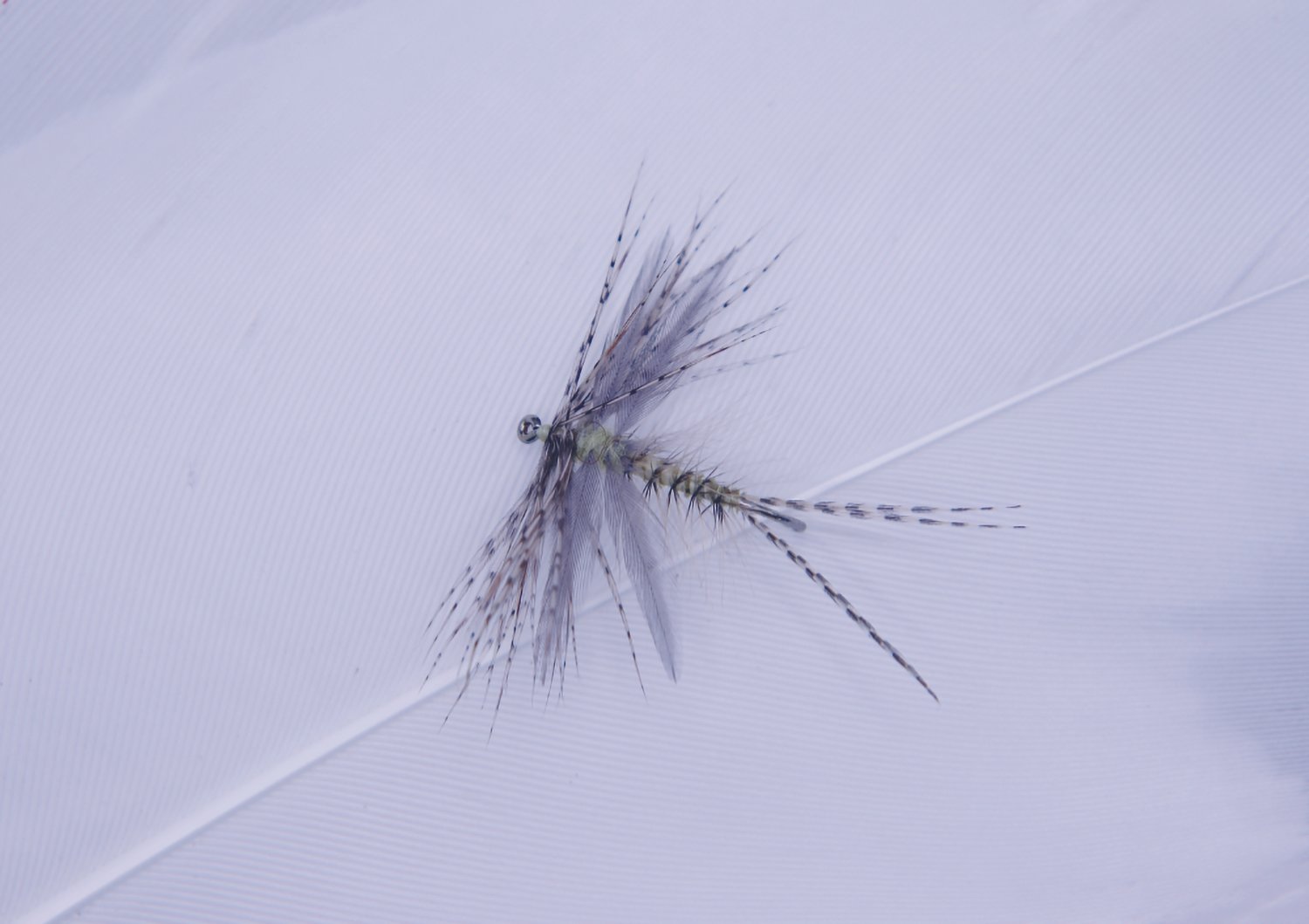
A Spent Gnat by George Marryat, "Price of Fly Fishers", in the Pale Morning Dun variation (PMD is the most iconic insect on Livingston's spring creeks). Dressed by Satoshi, it was featured on the cover of his book Trout Foods & Flies For Livingston's Spring Creeks.
Some flies are meant to be chewed up by trout. Some are meant to preserve an idea.
The best fly tyers understand both.
That is what I want the Fly Pattern Dictionary to represent. There should be room for the steelhead fly that has been fished hard, the exact historical reconstruction, and the fly dressed simply because it is beautiful.
Satoshi’s work makes a strong case for all three.
A Life Built Around Flies
What I respect most is that Satoshi did the work first. He is a fly academic. Satoshi called Past Master’s Treasure his master’s thesis; I would call the expanded Atlantic Salmon Flies of Major Traherne his doctorate.
Fly fishing has no shortage of people selling shortcuts. Satoshi’s career is the opposite: find the river, learn the run over several years, then become a guide, find a good teacher, read the books, study the materials, put in the hours, become a world-class fly dresser.
Then look at the head.
—Mark Combs
To purchase or view Satoshi’s flies, explore his book catalog, or learn more about his Montana guide service, visit Lefty Angler & Flies.