The Fly Dresser - Will Bush
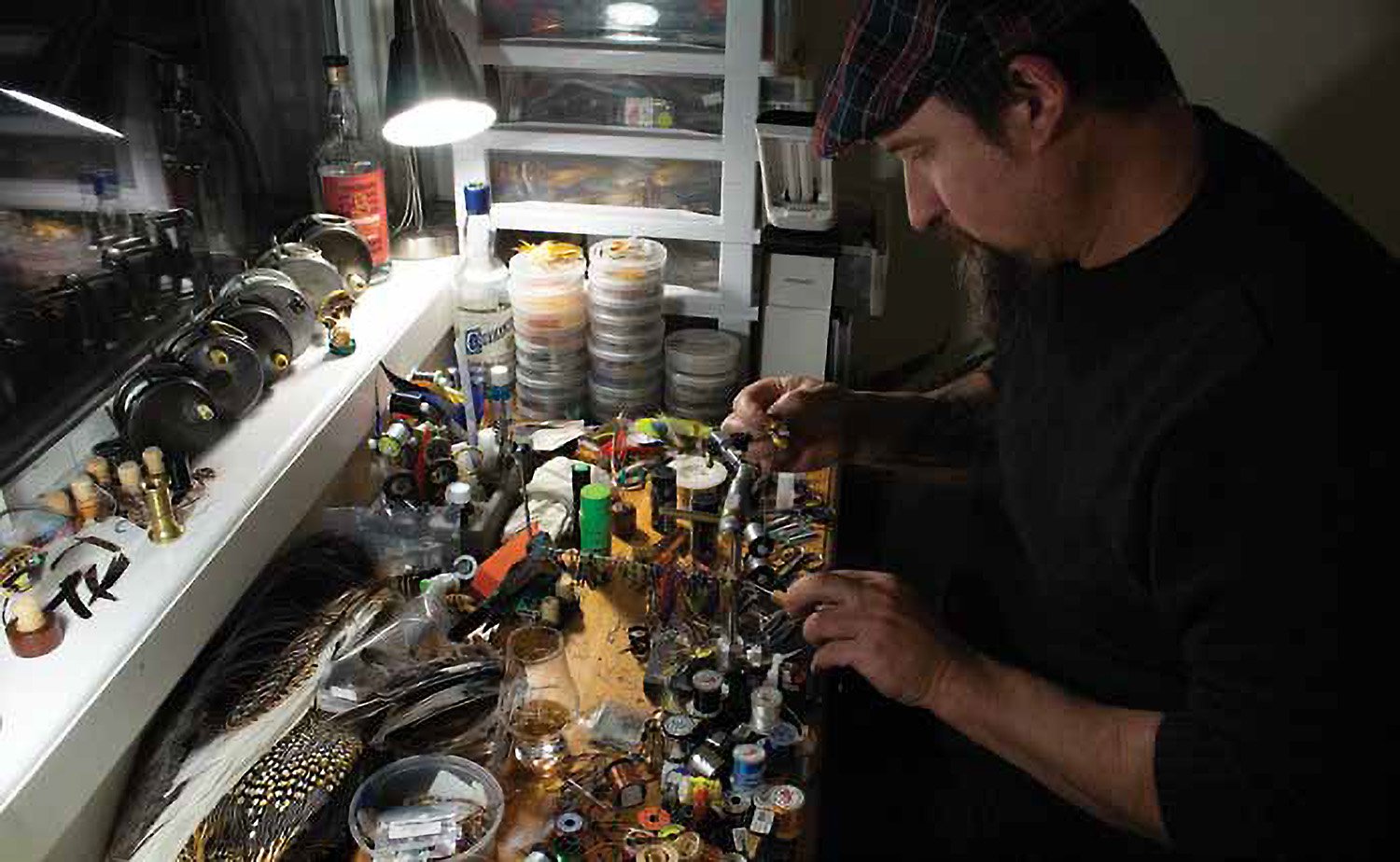
Will Bush is one of the finest salmon fly dressers in the world. His work, rooted in the Victorian-era traditions of Atlantic salmon flies, carries forward patterns like the Carron and the Dallas—classic Spey flies that remain as effective today for North Atlantic salmon and steelhead as they were more than a century ago.
When I was writing Flies For Atlantic Salmon & Steelhead, I received a call from April Vokey, the Canadian steelhead fly-fishing dynamo that made a welcome splash in the industry some years ago. April and I did a podcast, and I took the opportunity to ask if she had contacts who could talk about Atlantic salmon flies that were finding their way into our steelhead world. April immediately steered me to Will Bush, a Canadian who tied classic Victorian-era salmon flies with stunning fidelity to the original, and who fished two original Spey flies dating to the 19th century with great success for British Columbia steelhead. Once I saw his amazing dressings, I knew that I needed to write a profile - I liked the work he did that much.
As I started to write his profile and started looking through the images of his spectacular Victorian-era Atlantic salmon flies it becomes clear he is one of the finest dressers who has ever lived. And that’s saying something.
Will, a Canadian from Penticton, British Columbia, wears his passion for fly tying and steelhead fishing on his arm, literally. “Big Willie”— part of his email handle—has a foot-long tattoo of a Spey fly on his forearm. The tattoo is pattern specific, the Carron, named for the Carron Beat on the River Spey, Scotland’s most storied salmon river.
Will’s other arm bears another fly pattern tattoo, the famous Lady Caroline – probably the most traditional and well-known Spey fly which typically sports a coppery colored body obtained by blending red, orange and green fine- wool dubbing. The wing—a double layer of mallard scapular fibers which is tied in facing forward, then folded back over the fly and divided with figure-eight thread wraps to form two wings that stand well over the fly’s body.
Will is an extremely knowledgeable student of 19th-century Atlantic salmon flies, a subject almost entirely the province of the United Kingdom and Scotland, long the most salmon-rich country in the monarchy. Not only has he nearly memorized every classic work on the subject, he’s tied many of the flies described in Kelson’s work. In this regard, Bush compares favorably to Mikael Frödin who tied all the salmon flies photographed for his prodigious work Classic Salmon Flies (1991). Will ties salmon flies, from the simple to the most complex, with breathtaking perfection. He typically spends between eight and 10 hours on each single classic fly.
The classic-fly dresser has a long list of clients waiting for their flies, which they’ll have professionally mounted and framed. He charges a handsome price for his art, yet his waiting list grows longer. I know he once tied conventional steelhead flies for April Vokey. She had clients who wanted to cast the very best when she guided them on the Bulkley; Will takes care of that. When publisher Tom Pero made plans to construct a deluxe edition of a book on Atlantic salmon and steelhead flies, he wanted a classic Victorian Era salmon fly for the centerpiece of a framed assortment of the finest steelhead and Atlantic salmon flies tied by the most talented tiers in the world. Of course he asked Will Bush to tie the showcase fly (and image of that fly is included in this article) – the most “royal” of all classic salmon flies, the Jock Scott.
Will grew up in Cawston, a small community in south-central British Columbia. His parents were farmers and though they didn’t fish, Will did, and he can’t recall when he didn’t anxiously complete chores so that he could to fish the Similkameen River. When out of elementary school he was fly fishing, tying his own wet and dry flies for the river’s native cutthroat and rainbow trout. As he started high school, he began tying commercially, selling his flies to Cathedral Lake Lodge in Cathedral Lake Provincial Park. When his father died, Will helped support the family by driving heavy equipment—an easy transition for a farm kid who’d grown up driving tractors. And then, he says, “I did some cowboying.” But these activities were never far from his fishing and fly tying.
After high school, Will signed up with Michael & Young, Dave O’Brien’s two famous fly shops in Vancouver and Surrey, for a class in tying complex 19th-century Victorian Era salmon flies. The learning curve was life changing. Will devoted years to mastering the dressings’ technical challenges, while discovering how and where rare plumages could be obtained.
Gillies tied their Spey flies on “blind-eye” hooks that ended with tapered shanks without loop eyes. A loop of twisted silk was tightly wrapped down on the shank, a connection that simply did not fail in the course of many salmon. In historical hindsight, twisted silk seems archaic. Will first substituted white Dacron, a modern lookalike that when waxed behaves in a similar manner. To Will’s surprise, he discovered that the expensive braided silk was not only an authentic addition to the dressing, but it was stronger and more resistant to wear. “Those silk loops landed a lot of salmon at a time when salmon were larger,” he said in a reference to Scotland.
Will’s main tattoo illustrates just one of the salmon flies he fishes for steelhead. He also fishes the Dallas quite often. So, while many consider these dressings art, for Will they’re working flies as well - he does not fish them with a heart heavy and nostalgia, a spiritual effort to breathe life into the dead traditions from a bygone era, but rather he swings the Carron and the Dallas because they’re effective on steelhead in the rivers he fishes.
Will says, “I fish the Carron because I love the look and the colors in it.” Save for the addition of a teal flank throat, the fly with the sparkling orange body remains unchanged from the Carron fished 150 years ago. Certainly, Syd Glasso would have fished the dressing with as much confidence for Olympic Peninsula steelhead as would any 19th century ghillie for his employer on the River Spey.
Few spey flies have survived to take their place as historical markers in salmon fishing. Out of respect for tradition, American embellishments such as those Syd Glasso practiced were quite subtle: a teal throat or a body section of fluorescent floss over an underbody of flat silver tinsel, hardly more than residual nudges from the days when “gaudy” set the fly-dressing standard and spey flies were the lowbrow choice of ghillies who lived close to the earth. We might have called them guide flies back in the day; the Dallas illustrates these changes.
When driving west from Penticton, Will fishes Vancouver’s heavily trafficked city rivers, the Squamish and Vedder, and then drives north for the Thompson and Coquihalla. Every fall he travels to the Skeena country, the finest concentration of wild steelhead rivers on earth. He swims the Carron and Dallas in the Morice, Bulkley, Skeena, Kispiox and Babine before heading for the coast and the Bella Coola.
Under most fishing conditions for summer steelhead Will hasn’t fished anything other than a dry line for about the last 8-9 years or so. He typically skates dries - although he does grease line classics quite often. He does use sink tips in the winter, but for summer fishing unless it’s high and dirty he fishes only a dry line. He finds this a rather important ethical approach for summer fish.
I closely questioned Will how exactly he fishes the flies. I know the heron hackle makes the fly unstable and likely promotes the fly lying over during a hard swing. Much of this can be relieved by strongly leading the fly. Will, of course, knows all this. The slight downside is more than made up by how well the long heron hackle flutters as the fly wobbles about in soft water.
Historically, the River Carron was a relatively obscure river in central Scotland. We can trace the river from Highland origins to the Carron Valley Reservoir, a scant dozen miles, and flowing from there to flow into additional lochs. The meanderings total no more than 15 miles of fishing water, all private, and permitted by Attadale, an estate of some 30,000 acres and by the Larbert and Stenhousemuir Angling Club.
The salmon caught on this fly-fishing-only river total 200 to 300 annually. Central Scotland considers the river a national treasure, and today it’s a popular angling destination. That fact is a remarkable reversal of fortune. During the post World War II years to at least 1980, the Carron was one of the world’s most polluted rivers due largely to refinery waste at Falkirk. The water was so toxic that literally nothing could live in it, and no land animals drank from it.
Though the river was privately owned, and today’s fishing privately controlled, the public became heavily engaged in its restoration. A myriad of projects more than 30 years in the making began to restore the river to a pristine state not seen in 200 years. The Carron eventually was stocked with salmon and brown trout, and, most important, the run of salmon became self-sustaining.
When it comes to dressings, Will’s attention to dressing old patterns is remarkable. He typically uses century old, handcrafted hooks from England. He collects old and exotic feathers for use in his creations.
His knowledge of crest feathers I found incredibly interesting. For example, the feathers from a golden pheasant are used for tails, toppings, wings and hackles of old and modern salmon flies. Orange and black barred tippets are used extensively in tails, wings both upright and flat-wing style and as hackles or cheeks; red flank feathers are used in tails, wings, hackles and cheeks. Tail feathers are used in the construction of built-wing, mixed-wing and strip-wing patterns. Lady Amherst and silver pheasant are valuable feathers with similar uses in classic salmon flies. Additionally, there are 42 remarkable species called birds of paradise with metallic-like feathers in brilliant shades of yellows, blues, greens, orange and red. The raggiana bird of paradise has beautiful golden yellow napa feathers often used as veiling or cheeks of flies.
It’s no coincidence that the lucrative millinery trade during its peak years in the 19th century required the annual slaughter of birds by the millions also provided ample materials for the most creative of fly dressers. Today, authentic toucan, Indian crow, and macaw feathers are sometimes salvaged by passionate aficionados who purchase 19th-century salmon flies and take them apart to recover a few valuable feathers from birds no longer available in the wild. In this manner a salmon fly could be tied that is historically accurate and marketed accordingly. These rare feathers—what I call aftermarket plumage—begin with the toucan, a bird with a brilliant yellow breast. Individual feathers were used to veil other plumage and add a sense of movement to the fly. The Indian crow, a blackbird-sized species, was killed solely for the feathers making up its bright red throat patch. These small feathers were used, often lavishly, by adorning the body at different sections. It should be noted however, based on the geographic location, that this trade has the potential to be illegal and, in some cases, trigger criminality (e.g. Johnson’s 2018 book The Feather Thief: Beauty, Obsession, and the Natural History Heist of the Century
Adding to the mystique of Will’s incredible legacy dressings is his great eye for photography. He typically presents his flies sitting on top of a vintage salmon reel. For readers that would like to see photographs of his dressings, or to contact him about acquiring a salmon fly, he can be found on Instagram @willbushflies
By Trey Combs
A collection of salmon flies tied by Will featured below.
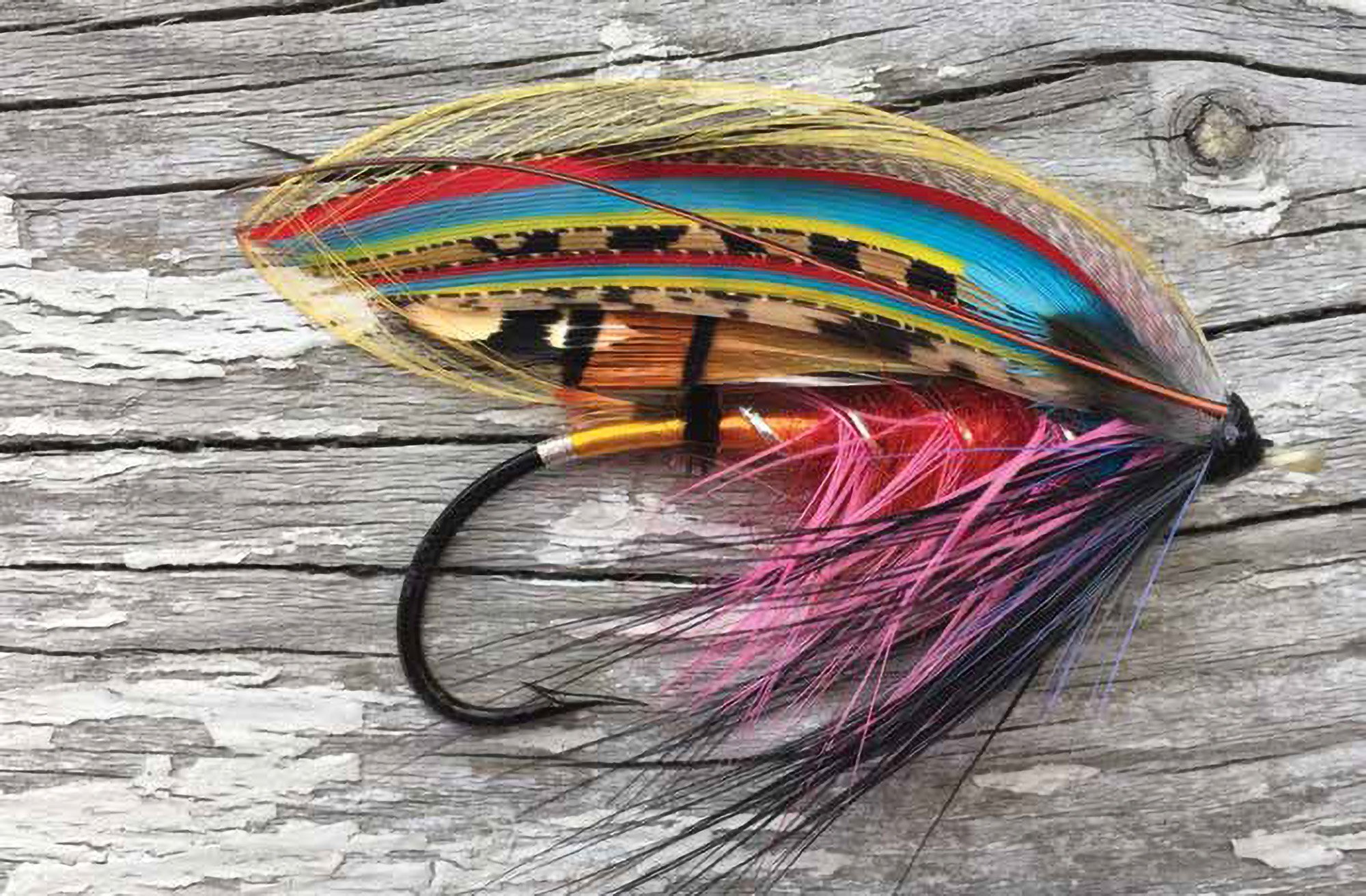
The McIntyre was popular through the golden age—this version is from How to Tie Salmon Flies by J. H. Hale (1892).
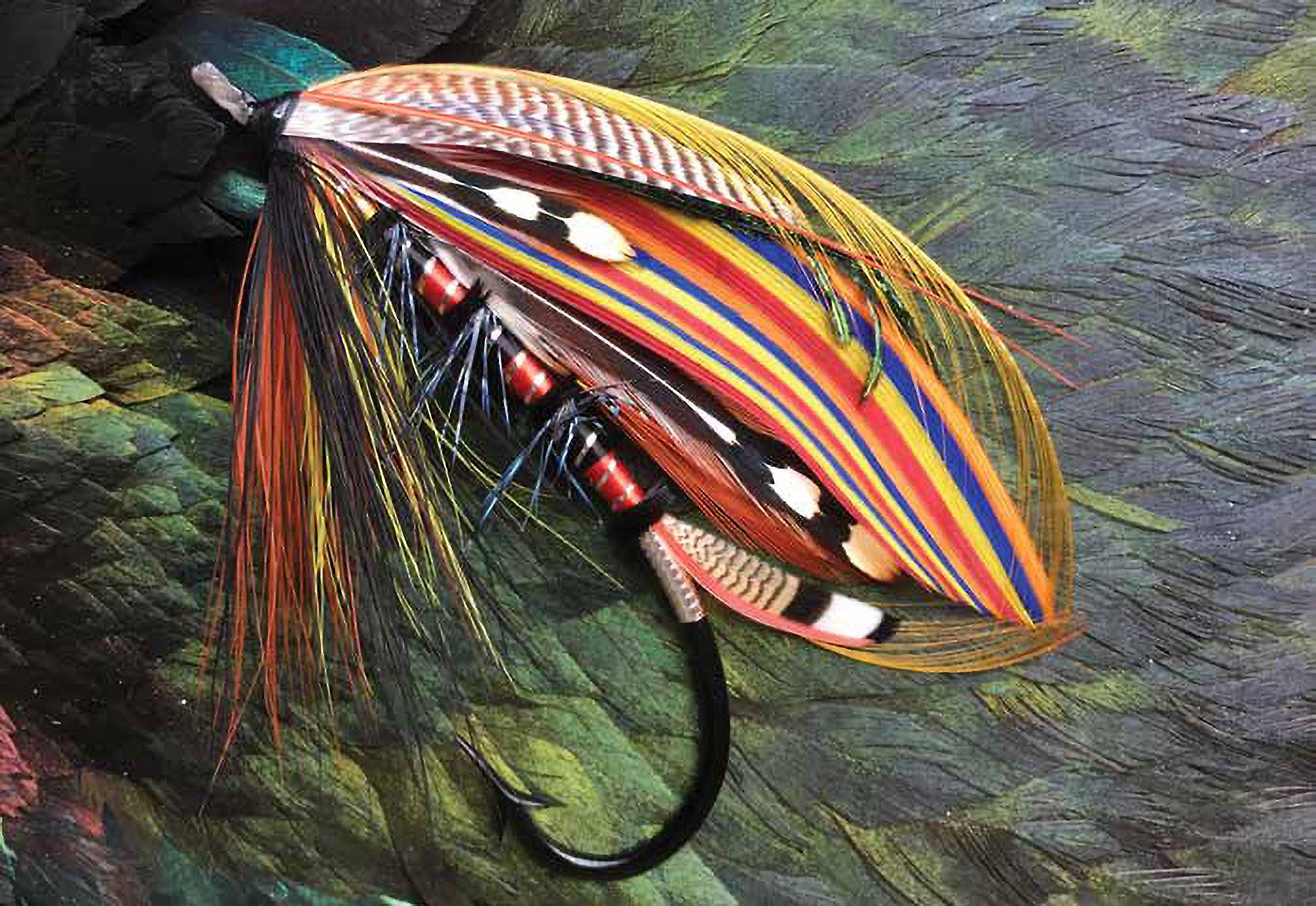
Nicholson—originator unknown—was featured for years in Farlow’s, over impeyan pheasant.
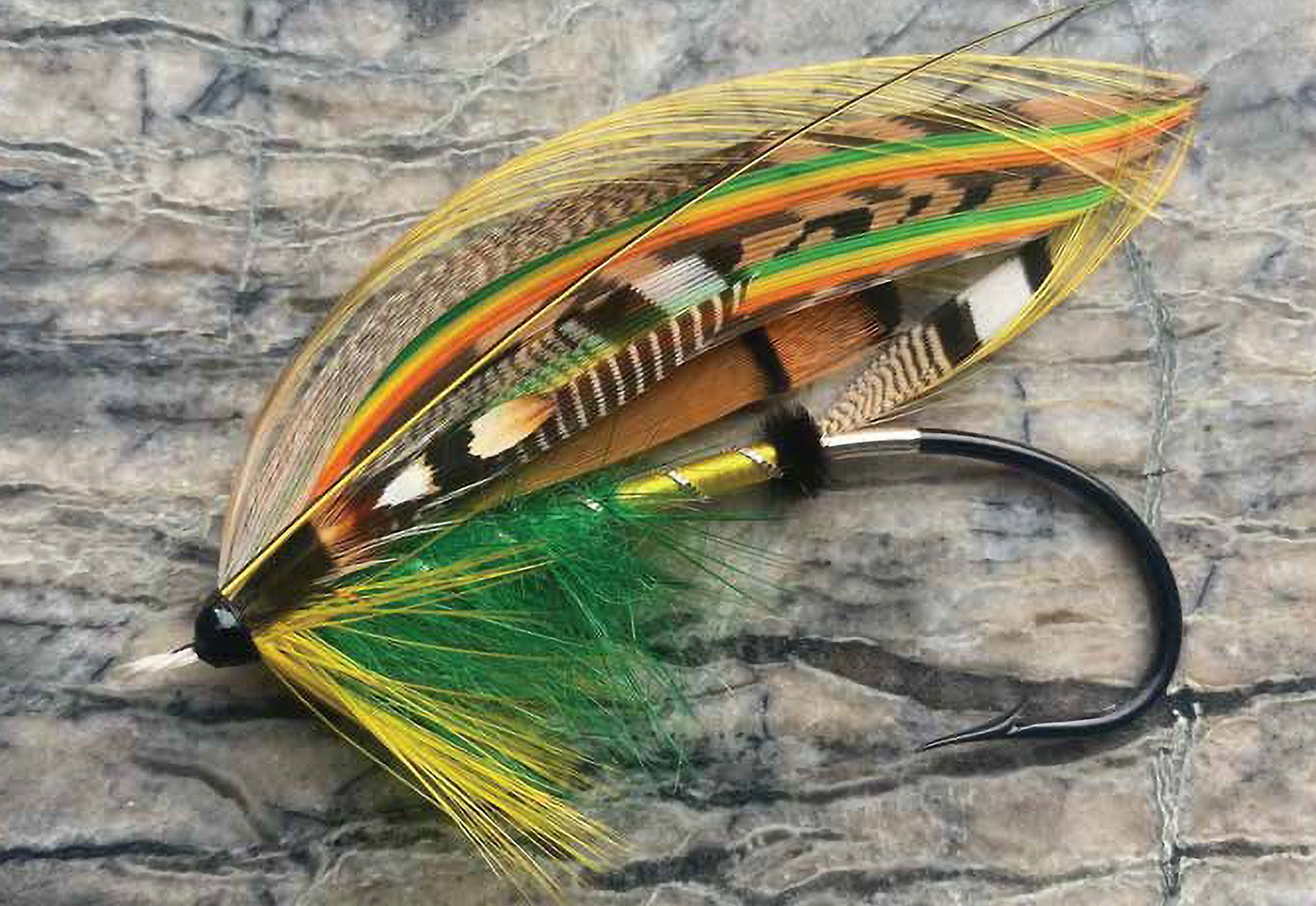
Green Highlander from T. E. Pryce-Tannatt (1914).