Syd Glasso’s Transformation of the Wet Fly, Part 2
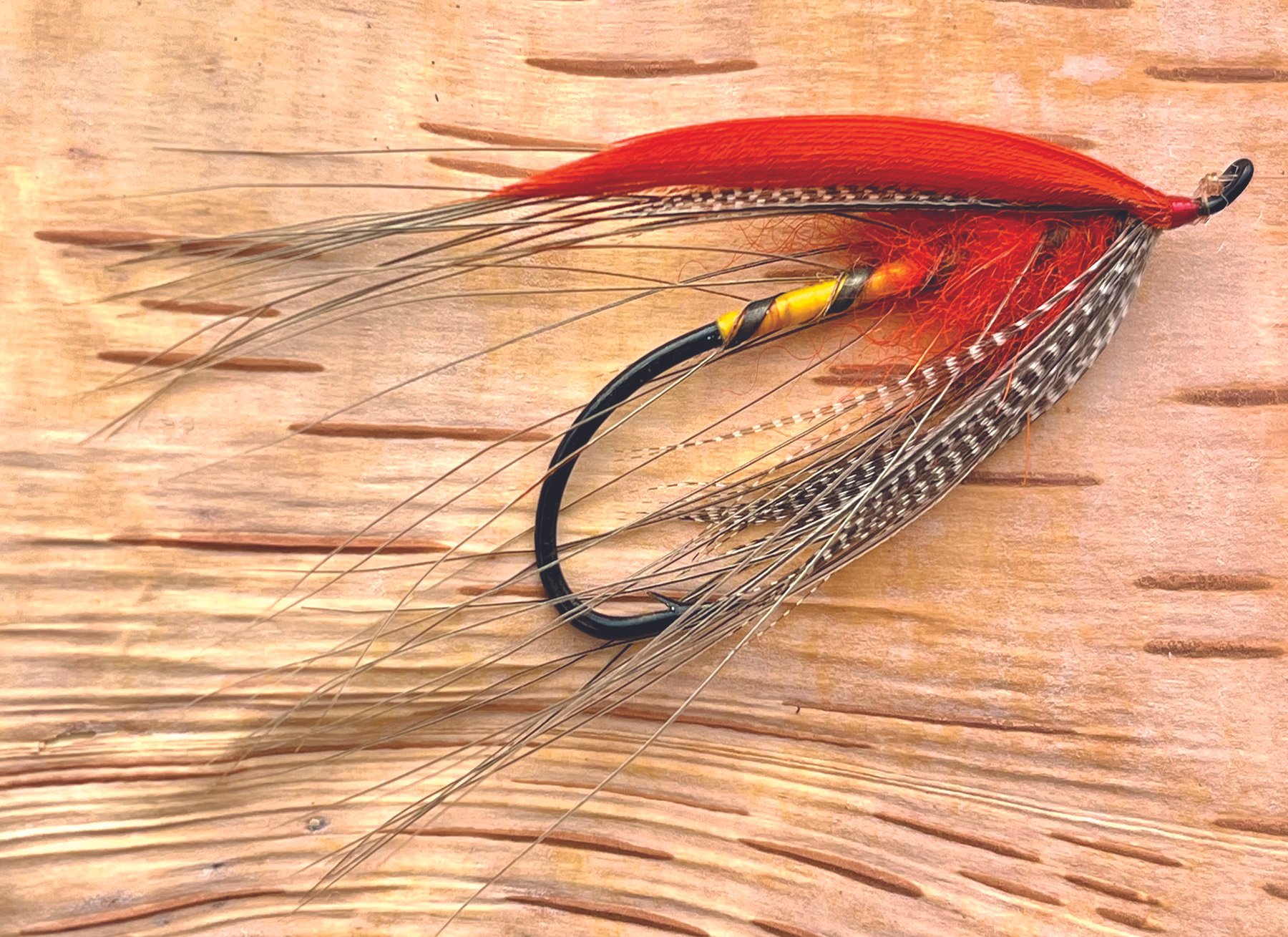
Orange Heron dressed by Glasso. In his 2004 book, Spey Flies And How To Tie Them, Bob Veverka wrote: “Glasso’s flies were tied sparsely in hot colors with the finest hooks and materials. His flies had flowing lines, were finely ribbed and hackled with long, wispy heron hackles, and were always tied symmetrically to the hook, which made them stand out from the rest. Throat hackles were of the most finely penciled teal flank, and the wings were precisely set, low and swept back. His flies were always finished with his trademark small, neat perfectly formed heads.” Viewing note: On a computer, right-click the image and open it in a new tab to view it larger and in more detail.
Syd Glasso’s Transformation of the Wet Fly, Part 2
Syd Glasso was one of several Washington winter steelhead fly fishing pioneers that included Al Knudsen, Ralph Wahl and Wes Drain. When I first met Knudsen in the late 1960s, he was in an Everett, Washington hospital recovering from pneumonia. Ever gracious, Al happily credited his peers for their steelhead dressings, and shared with me stories about tying flies commercially for Rogue River steelhead in Grants Pass, Oregon during the 1930s.
When I had exhausted the man’s patience, Al reminded me for the second time that day that above all else I must contact Syd Glasso. At the time, I’d heard the name, but didn’t know why I should remember it. After sending Syd a letter or two requesting a Spey fly for The Steelhead Trout, he sent me several samples, and then sent me all his steelhead dressings, including one designed by Dick Wentworth, for Steelhead Fishing and Flies (1976).
Almost from the moment the book came out that fall, the elegant Glasso flies—for the first time in color—swept aside steelhead fly-dressing convention and marked a permanent change in how we viewed flies we tied and fished for steelhead. This was like a tsunami that washed away everything in its path and left behind the grace and beauty of Syd’s flies. So great was our enthusiasm, that almost from the jump our Spey flies vastly exceeded the faint residual recognition Spey flies had in Scotland.
Syd Glasso became the perfect link between the Old World and Atlantic salmon and the western angler’s beloved steelhead, defined at the time as a sea-run rainbow. I thought I’d gained a coherent picture of the man as a tier of flies that were masterful blends of salmon flies in steelhead colors. But as to his private life, I knew almost nothing and I didn’t have the knowledge to put his skills in contemporary context.
I learned he was a public-school teacher in Forks where a dozen feet of rain a year contributed to the area’s many glacier-fed steelhead rivers. The “west end,” literally the geographic western end of the U.S. south of Alaska, was called “America’s Last Frontier.” It was more like Wild America, a place where sawmill employees, lumberjacks, river guides, poachers, loggers, truckers, and Native Americans lived uneasily beside each other.
This is where Syd Glasso quietly lived, taught school, drove to his fishing in his trademark white Porsche, and pored over obscure references about 19th-century Atlantic salmon dressings. He studied Pryce-Tannatt’s How to Dress Salmon Flies (1914) and Eric Taverner’s Fly Tying for Salmon (1942). As with all serious tiers of Victorian-era salmon flies, George M. Kelson’s magnificent work, The Salmon Fly, first published in London in 1895, became the ultimate reference for original material details. He was a perfectionist who was severely critical of his own efforts, always searching for materials true to the originals. The internet was still years away.
Glasso tied these impossibly complex flies with historical accuracy, flies that had flourished in the United Kingdom during the 19th century, flies that had long become an art form. And, as with all salmon-fly art, their value depended upon the talent of the artist and the historical accuracy of the materials incorporated in the fly. Only the extreme scarcity of original and expensive plumages prevented Glasso from completing more of these projects.
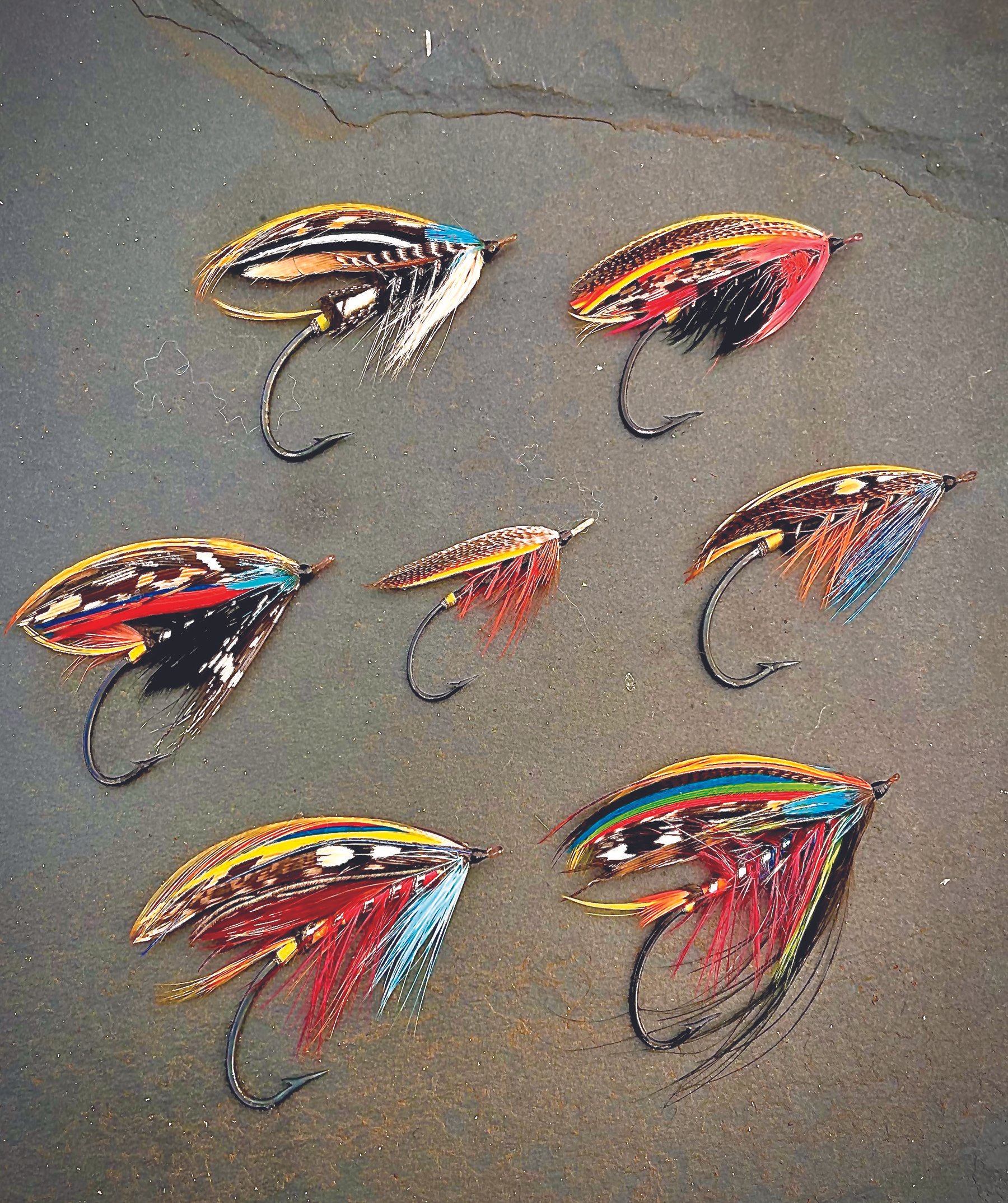
Image Caption: Among modern steelhead fly tiers, Glasso was the first to assiduously study and dress classic Atlantic salmon flies. His talent was recognized far and wide. His salmon flies appeared in The Art of the Classic Salmon Fly by Joseph D. Bates, Jr. (1987) and Fishing Atlantic Salmon by Joseph D. Bates, Jr. and Pamela Bates Richards (1996). The Glasso-tied flies shown here were photographed for Trey Combs’s newest book, Flies for Atlantic Salmon & Steelhead. Top row, left to right: Black and Teal, Cock Robin. Middle row: Sir Richard, low-water Thunder and Lightning (Glasso), Thunder and Lightning. Bottom row: Gordon, McIntyre.
George Kelson describes “variants,” slight differences from the legendary original, and what comprised this, feather by feather, and who made the change. I think these variants were largely ego driven, a way to hitch their inventor’s name to the name of the famous original dressing. That doesn’t mean the variant didn’t have value. Quite the contrary; just as in steelhead fly fishing, a slight change from the original can gain fame, and even be thought to have greater effectiveness than the original. A steelhead fly example would be the Skunk and the Green-Butt Skunk. I believe that Kelson’s grand work is especially important for segregating the original fly dressings and making sure the genealogy record doesn’t become a confusing muddle of “new and improved” salmon dressings.
Syd Glasso was almost completely self-taught, hard-won skills developed after many years of tying in isolation and then rarely shared. He made no effort to hide his irritation when asked how he obtained such remarkable results. There’s no fast track to becoming a world-class tier. Artists have their own techniques that help identify their work. Syd’s flies have been studied like a complex surgery; how he secured so many materials, yet still created such a small head, changed a clunky fly to one sleek and purposeful, each feather seamlessly joining others to create a single image of breathtaking beauty.
Like all tiers of classic salmon flies, Glasso’s greatest challenge centered on finding the original plumage for the fly being tied. This could be impossible to obtain because many species had long been protected under the Migratory Bird Treaty Act of 1918, the act later amended numerous times to ban the importation of either a whole animal or any part of it—possessing a single feather would be illegal. But securing valuable plumage from protected birds has long been available from a great many sources. At its core there was the shadowy world of smuggling, poaching and illicit sales, all making it possible for a tier to secure just the right feather without knowing how the feather was originally obtained.
Some wild birds integral to salmon dressings had been domesticated for centuries, most notably the peacock and its tail feathers with strands of herl that tiers used to butt most every salmon fly, and the golden pheasant with its barred bright orange and black “tippet” feathers, and its head covered with the glossy lemon yellow “topping” that Victorians found essential in hundreds of patterns. But jungle cock, marabou and—more recently—bleached and dyed blue-eared pheasant are now additions to our list of steelhead and salmon fly-tying materials.
Divine Intervention
Clever detective work can often lead a buyer to the genuine feather honestly obtained, especially if price isn’t an issue. Old beat-up 19th-century flies have been purchased on the cheap and taken apart for the feathers. If you had a friend who knew a friend who worked at a zoo, you might get feathers from birds that were molting. A friend might own a macaw and would give you a feather when the bird molted. Great blue herons, a species found in every state, possess superb—and valuable—feathers during the breeding season for incomparable Spey hackles, the feathers indistinguishable from those of the gray heron found throughout the United Kingdom and used in both Spey and Dee flies. Some tiers have been known to make vague references to divine intervention when a great blue heron became a roadkill while hunting for fish on the interstate highway. The feathers are still illegal to possess.
Anyone who has read Kirk Wallace Johnson’s The Feather Thief (2018) knows that the greatest depository of Victorian era bird plumage used in classic salmon flies can be found in taxidermy mounts in museums. Imagine how lucrative the single mount would be if sold on the Internet, feather by feather. And if there’s enough money on the line, there are people willing to kill the animal in the wild regardless of its importance to the community of nations working to assure its survival.
To the list of species protected by the Convention on International Trade in Endangered Species of Wild Fauna and Flora (CITES) must be added wildlife taken legally by indigenous peoples of Canada including seals and polar bears. But possessing any part of those animals is illegal in the U.S. Exception: if properly documented, old polar bear rugs can be cut, dyed, and sold to fly tiers. Regardless of how innocent the explanation given how a person has come to possess a few feathers or a patch of fur, it’s likely illegal unless it was purchased from a fly shop.
I’ve belabored this subject to underscore the difficulty if not impossibility of acquiring the historically correct materials to tie an authentic Victorian salmon fly. Syd Glasso tied as he could while searching for the correct plumage long before there was an internet to list such esoteric merchandise. He was modeling, waiting weeks and months to get just the right feather. It’s a tribute to his skills and determination that among his salmon flies are a handful so superb they must be among the very best ever tied.
Finding and dyeing feathers that will substitute for the authentic original feather has become a new and complex science. Dave McNeese has been a leader in experimenting with pressure cookers, bleaching and using multiple dyes in sequence.
This research could be feather-specific, taking a desired feather from, say, a blue-eared pheasant that in general size and curvature compares favorably to the wild original. Dave then worked on matching the dyed color so closely that even a fine student of Victorian salmon flies would be hard pressed to recognize the counterfeit.
For many years there were only a few fly shops that specialized in duplicating these rare materials, and no one did this with greater fidelity than McNeese’s Fly Shop in Salem, Oregon. If you were a serious tier seeking historical perfection in your artistry, you did business with Dave McNeese.
Meeting Syd
In order to meet Syd Glasso, McNeese attended a meeting of the Washington Steelhead Fly Fishing Club in 1975. He brought along bags of feathers that would go into Syd’s salmon flies. Dave then cemented the friendship when he purchased 50 large 19th-century salmon flies from a fly dealer in England. He took these apart and rescued feathers long unavailable such as toucan and Indian crow. Beginning in 1976 he began sending Syd some of these rare feathers.
During the early 1980s, Joseph Bates sent Glasso many additional rare feathers for the Glasso-tied flies that would be used to illustrate Bates’s 1987 book The Art of the Atlantic Salmon Fly.
McNeese’s relationship with Glasso led to Dave’s discovery that Syd’s signature Sol Duc family of flies with the deep, hot-orange wings glowing with such brilliance was obtained by mixing orange and yellow Veniard dyes. Syd generously—in confidence—shared the proportions with Dave. McNeese and Glasso remained close friends until Syd’s passing in 1983.
It’s important to point out that Glasso’s steelhead flies involved dressing a hook with materials easily secured from most any fly shop. The adventuresome can buy white saddle hackles and Veniard dyes and experiment until the desired color is obtained. For that matter, saddle hackles can now be ordered that are already hot orange and a dozen other colors as well. Schlappen—the super-wide soft hackle used to tie a Spey fly—can be purchased in at least a dozen colors including the chrome yellow Glasso used in his Sol Duc Spey. The difference, of course, came down to Glasso himself and the tying skills he brought to securing materials to a hook.
Syd Glasso was a school teacher in the remote, rainy, muddy logging town of Forks, Washington, where he drove around—improbably—in a white Porsche. He is indisputably the artistic father of the modern steelhead wet fly.
I was one among the army of steelhead fly tiers who looked at the Glasso flies and thought that tying any of these dressings would be simple.
I then made an absolute hash of his Orange Heron. My Sol Duc Spey was so bad it just mocked my tying skills and was sliced off with a razor blade before friends discovered the mess. Simply setting the wings low, tented and perfectly matched demanded skills I didn’t yet possess. Steelhead fly tiers were all works in progress. Syd Glasso lifted us all up on the same tide. To my mind this seemed to happen overnight.
Orange Heron Dressing Notes (From Steelhead Fly Fishing and Flies)
Body: Rear two thirds orange floss; orange seal fur for the balance.
Rib: Medium to wide flat silver tinsel and overlay with narrow oval silver tinsel.
Hackle: Gray heron, one side stripped, palmered along ribs.
Throat: Teal flank.
Wing: Four hot orange hackle tips, short and close to the body.
Head: Red.
Hook: No. 1 or 2, low water.
Read the Complete Syd Glasso Series:
The Glasso Age Begins: Sol Duc Spey, Part 1
Syd Glasso’s Transformation of the Wet Fly, Part 2
The Glasso Legacy: A Steelhead Revolution, Part 3
Explore more classic steelhead and salmon fly dressings in the Fly Pattern Dictionary.
This blog is excerpted from the chapter on Syd Glasso in Flies for Atlantic Salmon & Steelhead. The book is available directly from the author on Amazon in two formats:
Limited 1st Edition Hardcover — available on Amazon
Digital Reference Edition — available on Amazon Kindle