Gitana: Kelson’s Exaggeration Reimagined
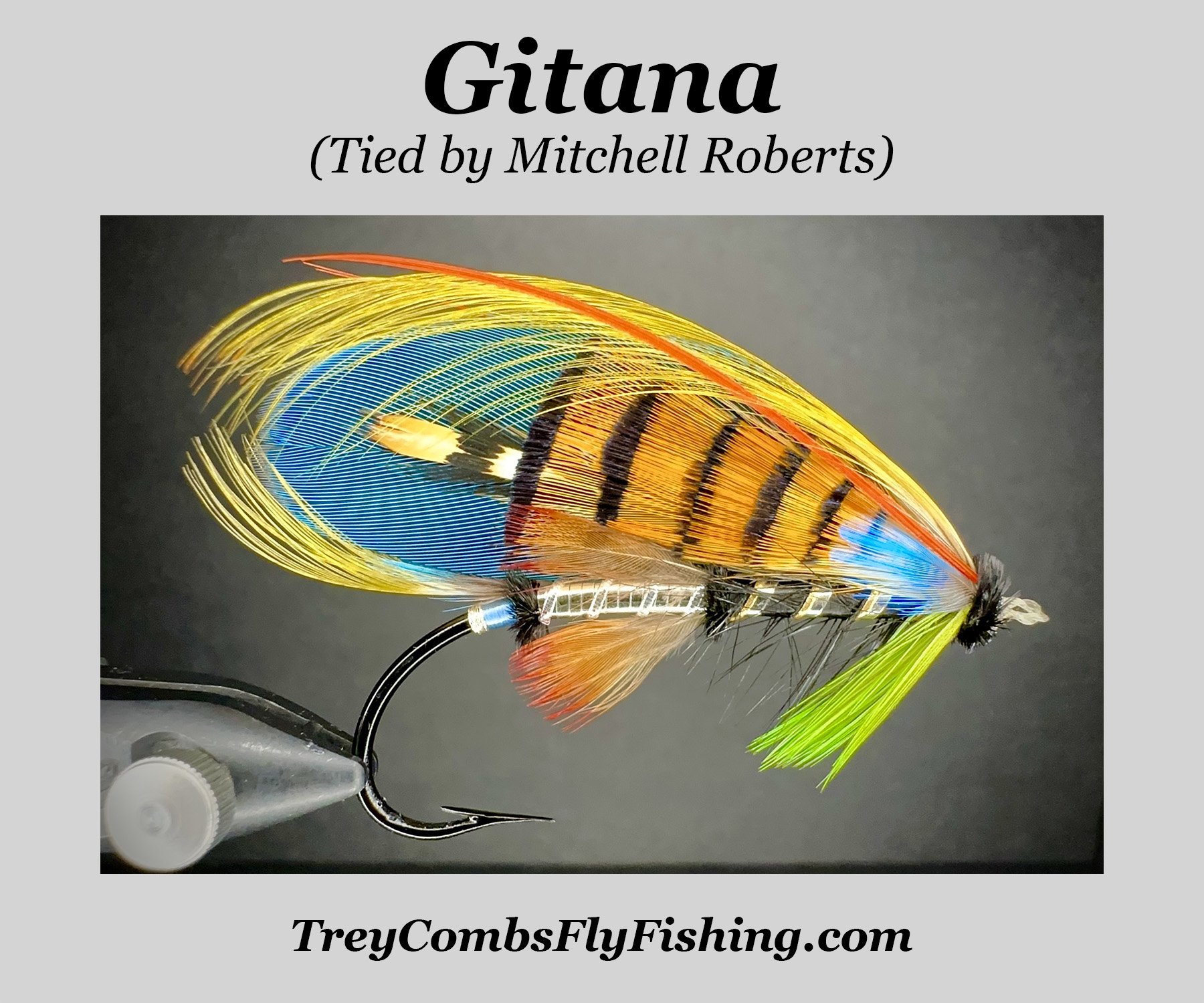
The Gitana is not a fly one encounters often. It is absent from many of the familiar pattern lists, does not appear in any of the Hardy catalogs, and is one of those ornate Traherne/Kelson dressings that seems to live at the edge of the classic salmon-fly tradition — admired, occasionally discussed, but rarely attempted.
George M. Kelson understood exactly what kind of fly it was. In his description of Gitana, he wrote that the fly represented “a definition of exaggeration,” an excess produced by the repeated use of brilliant feathers, especially “layer after layer” of tippet. That is the first thing one notices about the pattern. Gitana is not restrained — it is an explosion of color and extravagance.
The version shown here was tied by Mitchell Roberts, a talented dresser I discovered on Instagram. As someone fascinated by dressing history and smitten by both the historical and modern greats, I think Instagram is a powerful example of how social media can level the playing field for niche talent. A dresser no longer needs to be regularly published in fishing magazines or known through a small circle of collectors to have their work seen.
In 1976, when my father wrote Steelhead Fly Fishing and Flies, he didn’t have email, text messaging, or Zoom. He had to write letters, make phone calls, and drive to the homes of dressers he recognized as talented or influential. One of the reasons the book was so popular was that, for the first time, the fly-dressing community could see Syd Glasso’s flies in a color plate — plate #8 in the book. But today, the beauty of Instagram is that the fly itself comes first. Anyone can post a beautiful dressing, and that fly can be compared quickly against the work of modern dressing legends like Will Bush, Stuart Foxall, Satoshi Yamamoto, Mikael Frödin, and Steve Silverio, all of whom have an IG presence.
Roberts tied what is generally listed as the Gitana Variation, the version associated with Kelson’s Land and Water collection. It differs from another known Gitana dressing in several important ways. This version uses a blue tag rather than a red tag and calls for three pairs of tippets on the sides rather than five. Roberts chose Kelson’s Land and Water version but also decided to attempt the more difficult wing arrangement. As they explained, this was the kind of pattern they were unlikely to tie many times, and if they were going to do it, they wanted to take on the harder version of the wing.
Roberts’s decision to experiment highlights what is so fascinating about Victorian dressings. Modern dressers can choose to copy a pattern closely and attempt to use only original materials, or they can mix and match. While purists might frown on this, Victorian dressers routinely did the same thing. The Green Highlander is a good example: a dressing with several versions from the Victorian greats, as well as different versions in the Hardy catalogs.
Roberts also made some practical substitutions. Original materials for classic salmon flies are often difficult, expensive, or nearly impossible to obtain. In this dressing, golden pheasant neck feathers were substituted for Indian crow, and kingfisher was used in place of chatterer. Rather than weakening the fly, these substitutions point to one of the realities of modern classic salmon-fly dressing: historical accuracy matters, but so does the intelligent use of available materials.
The result is a striking modern Gitana. I’m guilty of “doom scrolling” fly patterns — an obsession I inherited from my father. As we have both grown older, talking about fly dressings has become one of the things we do. When I saw Mitchell’s Gitana, it stopped me in my tracks. It is faithful to the spirit of the pattern, honest about its substitutions, and beautifully executed. It is also a reminder that the classic salmon-fly tradition is not frozen in old books. It continues wherever a careful dresser studies the old sources, understands the pattern, and then brings it to life at the vise.
Gitana Variation Dressing Notes (From Kelson’s Land and Water)
Tag: Silver twist and blue silk. Tail: A topping and a chatterer. Butt: Black herl. Body: The first short half, flat silver tinsel ribbed with oval tinsel. Over this two Indian crows back to back, top and bottom, butted with black herl. The rest black silk. Ribs: Silver flat tinsel and gold oval tinsel over black silk. Hackle: Black from silk. Throat: Green macaw, the feather is from under the wing or tail of the bird. Wings: Two dark blue macaw feathers taken from the top of the wing, jungle cock on either side extending beyond tag, with three tippets overlapping on either side, the first reaching to the butt, and two toppings over. Cheeks: Blue chatterer. Horns: Red macaw, doubled. Head: Black herl. (Substitutions in the fly shown: golden pheasant neck feathers for Indian crow; kingfisher for chatterer.)
– Mark Combs
Explore more classic steelhead and salmon fly dressings in the Fly Pattern Dictionary, or in Trey’s latest book, Flies for Atlantic Salmon & Steelhead. The book is available directly from the author on Amazon in two formats:
Limited Edition Hardcover — $119.00 (Amazon)
Digital Edition — $24.99 (Amazon - Kindle)