The Glasso Legacy: A Steelhead Revolution, Part 3
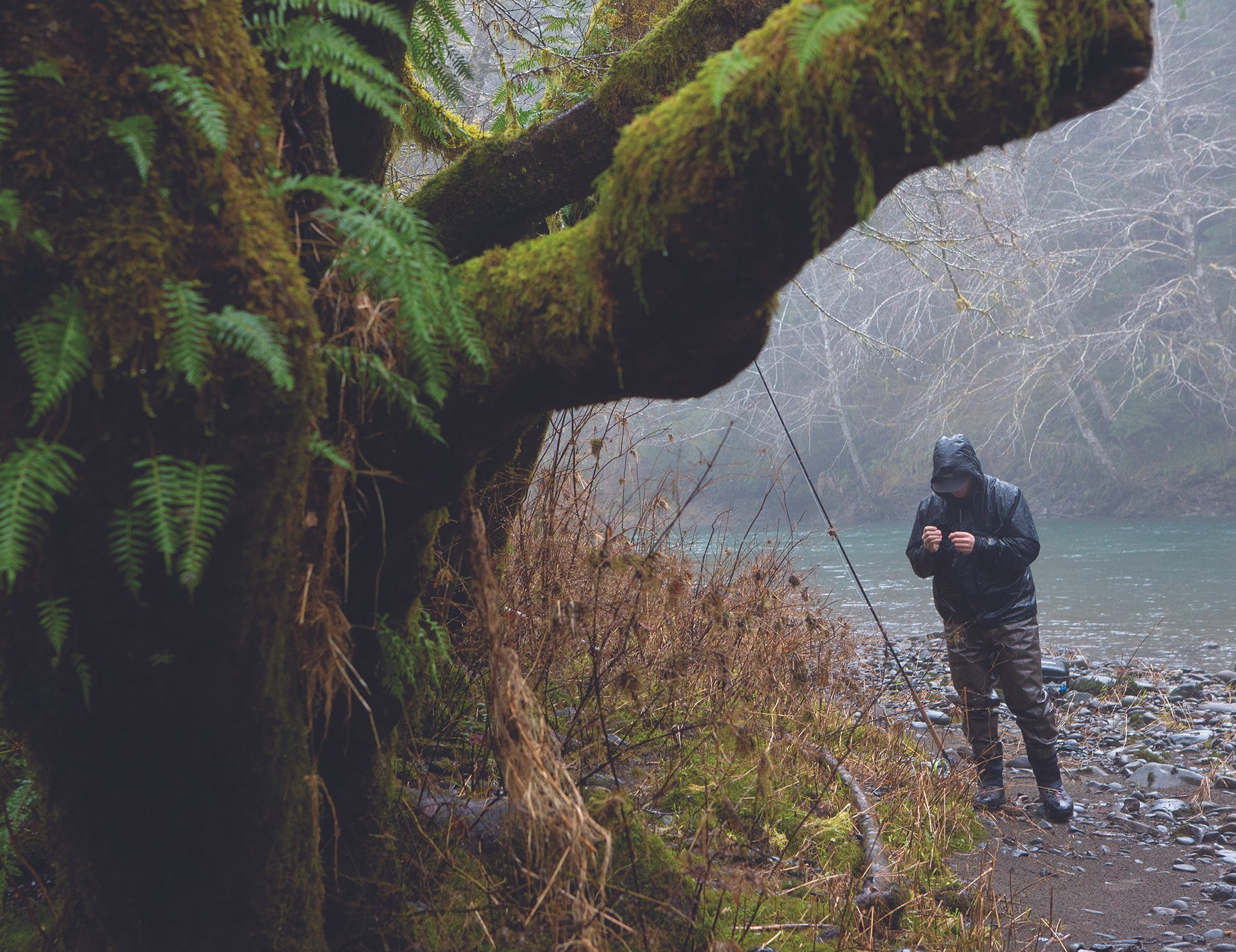
Angler tying on a fresh fly on the banks of the Sol Duc River on Washington State’s rugged Olympic Peninsula. This river and its race of legendary wild winter fish was the inspiration for a new, sleek look in steelhead wet flies. Desktop only: Right-click any image in this essay to open it in a new tab to view the high-resolution version. This feature is not available on mobile.
The Glasso Legacy: A Steelhead Revolution, Part 3
How Syd Glasso managed to sink his fly to a level where winter steelhead would take should be described. The classic down-and-across cast, where the fly is immediately swimming on a hard swing, strongly resisted sinking even with a heavily weighted fly—and this Glasso never did. The current simply begins to push the line upward as the currents grow ever-swifter nearer the surface.
To sink the fly, the fly line must be manipulated so that there’s a period of slack on the fly that gives it time to get down and begin swimming slowly, where steelhead are holding. A sinking line per se won’t necessarily do that. Strongly leading the fly must be employed, and that often will be done with a fly tied on a Waddington shank that additionally sinks the fly while promoting the swim. The fly passes downriver broadside to the current; the movement of the fly in the current takes place as the fly naturally swims to the angler’s side of the river.
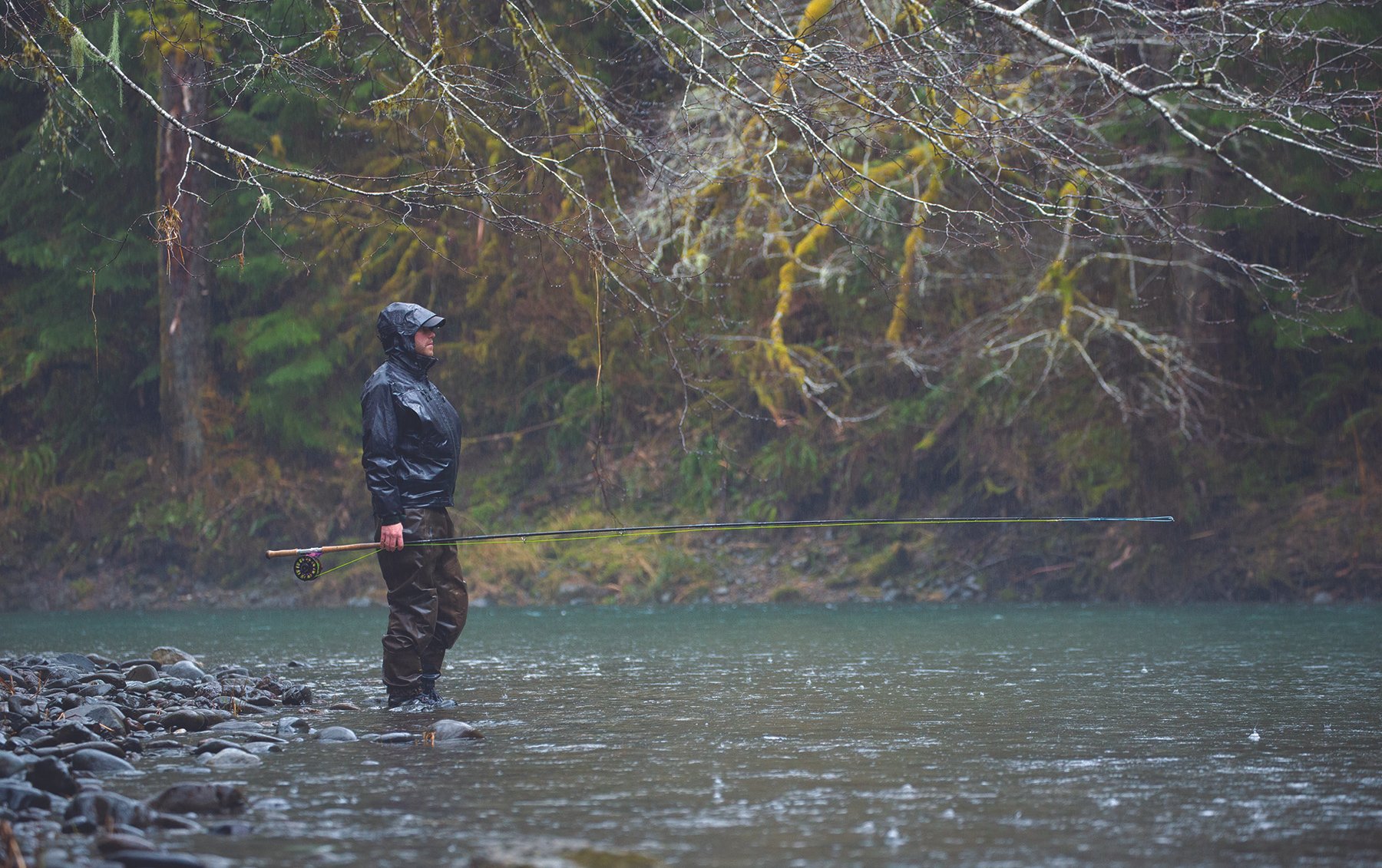
Forks, Washington, where Syd Glasso lived and taught, is drenched by roughly 120 inches of rain annually and promotes itself as “The Rainiest Town in the Contiguous United States.” It is also known, more recently, as the home of fictional vampires.
When Syd Glasso first began fishing for the Olympic Peninsula’s winter steelhead, he was casting a well-worn double-tapered silk line, a line that would sink slowly, but hardly fast enough to qualify as a winter line. I don’t know if he first employed the Scottish habit of fishing flies dressed on large, extra-heavy long-shank hooks, the weight of the hook taking the fly down. I doubt that as his tastes ran to beautiful and delicate Spey flies where hook size and dressing balanced perfectly.
For much the same reason, Glasso didn’t wind on an underbody of lead wire, much the most common way of sinking a fly through the 1960s. But I’ve never seen evidence of that either. Scientific Anglers Wet Cel sinking lines first came on the market in 1960. Until then a handful of anglers fishing winter rivers for steelhead were taking well-worn, porous silk fly lines and rubbing them down with red lead paint. The paint was brittle—suitable only for painting the bottom of boats worldwide—and it began flaking off on the first cast.
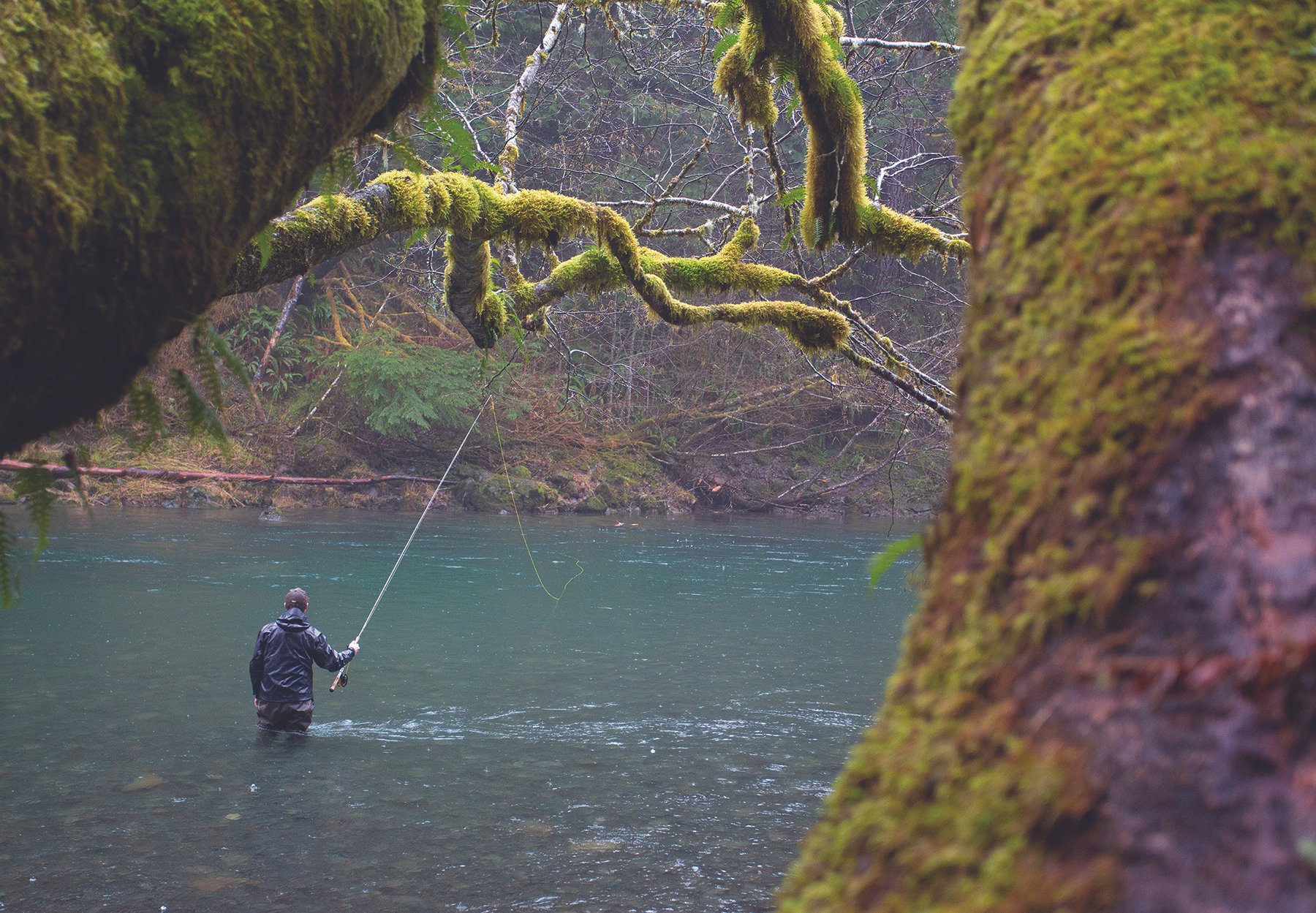
Steelhead fly fishers today wade the Sol Duc and other winter rivers armed with a wide range of calibrated sinking tips to get flies down to the fish. In Glasso’s day, he resorted to coating worn silk lines with lead paint.
Glasso bravely cast the line—steelhead fly fishing’s first chuck-and-duck line—with a nine-foot Orvis Shooting Star bamboo rod. Because the makeshift lines wore so poorly, Glasso carried several of them and could go through one after another as needed during the fishing day. He naturally tried to obtain maximum mileage out of each line. If he could wade above a seam of steelhead holding water, he could keep the fly swimming in the seam by holding the line in place after making a short lob or just stripping line off the reel. When Glasso waded off the confluence of the Bogachiel and Sol Duc, steelhead destined for either river would find his fly swimming in the current near the bottom. This technique drastically reduced the number of times he needed to cast and wait on the presentation.
Syd Glasso retired from teaching in the late 1960s and moved to Seattle to be closer to his daughter and her children. Patrick’s Fly Shop, a Northwest institution, became one source for materials and an important place for Syd to go and talk fly fishing. Visits from friends became his social circle that included Tom Darling and Bob Stroebel. They would join Glasso as founders of the Washington Steelhead Fly Fishing Club.
Glasso’s methods were as practical as his flies were elegant. His greater legacy, however, was the influence he had on the steelhead flies and fishing that followed.
A Revolution In Style
Before Syd Glasso died in 1983, he knew he’d revolutionized the way steelhead flies looked and the way Spey flies messaged back to us from Scotland. Northwest steelheaders—Anglophiles all—could not have been more receptive to the adoption, a transfusion from the rarified world of Atlantic salmon, of castles and kings, all meeting at our fly-tying table.
We embraced the relationship for how it elevated our individual fly-fishing world, to the refinement of the flies we tied to the two-handed rods we cast. Even the discipline we brought to how we methodically cast through a run became more thoughtful. There was something formal to this, like a tweed coat and a tie. Some anglers would return to fishing bamboo rods—even for Spey casting—and a very few would build extraordinary New World two-hand bamboo rods; a description that perfectly fits Bob Clay, A Canadian who first guided me on the Kispiox, literally his home river.
No one would claim a sheepskin fly book more practical than a Wheatley fly box, but then no display of Spey flies looked more natural than when resting on a bed of clipped wool. A few wealthy friends hung their Patagonia rain gear in the closet and put on their made-in-England Barbour waxed-cotton jackets, looking properly rumpled while driving their Land Rover to Spences Bridge to hunt for one of the few remaining Thompson River steelhead.
A handful of persons became famous fly tiers and perhaps could have today challenged the master. These few among the many, in no order, include Steve Gobin. Dave McNeese, John Shewey, Bob Veverka and Mark Waslick.
I can’t quite recall anything so comparatively dramatic since Ireland’s bright and flashy salmon flies had Victorian England standing on its head. I began emptying my fly boxes and replacing them with sleek flies tied on genuine turned-up-eye English salmon hooks. Gone was chenille in favor of organic dubbing. Fly shop owners watched fly fishers pore over their bucktails, searching for the rare tail with shorter and finer hair. Their search continued to the dorsal side of black bucktails where the fur was fine and short—what I used to tie Amato’s Night Dancer and Kaufmann’s Signal Light. Almost overnight, Arctic fox became the rage when tying white, black-and orange-winged flies. I used marabou blood plumes to tie steelhead flies with short wings that caught every current and with heads as small as pinheads.
The long bucktail that I once used to wing my flies was mostly wasted as I used only a bit of the ends. Now the long fur found perfect application with tube flies. Watching Roland Holmberg’s rod bob up and down and bring to life a three-inch-long black bucktail tube was a revelation. What the fly looked like at the bench didn’t necessarily mean how it would swim and attract steelhead. Roland’s simple fly was a sheep in wolf’s clothing, a deadly little tube fly missile. I bought a tube fly box and began carefully mounting my flies on its wire prongs, making sure each fly lined up perfectly. This was one more bullet in my belt.
In only a few years steelhead fly tying had grown exponentially. During these years steelhead fly fishing changed from a domestic and largely local following to the beginnings of an international following.
Until I began tying my winter steelhead flies on Waddington shanks, my favorite fly for clear water was the scarlet-and-white Admiral Spey. Every bag of saddle hackles included a few that were extra wide and webby. I carefully saved those in primary steelhead colors: orange, yellow, red.
I had received a bag of scarlet seal fur from a friend in England. At first I found the material tricky to spin, the short fur difficult to hold in a waxed dubbing loop. Yet the result was dramatic, the fur-like shards of scarlet glass over an underbody of flat French silver tinsel. I’d strip one side of the extra-wide Schlappen hackle, wind it forward, and pin it down with flat silver tinsel wound in the opposite direction. Instead of slips of white goose for the wing, I’d tie in a small bunch of white marabou blood plumes extending just to the point of the hook.
I had great faith in this fly, one that I was able to see for a considerable distance in clear currents. I never had enough of them. While staying in a cabin on Washington’s Skagit, I’d rise an hour early and try to get three of these Admirals tied before setting out for the day in my Aluma Drifter mini-jet boat. Rarely did I return with any of them, most lost to unforgiving rocks.
I imagined Glasso a kindred spirit, a man who fished in the wild west end, and who had caught a Field & Stream contest winner in 1959. I too had been grinding away on Peninsula rivers. And I caught almost nothing. No matter, I was a fellow winter steelhead fly fisher, and endured identical hardships while wading up and down the glacial rivers. I had not run into another fly fisher, and often I wouldn’t see another angler.
In this “band-of-brothers” climate I’d typed out a letter to Glasso and pined in a fly I’d tied using fluorescent yarn. The fly was nearly identical to the yarn flies I’d first fished using my drift rod and pencil lead. If the yarn fly worked—and nothing else was quite so crude—the rod it was cast from hardly mattered. Or so went my reasoning. Glasso read my letter with a patience it didn’t deserve and wrote back thanking me for the gift. At the time I had no idea that Syd Glasso was among the very best fly tiers in the world, who was fluent in the arcane language of 19th-century salmon flies.
I’d long forgotten about the letter when, after Glasso died, it appeared in some sort of auction. Dave McNeese saw it and bought the letter for almost nothing. Later he told me, “Syd must have looked at that fly and said, ‘What a piece of shit.’” We both howled with laughter over how naïve and unsophisticated I had been.
In hindsight, Glasso might have been a little irritated that I was passing myself off as a fellow fly tier, but he said nothing. Having taught school in a little rainforest town surrounded by ancient trees and pristine rivers filled with wild steelhead and salmon, not bringing attention to his remarkable skills and vast knowledge had become a practice he’d long perfected.
Read the Complete Syd Glasso Series:
The Glasso Age Begins: Sol Duc Spey, Part 1
Syd Glasso’s Transformation of the Wet Fly, Part 2
The Glasso Legacy: A Steelhead Revolution, Part 3
This blog is excerpted from the chapter on Syd Glasso in Flies for Atlantic Salmon & Steelhead. The book is available directly from the author on Amazon in two formats:
Limited 1st Edition Hardcover — available on Amazon
Digital Reference Edition — available on Amazon Kindle
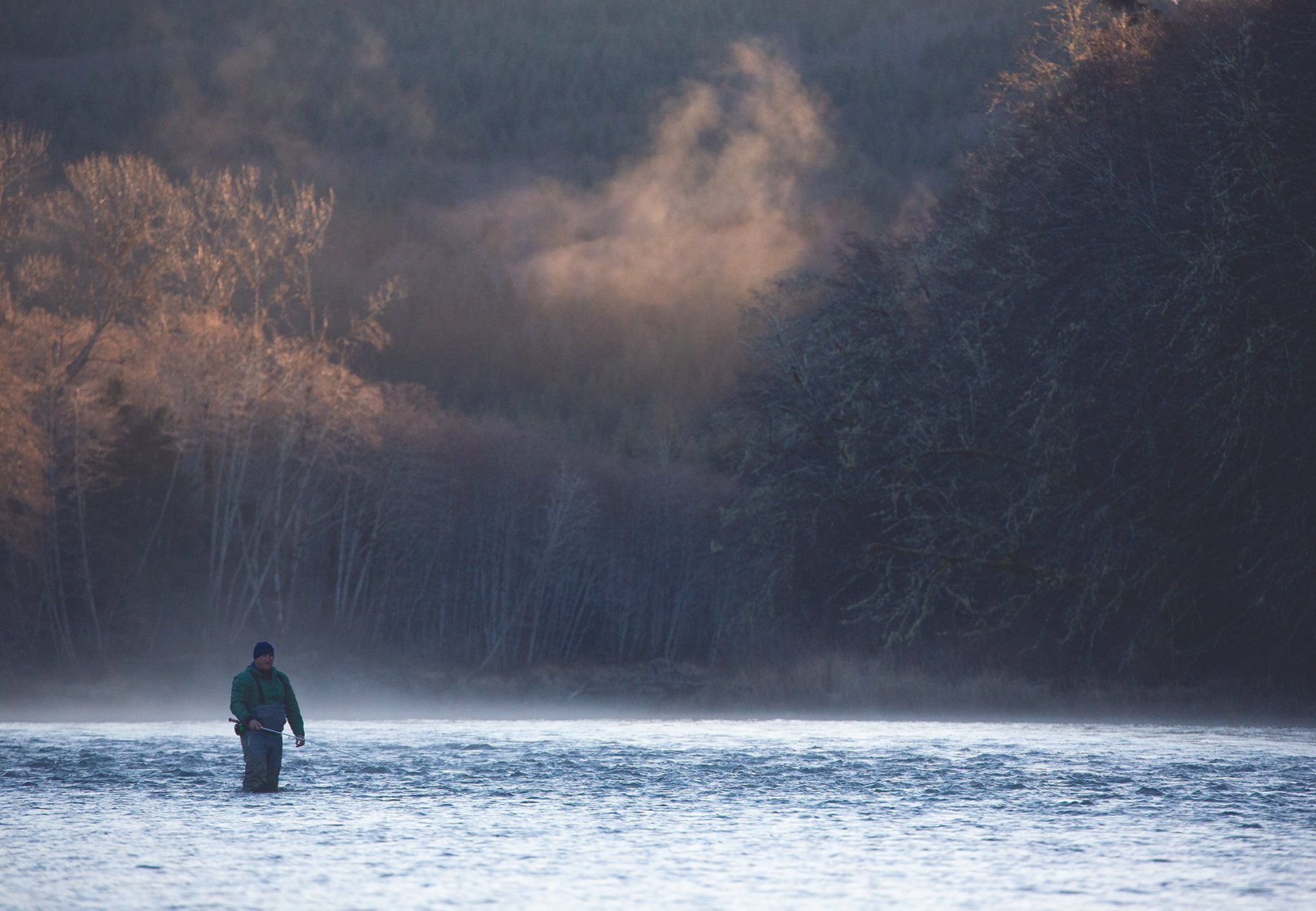
The 78-mile-long Sol Duc River heads in the breathtaking glacial peaks of Olympic National Park. It flows west through dense, green rain forests of giant Douglas fir, western hemlock, and Sitka spruce, and into a broad, rich valley. There the river forms gravel runs where steelhead hold—the water that helped shape Syd Glasso’s approach to steelhead flies and fishing. Lower down, the Sol Duc merges with the Bogachiel River to form the Quillayute before spilling into the Pacific at the tribal village of La Push, once an ancient whaling site.