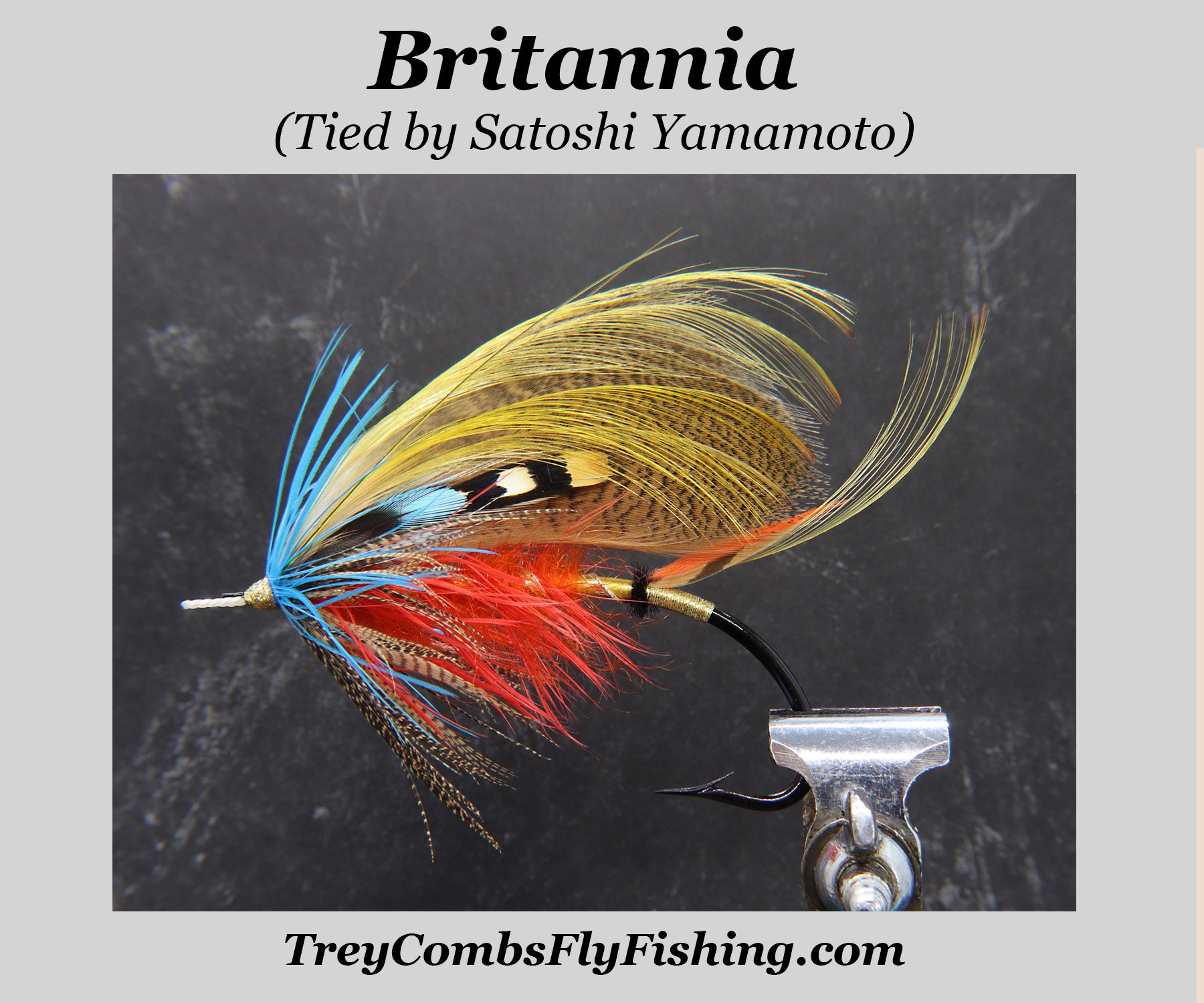
In The Book of the Salmon (1850), Edward Fitzgibbon regarded the Britannia as one of his favorite flies, and he placed it at the very top of the standard salmon patterns he knew. In his view, when a river was rising, high, and slightly colored, no large salmon anywhere would refuse it. His affection for the pattern was made clear in the line he wrote about it: “As Britannia is the ruler of the waves, this namesake of hers is the ruler of the waters.”
In A Book on Angling (1867), Francis Francis also praised the Britannia and wrote:
“The Britannia is a very rich fly, but it is a tried accepted favourite upon many rivers. It kills well on the Thurso, to which river, by the way, I first introduced it several years ago. I had very good sport with it there. The tag, gold twist; tail, a good-sized topping, a bit of scarlet ibis and fibres of bright bastard bustard; body, two or three turns of bright golden floss, and then bright orange pig’s wool, gold tinsel, and silver twist; bright red claret hackle; bustard or wood duck hackle over that, and dark blue or green hackle on shoulder, or rather as a ruff over the wing; under wing, a couple of shovel duck feathers, with from three to five toppings over it; two short jungle cock on either shoulder, and two shorter still kingfisher just below them at cheek; head, gold thread. A very warm gorgeous-looking fly. By using a dark orange or a red-brown hackle, the warmth of the fly may be toned down. The green shoulder-hackled fly is my favourite. Size, 4, 5, or 6.”
The Britannia, without question, is a classic salmon fly, as evidenced by several later variations published by different authors. According to Classic Salmon Fly Patterns (Mike Radencich, 2010), the pattern is also recorded by George Kelson (The Land and Water, 1886; The Salmon Fly, 1895), Major A. T. Fisher (Rod and River, 1892), Herbert Maxwell (Salmon and Sea Trout, 1898), and J. H. Hale (How to Tie Salmon Flies, Third Edition, 1930). This record spans from 1886 to 1930, showing how the Britannia continued to appear in print long after Fitzgibbon and Francis Francis. Each pattern differs slightly, incorporating different materials or styles. Yet each one is easily recognized as “The Britannia” at first glance.
Sir Herbert Maxwell also included a version of the Britannia, describing it as a colorful salmon fly with a reputation as an effective “killer.” His dressing was closer to the version praised by Francis Francis than to Fitzgibbon’s original, though Maxwell’s treatment of the hackle and wing gives his Britannia its own character.
Kelson also recorded a Britannia pattern, and his version appears to stand between Fitzgibbon and Francis Francis. Kelson credited Mr. Bernard as the originator of the Britannia, along with several other patterns, including the Louise, Lorne, Lady Blanch, Harlequin, and Goldfinch. That attribution is doubtful, however, since the Britannia was probably already in existence before Bernard composed his own fly patterns.
Kelson also noted that the Britannia was an excellent fly for the Wye and an old standard pattern on the Thurso, the river where Francis Francis had earlier introduced it. His version was the same as the one recommended by Hardy and Hale, and appears to be a slightly modified or modernized form of the older Britannia.
The Britannia was included in the Hardy general list from 1886 until 1897, and again from 1907 until 1912. It was also mentioned in the catalogues as one of the flies recommended for the Wye. Curious – while flies like the Jock Scott and Green Highlander continued for decades, it was last seen in the general catalog in 1912.
Notes From the Dresser:
We are incredibly grateful to have the image of the Britannia for this essay, which comes from the world-class vise of Satoshi Yamamoto. Regarding this version of the Britannia, he writes:
“I had a special blind-eye hook made by the late Ronn Lucas Sr., called a Britannia, and a very good pair of shoveller duck feathers, which are common to all variations. As I studied each element of each pattern, I started to ponder if I could combine all the distinctive features from all the patterns. Yet I envisioned a fly that would be recognized as The Britannia at a glance. For example, some descriptions call for one element for ribbing, while others call for two (oval and flat tinsels) - I chose the latter. Number of toppings described is either one or more - I tied in multiple toppings.
Would this be considered my original design? Kind of - but not really. I still think this is The Britannia and I’d like to believe so for most everyone’s eye. Some contemporary fly dressers are sticklers for the materials lists provided by each author. However, if one reads literally between the lines, considering (or at least imagining) historical backgrounds and life in general back then, I believe, it would be highly unlikely that the complicated patterns, such as The Champion or Jock Scott, would have been conveyed accurately from one author to the next, or among fly dressers. It would also have been due to the availability of feathers on the desks of authors or fly dressers at that point.”
About Satoshi Yamamoto
Satoshi is the author of Atlantic Salmon Flies of Major Traherne and Trout Foods & Flies For Livingston’s Spring Creeks. His flies are also available as custom collectibles, framed and mounted for display. Learn more about Satoshi’s books and custom framed flies through the links below.
Framed Custom Flies
Atlantic Salmon Flies of Major Traherne
Trout Foods & Flies For Livingston’s Spring Creeks
Contact Satoshi
Selected Britannia Dressing Notes
Britannia (Hardy Catalog - From Francis Francis)
Tag: Gold twist
Tail: Golden pheasant topping, fibres of ibis & florican
Body: 2 or 3 turns bright golden floss, followed by orange seal’s fur
Ribs: Gold tinsel & silver twist
Hackle: Bright red claret, bustard or summer duck
Wing: Two shovel duck feathers with 3 to 5 golden pheasant toppings
Cheeks: Jungle & kingfisher
Head: Dark blue hackle, & gold thread
Britannia (Edward Fitzgibbon)
Tail: Two toppings, rather long
Butt: Black ostrich herl
Body: Orange pig’s wool
Ribs: Gold and silver twist
Hackle: A scarlet or blood-red hackle
Shoulder: A purple hackle at and above the shoulder
Wings: Two shoveler duck feathers and four toppings
Sides: A blue chatterer feather each side and outside, and a little under them some silver pheasant tail feathers
Head: Small and black
The Britannia (Kelson)
Tag: Gold tinsel
Tail: Topping
Butt: Black herl
Body: Red orange seal’s fur
Ribs: Gold tinsel
Wings: Shovel duck & topping
Sides: Jungle cock
Cheeks: Chatterer
Horns: Blue macaw
Head: Dark blue hackle