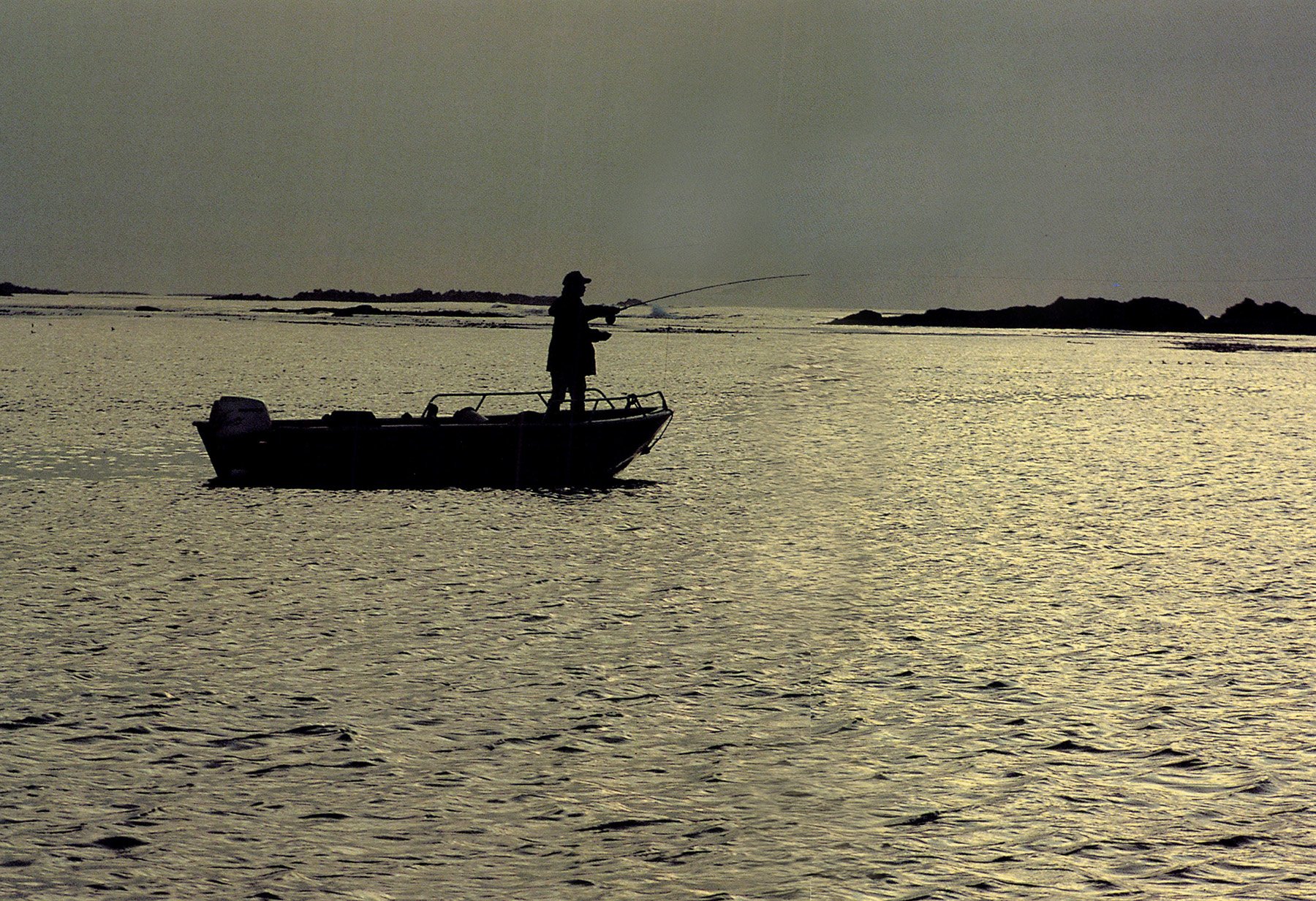
Fly fishing off Langara Island, British Columbia. Photograph by Trey Combs.
Langara Island and the Dream of Big Salmon
Before reading Trey’s chapter on Pacific salmon from his book Bluewater Fly Fishing, I want to point out that fly fishing for Pacific salmon off Langara Island should be considered, in some ways, a European-style experience: a chance to pursue and land large wild fish, on a fly rod, in a remarkable setting. Many anglers know they may never fish the great salmon rivers of Europe. Rivers such as Norway’s Alta are legendary, but access is limited, permits are difficult to obtain, and for most anglers the dream remains out of reach. Langara Island offers something different, but it can fulfill some of that same dream while keeping anglers in the Pacific Northwest.
There is also a great deal of discussion right now about declining steelhead and salmon runs. Those concerns are real, and the conversations are valid. But fly fishing for salmon off Langara Island points to another kind of opportunity: a rare chance to fish the high seas for several species of large wild Pacific salmon that are not spawning, but feeding. Once hooked, these fish offer a thrilling experience that belongs in the same conversation as landing a North Atlantic salmon on one of the great destination rivers.
— Mark Combs
Pacific Salmon - Langara Island, British Columbia, Canada
(Excerpt From Bluewater Fly Fishing)
Editor’s note: North Island Lodge, referenced in Trey’s original chapter, was the lodge name/program at the time of Trey’s visit. Langara Island continues to operate as a fishing destination today, but the excerpt below is preserved as originally written and reflects the lodge structure and guide program of that period.
British Columbia's storm-swept Queen Charlotte Islands possess the soul of the Haida culture: Gwaii Haanas, "Place of Wonder," say these daring seafaring people of their archipelago. Biologists, with no less wonderment, call the 138 islands the "Canadian Galapagos" for the wealth of endemic plants and animals that evolved here during their long isolation from the mainland. Backpackers, too, embrace the Misty Isles, losing themselves in the silence of moss-carpeted trails that deer and bear have tunneled deep into the ancient forests of Sitka spruce, hemlock, and red cedar. But the Charlottes reserve their greatest riches for anglers. Five species of Pacific salmon, high-seas fish in the prime of life, salmon from nearly every watershed between northern Oregon and southeastern Alaska, stop during the last summer of their lives at·tiny Langara, the Charlottes' northernmost island. For those anglers who cast a fly, Langara is paradise.
The dynamics that create this remarkable high-seas rendezvous are several. The Queen Charlottes perch on the very edge of the continental shelf, where massive cold-water upwellings bring to the surface dissolved nutrient salts, mainly nitrates and phosphates. These are energized by the sun and absorbed by phytoplankton, the foundation of the marine food chain. The phytoplankton bloom that occurs during long hours of spring and summer daylight feeds copepods and other crustaceans, which support immense schools of Pacific sand lance (Ammodytes hexapterus) and Pacific herring (Clupea harengus pallasi), which in turn feed the vast numbers of migrating salmon. Anglers familiar with these baitfish on home waters are astonished when encountering great rafts of them at Langara. Sand lances, known as "needlefish" along the Canadian coast, and "candlefish" in Washington's Puget Sound, may be so tightly balled by feeding salmon and rhinoceros auklets that gulls can stand on the tumult. At such times, bald eagles swoop down to snatch up dozens of the fish in their talons and carry them to waiting young.
The second reason for Langara's concentration of salmon is the way these high-seas fish close with land in preparation for a final migration to their spawning rivers. Dixon Entrance, a deepwater passage between the Queen Charlotte Islands and Alaska's Dall and Prince of Wales islands to the north, lies at the right latitude to draw salmon, in summer, from the high seas to its fjord-rich coastline, and to its many reaches and channels that comprise the Inside Passage between Washington and Alaska. Directly east of the Queen Charlottes is Hecate Strait, where the water is so shallow that if the ocean level were to drop 50 feet, one could walk, at low tide, the 40 miles from the mainland to the islands. Storms here cause seas so steep that boats have collided with the ocean floor. "Horrible Hecate," say the commercial fishers who cross it at their peril for the richer fishing grounds beyond. But the shallow strait concentrates salmon at Dixon Entrance and the northwest Charlottes in general, and at Langara in particular.
Once salmon have reached Langara, the abundant food supply holds them for weeks, until sexual maturation moves them toward their spawning rivers. Ultimately, the shorter days of fall cause declines in the herring and sand lance populations. By winter, only small, immature silver and chinook salmon remain to pursue remnant baitfish.
Steve Shelly, a steelhead fly-fishing companion of mine from our days together at Chick and Marilyn Stewart's Babine Steelhead Lodge, manages the guide program at Langara Island's North Island Lodge. This has traditionally been a gear-fishing program for chinook salmon, known in Canada as the "spring" or "tyee," the latter name reserved for chinook salmon weighing 30 pounds or more. Shelly and lodge owner Fred Edworthy had long been interested in building a fly-fishing clientele at North Island. To this end, Edworthy asked if l would be interested in coming to his lodge and sampling the fishing.
I first visited the Charlottes fifteen years ago, sailing with my wife and two children aboard Shearwater, our 38-foot cutter. We wandered for more than a month along the coasts of Graham and Moresby Islands, diving for abalone and rock scallops with sea lions, visiting deserted Haida villages, fishing the bays for salmon and yelloweye rockfish, and finding sea-run cutthroat in the little streams that ran off the Queen Charlotte Mountains. The experience left me with an abiding fascination with the islands, and a determination to one day return.
I asked Les Johnson from Seattle, Washington to join me. He had co-authored Fly Fishing for Pacific Salmon (Frank Amato Publications, 1985) with Bruce Ferguson and Pat Trotter.
I was confident of finding the "northern coho"-silver salmon weighing in the teens-that crowd Langara late each summer for a final feeding binge. Shelly had told me to expect ocean-bright pink and chum salmon, too. Edworthy's interest naturally centered on the huge chinooks. Neither Shelly, Johnson, nor I had ever caught them in deep water. The Charlottes' huge tides could further complicate our efforts. Rick Steen, an extremely knowledgeable Canadian saltwater fly fisher who guided on the Charlotte Explorer, and who had caught many ocean chinooks on a fly, had once described large chinooks to me as "the hardest fish to take in salt water, worse than permit."
Johnson and I flew on the lodge's charter flight from Vancouver, British Columbia, to Masset on Graham Island. While waiting for our amphibian shuttle flight to the lodge, a Museum of Flight-perfect Grumman Goose, we asked a departing angler for an update on the fishing.
"Well, in four days my partner and I boated seventy-two springs that averaged 25 pounds. The largest weighed 56."The man's laconic answer contrasted to my wide-eyed, open-mouthed look of disbelief. Where I come from, in Washington's salmon-rich Puget Sound, a single 25-pound chinook in a year is reason to buy the house a round.
Shortly after our arrival, Edworthy and I reviewed the lodge's current catch records and confirmed these remarkable figures. The possession limit on springs is four. Guides at North Island and neighboring Langara Lodge encourage anglers to kill salmon injured by the hook, "bleeders," regardless of their weight. Nevertheless, for the previous eight weeks, the average chinook killed and packed for shipment home weighed exactly 30 pounds.
Iced-down chinook, many over 40 pounds, filled tubs on the dock. These were remarkably handsome fish, so sexually immature that no kyping (hooking) of their jaws disfigured their sleek, hog-fat lines. Colors remained high-seas silver and gunmetal gray, a dress I had associated only with winter-caught chinooks, Washington's blackmouth salmon, and the feeder springs of lower mainland British Columbia.
Could these salmon be taken on the fly? Edworthy told us that the previous year a Canadian fly fisher had watched a spring of 40 pounds crashing bait; he had cast to it, hooked it, and successfully landed it, the only chinook thus far caught while fly fishing at North Island Lodge. One salmon does not a strategy make, but that was our only lead, a fish Johnson and I searched for in vain. In the meantime, other salmon found our flies, an embarrassment of incredible riches.
Langara Island is somewhat shaped like a frying pan, the handle fitting deep into Parry Passage, the narrows that separates huge Graham Island from tiny Langara. North Island Lodge, a luxurious condominium built on an ocean barge, floats in a tiny bay at the end of the handle. Headlands, rocky islets, bays, and reefs characterize Langara's convoluted coast. Boats remain in radio contact with each other and guides readily communicate news of a chinook bite. Within a few minutes of such news, anglers from North Island, neighboring Langara Lodge, and the Charlotte Princess mothership are racing toward the action. Boats pile up, the congestion forgivable; chinooks are on the cutplug herring before anglers can get a dozen pulls off their reels. Everyone hooks up, the boats drift apart, 50-pound tyee sometimes taking anglers a mile away.
Amid this action are the other salmon, the pinks, chums, and coho, magnificent 4-to-15-pound fish slashing through the ever present schools of bait. This goes on before the chinook bite begins and continues long after the deep running chinook have slipped away for other headlands to plunder their herring and sand lance.
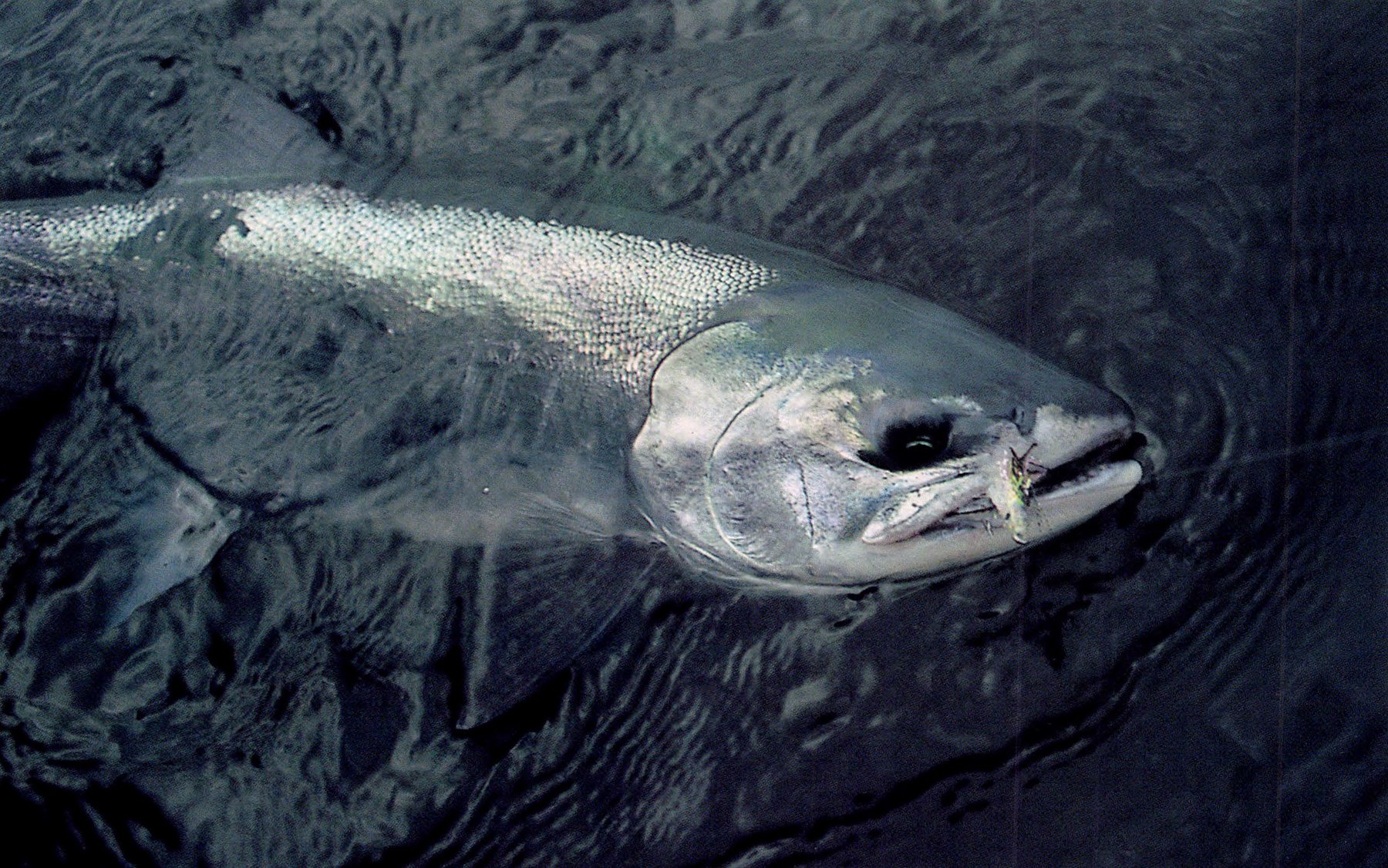
This Langara Island chum salmon hit a Sea Habit Bucktail in the Herring pattern. Photograph by Trey Combs.
Tackle and Flies
I fished a 9-foot 8-weight rod lined with a 30-foot shooting head, sink rate IV, and a .030 medium-sinking monocore running line for pink, coho, and chum salmon. My 9-foot leader tapered to 15-pound test. If there had been really large coho about, or if I’d located chinook crashing baitfish near the surface, I would have changed to a 9-weight. My saltwater reel held 250 yards of 20-pound backing. For chinook salmon, I fished a forward taper, experimental Scientific Anglers Bluewater line with a sink rate the same as that of the 550-grain Deep Water Express. (This line, not yet in production, can be reasonably duplicated with a forward taper full-sinking line in a sink rate of V.)
I fished Sea Habit Bucktails and Sea Habit Deceivers in the Herring and Sardine patterns. A single fly-basically a Sea Habit Deceiver in the Sardine pattern tied long and extremely thin to imitate a sand lance-took four species of salmon.
For the Deceiver style that imitates the Pacific sand lance (pictured below). Tie in a few strands of bucktail mixed with pearl Flashabou at the tail. Tie in two to three thin white saddle hackles on each side. Tie in an underbody of pearl Flashabou as described above. Tie in white bucktail as described above. Tie in a few strands of lime green and olive Krystal Flash above the midline. Tie in a few strands of lime green bucktail. Top with olive Krystal Flash. Topping: Moss FisHair. Shoulder with a few strands of silver Krystal Flash. Head: Color the Sea Habit head with any glitter paint or marking pen that matches the moss FisHair.
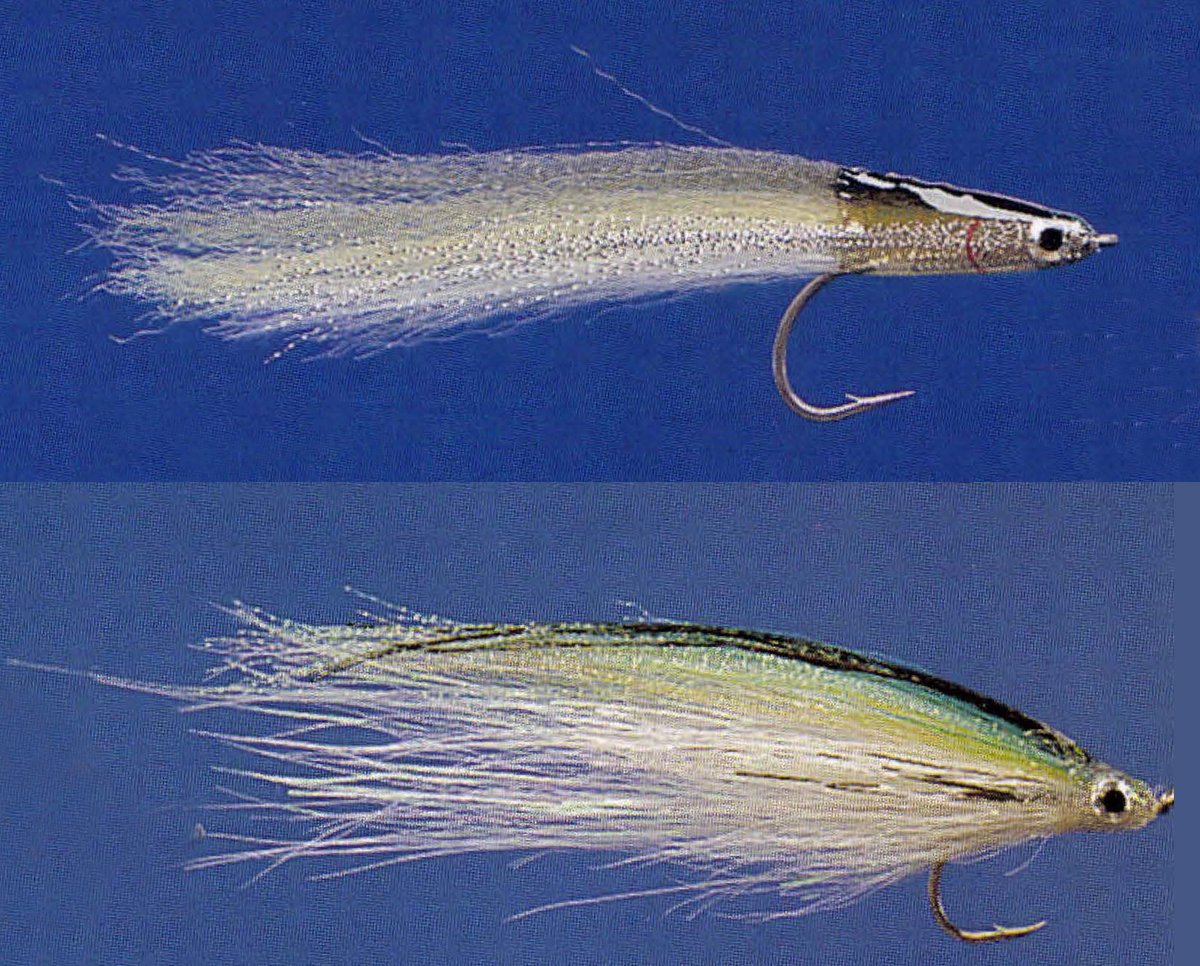
Top: Sea Habit Bucktail Sardine. Bottom: Sea Habit Bucktail Deceiver (Sardine Pattern)
Pink Salmon (Oncorhynchus gorbuscha)
Pink salmon, named for the color of their flesh, and called "humpback" salmon, or "humpies," for the disfigurement that characterizes their sexual maturity, are fine-scaled, remarkably handsome fish of four to six pounds at Langara. With a range in both the Pacific and Arctic Oceans and the Bering and Okhotsk Seas, and a distribution in North American rivers from California's Sacramento to the McKenzie in Canada's Northwest Territories, they number among our most abundant salmon.
Pinks have a characteristic way of leaping out of the water on their flanks when they pursue crustaceans and small baitfish, a kind of skipping action that marks them at a considerable distance. They showed a decided preference for open water; rarely did we find them around the dense forests of kelp that filled the shore and small bays. I thought them the most surface-oriented of the salmon, often taking our flies as we stripped them back only a foot below the surface. I didn't observe them balling up bait, and I didn't notice them joining coho or chum salmon that did so. For this reason, we often took pinks incidentally while casting for the larger coho and chums that were charging around tightly packed schools of herring and sand lance.
Fly selection was for me simple and straightforward: Sea Habit Bucktails, sizes 4 to 1/0, in the Sand Lance and Herring patterns.
No special retrieve was necessary. I generally cast the fly blind to where pinks were feeding, gave the fly a few seconds to sink, and began stripping it back. The shooting head allowed me to cover a lot of water with ease.
Pinks took the fly solidly and fought well enough to take me into my backing. I wasn't thinking of world records, and hadn't bothered checking the International Game Fish Association's 1993 World Record Game Fishes. Therein, all Pacific salmon are listed as "freshwater species." For pink salmon, the 10 kg category, added in 1992, was vacant. Records in the 8 kg and 6 kg categories were 5 and 6 pounds-pinks Johnson and I found ourselves releasing.
Chum Salmon (Oncorhynchus keta)
Coho Salmon (Oncorhynchus kisutch)
Anglers searching for chum salmon in fresh water or on saltwater flats near the mouths of spawning rivers find green-backed fish with deep red vertical markings. Their hooked jaws are grotesquely bared with long canine-like teeth, a physical characteristic that some say was the inspiration for their common name, "dog salmon." (Alaskan natives feed their sled dogs chum salmon. I belive the common name "dog salmon" actually derived from this custom.) Such aesthetically unappealing fish would be hard to love were it not for their incredible strength. First-time chum fishers immediately subscribe to the widely held belief that, pound for pound, they are the strongest of all Pacific salmon.
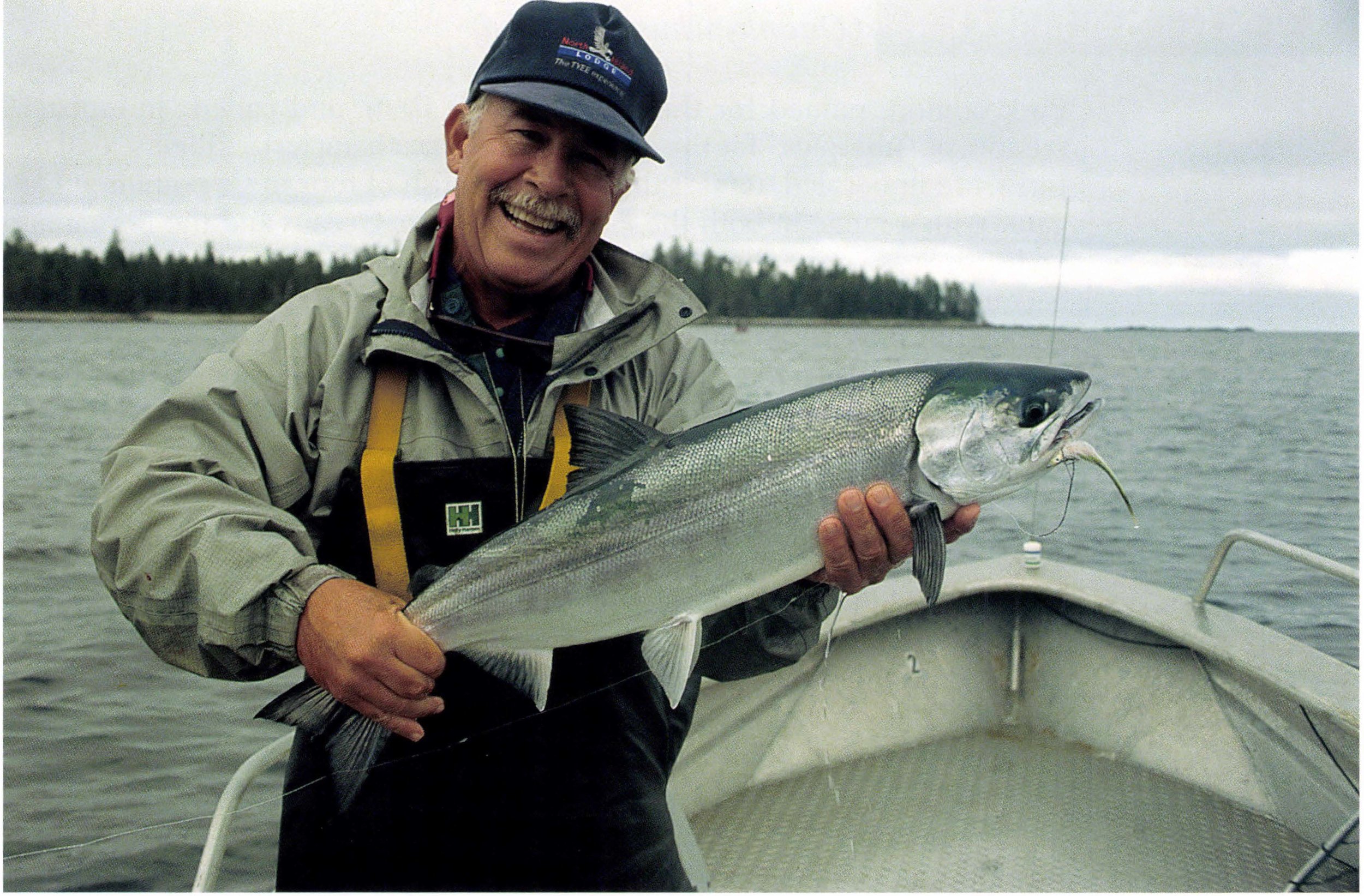
Trey Combs holds an ocean-bright 10-pound chum salmon. Photograph by Les Johnson.
The same species, when a high-seas, fly-caught salmon, is a revelation. No salmon is more dramatically handsome, with indescribable shades of blue and grass green over the eyes that give way to dorsal runs of traditional salmon colors, gray and silver, but overlaid with traces of green. When hooked, an ocean chum shakes and twists before exploding into a series of long runs interspersed with leaps that can make a coho look lame. As the fish tires, it remains bull-tough, turning on its side and resisting the rod every inch of the way.
Though chum salmon are widely distributed throughout the Pacific and Arctic Oceans, the Bering Sea, and the Sea of Japan, and ascend rivers from California's San Lorenzo to at least as far east as the McKenzie in the Northwest Territories, the Queen Charlottes offer the best opportunity to take them as sexually immature ocean fish. I often found myself casting for chums in water 80 feet deep, while behind me, only 300 feet away, Pacific white-sided dolphin had schooled up in water that was hundreds of fathoms deep.
We regularly observed coho and chum salmon ball sand lance and herring into pulsating masses 30 or more feet across, and 10 feet deep. We could not separate the species as the salmon streaked through, under, and around the bait. If we cast on the bait and immediately began our retrieves, we invariably hooked baitfish. Letting a fly sink until it had fallen below the bait avoided fouling the fly, and gave it the appearance of a cripple.
Under these conditions, I fished my Sea Habit flies, either Bucktails or Deceivers, tying the fly onto the tippet with a fixed loop knot. The epoxy-soaked head tipped the fly head down on the sink, leaving the narrow fly to flutter helplessly downward. The chums and coho often took the fly when it was in this attitude. If they didn't, a few strips-casual, so the fly worked properly - were all that was necessary to get a strike.
While on the subject of coho flies, I must add that the tandem hook coho fly, with the forward hook down, and the rear or "stinger" hook up, is an outgrowth of "bucktailing," the fine art of trolling a fly in the wake of the boat that pioneering Canadian angler Jimmy Gilbert perfected two generations ago. Many Pacific salmon fly fishers have assumed this tying habit. But fly casting is not trolling. When casting, I believe the tandem hook arrangement both unnecessary and unwise. Coho and chum salmon attack flies from many different angles and invariably find the single hook. More importantly, tandem hooks detract from the action of the fly, which never dives as effectively as does one tied on a single hook. Also, the stinger hook can foul the material in the fly, especially if FisHair is used, creating on each false cast an ever greater mess. I believe that using a traditional 3X or 4X long streamer-type hook is equally unnecessary. It fouls too readily on the cast and adds absolutely nothing to the fish-catching attractiveness of the fly. I go to the opposite extreme, tying my Sea Habit salmon flies on short shank bait hooks by Gamakatsu and Owner.
We often located chum and coho lurking at the edges of the thick kelp forests that filled the shoreline. These fishing areas were especially productive where the kelp clung precariously to severe, wave-pounded drop-offs. The salmon either pinned baitfish against the walls, or dashed out from the cover to attack cruising schools of baitfish. In either case we simply cast at the shore, gave the flies ten seconds to sink, and began strip retrieves. The retrieve could be a mixed bag: long, short, quick, and slow. Regardless, angling success remained constant.
After a couple of days casting along these edges, I felt that the chum salmon required a deeper sink than did the coho. When I gave the fly a half minute to sink before stripping it back, the chum might immediately pounce on it, or track it nearly to the surface before grabbing it only a rod's length away.
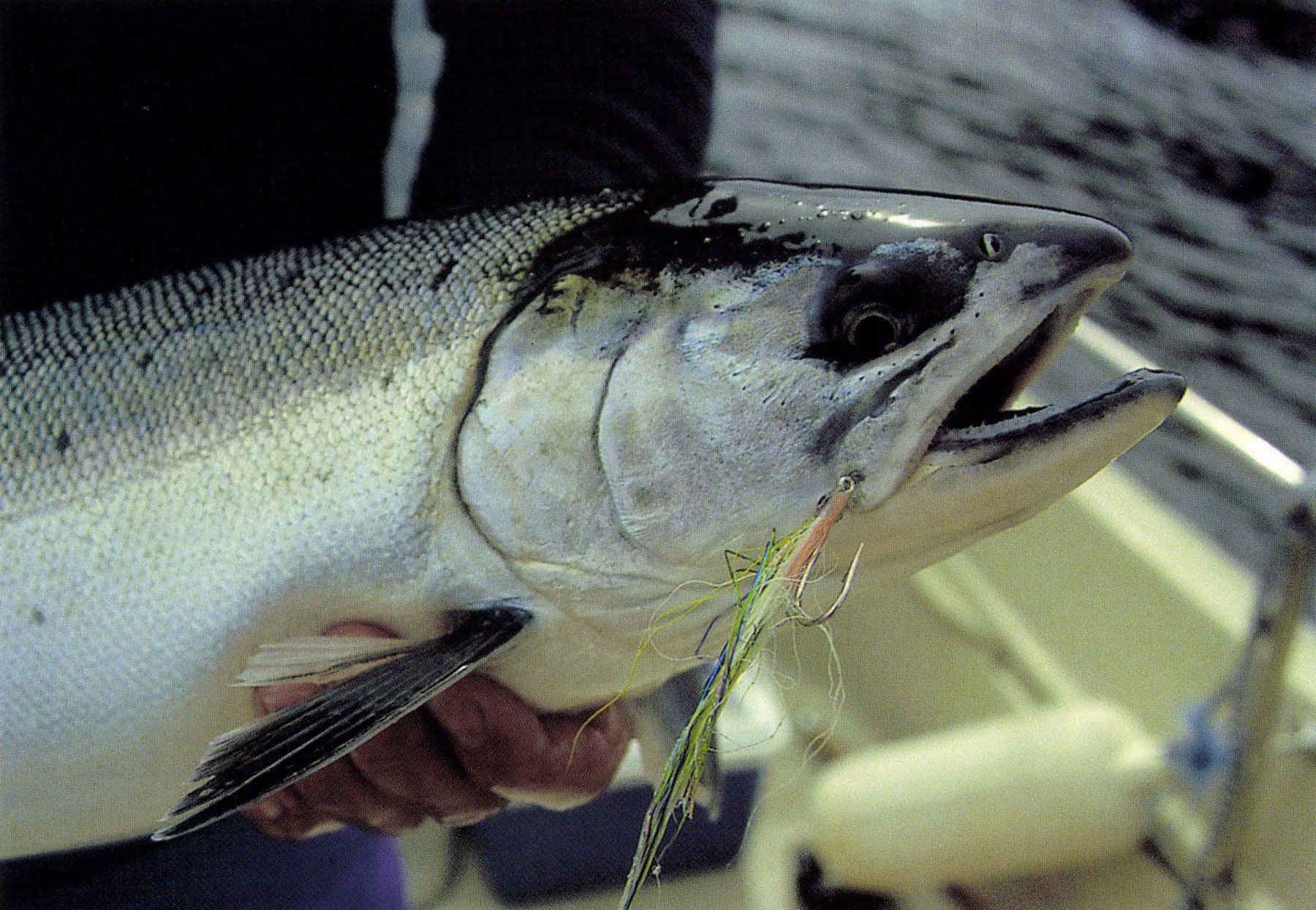
This silver (coho) salmon hit the Butktail so hard that the fly passed completely through its jaw. The fly had to be cut off to make a safe release. Photograph by Trey Combs.
Chinook Salmon (Oncorhynchus tshawyscha)
Finding ways to take chinook, the springs and great tyee, in deep water when the bite was on became our challenge. Rick Steen likens them to "sumo wrestlers waiting to be fed," fish that suck in baitfish from a foot away, and take deep-running flies as lightly as any trout picking up a nymph. I had jigged for chinooks in deep water on gear and remembered how they often took lures that were fluttering down on the drop between upstrokes of the rod. I decided to duplicate, as closely as possible, this approach while using flies.
Johnson and I fished full-sinking forward taper lines, a IV and an experimental VI respectively. The considerable weight in the running lines made long shoots impossible, but the sink rate allowed us to reach the level where chinooks were feeding, and then keep theflies swimming at this level. To accomplish this, we found it necessary to fish on, or nearly on, the slack tide, and to do so where there was very little wind. We began the presentations by casting the flies in the direction the boat was drifting, paying out additional line as we floated over the fast-sinking lines. We would then pass the lines around the bow or stern of the boat and begin the retrieves as the lines assumed a slight angle away from the boat. At this point our flies were down 50 feet or more, and the 25-meter fly lines entirely off the reels. We retrieved the flies in slow, short strips while giving the rod tips slight twitches.
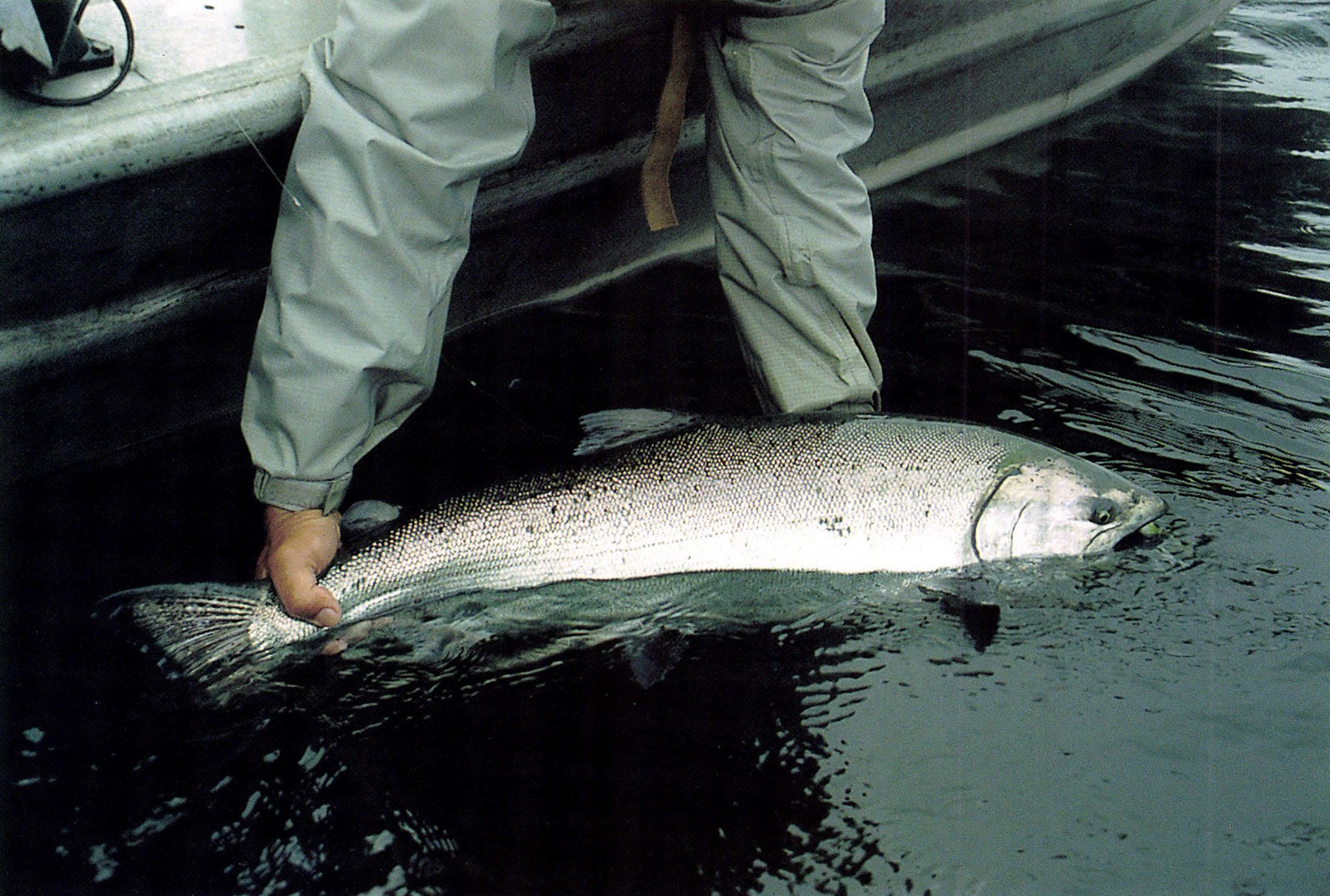
Trey Combs releases a fly-caught chinook salmon. The fish look a Sea Habit Deceiver tied to suggest a Pacific sand lance. Photograph by Les Johnson.
The fly I found most effective was a Sea Habit Deceiver tied to imitate the sand lance-an especially thin, primarily white dressing. It would swim nearly straight up on the short strip and rod twitch, and then turn head down on the slack created when the rod tip was dropped. Sometimes a chinook would follow the fly right to the surface, but usually it crushed the fly while on its feeding level, 30 to 50 feet down. If the wind remained light, I could release retrieved line when the fly was halfway to the surface and then repeat the retrieve. Wind blowing more than a couple of miles per hour on the slack tide dragged up the line to above the desired level, and prevented a superslow, jiglike retrieve. At such times it was necessary to move to a headland situated in the lee of the wind.
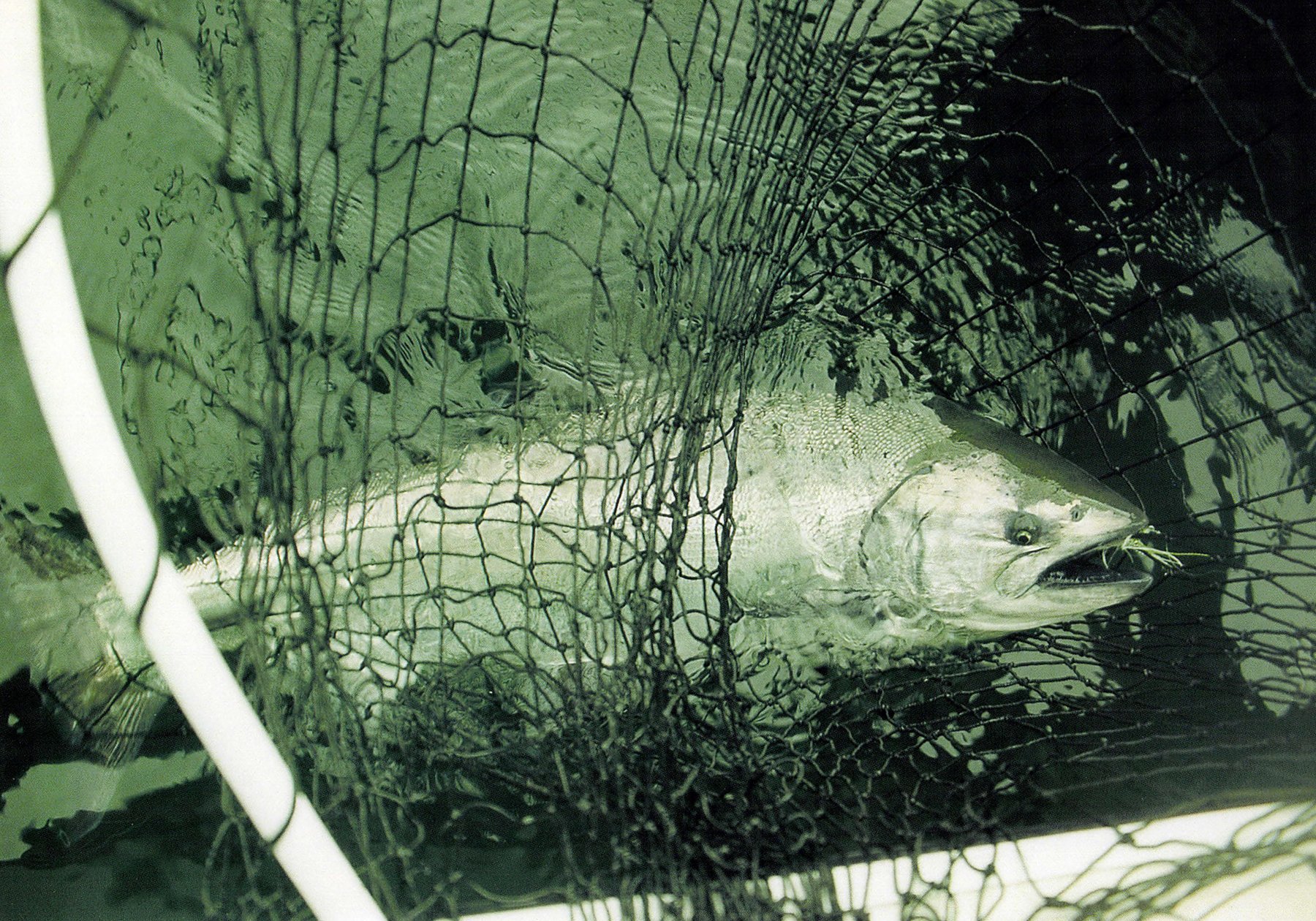
Trey Combs took this chinook salmon on a Sea Habit Dereiver in the Sand Lance pattern.
Not until our last morning at Langara did we finally hook chinook salmon using this approach. At Coho Point, Johnson got one in the teens while I got one in the twenties. Shelly and I both had door-sized chinook follow flies up from the depths. When a chinook snapped my fly off on the strike, I changed from a 15- to a 20-pound tippet. While these fish are not known to be leader shy when anglers troll cutplug herring, I felt that my flies sank and fished better on a fine-diameter, soft monofilament leader.
Other refinements will surely follow. I left Langara Island convinced that the full-sinking line approach (rather than the use of shooting heads), the method of presentation, and the flies fished would ultimately lead me to Langara's great tyee, chinook salmon of 30 pounds or more.
[End of excerpt from Trey Combs, Bluewater Fly Fishing]
What Fly Anglers Should Know About Langara Island Today
Langara Island welcomes fly anglers. The lodge’s own description of its ocean fly-fishing opportunity points to the appeal: Langara has strong salmon numbers, sheltered bays, and kelp beds where it is possible to cast or bucktail flies for Coho, Chinook, Pink salmon, and black rockfish.
All five species of Pacific salmon are found around Langara Island. Chinook and Coho are the main draw. Chinook can range from 12 pounds to more than 70 pounds, while Coho commonly run from 7 to more than 20 pounds. Chum, Sockeye, and Pink salmon also move through these waters, and even the occasional steelhead shows up. At the right time of year, it is possible to catch three or four different salmon species in a single day.
After corresponding with Bill Gibson, Langara’s longtime general manager, I came away with a more practical understanding of what ocean fly fishing at Langara means. Langara should not be thought of as a dedicated fly-fishing lodge. Its primary Chinook program is built around weighted rods and plug-cut herring, and most guests come to the island for that traditional ocean salmon fishery. Bill told me that many guests bring a fly rod, but often do not take it out until after they have already taken their Chinook limit.
Bill has spent years trying to catch Chinook on a fly around Langara, and he has done it in a number of different places. Bucktailing can be especially effective when needlefish are in shallow water, and there have been days when large Chinook, including tyees, were taken that way. Cast flies can also work, but success depends on timing, salmon abundance, baitfish conditions, boat traffic, and local knowledge. For confident or highly experienced anglers, unguided boats are also available, typically for one to three anglers.
One of Bill’s most useful observations was the comparison between ocean Chinook fishing and steelheading. A steelheader is often at the mercy of river conditions. An ocean fly angler is at the mercy of salmon abundance. When the fish are present in strong numbers, the odds improve. The fish themselves may not be especially difficult for a patient angler using baitfish patterns of the right size and color. Bill has caught Chinook on flies ranging from large herring patterns to small, sparse needlefish imitations.
The challenge is not simply getting a salmon to take a fly. The challenge is finding water where fly tackle can be used effectively. The best Chinook locations around Langara can be crowded with boats, and a fly line is not always practical in those places. But there are sheltered bays, kelp beds, and other pieces of water where casting or bucktailing can be done, especially with a guide who understands fish movement and how salmon travel around the island.
So Langara should not be oversold as a pure fly-fishing destination in the way one might describe a famous Atlantic salmon river. It is something different: a high-abundance ocean salmon fishery where fly anglers are welcome, where casting and bucktailing are possible, and where a patient angler, fishing under the right conditions, has a real chance of landing a Pacific salmon on a fly rod. That alone would be a thrilling experience.
For more information visit the Langara Fishing Lodge website
— Mark Combs
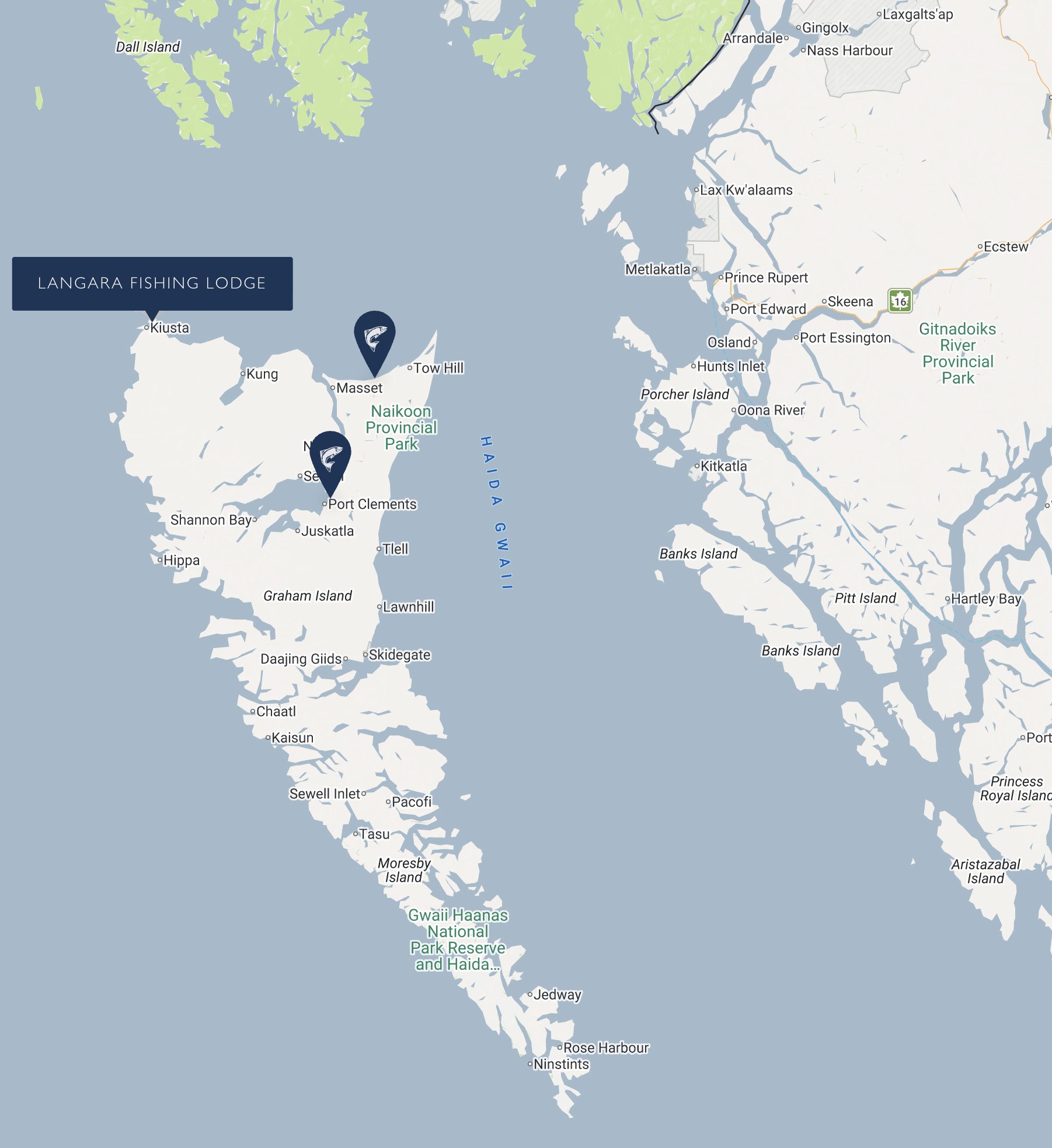
The Langara Fishing Lodge sits off the northern end of Haida Gwaii, near the edge of Dixon Entrance and the salmon-rich waters between British Columbia and Alaska.
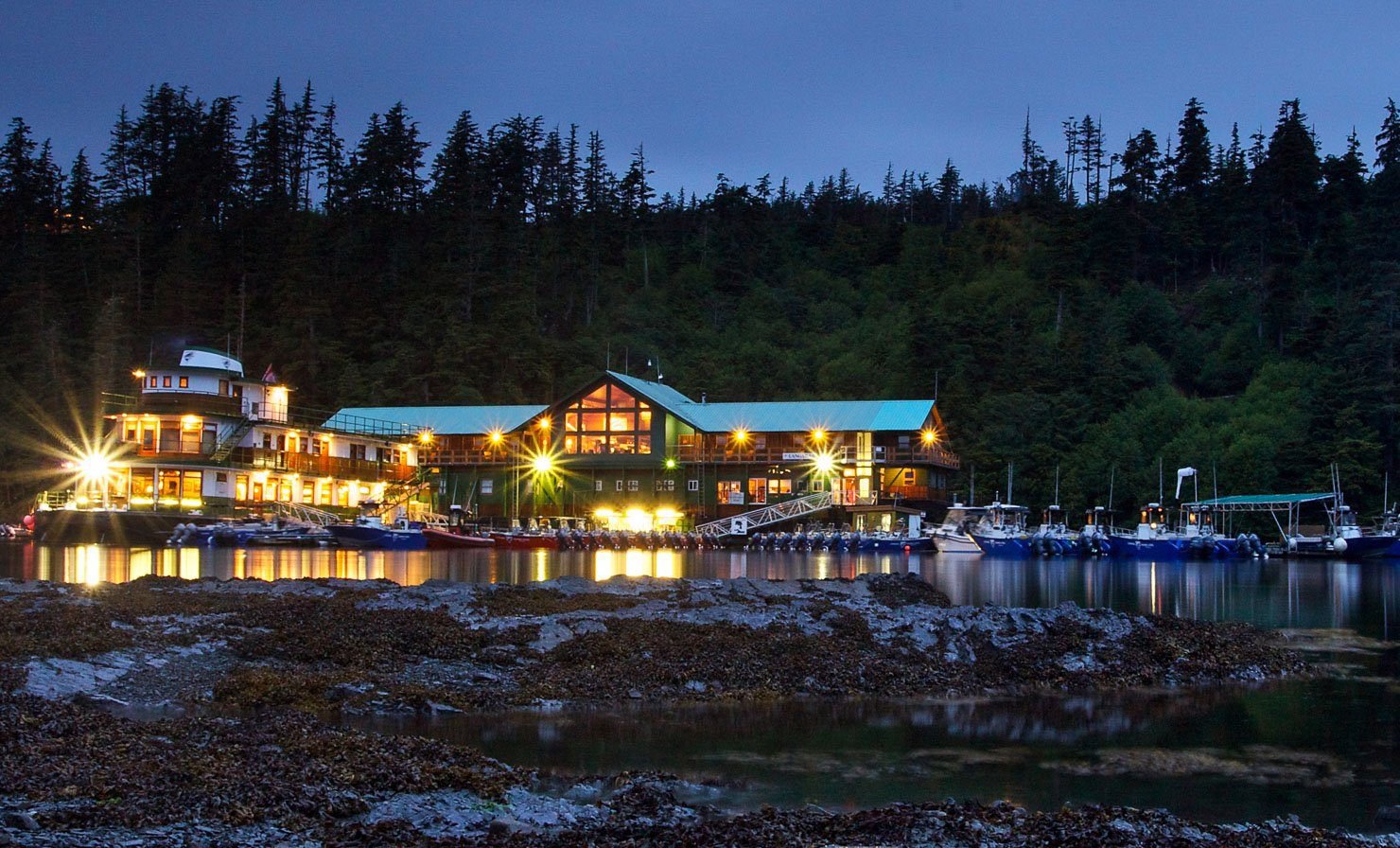
The Langara Fishing Lodge
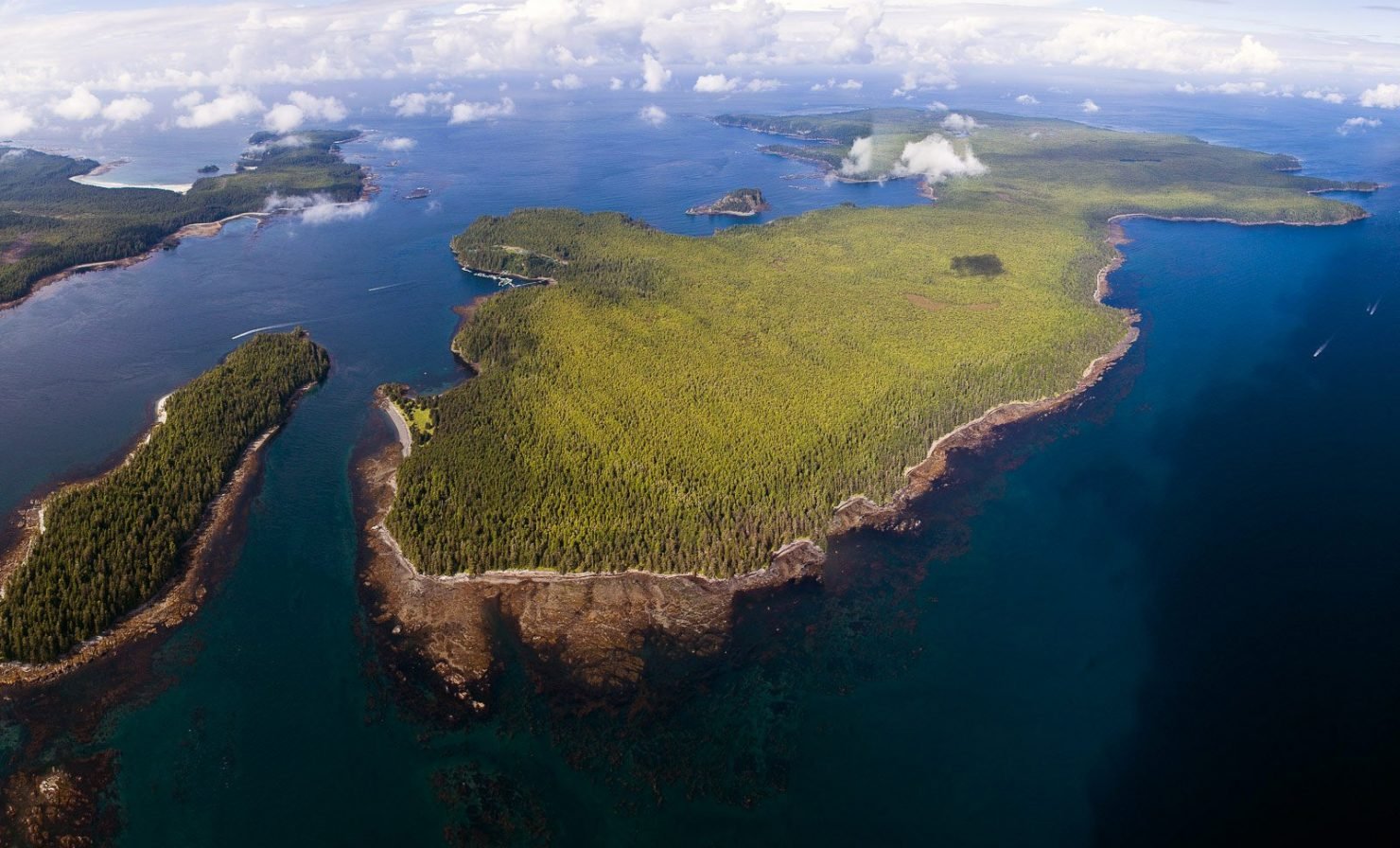
Arial view of Langara Island, Haida Gwaii
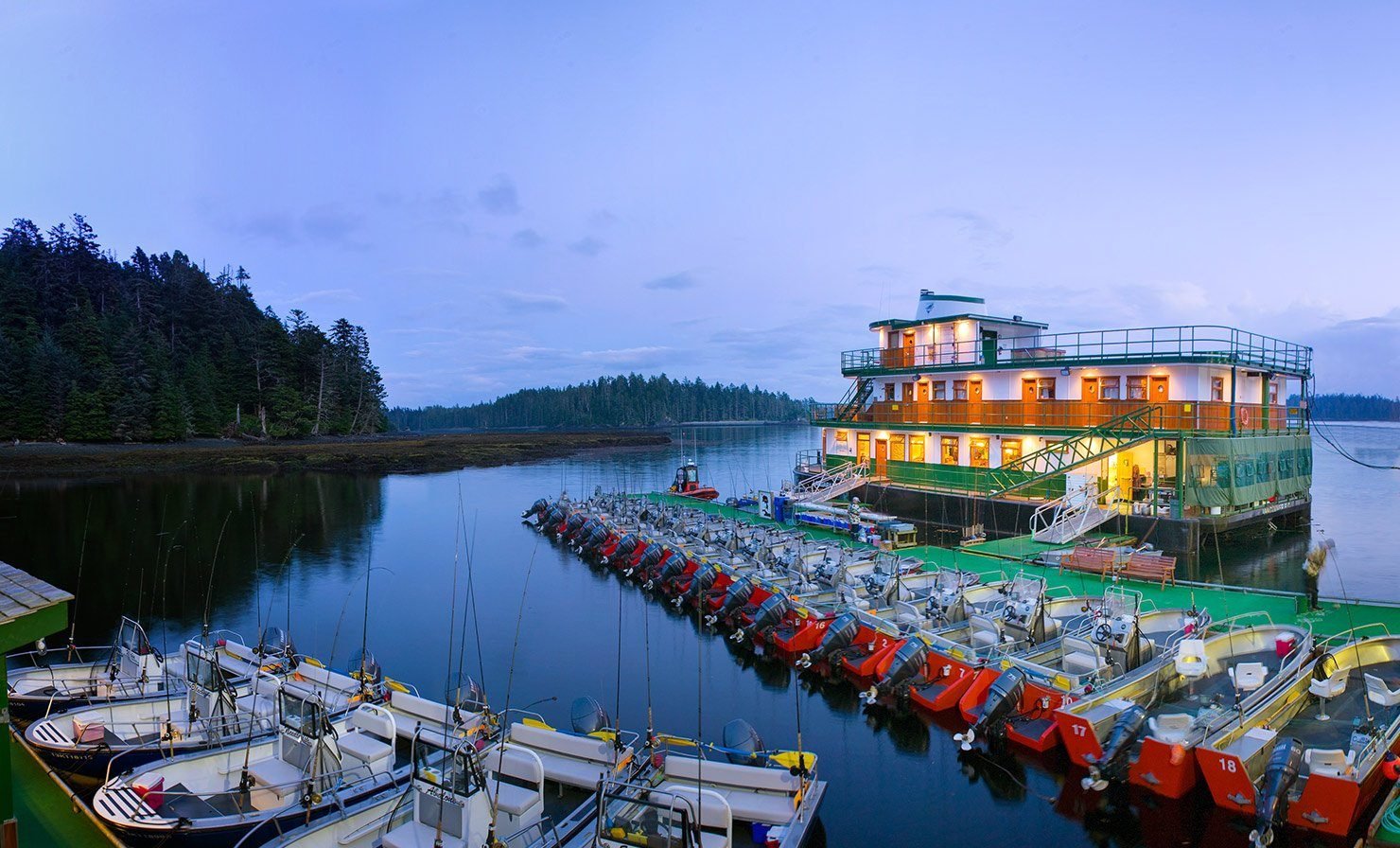
Multiple options for guided and unguided boats
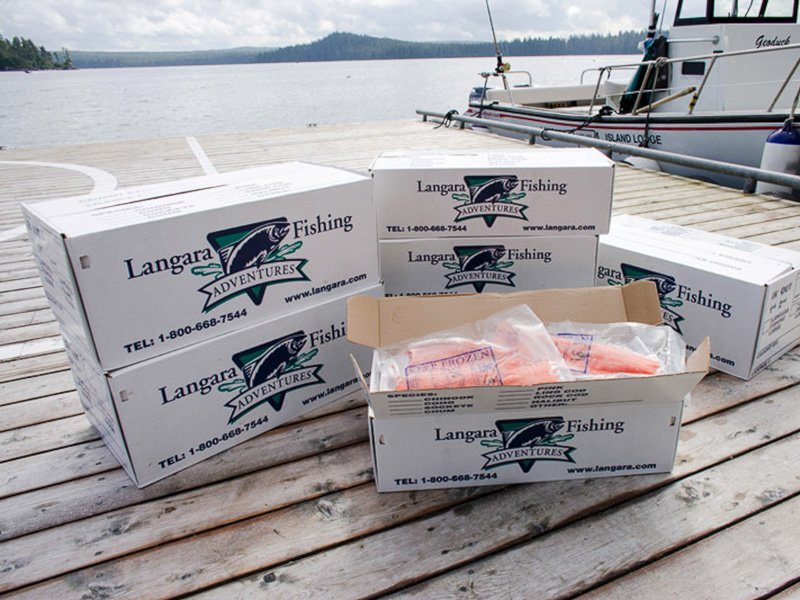
Langara staff will clean and pack your salmon to take home. When I fished at Langara, Les Johnson and I each took home one of the salmon we caught; I thought this was an appropriate image to finish this essay. Fishing off Langara Island has been one of the best fishing experiences of my life —Trey Combs