The Shannon Salmon Fly Pattern
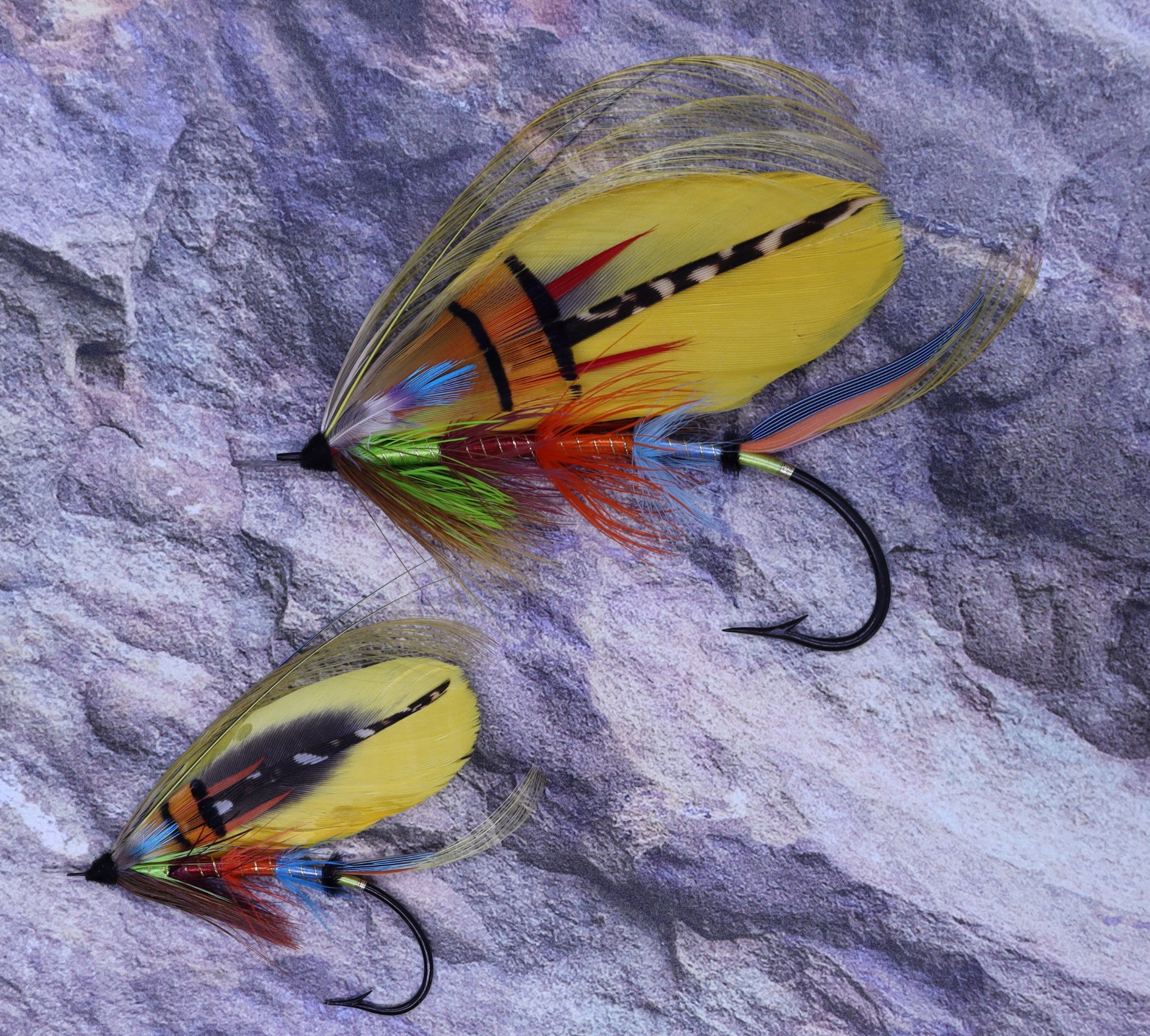
Two versions of the Shannon, dressed by Satoshi Yamamoto. The large and small dressings provide a rare side-by-side view of the pattern at two scales. Desktop only: Right-click any image in this essay to open it in a new tab to view the high-resolution version. This feature is not available on mobile.
A Difficult Tie and a Rare Feather
Francis Francis called the Shannon “quite a work of art.” The fly he described in A Book on Angling had been dressed for him by William Blacker many years earlier. Francis also called the large, heavy-water Shannon flies “very showy affairs,” but the pattern is more than a display of color. It is one of the most complicated classic salmon flies to dress, and one of its defining materials was difficult to obtain even in Francis’s time.
The rare photograph accompanying this essay shows two Shannons dressed by Satoshi Yamamoto, one large and one small. I have never seen another image of the pattern presented this way. Both dressings retain the jointed body and the yellow wing marked by a single black stripe. Together they provide a rare side-by-side view of the Shannon at two very different sizes.
Francis described the Shannon as “a very large and heavy river.” In places the water was rapid, broken, and filled with hidden and awkward rocks. An angler who hooked a salmon could be forced to hold on without giving it a yard of line. Castle Connell had long been celebrated as first-class sporting water, while the water at Killaloe was more open and easier. Much of the fishing, Francis wrote, was done from cots (traditional, flat-bottomed wooden boat). His account gives context to his reference to the “large heavy water Shannon flies.”
The version recorded by Francis was the pattern he had received from Blacker. Blacker did not include it in Fly Making, Angling & Dyeing (1855), instead providing another pattern for the same river, the Bally Shannon. The Shannon was later illustrated as Plate XVII, Figure 4 in the fifth edition of Francis’s A Book on Angling, published in 1880. That color plate is reproduced here with Satoshi’s modern dressings. A later Hardy account noted that Blacker had described several flies in this general style as “Spirit Flies.”
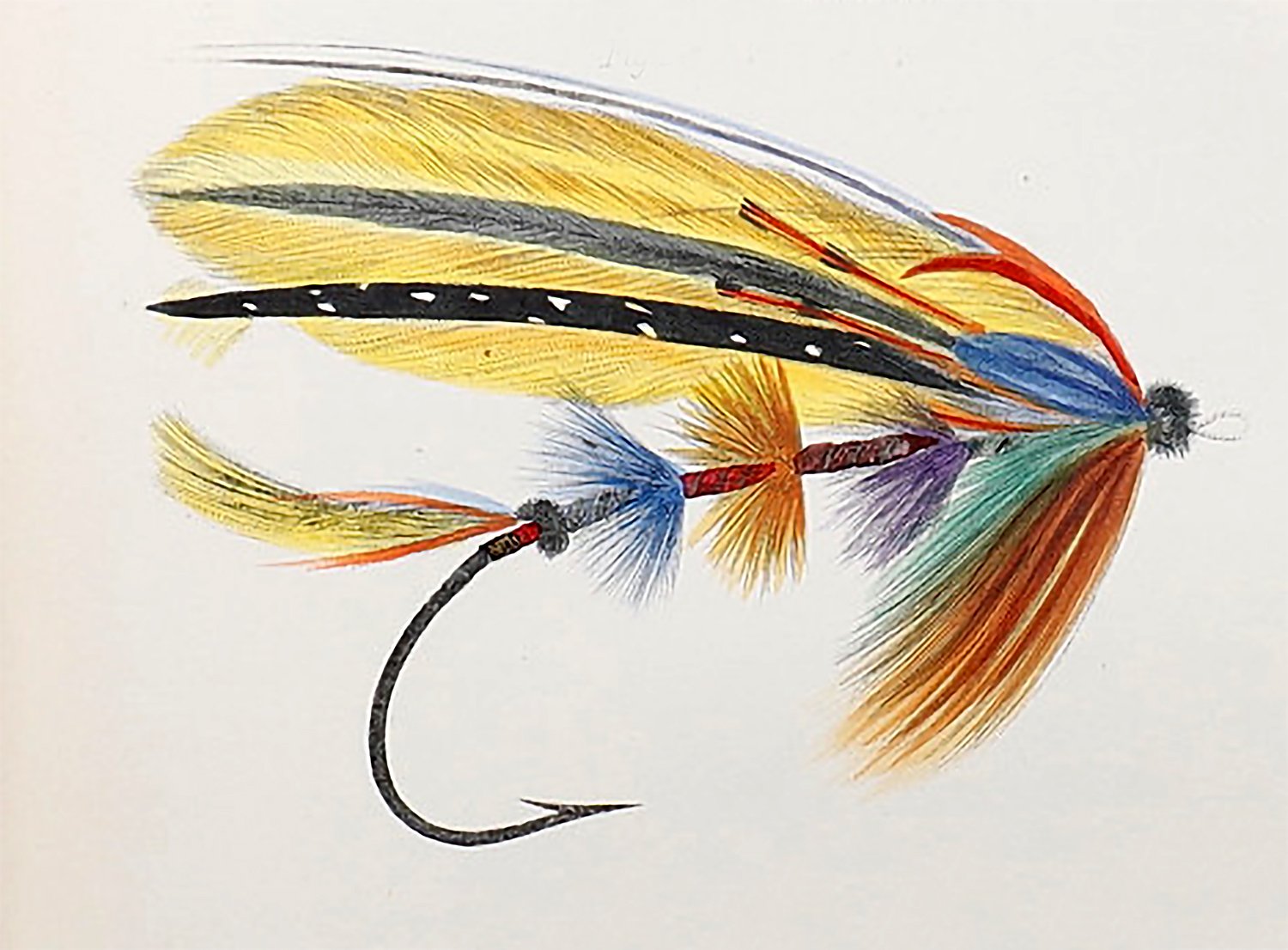
Historical image: Detail from Plate XVII, Figure 4 in Francis Francis’s A Book on Angling
The difficulty of dressing the Shannon begins with its body. Francis called for floss silk arranged in joints of pale blue, orange, puce, and pea-green. Each joint was mounted with a turn of ostrich herl, with a hackle of the same tint wound over it. Gold thread was applied to each joint separately, and one or two golden pheasant rump feathers were used at the shoulder. This construction is why the Shannon was described as extremely time-consuming to dress.
The greater obstacle is the wing. Francis specified two bright yellow macaw feathers with a black streak down the centre. He also noted that yellow macaw feathers of the correct size were not easy to obtain. A later account explained that yellow feathers carrying the required black centre streak occur in very few parrots. The stripe is not added by the fly dresser; it must be present in the feather itself.
Those yellow feathers are only the foundation of the wing. Francis added dark-specked argus on either side, sprigs of tippet, slips of ibis at the shoulder, a small purple lory feather on each cheek, and two or three large toppings over all. Blue macaw completed the horns. In both of Satoshi’s dressings, the single black stripe is plainly visible through the centre of the yellow wing.
Francis did not claim that all this complexity was necessary for fishing. Immediately after recording Blacker’s dressing, he wrote that he did not consider the jointed body necessary and that it was not generally used on the Shannon. He also believed that a fly with the same wings and a simpler orange body would work equally well. The elaborate Blacker pattern was the version he chose to record and illustrate, but he separated his admiration for the fly from what he considered necessary on the river.
The name Shannon was also applied to other dressings. In Book of the Salmon (1850), Edward Fitzgibbon, writing as Ephemera, described a considerably different pattern. His Shannon was tied on a long, low-water hook with a very long topping tail and wings extending beyond the curve of the hook. Its body was divided between light orange and blue floss silk and ribbed with broad silver tinsel and gold twist.
Hardy later treated the Shannon as an Irish fly and included a pattern under that name in its general list from 1886 until 1897. The identification is not certain. Hardy’s records state that the listed pattern may instead have been the Tay Shannon. The surviving notebook reference points back to page 414 of the fifth edition of A Book on Angling, where Francis described Blacker’s fly.
The full Blacker-Francis Shannon remains difficult to reproduce for two straightforward reasons. Its jointed body and layered wing require a complicated tying sequence, and the yellow macaw feathers with the single black stripe are exceptionally difficult to find. Francis’s color plate provides the historical image. Satoshi Yamamoto’s two dressings show the pattern at large and small scales. Together they make Francis’s description of the Shannon as “quite a work of art” easy to understand.
Dresssing Notes - Tag: Gold tinsel and lemon yellow floss. Tail: Two toppings, scarlet ibis and blue macaw. Butt: Black ostrich herl. Body: Of floss silk, in joints of various colours, pale blue, orange, puce and peagreen, every joint being mounted by a turn of ostrich herl, and over this a hackle of the same tint as the joint. Ribs: Gold thread warped on each joint separately. Throat: One or two golden pheasant rump feathers. Wing: Two bright yellow macaw feathers with black streak down the centre, a strip of dark speckled argus pheasant on either side, and strips of tippet ditto; two or three large toppings over all. Sides: Two or three slips of ibis. Cheeks: Small feathers of purple lory (a Polynesian parrot). Horns: Blue macaw ribs. Head: Black.
I would like to thank Satoshi Yamamoto for providing the beautiful and rare image of two Shannon flies tied in different sizes. The Shannon is now included in the fly pattern dictionary.
—Mark Combs
Sources:
Francis, Francis. 1880. A Book on Angling: Being a Complete Treatise on the Art of Angling in Every Branch, with Explanatory Plates, Etc. Fifth edition, Revised and Improved. Longmans, Green, and Co.
Frödin, Mikael. 1991. Classic Salmon Flies: History & Patterns. Bonanza Books.
Lanigan-O’Keeffe, Martin. 2019. Hardy’s Salmon Flies: Patterns from the Fly Tying Department 1883-1969. First edition. Coch-y-Bonddu Books.