The Mickey Finn and the Missing Fly Image
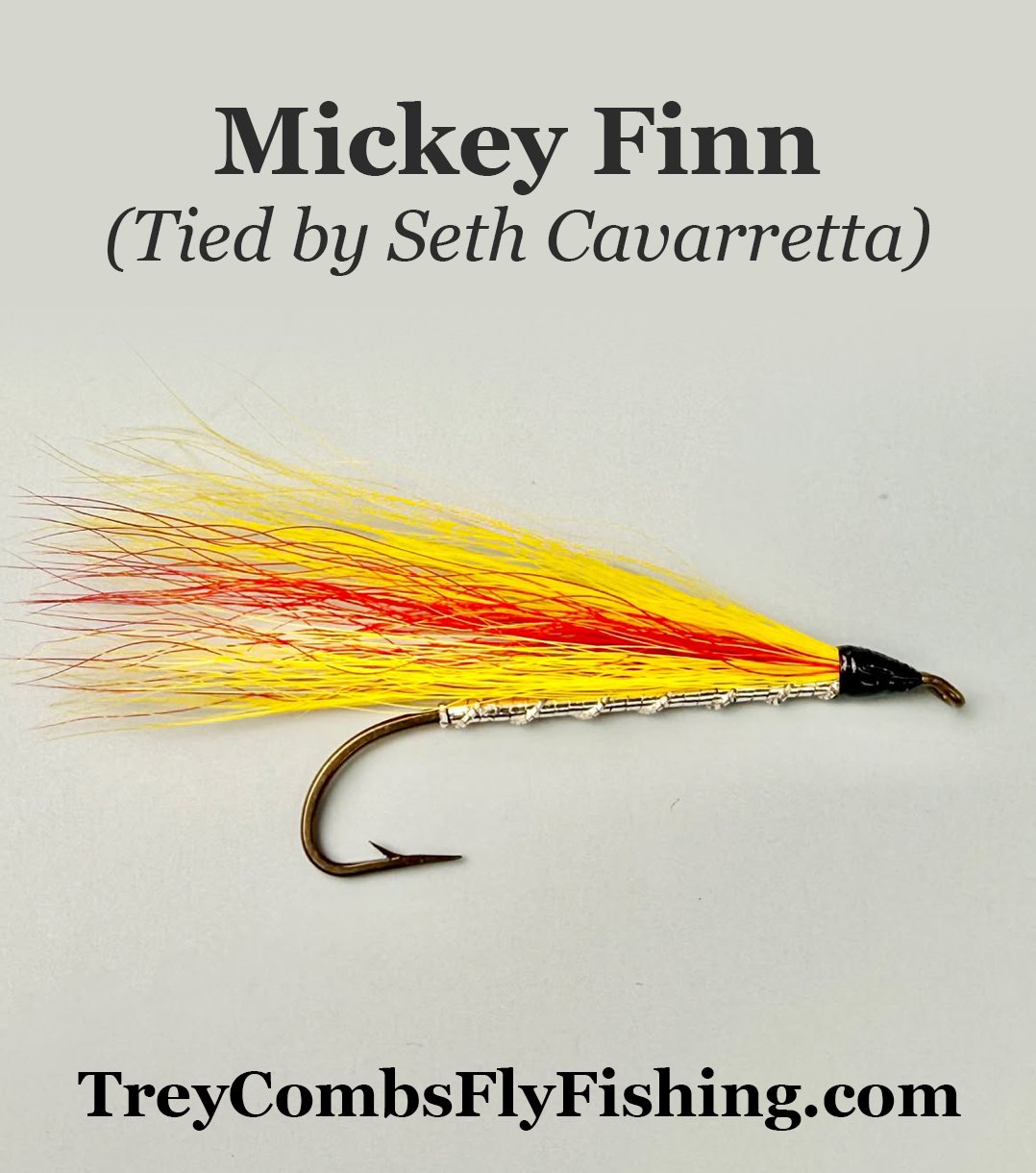
The Mickey Finn is one of the most recognizable classic bucktail patterns in fly fishing and has a long history as a steelhead and salmon fly, although it is seen far less often today than it once was. Trey Combs included the pattern in Steelhead Fly Fishing and Flies in 1976, along with an early photograph of California steelheader Roy Donnelly and a short account of the fly’s history, but oddly enough, he did not include an image of the fly itself.
Now, 50 years later, we fix that with this blog entry. We pair a newly dressed Mickey Finn with Trey’s 1976 comments, a much more detailed account from Joseph D. Bates Jr.’s Streamer Fly Tying and Fishing, and later research published by the American Museum of Fly Fishing. Read together, they provide a clearer picture of the pattern and John Alden Knight’s role in making it famous.
Featured Fly Dresser – Seth Cavarretta
The Mickey Finn pictured here was dressed by Seth Cavarretta, whose fly dressings can be found on Instagram at @sethcavarretta. We are grateful for Seth’s willingness to tie this classic pattern. Seth dressed the fly according to the notes from Joseph D. Bates Jr. in Streamer Fly Tying and Fishing. When Seth sent us the image, Trey was thrilled to see it and commented that he especially liked the way Seth dressed the body and ribbing. Seth’s Mickey Finn is now also included in our ever-expanding Fly Pattern Dictionary.
Trey Combs, Steelhead Fly Fishing and Flies
Trey described the Micky Finn as a pattern originally intended to imitate a stream minnow rather than simply serve as an attractor. He explained that the yellow bucktail provided translucence, while the more definite red suggested the dense spinal area of a small fish. The silver tinsel body supplied the flash.
In his 1976 account, Trey credited John Alden Knight with introducing the pattern in 1936. He wrote that Toronto anglers found the fly so effective that they first called it the Assassin, with the name later changed to Micky Finn.
Trey also noted that the pattern had become a popular steelhead and chinook salmon fly. In steelhead dressings, however, tiers often departed from the original proportions by increasing the amount of red or eliminating the upper yellow section entirely.
The book includes a photograph of Roy Donnelly holding a morning’s catch from California’s Eel River. The caption identifies the pattern as the Micky Finn, dates the photograph to circa 1935, and notes that the fly was an early favorite among steelheaders.
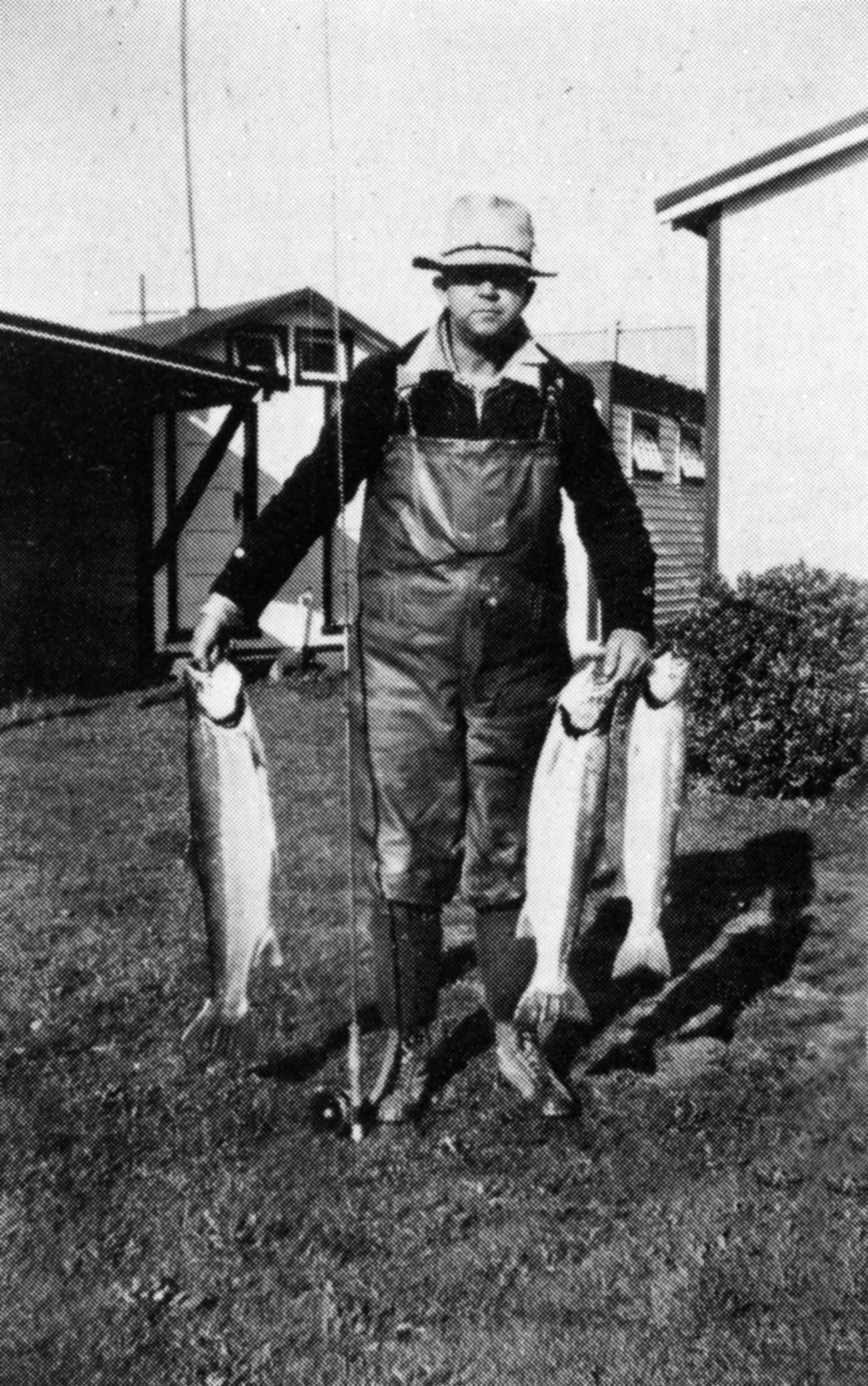
Original caption fromSteelhead Fly Fishing and Flies (1976). Roy Donnelly holds a morning’s catch from the Eel. Pattern: Micky Finn. Photo circa 1935. The Micky Finn was an early favorite among steelheaders.
Joseph D. Bates Jr., Streamer Fly Tying and Fishing
Bates provides considerably more detail about the pattern’s history and, importantly, bases much of his account on correspondence with John Alden Knight and Gregory Clark.
According to Knight, the fly already existed when Junior Vanderhoff gave him one in 1932 while the two were fishing near Greenwich, Connecticut. Vanderhoff told Knight that the pattern had been one of a series of small bucktails formerly sold by William Mills and Son. At that point it was known simply as the Red and Yellow bucktail.
Knight used the pattern successfully for several years. In 1936, while visiting Toronto, he introduced it to Canadian anglers and demonstrated its effectiveness on trout. The fly was initially given the name Assassin.
Gregory Clark, a Canadian writer associated with the pattern during this period, subsequently changed the name to Mickey Finn.
Knight later promoted the fly through his writing. In 1937, Hunting and Fishing Magazine published his story about the Mickey Finn while the Weber Tackle Company advertised the pattern in the same issue. According to Knight, the fly quickly became enormously popular, with tiers at the New York Sportsmen’s Show producing Mickey Finns throughout the week and tackle companies struggling to keep up with demand.
Later Research from the American Museum of Fly Fishing
The history becomes more interesting when later research published by the American Museum of Fly Fishing is added to the record.
In a 2014 article in The American Fly Fisher, Willard P. Greenwood II examined the history of the Mickey Finn. His research supports the idea that the yellow-and-red bucktail existed before John Alden Knight made the pattern famous and that the identity of its original creator remains uncertain. Knight's importance was in recognizing the effectiveness of the fly, promoting it, and helping establish the names by which it became known.
The museum returned to the subject in 2015 when Jan Harold Brunvand investigated another claim concerning the fly's origins. That story attributed the pattern to Québec angler Charles Langevin in the nineteenth century, a claim that was also repeated when Canada Post issued a Mickey Finn stamp in 2005.
Brunvand was unable to find conclusive documentation connecting Langevin with the familiar yellow-red-yellow bucktail pattern. He did find evidence of a nineteenth-century fly called the Langevin, but that fly was constructed from yellow feathers and lacked both the red bucktail and silver body characteristic of the Mickey Finn. Brunvand therefore left the Langevin connection unresolved rather than accepting or rejecting it outright.
What Seems Most Likely
Taken together, Bates and the later research published by the American Museum of Fly Fishing make it difficult to credit John Alden Knight as the original creator of the pattern. What is much better documented is his role in recognizing its effectiveness, promoting it, and helping establish the name by which it became famous. The identity of the person who first dressed the yellow-and-red bucktail remains uncertain.
The Roy Donnelly photograph in Trey’s book adds another interesting piece to the story. Trey’s caption dates the photograph to approximately 1935 and identifies the pattern as the Micky Finn. Because the caption was written decades after the photograph was taken, it does not establish that the fly was already known by that name in 1935. It does, however, document the pattern’s early association with Eel River steelhead fishing.
Mickey Finn Bucktail – Dressing Notes (Streamer Fly Tying and Fishing)
Head: Black. Body: Medium flat silver tinsel. Ribbing: Narrow oval silver tinsel.
Wing: A very small bunch of yellow bucktail, over which is a very small bunch of red bucktail, with a bunch of yellow bucktail equal in size to the first two bunches over this.
Bates emphasizes the proportions of the wing: the lower yellow and red sections should be equal in size, while the upper yellow section should be approximately twice the size of either of the first two sections.
The dressing is identified by Bates as being “As dressed by Mr. John Alden Knight.” Jungle cock cheeks are not called for in this version, although Bates notes that they were frequently added.
Bates also records other versions of the Mickey Finn, including Canadian feather-wing and marabou dressings, but the yellow-red-yellow bucktail wing over a silver body is the version associated with Knight.
Micky Finn – Dressing Notes (Steelhead Fly Fishing and Flies)
Body: Embossed silver tinsel over a white floss core. Wing: Yellow over red over yellow bucktail in a 2/5, 2/5, 1/5 sequence.
Sources: Trey Combs, Steelhead Fly Fishing and Flies (1976); Joseph D. Bates Jr., Streamer Fly Tying and Fishing; Willard P. Greenwood II, “A Personal and Natural History of the Mickey Finn,” The American Fly Fisher (2014); Jan Harold Brunvand, “More on the Mickey Finn,” The American Fly Fisher (2015).