Skagit River
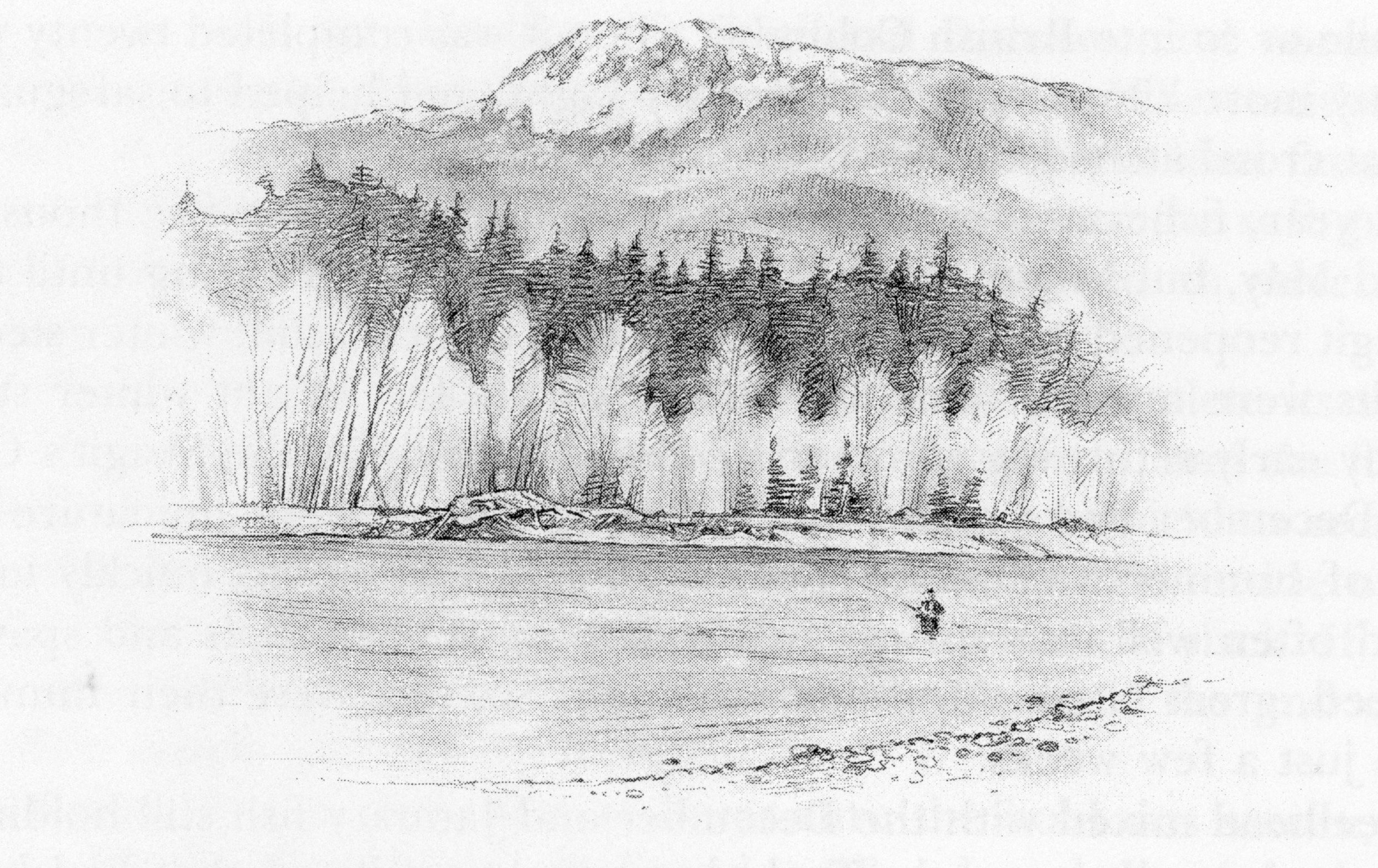
This is the complete chapter from Steelhead Fly Fishing, written by Trey Combs and originally published in 1991. It is presented here in its original form. Desktop only: Right-click any image in this essay to open it in a new tab to view the high-resolution version. This feature is not available on mobile.
For as long as any living angler can remember, the Skagit has been the flagship of Washington's winter steelhead sport fishery and a river repeatedly dammed for the electricity it could generate for the city of Seattle. These resources seem never to have been in dire conflict and, in fact, have enjoyed a remarkably harmonious relationship compared to other dams and other runs of steelhead.
Gorge Dam was completed in 1924. Sited in the Cascade Mountains at the base of a long, exceedingly narrow and violent run of canyon water, it rises 300 feet, spans 670 feet, and creates a lake four miles long. Two miles below the dam, and connected by a twenty-foot-wide tunnel, is Gorge Powerhouse. Here at the tailwater is a river less subject to the seasonal forays of drought and flood, to severe temperature changes, and to discoloration through snowmelt, for the lake helps to settle out the opaque runoff.
The long, shallow glides of clear currents below the Powerhouse were as far up as winter steelhead ever spawned, the canyon creating a natural barrier that a few summer steelhead may have ascended. But the myriad headwaters that threaded together alpine lakes and glacier-filled cirques were for resident trout and char, not for salmon and steelhead.
More dams followed immediately upstream of Gorge. Diablo was the tallest arch-type dam in the world when completed in 1930, nearly a hundred feet higher and twice as wide as Gorge, but picayune compared to Ross Dam. Rising 540 feet above bedrock, and a quarter-mile across, Ross backed up the Skagit a mile or so into British Columbia when it was completed twenty years ago. These two dams generated many more kilowatts for Seattle City Light, and helped to safeguard the farms, eighty miles downriver, that crosshatched the flood plain of the Skagit Valley.
In a decent year, fishermen expected a run of at least twenty-five thousand steelhead, a trickle in November and May, but bright fish right through winter and spring until the season closed in April. When the Skagit reopened in June for the statewide trout season, winter steelhead were still spawning, and many kelts were making their way to the sea. A few bright winter steelhead still ascended the river, joined by early-returning summer steelhead bound for the Skagit's Cascade River.
The native December and January steelhead were remarkably immature sexually, fish analogous to the springers of summer-run fame. These sea-bright fish moved quickly into the system, then stayed all winter, and often well into spring, before joining later arrivals and spawning in May. They were, everyone agreed, great biters. Mortality was high. So, too, were their numbers. Thousands filled the lower river in just a few weeks.
February steelhead mixed with the December and January fish still holding main-stem lies, and this was often the peak angling month. Truly huge male steelhead that had been grazing in the ocean's fastness for three, four, even five straight years were now found in the lower river, March bucks that in the less-forgiving upriver currents left bait-casters swearing to their deathbeds that the one that got away was four feet long.
March steelhead entered as other steelhead left the Skagit for tributary rivers and for stations on those broad tailouts suitable for spawning, often shallow lies two to four feet deep. Selecting spawning gravel and digging redds spread steelhead throughout the system, and by mid-May, fish were spawning from Newhalem, Seattle City Light's company town below the Gorge Powerhouse, to near tidewater in those lower two channels of the Skagit that deliver the river to the ocean, a hundred river miles in all.
March rains only infrequently brought snow to headwaters. When this marine weather pattern was followed by a strong high pressure system, spring became summer and tributary rivers churned out glacial grit, snowmelt, and mud torn from clay banks along the elbow holes. Steelhead traveled on these flushes of turbidity, and the confluence points became way stations filling and emptying almost hourly.
Of these suddenly unruly rivers, none was so elementary yin to the Skagit's yang as the Sauk, a truly great steelhead river in its own right, the parent river's largest tributary, and a spring river breathtakingly beautiful, mercurial, and cranky. Anglers claim that its steelhead were like that, too, short-fused native stock with such big shoulders that they could be easily distinguished from the more gently streamlined Skagit fish.
The Sauk reached west and south eighty miles for many lesser Cascade streams, the Suiattle chief among them, before joining the Skagit at Rockport, one of three hardscrabble settlements, including Marblemount just upriver and Concrete close below. In spring, plunkers with roe, gear fishermen casting spoons, and guides with their clients still confidently searched the Skagit below the confluence for Sauk steelhead.
"Most of the steelhead come up and hang a right," said the old Skagit hands.
April
Howard K. Miller Steelhead Park, a fairway of green campsites with a boat launch, lies between the Skagit River and the block of houses, two bars, one restaurant, and a gas station that make up Rockport. In early spring, the park is full on weekends and only a little less so on weekdays. Most of the campers are fly fishermen, old friends whose happy reunions are annual vacations timed so that they might find an April steelhead with their carefully crafted flies. If this results in a fish in the hand, it is truly an epiphany for those whose faith has remained unshakeable. Talk is of little else the entire month.
The object of this devotion is the most marine of all steelhead. Their spawning run may be com-pleted in as little as a month, and when encountered, they are so full of the ocean, so silver-grey and white, that one searches in vain for even a hint of rainbow on their flanks. They enter the river when summer is on the water and surface currents are in the midforties. With metabolisms at cruising speed, they move well to the fly, as tentative or as crushing on the take as any summer-run. No steelhead are stronger. No steelhead are more beautiful. Never are they commonplace. "Run" is much too generous. Thousands in winter become hundreds in spring, and late in the month a flush of steelhead counts a dozen. The single fish racing for your fly must fulfill a day. To expect more of the river, to demand more of yourself, becomes passion without joy.
When I launched my McKenzie boat at the Park one morning in early April, I intended to stay until the season closed at the end of the month. My boat was new, an aluminum replacement for the wood McKenzie I'd wrecked on the Hoh. Ash oars with yard-long blades would keep me moving discreetly downriver. A small jet engine mounted on the transom would allow me to run back upriver, a noisy concession to the inconvenience of hitchhiking around for my car when fishing alone. A pair of two-handed rods lay along the gunwale. My boat bag was full of gear and my Wheatley boxes full of flies. I didn't want for anything.
Huge alders shade the park's water. Only the careful wader who can spey-cast his double-handed rod will cover these lies, water so deep that few anglers even try. At the bottom end, a fly fisherman was silhouetted in the glare. As I watched him, he swept his long rod upstream, executed a delicate figure S, and then drove the line eighty feet out. Only one angler in the world did a double-spey exactly that way. I kept the boat tight to the bank and drifted down. His back was to me when I called out softly, "Harry?"
Harry Lemire turned and began reeling in.
"I heard you were coming this week," he said.
"How's the fishing been?"
"Awful!"
"Tell me about it! I was here for four days last week with Bob Arnold and hooked one steelhead, a five-pound hen. A native, I think. The Game Department says the two-salt steelhead are unusually small this year."
"I had one good day last week," said Harry. "On a pool below Concrete, I rose three fish and hooked two. The steelhead I got to the beach was thirty-seven inches. A buck."
"What was the fly?"
He held out his rod. A large Golden Edge Orange was secured to the crossbar of his Hardy reel. This is a classic pattern of bronze mallard and golden pheasant crest with jungle cock cheeks, not the kind of dressing I associate with winter steelhead. Harry calls my box of bright marabou spiders, "damn Buck Rogers stuff," or "pillows."
"Do you want to go for a boat ride? I have enough sandwich makings for both of us. Coffee and pop, too."
"Sure! Let me get my stuff."
Harry returned from his truck with a bag of gear, a jacket, and Penny, his seventy-pound Collie, a fly fisherman's dog that would move along the beach just ahead of her companion. Neither of us had to worry about our backcasts.
We drifted downriver until we came opposite the Sauk. The past couple of days had been warm, and this day would reach into the seventies. It takes at least eight hours for any snowmelt to reach this confluence. Not until late that afternoon would we know if the Sauk was going out. For the time being the river was clear, but, typically, not as clear as the Skagit. For more than a mile the two rivers run side by side until forced together in a deep pool with hydraulics so severe that it is called the Mixmaster.
The Skagit River below the Sauk is paradise. To the east lies North Cascades National Park, and this morning its pale blue glaciers sparkled in the sunlight. The other cardinal points have lesser mountains that still carried snow well below their ridge lines. Only the Dean River below Moose Rapids and the Skeena below the Kispiox offer such a spectacular backdrop.
At Harry's suggestion, we started at Island Pool, split the water between us, and began swimming our flies through on fifteen-foot sink-tip lines, each with a sink rate of IV. This is a good average. I had sink tips I could change to from twelve to nineteen feet with sink rates of III, to V (Deep Water Express). Getting the fly down was not nearly so important as slowing the fly on the swing. Neither did we want to hang up. When that happened, it was usually on a waterlogged branch or a piece of driftwood. Often our flies were three or four feet above the bottom, sufficient unless the water temperature dropped precipitously or the river filled with turgid runoff.
Some pools are known to fish best in high water, others in low. A few pools hold steelhead regardless of the water level, but individual lies will change depending on the volume of flow. Skagit anglers soon learn that when the river rises and falls a foot at a time, extra water is being let out of the dams. This happens early in the morning, the river then dropping throughout the day. The Sauk is not dammed and provides an additional set of parameters as its runoff and turbidity is factored into Skagit pools below the Mixmaster.
Of course, no pool is entirely static. Each water changes a bit from year to year, dredged out here, filled in there, and the lies change accordingly. Some pools are lost altogether. Harry is always searching for new lies, especially the subtle, often overlooked pocket that will produce a single steelhead when anglers up and down the river are glumly finding the well-known pools completely empty.
We did not turn a steelhead in Lake Pool, nor in two pools just below the Sauk, nor in the Mixer, the famous Skagit drift just above the Mixmaster, known locally as Sauk River Bar. After ten hours of fishing we returned to Rockport and planned a full-day float from Marblemount to Rockport the next day.
The Skagit River below Marblemount is better known for the hundreds of bald eagles that winter there than for its steelhead. They are drawn by the huge schools of spawning salmon. The chums that follow the pinks do not finish spawning until the second week of December, and their carcasses are an important food source into early February. By March, the adult eagles have left. To safeguard river frontage for these feeding and roosting eagles-the largest such concentration in the United States outside of Alaska-the Nature Conservancy purchased over nine hundred acres along seven miles of river below Marblemount. Private and commercial eagle-watching floats take place, gear fishermen in drift boats make their daily rounds, and early-morning fly fishermen sometimes find themselves competing with eagles for places on the gravel bars.
Even without the eagles, the upper Skagit is a magnificent float. Frequent braids take the river away from the nearby highway, and wildlife boldly come into view at every turn. Beaver, otter, mink, and deer are everyday sightings, and black bear and mountain lions roam the foothills outside the clear-cuts.
Biologists disagree as to what percentage of Skagit/Sauk steelhead are main-stem spawners above Rockport, that is, above the Sauk River. I don't think nearly as many April steelhead continue on past the confluence as pass up the Sauk, an opinion no doubt fostered by my poor showing on the upper Skagit. It is a higher-gradient river than just below the Sauk, and many lies in high water are only marginally fishable. Plug pullers speak of five-fish days, mostly sea-bright "chromers," caught in four to eight feet of water. Their desirable water and mine barely overlap. Yet the ten-mile float contains a half-dozen pools that so promote my fly fishing that success is pretty much up to my persistence. John Farrar, a friend of mine who has for years guided fly fishermen on the Skagit, told me that around the middle of April the upper river gets a fresh push of fish. John knows of what he speaks and can find these steelhead when I cannot.
Harry and I fished the familiar lies, sometimes with difficulty due to the high water, and turned a single fish, perhaps a steelhead, but more likely a Dolly Varden. These char were shaking off winter by chasing after the newly hatched chum-salmon fry, often foraging their way to tidewater before returning weeks or months later with a patina of silver over their handsome colors. As stream residents they'll consume the spawn of other salmonids, and anglers often kill them for this reason. Most fly fishermen malign them simply because they aren't steelhead.
We found no steelhead that day, nor on the day after, nor on the day after that. This was the longest period without hooking a steelhead that I could remember. For Harry, the bad run was incomprehensible. After a run downriver one morning, we came back to the launch and retired to Mom's Cafe for breakfast.
"I don't think I'll ever see another steelhead again!" he said over coffee. His tone was rueful, but Harry Lemire, the complete steelhead fly fisherman, never despairs.
"Years ago I read an article by Ted Trueblood about fishing for winter steelhead in the Olympic Peninsula," I said. "There was a photograph of Trueblood, and the caption went something like, 'After a slow week, Ted got this bright sixteen-pound steelhead.' That's when I learned what slow means in angling. Harry, we're just having a slow week!"
He needed no reminding that you don't beat up on yourself during a slow week. Our fishing wouldn't change a pool empty of steelhead. Empty is merely a temporary condition capable of changing on the next cast. We cast our flies with the conviction that a steelhead is out there, and although it does not gladden my heart when they fail to materialize, I really do believe that a day or two of empty pools can still be recreational. Jimmy Hunnicutt, a frequent fishing companion, says this is "getting into the flow of the river," and I agree. It is the river, not the steelhead, that I must come to understand. But regardless of how philosophically we drone on about the joys of rushing water and the long rod, four or five days of nothing is not recreational. By then the fly patterns look awful, their magic completely in tatters. I stray from the dressings that enticed steelhead in the past-and thus provided confidence-for the one-off, experimental tie that might catch lightning in a bottle. When backing this longshot doesn't work, I return to recycling the standards. I remain as hopeful as any gambler, convinced that the next cast will be the cast, the start of a three-fish day. Soon, however, the lively rhythm of working the fly becomes a labor as fatigue, monotony, and disappointment set in. I look through my fly boxes and ask, "What don't I want to raise a steelhead on now?"
The long run of lovely weather finally broke, replaced by a cold and determined overcast that drifted over the surrounding foothills and locked the valleys in a drizzly fog. Harry and I thought the dark day could entice steelhead from the deeper pools and nurture them in shallow lies. We drifted past the familiar riffles of holding water with renewed expectations and found the Mixer in a state of virgin grace. I could not imagine what we had done to deserve such a remarkable stroke of good fortune. Three hours later I had my answer. The gods had granted us only one wish. Our second wish-that the pool hold steelhead-had been ignored.
Farther downstream we split two small pools between us. On the lower water, I was twenty casts into the run with an Admiral Spey when a steelhead took the fly almost directly downstream. I held fast to the fish and was determined to make it turn and take the rod down to properly drive in the hook. Negotiating this takes a second or two of mind-numbing patience. As I was thinking that this was going well and my double-handed rod was taking a deep set, the steelhead simply and violently left with the fly. Breaking off a winter steelhead on the strike after a slow week is a journey to the brink of insanity. I did not tie on another fly, but stood and tried to remember the last time such a thing had happened. I couldn't.
The lost opportunity marked a change in our fortunes. The rains came that night, and in the morn-ing persistent showers sent fresh steelhead up through the pools. I found a hen of twelve pounds with a Deep Purple Spey, while Harry landed a hen several pounds heavier with his Golden Edge Orange. A day could hardly pass now without a steelhead touching our flies.
When Bob Arnold and I fished Island Pool in late March, he had observed, "Twenty-pound winter steelhead are caught on flies each year, now. I don't think there are more big steelhead than in the past. There are a lot more fly fishermen, and they are better equipped."
Bob has written often and well of Washington's early masters of steelhead fly fishing: Ken and George McLeod, Al Knudson, Ralph Wahl, Walt Johnson, and Wes Drain, for example, regulars on the Stillaguamish River's North Fork during the 1940s. These men and their Stilly friends were also fishing winter pools for Skagit steelhead that could easily be several times larger than the North Fork's Deer Creek fish. This was not so much a matriculation as a quantum leap. The river was imposing, the winter-run steelhead holding in more challenging lies and in water ten to twenty degrees colder. Anglers tried to make the best of it with old silk lines dressed with everything from graphite to red lead paint; the steelhead could be incredibly difficult to take.
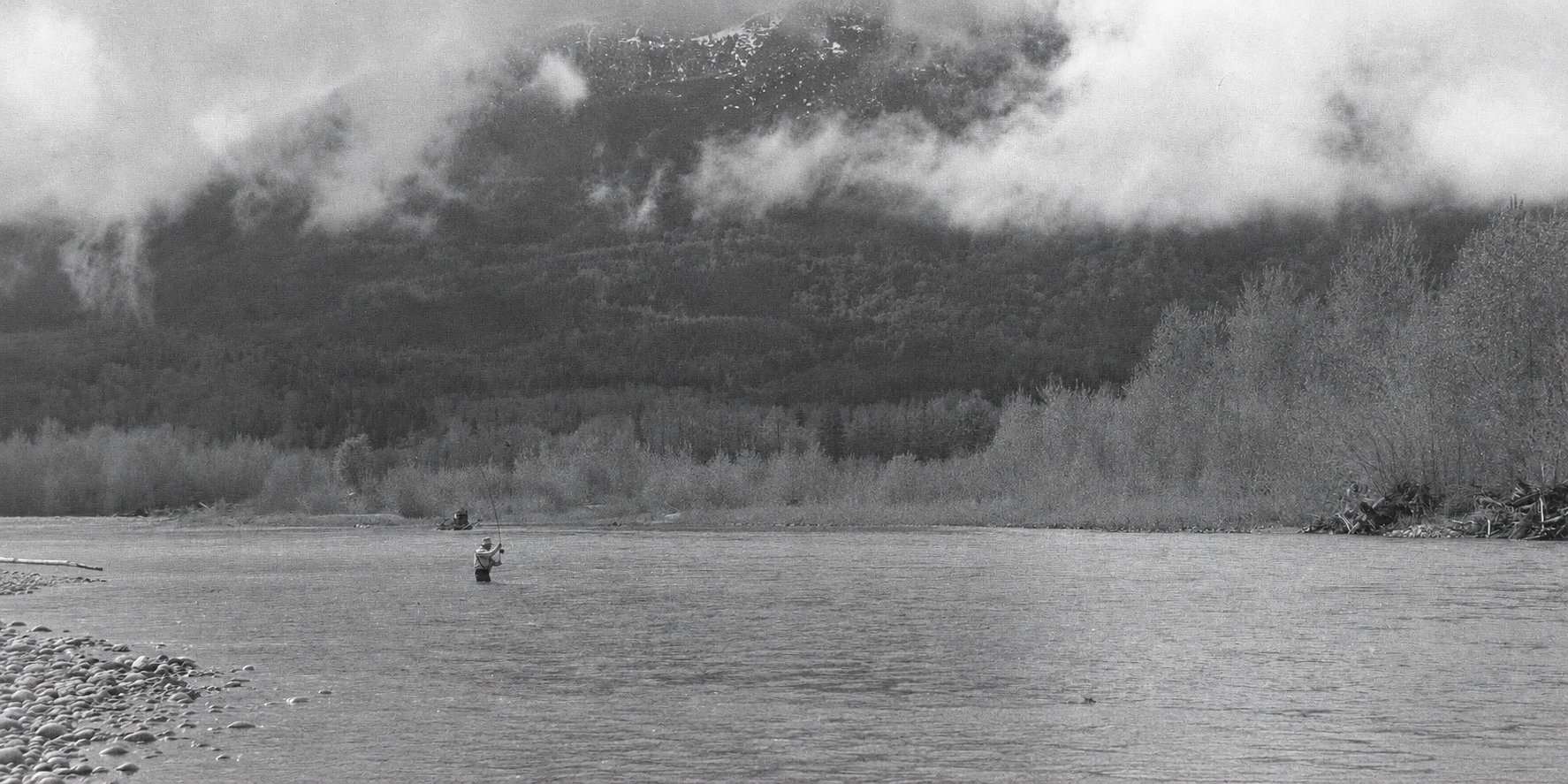
Jimmy Green on the Sauk River.
Ralph Wahl (Angler Profile) looked to Jim Pray and Peter Schwaab for inspiration at the tying vise, and his early winter patterns, the Lord Hamilton and Lady Hamilton (1940), and Painted Lady (1945), were compact and optic-like. Al Knudson sometimes used 5/0 to 7/0 Carlisle streamer hooks to take his marabou flies down. Wes Drain, the finest tyer in the lot, took a twenty-pound, seven-ounce Skagit steelhead in 1947 on a fly he came to call Drain's 20. (Fly Image - Dressed by Dave McNeese) No one claimed a larger fly-caught steelhead in Washington for twenty years. When that finally happened, it was Ralph Wahl who settled the matter with a Skagit steelhead of twenty pounds, eight ounces. Between these two great bucks were many fine steelhead caught on flies by a handful of pioneer anglers.
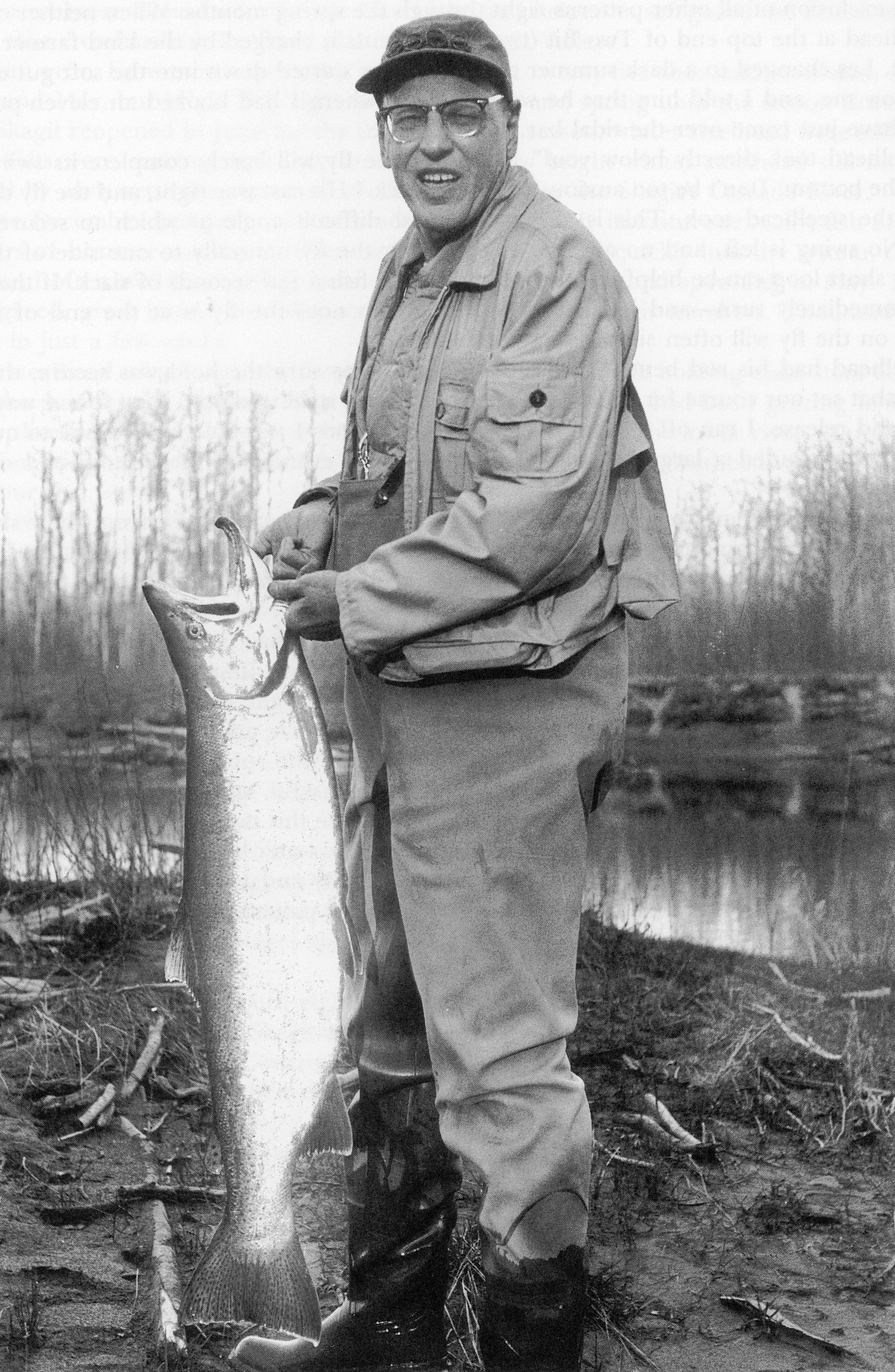
“The big one,” says Ralph Wahl of the 20 pound 8 ounce buck he took from his Skagit “Shangri-La” on March 3, 1967.
When Wes Drain caught his unofficial state record in 1947, the Field & Stream fishing contest allowed "rainbow trout" entries if caught during the traditional trout season, April to October. Steelhead could be counted as rainbow trout, but not if caught during Washington's winter steelhead season, December 1 to April 15, on the Skagit. As a result, the Skagit received little national recognition as a trophy river and source of fly-fishing records.
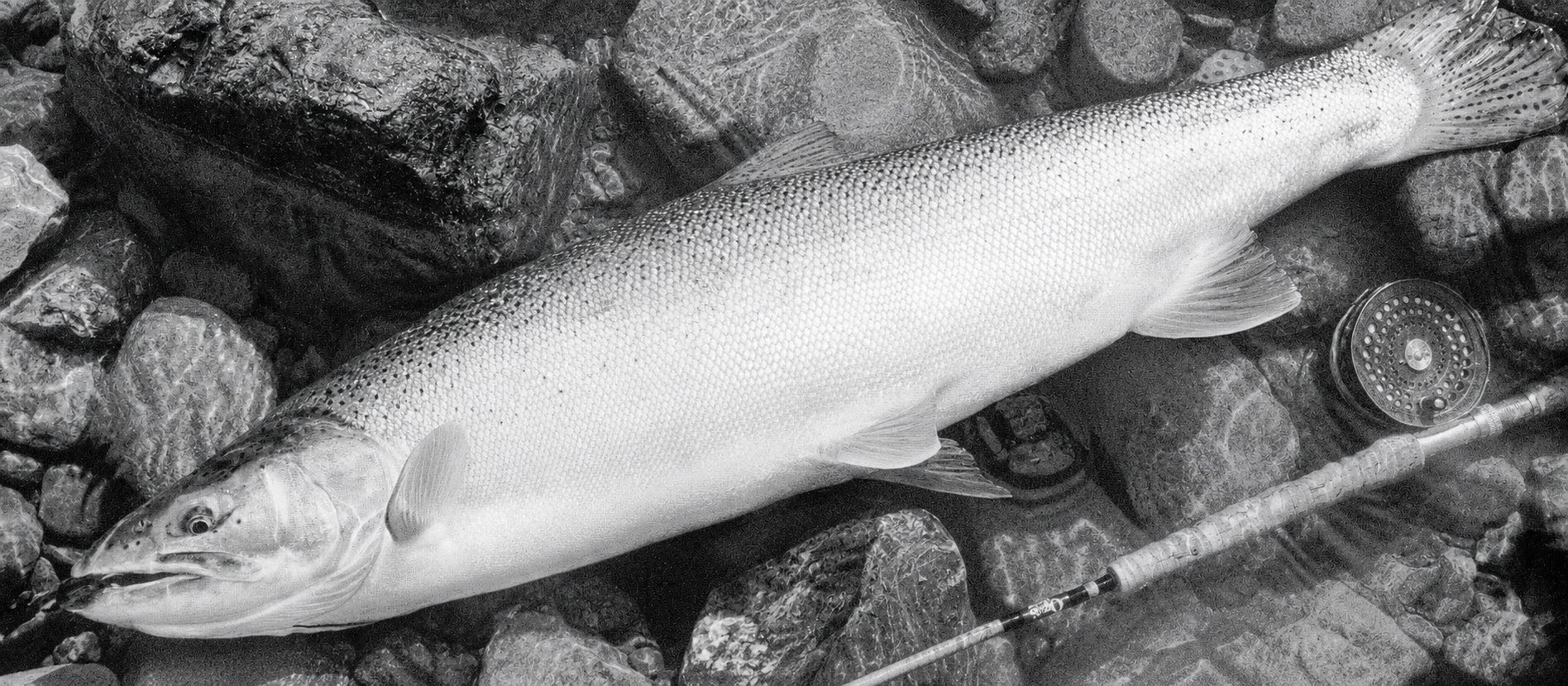
A 33-inch April Buck
Ralph Wahl managed Wahl's Department Store, a family business in Bellingham, the Puget Sound city just north of the Skagit. Once, while on a buying trip to New York, he dropped in to the Field & Stream office to argue for a needed change in the regulations. Shortly thereafter, a steelhead caught anytime during the year was eligible to be a "rainbow trout" in the magazine's fishing contest. Winter steelhead from both California and Washington were soon included. Ralph and his longtime fishing companion, Judge R. O. Olson, and Al Knudson and Russ Willis all placed Skagit steelhead in the contest.
Among Washington's hardy breed of winter fly fishermen, only the Skykomish River and the Skagit's own Sauk have seriously divided affections in the years since.
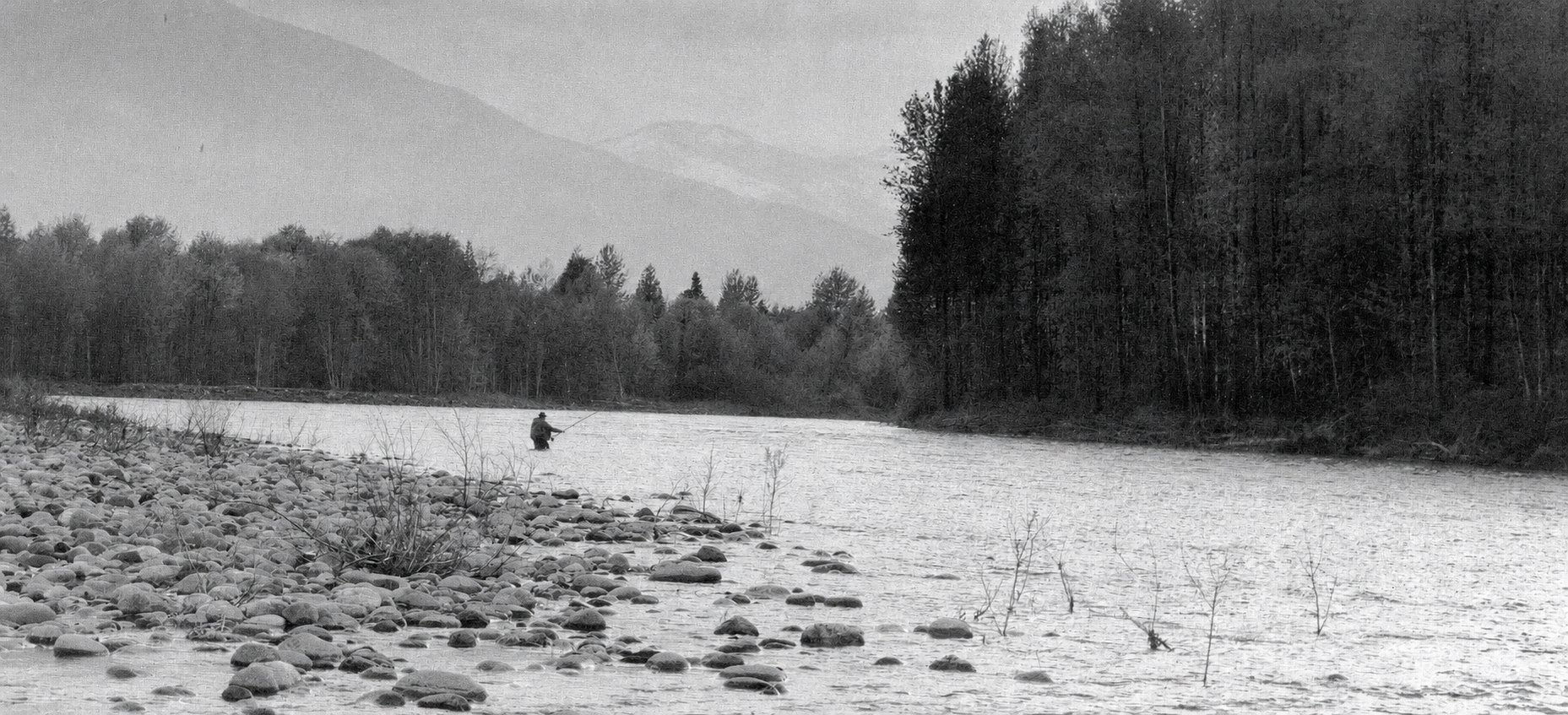
Jim Vincent on a Skagit pool above Rockport
After a long day on the Skagit, my custom was to join friends at the Fish In for a pitcher of Red Hook, a Seattle brew that exorcises despair and liberates the tongue. John Farrar, his guiding day over, would skol with clients and then head for the tavern. BJ Meiggs was photographing winter steelhead, while Bob Arnold, Dale Edmonds, and Harry Lemire were looking to catch one, and they liked Red Hook, too. By the second pitcher, inhibitions were sufficiently suppressed to promote steelhead gossip with the locals, referred to hereabouts as "tarheels," but generically, like redneck or cracker, and not as a reference to family origins. Outsiders sometimes liked to think of them as hunch-backs in bib overalls. "They live so far in the woods they have their sunshine piped in," said one angler-anthropologist. The tarheels, in turn, believe that "yuppie" is a curse, both an expletive and descriptive of such a complete fall from grace that one's soul has been blighted beyond redemption. They often precede the word with a series of vigorously perverted adjectives, a creative outlet that has become a local craft, like quilting.
This cultural gamesmanship has deeper roots.than the uneasy relationship between city mice and country mice, but it is rarely at mean-spirited loggerheads unless the conversation turns to the management of steelhead stocks. Then the gloves come off. The relative perceptions between some local gear fishermen and visiting fly fishermen could not be more different.
Fly fishermen see the gear fishermen's need for more hatchery steelhead to be insatiable because "quality" and "sport" are interchangeable with "limit." Catch-and-kill is an exalted way of life, and "maximum sustainable harvest" the buzzword for properly managing native stocks. The gear fishermen sarcastically counter by claiming that selective fishery regulations-such as the Skagit's April-long catch-and-release season-are laws made for fly fishermen so that they can fish over spawning redds. They also believe that the worst defeat America ever suffered occurred in the courts, in the "Boldt Decision," in which Native Americans with treaty rights were given the right to take half the annual run of steelhead on Washington rivers.
"Indian" is another curse heard in these parts.
Indian fishing has been a bone of contention, the state and federal governments historically on opposite sides of the fence, the matter litigated in federal court, the decisions handed down invariably in favor of the treaty Indians. Nevertheless, "Indian fishing," the harvesting of steelhead with gill nets, either drift or set, and the commercial sale of those steelhead, must be coordinated with Washington's need to manage stocks at sustainable levels. This is not law so much as necessity, the reasons not always penetrating the sportsmen's bitter resentment. First, the Indians have a court-ordered right to fifty percent of the total run, whatever that might be. Both user groups, sport and commercial, suffer if either one exploits stocks to the detriment of the run. Secondly, the value of the Skagit steelhead fishery, particularly insofar as the Indian take is concerned, depends heavily on hatchery plants. Though Skagit Indians have their own fishery biologists, hatcheries, and stocking programs, they still depend on state hatchery plants in the Skagit to obtain their fifty percent of the run. Just as important, hatchery-reared steelhead smolts return as adults early in the run, mostly December and January. This predictability makes their commercial harvest more timely and efficient, while simultaneously taking pressure off native stocks. The native stocks remain the genetic depository for the race's size and spirit.
Three tribes net steelhead and salmon from the Skagit River. The Swinomish Indian Reservation is on Fidalgo Island at the mouth of the Skagit. Traditionally, the tribe nets from tidewater to the city of Mount Vernon. The Upper Skagit Indian reservation is near Sedro Woolley, its nets set between Mount Vernon and the mouth of the Baker River.
The Sauk-Suiattle Indians have ancestral fishing grounds on late season spawning waters along the upper Sauk, but they limit their commercial netting to the lower Skagit, doing so by invitation from the other two tribes.
I discussed this netting with Eric Beamer, a Swinomish Indian and the Managing Biologist for the Skagit System Cooperative. He explained that the tribes own and manage the Red Creek Hatchery. Fry are transported to rearing ponds at Lake Shannon. Approximately fifteen thousand to twenty thousand smolts are released a year later. This is not a trivial number, but it remains small compared to the State's hatchery plants in the Skagit that typically run from two hundred thousand to three hundred thousand. The tribal fishery takes place in December and January, and sometimes for a few days in February. Over the past twelve years, the Indian steelhead catch has totaled two thousand to five thousand, with three thousand to four thousand a typical season. By late in December the run size is updated, the Cooperative able to establish fishing days, hours of netting, and so forth.

A breakdown of the 1988-89 annual run of Skagit steelhead
Hatchery stocks are exploited at a much higher rate than wild stocks. Although the Skagit's state hatchery program is funded by the sale of licenses and punch cards to gear fishermen and fly fish-ermen, it is the Indian net fishery that actually takes most of these hatchery steelhead, more than seventy percent of the total, though the tribes provide less than ten percent of the hatchery smolts. Yet I would not have it otherwise. To net native stocks commercially-the Indians account for only 676 steelhead from a run of 19,334-would be an unforgivable waste. It can be said that sportsmen fund Indian netting in order to protect the native Skagit steelhead.
Our dependence upon hatcheries to sustain the early-returning winter-run steelhead is accomplished by nearly eliminating the native, December-run steelhead, for they make up less than ten percent of the December run. This trade-off troubled me, and I discussed it with Curt Kraemer. He explained that some progeny of February and March native steelhead would always be predisposed toward returning early in the run, that in effect, the Skagit's winter run will naturally continue to reseed for the extremely high mortality suffered by early-returning fish.
Following the Boldt decision in 1974, the "minimum sustainable harvest" numbers determined by the state were challenged by tribal biologists and then mostly ignored. The tribes and Washington's Department of Game (now Wildlife) had their own agendas, and the Skagit's native run of steelhead went into swift decline until, by the late 1970s, it had reached a low of about four thousand fish. It was evident that the tribes would ultimately need to depend on hatchery stocks, make peace with the Department of Wildlife, and co-manage the resource more intelligently. An outgrowth of this coopera-tion has been a division of hatchery stocks and a spring catch-and-release season.
I believe that a catch-and-release season is nothing more complicated than a way of making a world-class and critically finite resource go farther. That's it. According to Kraemer, the law was not put into effect to build native stocks. "If numbers were depressed, I'd shut down the river," he said. Neither does catch and release have anything in common with minimum sustainable harvest. The concept that a river's run of native, wild steelhead can be enjoyed at historically high escapement levels is for me the ultimate experience. I do not care to have this fishery gutted by a handful of anglers catching and killing these steelhead for their annual thirty-fish limit and then the river shut down because the mini-mum sustainable harvest has been reached.
The relative positions held by fly fishermen and gear fishermen as to what constitutes the sport of steelheading and how the Skagit's steelhead stocks should be managed are predictable and unlikely to change soon. But both groups are deeply committed guardians of the river, and that fact makes our differences less significant. And while we drink beer at the Fish In, our differences are forgotten when talk turns to the river's great winter-run bucks, valley gossip that is sure to heat up the imagination and keep the Red Hook flowing. In April of 1990, the question was more intriguing than in any other sprmg in memory.
Jerry Wintle's giant steelhead was the reason.
I had heard his story and seen it in print, all reported third-hand, and I didn't believe it. The facts were sketchy: On the last day of the previous season, April 30, 1989, Jerry caught a Skagit steelhead forty-eight inches long, and had, of course, released it.
I knew Jerry, and no one so understated his angling. This retired Canadian fished a cane rod with an old, battered English reel. Though he might be gracefully losing a step or two, he remained athletic, a good wader who cast a pretty line. No one read water better-or kept shorter fishing hours. Ehor Boyanowsky, a Canadian who is very knowledgeable in the ways of steelhead, once told me: "Jerry Wintle is the best steelhead fly fisherman in British Columbia-and he makes it look so easy. He goes out, makes a few casts, and before you know it he's caught a couple of steelhead!"
Last fall, when I met Jerry on the Thompson River's Graveyard Pool, I wasted little time getting around to his Skagit steelhead. He said that a couple of times he just about decided to break the fish off, for he became worried that the rod wouldn't hold up.
"You mean you hooked the fish on your little cane rod?"
"Oh yes," he said. "I had a hard time getting the fish in. It was so long I couldn't even hold it up."
"I understand you measured the fish with your rod?"
"Yes. I carefully measured its length. When I got back to camp I found my tape and measured the rod. No one would have believed it, so I knocked a couple of inches off."
"And that's how you got 48 inches?" I asked. Jerry nodded. He showed me, head to tail, rod butt to nearly halfway down the rod, the length of the steelhead.
"Just its head came to here," he added, and pointed to a place above the grip in the butt section.
"Such a steelhead would weigh over thirty pounds, could weigh over forty pounds. That's easily the longest steelhead I've ever heard of!" I paused to catch my breath and visualize it all. "What fly did he take?" Jerry doesn't tie and often fishes whatever is available in a friend's fly box.
"Oh, one of those orange things, you know, a shrimp fly."
"A General Practitioner?"
"Yes, that's the fly," he said. "Bob Aid had just given me one to try out."
John Farrar was in camp that day when Jerry came back. He recalled, "Jerry called out to Jean, 'Where's my tape?' and climbed into the cab of his pickup. Things began firing out of the back as he tore the truck apart. I couldn't imagine what had happened. No one had ever seen Jerry in such a state!"
Jean Wintle often goes fishing with her husband, and in recent years has videotaped some of his catches. Unfortunately, she had stayed in camp on this last morning of the season.
John and I retold our stories in the Fish In. We both believed Jerry, but neither of us could quite believe in such a steelhead, an odd dichotomy that I thought would only be settled when we had thoroughly exhausted a discussion of our mutual faith. One evening, when Bob Arnold had joined us and the topic had again turned to this fish, a local on the next bar stool explained that he was a Wildcatter, a member of a local steelhead club that had spearheaded many good works and possessed considerable political clout. When these credentials had sunk in, he leaned over and confided, "The Indians have caught steelhead of fifty pounds in their nets!"
I wondered if he believed his own story, whether this chapter in valley mythology was for the long-rod rubes swathed in pile and polypropylene. Years ago I heard this exact tale about the Kispiox River, but many angling experiences supported it. The Skagit was another matter. After all, an entire generation had passed between two fly-caught twenty-pound steelhead. Nevertheless, my friends and I greeted this news with courteous solemnity.
Shortly thereafter, I met Bob Forbes, a Washington Department of Wildlife enforcement officer. A couple months earlier he had checked in a forty-seven-inch steelhead that a gear fisherman caught from the lower Skagit in the Mount Vernon area. "The fish was a snake," said Forbes. "It weighed only twenty-nine pounds."
By his account, the buck was in good shape, somewhat colored, and certainly had lost a little weight. Given its slim build, its ocean weight would likely have been unremarkable, but certainly over thirty pounds. Other than Jerry Wintle's extraordinary fish, this was the longest steelhead (by nearly two inches) I knew of that had been reliably measured.
When I asked Curt Kraemer how real he thought these steelhead could be, whether the Skagit winter-run possesses the genetic potential for length beyond that of any other race of steelhead, I expected some sobersided debunking. Fish biologists are not by nature given to romantic specula-tion-no dreams of elephant graveyards in their carefully documented world. Besides, one fish-or even two-doesn't make a race. But Curt had a story to relate.
"Years ago, a dairy farmer on the lower Skagit caught a huge steelhead, which the Department of Wildlife heard about. When a biologist was sent out to investigate the catch, all that remained of the fish was a number of enormous steaks. The farmer, however, reported that the steelhead had weighed thirty-six pounds on his milk scales."
"Are there more recent records you can draw from?" I asked.
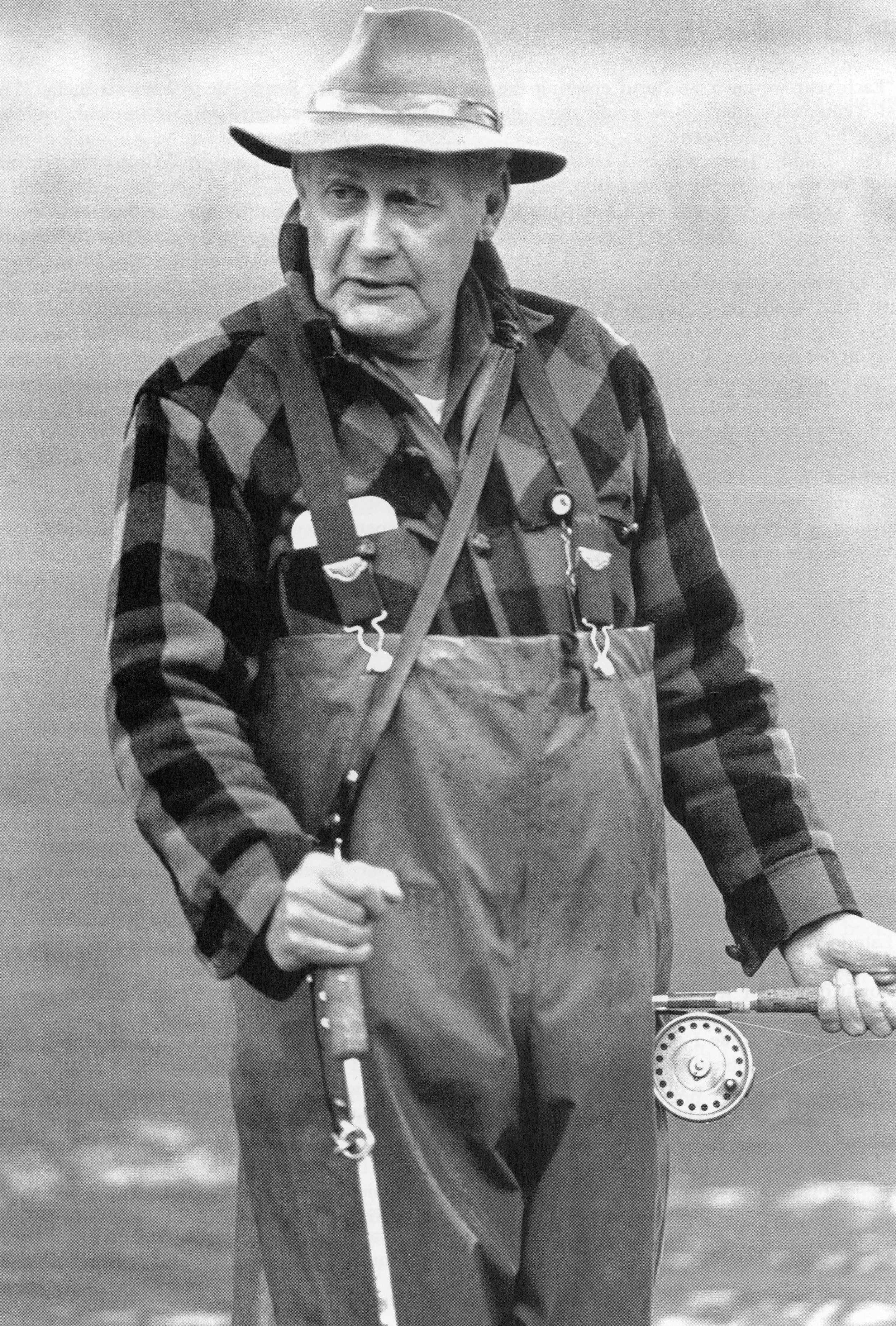
Jerry Wintle. Photo Credit: Don Roberts
"Each year we have steelhead entering the Skagit that measure forty-four to forty-six inches," he said. "Potentially they could weigh thirty-five pounds plus. You've heard of the 48-inch steelhead caught by a fly fishermen?"
"Yes," I said, "Jerry Wintle. I know him. He wouldn't make up such a story." Curt then told me about the 47-inch steelhead that Bob Forbes had checked in.
Had Kraemer ever aged such a steelhead? Not these fish, he said, but he told me that he has used bait-fishing gear to secure brood stock for the hat?ery operation at Chambers Creek, and one day he had caught steelhead of 16½, 22, and 31½ pounds. Scale samples determined the ages of the three fish, all remembered for their remarkable life histories. The 16½-pound female was spawning for the third time, while the 22-pound male was spawning for the second. The 31½ pound male was 43½ inches long and had spent two years as a premigrant in the Sauk, and then more than five complete years in the ocean, a 2/5 life history, and a first-spawning steelhead in the eighth year of life.
Five straight years of rapid ocean growth, a very rare component in any race's life history, represents a size potential of awesome proportions, a steelhead four feet long, for example. Two fly-caught Skagit steelhead of nearly this size, bucks of twenty-five to thirty pounds, were caught by Bob York and Dan Reiff. Twenty-five Pounder Hole now celebrates Bob's fish, a steelhead he had to chase for more than a half-mile before beaching it for a safe release.
Kraemer brought our discussion back to less-celebrated steelhead, and explained that although approximately fifty percent of the first-spawning native fish spent two years in the ocean, fifty percent spent three, four, and five years in the ocean. This breakdown was strongly at variance with hatchery steelhead, of which eighty-five percent spent two years in the ocean and fifteen percent spent three years. The rare one-salt steelhead, with either native or hatchery origins, were invariably ''.jacks," sexually mature males only sixteen or seventeen inches long. (A sampling of three hundred steelhead contained a single one-salt male.)
What all this means to the angler invites generalizations. Most December and January steelhead will be hatchery stock smaller than later-arriving native fish. Eric Beamer, Managing Biologist for the Skagit System Cooperative, claims that twenty-pound steelhead are a very uncommon catch in their nets.
That fully half the native fish spend three years or more in the ocean helps to explain why these spring-run steelhead typically weigh over ten pounds. Anyone claiming the Sauk and Skagit races to be the largest of all winter steelhead would soon hear arguments on behalf of the Skykomish, or perhaps for Olympic Peninsula Indian rivers less well known to fly fishermen, the Quinault or the Queets. Regardless, the list of Skagit-class winter rivers is very short. And I would begin that list with the Skagit itself.
Late in April, Don Roberts flew up from Bend, Oregon, to join me for a week on the Skagit. He would not even pick up a rod, so that he could give his full concentration to completing a magazine pictorial on winter steelhead fly fishing. We both knew this sport to be ever so slow, in the worst possible light and weather. However, some reading material and a large umbrella would enable him to pass the time while I tried to find a pretty steelhead for his cameras. There was enough rain to encourage the steelhead to move, and we found a ten-pound buck at last light on the very first day. That night, rain fell in a driving deluge that blew out all the waters from just below the Cascade snow pack to Puget Sound. The feeder creeks, the larger streams that supported angling reputations, and the Sauk were all so roiled that they were taking out even the Skagit. When we launched the boat the next morning, the Skagit was up more than two feet, and I couldn't make out my boot tops while standing knee deep in the river and the rain.
We found the Mixer deserted, a rare event for any April morning, but a natural expectation this day. The river flooded the gravel bar and was tearing away at the newly leafed willows, which only the day before had caught my lazy backcasts. Entire cottonwoods, alders, and evergreens floated by and served as awful reminders of the hell breaking loose on the Skagit's tributaries. A raven perched in a passing tree and croaked out a greeting.
"He must be looking for his mate," I said. "All the animals, two by two." Don shook his head and happily set up housekeeping beneath the umbrella.
I worked through the long pool, confident that I would find a steelhead near where I had been wading the previous day, all but certain that the fish would prefer the new lies close to shore, water now three to four feet deep. This did not happen, and on the second pass through I reached out somewhat farther, to water at least six feet deep. The fly I chose for this was my marabou version of Bill McMillan's Winter's Hope, a high-visibility dressing that could, I thought, pull a fish from the deeper holds to track the fly into the shallows and take it hard on the swing. When my second time through was no more successful, I returned to the boat to complain to Don and to note that even the gear fishermen were not about.
I wondered aloud if perhaps the steelhead were still holding their old lies, water really too deep for the fly, but at a distance I could reach with my two-handed rod. Don has little experience with winter steelhead, but he is a shrewd judge of rivers and of people. I told him I had deeper-running sink tips, and he urged me to start at the head again with a nineteen-foot sink tip I had made by cutting off the lead from a Teeny 300 line.
Each cast made slightly upstream and across was followed by a strong back-mend and a dead drift that gave the line time to work the fly down deep. I was above the softest water in the long drift with the fly just beginning to swing when a steelhead took the fly solidly, made a single jump, and raced for the middle of the river.
"There he is!" I called. The big salmon reel's ratchet changed to a higher octave as the backing knot disappeared into the river. Don came down the shore with cameras flying, a one-man production company with exclusive film rights to the unfolding drama. I prayed the hook would hold. It did, and with the brilliant buck of twelve or thirteen pounds panting in the shallows, Don the director, the passionate artist, went about his business.
"Work with me!" he cried. With the fish's panic not yet rekindled, Don was in macro heaven. Shoot at water level and underwater, switch cameras, shoot in color, more in black-and-white. Give the fish sips of oxygen. I was watching for a change in the steelhead's complexion, a telltale blotching that would signal serious stress and shock. Nothing of the sort appeared, and the released steelhead darted into the clearing currents.
"One more," said Don, "and I'll be happy. Insurance."
"Perhaps the buck has a fair companion!" I said
I walked back up the pool, dealt myself in just a few casts above where the steelhead had struck my fly, and again began working the Winter Hope. As the fly was swinging through the holding lie, an enormous hen steelhead raced up at the fly with such momentum that the take occurred on the surface. I saw her dorsal fin roll through a slow-motion arc, saw her turn, and felt her weight on my rod as the fly gained a firm hold. The steelhead bolted for the heavy currents, gathered the river about her, and streaked for the Mixmaster. Seventy yards downriver she made a towering leap that carried her ten feet across the currents. "My God! She'll go eighteen pounds," I cried to Don. I was certain that that would be it, but the reel continued paying out line. "Better get the boat!" I called as I stumbled after the fish, astonished now that she was more than a hundred yards away, already the longest-and fastest-single nonstop run in all my years of steelheading.
She stopped abruptly and slowly came upstream on the same track on which she had departed. The steelhead was determined not to run downriver again, but remained a stone wall of resistance close in, fighting the rod as if it were a petty intrusion into her peace of mind. Twice I thought I had her when she staggered and wobbled in the shallows, but each time she spread her pectoral fins, steadied herself, and fought off the big rod by moving out and disappearing into deeper water. The last time I saw her clearly I had been able to move her into a couple of feet of water only a rod's length away. I doubled the rod over parallel to the water and tried to drag her into sudden exhaustion. She would not roll over, and I could see her tense as I applied pressure. She moved upriver twenty feet, but before I could pressure her again, the hook came away.
When you've had your way with a steelhead this long, there is no loss. I was jubilant. No doubt Don was disappointed in equal measure. A portrait of this steelhead, a hen fish of rare beauty, could have fulfilled his expectations, too. We could not have scripted a more exciting meeting, and for both of us this steelhead would become the Skagit in our tales of fly fishing.
Joe Butorac helped me put that sense of the river into words.
One evening I was on the Mixer with Joe and Faith Holste. They were well below me, and I could watch them each time my fly began to swing. An hour before dark I saw Joe react to a steelhead's take, a strong pull that bested Joe's reaction. He changed from his Skagit Monster to a Half and Half, a smaller marabou fly that might entice the steelhead again. When this failed to bring the steelhead back, he pulled out. Joe and Faith were chatting on the beach as I continued fishing through. I think I found his steelhead, a pull, and then nothing. When I could not find the fish again, and I thought only twenty minutes remained of the day, I decided to reel in and change flies. I did this when the swing was nearly completed, bending over and reeling as fast as possible, the Winter Orange skidding across and up the river. Halfway back to me, and in water less than two feet deep, a steelhead slammed the fly so hard I wondered that it didn't break off. The fish jumped twice and drove for the middle of the river amid astonished laughter from Joe and Faith. As soon as I could collect myself, I began to laugh, too. Now I believed John Farrar's story: Jimmy Wright, a well-known Canadian angler, twice raised an April steelhead on a dry fly by standing exactly where I stood. How little we know about these winter steelhead of spring!
The steelhead became mine to release, a buck of ten pounds that glowed molten in the damp night air. Joe and Faith stood over me and studied the fish. "I've caught these steelhead on the last day of the season and you could still see through their fins," he said.
My hand ran along the flank of this steelhead, this ocean race only fleetingly of my river world, and lifted the broad tail. In the faint twilight I saw the clear outline of my fingers. I gave a gentle push. In a blink, the steelhead was gone.