Bugs And Bombers
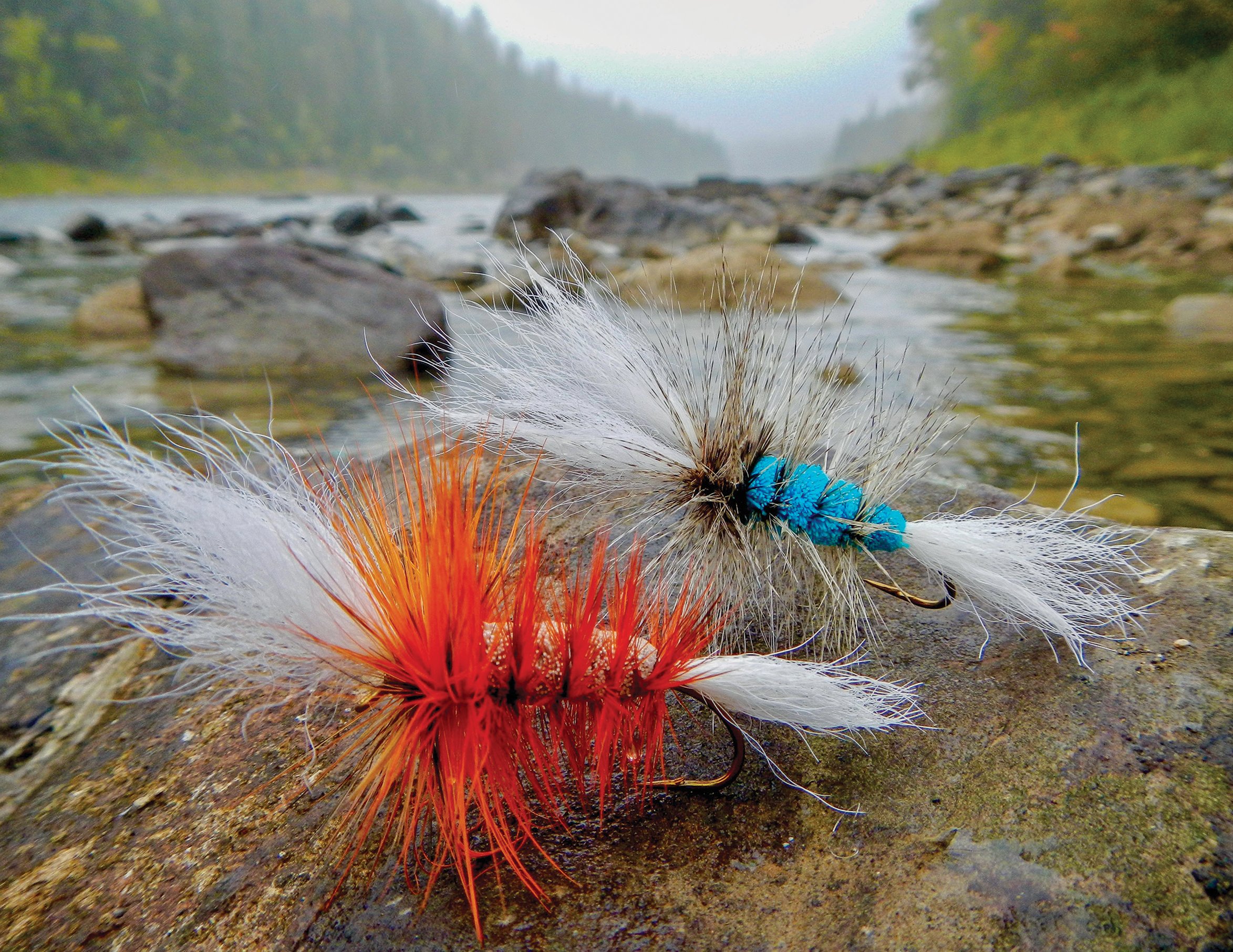
A pair of Québécoise-style Bombers sit at the edge of a promising pool on the Bonaventure River, ready for flight. Characterized by their heavily hackled collars, in the manner of a Lee Wulff dry fly, they often feature exotic feathers such as Coq de Leon, and sport the signature divided wing that is a feature of the dry flies of the Gaspé. Desktop only: Right-click any image in this essay to open it in a new tab to view the high-resolution version. This feature is not available on mobile.
Editor’s Note: “Bugs and Bombers” is one of the more unusual chapters in Flies For Atlantic Salmon & Steelhead. Written by Steve Silverio, it grew into a collaborative history of the spun-deer-hair flies used for Atlantic salmon, incorporating the experiences and recollections of several prominent Canadian anglers and fly tiers. The following excerpt focuses on the origins and evolution of the Bomber and is accompanied by four images from the original chapter.
Bugs and Bombers: Thrilling Takes on Spun Deer Hair
by Steve Silverio
Long regarded as the undisputed king of dry flies for Atlantic salmon, the Bomber is the aerial ace that has earned its unique place among other notable designs in the salmon angler’s fly box. Coming from humble surroundings, the “commotion fly,” as it was dubbed initially, is commonly acknowledged as the brainchild of the Reverend Elmer Smith, who apparently borrowed the basic design from a clipped-hair mouse, which had proved extremely effective in attracting sea-run brown trout in tidal rivers of coastal Maine. Smith surmised that a similarly constructed pattern would be also effective at taking top-water salmon on the Miramichi River in New Brunswick.
Years and several hundred variations later, the Bomber in all its hybrid forms has delighted fly-rodders and continues to prove a successful fly for a range of fish species worldwide—of greatest interest to you and me, Atlantic salmon and steelhead.
In its present form, the Bomber can be divided into two basic styles: Father Smith’s original design, popularized by W. W. Doak, the famous fly shop on the banks of the Miramichi, featuring a single wing and tail and a tightly packed body ribbed with hackle; and the Quebecois design, which shows the strong influence of Lee Wulff, the noted American author, fly tier and salmon angler. This is essentially a combination of a bi-wing, heavily collared and a sparser clipped body and tail, with longer hackle intended to support the fly, much like the early palmer-hackled patterns of La Branche and Monell.
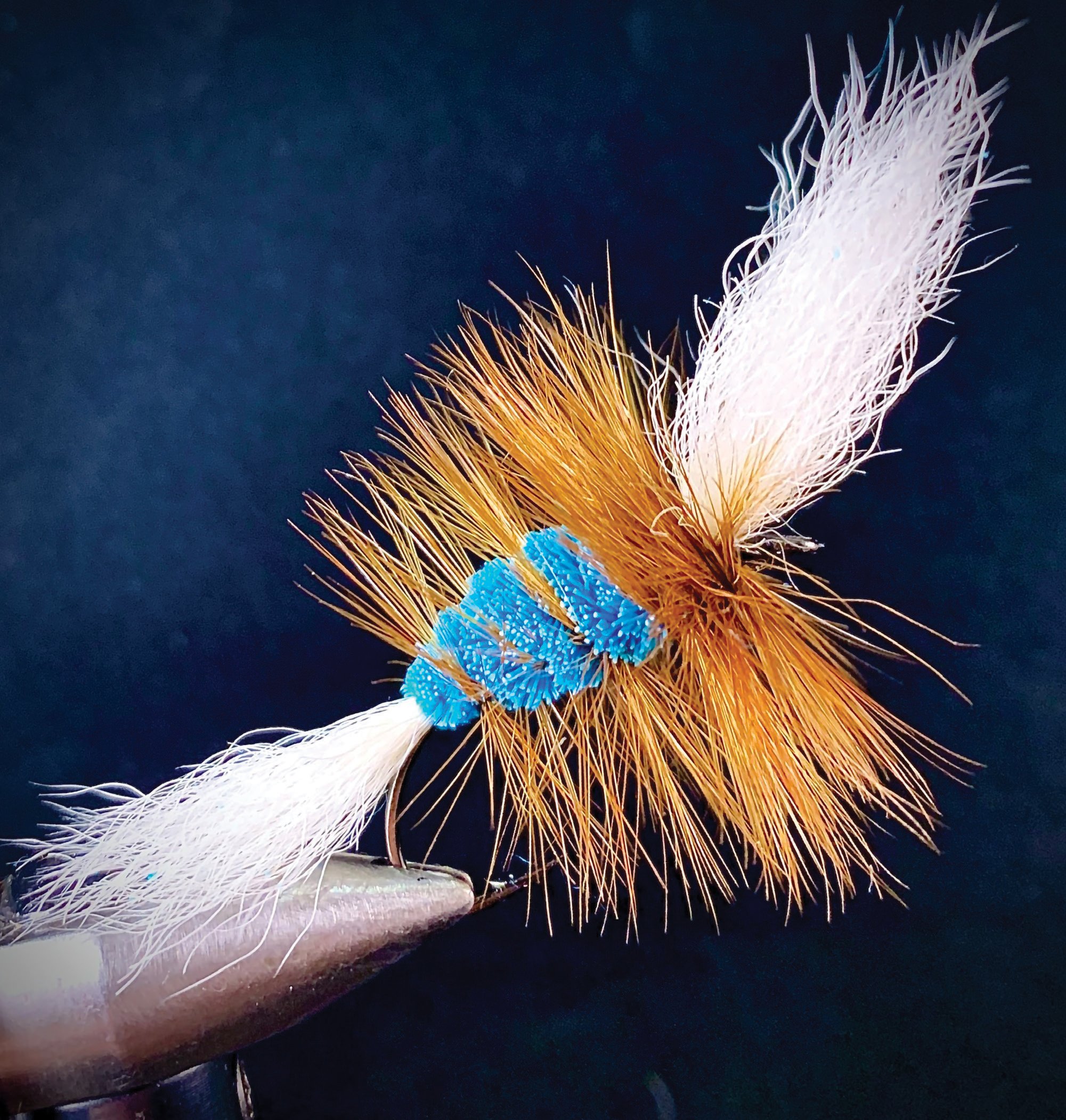
The Iconic Labatt Blue, one of the most popular and successful Bomber patterns of the Gaspé region. Like the Canadian beer by the same name, it has become a staple and still a popular fly in the dry box of any salmon angler. This one is tied in Gaspésie style with a split wing and heavily hackled collar.
While variants abound, at least one notable coevolved pattern exists, the Carter Bug, conceived by Bill Carter. Though overshadowed by the popularity of the Bomber, it has remained a staple and successful dry-fly pattern since its inception. Bryant Freeman, noted tier and advocate of the Carter Bug, offers his insights and detailed tying description later in this chapter.
Though elements of the two styles of dressing the Bomber are often interchangeable, the design differences are indicative of the waters in which they are fished. The Doak-style is favored primarily in eastern tannin-stained salmon waters, or in the turbulent steelhead rivers of western North America, where the fly can be waked or riffling-hitched to great effect. The Quebecois design, with its forward-facing wings and lighter body, is perfect for launching long, arching casts that allow the fly to gain hang time over salmon resting in clear pools, thus landing softly and fishing much like a trout fly.
It would take 20 more years into the 1960s, before Reverend Smith ignited a new flame. By this time, angling authors in books and magazine articles were touting the excitement of taking salmon on the surface. Competing with established Canadian dry flies such as the MacIntosh, Cosseboom dry and Whiskers, as well as the Wulff series, the Bomber nevertheless gained fans. Surpassing the deer-hair bodies of the traditional-profile Rat-Faced McDougal and Irresistible, the rough, cigar-shaped fly grew rapidly in popularity, becoming the bug of choice for salmon on the surface. Soon tiers were creating many variants in the original Bomber’s image.
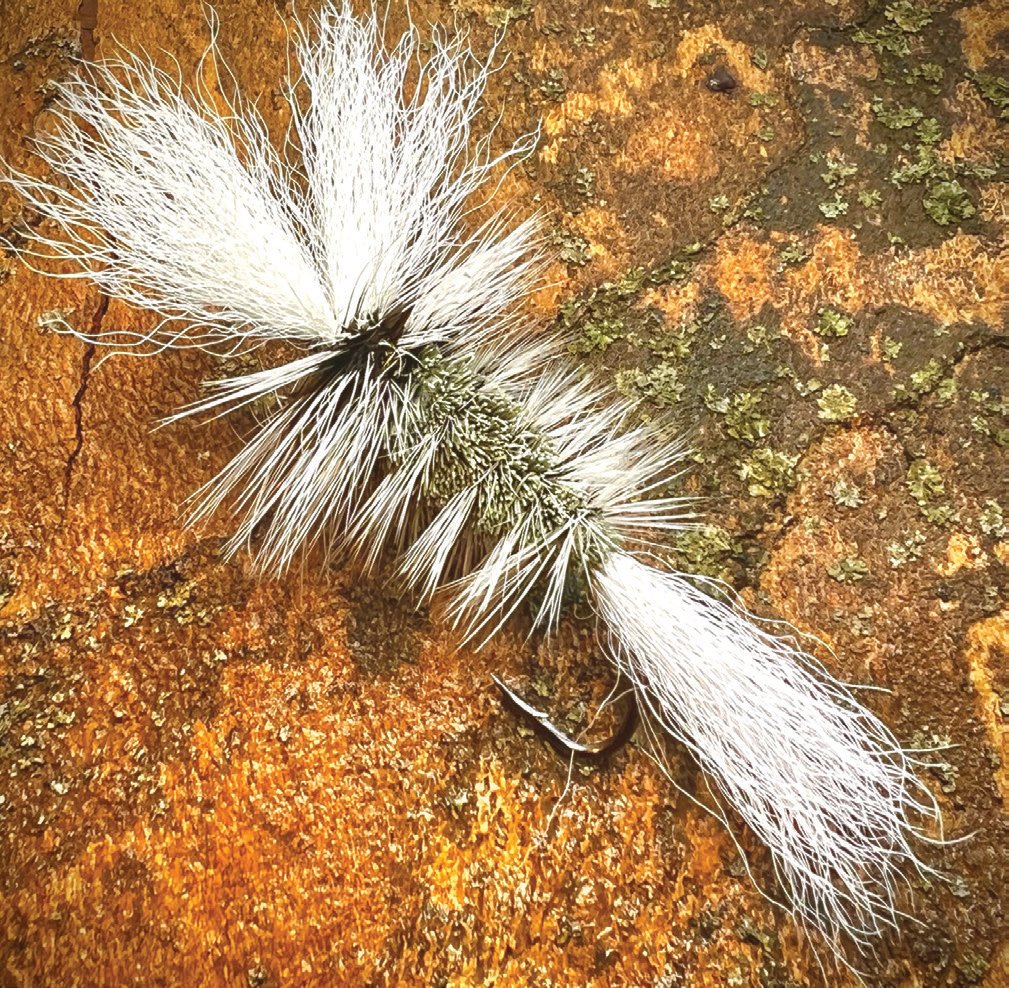
One of the standards of the Matane River, the Canuel, by Raynald Canuel, is unique in that the color of the body of the fly, which is often described as dun-green, is the secret of the success of this fly. Set off with a hackle of badger, the fly presents itself well over deep, slow pools. Originated in 1975, it has become widely popular throughout the Gaspé Peninsula.
Why Salmon To A Dry Fly?
A perennial question always arising whenever salmon anglers gather, especially after a hard day on the water, is why salmon take a fly—moreover, why a dry fly?
The reasons are often conjecture, though when guides join in the conversation, speculation is often mixed with professional observation, even if, at times, fanciful. Impossible to count the number of times I’ve heard the one about the angler who, after a frustrating day, calls it quits, only to watch his guide absently toss the last of a cigarette over the side of the canoe and have it engulfed at the stern in the huge swirl of a salmon take. While these and other stories fill the long hours of a day on the water, there are also recorded events that cannot be dismissed so easily, and certainly give pause for thought. Salmon lore is replete with guides and their sports observing what they believe is feeding activity, when salmon are seen rising to surface insect activity.
The fact that salmon do rise—if only occasionally—for the dry fly, is enough for me to continue pursuing them. While theories, like Bomber variants, continue to multiply, I can only look to those who have made fly fishing for salmon their life’s goal, to offer the most plausible reasons for why or why not.
Canadian Voices
This chapter started with a phone call. After what seemed too long a time, Trey Combs and I finally reconnected, and he told me about the book he was working on. Trey asked if I would be interested in contributing a photo or two of Bomber flies to the book and I said yes. After a time and several conversations later, he asked about my doing a chapter on the Bomber. To say that I was flattered would be a gross understatement—I accepted immediately.
Upon further reflection and more information from Trey about what he was looking to achieve in the chapter, I knew that I alone was not adequate for the task. The idea of calling for aid from over the border took shape and so I began to contact persons with whom I had become friends and for whom I have had great respect. The people whose stories you will read are also guides, authors, lodge managers and fly fishers, but above all, they are brothers of the spun-deer-hair dry fly.
Sadly, both the great angler Mike Crosby, pride of Nova Scotia, and Bryant Freeman, angler, author, fly tier and salmon conservationist, had passed away prior to the final editing of this book, but not before contributing their voices to this chapter. All of us cherish their participation in this project.
Background Of The Bomber
by Paul Marriner
On July 1, 1927, New Yorker Frank Gray Griswold, a member of the Cascapedia Club, was fishing a fast-flowing run on the Grand Cascapedia River in Quebec. A salmon showed and he rang the wet-fly changes—some show of interest but no sale. Loath to leave a customer, Griswold pondered the contents of his boxes and his eyes fell on a concoction of deer hair: straight wing and tail with spun and clipped body—a bass bug. Griswold wrote: “The second time this fly, floating on the surface of the rough and rapid water, danced over the spot where the fish was lying, the salmon rose and took it with such keenness that the large hook was driven completely through its lower jaw.”
The pattern, a South Bend Fuzz-Oreno, was a large, striped, spun-deer-hair bass bug, sporting both tail and swept-back wing of bucktail. Recent (1925–26) reports of dry-fly success explained this rather odd inclusion among the feather-wing wets, most prominently his own Griswold Gray. With some interest in trying the “new” tactic, his astute angling mind reasoned as follows:
“The colorless hackle flies used in dry-fly fishing I knew would not answer, for in high-water conditions they would hardly prove attractive even if a fish could see them, also in heavy water it would be impossible to mark your fish and cast directly to it. What I looked for was a large, brilliant, bucktail fly that would not sink and could be fished in the usual manner downstream.”
Griswold’s salmon weighed 25 pounds. My multi-decade ramble through Atlantic salmon angling history has yet to unearth an earlier record of a salmon taken on a floating deer-hair fly.
A week later, Griswold encountered a trio of sulky salmon spread out across the smooth-flowing tail-out of a pool. Choosing the largest, he offered his best wets. Discouraged by the total lack of response, he was prepared to yield and leave the pool when his gaffer suggested a try with “one of them funny flies.” Up came the target to the first float across its lie; soon a 32-pounder was in hand.
In an early South Bend catalog (color plate No. 7), I found the successful pattern. Although not certain, it appears the hook was a size 3/0, similar to a Mustad 3366.
Yellow wing (bucktail)
Yellow body (spun deer hair)
Red stripes (spun deer hair)
Red tail (bucktail)
More than three decades would pass before another deer-hair bass bug (mouse) would inspire the creation of Atlantic salmon angling’s most celebrated dry fly, the Bomber. Fished on at least five continents (likely more) for numerous species, the variations number in the thousands. As for its success with Atlantics, it can lay a very reasonable claim to have landed the largest fly-angled specimen to date, Mike Crosby’s 60-pound-plus Restigouche River male. True, the weight is an estimate, as Mike released the massively kyped behemoth unharmed, but at 63 inches in overall length, it was an incredible capture, not to mention being on eight-pound-test. Another worthy mention is Murray Palevsky’s 40-pound Cascapedia set, a male and a female from the same pool, on the same morning, to the same Bomber.
As for me: naught but grilse. Could it be because I prefer to fish a Carter Bug—or the very similar Orange Bug in Newfoundland—or riffle a wet when up top? Or simply lack the patience to cast for hours over the same salmon, like the venerable Olivia Lefrançois (a highly successful Matane River specialist)? Regardless, others will surely take up the anecdotal slack.
The Carter Bug
While writing Modern Atlantic Salmon Flies (1998) I interviewed Bill Carter of Portage Vale, New Brunswick, now deceased, concerning the genesis of the Carter Bug. As a bit of background, the Big Salmon River flows into the Bay of Fundy. Until the latter half of the 1970s it fished reasonably well with a grilse-to-salmon ratio between two- and three-to-one and an average total annual catch of 500. Salmon consistently averaged 11 pounds. Then the bottom fell out and in 1982, along with many other rivers, release of large salmon became mandatory. By 1990 the rivers were closed completely and remain so today. Sadly, it’s unlikely to change in the foreseeable future, if ever.
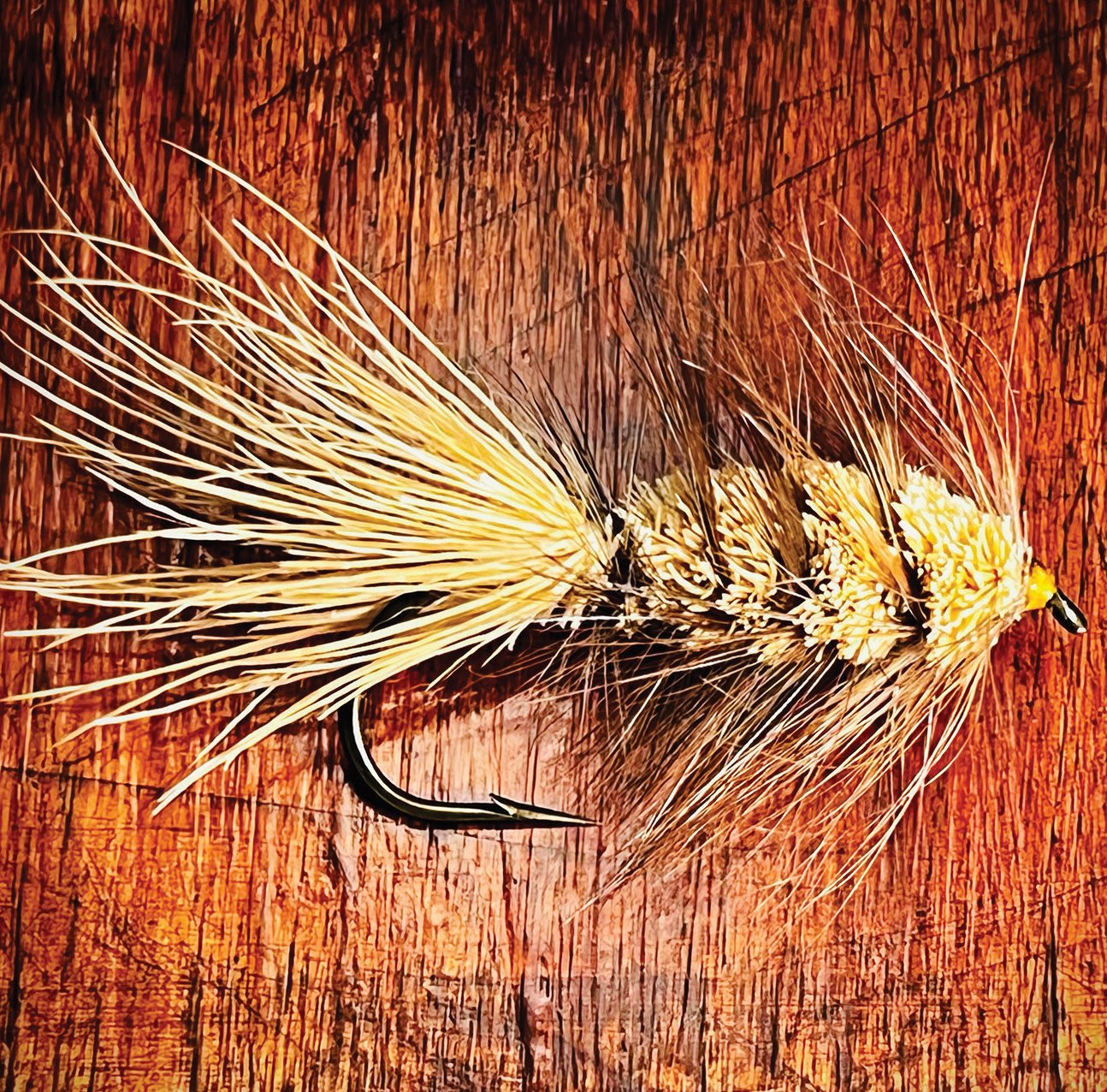
The unruly Carter Bug first took flight in the 1960s on New Brunswick’s Big Salmon River. Bill Carter first tied it with sun-bleached deer hair. In recent years its popularity has surged on the Restigouche, with most summer catches on the surface coming on the Bug.
In better times, circa 1960, Bill was fishing the Big Salmon. Never an easy river, he hadn’t had much luck. On the way out, he spotted a pod of salmon from a high bank. On impulse he tossed a piece of moss onto the pool and a salmon promptly rose to take it. At home he tried to roughly imitate that bit of vegetation and the yet to be named Carter Bug was born. Stillborn to be sure if it hadn’t performed on its next outing and many times afterwards, for him and others. Sadly, I didn’t ask Bill who named the fly, but one can imagine many scenarios. After all, he did own a fly shop.
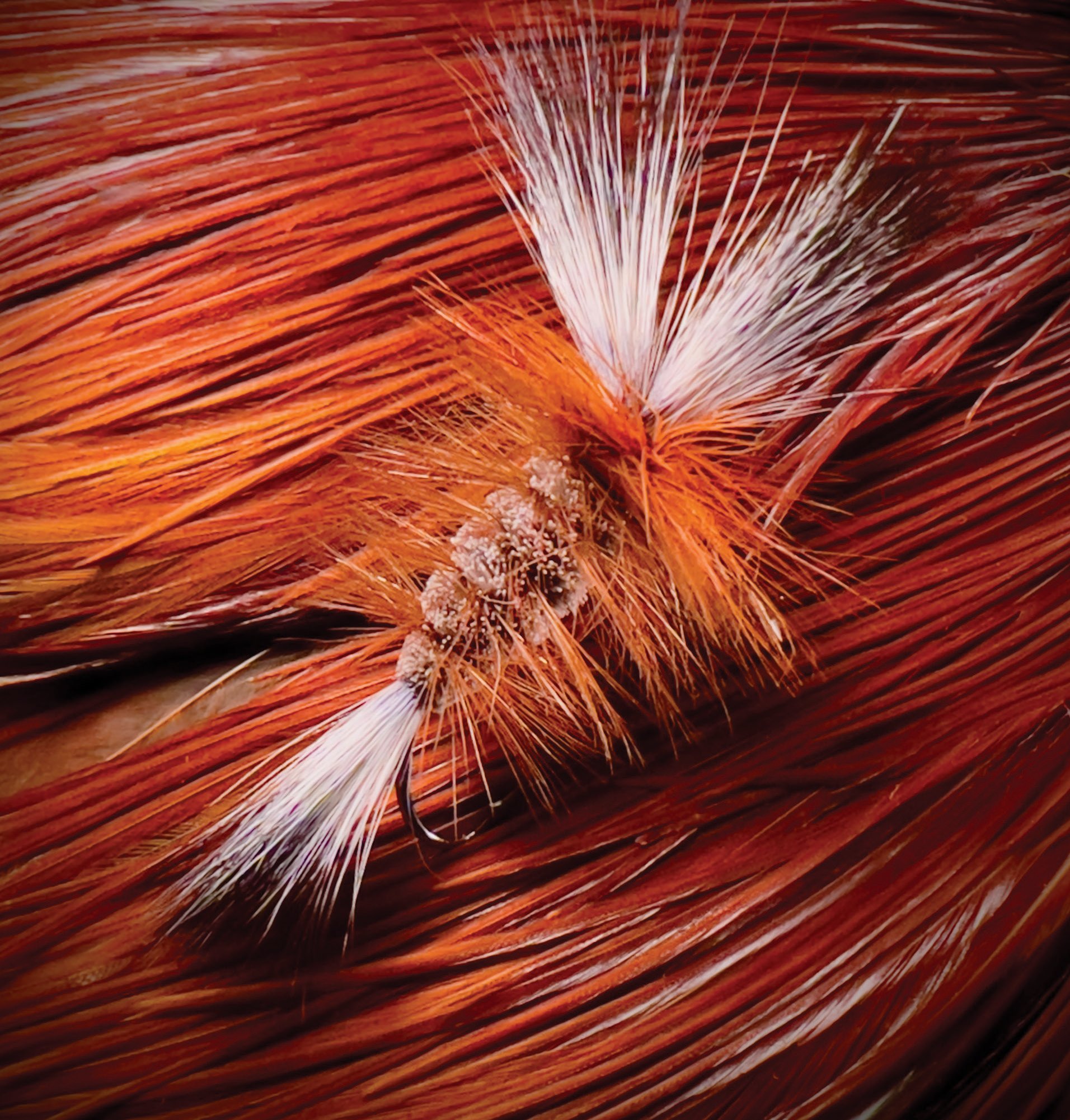
Regarded as the most beautiful of all the Bomber dries, the Hazel, by Paul LeBlanc, was named the Fly of The Year in 1989 by the Atlantic Salmon Federation. Dramatic, with its tail and wings of gray fox guard hairs, the fly also earned Paul the Federation award of Fly Tyer of the Year. A truly stunning pattern, named after his longtime friend and companion Hazel Maltais.
All the flies pictured, except for the Hazel, were tied by Steve Silverio. Dressing notes for all flies pictured in this chapter excerpt can be found in the Fly Pattern Dictionary.
This blog is excerpted from the chapter “Bugs And Bombers” in Flies for Atlantic Salmon & Steelhead. The chapter was written by Steve Silverio and includes contributions from Paul Marriner. The book is available directly from the author on Amazon in two formats:
Limited 1st Edition Hardcover — available on Amazon
Digital Reference Edition — available on Amazon Kindle