Roderick Haig-Brown and the Steelhead Bee
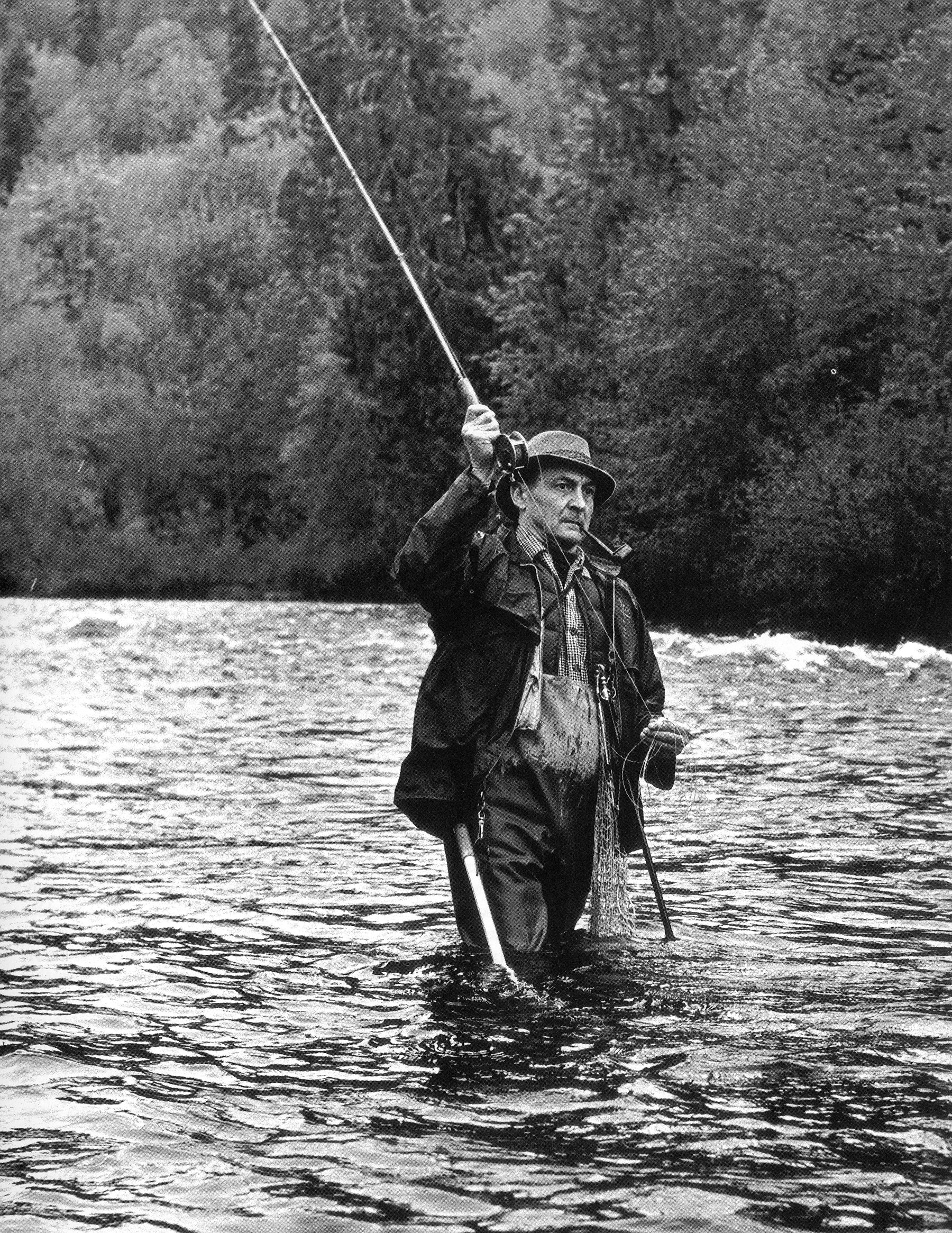
Roderick Haig-Brown fly fishing the Campbell River (photo by Mary Randlett). Desktop only: Right-click any image in this essay to open it in a new tab to view the high-resolution version. This feature is not available on mobile.
Roderick Haig-Brown and the Steelhead Bee
When I was able to complete my two year teaching contract, and graduate from Whittier College—I’d begun teaching as a junior with an emergency credential, --my wife and I obtained teaching positions near Tacoma, Washington. Our family included a brilliant little toddler (who runs my website now), and I was bursting with a long-standing obsession for the gamefish and anxious to introduce my son to the sport I knew only from accounts in fishing magazines. I visited a local fly shop and basked in an atmosphere filled with rainbow trout abundant in lowland lakes, sea-run cutthroat of such quality no one freely discussed the resource, and of course, steelhead, a legendary gamefish so difficult to take on a fly that only one place, the North Fork of the Stillaguamish River below the confluence of Deer Creek, was worth fishing.
The owner of the business invited me to attend a meeting of the Puget Sound Fly Fishing Club. This was the proverbial duck to water! Members were giving and took me in and took pleasure in orienting me to their myriad of fly fishing passions. There were monthly club outings to various lakes that were fished from prams made from a single sheet of quarter-inch plywood. To do this and be part of the fun, I needed to borrow the club’s jig and some clamps, and soon I had a pram set up with rowing facing the bow. One could pick out a rising trout and row forward while keeping the fish in view. But that was half of where the club took me. The other half that Morrie Kenton, the club’s most notable fly fisher, impressed upon me was to read the books by Roderick Haig-Brown. No better fly-fishing advice would I ever receive.
I naturally asked Morrie about steelhead fly fishing. His answer was disappointing. “Why do I want to fish all day and never hook a steelhead when we have sea-run cutthroat fly fishing that’s among the finest trout fishing on earth.” I wasn’t in his corner yet, but he put me on to a couple places that would be fishable in winter after the first freeze had rid the surface water of algae. In those years there were many small creeks that led to Puget Sound and they held small and fragile populations of sea-runs. There was a simple oddball fly the few sea-run addicts fished almost exclusively. The body was alternate bands of black and yellow chenille. The wings was equally divided with sparse white bucktail topped with a bunch of peacock herl. The head could be cleaned up with a few turns of black hackle, and many anglers added a tail of red hackle fibers. That’s it, and oh dear did this Bumble Bee work so well that calling it Assassin would have been more appropriate.
I soon shared my enthusiasm for sea-run cutthroat with Morrie. One day—one since regretted—I took home three sea-run of 18, 20, and 23 ½ inch sea-runs beautiful gamefish. I soon did an article for a British fly-fishing magazine. I needed a photograph of a trophy-size sea-run and to provide this I visited the lone hatchery in Washington that had a small program to sustain numbers. An exceptionally large female brood cutthroat was netted, briefly put in a bucket of water where it was anesthetized and then put on grass with a fly rod and reel, and photographed. The tackle helped appreciate the size of the fish, five pounds as I recall. I never wrote about the runs for local consumption. A person could slowly row a boat off one of the sea-run creeks, and pull a spinner with a hook carrying a garden worm, and easily catch a limit of eight or ten trout. A repeat visit would result in the run decimated.
I found the addresses for second-hand book sellers and began reading Haig-Brown and overnight became obsessed with his writings. After A River Never Sleeps, I read the single volume edition The Western Angler from the original limited two-volume edition. This book was how I was introduced to General Noel Money, and the pool on the Stamp River that bore his name, a place where the General and Haig-Brown fished and a place that Haig-Brown wrote about and the event the General meticulously logged in on one of his game books. Then I began purchasing his Fisherman’s Spring, and Summer through the year.
I’d been searching for any fly dressings that had application for steelhead and had assembled a tidy little trove that included flies by notable Northwest anglers such as Al Knudson. But then while waiting at the checkout of a grocery store I saw in a wire display rack copies of a new magazine called Salmon Trout Steelheader. I grabbed a copy as I went through checkout. When home I devoured the articles and advertisements until I had a sense where Frank Amato, the editor and publisher, was taking it. A phone number was provided in the masthead, and I screwed up enough courage to call the person without nervously stuttering and told him about my research on steelhead flies. Frank was receptive to my sending him an article and I did so. Frank wrote back that he would publish the article and a short time later sent me a royalty check for $5.00. At that point I was wildly ecstatic, but I still had never seen a steelhead in my life. I wrote something readers found interesting. Suddenly I had a home for my writings and then, as now, Frank Amato was a man forever dear to me.
One weekend the PSFF had a lowland lake outing where we would pursue rising rainbow trout. My education was advanced when I was able to watch Morrie do his magic. He had a rising trout that was refusing his Royal Buck as it slowly moved down the lake, a dimple of water signaling its progress. Morrie would row, make a cast, mutter a curse, and silently row again. I thought the fly had dropped perfectly in the path of the rising trout only to again reject the fly. His frustrations grew along with his curses. Those members rowing nearby became a light patter of giggles. Morrie was reaching hard into long beautiful casts that were snaking out over the water 80 feet away. Then, finally, the trout sipped in the fly and Morrie tightened on the line as a ten pound steelhead shot into the air and began to porpoise down the lake. Morrie had one of those spring loaded reels where a lever could be depressed and the line and small trout came skidding on the surface to the boat. Now, in just a few seconds, the reel blew up, the housing becoming a Cuisinart and grinding away at the screws and springs.
I sent articles to Frank about steelhead flies for years, and after a year he put a picture of me above what was now a regular and anticipated column. He began a second magazine with Bill Bakke the editor. This was orientated more to wildlife and conservation issues, subjects that matched my wheelhouse as much as steelhead and the flies used to attract them. Bill was just brilliant in framing steelhead management issues. He’d go on and on how fish hatcheries would bring extinction to runs of steelhead, and to avoid this wild steelhead stocks must be preserved. But I was a typical Washington resident and thought hatcheries were a long standing promise to license holders that Washington would always have great runs of steelhead. Bakke worked on my misconceptions and gradually iron my brain free of them.
I was making a few trips in the winter for Quinault steelhead, my dismal learning curve promising only cold in snow or rain and not even a grab after hours spent firing a Wet Cell shooting head as far as it could. One mild winter day filled with rare sunshine, I drove north to the Hoh River, parked my car, and walked down nearly to the mouth of the river. I think this was the first pool above tidewater and on the tiny Hoh Indian Reservation. On my first cast I could see that the head was passing downriver evenly, the au naturel Royal Coachman hair-wing passing broadside to the currents. I shortly hooked and landed a grilse, and then a two-salt hen fish. I should have better learned from this incident, the fly swimming broadside to the currents, the effect of strongly leading the fly, but I didn’t.
Frank called one day and invited me to join him and his wife, Gayle, to a Trout Unlimited banquet in Portland, Oregon’s largest city near his rural home on Kellogg Creek. Roderick Haig-Brown would be the guest speaker, a person that we both worshipped. I was giddy over the prospect of seeing the great man, a living legend, and I was as star struck as any 10 year old girl in meeting their pop artist.
When we arrived at the banquet, I saw Haig-Brown and immediately approached him with a somewhat arcane question. His dry fly, the Steelhead Bee, was now famous in steelhead fly fishing circles because he’d written about it in Fisherman’s Fall. He’d described how as the fly came downstream, a steelhead might drop back with its passage and then take down the fly when it first came under tension. I took the liberty of reading between the lines and wondered if the sedate dry fly was now suddenly waking, and was the fly tied to anticipate this fly under tension. The question was a labor to ask because the concept of a waking dry fly for steelhead was very new. There was a back story to my question after Frank had published my book The Steelhead Trout in 1971, I had exhibited and sold copies of it at a little outdoor show in Seattle. Across from my “booth,” a counter to hold copies and a fabric backdrop, was Harry Lemire’s booth where he was promoting his unofficial world record, a huge steelhead in the 24 pound range caught on a dry fly. Harry had a mount of the steelhead displayed above his booth and I think there was a little fly with a foot of mono hanging from its mouth. This was a staggering accomplishment. In Washington a steelhead of just over 20 pounds was a winter fish caught by Wes Drain. The only dry fly caught steelhead I’d ever heard about was from the North Fork of the Stillaguamish, one of the rare Puget Sound rivers that had runs of “trouty” free rising grilse steelhead. Walter Johnson told me about taking such a steelhead on a dry fly that would have weighed seven pounds, exceptionally large for one-salt grilse steelhead. And Walt’s steelhead took the fly while it was on a dry fly presentation; waking under tension was never part of the equation. I didn’t realize that Harry’s trophy steelhead had taken a waking dry fly,
To my astonishment, Haig-Brown knew me from the little column I was writing for Frank, and who, in turn, was sending copies of the bi-monthly magazine to the great Canadian writer who lived and fished the Campbell River on Vancouver Island in British Columbia. As we chatted he suddenly asked, “Can I join you for dinner?” I was overwhelmed by his graciousness and could hardly believe my good fortune. With Haig-Brown between me and Frank and Gayle Amato, we tried to act unhurried as we attempted to ask as much as possible into the short time dining. I’d noted in his writing how he described a steelhead dropping back under the Steelhead Bee as the fly passed downriver. But then as the fly came under tension, it would begin to wake, to wobble about, the wings touching the surface and creating a disturbance. The writer then described that it was then the steelhead rose and took the fly. My question wasn’t a “gotcha,” but I asked if he cast his fly and whether he cast his fly with this strategy. I thought he dissembled a bit, and I didn’t fully understand his approach.
After dinner and following his talk, Haig-Brown lit up a cigar and listened as more presentations took place. At the conclusion of the evening, Haig-Brown lightly tamped out his cigar. As we collected to say our good-byes, Gayle had her purse opened beside the ashtray and in half a second the cigar disappeared into her purse. I don’t know if others saw this and I could hardly believe I’d seen it myself. Gayle was looking up and smiling and chatting when a busy hand made the steal. But on my next trip to visit the Amato family, there was the cigar butt encased in a solid block of clear plastic, a reminder of that unforgettable dinner. I teased Frank and Gayle for years over the incident, the cigar butt a talisman of being with the celebrated author who wrote such perfect steelhead fly fishing literature. Never before nor since have I been so star stuck in the presence of anyone.
Several years later I was madly gathering up flies dressings for a new book I was writing to be called Steelhead Fly Fishing and Flies.
Neither Frank nor I imagined the book would remain in print for 29 years and go through so many printings in paperback. Harry Lemire was eager to tie up a general dressing “A to Z” dictionary of fly dressings I’d assembled with some with no widespread following. At the time Harry was rapidly developing tying skills and was eager to tie these flies. I couldn’t afford to pay him, something that never came up. When the photography was completed at the local photography studio in Port Townsend, I did as I had promised and returned the flies to him.
(Author’s Note: Harry’s fly tying skills were on a very steep learning curve and he was improving weekly. The widespread adoption of Atlantic Salmon hooks with turned up eyes (TUE) immediately gave all our flies an elegance heretofore missing. In only a few years Harry looked upon his flies now documented for the ages with no little disdain. In later years Harry could tie a complex salmon fly by holding the hook in one hand and dressing the fly with the free hand, a skill a Scottish gilley took pride in performing streamside for his Lord.)
Steelhead Fly Fishing and Flies wasn’t expensively produced, but it was the first coherent description of a growing sport and the culture and what it meant to be part of that fraternity of fly fishers.
My dinner with Haig-Brown provided me with sufficient courage to write the great writer and tell him about my new book and how it wouldn’t be nearly complete if his Steelhead Bee wasn’t represented. He sent back a nice letter written in longhand and included two of the flies requested. The flies were included in a box so they would be crushed. One fly had been fished and the leader knot was still attached. The other Bee was fresh from the vise. Both were unlike any so called “dry” flies I’d ever seen. The wings were pitched forward at an extreme angle. In fact, the fly that had been fished on the Campbell River was flat, so flat that it appeared to have been stored between the pages of a large book. Why fish such a fly? Because Haig-Brown was fishing a waking dry fly. Even the sparse turns of hackle was flattened and swept back and under the fly. The flies spoke volumes as to what the fly was tied to do, a fishing fly, not a fly tied in typical dry fly fashion, an abundance of hackle its intended to keep the fly floating properly high, the shorter wings tied upright and divided. And serving no need when searching for steelhead unless the fly drowned and began moving surface water, because they were evidence that Haig-Brown fully understood what this exciting new approach to steelhead fly fishing was about.
I was mortified when I discovered the color plate with an assortment of flies in a row that included the Haig-Brown Steelhead Bee was identified as a fly tied by Harry Lemire. This fly had such an important history, especially among British Columbians, that the misidentification was very disappointing.
The Stamp River
Research for Steelhead Fly Fishing, 1991, picked up where Steelhead Fly Fishing and Flies, 1976, left off, still finding in a single name a reason to exhume the memory and discover the details of the man’s fishing life. This often led to how the angler edited the river’s many pools to a single water where the river was best fished, the single pool standing for the entire river. No history was more important to me as was Roderick Haig-Brown’s dedication in his magnificent two volume work, The Western Angler, to General Noel Money. I soon appreciated that he was an revered presence by the people of British Columbia citizens, whether they had any interest in fishing. He was decorated for the bravery he had exhibited in the Boer War, today a most obscure conflict that took place in today’s South Africa. The first European settlers to the area were farmers who immigrated from Netherlands in the late 1600’s. Ultimately these tough-as-nails Afrikaners were an impediment to the British who wanted to consolidate their colonies in the greater area. Ultimately the Afrikaners suffered horribly under the weight of the British Empire, but that inconvenient truth had nothing to do with why the General was annually given the honor of having the Provincial plate with number one.
I made plans to visit Vancouver Island’s Stamp River and if possible find and fish the General’s favorite water that came to be called Money’s Pool, the water he and Haig-Brown fished together.
To my astonishment, locating the water was easy, a well-marked trail led me to the pool and left me standing on a high bank with the deep holding water swirling below my feet. Across the river was a gravel shore and after some reconnoitering I took the obvious to heart and looked to where I could cross to the fishing side. The best crossing I was able to find came to less than an inch from the top of my waders as I tiptoed and bounced across. I walked to the head of the pool and from the long sweeping gravel shore, I could see why for Haig-Brown and the General, fishing the Stamp meant fishing this one pool. I’d been able to investigate parts of the Stamp, and no other water was half so fine as the Money’s Pool. I gave a fair go, fishing through the water several times without a touch. I left unable to claim I understood this legendary pool so central to the Province’s history of steelhead fly fishing,
I needed to make a trip to the Stamp River’s Robertson Creek Hatchery, Canada’s largest, when it was completed in 1960, and then expanded for Chinook and coho runs in 1972. This casual visit would profoundly change my life. I’d heard about the person who was managing the resource, Bob Hooton, and if ever steelhead fly fishing needed a hired gun, Hooton was that person. I can’t now say what I’d heard about the man, but the gunfighter image was one honestly earned by the man. I knew his reputation was partially built on what I wanted badly to believe; here was a man who could and would shake things up among the faceless bean counters in an impenetrable bureaucracy. Right from the jump, Bob told how returning hatchery steelhead stormed upriver so quickly, they were collected at the hatchery gate, put in a truck with aerated water tanks, and driven back to the mouth of the Stamp and dumped back in the river and thus giving anglers another shot at the fish. We joked that the steelhead might beat the truck back to the hatchery. I can say that Haig-Brown and the General in the 1950’s were fishing for wild steelhead that were profoundly different when ascending their natal rivers, the steelhead holding in hundreds of stations throughout the Stamp, steelhead that with hair-trigger suddenness would take the General’s fly and, in a single move, clear the great pool and run deep into the General’s backing.
I wished Bob Hooton every success in his new assignment to the Skeena Country, home to the largest steelhead on earth. His wisdom and brilliant assessments of management practices for our steelhead and salmon resources may have put him at odds with his superiors, but no one I ever met cared more for the steelhead we both so loved.
During the years writing Steelhead Fly Fishing, I fished British Columbia’s Thompson River numerous times and never once had a banner day. Back in the 1980’s, the run was down to about 1,200 steelhead with the typical buck a three-salt fish that weighed 20-pounds. The river is very large with currents so strong they can drown an experienced wader. I could count only a handful of fly fishers who could honestly say they understood it well. Dave O’Brien was one, Harry Lemire another. But for many of the best rods in the world of steelhead fly fishing, the Thompson had the largest and strongest steelhead on earth, and each fall these persons would drive to Spences Bridge and disappear for a week or more searching the Thompson with their flies.
Bob and I and fly fishers worldwide have anguished over the gradual loss of the Thompson race of steelhead, certainly among the largest on earth and likely the strongest. The loss is riddled in politics; incredibly, the Thompson steelhead has never been listed by Canada’s SARA, its Species at Risk Act. The most basic of reasons stems from the First National peoples, some 12 bands, that have an agreement with the federal government to net the Fraser River in the fall for its huge run of chum salmon. The fish, both males and females, are sold to a seafood company solely for the roe carried by the females. The roe is processed and shipped to restaurants worldwide under the name keta caviar with a canned pound retailing for as much as a hundred dollars. This relationship has provided the indigenous peoples an ongoing source of considerable income, a success story the government points to with pride. Washington and Oregon governments feel much the same, that the indigenous peoples were often treated inhumanely, wrong that could never be made right. In that light, steelhead fly fishers regret that the government won’t so much as discuss anything that might compromise this successful relationship. Bob Hooton has brilliantly documented the gradual loss of these steelhead in a book Managing to Zero, the Thompson River Travesty. This stupendous achievement can be purchased from Amazon for about twenty bucks in hardback.
To put a fine point on this loss of Thompson steelhead, the last escapement figures I heard about came to less than a dozen, down from many thousands in the years after WW II.
I discovered that General Money had carefully documented his days afield with rod and gun in what he called his Gamebooks, and had even included photographs of the sport at hand. I knew my story about the history of steelhead fly fishing wouldn’t be complete without knowing whether Roderick Haig-Brown’s association with the General had been recalled in one of the Gamebooks.
I learned that Gordon Money, the youngest of the General’s four children, had held the gamebooks since his father’s passing. He was agreeable to my examining the gamebooks but he was in poor health, so long as this didn’t take long. Just as his father had done a generation earlier, he served in the army for Great Britain, and had suffered from a mustard gas attack in WW I that left his health seriously compromised.
We stacked the gamebooks on the sofa and then moved each to a table with a large lamp. Gordon would turn the individual pages while I recorded the images with my camera. I hadn’t investigated the pictures beforehand; I’d study the images later. But then I came upon a page where the General had spent a day with a young Haig-Brown on the Stamp River. Hard to explain why this was so important to me, but I found in the record a spiritual connection that was a major event contributing to the culture of steelhead fly fishing.
— Trey Combs
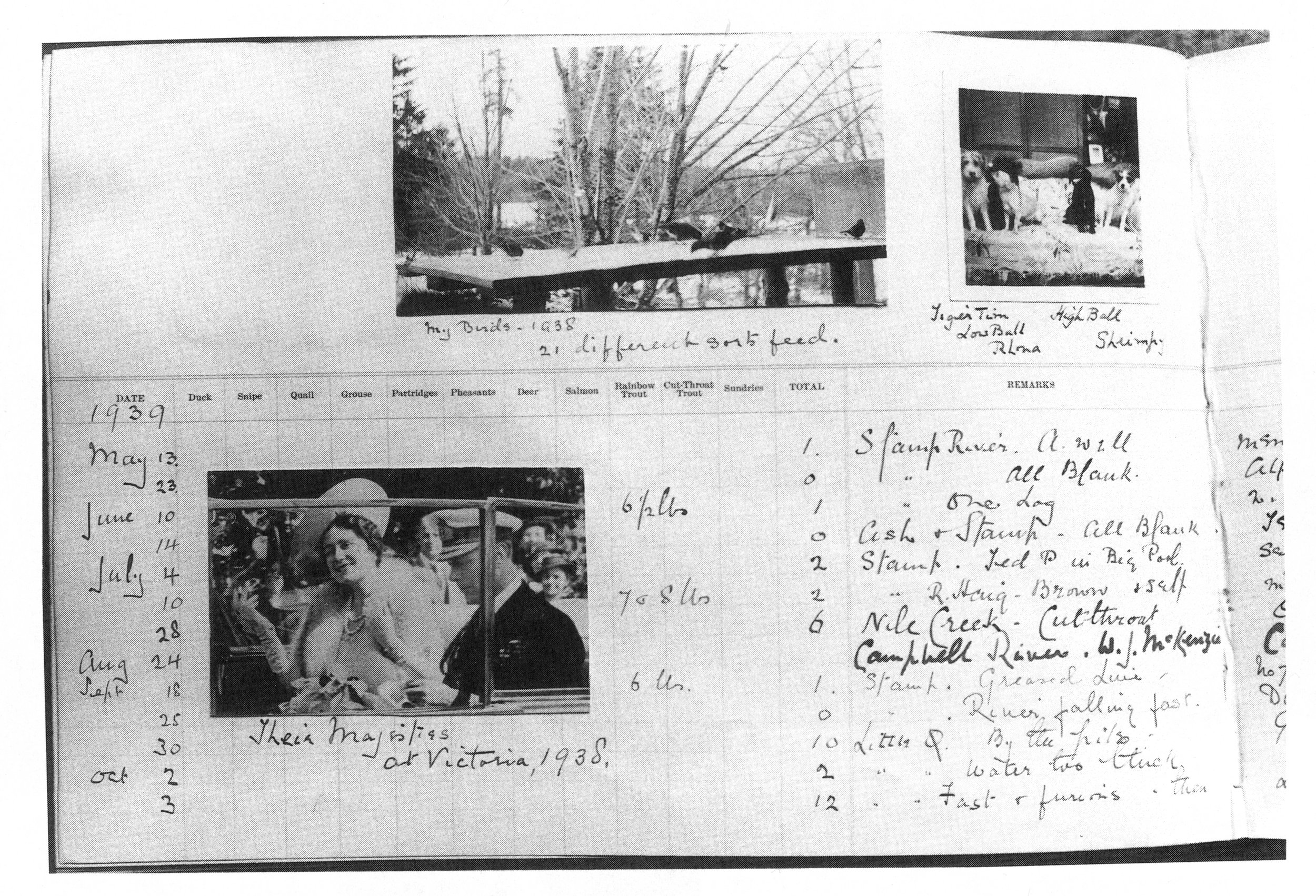
A page from the general's gamebook in 1939. The entry on July 10 marks a day Roderick Haig-Brown described in A RIVER NEVER SLEEPS. Note also: a) Entry for July 4: "Ted P," is Ted Pengelley. b) The General returned to the river on September 18 and took a 6 pound steelhead on the "greased line." c) Snapshot is of King Edward VII before his abdication.
The Steelhead Bee: Then and Now
When Trey received two Steelhead Bees from Roderick Haig-Brown, he gave one of the flies to Frank Amato. That fly had been fished and was flattened, almost as if it had been sitting between the pages of a book. The other Steelhead Bee—the one used on Plate #5 in Steelhead Fly Fishing and Flies—was pristine and had never been fished. Unfortunately, when the book was published, Haig-Brown’s Steelhead Bee was mistakenly attributed to Harry Lemire.
By the time the error was discovered, multiple printings of the book had already been produced, and Frank made the decision to let the attribution remain. Harry wanted the flies he had tied returned to him. Most appeared on Plates 1 through 4, although several of his flies appeared on later plates as well and were removed and returned.
Trey eventually donated Plates 5 through 8 to the American Museum of Fly Fishing, where they have remained for decades.
Prior to writing this essay, Trey and I discussed the long-standing error and contacted the American Museum of Fly Fishing to ask whether the plates could be photographed. The flies are now brittle with age and could not be removed from the plates, but the museum was able to photograph them in place. And there, on Plate #5, was Haig-Brown’s Steelhead Bee.
Now, on the 50th anniversary of the publication of Steelhead Fly Fishing and Flies, we are able to present a Steelhead Bee tied by Roderick Haig-Brown himself.
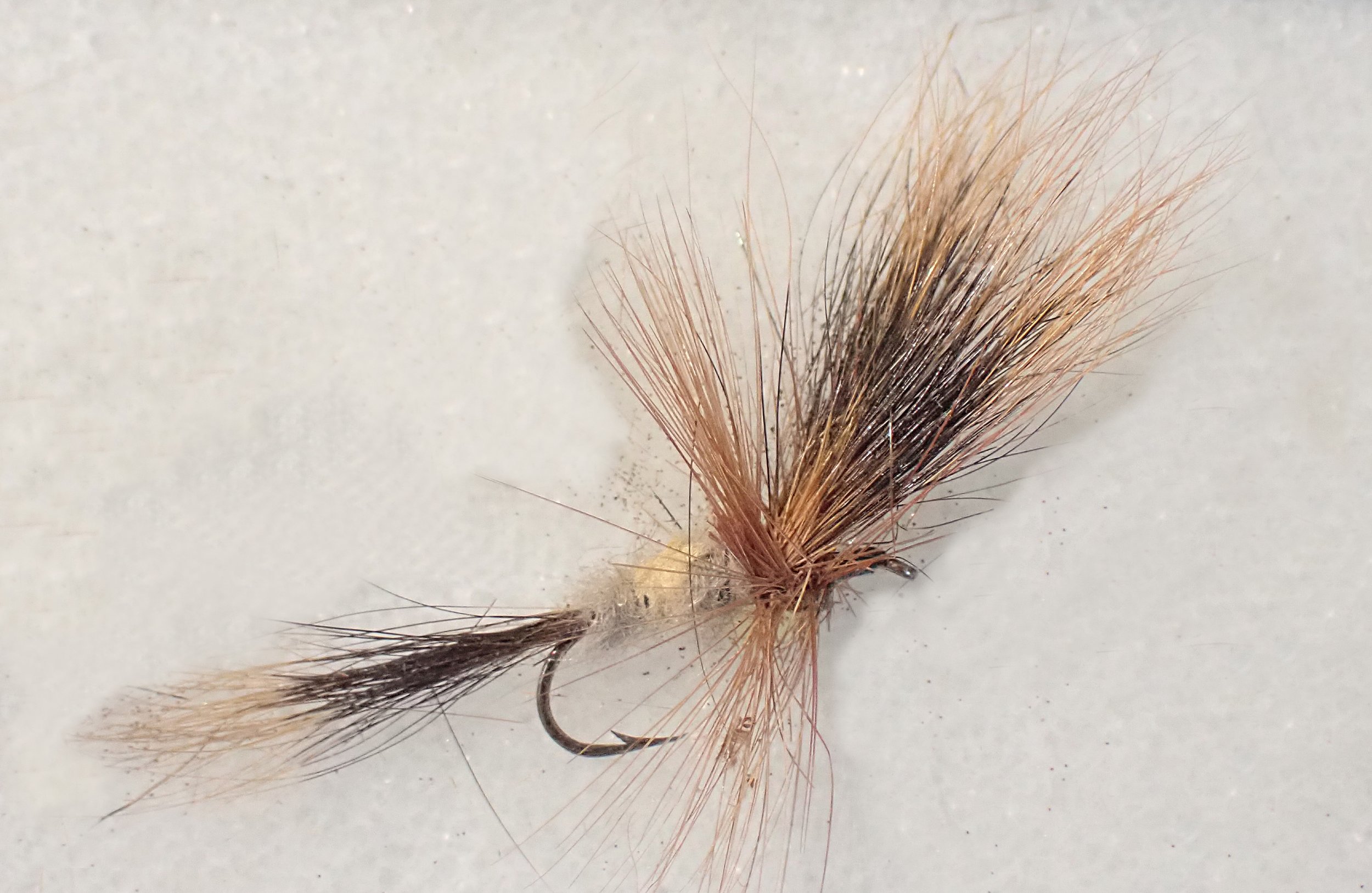
Roderick Haig-Brown’s original Steelhead Bee fly from Plate 5 of Steelhead Fly Fishing and Flies, photographed by the American Museum of Fly Fishing.
Haig-Brown Dressing Notes: Tail: Fox squirrel slightly longer than the hook shank - Body: Divided into three equal parts of brown-yellow-brown floss or like colored dubbing - Wings: Fox squirrel, long and well divided. Wings are set forward at a 45-degree angle - Hackle: Natural red (fiery brown}, sparse
We are also including two modern interpretations of this famous fly pattern, tied by well-known Instagram fly dressers Seth Cavarretta @sethcavarretta and Adrian Cortes @adriancortessteelhead. Seth dressed his Steelhead Bee according to Haig-Brown’s dressing notes, while Adrian dressed his fly in hand using the dressing notes published in Steelhead Fly Fishing and Flies.
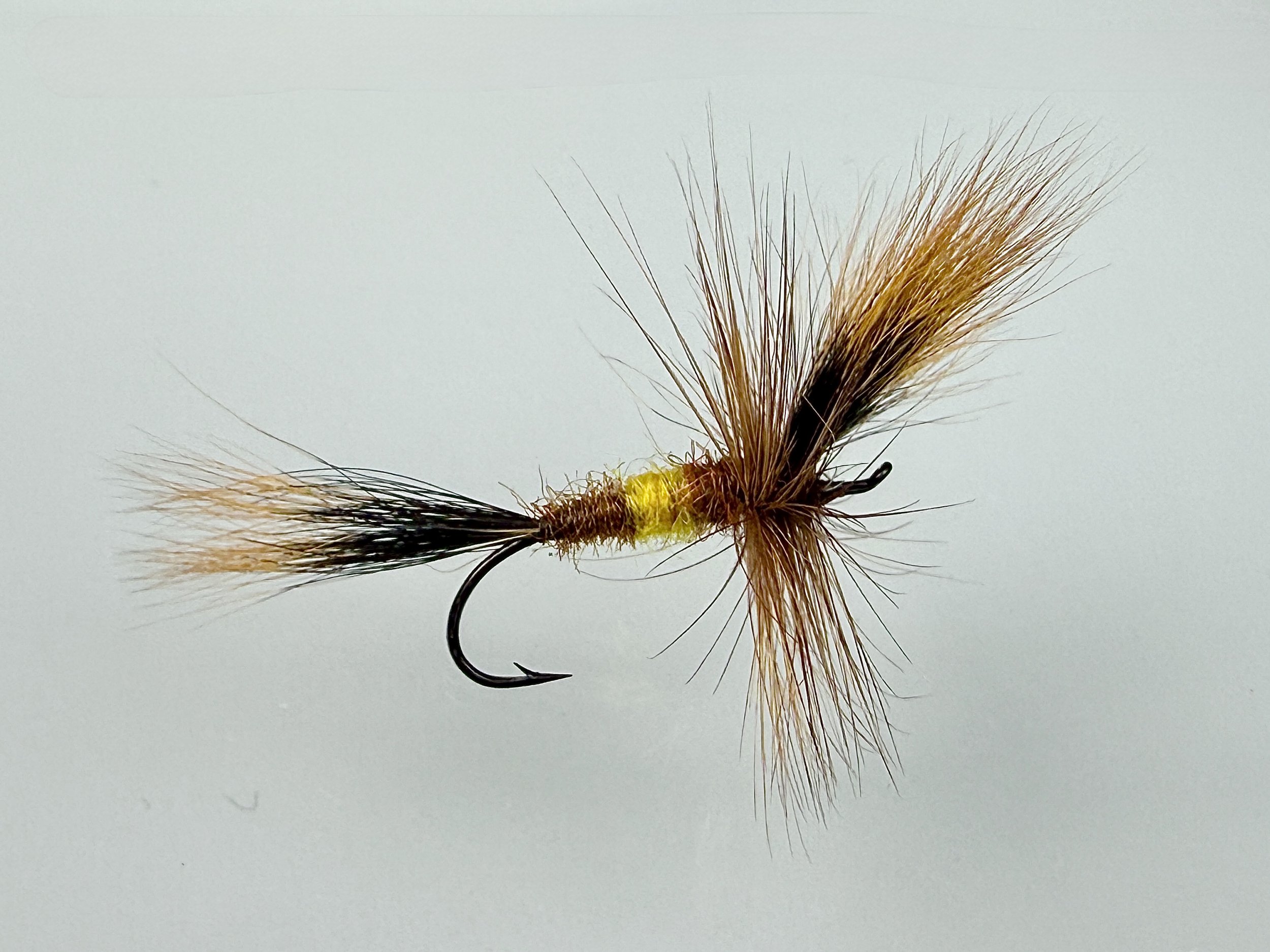
Steelhead Bee, dressed to follow Haig-Brown’s recipe, tied by Seth Cavarretta.
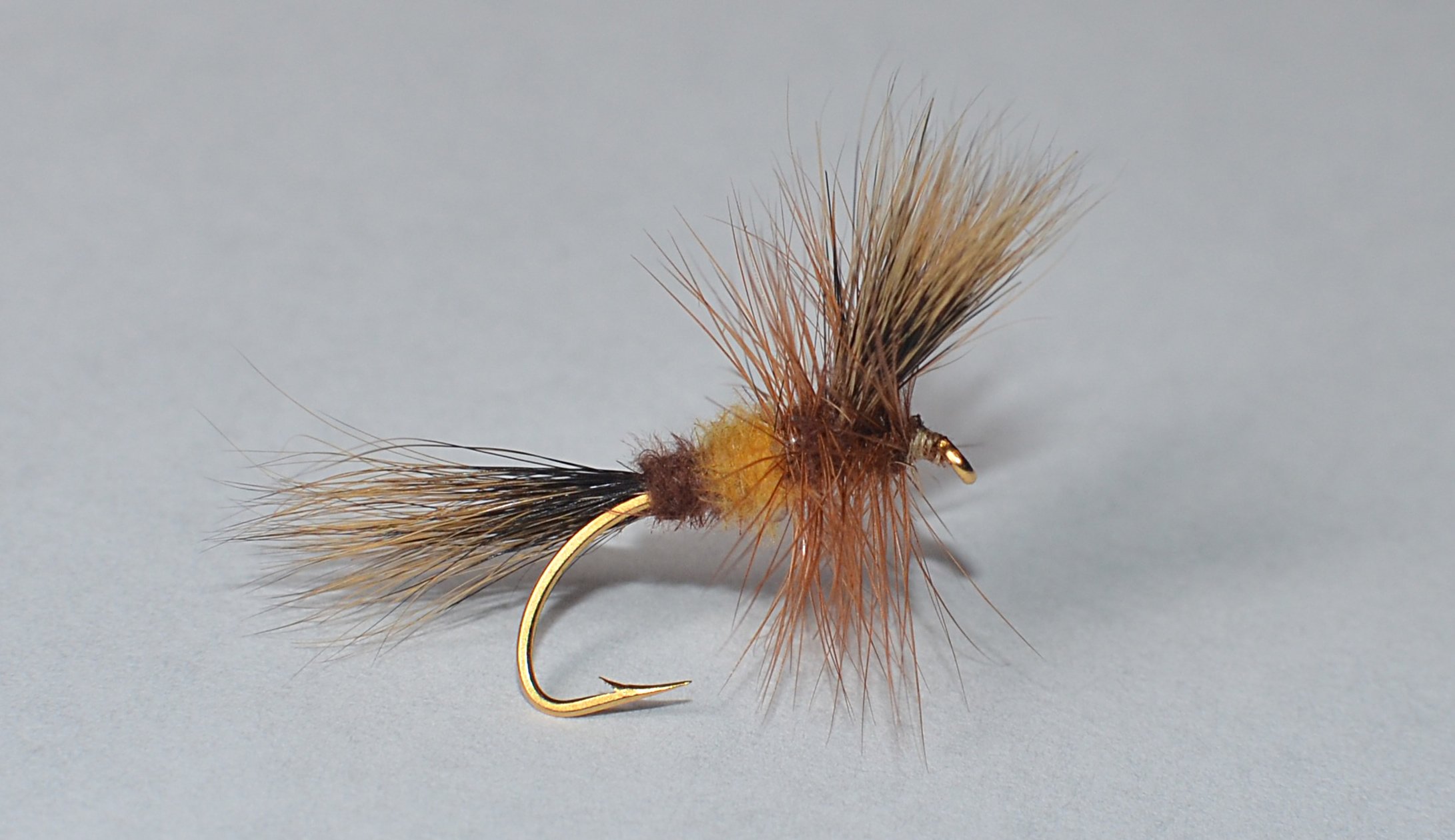
A Steelhead Bee variant, tied in hand by Adrian Cortes.
We are grateful to Seth and Adrian for their contributions to this essay. One of the goals of our Fly Pattern Dictionary is to present classic fly patterns tied by well-known fly dressers, while also highlighting talented dressers on Instagram who have built impressive portfolios of traditional and contemporary patterns. Both Seth and Adrian exemplify that goal.
— Mark Combs