Clearwater River
This is the complete chapter from Steelhead Fly Fishing, written by Trey Combs and originally published in 1991. It is presented here in its original form. Desktop only: Right-click any image in this essay to open it in a new tab to view the high-resolution version. This feature is not available on mobile.
Columbia River
More than 150 tributaries, each large enough to be called a river, are the branches of this giant twisted trunk. They reach into an area the size of Texas from seven states and British Columbia, and give the Columbia a volume exceeding the total of all the other rivers that meet the Pacific Ocean between Canada and Mexico.
The journey is precipitous. The Columbia's tributaries draw from thousands of wildly coursing streams and creeks, the snowmelt, glacial runoff, and rains that tear away at the continent's grandest mountains. Rising in the Selkirks, some twelve hundred miles from the ocean, the Columbia gathers its primary volume from Montana's and Wyoming's Rocky Mountains, drains Idaho's Sawtooth, Salmon, and Bitterroots, draws mightily from Washington's and Oregon's Cascades, and receives a final boost from the Coast Range.
This high-gradient drainage possesses more horsepower than any other river on earth, one-third of all the water power in North America, more than sufficient to spin turbines in fifty dams that are the largest structures ever built by man. The Columbia system is also the world's largest and finest cold-water drainage, thousands of miles of oxygen-rich spawning gravel that once supported Pacific salmon runs totaling fifteen and twenty million fish. Unfortunately, these remarkable resources, fish and hydropower, were never thoughtfully hoarded. As with the forests, the wealth proved too staggering to be exploited rationally, and each resource came into serious conflict with the other.
The Lewis and Clark Expedition, 1803-1806, reached the Columbia by way of the Clearwater and Snake rivers in 1805. The journals of William Clark and Meriwether Lewis provide a detailed record of how the Indians harvested salmon for both subsistance and commercial trade. A number of tribes, often linguistically divergent, communicated in Chinook, first of all the language of a family of tribes along the Washington side of the lower Columbia, but also a trading jargon containing words from Indian dialects and white traders who were English, Russian, and French. The Chinook Indians were so closely identified with the runs of Columbia River salmon that early settlers applied their name to the largest of the salmon.
The geographic scope of the Indians' commercial and subsistence fishery is well documented; the size of the salmon harvest is not. Numbers are general: Thousands of Indians, a million salmon. More important than knowing the exact numbers, however, is appreciating that no matter how many salmon were removed, they were replenished each year. The perpetual nature of this harvest, like the Indians' cultural dependence upon salmon, was to change in a remarkably short time.
The first salmon cannery along the lower Columbia River began operation in the late 1860s. Led by William Hume, the "King of the Canneries," the number of canneries increased each year until 1883, when the Columbia's runs of salmon required thirty-nine canneries and their Chinese workers to process a pack that totaled 630,000 cases, more than 30 million one-pound cans. That was the peak year, with something like ten million Columbia River salmon and steelhead canned or sold fresh. During the next decade, Finns, Swedes, and Norwegians put to sea from Astoria, Oregon, and swelled commercial landings with ocean-caught salmon. The pack of 1895 was the equal of 1883, but from that year forward, the decline was continuous, always the result of too many fishermen and too few fish.
The chinook, whether gathered by gill nets or by fish wheels, was the mainstay of this commercial industry. Averaging twenty-two pounds and sometimes weighing several times that, the "Royal Chinook" of can labels divided into three distinct seasonal races beginning with the spring-run, sexually immature fish that entered the Columbia in late winter for spawning areas as far as a thousand river miles away. Summer chinook more typically spawned farther down in the Columbia River Basin, while the fall run were mostly concentrated in the lower river.
Coho salmon were far less numerous, but common each fall in the Methow, Wenatchee, Yakima, and Grand Ronde rivers, and usually abundant in tributaries of the lower Columbia.
The sockeye, locally called "bluebacks," entered the Columbia in June for the Okanogan system of rivers and lakes in British Columbia, Idaho's lakes that headed the Salmon River, such as Redfish, Alturas, and Stanley, and Washington's lake-headed Wenatchee. They were small salmon, averaging five pounds or so, but with flesh that kept its red color so well when canned that it held premium market value. For its rich and oily flesh, the Indians, too, valued the sockeye above all other salmon.
Before Oregon classified the steelhead as a gamefish in 1935, the Columbia River pack often exceeded two million pounds, with another million pounds sold frozen, both winter-run and summer-run. East of the Cascades, the steelhead was strictly a summer-run, known to travel hundreds of miles up the Salmon River to Stanley Basin, a mile above sea level; up the spectacular North Fork of the Clearwater and into the Clearwater Mountains; up the main stem of the Columbia to Kettle Falls and into British Columbia; up the Snake River to dozens of spawning tributaries in Idaho and Oregon. Only the Snake River's Shoshone Falls prevented steelhead from reaching into Wyoming, though Salmon Falls Creek led them discreetly into Nevada.
During the 1930s, the Army Corps of Engineers surveyed all American rivers for potential dam 'sites. Rivers were reduced to hydroelectric power, flood control, irrigation, and navigation when dams were engineered with lock systems. Their completed study, called "308 Reports," included many recommendations for the Columbia River and its tributaries. The first of these federally built hydroelec-tric dams on the Columbia would be named for Captain Benjamin Eulalie de Bonneville, first commandant of the Vancouver Barracks in Washington Territory.
Bonneville Dam was sited just below the Cascade Falls, some 145 miles from the ocean. Construction began in 1933. When completed in 1938, Bonneville's locks allowed ocean ships to reach into the wheat country of Washington's interior. The dam also incorporated a system of fish ladders and counting stations so that adult salmon and steelhead could pass unimpeded upstream. For the first time on a large western river, accurate escapement totals, species by species, could be determined.
In the spring, downstream migrating smolts passed over the spillway, and through the turbines, or they were conducted through four bypasses. The annual average number of adult salmonids passing up the fish ladders during the next ten years was as follows: 359,054 chinook; 127,431 steelhead; 72,834 sockeye; 9,437 coho; and 1,600 chum.
Bonneville was not the first dam on the Columbia. Rock Island Dam, completed by Puget Sound Power and Light in 1931, was constructed just below the Wenatchee River confluence. Like Bonneville, it had a fish ladder and operates to this day.
Grand Coulee, at a site nearly six hundred miles from the ocean, was the third Columbia Rivet dam. Salmon and steelhead had once passed hundreds of miles above this point, above Kettle Falls, where each fall for centuries Indians had netted thousands of salmon, and above the confluence of the Clark Fork and the Kootenay rivers in British Columbia. Yet when the dam was completed in 1942-the most massive structure ever built by man-it contained no fish ladders. Runs above the dam were simply terminated. The reason was first a practical one. The reservoir created was 151 miles long, and no fish ladder could help salmon find their way in such a vast reach of still water. The second reason was legal.
In 1911, a sawmill in Port Angeles, Washington, began construction of a small hydropower dam near the mouth of the Elwha River. No fish ladders were built, and when the dam was completed in 1913, the largest strain of chinook salmon known to inhabit the contiguous United States was blocked from spawning. Washington, like other states, recognized its obligation to protect its runs of salmon and took the company to court. Years passed while the two parties litigated. Ultimately, the run was lost, but a settlement was eventually consummated: If the company funded a hatchery to compensate for the loss, the dam could remain without a ladder. This arrangement became an important legal precedent, one that gave tremendous impetus to hatchery programs, and one that delighted politicians. Farmers could get ample water for irrigation, the cities could purchase cheap and abundant power from state and federal governments, and the fishermen could depend on their rivers filling with salmon and steelhead. "Go forth and multiply," said the government to the Army Corps of Engineers. "Mitigation" and "hatcheries," said the Army Corps of Engineers to the State, the mantra repeated over and over, dam after dam.
Mitigation for the loss of salmon and steelhead above Grand Coulee began by trapping fish at the Rock Island fishways and transporting them to four tributaries below the dam, the Wenatchee, Entiat, Methow, and Okanogan rivers. The fish were ripened in holding ponds, and the fertilized eggs were hatched at salmon and steelhead hatcheries sited on the rivers. Increasing production of salmonids below the dam became mitigation for the loss of salmonids above the dam.
More dams followed, each with a fish-passage facility, each with locks, each with an enormous reservoir behind it, each a monument to our industry and engineering skills. The Dalles, John Day, McNary, Priest Rapids, Wanapum, Rocky Reach, Wells, and Chief Joseph dams hobbled the Columbia's free flow. Ice Harbor, Lower Monumental, Little Goose, and Lower Granite dams reduced the lower Snake to barely measurable currents. To reach Idaho's Clearwater, Salmon, and Snake rivers and Washington and Oregon's Grande Ronde, steelhead would now have to cross over eight dams. They did, by the thousands, and hatcheries worked furiously to keep them coming.
All is not well, however. Smolts pass over spillways during the May runoff and suffer from nitrogen supersaturation, a condition that leads to deformities and even death. They suffer additional mortalities passing through the turbines. The reservoirs become huge predator sinks, with thousands of squawfish, smallmouth bass, walleye, and channel catfish feeding greedily on the smolts. Ring-billed gulls line up below spill gates and account for the loss of many additional smolts, possibly as many as two percent of the total. Each dam results in a loss of ten to fifteen percent of the fish; the loss through eight dams is staggering. A partial solution at upriver dams involves installing diversion screens that lead smolts though a complicated series of conveyances to a collection facility. They are loaded into trucks or put on barges and taken downriver though each dam's lock system to be released below Bonneville Dam. Though the overall benefit is substantial, the procedure stresses the smolts and causes additional losses.
In addition, when all, or nearly all, brood stock has hatchery origins, the juvenile populations are so isolated that bacterial and viral diseases can devastate annual populations. On occasion, millions of eggs and adult brood stocks must be destroyed in an effort to eradicate diseases such as infectious hematopoietic necrosis virus (IHNV), and infectious pancreatic necrosis virus (IPNV). Biologists are so concerned about the possibility of hatchery plants infecting wild stocks that they refuse to plant juvenile salmon and steelhead in areas where natural spawning is producing wild, disease-free juveniles. Yet releasing juveniles only from hatchery points results in a glut of adult fish at hatchery weirs and a hog line of anglers immediately below this point.
No one more appreciates the problems of getting healthy juvenile salmon and steelhead safely to the ocean than Steve Pettit. Anglers know him for his steelhead fly-fishing skills and his remarkable knowledge of the Clearwater River. But Steve, a fisheries staff biologist with Idaho's Department of Fish and Game, is the State's Fish Passage Specialist and Chairman of the Fish Transportation Oversight Team, a multiagency crew that runs the juvenile transportation program. The team receives input from federal, state, and tribal agencies, and negotiates a plan that becomes the guideline for individual operators at Lower Granite, Little Goose, and McNary, the "collector dams," with screens that gather smolting juveniles released upstream.
When I spoke with Steve in Lewiston, Idaho, in September 1990, he first explained that the diversion screens were not 100 percent effective. "Approximately fifty to sixty percent of the juvenile chinook are diverted, and up to eighty to eighty-five percent vf the steelhead."
"What of the other dams?" I asked.
"Congress has ordered the Army Corps of Engineers to complete bypass systems on the remaining unprotected dams between here and the ocean by 1994." Steve paused, and then added, "As money becomes available."
"Would this solve your greatest problem?"
"The main problem is short and sweet. No longer is there adequate flow to get the juveniles downstream in a timely and safe manner. What we're learning now as we get into this impounded river system-if you can call the Columbia a river-is that the delay associated with having eight reservoirs instead of a free-flowing river probably has as significantly a high mortality as the physical mortality experienced when they pass through the dams. The delay challenges the fish to reach the ocean in that physiological window when they are transforming from freshwater organisms to saltwater organisms. The longer you delay the fish down these impoundments, the greater the likelihood of having them arrive at Astoria already reverting back to parr instead of being smolts."
We discussed what the future is likely to be for the declining runs of Columbia River salmonids. I found the losses especially chilling when viewed against a time line of only two generations. Some forty-five hundred river miles have been lost to spawning. Runs once totaling 15 to 20 million fish are down to 2 million. From a high of 10 million, the commercial take is down to a million. The runs of sockeye salmon have been reduced by ninety-eight percent. During 1990, a single male sockeye made it to its ancestral spawning area in Idaho's Redfish Lake. Idaho's sockeye, as an anadromous species, is now unofficially considered extinct. Coho salmon, reduced by ninety-two to ninety-six percent, have been extinct in Idaho's Snake River since 1984. The great runs of chinook salmon above Bonneville Dam have been devastated. The Snake River's fall chinook decreased from 27,700 in 1962, to 600 in 1989. The loss of the river's summer chinook is equally depressing, 30,900 to 4,200 for the same period. Though supported by a vast system of hatcheries, the combined escapement of all races of the Columbia River Basin's chinook salmon remains but seventeen to thirty-three percent of previous size. Nearly the same can be said for steelhead, where the overall run size represents sixteen to twenty-seven percent of predevelopment size. As with chinook salmon, most of these steelhead have hatchery origins; only four to seven percent of the Basin's steelhead now spawn naturally.
Steve's life is fish and fly fishing, and he has worked tirelessly to save the remnant runs of salmon and steelhead. His tone was pessimistic.
"Since I've been working in this field, it's been a steadily deteriorating situation. The rivers are tweaked more and more for hydropower. We've gone from a surplus state in hydropower to a position now where we're barely meeting the requirements of the Northwest. Because we're not in a surplus situation anymore, the Bonneville Power Administration and private PUD's are trying to maximize the water that is left in the main stem to produce power. The fish are the losers."
Idaho's State Senator Ron Beitelspacher shares that view with Pettit. As Chairman of the Pacific Fisheries Legislative Task Force, he deals with an often intractable federal bureauracy. We met in 1990, at the Kelly Creek Fly Fishers' annual fall fair in Clarkston, Washington. For a politician, he is refreshingly blunt. "The law calls for fifty percent of the Columbia's flow for fish and fifty percent for power. The BPA and the Army Corps of Engineers have not recognized what the law says." He explains how power from BPA is sold throughout the West, even to Los Angeles, and describes this as "helping to balance the federal budget." He charges that "The BPA moves the water through the dams when they can get the most for the power, not when it is most beneficial for the fish. They take money from here and ship it to there. That's billions of dollars going the wrong direction. The BPA isn't responsible to anyone."
Perhaps that will change. In April 1990, Idaho's Shoshone-Bannock Tribes petitioned the National Marine Fisheries Service for endangered-species status for Idaho's nearly extinct Columbia River sockeye. Two months later Oregon Trout petitioned on behalf of Snake River spring, summer, and fall chinook, and lower Columbia coho salmon. The agency must make its determination within one year. If the ruling is favorable to these runs, the Service must submit a plan one year later detailing how the "threatened and endangered" races can be saved. Everyone knows what the principal answer will be. More water.
As Steve Pettit prepares to join the battle to save Idaho's salmon and steelhead, he says, "The utilities and the power people are screaming bloody murder. This will make the spotted owl controversy look like kindergarten."
Clearwater River
Approximately 325 miles above its mouth is the Columbia River's confluence with the Snake, a joining of the two main branches that form the vast interior drainage of the great river. Another 138 miles upriver, the Snake enters Idaho at Lewiston and meets the Clearwater, forty miles of desert river running between mountains narrowly terraced by a century of browsing cattle. Its branches are the North Fork; the Middle Fork, which becomes the Selway and Lochsa rivers ("smooth water" and "rough water" in Nez Perce); and the South Fork. Steelhead entering the North Fork will have traveled almost exactly five hundred river miles.
The North Fork's origins are in the Bitterroot Mountains, its spawning gravel the valleys of the Clearwater Mountains, a geography unremarkable among north Idaho's steelhead rivers. At least no terrible rapids nor nearly impassable falls can be identified as factors in the natural selection process that produces a population of summer steelhead that are larger than any others in the United States. But that is the overriding fact of this race, giants known to weigh over thirty pounds, the legendary steelhead of the Clearwater and all the rivers to which it flows: the Snake, the Columbia, and the mouths of a dozen tributaries.
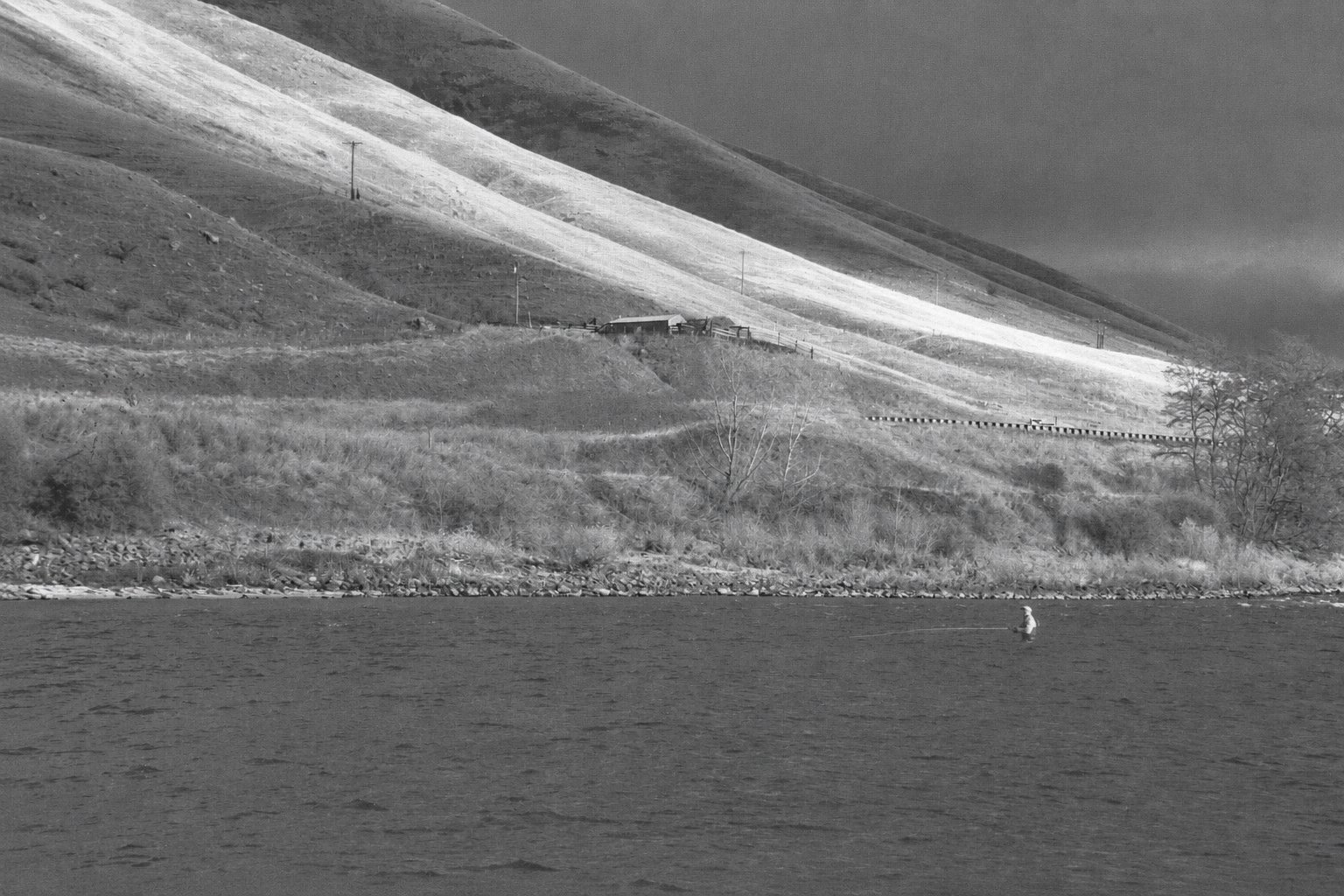
Doug Fagerness on the Clearwater River.
These are remarkably fast-growing two-salt fish, rarely three- or four-salt, whereas nearly all other steelhead native to the forty rivers that feed into the Snake River are typically one-salt fish. Biologists call the North Fork strain "B" fish to distinguish them from the more common "A" fish found in other branches of the Clearwater, the Lochsa and Selway, the many tributaries of the Snake and Salmon rivers, the Grande Ronde, even the Deschutes. Of course, the respective size of different ocean ages easily distinguishes the differences, but even when the A's and B's are the same ocean age, both one-salt or both two-salt, morphological differences are evident. North Fork steelhead are noticeably larger and more robust, a true giant race, typically weighing twelve to fifteen pounds.
The A fish peak at Bonneville in July, the run dropping off dramatically in late August, with early September historically the low point in the Idaho escapement. From then until the run peaks again at the end of October, the steelhead are counted as B fish.
Steelhead reach the main stem of the Clearwater in July, and by August those A fish destined to spawn in the Middle Fork, the Selway, Lochsa, and South Fork, can be found in satisfying numbers in the Clearwater. September and October are peak angling months, the great B steelhead arriving and joining the A steelhead that delayed pushing on to their spawning tributaries with the onset of winter. They pull out of the thin water to hold in the deeper pools, or drop down into the warmer Snake until late winter warms the surface currents and sends them racing for their spawning tributaries.
Early Clearwater anglers mostly fished bait-usually roe-but shrimp, crawfish tails, and worms had their place. A few spin fishermen cast spoons, red-and-white or hammered brass. By the 1950s, locals got the hang of backtrolling with a Flatfish-like lure that had a metallic finish. Jet drives weren't yet available, but the careful operator could keep his propeller off the rocks even when the river ran at its fall low of eleven thousand cubic feet per second, big water not yet cut down to size by fly fishermen.
Local fly fishing focused on resident trout: the exquisite native cutthroat, the famous rainbows of Silver Creek and Henry's Fork of the Snake. Here flourished the science of matching hatches and the attendant tying skills that made joining this spectacle possible. New dams added to the resident trout water each year, and not a few anglers found satisfaction in that trade-off. Lakes had always been a bountiful source of quality fly fishing, so much so that special fly-fishing-only restrictions were never considered. The largest lakes, like Pend Oreille, housed Kamloop rainbows that sometimes topped thirty pounds, always a gear-fishing proposition. Except for Ted Trueblood and a handful of his closest friends, Clearwater steelhead were related to in much the same manner-something to be muscled up from the depths, dragged into the boat, and hit on the head.
Ted Trueblood lived in Nampa, Idaho, fly-fished for Clearwater steelhead, shot big game, and hunted the wealth of upland gamebirds that grew fat on cheatgrass along the rimrock benches. During the late 1950s, this Renaissance outdoorsman worked as Associate Editor of Field & Stream. Fellow columnists included Corey Ford, Robert Ruark, and Kip Farrington, a grand tour of Carolina quail hunts, African safaris, and Peruvian black marlin. For my rural generation, Ted Trueblood epitomized the rugged individualist, very much the West still wild, a man with an impossibly perfect surname.
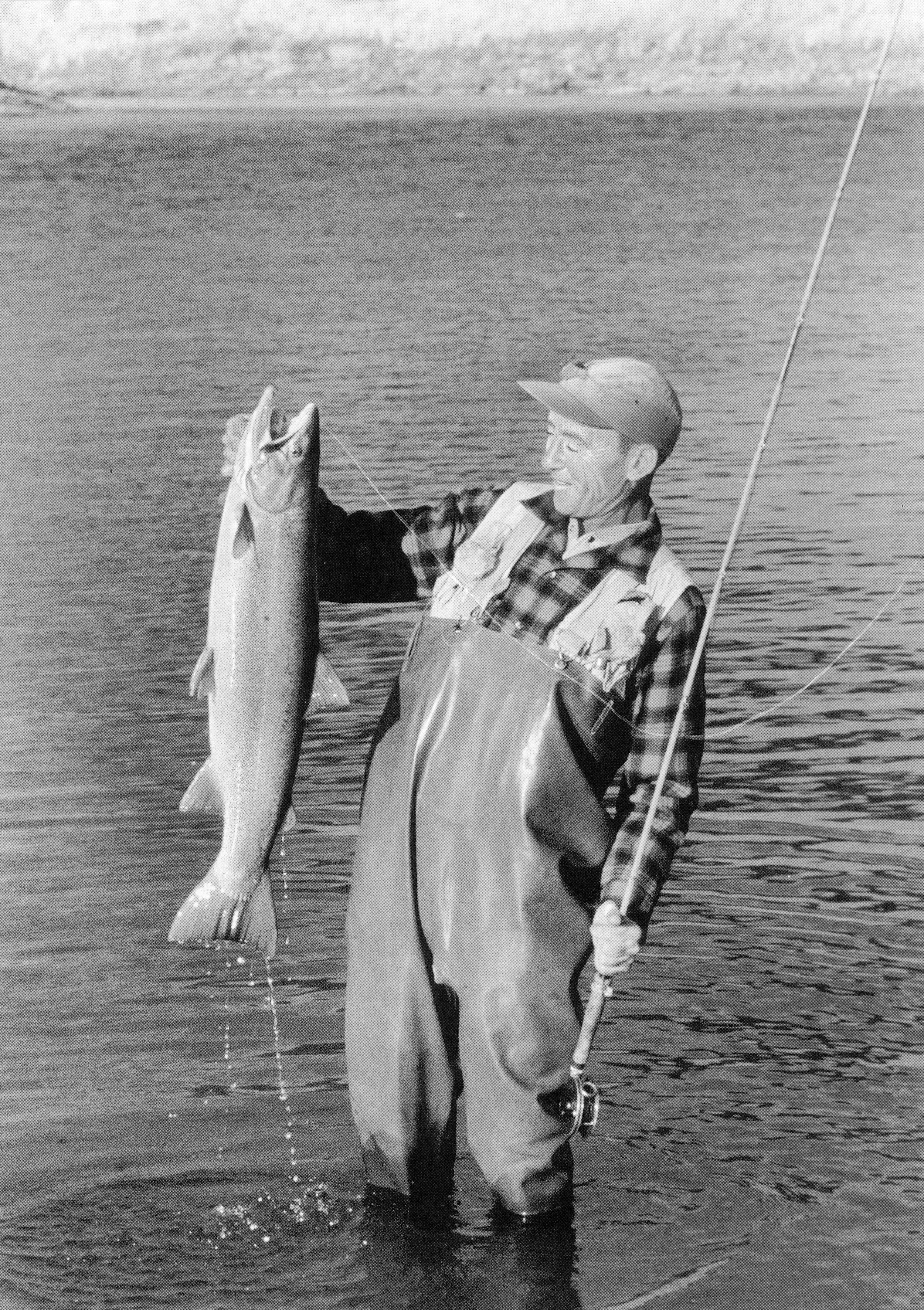
Ted Trueblood holds a Clearwater steelhead. Photo courtesy of Field & Stream, permission by Daniel J. Trueblood.
Twenty years ago, I wrote to Trueblood and asked about fly patterns for Idaho's steelhead. He wrote back to say that in Idaho the Clearwater was ')ust about the only stream of importance." He did not tell me about his favorite steelhead river, which he truly kept secret, the mile or two of Washington's Grande Ronde just above its confluence with the Snake that could be reached only by dirt road from Lewiston, Idaho.
When Trueblood fly-fished the Clearwater for steelhead, he shared his discovery with Ed Ward, the husband of Jane Wyatt, star of TV's "Father Knows Best." Ward, a professional tennis player, related his Clearwater experiences in confidence to other Hollywood fly fishermen. This soon included two executives at Disney Studio: Ken Anderson, the studio's Art Director, and Milt Kahl, an animator. Ken Peterson and Duke Parkening soon joined the group. Like Trueblood, all had previously made annual trips to California's Klamath River for its three- and four-pound steelhead.
After his first trip to the Clearwater, Anderson showed Mel Leven a snapshot of two eighteen-pound steelhead. Mel, a songwriter and lyricist at Disney, recalled thirty years later, "At first Ken wouldn't reveal where the steelhead came from. Later in the day he told me. Idaho. 'Idaho?' I said. 'Ah, cut the crap!' But he drew out a map for me, showed me where the pools were, and I knew exactly where to go."
Mel Leven, now seventy-five, and one of the world's most knowledgeable fly fishermen (Mexican sailfish? Welsh sea trout? freshwater dorado?) is probably the most entertaining. He has been the voice in TV commercials and Sesame Street tunes, the writer of Academy Award winning songs, and cartoon voices for the late Mel Blanc. His peripatetic schedule of destination trips would easily defeat a man half his age. He talks of where he's going, not of where he's been, and I must press him about the early days of angling for the Clearwater's fabled steelhead. He says, "Oh, God! So big you couldn't hold them!" He and Terry Gilkyson, a songwriter, first visited the river together in 1960, often in the company of Duke Parkening. They fished shooting heads, he explains, homemade at first, but Wet Cel heads as soon as they became available, and ran them to 20-pound monofilament.
Mel was sure that the first Clearwater fly patterns were brought in by the Disney people from the Klamath River: the Golden Demon, Silver Hilton, and the orange-and-black Woolly Worm, for example. "We only had the Skunk, no such thing as the Green-Butt." Mel modified the original by dropping the wing, winding white hackle at the head, and tying in bead-chain eyes, kind of a short, compact Comet. "Eventually they were sold that way in Lewiston." He also fished a hot-spectrum hackle fly of red, orange, and yellow, called the Orange Bastard. Mel remembered the Cole's Comet, some of Jim Pray's optics, and the Juicy Bug. Ken McLeod's two Washington classics, the Purple Peril and Skykom-ish Sunrise, filled out his list.
Ed Ward fished a Princeton Tiger (orange wing and tail, black body) sometimes on a keel hook to prevent the deep running fly from fouling the bottom. (I had never heard of this approach until Lani Waller showed me the Krystal Flash Boss tied in this manner.) He liked his own Ward's Wasp. Mel still carried a few originals tied by Ward in his tightly packed and multilayered fly book. They had obviously been fished, for the hooks were points sharpened until the bare metal shone.
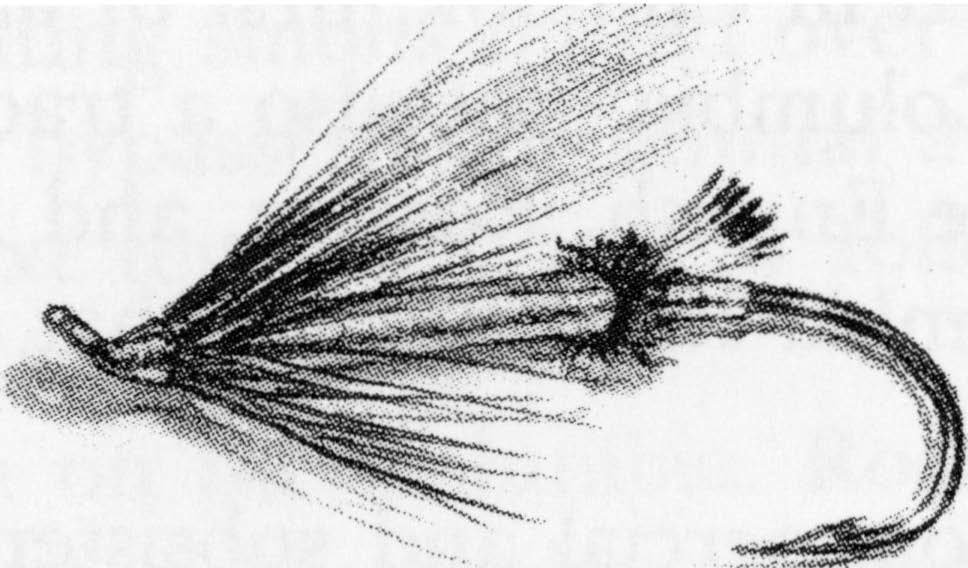
Ward’s Wasp: Tail Golden pheasant tippet fibers. Butt Yellow chenille. Hackle Yellow. Wing Dark brown or black fur. Body Black chenille ribbed with flat silver tinsel.
The Disney people hardly passed unnoticed, and fly fishing quickly became an accepted method of angling on the Clearwater. Then, in the early 1960s, a Seattle musician named Dub Price began fishing the nearby Grande Ronde with a sparsely dressed #8 or #10 Muddler on a floating line. He and Bob Weddell, a local from Orofino, enjoyed tremendous success, sometimes hooking forty steelhead in a day. Word of this fishing reached Keith Stonebreaker, a young Lewiston insurance agent long aware of the Disney people and their doings.
Keith had come across Lee Wulff's The Atlantic Salmon, and discovered the author's account of how Portland Creek anglers in Newfoundland used the "Portland Hitch," a riffling hitch, to secure salmon flies discarded by British officers because the gut leader was worn and no longer reliable. Of course, today's steelheaders are familiar with this method of pulling the fly up into the surface film so that it wakes when swinging under tension. But twenty-five years ago, the approach was revolutionary for steelhead. Keith began waking the Muddler Minnow introduced by Dub Price, and for the first time he raised Clearwater steelhead to a damp surface fly.
At the time, Idaho's two powerful U.S. Senators, Henry Dworshak and Frank Church, had gained federal approval for the construction of an enormous dam across the mouth of the North Fork of the Clearwater at Orofino. This dam, six hundred feet high, would produce a reservoir so vast that the river itself would be eliminated, and with it, the spawning grounds of the North Fork steelhead.
Arguments for its construction began with flood control, its proponents reminding citizens that on May 29, 1948, the Clearwater had flooded the valley at a rate of 177,000 cfs. This new dam, it was claimed, would protect cities as far away as Portland, Oregon. The dam had a six-turbine capacity but would operate with three and still provide for local power needs. Naturally, a huge hatchery complex would be m1t1gation for the loss of the North Fork's unique run of steelhead. In fact, claimed its supporters, the size of the historical run would increase because of the hatchery. The reservoir would be stocked with Kamloops trout and bass, the resulting recreation area a wonderful asset to the area. Finally, a dam on the North Fork would render a dam on the Selway unnecessary; with this dam, the Selway would be spared.
Dworshak Dam was also a pork barrel, the federal payroll a boost to the Orofino economy that would filter through the region for years to come.
Idaho's timber companies, which had grown rich by high-grading old-growth ponderosa and white pine, began running out of virgin forests to cut. One of these companies was the politically powerful Potlatch Corporation. Originally Maine-based, it had moved to northern Idaho in 1903 and purchased vast tracts of forest lands in the Clearwater watershed to supply the lumber mill and wood processing plant it was constructing in Lewiston. During spring runoff, the North Fork and the main stem of the Clearwater were used to transport logs to the mill. Potlatch owned logged-over land that would be flooded by Dworshak Reservoir and it, too, became a vocal supporter of the dam.
Dworshak was not the first dam on the Clearwater. The Washington Water Power Company had constructed a dam across the Clearwater in 1927. This generated power for the city of Lewiston and provided a log pond for the Potlatch Corporation. As a perfunctory obligation to the runs of salmon and steelhead, the company built a fishway. Its poor design allowed neither coho nor spring chinook upstream, and both runs were lost. The steelhead survived, but the run was considerably reduced. With the completion of Dworshak at hand, the dam was removed in 1973.
The coho salmon was never replaced in the Clearwater. From 1947 until 1953, small hatchery plants of chinook salmon from the Salmon River reestablished the spring chinook salmon in the Clearwater drainage.
Dworshak National Fish Hatchery currently (1990) releases about one million chinook salmon smolts and two million steelhead smolts into the Clearwater system each year. In a typical year, these plants return twenty thousand adult steelhead, half of which are caught by sport fishermen. Perhaps another fifteen hundred are netted by the Indian tribes, and at least several thousand pass upriver of Dworshak to the Middle Fork. This leaves five thousand or so steelhead surviving to return to the hatchery.
This hatchery program is no longer concerned only with returning numbers of adult steelhead to the parent "river." A danger exists that endlessly recycled hatchery stocks will inexorably reduce the genetic diversity within the race, and thus its racial distinctiveness and vitality. With all the race's eggs, literally, in one basket, viral diseases can so devastate annual hatchery production that it ultimately represents a threat to the race itself. Run timing becomes more condensed, the hatchery fish moving rapidly though the lower river to reach the hatchery. Even as hatchery production increases, the recreational value of the resource decreases.
On the Columbia River, Indians are allowed to commercially harvest thirty-three percent of the steelhead and salmon. Net mesh size is often eight inches, designed to target chinook salmon, but the largest steelhead are also caught. When no mesh-size restrictions exist, the smallest steelhead are still those most likely to pass safely through the nets. Keith Kiler, a biologist and game enforcement officer for Idaho's Department of Fish and Game, is concerned over the long-term effects of this netting. He said in 1990, "The downstream nets tend to select the larger fish in the harvest. Even when there are net mesh restrictions, our really big Clearwater fish seem to be on the decline. The net fishery is taking our three- and four-salt fish. We may eventually lose those big Clearwater steelhead."
Some of Dworshak's production has been earmarked for an experimental effort to increase the production of steelhead in the South Fork between Orofino and Kooskia. Using this area for release sites might produce a fall run where none currently exists. If successful, these steelhead would take some of the pressure off the Clearwater.
I discussed the hatchery program and my concern for the few wild stocks with Bert Bowlin, a biologist with Idaho's Department of Fish and Game. In Idaho, all wild steelhead must be released. "How many remain?" I asked. "What is their future?"
"We have two drainages in Idaho in which we're not going to release any hatchery steelhead. One is the Selway, the other is the Middle Fork of the Salmon. Also, the Lochsa is on hold for any hatchery production."
"What is their importance?"
"Nearly all the wild steelhead that arrive at Lewiston in the Clearwater are Selway stock, two thousand to five thousand fish. They come in the fall, and winter over in the Middle Fork of the Clearweater or the lower Selway. The traditional sport fishing site was Selway Falls. It was used heavily in the springtime. Now there's a fishway around the falls. The Selway supports the best steelhead habitat. It is still mostly wilderness."
"And the Lochsa?"
"The Lochsa was never much of a steelhead sport fishery. What there is comes from Fish Creek. We've termed Fish Creek the Sistine Chapel of steelhead production in the Lochsa. We're only talking about several hundred adult steelhead. But if you have wild stocks you had better hang on to them and not dilute them at all with hatchery fish."
Bert Bowlin's description of the Clearwater's tributaries underscored the importance of the North Fork, and how painful has been its loss.
"Even back in the 1970s, this dam would never have been authorized. We lost a world-renowned, naturally producing steelhead population, 'B'-run fish that had the capacity to produce fish over twenty pounds."
As Dworshak was being completed, Alan Johnson, a distance-casting champion from Chicago, came to Lewiston and fished the first Bomber on the Clearwater. He was an Atlantic salmon fisherman, a regular on New Brunswick's Miramichi River, where Bombers were being waked to entice salmon to the surface. The discouraging decline of the Canadian fishery found him investigating the North Fork for its giant steelhead. Idaho became Johnson's second home.
Keith Stonebreaker discovered the natural deer-hair Bomber through Alan Johnson, and was soon tying the original without hackle and calling it a Cigar Butt. The low-riding, slick-bodied fly with a white calf-tail wing and tail did not skate so much as wake, and it possessed a rocking motion like a little boat plowing though a sea. Best of all, it was simple to tie and enticing to steelhead. He also married the Purple Peril and Green-Butt Skunk, calling the hybrid offspring a Purple Skunk. He did not extol its effectiveness and needn't have. That Keith used it was reason enough for others to fish it. These two patterns became the first popular steelhead flies with Idaho origins.
Purple Skunk: Tail Grey squirrel tail, sparse. Butt Fluorescent green chenille. Hackle Purple
Wing Grey squirrel tail, sparse. Body Purple chenille ribbed with silver tinsel
When I last visited the Clearwater, in late September 1990, I intended to stay two or three weeks, ample time to find a few steelhead before the catch and release season ended on October 15. That does not necessarily end the fly fishing, but locals feel the change in regulations erodes the civilized nature of their sport. This is, they remark, the start of their "combat fishing," when hundreds of jet boats, the "aluminum hatch," roar up and down the river and jockey for room before settling down to back-trolling plugs. The steelhead that hold inside the currents along the shore, those lies that make fly fishing possible on the truly big steelhead rivers, now become rare, the constant angling pressure driving them into deeper water. Boatloads of anglers with six, or even eight, rods working plugs can now reach those steelhead, and they do so with a vengeance. These gear fishermen have waited impatiently for weeks while the fly fishers mucked around with their long rods. The Clearwater is full of steelhead by mid-October, surplus stock Dworshak can't possibly handle. Fall is harvest time. It's in the air, like the smell of windfall apples and backyard smokers filled with venison sausage.
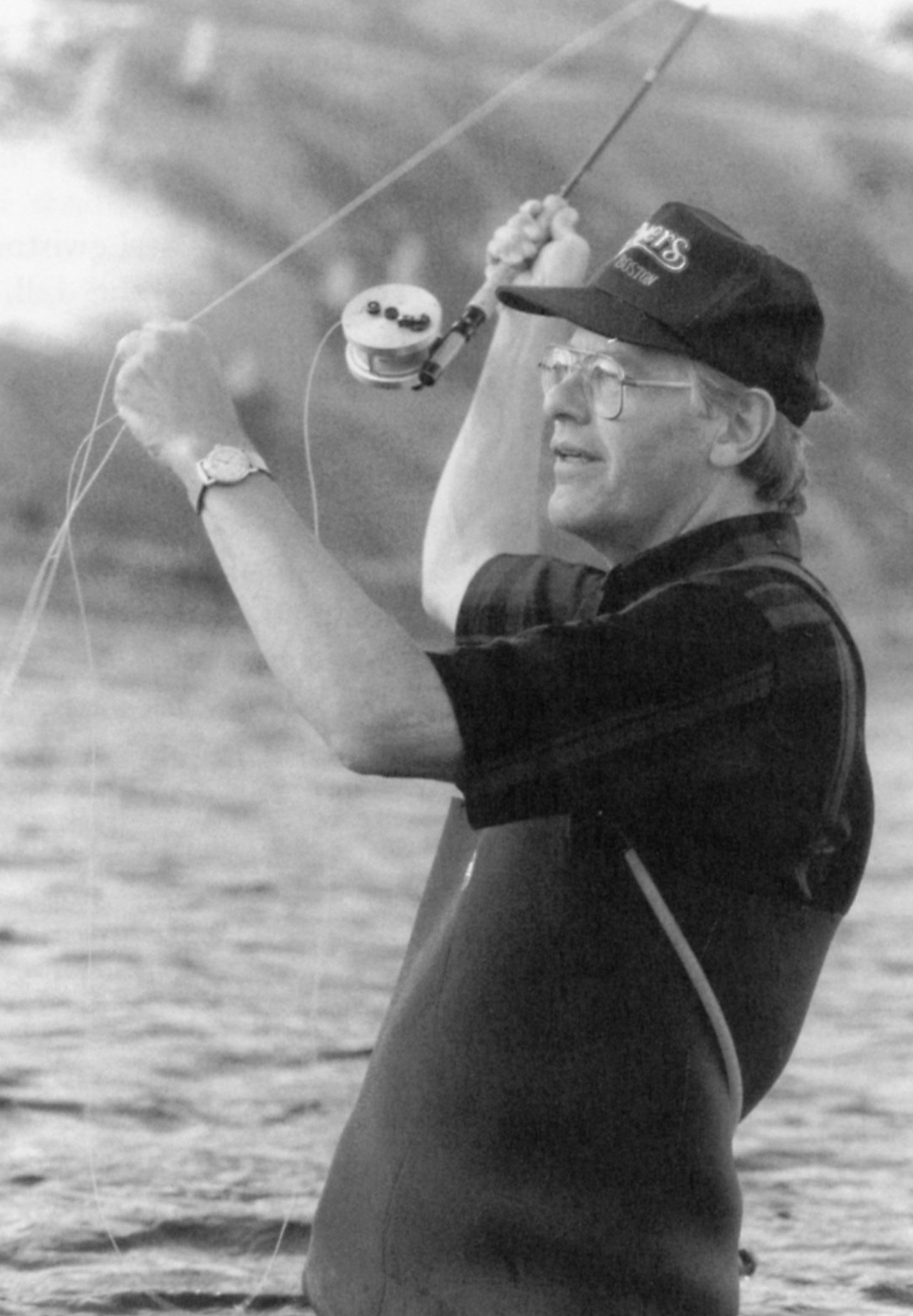
Keith Stonebreaker
The "catch-and-kill" season continues through December, less a time of competition between gear and fly fishermen than of gear fishermen with themselves. Nuthouse Pool near Orofino has been the scene of some locally famous battles. "That's one of the pools where the baseball bats and guns come out," an angler told me.
Much of the Clearwater is a tailwater river, a flow sedate and dependable, the modest changes in water level determined more by power needs at Dworshak than by seasonal rains. This robotic state should be perfect for fly fishing. The river usually comes to Lewiston at fifty-six degrees, a fact changed little by the lingering desert summer. This fall, the Snake flowed at a tepid seventy-two de-grees, nearly lethal to migrating steelhead, and created a situation the Army Corps of Engineers calls a "thermal barrier."
A thermal barrier occurs when the Snake runs so warm that steelhead won't move on the water. The Clearwater, running at 12,000 cfs in late September, should mix with the Snake and improve this situation below their confluence, but that does not happen. Instead, the Clearwater slides under the much warmer Snake, a substratum of cold water leading from the base of Lower Granite Dam to the Snake and the Clearwater. The steelhead that brave the Snake River in the fishway have little encour-agement to continue their journey to either of the drainages. Those that do are often schizophrenic, temporarily ignoring their Snake River origins for the Clearwater and its more tolerable temperatures. I hear about two steelhead that are caught in the Clearwater in two weeks. Both are "A" hatchery fish, possibly with Middle Fork origins, but probably not. The "B" steelhead are still a dam or two away and showing no signs of homing in on the water spilling over Dworshak. Only cold weather would cause that. I thought of what Roland Holmberg, an Atlantic salmon guide, once said: "When I get up in the morning and the sun is shining, I want to cry." He was flying from Sweden to fish with me and would arrive the next week. I began praying for lousy weather.
Thermal barriers make bad public relations. The engineers at Dworshak release extra water to get the steelhead moving. They announce this as if the act were a benevolent sacrifice. Locals greet the news cynically. They call this "ramping up the river." The Corps is required by law to provide adequate flow for the escapement of the Clearwater's steelhead and salmon, but more cold water under warm water doesn't move the fish. Fly fishers know that raising the Clearwater only obscures many of the best steelhead lies, making them difficult or impossible to fish properly.
I stayed in Lewiston with Bob and Toni Wagoner, fishing the Clearwater each day with friends, while Bob tended to his business, the Fly Den, a commercial fly-tying operation that supplies companies from Alaska to Vermont with flies for every imaginable gamefish.
I have found that the typical Clearwater fly fisher can give you Greased Line Fishing, chapter and verse. He is committed to skating and waking dries, and swimming the most sparsely dressed wets of any steelhead river, #6's and #8's with only a few strands of hair for a wing. The dressings are unique, a low-water style strongly influenced by Mike Arhutick's Green Ant, the most popular of the Clearwater dressings.
Green Ant: Tail Golden pheasant tippet, very short, and tied well forward of the bend. Hackle Black. Butt Peacock herl. Body Fluorescent green floss. Wing Grey squirrel tail, very sparse
Other Clearwater dressings often take this form. For example, Marty Sherman's The Stewart has the tail of tippet fibers shortened up, and the black body with gold rib is thinned out while the wing of black calf-tail topped with a few strands of orange calf-tail becomes a few hairs of grey squirrel tail dyed orange. The black hackle is no more than two turns-a very different-looking The Stewart.
Besides Stonebreaker's Purple Skunk and a few other Ants (the traditional Red, for example), is Jimmy Green's Green-Butt Skunk. Never mind that the pattern looks very similar to the Black Bear, the popular Atlantic-salmon fly. Anglers on the Clearwater and neighboring Snake and Grande Ronde rivers care as much for the dressing as they do for Jimmy, a revered folk hero in these parts. He and his wife, Carol, live in a splendid mountaintop home overlooking Ted Trueblood's old Grand Ronde beat. Jimmy designs rods for Don Green at Sage, and the long-retired tournament caster still lays out a line with wonderful grace. Visiting them is an homage, and one I would not fail to make.
When I fished with Bill Alspach and Glenn Cruickshank, two highly regarded local experts, they cast Bombers while I swam low-water wets. I wasn't sure that so small a wet fly was necessary, and I raised two steelhead to a # 1 Purple Peril. These were both "A" steelhead, no more than five pounds, but one came from the main current to run the fly down right to the beach. Was the fish's miss due to the size of the fly? I think not. Glenn raised a steelhead to his dry, and we found no other fish. We worked miles of river, including Coyote's Fish Net, and Ant and Yellow Jacket, two pools with names from Nez Perce folklore.
"You can see these figures on the hillside if you have enough hallucinogenic drugs," said Glenn. He pointed across the river to the birthmark of black basalt stark against the pale grasses and sagebrush. "It's no secret where to find the best pools," I said. A highway borders the Clearwater for forty miles-eighty miles of shoreline not counting the braids. I have arrived at these highway pools before first light only to find anglers standing at the ready in the dark. The first person through will almost certainly raise a steelhead, a good reason to be on the road at four in the morning when steelhead are in the river. In their own way, fly fishers are just as competitive as gear fishermen for time on the right water.
We floated the river in Glenn's McKenzie boat and worked both banks to fish the many secondary pools, obscure lies the visiting angler is not likely to discover and even less likely to be told about. Where the Clearwater braids, we pulled the boat out and fished the island runs. The many creases and flats were the Clearwater in miniature, and each of us become lost in his own water.
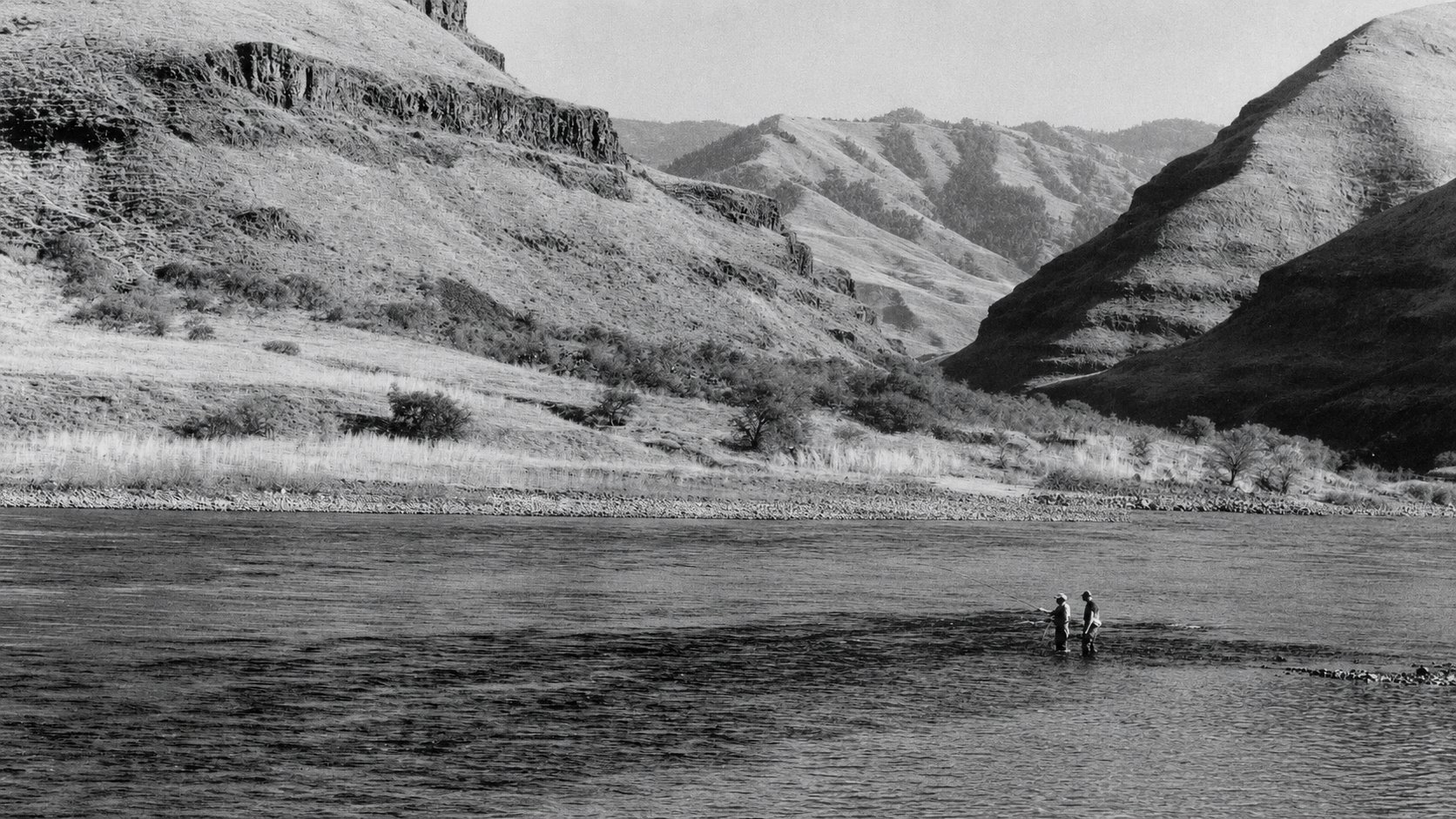
Bill Alspach and Roland Holmberg on the Snake River.
When Bill Alspach tires of the Bomber, he ties on a very large Bloody Muddler on a dropper with a small wet fly secured at the end of the leader. The Bloody Muddler, a local tie by LeRoy Hyatt, has all but replaced the original in Idaho's steelhead circles. Billfishes it greased-line, a big locator fly plowing surface currents and moving steelhead from long distances. When steelhead rise to investigate the commotion, they are seduced by the petite offering bringing up the rear. On no other river have I seen this arrangement employed so frequently.
We didn't see any more steelhead, and our flies couldn't locate the hidden fish. This discouraged me. Steelhead are telltale animals. If an angler does not blunder about, he can often observe them holding in various lies. Moving fish frequently roll while passing up a pool. A steelhead will crash the surface for no apparent reason. A large boil on the fly is almost certainly a steelhead. Nothing of this sort happened in the afternoon, and I became certain the river was empty of fish other than the schools of squawfish that darted away from the shadow of our boat.
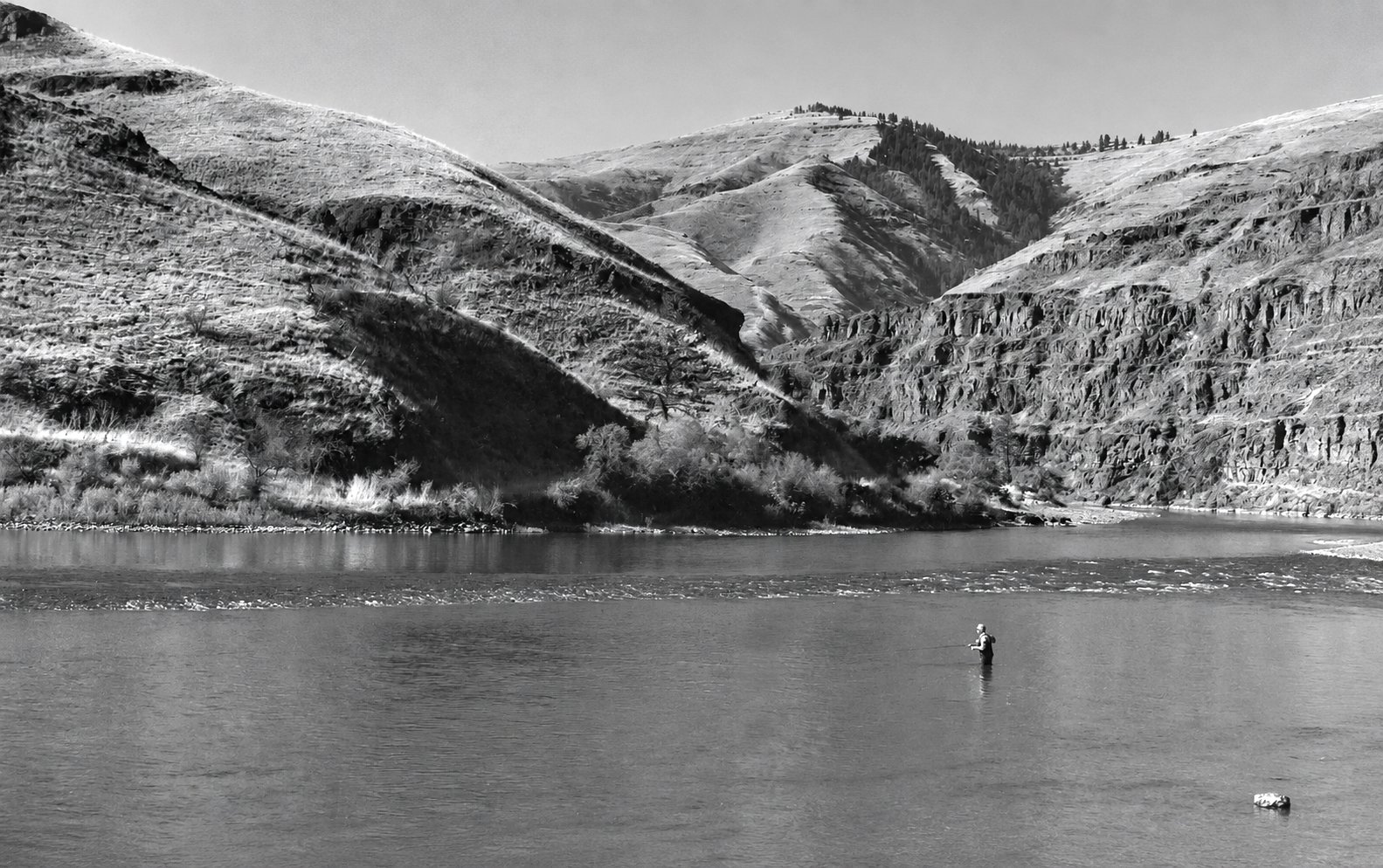
LeRoy Hyatt leads a Bloody Muddler through the Grande Ronde’s Hole in he Wall.
I fished with Keith Stonebreaker on his favorite piece of water. Keith, Jack Hemingway, and Will Godfrey had served on Idaho's Game Commission together, and had been instrumental in setting aside twelve hundred miles of river to be managed as catch and release water. Keith had a clear understanding of the big picture in all its bureaucratic glory, and he knew how to present a certain fly on a specific slot of holding water. He could not, however, find a steelhead where none existed.
One day Craig Lannigan ran Bill Alspach and me from pool to pool on Sushi, his nineteen-foot boat. "Last year at this time we had forty thousand steelhead over the Lower Granite Dam. This year it's five thousand," said Craig. In case I didn't appreciate the arithmetic, he added, "That's one-eighth as many."
"That's plenty! If only they would come on up!" I answered.
Craig once took a wild Clearwater buck that was forty-four inches long. His dad, Darrell, caught a hen that weighed twenty-four pounds, fourteen ounces. Both were late-season fish. I found Craig to be one of the few local anglers who pushed his fly fishing well into winter. "When the water temperature drops below forty degrees, I fish my December Gold," he said. The beautiful dressing-often tied on a double hook-was somewhat like Haig-Brown's Golden Girl.
December Gold: Tail Large golden pheasant crest. Body Hot orange dubbing palmered with or-ange saddle. Wing Matching golden pheasant tippet feathers, set low and extending to the tail
At the end of the week, Danny Diaz and I went twenty miles upstream to the town of Lenore to begin a long float with his high-speed raft. My friend knows all the upcountry ravines and the white-tailed deer that hide in their deep cover. Each year he hikes a thousand miles to learn the habits of trophy bucks, and he is known nationally for his hunting success. He steelheads with equal enthusiasm, and he located several fish, which we could not raise.
The valley of the Clearwater is less arid here, hillsides of ponderosa pine contributing to a setting as beautiful as any in steelhead fly fishing. Yellow daisies and blue asters carpeted the river bars, while blue-winged olives filled the air above the long pool. An occasional October caddis sent me hunting through my fly box for a burnt orange dressing. I counted these blessings, looked at the hillside far above my head, and gave a shudder.
In the mid- l 970s, the Army Corps of Engineers announced plans to install a fourth turbine in Dworshak Dam and to build a regulating dam on the Clearwater at Lenore to moderate the extra flow. As a formality, public hearings would be held in Lewiston. Fishermen still like to remind one another about what happened. Five hundred outraged Idahoans showed up, each sick to death of the Army Corps of Engineers and its dams. While the Association of Northwest Steelheaders spearheaded the opposition, it was LeRoy Seth, a spokesperson for the Nez Perce, who best summed up local feeling for the dam. "It's about time for the cowboys and Indians to get together and fight the cavalry!" he shouted.
The dam was never built, a fact Danny and I appreciated as we floated through the canyon.
I joined LeRoy Hyatt for two days on the Grande Ronde, water ten to twenty miles above the mouth of the Snake. This is wildly spectacular country where the ancient river has cut away mountain slopes to make stupendous cliffs of their basaltic cores. Hackberry, the "forest" climax tree, grows twisted and desiccated by canyon winds until the groves look prehistoric. Sumac, oddly lush on the harsh talus slopes, gives sparse cover to the coveys of chukar that call down from rock outcroppings. We saw cock pheasant around patches of poison ivy that had turned fall crimson. Just before Hole-in-the-Wall, a pool named for the old stagecoach tunnel it borders, LeRoy herded twenty-five wild turkeys along with his pickup. Golden eagles, prairie falcons, and bighorn sheep kept me squinting skyward all day.
Almost with the first cast I saw a four-pound steelhead hurrying through Hole-in-the-Wall, a traveling fish searching for cooler water upstream. Our river was sixty-six degrees-tepid, but not dangerous for steelhead. LeRoy and I each raised a fish, the tiny vanguard of what was to arrive when the weather turned cold. The next day, LeRoy caught several smallmouth bass with his Bloody Muddler.
"If you're finding bass, you won't find steelhead," went the local adage, and it was true.
I returned to Lewiston, waited for Roland Holmberg, and for the Snake to cool. Most of all, I waited for the steelhead. On the day Roland arrived from Sweden, Indian summer still hung in the valley of the Clearwater, a prolonged plague of clear skies. Bob Wagoner proudly explained to my Viking friend that Lewiston was in a banana belt. Roland caught my look of dismay. "The problem isn't stale fish," I said. "The problem is no fish."
We haunted the rivers, visited old friends, and talked of fly fishing. Roland had guided Jack Hemingway on Norway's Aa in July. I hadn't seen Jack since we roomed together two years before at Far West Lodges on the Bulkley River. I knew him to be a fine fly fisher who enjoyed putting his rod down to chase after grouse. Now he was building a cabin above the Grande Ronde for his wife and their bird dogs. He and Keith Stonebreaker, his old pal on the Game Commission, joined us for an evening of steelhead gossip.
Bob Wagoner took Roland and me to fish the Snake below its confluence with the Grande Ronde. Jimmy Green was there with Mel Leven and later with Bob Stroebel, harbingers of the season's houseguests. We drove up to his new house and visted his fly-tying room. "Jimmy," I said, "let me describe a rod you should design."
"I've discovered a new kind of cast." he answered.
I showed Roland the gravel points that reach out into the Snake to create holding water for steelhead. Only a few anglers were about, and most of those cast two-handed rods. Long casts really weren't necessary, but when standing up to a river so vast that human sounds are lost, the big rods help one to maintain a sense of proportion. Roland's salmon rod sliced at the air to send a shooting head far out into the river, the fly swinging through a gigantic arc. His expectations were not yet dulled, and his excitement rekindled my own enthusiasm.
The Snake River drainage once produced more steelhead than any other in the world. No more. Three dams, Brownlee, Oxbow, and Hells Canyon effectively eliminated all runs of salmon and steelhead from the upper Snake River, a vast drainage with dozens of rivers covering most of southern Idaho. When completed in 1959, Brownlee proved too high for a fish ladder. Idaho Power trucked the steelhead and salmon around. A net was placed to capture·downstream smolts, but they passed through the mesh and into the turbines. Two years later, the effort was scrapped, and the steelhead runs to the Weiser (a favorite with Ted Trueblood), Payette, Boise, and dozens of other rivers were lost.
Oxbow and Hells Canyon Dams added to a power-generating complex capable of producing a million kilowatts per hour. Mitigation for the loss of salmon and steelhead-a requirement by the Federal Regulatory Commission before a license can be issued-consisted of a steelhead egg-taking station on the Pahsimeroi River and a steelhead hatchery at Niagara Springs.
Due to water-level fluctuations, the sixty miles below Brownlee were also lost as spawning habitat. For that, there was no mitigation.
Lynn "Radar" Miller invited Roland and me to float the Salmon River from Rice Creek to the Snake confluence, about forty miles, and then twenty miles of the Snake to Heller's Bar, the point just below the mouth of the Grande Ronde. Guidebooks claim this "River of No Return" is the longest river entirely in one state in the country. Radar promised a wilderness trip with dangerous rapids and a remarkable assortment of gamefish, everything from sturgeon to smallmouth bass and Kamloops trout. He said that some of the river's "A" steelhead had already slipped up the river, and that its Middle Fork held a native run of "B" steelhead that reached twenty pounds and more. The sun still blazed down on Idaho's rivers, and nothing yet was really stirring from the lower Snake's deep pools. Should the steelhead start moving, they would reach the Salmon as quickly as the Clearwater.
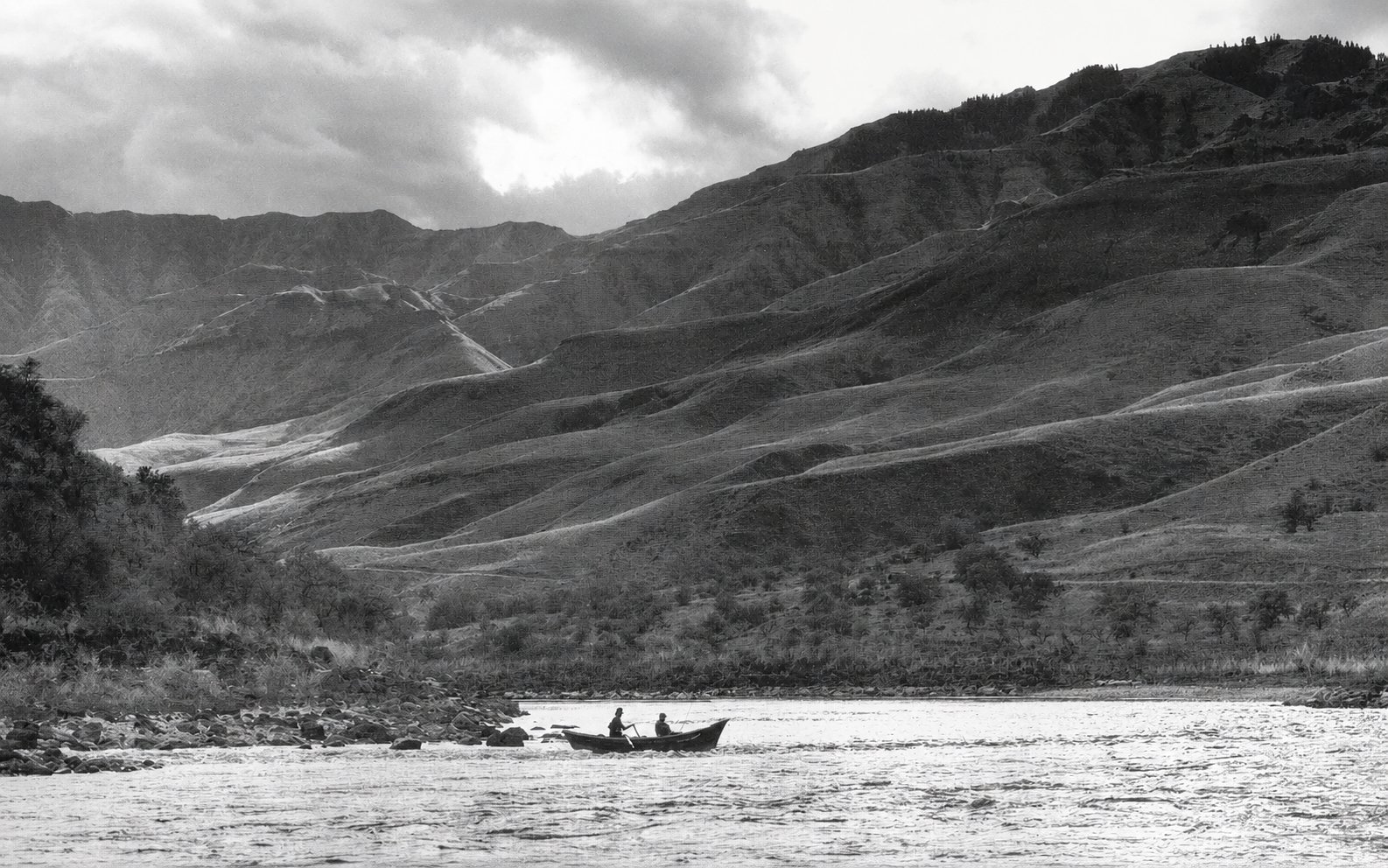
Rusty Gore and Roland Holmberg on Idaho’s Salmon River, the legendary “River of No Return”.
The nickname "Radar" relates to the X-ray vision he depended on for years when running huge commercial jet boats into the Hells Canyon of the Snake and always avoiding barely submerged rocks. Now he owns his own business, the Lower Salmon Express, and enjoys an epicurean approach to river rafting. "I only have four cans of food on board," he told me proudly. He also had four coolers filled with salmon fillets, beef steaks, fresh vegetables, fine wines, and sinfully fattening desserts. Rusty Gore, his partner on our float, is a fellow outfitter from Salmon, Idaho, who has guided anglers for steelhead in the far upper reaches of the Salmon River for twenty years. On this trip, he would run the McKenzie boat while Radar operated the nineteen-foot commissary raft cum garbage scow. "Everything we bring in is brought out," he said, and pointed to the raft. Lashed down atop the mountain of gear was a spotlessly clean portable toilet.
Rusty calls his beloved fish "Mile High Steelhead," because they are caught a mile above sea level, in the Stanley Basin, more than eight hundred miles from the ocean. He thought that with dams having exterminated so many interior races, these steelhead now migrate farther than any other. I asked whether some of the steelhead we hoped to find on the lower river would eventually spawn in the Stanley Basin area.
"This is a spring fishery, March and April," he said. "The hatchery fish are brick red, especially the males. We call them 'factory fish.' They enter the lower Salmon in the summer and fall. But the native Stanley steelhead, 'A' fish twenty-three to twenty-seven inches, come in bright. They winter over in the Hanford Reach, the part of the Columbia River below Priest Rapids Dam, and then race up to Stanley Basin in the spring. But I don't think anyone is sure exactly when they come in from the ocean."
"Why do they hold in the Columbia?" I asked. "Why not in the Snake or the lower Salmon?"
Rusty wasn't sure. "Ranchers are dewatering, and the drop in water level leaves the Salmon warmer in summer and colder in winter."
"But the steelhead wouldn't know that from Hanford Reach," I said. Many interior races drop down out of spawning rivers for deep pools in larger rivers with the onset of winter. But these Stanley steelhead come in and park. It almost seemed like a genetic trait.
Rusty wondered if an absolutely pure strain of wild Stanley steelhead now existed. They mix with "natural steelhead," hatchery fish allowed to spawn above the hatchery projects. He was sure that Stanley fish were different genetically. Were they slowly being lost to hatchery plants?
During the drought of early fall, the Salmon is a small turbulent river flowing at 3,000 cfs, a "pool and drop" river falling an average of ten feet per mile. The carefree rafting water of summer becomes rapids fanged with exposed boulders, nasty little runs that sent Radar and Rusty scouting ahead to time the currents and work out strategy. Both are experienced watermen, and we made our way down the whitewater chutes with no mishaps.
The river was sixty-two degrees, down from seventy degrees in early September, still warm enough to keep smallmouth bass and enormous squawfish chasing after our Woolly Buggers. Where the river broke into glides, Roland and I found planted Kamloops rainbows to sixteen inches with our steelhead flies. This fishing kept us from despairing over the whereabouts of the steelhead. We passed four anglers who had been pulling plugs for a week and had yet to land a steelhead. "“Hooked one yesterday and lost it,” they called to us. They were like men who had run a hundred quarters through a slot machine. Their luck-and ours-was about to change. The odds promised nothing less.
We camped on white-sand beaches, set up the kitchen shelter, and baited up the sturgeon rod. Roland and I filled the firebox with dense limbs of curled leaf mahogany and settled in for campfire stories. Radar told about white sturgeon, how they were once anadromous and how they are now entirely landlocked because of the dams. Like wild steelhead, all sturgeon must be released. They proved safe from our casual attentions, however, and the big rod remained a conversation piece.
The second night, the wind blew so hard we dared not leave our free-standing tents for fear of losing them and their contents. This was the first big southerly of fall, the collapse of the high pressure system that had caused Idaho's long Indian summer. The rain that followed was not much of a show, a few midday sprinkles between sun-breaks, but hourly the day grew colder, and the next morning we awoke to find water in the kitchen pail frozen solid. The river and the air temperature felt frigid, the surface currents only fifty-six degrees in early afternoon.
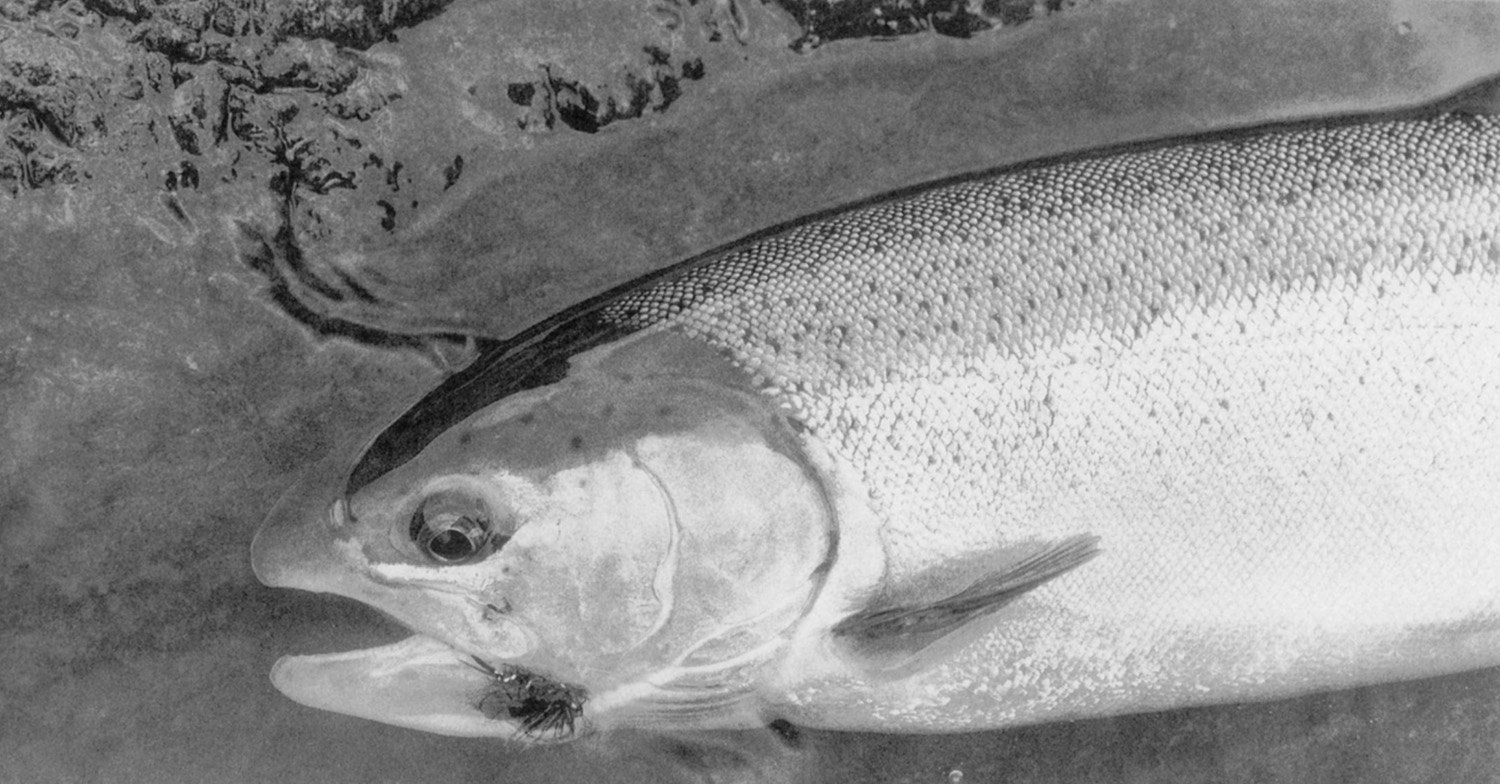
An Idaho “A” steelhead and a Night Dancer.
As the outfitters busied themselves with lunch, I worked a thin low-water Night Dancer through the run that ended a short distance above the Snake. A steelhead immediately rose to the fly and turned to dash downstream, a perfect take that took the point of the hook to the corner of its jaw. This hatchery steelhead, a bright and spirited hen weighing five to six pounds, took me fifty yards into my backing on the first run. She was in all ways a wonderful fish, an "A" steelhead five hundred miles, eight dams, and eight fishways from the ocean, running downriver so hard that my heart was pounding in my ears.
I released her to continue her journey. I was sure-albeit wishfully so-that she would reach those distant headwaters to spawn. I was equally certain that in a life almost impossibly circuitous, she would never return to spawn a second time. Historically, several steelhead from each hundred managed a second spawning. Dams reduced those odds. One in a thousand is hardly an expectation; more a statistical degree of error than a contribution to the future of a run.
I was finally in the thick of the fishing, and a week remained before the catch-and-release season ended. This was my window of opportunity, less this year than perhaps ever before. No matter. These free rising summer steelhead of the Snake River's tributaries give classic definition to my sport as on no other waters in the United States.