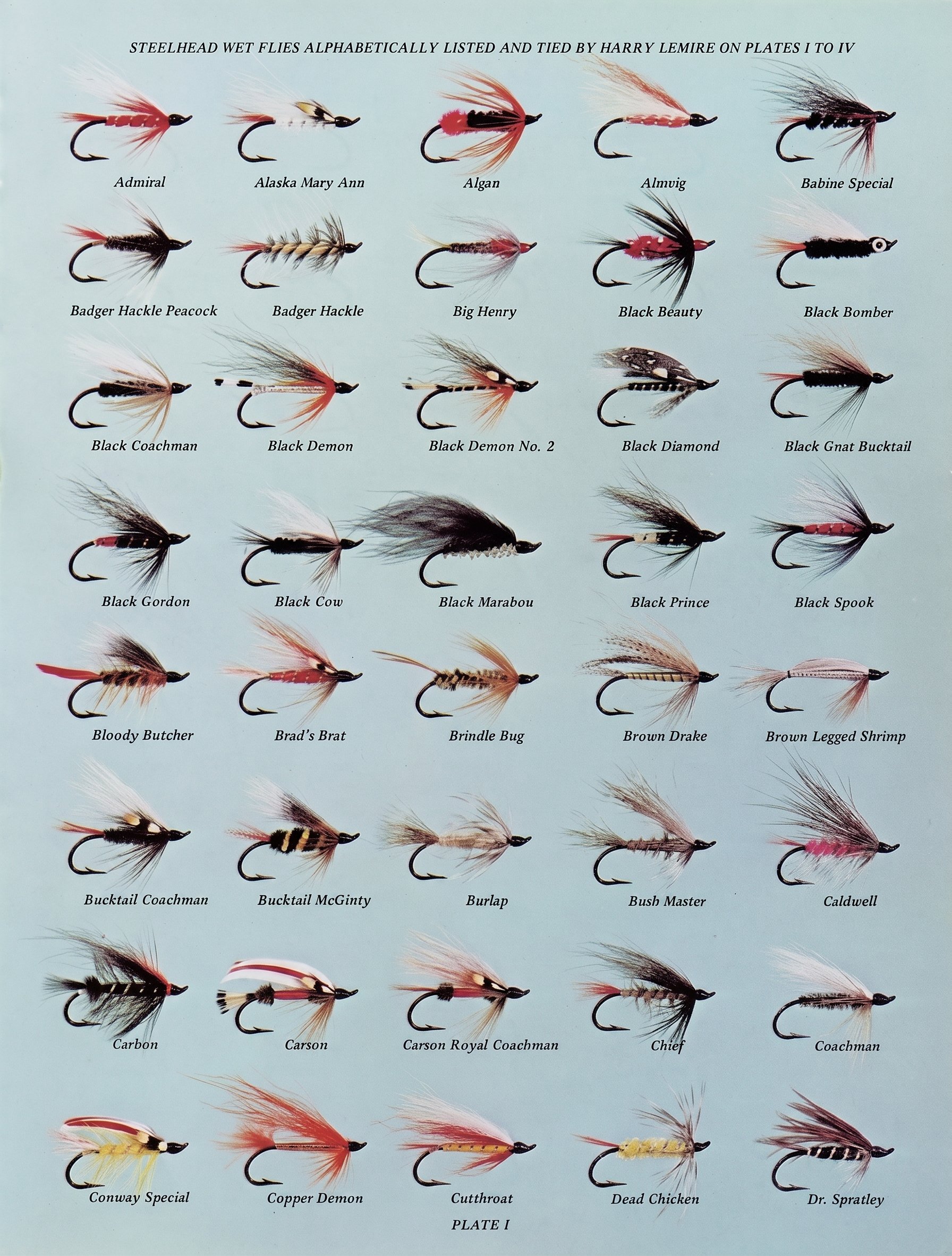
Plate 1 from Steelhead Fly Fishing & Flies (1976), presented here as a historical reference image. Viewing note: This plate contains many small fly images and labels. On mobile, pinch to zoom for a closer view. On desktop, right-click the image and open it in a new tab or save it for a larger view.
Steelhead Fly Fishing & Flies - Plate 1
This plate is from the 1976 edition of Steelhead Fly Fishing & Flies and shows a selection of steelhead wet flies alphabetically arranged from Admiral through Dr. Spratley. All flies on the plate were tied by Harry Lemire. Many of these patterns are obscure and not widely known today, so the image is presented here as a historical reference for anglers, fly tyers, and collectors interested in how these flies appeared in the original book. Although the image reflects the printing and reproduction quality of the original 1976 edition, the plate remains a useful reference for understanding the form, color, and general character of these classic steelhead patterns. Our goal is to preserve both the images and dressing notes for these flies. Note: Not every fly shown on this plate had a corresponding dressing note in the 1976 text. When available, dressing notes are included in the Fly Pattern Dictionary, and original background notes from the book are included below.
Flies Shown on Plate 1
Admiral, Alaska Mary Ann, Algan, Almvig, Babine Special, Badger Hackle Peacock, Badger Hackle, Big Henry, Black Beauty, Black Bomber, Black Coachman, Black Demon, Black Demon No. 2, Black Diamond, Black Gnat Bucktail, Black Gordon, Black Cow, Black Marabou, Black Prince, Black Spook, Bloody Butcher, Brad’s Brat, Brindle Bug, Brown Drake, Brown Legged Shrimp, Bucktail Coachman, Bucktail McGinty, Burlap, Bush Master, Caldwell, Carbon, Carson, Carson Royal Coachman, Chief, Coachman, Conway Special, Copper Demon, Cutthroat, Dead Chicken, Dr. Spratley.
Original Background Notes for Plate 1
Not every fly shown on Plate 1 had a corresponding background note in the original 1976 text. Some flies had only dressing notes, while others included both dressing notes and additional background notes. The background notes reproduced below are the additional historical notes from Steelhead Fly Fishing and Flies. Dressing notes, when available, appear in the Fly Pattern Dictionary. For best viewing, open the enlarged plate in a new tab on a desktop and use a second browser window to view the Fly Pattern Dictionary alongside it.
Admiral: This is a steelhead version of the original by Rear Admiral Eustace Baron Rogers, U.S.N., 1855–1929. Admiral Rogers was born in San Francisco and after his commissioning advanced to become the Navy’s Paymaster General. The original Admiral had a scarlet floss body and white primary strip wing. This dressing was intended for rainbows, though not specifically for the ascending steelhead.
Alaska Mary Ann: The late Frank Dufresne was synonymous with Alaskan hunting and fishing for many years. He worked as Fish and Game Commissioner of Alaska and later for the U.S. Fish and Wildlife Service. The idea for the Alaska Mary Ann was taken from a lure used by Eskimos on the Kobuc River north of Nome. Called the ‘Kobuc Hook,’ it consisted of a minnow-shaped piece of ivory inlaid with black whalebone eyes. A heavy piece of copper wire was driven through the eyes and bent around to form a barbless hook. To the hook shank was fastened a bright red triangle from the webbed foot of the sea parrot or guillemot. Dufresne had first noticed the lure in 1922 while on a trip to the Kobuc area. . . . This flash of streamside inspiration gave the fly its name.
Algan & Almvig: Both the Algan and Almvig are believed to be Washington summer-run dressings originally developed for use on the Stillaguamish River. They were first used about 25 years ago.
Badger Hackle Peacock & Badger Hackle: These are two California variations of the “hackle flies” so popular for both resident and migratory trout.
Big Henry: Jim Nelson of Klamath, California tied this nymph for use on the Klamath and Trinity rivers. It was first used in 1952 and named for C. E. “Henry” Sainsbury of Santa Monica, California. As used by its originator, the fly was fished during clear water conditions.
Black Beauty: Karl Mausser, present holder of the world’s record fly caught steelhead, first tied this compact, fast-sinking pattern in 1960. It has primarily been a Canadian fly, its use restricted to tributaries of the Skeena River.
Black Bomber: The Black Bomber is one of several highly original flies tied by Warren Erholm of Anacortes, Washington. He ties it only as a heavily weighted fly. For this reason, it is sometimes tied upside-down to prevent it from snagging bottom. Besides steelhead, the Black Bomber is effective on sea-run cutthroat and jack salmon. Erholm first fished the pattern in 1957 without the plastic eyes. After five years of use the eyes were added and the fly given its present name.
Black Coachman: The Black Coachman is identical to the hairwing Coachman save for a body of black chenille instead of peacock herl. Conversion to the more durable chenille dates to the 1930’s.
Black Demon: Following the introduction of the Golden Demon to the Eel River in 1934 or 1935, Jim Pray tied the Silver Demon and Black Demon flies. They have survived in that order of popularity. Pray dressed the latter because he believed a black fly was “much favored” in the Orleans area of the Klamath River. It was and, minus a tail of drake wood duck flank, closely resembled the above pattern. The Black Demon was first tied about 1937 and is also dressed with a gold body.
Black Diamond: Harry Lemire originated the Black Diamond in 1969 for slightly off-colored water during the summer season. However, after taking a thirteen pound steelhead from the Green in December, 1970, he brought this most handsome pattern into frequent winter use and now considers it to be highly effective for all the seasons, whatever races they hold. Harry has found that when fished on winter rivers, the fly seems to be at its best when working deep in slower water, such as in the center of the drift. He and his wife, Marlene, live in Black Diamond, Washington. The Green is his “home” river.
Black Gnat Bucktail: This fly’s origins go back to England, where an ancient Black Gnat was a simple black-bodied fly with grey wings. Americans gave the fly black wings, while steelheaders substituted a hairwing, added hackle and the almost required red tail. The Black Gnat Bucktail has been around for nearly forty years and was perhaps the product of North Umpqua anglers.
Black Gordon: Clarence Gordon developed the Black Gordon during the late 1930’s for use on the North Umpqua. He was a fine fly tier and extraordinary angler who had a concession from the U.S. Forest Service for a lodge on the North Umpqua at the old Major Mott site. (See Chapter 3.) Variations of this dressing abound. Sometimes a tail of golden pheasant tippet is added; the red and black body may be evenly divided, and floss used instead of wool.
Black Prince: The Black Prince remains little changed from its initial development in the East during the 1880’s. The originator is unknown. Like so many patterns, it is probably the result of many people tinkering with the basic, all black design. Steelheaders gave it a red tail, bucktail wing, and added yellow to the body. It is an excellent alternate to the Black Gordon.
Brad’s Brat: Enos Bradner is something of a Washington institution. Thousands know him as the former outdoor editor of the Seattle Times, a position he actively held for 26 years. Brad’s Brat was introduced in 1937 for summer-run steelhead on the Stillaguamish River and its Deer Creek tributary. With the advent of fluorescent materials, the pattern has become an all-season favorite for Washington waters. It is used in a wide variety of sizes: 4 to 2/0 for the winter-run and 4 to 6 for summer fish. It is an effective sea-run cutthroat pattern in the smaller sizes and has produced well on lakes as a No. 10 or 12 wet fly.
Brindle Bug: Lloyd Silvius, a longtime Eureka professional fly tier and Eel River angler, developed the Brindle Bug about fifteen years ago. It is a California favorite and has gained quite a following among anglers fishing the Klamath and Trinity rivers.
Brown Drake: This is an alternate to the better known Green Drake, and is a more recent tie. Both of these patterns are used primarily on such northern California rivers as the Klamath and Trinity, though they have proven their worth on other southern anadromous rivers.
Brown Legged Shrimp: The Brown Legged Shrimp is a local variation of the Horner Shrimp, and, like that pattern, it originated on the Eel River. It is one of several honest shrimp imitations used to entice both steelhead and fall ascending chinook salmon.
Bucktail McGinty: The hairwing McGinty has been winged with a variety of furs. The original, however, is specific: wings of turkey containing white tips. Used on many of our rivers, it is more popular on the Klamath and adjoining waters than anywhere else. An alternate McGinty primarily for sea-run cutthroat is worth mentioning. Tied on a No. 6, 3X or 4X long hook, it has a red hackle tail, a body of fluorescent yellow and black chenille (rib with black or wind together), and a white bucktail wing with peacock sword fibers for the topping. It was invented by harvest-trout expert Morrie Kenton of Tacoma, Washington. The pattern is extremely effective.
Burlap: The late Arnold Arana, a skilled steelheader from Dunsmuir, California, introduced the remarkable Burlap in 1945 for use on the Klamath River. (Nothing is entirely new. The Barley Sack by E. T. Halvorsen of San Francisco predates the Burlap.)
Bush Master: Closely resembling a winged Burlap, the Bush Master is considered an outstanding clear water pattern for summer and fall steelheading. Steve Raymond of Siletz, Oregon introduced the dressing.
Caldwell: Louie Caldwell first tied this attractor pattern for summer-run steelhead in those rivers tributary to the upper Columbia River in the Bridgeport area. Dams have brought these steelhead and, in some cases, the rivers themselves, to extinction. The Caldwell survives, a reliable fly for winter fishing.
Carson Royal Coachman: This pattern was named for Sumner Carson of Eureka, California, about the year 1900.
Coachman: Other than the wing of bucktail, this fly is almost identical to the feather wing original by Tom Bosworth. He was the coachman for Britain’s royal family during much of the nineteenth century and the person for whom the Coachman was named. The pattern has sired more steelhead and trout flies than any other pattern, American or English. For the sake of continuity, the complete story of the Coachman and its many variations are included under Royal Coachman.
Conway Special: The late Dan Conway was a one-armed professional fly tier who resided for many years in Seattle, Washington. He learned his tying skills as a boy living in his native Ireland. The pattern was first used in 1934 and intended for sea-run cutthroat, though it quickly became popular for summer-run steelhead. Conway’s original dressing had a peacock herl head, a style of finishing a fly then still in vogue. The beautiful dressing fishes well with a more durable bucktail wing.
Cutthroat: This variation of Al’s Special was designed for sea-run cutthroat, but in the larger sizes it is fished for steelhead.
Dead Chicken: This easy to tie Northwest sea-run cutthroat pattern with the dreadful name is sometimes used on steelhead. It follows the basic red-yellow combination so favored on our anadromous rivers.