Fly Pattern Plate #4 - Rob Roy
The download link to the high resolution version of this image is located at the bottom of this page.
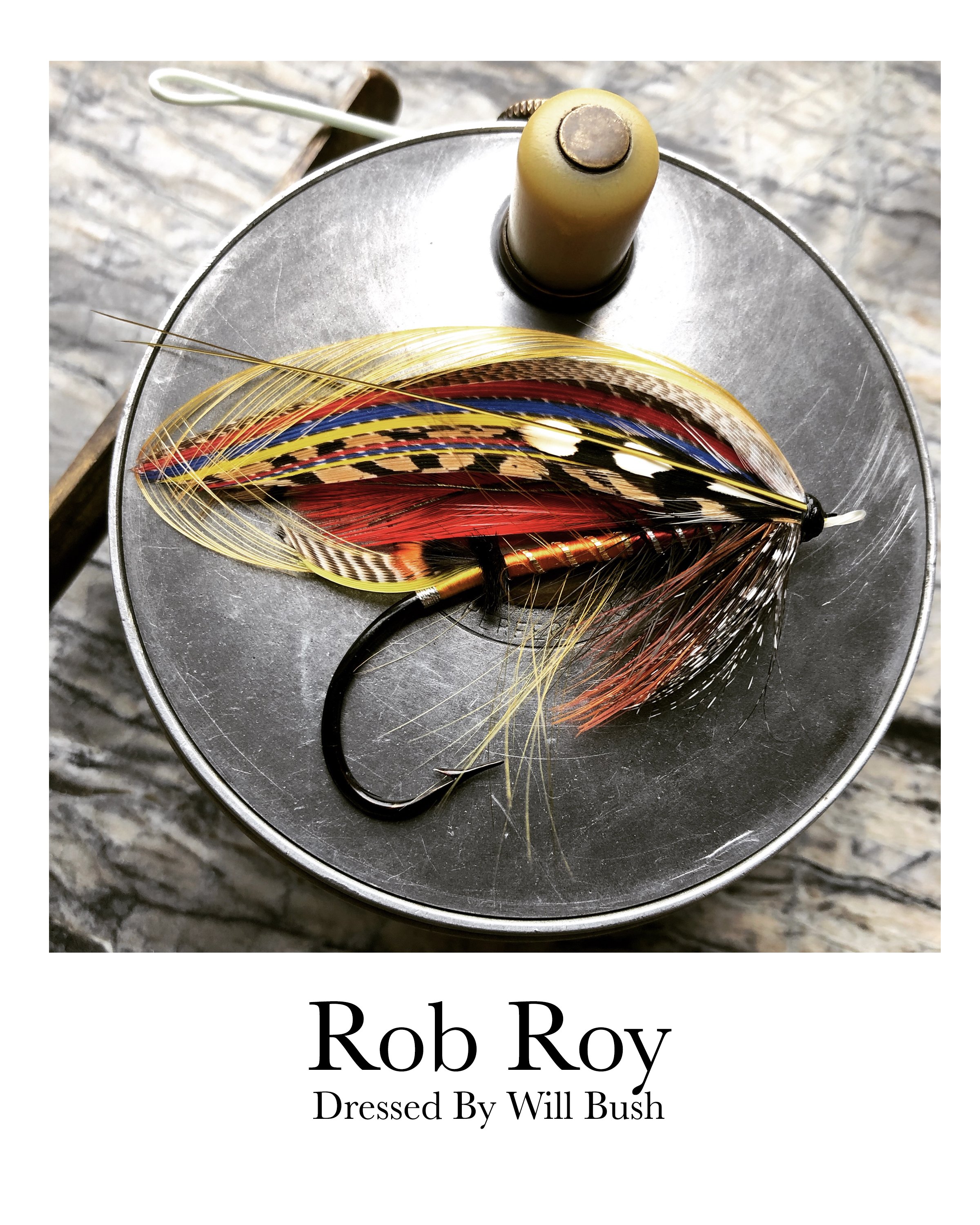
Archive Fly Pattern Plate #4 – The Rob Roy, Dressed By Will Bush
Hardy’s Anglers’ Guide was a long-running European angling catalogue that began to be published in 1883. By the early twentieth century it had become much more than a price list. Issued by Hardy Bros. of Alnwick, the guide presented rods, reels, lines, hooks, lures, fly-dressing materials, and salmon flies in a form that anglers could study as well as order from. Early Hardy catalogues began in the late nineteenth century, and by 1886 the company was producing a fully illustrated catalogue. Over time, the Anglers’ Guide became one of the most important printed records of Hardy tackle and fly patterns. For salmon-fly history, its value is considerable: a pattern listed there had entered Hardy’s commercial range, even when it was not illustrated in color.
The 1912 “Scott” Series
Hardy’s “Scott” Series was introduced in the company’s 1912 catalogue as a new group of salmon flies for that season. The catalogue described the patterns as the result of work done in November 1911 by a committee of experienced anglers and fly-dressing specialists. There were six flies in the series—Ivanhoe, Waverley, Rob Roy, The Black Dwarf, The Lady of the Lake, and Marmion—all named for literary works by Sir Walter Scott. Hardy continued to include the series in its catalogues through 1927.
The Rob Roy, featured in this blog entry, is a mixed wing pattern that gets its name from Robert Roy MacGregor, the Highland outlaw and folk hero at the center of Scott’s novel Rob Roy (1817). Rob Roy was a real historical figure, sometimes compared to a Scottish Robin Hood. In Scott’s version, he is bold, dangerous, charismatic, and deeply tied to Highland identity. For a salmon fly, Rob Roy is probably the most immediately recognizable Scottish name in the series.
Original Dressing Notes
Historical dressing notes for the Rob Roy come from the catalogue, but another version from the period is available as well from J. H. Hale’s How to Tie Salmon Flies. These dressings are listed below:
Rob Roy No. 3 - Hardy Catalogue
Tag: Silver & light orange floss
Tail: Golden pheasant crest, Indian crow, & fibres of teal & sword peacock
Butt: Black wool
Body: In two joints, 1st light orange floss, ribs gold, & having a golden pheasant crest run down from 2nd turn & butted black wool, 2nd half red claret floss, ribs silver oval, with black hackle over
Shoulder: Golden pheasant red breast
Throat: Gallina
Wings: Two scarlet hackles & few strands peacock herl in centre, over strands of yellow, bustard, blue, & red, golden pheasant tail, slip of mallard over golden pheasant crest
Sides: Jungle cock
Horns: Blue macaw
The Rob Roy — Hale Dressing
Horns: Blue macaw
Tag: Silver tinsel, light orange floss
Tail: Crest, Indian crow, green parrot, teal
Butt: Black wool
Body: First section, orange floss, gold oval tinsel, golden pheasant crest. Second section, bright claret floss
Ribs: Silver oval
Hackle: Black
Throat: Golden pheasant breast, guinea fowl
Wings: Two red hackles, bronze peacock, blue, red, & yellow swan, bustard, mallard
Sides: Jungle cock
Horns: Crest, blue macaw
Hardy Versus Hale
The Hardy notebook dressing reads as a technical shop dressing, with fuller instructions for the body construction, ribbing, hackle placement, and wing arrangement. Hale’s published dressing gives the same general pattern in a more condensed format. Both versions retain the essential Rob Roy structure: a silver and orange tag, golden pheasant crest and Indian crow in the tail, a black wool butt, orange and claret body sections, black hackle, golden pheasant breast at the throat or shoulder, a mixed wing with red/scarlet hackles and colored swan, jungle cock sides, and blue macaw horns. The main differences are in the tail and wing descriptions: the Hardy notebook version includes fibres of teal and sword peacock in the tail and gives a more detailed wing sequence, while Hale lists green parrot in the tail and gives a shorter published description of the wing materials.
— Mark Combs
Archive Fly Pattern #4 is a Rob Roy dressed by master fly dresser Will Bush that follows Hale’s published notes using materials, proportions, and construction consistent with the historical dressing notes.
Download Information: Archive Fly Pattern #4 is a high-resolution archival plate. Each plate includes a white border and is suitable for high-quality printing and framing. Dimensions: 8” (width) x 10” (height) at 300 DPI. Click the button below to automatically download the high-resolution image.