This is an excerpt from Bluewater Fly Fishing by Trey Combs. Originally published in 1995. Presented here in its original format.
PACIFIC SAILFISH - Gulf of Papagayo, Guanacaste Province, Costa Rica
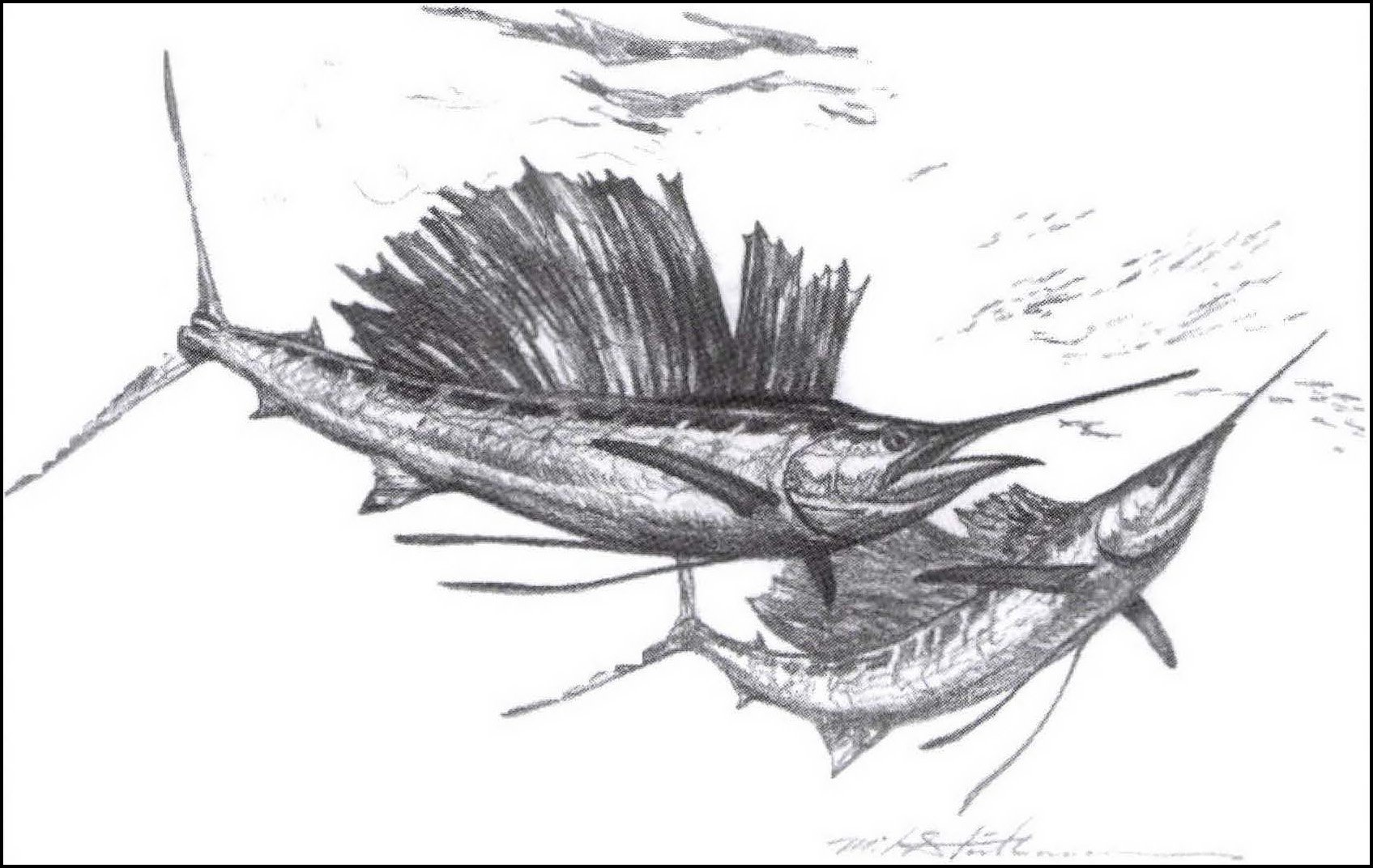
The Pacific sailfish, Istiophorus platypterus, meaning “to bear a sail” and “flat wings,” is a fish that, with its immense, cobalt blue dorsal fin, seems to fly as much as to swim.
Certainly any angler who has fought one could only agree. A hooked sailfish cartwheels and somersaults, porpoising gracefully on breakaway runs of 200 yards, and tailwalking in headshaking panic. Some authorities claim its speed is not exceeded by any other billfish; its short bursts are said to approach 60 miles per hour. Whether it is faster than the marlin is arguable. What cannot be argued is that sailfish do not husband their strength by sounding. They stay on top and fight on top with an abandon not equaled by any other pelagic gamefish. In trying to rid a hook, one can exhaust itself on a reel in free spool, and pounds of reel drag become largely meaningless. For the gimballed and harnessed big-game fisher who sits in a fighting chair ready to derrick giant marlin and tuna from the ocean depths, the sail has an abundance of heart, but no staying power. However, this heart is what makes the Pacific sailfish one of the finest of all the bluewater gamefish on a fly rod.
For years, taxonomists divided sailfish into two species, Atlantic (I. albicans) and Pacific (I. greyi). Sportfishers accepted the separation when they caught Pacific sailfish that were twice the average size of Atlantic sailfish; they most commonly compared sails from Florida and neighboring Caribbean waters with those from the Pacific coasts of mainland Mexico and Baja California. As new areas opened up, the size differences became less marked. For example, in the Indian Ocean were found sailfish whose size was about midway between the known sizes of Atlantic and Pacific sailfish. While fly fishing in Mozambique's Bazaruto Archipelago, I examined the catch records for Bazaruto Island Lodge and found that the Indian Ocean sailfish-fish that for the purposes of record keeping are considered "Pacific" sailfish by the International Game Fish Association (IGFA) - ranged from 44 to 85 pounds. The East African record was a sail from Malindi, Kenya weighing 145 pounds, well below the all-tackle Pacific record of 221 pounds from Santa Cruz Island, Ecuador, but above the all-tackle Atlantic sail record, a West African fish of 128 pounds from Luanda, Angola.
West African sailfish in particular obscure differences between Atlantic and Pacific sails, for they are twice as large as those in Florida waters, and can average at least as large as those in some Pacific locales. Most of the sailfish I saw in Dakar, Senegal were as large as-or larger than-many sails I've seen caught in Mexico's Sea of Cortez, fish often weighing only 50 pounds. These and other populations of sailfish may be discrete races, but they may also be various age groups-fully mature Senegalese sails to younger Mexican sails, for example.
The whereabouts of spawning Pacific sailfish is little known, and even less is known of their migratory habits. Scientists believe that Pacific sails breed from early spring to summer. When I fished the Cabo Marzo area off Colombia's west coast in February, my fishing companion boated, on conventional gear, a 90-pound sailfish that was very ripe and apparently ready to spawn. When brought aboard, thousands of tiny, pale yellow eggs spewed freely from her vent. But if spawning took place in this vicinity, it would be reasonable to expect some angling record of juvenile sailfish, and there was none.
I always found the scarcity of really small Pacific sailfish, those of several to 20 pounds, most perplexing. A 6-pound sailfish would measure at least four feet long including its bill, might be five to six months old, and would be fully capable of going after teaser baits. But only once have I seen such a Pacific sail, a fish I estimated at 20 pounds that came to my fly while I was fishing off Australia's Cape Bowling Green.
Most often sexually mature Pacific sailfish are caught within sight of land, usually in areas where seamounts and severe drop-offs create cold-water upwellings, a strong mixing of ocean currents, and a rich environment for baitfish. Possibly, for reasons yet to be understood, these sailfish spawn in the open ocean, far from land and beyond the reach of sports boats. We know Pacific sails spawn as free-swimming fish, the eggs left at the mercy of wind, waves, and predators. The young hatch and may remain in that environment until they themselves near sexual maturity. While plausible, this scenario does not yet gain support from the commercial fishing industry, for, regardless of the fish ing methods employed, young sailfish remain a rarity wherever they are found. Saltwater fly fishers are left only with the certainty that some areas on the west coast of North America have larger sailfish than other areas, and that the reasons for this are not clear, but involve some combination of migratory move ments, age, and discrete populations.
Today, I believe that the largest Pacific sailfish in the world are most often found in the waters off the northern coast of Costa Rica, the West Virginia-sized Central American country bordered by Panama to the south and Nicaragua to the north. I am almost as certain that nowhere else in the Americas are there as many captains and mates skilled at teasing in sailfish for fly fishers.
The Costa Ricans, who live approximately eight to eleven degrees above the equator, call "winter" their cool days of afternoon rain and frequent over cast that persist from May to September. "Summer" is the dry season, October to March. The reason for this is historical: Early colonists were from Spain where summers were hot and dry and winters were wet.
The ocean water warms in "winter," from late March onward. In the waters off Quepos in the south, the water temperature always remains above 80 degrees. At the same time, sailfish are relatively scarce in the country's north western Guanacaste Province, where during the "summer" the water temperature may dip to the mid-70s. With the onset of the rainy season in April, the surface temperature rises to 80 degrees, and continues to increase until, in May and June, the daily highs are usually 83 to 86 degrees and Pacific sailfish are concentrated in the Gulf of Papagayo.
Charter boat captains will tell you that these Costa Rican sails are not the same as sails from, say, Panama and Colombia, or Mexico. They believe that the sails from Bahia de Coronado in the Quepos area, which average 85 pounds from December to February, are the same sails that appear in the Gulf of Papagayo in May averaging 100 pounds. More than national pride may be in their convictions. Sails smaller than Quepos sails are not found to the south in neighboring Panama. Nor does Mexico get a run of large sails on any known south-to-north migration from Costa Rica. But no one is certain of the actual movement of Costa Rican sails. From where do those Quepos sails migrate? We know that in late summer and fall, when the Gulf of Papagayo waters cool, some sails will stay there through the months of Papagayo storms; but the whereabouts of the main body of sails remains unknown.
The Pacific sail is very fast growing, reaching 100 pounds in three years. However, in many trips to Costa Rica and during more than 100 days fishing Guanacaste waters, I have yet to see a sail weighing under 80 pounds. Dave Meyers, the former manager of Bahia Pez Vela Lodge, told me that in ten years his captains had released thousands of sails, the smallest about 65 pounds.
Few other areas in the world have such a concentration of angling's most prized saltwater gamefish. Sailfish, blue, striped, and black marlin, wahoo, dorado, bigeye and yellowfin tuna, and a variety of inshore species, including the exotic roosterfish, abound in these waters. This wealth of gamefish was one reason why foreign investment, immigration, tourism, and resort development came with such a rush to Costa Rica in general and to the Guanacaste coast in particular during the 1970s. Contributing factors included the country's peaceful nature-its citizens like to boast they have more teachers than soldiers and its smooth-ticking democracy, the most stable in Latin America.
Resorts and fishing camps sprang up along the coast, and fleets of locally built Palm Beach 30s were delivered and fitted out to satisfy the most discriminating big-game anglers. Villas Pacifica and Flamingo Beach Resort were built on Guanacaste Province's Flamingo Bay. At the end of the bay, a harbor was dredged and docks and moorings installed. In the small, remote coastal village of Playa del Coco, Mario Vargas bought three Boston whalers, hired local fishermen including Jose Canales to captain the boats, and began a charter boat business. A Chicago investment group purchased property between Coco and Flamingo Bay and built a fishing camp just above a beautiful black sand beach. They called their lodge "Bahia Pez Vela," Spanish for "Sailfish Bay." Henry Nor ton, one of the investors, managed the camp. Jose Canales's son, Calin, 19 years old, signed on as a mate at the new camp. Within two years he became the youngest game boat captain in Costa Rica. Winston Moore, a wholesale sporting goods dealer from Boise, Idaho, booked Canales, and Curpin Mendez, the mate. The three fished together, often for weeks at a time, aboard Pez Vela, a wooden, single screw boat with great fish-attracting harmonics. During the next ten years, the young Tico captain, his mate, and his fly-fishing client combined their talents to catch more than one hundred Pacific sailfish on the fly. While Canales developed into one of the three or four most celebrated captains for fly fishers in the world, Moore became a legend in the sport of bluewater fly fishing.
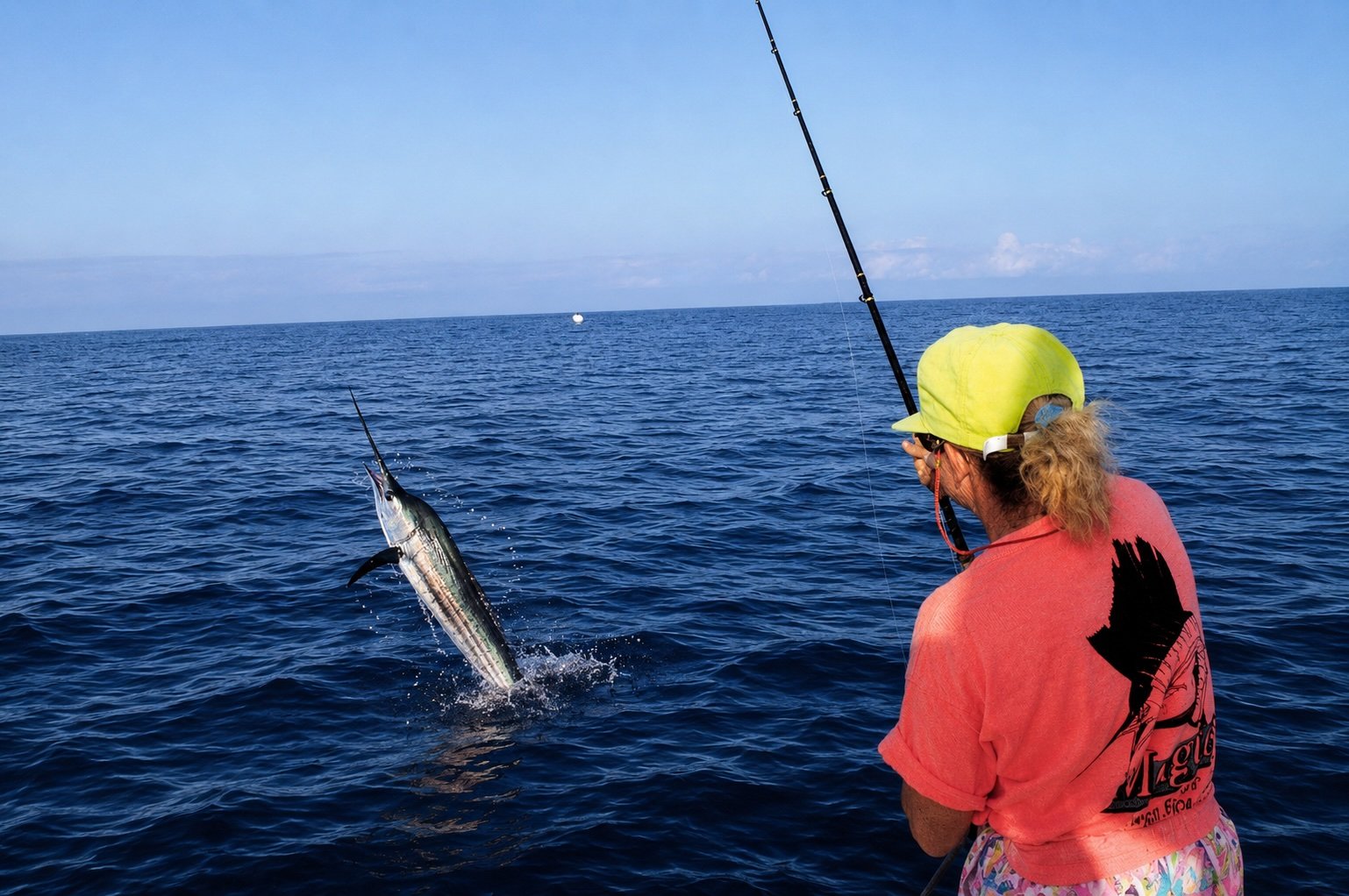
Linda Rogers stays with her Costa Rican sailfish. Neal and Linda Rogers are well known among offshore fly fishers for their remarkable gamefish photography and their beautiful book, The Magic of Saltwater Fly Fishing. Photograph by Neal Rogers.
Winston Moore had, like Billy Pate and Stu Apte, heard how Dr. Web Robinson and his wife teamed up to tease in and hook Pacific sailfish on the fly in Panama's Pinas Bay. Using that information, he traveled to Panama in the mid-1960s and chartered boats out of Club Pacifico to fish the waters off Hannibal Bank. Later, he would book weeks at Tropic Star Lodge and fish Pinas Bay. Moore tried many teaser configurations to determine what was the best number to troll, what colors might make a difference, what were the most effective distances to set them from the boat, whether they fished better with or without bait, and whether trolling teasers with various kinds of attractors made a difference. He came to rely on plastic squid trolled from two teaser rods. Privately, he thought they held sailfish as well as skirted teasers with "meat strips." The crew had far more confidence in teasers with bait, belly strips from either black skipjack or dorado, and he let them have their way. Between the teasers, Moore trolled a Sundance Teaser by the Boone Bait Company. This 16-inch-long cylinder with narrow panels of mirror along its sides produced tremendous bolts of flash when the cylinder rotated. Moore became convinced that this drew sailfish from great distances.
When I visit Costa Rica in May, recent rains have ended the six-month dry season in northwest Guanacaste Province. Only a few days of afternoon showers can transform the tropical deciduous forest from leafless east-Texas-arid to a lush green that fills the hillsides with jungle and frees bands of howler monkeys from their imprisonment in the milk and chicle trees that remain fully foliated throughout the dry season. Cebu, an Indian breed of cattle with bodies of knobs and sticks under loose, pale skins, munch incessantly at the new grass on the sabanas. Lowland forests were cut down and burned for these pastures, a terrible bargain, say environmentalists, who claim the sacrilege shortened the rainy season by two months and forever changed the way seeds germinate, trees grow, and rains fall in Costa Rica.
I know the large Cebu reserves, the lands of the wealthy rancheros, for they lead me on my drive from San Jose and the coffee fincas of the interior highlands to the coastal plains and their miles of white fences, flocks of white fronted parrots and orange-chinned parakeets, and majestic parasol-shaped guanacaste trees, as characteristic of northern Costa Rica as the baobab is of southern Africa. My journey takes me through Coco, and then to a narrow blacktop road that drops precipitously toward the ocean. When I first view the brick red roofs of Bahia Pez Vela's guest cottages, and see Captain Canales's Roosterfish at her mooring buoy, I feel at home.
Canales leaves Bahia Pez Vela Lodge each morning at seven, and by pushing the 31-foot Boston whaler nearly flat out he can make the run to the fish ing grounds, the Triente Miles-"30 Miles"-in a little over an hour. In the Gulf of Papagayo, grounds most often means an undersea mountain that comes within 300 feet of the surface. Typically, Canales searches this seamount area in close company with a dozen other boats from neighboring resorts.
The seamount's cold-water upwellings ignite a food chain that begins with plankton and ends with the concentrations of billfish for which the area is famous. When I worked with Mako Video Productions in 1992 on getting underwater shots of sailfish, Patrick Guillanton and I snorkeled here and discovered bands of warm and cold water that sometimes flowed only a meter apart. I knew from the boat's thermometer that the warm water was 87 degrees, and I thought the "cold" water was at least 10 degrees less. This experience left us wondering about the dimensions of the displacements happening hundreds of feet below us. Even a conservative estimate involves cubic miles of ocean.
Canales sets a classic half spread. From each port and starboard flat line a teaser bait chugs out and slides down the fifth wave before digging in and disappearing into a blue Pacific swell. On a handline of parachute cord a Boone Bird leads a daisy chain parade of rubber squid down the center of the wake. The bird, a foot-long orange fuselage with stubby supersonic wings, flutters about with its nose in prop wash. For 20 feet behind, the pink squid swim sinuously on the surface.
Sometimes the bait is the belly strip of a black skipjack, locally called "bonito." Dorado belly strips are tougher and last longer. Canales believes they smell better to sailfish. On this May day we'll fish Canales's favorite teaser bait, a mullet with its tail split dorsally, the fish set inside a plastic skirt too short to cover it entirely. When the bait comes out of a wave, the two tails flail about, a convulsive action sailfish can't resist.
More than 10,000 surface-swimming sailfish have taught Canales that they can see this spread laterally from 100 meters. A full spread involving two additional attractors set on outrigger poles gives him a few meters more range for his gear fishers. But then fly fishers must carefully roll cast under one of the poles, wishful thinking when the body grows faint from the rush of adrenaline and the brain is recording the dance between sailfish and teaser one frame at a time.
Mate Curpin Mendez sits on the gunwale. I rest on the cooler where the stitched baits are stored. Canales perches above us both at the engine controls on the flying bridge. We face aft, intensely working on identifying the right kind of shadow, detecting the short length of bill breaking out, or noticing the top few inches of tail cutting the surface. The sailfish may come to any part of the spread and our eyes dart from one teaser to the other, to the bird, and down the line of squid and back to the teasers. When the fishing slows, this tour bores, and I lose my concentration. But on 25-sail days, the search becomes hypnotic, almost hallucinogenic when glare ignites the wake and everything from the bait to an errant jet of water turns into a bill. Once in awhile I see the sailfish when they do. Only a few times have I seen a sail first. Rarely, a half dozen sails come in at once and latch onto the squid. Occasionally a sail makes everyone crazy by materializing right off the transom and grabbing the lead squid. But generally the raised sail behaves more predictably: It sees the daisy chain of squid, drops back to track them, and comes alongside the baited teasers. If hungry, the sail raises to one of these-not to spear it with its bill, or even to bat it to stun, but to smell it and then eat it. Instinctively, the sailfish tries to take the bait crosswise, for then its raspy jaws can take a hold that prevents any escape. But because the bait keeps trolling along, the fish grabs the teaser from behind, first from one quarter, then from another, each time trying to reposition itself to get a better purchase. If the crew is alert, the mate will be on the teaser rod before the sail can get a death grip on the bait. If not, the mate and the sail begin a tug-of-war. Soft baits like mullet and ballyhoo get shredded, the sail leaving with the remains. Tough baits like dorado belly strips survive, but the sail may be so discouraged by the unexpected struggle that it swims off for less combative prey.
To successfully catch the moving teaser, the sail must keep its tail submerged. This places the fish at an angle: tail down, head up, the bill out of the water. As the fish mauls at the teaser, the captain quickly removes the second teaser, for now it is a distraction. A sail swimming from one teaser to another often loses interest simply out of indecision. Once focused, the sail's frustration over not being able to eat the teaser is exceeded only by its hunger and determination.
Canales has told me that billfish are extraordinarily opportunistic, capable of feeding through a wide range of depths. He isn't so sure from what depths marlin and sailfish will come for his teasers, but common sense suggests a vertical range, from dark depths to brilliantly lit surface, greater than any horizontal range. While fishing with him I have many times observed billfish coming up on a teaser without warning. The previous June, with El Nino in full bloom and surface waters holding at 88 degrees, I was fishing with Canales when he radioed Captain Richard Chellemi on Gamefisher II from Flamingo Bay Pacific Charters. I had fished with Chellemi only the month before, and while we chatted about the absence of sailfish, he told us that his fish finder was regularly picking up sails 100 feet down, presumably in cooler water more to their liking. Chellemi's comment prompted me to ask Canales how deep these sails will go to feed.
"Four, five years ago," he said, "the fishing was very good and then no sailfish for three days. Not one. Nothing on the teasers. Didn't even see one. Very unusual. I stopped by some friends on a commercial boat who were fishing for grouper with handlines. They had caught sailfish on handlines, right on the bottom in 600 feet of water. The sailfish were feeding on calamari, [squid] ."
When Canales abruptly changes the boat's course, Curpin and I look over the port bow and see a rapidly expanding, mushroom-shaped cloud moving across the horizon. At its base, a concentration of geysers reaches up from the center and makes the whole business look nuclear. My binoculars turn the smoke into hundreds of birds, and ground zero into spinner dolphin that twist into the air to make the largest splash possible. At any given moment, 1,000 dolphin are in view. Below them are ten times that number, one atop the other, a close-order choreography that corrals baitfish and the small tuna that are alternately feeding and fleeing.
Terns, shearwaters, frigate birds, and boobies wheel and dive. The sharp eyed terns, both noddy and bridled, track the fleeing baitfish. The huge frigate birds, remarkably agile in any wind, pirate from the other species. Canales tells me that 80% of the time, a frigate bird on the open ocean means a billfish. For all their incredible soaring ability, shearwaters feed on the water. Rarely do they gather in large numbers unless there are concentrations of both small baitfish and the predator fish that mangle them. They remind me of passersby rushing to view an accident.
Canales studies the birds as the distance closes. "Sardines," he says when we are still a mile away. Ten minutes later we motor by a brown circle 100 feet in diameter, a school of sardines driven to the surface by tuna and balled momentarily into the beating heart at the center of this gathering of birds, mammals, and fish. A million more sardines are fleeing, the tuna and dolphin in pursuit. When their mass becomes sufficiently concentrated, these sardines, too, will be balled up and feasted upon. The dynamic is constant, the activity rising and falling like the ocean's tides.
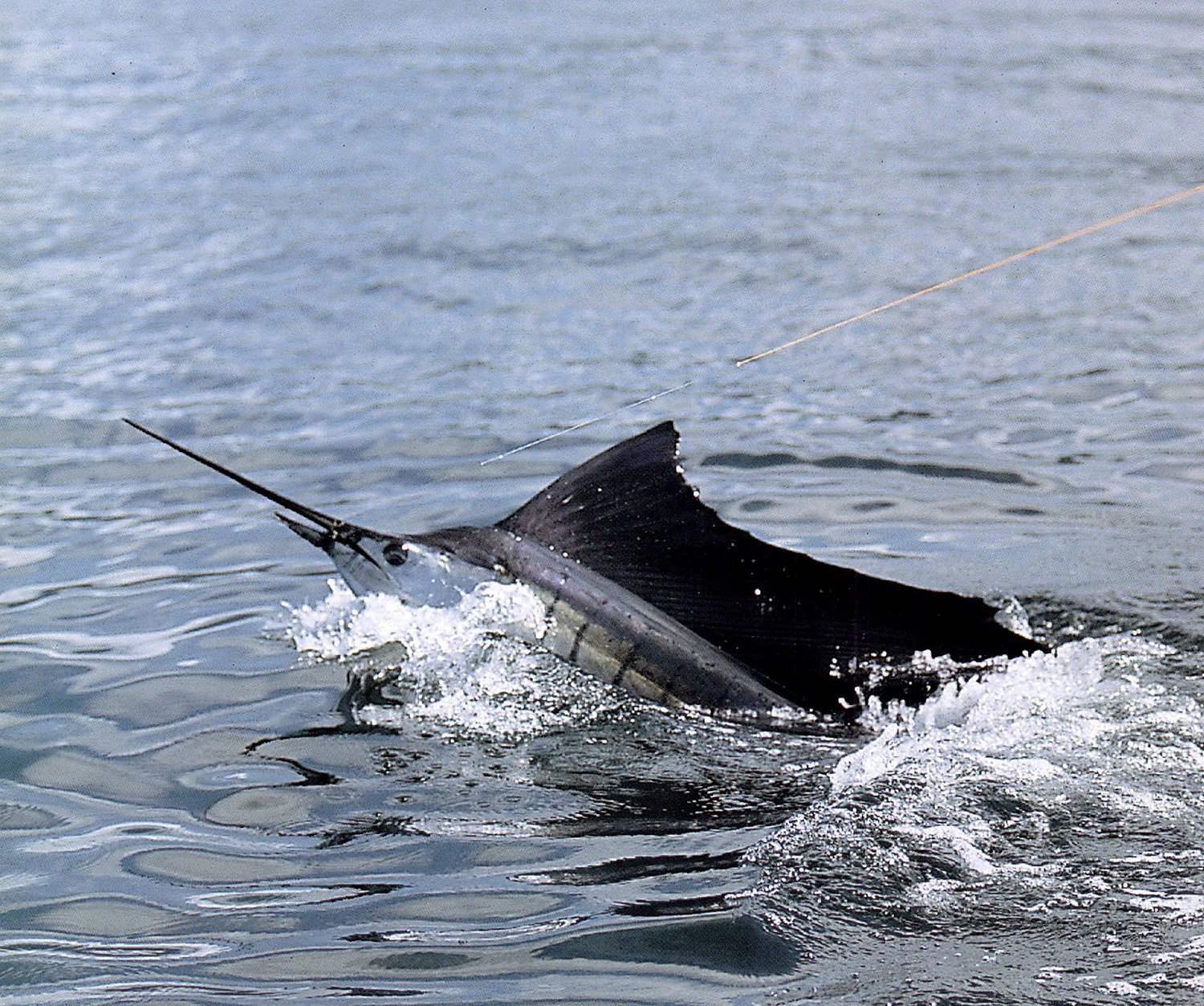
A Pacific sailfish surges away after taking the fly. Photograph by Neal Rogers.
Blue marlin may lurk at the front of a moving school of tuna, while sailfish often hunt along the rear edges. Neither species has anything to fear from the dolphin. Among the species of billfish, I think sailfish are especially willing to pass through schools of dolphin to attack teasers.
I know the drill when the sail comes to the teaser. Canales bolts from his chair and heads for the rod that, for the moment, does not have the sail. Unless he says otherwise, I clear the handline of daisy chain squid, and drop them to the deck, pushing the pile to the right-hand corner of the stern, as far away as possible from my left-handed cast and any running line that might find its way to the deck. Mendez has pulled the bait from the sail's mouth. They hold their rod tips up, Canales waiting a few seconds to make sure the sail gets locked on the other rod, Mendez tensely anticipating the next grab. Sometimes a sail makes an initial grab, loses the bait to the mate, and immediately tries to eat the other teaser bait; Canales and Mendez must make sure they're not clearing the wrong rod. The sail lunges, and as its head comes out of the water, Mendez takes two quick turns on the reel. The sail lunges again, and again it misses. Canales has glimpsed the sail's shoulders. "One-fifteen, one-twenty," he says. He reels in the second teaser, jams the rod in the right gunwale, and returns to the engine controls. I'm in the left-hand corner of the boat with my fly rod in one hand, my Pink Squid popper in the other. Mendez moves to the center of the boat. The sail, with its bill flashing back and forth like a fencer's epee, is on tracks, a hot fish so totally consumed with the split-tail mullet that it could be teased in until I touched it with my rod tip.
Now begins the most exciting thirty seconds in bluewater fly fishing.
My fly line is 55 feet long and the bucket at my feet contains 45 feet of it, stowed from the reel end so that on the cast the line comes out tangle-free. A few turns of fly line remain on the reel; I don't want to strike the fish with backing in my hand. I have a midrange drag setting, four to five pounds, enough to provide some resistance if the running line gets away from me. I toss the popper to my left, away from the boat, and let 15 feet of line slip between my fingers. If I drop it directly over the transom into the turbulence of the wake, the popper bounces around on mini-wave reversals and doesn't go anywhere. With a sail charging in, these lost seconds can be disastrous. I keep the rod tip pointed almost straight up so that the popper skims along with very little drag.
When the sail is about 40 feet away, several actions take place each separated by only a second or two. I drop my rod in preparation for the cast. That is the signal for Canales to take the boat out of gear. That is also the signal for the mate to drop his rod tip to prepare for removal of the teaser. The popper has drifted back a few feet, some line is now on the water, and all is ready for my backcast. The tension from the line and popper on the water-a water load-gives my backcast the energy needed to keep the big bug moving. I must be sure my backcast is not made straight back, but at an angle, so the popper doesn't foul in the flying bridge, or in the rigging of the folded-up outrigger pole, considerations especially critical when a severe crosswind blows from my left.
During my backcast, Mendez points his rod directly at the teaser, and simultaneously takes a few quick turns on the reel to prevent the sail from catching the bait. As I begin my forward cast, he yanks so hard on the teaser that it flies from the water to land past the bow of the boat and completely out of view of the sailfish, a "clean jerk." Were he to simply reel as fast as possible to clear the teaser, or pull it halfheartedly from the water, the bait would skim along the surface, and the sail would continue after it and overrun the boat.
When I'm fishing with Mendez, I'm with one of the best teaser rod persons in the world; regardless of how exactly I direct my cast to the sail, I know I won't tangle his line. I cast well to my right, across the sailfish, and over Mendez's line as he pulls the teaser free of the water. When my popper hits, line continues to play out until the running line hits the reel. The angle of the cast and the slight movement of the boat combine to put a belly in my fly line. When the line comes under tension, and I make my first strip, the popper begins chugging across the wake to give the sailfish a side view rather than an end view. I keep my eye on the popper, not on the sailfish.
The crack-the-whip retrieve sends a foot-high wave cresting before the one-inch-diameter popper. No more than several seconds have passed between the removal of the teaser and the appearance of the popper. To avoid missing the blink-of-an-eye rise, I concentrate on watching only the popper and don't see the neon blues that characterize a lit-up and frantically excited sail. When the fish snaps to its left, its head comes completely out of the water, and in one fluid motion the popper is engulfed. I wait a moment before striking, wait for the line to come taut in my hand, wait as the fish continues to turn, all fractions of one second and three heartbeats, and then with the rod pointed at the fish, and the butt of the rod jammed into my stomach, I strike, once, twice, doing so with the rod horizontal to the water and in the direction opposite from the movement of the sail.
The sailfish stops and shakes its head while panic builds, a very brief timeout that lets me get running line on the reel, back off my drag setting, and collect my senses. When I gain a tight line and the sail feels the tension, it accelerates away for some 75 yards when it breaks out, violently shakes its head, and bounces off its tail through 100 feet of blur and foam before settling down and greyhounding away through 200 yards of backing. The sail then bears left, and goes into a series of berserk headshaking-tailwalking leaps and spins. I have only enough drag to prevent an overrun on the reel, but the huge belly of line increases tension on the leader regardless of what I do. Canales has been backing down the boat, toward not where the sailfish is, but where it has been, so that, with the fish crossing the horizon, he heads for the spot where the fish first changed direction. He does so as rapidly as I can pick up line.
In these few seconds the sailfish, a sprinter in a world of billfish marathoners, has nearly exhausted itself. It will not tailwalk again, and when it does show, its leaps are jumps that no longer possess the kinetic dazzle that marked its first bursts across the water. Copper bars segment its electric-blue-and-white sides, signaling its stress. The sail swims slowly near the surface and must wait for me to catch up.
How fast I do, and increase the stress on this sailfish, determines in large measure how long the struggle lasts. I increase the drag, and reel and reel, as fast as I can, and reel until my arms burn and I think my fingers will fly away, and reel some more. I'm fishing an anti-reverse reel and, with 250 yards of backing out, I can still maintain a decent rate of retrieve, at least as decent as I can expect with a 1:1 gear ratio. Canales watches all this and makes sure we don't create hundreds of feet of slack line and leave the sail with nothing to do but rest and recover.
When I'm again able to go right at the fish with rod pressure and reel drag, the sail is less than one hundred yards out and it reacts and jumps, arching out airborne to only its ventral fin before falling back in. The fish still jumps this way and that way and Canales and I must work toward it carefully for we don't want to pressure it while it thrashes about facing us. Once I've survived the frantic jumps, I figure the sail is mine if I can stay behind it, or can at least have it in this attitude when I apply the maximum pressure my tackle and leader will bear.
When the sail reaches a point of extreme stress, it turns from bronze to copper, takes notice for the first time of our physical presence, and swims down into deeper and cooler water. It clearly identifies the direction of pull, and turns away from it. From this point on, with its head down and huge pectoral fins outstretched, the sail gives me its broad tail.
Canales studies the angle of my line, and complies with my hand signals to continue to back down, stop, or go forward. With the sail holding directly away from me, he spins the boat until I am beside, above, and slightly behind the fish. As soon as this position is achieved, I lift on the fish with the drag as tight as I can set it, with the fly line pinned against the foregrip with my palm, and with the fly rod pointed down into the water. When I lift, with both hands on the foregrip, the sail comes up.
Depending on sail's size and strength, this may be only a few inches, or perhaps a foot or more, but always I am able to lift the fish. I may be able to lift and reel twice from this angle, but if I do the sail invariably turns away, gets its head down, and bores away with its tail. Short of breaking the tippet, I do everything I can to stop it, including putting on the brakes while Canales backs down on the fish. When the sailfish and I have arrived at another stand-off, its tail against my drag, Canales again moves the boat to the side so that I can bring the sail up. Whenever necessary, I move from one side of the boat to the other to complement Canales's efforts and improve my angle on the fish. In a remarkably short time, this constant pressure causes the sail to swim to the surface. I'm not always able to take advantage of this, but today Canales rapidly backs down as I maintain pressure and we're able to keep the sail up. The mate stands ready with the gaff. As we side up to the fish, it goes down several feet, but Mendez quickly lifts its bill up with the gaff and bills the sail with a gloved hand. So complete is the sail's exhaustion that it hardly quivers when Mendez twists the lead hook free.
Years ago sailfish hooked on flies were played until the angler could bring the fish in close enough for the mate to bill. As a result, many were lost beside the boat. When Canales was fishing with Winston Moore he hit upon using the gaff to get the fish's head up and its bill suddenly close enough to grab. This procedure, now routine in Costa Rica, saves a lot of catches and helps prevent the sail from being played to death.
Canales must decide whether the sailfish can be brought aboard for a picture. Almost invariably he agrees to this, but watches the sail intently. A sudden deep bronzing of the fish's gill covers presages death and he orders its immediate release. Catch-and-release are more than empty words to Canales. Sailfish keep him employed and Bahia Pez Vela Lodge operating.
Mendez revives the sail by grasping its bill and dorsal fin in his hands and holding its nearly 10-foot length beside the boat. Canales slips the boat in gear and motors slowly along to increase the flow of water through the fish's gills. In several minutes the sail is sufficiently revived to be released safely. With a few feeble strokes of its huge sickle tail, the overheated fish disappears into the darkness of the cool depths.
This is no time to celebrate. I've sometimes had a fresh sailfish on less than a minute after making a release. A second outfit always stands ready to go. While waiting, I check my fly line for any nicks or cuts. If not, I change to a new butt section. The old one has been buffed opaque by the rough skin of the sail's back. I loop on a new class tippet that has been secured to a 100-pound shock and a Pink Squid popper. Canales brings Roosterfish to trolling speed, Mendez snaps on freshly stitched teaser baits, and we resume our vigil.
Hookups
I often think that Murphy, whose First Law says, "If something can go wrong, it will," was not an inveterate pessimist but an offshore fly fisherman having a typical day chasing sailfish. Losing sailfish is integral to the sport, part of the mystique and excitement, and one soon adopts a bloody but unbowed philosophy. Losing sailfish? Let me count the ways!
Years ago, I discovered that when a sailfish crushes a piece of ethafoam in its mouth, whether a popper head or a sliding head, it can remain convinced for a remarkably long time that it is something digestible. Once I was fishing with Canales when a sail took the foam sliding head-not the fly-and began a long series of greyhounding leaps. I struck the fish hard and remained convinced it was securely hooked until it opened its mouth and the fly came out. The sail simply turned and ate it again. The entire scene repeated itself. When the sail coughed up the fly again, and again came back to eat it, I was jabbering incoherently and Canales was trying to give me a studious explanation without laughing. Several sailfish later I again hung a fish that was locked only to the sliding head. Since then, I've never been a big fan of sliding heads, but I must add that on at least a dozen occasions I've watched a sail take a popper at the head and hold it so firmly that a hard strike failed to get the hooks into its mouth. These fish, too, ran tailwalking across the ocean while absolutely determined to keep the popper. The sure sign that they were never initially hooked was that when the popper came free, the sail returned to eat it again. After one of these experiences, I found the 5/8-inch-diameter doll eye cut almost in half. That's a lot of compression!
When a sail goes into a full-blown series of panic jumps, it literally bounces off its tail while violently shaking its head. Sometimes the fly comes away and the sail continues jumping. This happened to Bob Harper, a hometown fishing buddy of mine. He got hooked into a sail that jumped away for a couple hundred feet before the popper came free. The sail then fell into the water and repeated all its jumps exactly in reverse. For a moment I wondered if this fish would end up in the boat. Instead Bob and I stood at the transom and watched it go by a few feet away from us, like two kids at a railroad crossing when the noon express roars through.
During a week of fishing I'm likely to experience a severe billwrap either shortly after the initial hookup, or in conjunction with it. I think this most likely occurs when the fish is hooked near the end of its mouth or at the base of its bill. Rather than fleeing in panic, the fish turns and shakes its head. The bill, with its raspy edges, catches the shock and a full wrap is made. Sometimes the hook catches the shock to form a noose. Other times the hook gets a light hold until the shock has a turn or two around the bill. Regardless, the result is a snared rather than hooked sailfish, an irritation that leaves the fish shaking its head and looking down its bill. Otherwise, it will not move. I've had sails hold 25 feet away in this manner for several nerve-racking minutes. Eventually, they free themselves, regardless of any action on my part.
I once had a sail take my popper and greyhound in an absolutely straight line for 250 yards before stopping and fully raising its dorsal fin. "Nerve," said Canales, opening his mouth and putting a forefinger to his palate. He backed Roosterfish down as fast as I could reel, and in a couple of minutes we billed the sail, just like that. Canales thought perhaps one sail in ten was affected in this manner by the placement of the hook. I've not observed those kinds of numbers, but I have seen sails begin bronzing up as soon as they began jumping, and virtually quit the fight soon thereafter. Canales would say these fish were "bothered" by the hook. These kinds of hookups have accounted for a few light-tippet records, more than a little bragging about how quickly a sail was brought to the boat, and some complaining about the lack of staying power of the Pacific sailfish.
At the other extreme are the sails hooked in their cheek or shoulder areas, or well outside and above their mouths. No amount of rod pressure can directly interfere with their breathing, and little or nothing in the hook's penetration causes them the kind of duress a hook in the mouth causes. The resulting fight becomes interminable-an hour or more. Several times I have had this occur when the stinger hook swung around and impaled the sail outside its mouth. Eventually the double leverage caused the lead hook to tear out. Usually, however, the hookup happens on the initial grab. Though I often can't see this when I'm fishing, either the captain or mate can. When I'm foul hooked, I play the sail hard, taking liberties that either get the fish to the boat in under an hour, or cause a break in my class tippet.
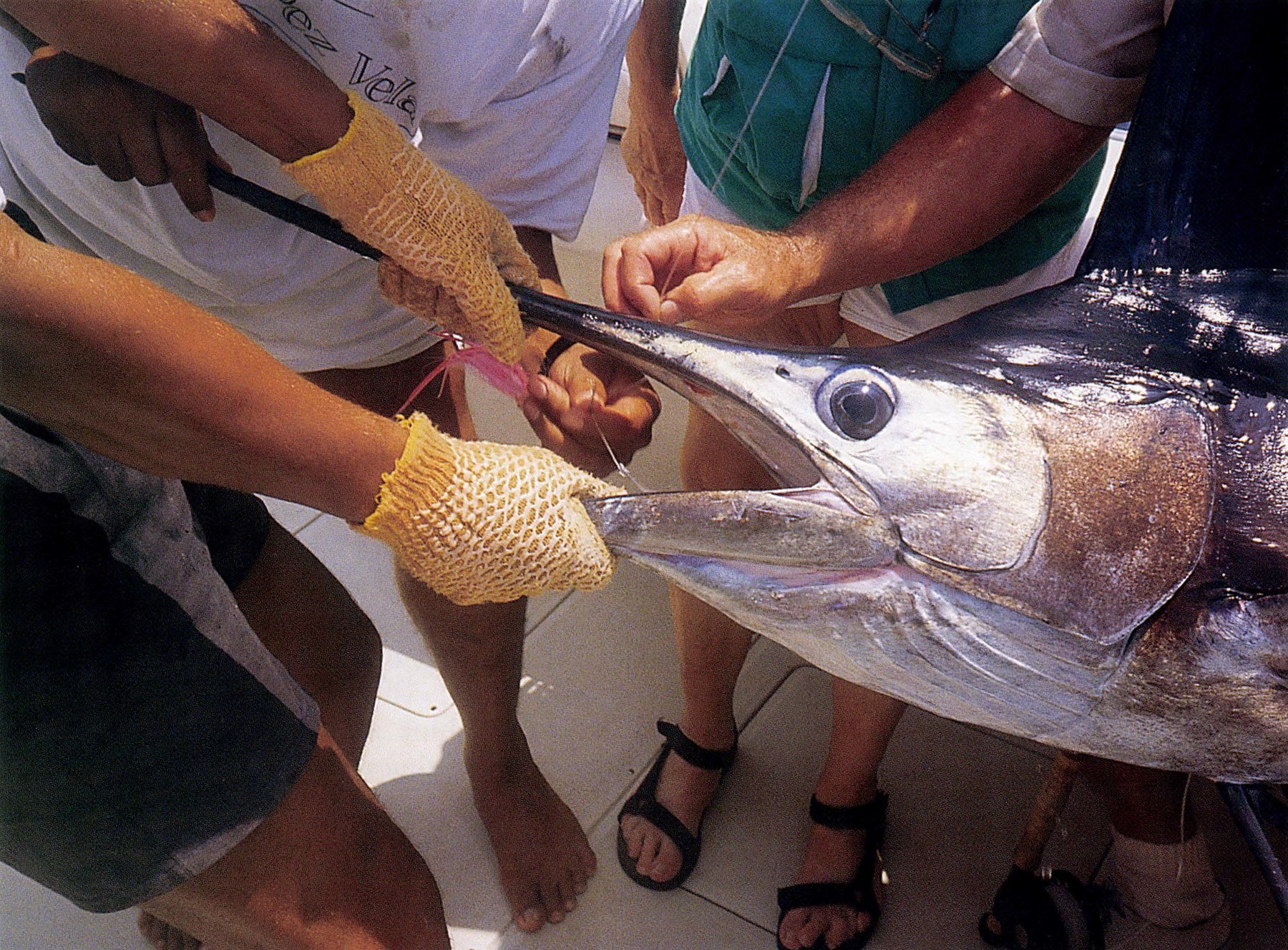
The mate removes a Pink Squid popper from a Pacific sailfish that was hooked both in the lower jaw and in the soft spot in the roof of its mouth. Billfish usually react violently to a hook penetrating their palate. Photograph by BJ Meiggs.
When a sailfish jumps, a tailwrap sometimes occurs through no fault of the angler. The sail might then swim on the surface in a large circle, or even flip its tail out of the water in an effort to free itself. If the fish jumps with a tight tailwrap, something is certain to break. Given the length of an average sailfish in Costa Rican water-9½ to 10 feet-the break often takes place at the end of the fish's tail, in the fly line. This is just one of the reasons I urge fly fishers to set up an extra outfit, and to have several fly lines ready to go-each with butt section, Bimini Twist class tippet, and shock connected and ready to take a fly.
A sailfish has a small head remarkably concentrated in its anatomy. The top and bottom of the concrete-like jaws contain small teeth that form extremely sharp, raspy edges. On the upper jaw, this edge extends without a break for the full length of the bill. Any part of this coming into brief contact with a class tippet separates the angler from the fish. I've found my shock tippets and several inches of my class tippet badly abraded after even a momentary connection to a sail-a rise and a missed strike, for example. On the roof of the sailfish's mouth there is a soft spot, the size of a child's palm, between the forward end of the hard palate and the aft end of the bill. This is the only area that a hook can easily penetrate once it’s gotten an initial hold. When Dr. Web Robinson fished one of his cork poppers with the hook turned up, he hoped to set the hook into this soft area, and often he did. The rear corner of the jaw is an especially good place to set the hook, for the tissue is very tough, and a needle-sharp hook will penetrate and not easily come out. When I have been able to hook a sail here, and then keep my line and leader behind the fish through its jumps, I've been rewarded with a fairly pristine class tippet even after a long fight. The bony lower jaw can also be a good hookup point if the gap of the hook is sufficient to get around the jaw to penetrate the softer tissue beneath-at least a 4/0 in the case of Pacific sailfish.
I recently read in a magazine article that the phase of the moon makes no difference to the quality of Pacific sailfish fishing. No details were given as to how the survey was conducted, but I suspect much of the information came from a fishing resort trying to fill a full-moon week. I have fished through entire moon phases, sometimes working offshore every day for 15 or more days, and found that the best fishing was the week on either side of the new moon, my preferences being the new moon day, a couple of days after it, and the three or four days preceding it. My last choice was the full moon, including the several days before and after.
When I last fished from a new to a full moon, I experienced a steady decline in the number of sails raised, beginning with 27 fish two days after the new moon, and ending with 4 the day after the full moon. As the full moon approached, my first sail of the day appeared later and later. Then one morning, just before noon, I witnessed a silver projectile on the horizon fly from the water straight up into the air-at least 20 feet. The fish was too far away to see clearly, but the flash of white led me to think manta and I gave it no more thought. When this happened several more times, I pointed it out to Canales.
"Sailfish!" he exclaimed.
"Sailfish on the hunt," I said. Canales nodded. Twenty minutes later we had our first sail of the day on the teaser.
Fly fishers theorize that heavy overcast hides the moon and presumably frustrates the sailfish, leaving them ravenous and ready to attack flies at first light. But in reality overcast brings an hour of rain, then breaks up, carrying local showers to other beaches, mountain slopes, and remote jungle valleys. Here and there the moon lights up the sea and the sailfish feed. During the full moon phase, overcast nights rarely bless my daytime fishing. The silver lining may be the phase's reputation for improving the blue marlin fishing. My first Costa Rican blue ate a Pink Squid popper the day after a full-moon night.
A "lazy" sailfish will appear near one teaser to track it, lightly grab at it; then go to the other teaser; then return to the first, before swimming away. The captain puts the wheel down, runs the teasers through a large circle, and again raises the fish. Perhaps this time the mate can tease the fish in, and it will stay long enough to come to a popper for a delicate "scissorbill" take at the end of its mouth. When you strike, the popper will come free and the sail will not return for it. The scissorbill rise, so different from the snap roll take of hot sails, is devilishly hard to convert into a hooked sail. With luck-and needle-sharp hooks-I've landed a few that were hooked at the bases of their bills. But generally these too well fed sails must be found on another day when they are hungry and more aggressive.
While on the subject of hookups at the end of a sail's mouth, I should point out that they often occur when trolling a fly or popper for sailfish. I believe that a sail grabs the fly from behind, and before it's able to reposition itself for a crossbill hold, the angler strikes, either pulling the fly free, or gaining such a poor hold at the end of the mouth that the sail tosses the fly during the first series of jumps.
I have faced similar problems when fishing off boats in the 50-foot range. Once taken out of gear, the boat still coasts along like a battleship for a block, and the cast popper becomes a trolled popper. Faced with this dilemma, I make the cast well across the wake and allow additional line from my bucket to belly the retrieve. If the sail takes immediately, the slack line in the cast gives it an opportunity to get a good angle on the fly.
Large boats also produce a wake and afterwake of such size and turbulence that it can put off hot sails. When I was invited to be the guest on ESPN's "Fly Fishing the World,"John Barrett, the program's producer and host, chartered the largest boat available in Flamingo, Costa Rica, a Bertram 56. Barrett reasoned that the huge boat would give his shooters, Brian Blackburn and Dennis Natalin, a solid two-story platform from which to film. However, to our dismay we found that sails followed the teasers only half the way to the boat and then swam away, far out of range of any cast. After a disappointing day, Blackburn called me to the bridge and we viewed a playback of the last sail. The telephoto lens had captured the sail in close-up, and we could see its bill penetrate the bubbles of the wake. As it continued to chase after the teaser, its head and shoulders were lost from sight. Suddenly the fish turned and swam off. The next day I cast early to the incoming sail, and with the drag backed completely off the reel, I free spooled additional line and then backed off the reel. A long range teaser removal was made and an instant later the sail had my popper. To strike the fish I kept the rod pointed at it and locked the spool with my hand. After the sailfish was hooked, I adjusted the drag up a shade to avoid an overrun. The fish was hooked and later boated.
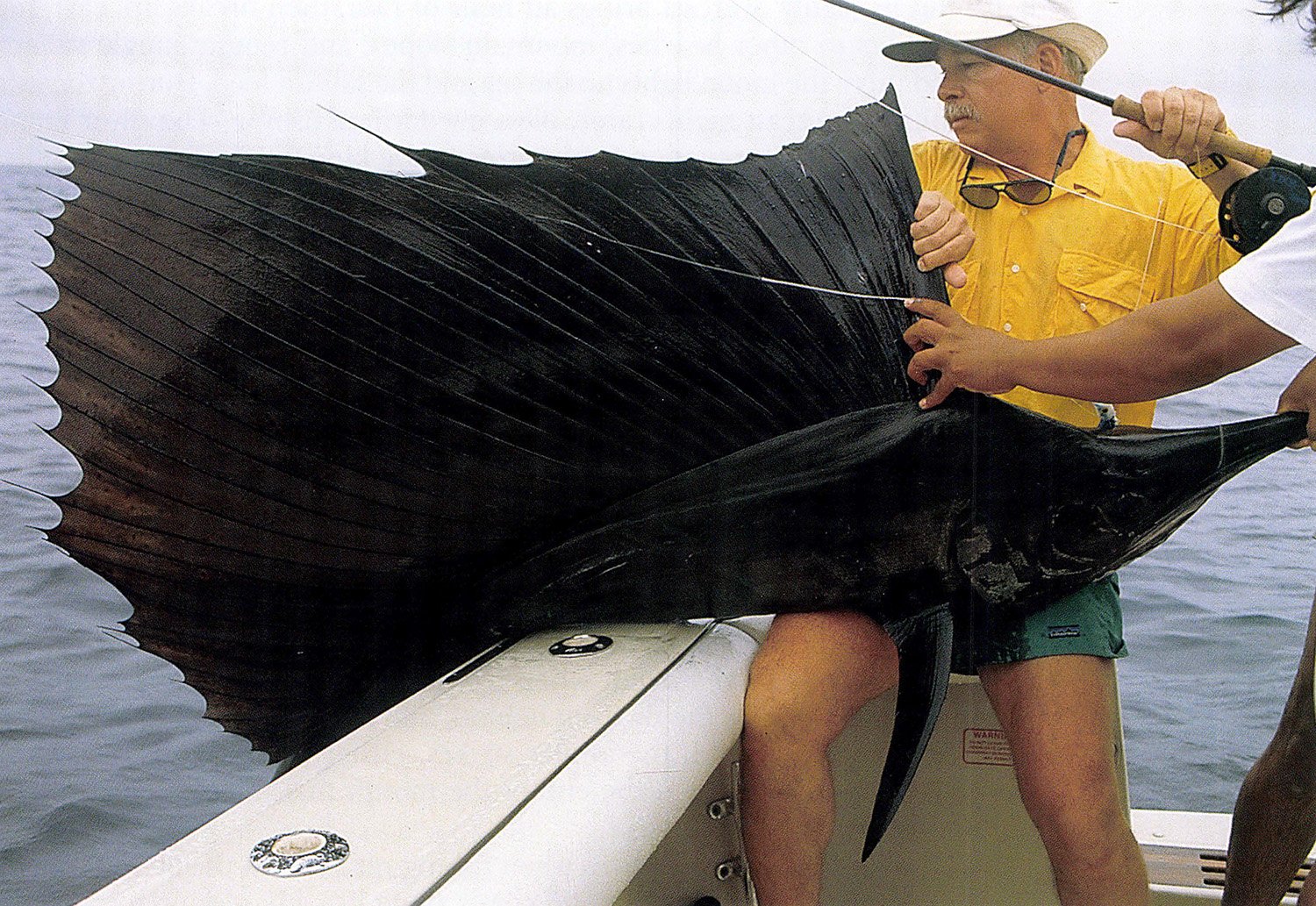
Calin Canales estimated this Pacific sailfish (caught by the author) to weigh at least 140 pounds. The sail was caught about thirty miles off Costa Rica’s Guanacaste coast. Immediately after the photograph was taken, the fish was revived and released. Photograph by BJ Meiggs.
With little or no wake to contend with, a sailfish can be teased right to the transom. When I worked with Mako Video Productions, Patrick Guillanton and I wanted to get underwater video of a sail taking a fly. We arranged with Canales that, when the sail crashed the teaser, the boat was to immediately be taken out of gear. This would give time for the bubble-congested afterwake to clear out for us. I would then submerge a video camera off the transom, and get a clear view of the sail on the teaser. In the meantime, a popper would be dropped off the transom and not moved. The plan called for the mate to tease the sail right to the popper, then remove the teaser just before Patrick gave the popper a slight "pop." We all held our breath as the sail came in, and when it took the popper-an almost delicate take less than a rod's length away-we got both the video footage we wanted, and a remarkably intimate view of a free swimming primal hunter.
These efforts to gain underwater video footage of sailfish led Patrick and me to an interesting discovery. Charter boat captains anticipate two sailfish coming in, one on each teaser, and I always keep two rods rigged and ready to go primarily for that reason. Consequently, the boat I'm on is usually good for a double at least once on each trip to Costa Rica. Sometimes when two sails come in only one shows on the teaser, but we're still able to glimpse the second fish. During our time in the water Patrick and I found that two sails came in together far more frequently than even the captains suspected. A second sail sometimes came in low, 20 or 30 feet down, out of view unless one of us was in the water. When the primary sail was hooked, the second fish stayed with it, swimming along while its companion frantically jumped and tried to rid itself of the hook. When the hooked sail was finally brought to the boat to be released, the second sail was there, too, nervously swimming about. Casting then at the second sail with either a fly or a popper proved to be a waste of time. If the hooked sail was brought into the boat for a photograph, the second fish left. We never observed the released sail and its companion swimming together down into cooler water.
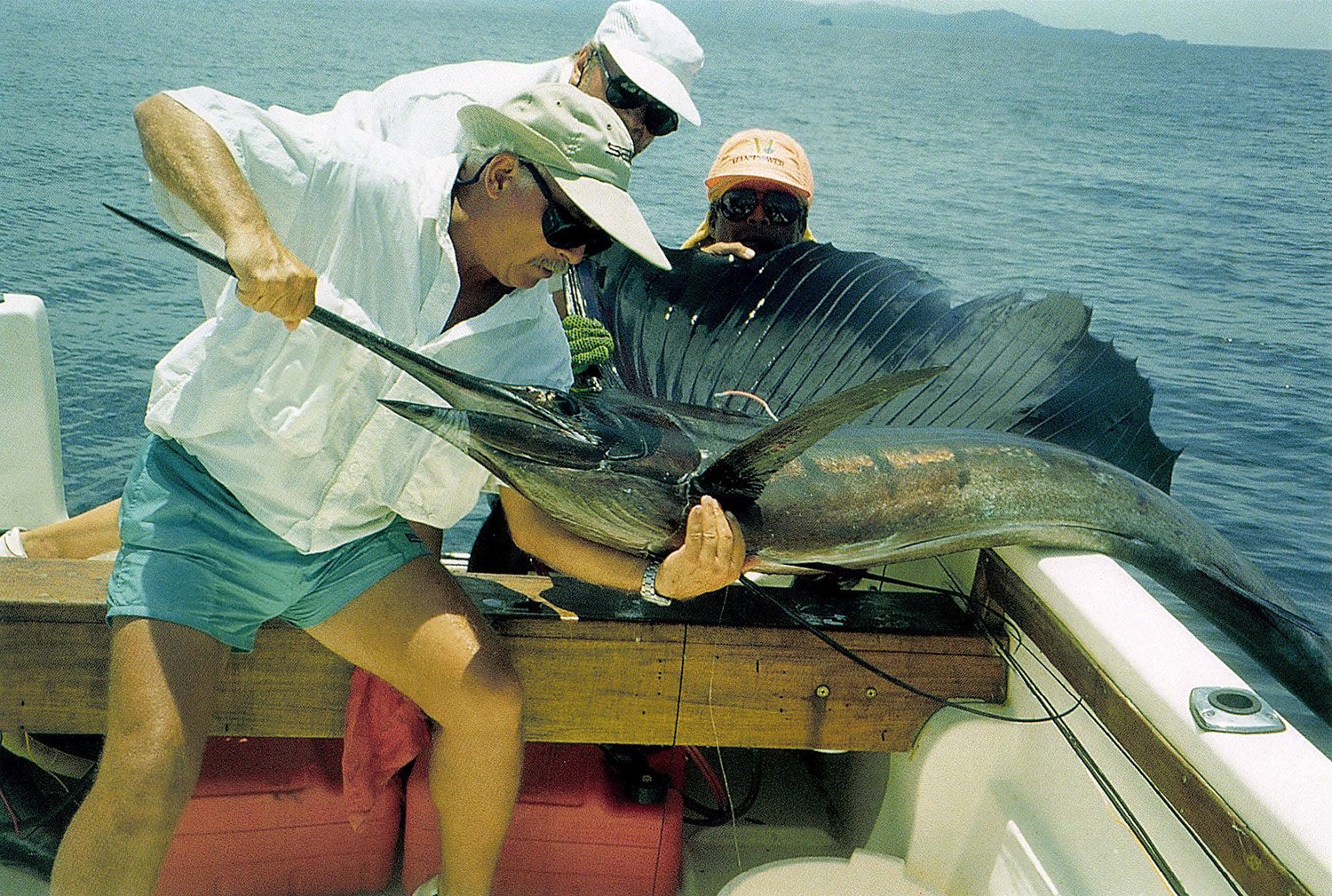
The author and Steve Jensen hold a 120 pound Pacific sailfish that the author caught off Bahia Solano. Note the tag. This was the first sailfish tagged for the Billfish Foundation on Colombia's Pacific coast. The author and Jensen provided the various fishing camps on Colombia's west coast with the Billfish Foundation's tag kits.
Read More from Bluewater Fly Fishing
Additional chapters from Bluewater Fly Fishing are available in the Bluewater Fly Fishing archive. The complete original edition will also be available as a free downloadable PDF here soon.