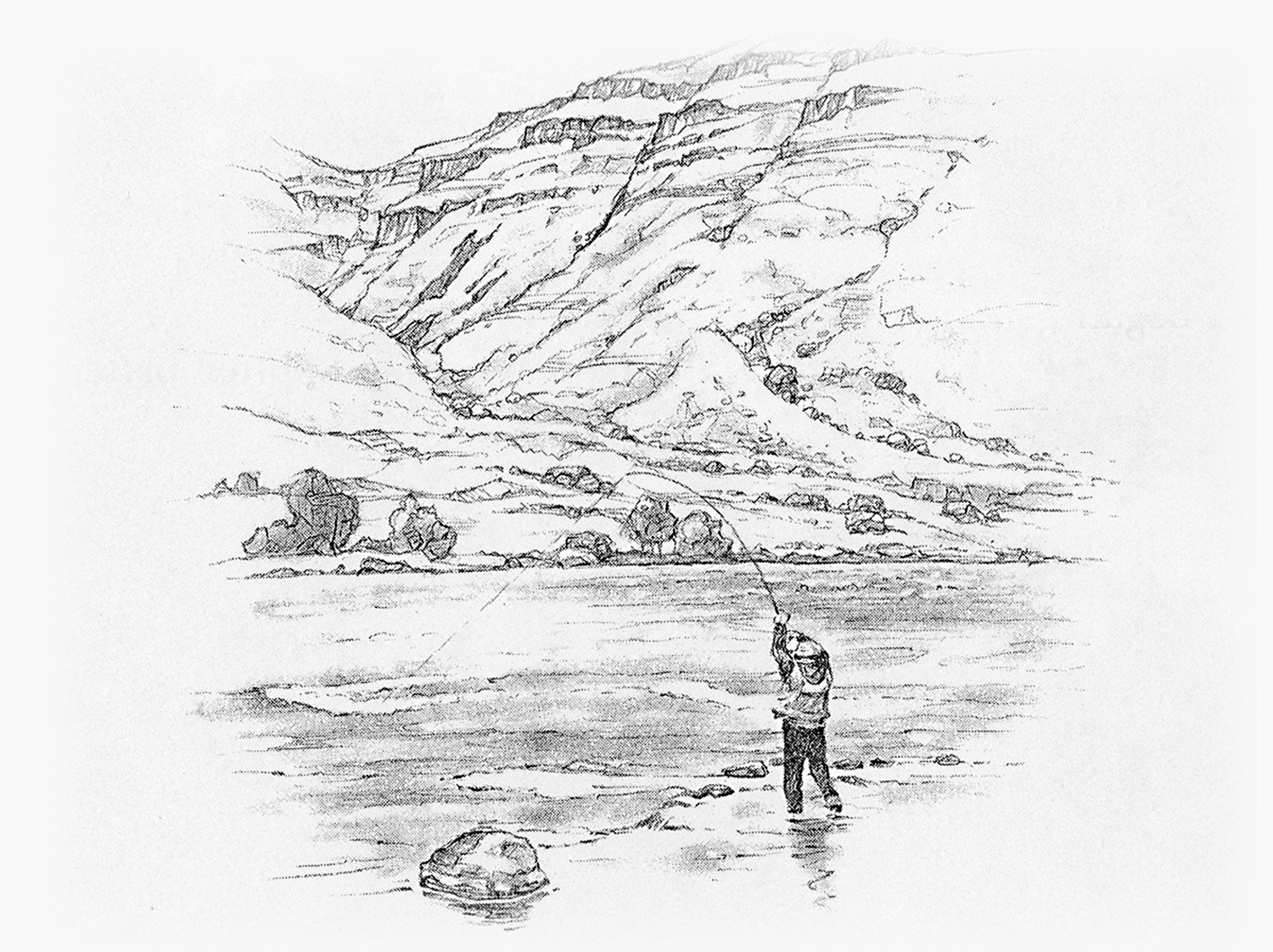
This is the complete chapter from Steelhead Fly Fishing, written by Trey Combs and originally published in 1991. It is presented here in its original form.
My steelhead fly-fishing education began when I first visited the Deschutes River nearly twenty-five years ago with Frank Amato and Bill Baake. I had caught steelhead on a few other rivers, but the encounters had always surprised me as much as they'd startled the steelhead. I had certainly been able to draw little from these experiences. I did learn that if I spent enough time casting a sinking shooting head and dredging out runs with bright, often fluorescent flies, a steelhead would come my way. Months or an entire winter could pass between fish, but I found this a heady quest where suffering and success went hand in glove.
It was easy to be a disciple of Enos Bradner, Ken and George McLeod, Tommy Brayshaw, Al Knudson, Syd Glasso, Ralph Wahl, Walt Johnson, Wes Drain, and, of course, Roderick Haig-Brown. As these anglers were sorting out new rivers in terms of the fly, they were pulling me away from the strong steelhead fly-fishing traditions of southern Oregon and northern California and giving my sport a Northwest bias that still exists today. They demonstrated that the Skagit's great winter steelhead were a springtime celebration, that the "springers" of the Wind and Kalama rivers were the most potent of all the summer-runs, and that when very large steelhead came to a dry fly the event was no accident. They traveled north into the Skeena drainage and, for a time, rewrote the record books with summer-run steelhead that proved to be the largest on earth.
Hard on their successes came a second wave of anglers who gathered from them the raw material to continue refining techniques and to show how well steelhead could be caught. Bill Baake, Bill McMillan and Harry Lemire began preaching a gospel that told of floating lines, sparsely tied low-water wets, Portland hitches, and deer-hair drys fished across and down, a cross-pollination of Atlantic salmon techniques and Northwest rivers. I became a passionate proselytizer of this new faith, totally convinced of its practical and aesthetic rightness.
When Frank and I began fishing, he offered me a fly. I would have preferred one of my own had this dressing not been so attractive. It was a Skunk, a bread-and-butter pattern for all steelheaders, but now tied on a low water salmon hook with a thin body and a bucktail wing set low, short, and sleek. The proportions were better than I had ever conceived, and were in contrast to my own clunky, early California style of steelhead flies.
"Did you tie this?" I asked. I did not know Frank to be a tyer in any classic sense.
"No, Randall Kaufmann tied these several months ago. This is the first chance I've had to fish them," he said, holding the box out for inspection. We both knew the talented young tyer who, with his brother, Lance, operated a tiny shop in Tigard, Oregon.
I was soon casting Randall's fly and praying against its loss. If I back-mended my line, the fly would sink quickly and then on the swing come up from the depths to scintillate in the surface film. Before long, a six-pound buck dashed from the bottom, took the fly, and turned toward its holding station. All this happened so nearby that the entire rise was plainly visible. What I saw made my brain go numb, and my response to the rise correct. I did nothing. A few minutes later, I was releasing my first Deschutes steelhead.
The fly had survived the ordeal. I washed it and continued fishing, but when the next fish turned out to be a jack salmon, I so feared for the safety of the fly that I cut it off and saved it for when I was certain it would only attract steelhead.
Bill Baake had a new fly that possessed none of the low water qualities I so admired. It had a plump orange body. The squirrel-tail wing was tied upright, divided, and set so far forward as to leave room behind the wing to riffle-hitch the fly. He called the pattern an October Caddis, and at the time I could only guess at what it might suggest. The next evening, I fished Bill's creation, and while admiring the surface-film commotion created by this wet fly or dry fly-I knew not which-a hen steelhead of just over thirty inches confidently rose to it. To this day I've never seen a prettier trout. I cradled her in the water, the twilight giving her pink-and-white flank a dazzling brilliance. When she swam off, I knew that the way I tied my steelhead flies and the manner in which I fished them were changed forever.
The Deschutes had been a fortunate choice. Unlike other rivers in my experience, it had thousands of summer-run steelhead ascending in a single month, August. It was a desert river with water temper-atures that frequently topped sixty degrees, and its steelhead drew from this warmth a remarkable vitality. Fly drifts were languorously long in the summer heat, the always-clear-running currents giving plenty of play to the flies I was soon tying on low water Veniard hooks.
A year later, Frank Amato and I floated the twenty five miles from Macks Canyon to the Columbia River in his little wood McKenzie boat, braving the four great rapids that guard the lower Deschutes: Gordon Ridge, Colorado, Rattlesnake, and Moody. We took an island campsite, its grass still green in early August and browsed short by cattle. There was an outhouse nearby, a picnic table in the center of the lawn, and a fire pit off to one side. A quarter-mile fly drift fronted the camp. It was paradise. We sat on the grass and began setting up our rods. As we talked, I glanced over Frank's shoulder and noticed a rattlesnake coiled scarcely a foot from his behind. I was momentarily speechless, afraid to say anything, and afraid not to.
"Frank," I said in a chatty, friendly sort of way, "look to your left."
"Well, well, I'll be!" He took the tip section of his fly rod and goosed the snake. It made a buzzing sound. Frank poked it again and began herding it into the bright sun. He relocated the rattlesnake in the shade of the picnic table.
"It will be okay here," he said.
"The rattlesnake will be okay? What about us? Where are we supposed to eat? Frank, we don't have a tent. Good God! Where in hell are we supposed to sleep?"
"Oh, he won't bother us," said Frank. He tied on a fly and studied the river, the snake all but forgotten. After he waded in and began working out line, I returned to the picnic table and stared at my adversary. It stared back.
I walked upstream and started casting. Two hours passed without either of us raising a steelhead. I was finding it hard to concentrate on fishing. While the light was still decent, I wanted to find the rattlesnake and plot its murder. It could easily be dispatched. I was still hatching my scheme when I looked down into the inch or two of water and discovered that I was standing on a huge rattlesnake. The scream I emitted was primal hysteria accompanied by body levitation. Frank looked up, noted my remarkable exit from the river, and resumed fishing.
I was now in a frenzy, and I began a long-range artillery salvo with derby-size rocks. The snake didn't move, because it was already dead, the victim of some other angler's terror and prejudice. I was shaking all over as I made my way to the picnic table.
The rattlesnake was gone.
Frank returned to camp. I tried to look casual perched atop the picnic table. He was either too kind or too tired to take notice and shortly began scouring the area for wood to burn. I took heart and joined him beside the fire for dinner. We rested in our sleeping bags and looked into the desert's night sky, this planet's best view of infinity, and as our talk turned to steelhead, my thoughts were of snakes. When Frank fell asleep, I searched the grass through the flickering shadows of the rapidly dying fire. If I encountered the rattlesnake, it would be at his level. The image made sleep impossible. Soon it was dark, and a few minutes later I heard a rustle of activity in our little compound.
"Frank! Listen!" I whispered. He searched the duffle beneath his head and pulled out a powerful flashlight, the beam of light swinging across the camp from boat to food boxes to fishing vests. Skunks were everywhere, eight or nine in all, and they were rummaging through and dragging around everything but the boat. I offered to bounce a rock off one of the enterprising vagrants. Frank discouraged the idea.
"Oh no, that could make a terrible mess of things."
"I hope we can recover all our gear," I said glumly. We lay back in our bags as the skunks boldly tore around the camp. Could they also be policing the area against a rattlesnake invasion? I brightened at the thought and fell into a deep sleep.
In the morning I shook a scorpion out of my boot and checked the outhouse pit for black widow spiders, then I gathered water from the river for coffee. The strong winds I associated with late afternoon were already blowing up the canyon, sending sand flying through our campsite. Fishing was out of the question. Without shelter, we turned our backs to the wind, and eventually I simply stretched out on the ground and put my head in my sleeping bag for protection against the storm. The hours passed slowly. By late afternoon the wind eased up, and the temperature topped a hundred degrees. We returned to our fishing, and that evening Frank beached a steelhead, a native fish of seven pounds, which he would not kill; only fin-clipped hatchery fish would be sacrificed for roasting over sagebrush roots for dinner. No other steelhead came to our flies, and that night we dined on one of Frank's favorite meals, canned chili topped with chunks of raw onion. For the occasion, he heated it.
I've made other trips to the Deschutes, so I'm pretty blase about rattlesnakes today, though I still hate to be buzzed by one. When the subject comes up, I say, "Oh, I've done rattlesnakes," and I think of this wonderful river and its steelhead. But if a toast is to be offered, I make it to skunks-regular, Green-Butt, and the four-legged variety.
EARLY HISTORY
By nine o'clock on Tuesday morning, October 22, 1805, Meriwether Lewis and Captain William Clark had broken camp on the Columbia River about four miles east of the John Day River. Their party of thirty continued downriver in the five dugouts they had fashioned from ponderosa pine logs on Idaho's Clearwater. Apparently they were delighted when Yakima Indians traded forty dogs to the party for "heeds, bells & thimbles." It was probably Clark who had finagled firewood from the Nez Perce Indians the previous evening, enabling them to roast a few of these dogs for dinner.
The party was doubtless weary of a salmon diet only occasionally supplemented with camass root, grouse, coyote, and even crow. As the most famous expedition in American history continued to the Pacific, their dugouts filled with dogs to be eaten, thousands of Indians were engaged in the most ambitious commercial food gathering enterprise known to have existed in North America.
Salmon glutted every waterway. They were split, dried, pounded into pemmican for nearly indefinite storage, packaged in salmon skins, and stowed in large reed baskets. The baskets assured a food supply in lean times, or were traded in a thriving east-west commerce that extended all the way to the Great Plains. At no place on the Columbia River was this activity more intense than at Celilo Falls, where dozens of tribes collected each year to snag and net chinook salmon.
Clark noted in his diary an island with a number of Indian lodges, drying racks, and pounded fish, and "several Indians killing fish with gigs." Opposite the island they discovered the mouth of a very large river that they estimated was fully one-fourth the volume of the Columbia. It was known to the Indians as Towornehiooks. Lewis and Clark ordered the party to the west side of the river mouth so that they could investigate. The viewing must have been cursory, for they shortly resumed their trip, con-tinuing on to Celilo Falls, the Narrows of the Columbia River, which has rested beneath the placid waters behind The Dalles Dam since the 1950s.
When Lewis and Clark began their return trip, they named the river for Clark. (Lewis granted himself a similar distinction on the north side of the Columbia.) The name tidied up some cartographic loose ends, but otherwise didn't survive. Twenty years later the ubiquitous French fur trappers of the Hudson Bay Company came to call the water the Riviere Des Chutes, literally River of the Falls, presum-ably for its location by Celilo Falls.
These early explorers hardly made note of this river, no doubt because of the magnitude of the Columbia and the dramatic nature of Celilo Falls. However, even against such comparisons, and on the grand scale by which we measure our western rivers, the Deschutes is a colossus. It is 250 miles long, drains an area of 10,000 square miles, and in March may have a volume of over ten thousand cubic feet per second. The lower 100 miles rushes along at an average speed of four miles per hour, propelled by a gradient approximately the same as the Colorado's, thriteen feet per mile. Its rapids are legendary.
Saying where a river actually begins is rarely possible. For the sake of convenience, a sign or a map may claim that beyond a certain point there is a river, but practically speaking, the spring tenure of some nameless trickle with origins in a soggy meadow often marks the uppermost headwater.
The Deschutes bears no such burden. Little Lava Lake springs to life on an eastern slope in central Oregon's Cascades, and the outlet at its southwestern shore marks the beginning of the Deschutes River. From this tranquil start, a continued low gradient maintains the river in a bucolic state for many miles. Then the impassable rowdiness of Pringle Falls, Benham Falls, and Lava Island Falls marks a dramatic character change, and the river becomes a serious gatherer of other rivers, ultimately coming together with the Crooked River and then with the colder Metolius. The Deschutes plunges on to cut ever deeper through ancient lava flows, the history of its prehistoric past written on towering canyon walls.
The entire drainage has extremely porous volcanic substrata that store excess rainfall and snowmelt and release the absorbed water during drier months through springs. No other river of comparable size has such a remarkably even flow, its maximum but 4.5 times its minimum. As a consequence, steelhead lies are usually dependable from year to year, and the angler need only learn once how a water is best fished.
DESCHUTES STEELHEAD
For a hundred years after the Lewis and Clark Expedition, steelhead entered the Deschutes and sought their ancestral spawning grounds well up the Crooked River, into the lower Metolius, and up the Deschutes main stem probably as far as Lava Island Falls. There is no documentation for the size of this run, and any good estimate is, at best, guesswork, but it was certainly in the tens of thousands. The Deschutes system remained free-flowing until this century. The Federal Reclamation Act for Power and Irrigation of 1902 led to the construction of two dams and two trout-rich reservoirs, Crane Prairie and Wickiup. Their location was so far upriver that it is extremely doubtful either dam blocked runs of summer-run steelhead or spring and fall chinook.
On December 21, 1951, the Federal Power Commission granted a license to Portland General Electric to construct a dam approximately 100 miles up the Deschutes. Pelton Dam was the result. Rising 204 feet above bedrock and spanning 965 feet, it was completed in 1958, at a cost of $21 million. A much smaller regulating dam was built a couple of miles downstream of Pelton to help maintain the river's natural flow and to prevent sudden fluctuations in water level. To enable steelhead to pass over Pelton Dam, a three-mile-long fish ladder was constructed between the Pelton Regulating Dam and Pelton Dam.
The success of the fish ladder had hardly been determined when the Federal Power Commission granted Portland General Electric (PGE) a second license in 1960 to construct an enormous rock-filled dam just upstream of Pelton Dam. Called Round Butte, it would rise 440 feet above bedrock, span 1,380 feet, and measure 1,570 feet across at the base. A cable tramway was constructed to transport adult steelhead and salmon over the dam. At both Pelton and Round Butte, artificial outlets were constructed for emigrating smolts. On paper it was a grand success. In practice, the entire effort was pretty much a failure, and runs of steelhead declined rapidly during the 1960s. Engineers had not taken into account the lack of flow in Lake Billy Chinook, the reservoir behind Round Butte, and smolts were unable to locate the artificial outlet in order to successfully complete their downstream journey. To mitigate against this loss, Portland General Electric began financing hatchery operations in 1969, and constructed the Round Butte Hatchery in 1971. This facility, owned by PGE and operated by the Oregon Department of Fish and Wildlife, reportedly releases 160,000 steelhead and 240,000 spring chinook smolts each year. Approximately two-thirds of these smolts are trucked downstream to various release sites. Adult hatchery steelhead will delay their return by lingering at these areas of release, making them available to sports fishermen for longer periods.
The total escapement of summer-run steelhead in the Deschutes is not known, because no collecting point or counting station provides reliable numbers below the fish trap at Pelton Dam. Here steelhead, mostly of hatchery origin, are captured and trucked farther upstream to Round Butte, where they are used for brood stock. Those steelhead not needed for hatchery operations are donated to the Confederated Tribes of the Warm Springs Reservation. About five thousand Round Butte hatchery steelhead are trapped at Pelton each year. They first arrive in September, their numbers fluctuating dramatically due to increased stream flows caused by winter rains and snowmelt. The peak periods normally are December and January, but they continue to enter the trap through April. Most are close to spawning when they arrive.
As many as four thousand steelhead from the Round Butte hatchery may spawn in the main stem of the Deschutes. The vast majority will spawn between Sherars Falls, mile 45, and Pelton Dam, mile IOO from the Columbia River.
About ten thousand steelhead are harvested from the Deschutes each year, approximately seventy-five percent from the intensive sport fishery and twenty-five percent from an Indian subsistence fishery using traditional dip nets at Sherars Falls. All the sport-caught fish are of hatchery origin; wild fish must be released. Hatchery fish outnumber wild fish about two to one in the Indian dip net fishery. When the thousand or so wild fish are subtracted from the above total, it leaves nine thousand hatchery steelhead killed annually. These numbers add up to an escapement of eighteen to nineteen thousand hatchery steelhead.
In recent years, the escapement of wild steelhead has ranged from five thousand to nine thousand. Most spawn above Sherars Falls in eastside tributaries, or in the main stem of the Deschutes. Hundreds find their way to the Pelton Dam and make up about fifteen percent of the total captured at the fish trap. This is probably not an instinctive longing for ancestral spawning grounds, but a natural wandering inherent to these steelhead.
By means of electrofishing, the Oregon Department of Fish and Wildlife has demonstrated that wild steelhead hold in the lower forty-three miles of river longer than hatchery steelhead. Their numbers do not decline until February, when they pass upstream to search out spawning tributaries. The wild fish characteristically spawn farther down in the system, and late in the fall they dominate the lower river. This is true even though hatchery smolts are taken to release sites on the lower river to reduce the propensity of returning adults to hurry through the system so quickly that their recreational value is reduced.
My experience on the lower river suggests that although wild steelhead are a smaller percentage of the total escapement, they are far more in evidence when I am fly fishing. I have discussed this at length with Oregon fishery biologists familiar with Deschutes steelhead. They view the increased runs of Deschutes steelhead with some satisfaction, and are understandably reluctant to doubt the value of hatchery steelhead in the overall scheme of things. However, numbers of steelhead are not as important as the recreational value of the fish. It doesn't really matter if the waters are filled with steelhead if the hatchery process has programmed them to race upriver with such speed and single-minded determination that they no longer respond well to the fly.
A Deschutes stream-born premigrant normally smolts after two years in fresh water and then, whether wild or hatchery-reared, spends one or two years in salt water before returning as an adult. The one-year ocean steelhead typically weighs four to six pounds, the two year six to nine pounds. Native Deschutes steelhead spending three or more years in the ocean are unknown. But other Deschutes steelhead with this life history, giant fish of twenty pounds or more, are not.
In 1946, Morley Griswold, the governor of Nevada, was fishing the Deschutes just above the mouth when he landed a twenty-eight-pound steelhead on a fly. The fish was then an all-tackle world's record, and today it is still an Oregon record for the fly. What makes the record an interesting one is that Griswold's great fish was what Oregon biologists prosaically call a "stray," a steelhead that wanders into the Deschutes for a time before resuming its migration. Remarkably enough, an intelligent guess can be made as to this fish's origins.
For many years we have known that a few of Idaho's famous "B" steelhead, North Fork of the Clearwater and Middle Fork of the Salmon stocks with individuals exceeding twenty pounds, migrated up the Deschutes, encountered an angler here and there, and sparked some legendary angling tales. The lower river is large and open, the currents strong, perfect water for immensely strong, fresh-from-the ocean steelhead to test an angler's skills.
Several years ago, Randy Stetzer and I began reminiscing about our days on the Deschutes. Randy is an extraordinary talent with a fly rod, and he has caught many large steelhead. Only twice have steelead taken out all of his backing and broken him off. Both experiences came on the Deschutes. "I want to go back in the fall, maybe October, and have a reel with a good drag system," he told me.
The presence of these fish has been attributed to differences in water temperatures between the Deschutes and the Columbia. I've heard the explanation both ways, that is, one river or the other being either too cold or too warm, and possibly there is something to this. Also, a theory is commonly held that these aberrant migrations occur only on the lower river, that large steelhead above Sherars Falls are only Deschutes stock.
Fishery biologists for the Oregon Department of Fish and Wildlife recently began tagging steelhead at Sherars Falls to help determine the migratory habits and ultimate whereabouts of these "Deschutes" steelhead. The tagged fish showed up on the John Day, Salmon, Clearwater, Imnaha, Snake, Wallowa, Icicle, Kalama, Washougal, Klickitat, Grande Ronde, and Yakima rivers! To get to the Washougal and Kalama rivers, the steelhead had to reverse themselves and pass down the Dalles and Bonneville dams to relocate their rivers. Futhermore, it was known for certain that many of these steelhead never returned to their rivers of origin. During 1981 through 1988, 7.4 percent to 33.4 percent of all the steelhead found in the Pelton fish trap were strays. The latter figure represents 1,550 steelhead checked during the winter of 1986-87. The average for the period was 24 percent, nearly one in four. This means that hundreds of steelhead, born in other rivers, will migrate 100 miles up the Deschutes and enter the Pelton fish trap. I discussed these stray steelhead with Brian Johanson and Eric Olson, biologists at The Dalles office of Oregon's Department of Fish and Wildlife.
"Many of these stray steelhead must be spawning in the Deschutes," I said to Brian.
"Oh, yes, I'm sure they do!"
"If they spawn with wild Deschutes fish, aren't they changing the genetic makeup of the native stock?"
"We're not sure there is a native Deschutes steelhead," he replied with a laugh.
I asked Brian what might account for such strange behavior. And had these races of Columbia River steelhead always been so haphazard in their freshwater migratory habits, or was this a recent development? How about the trucking of smolts around dams? Has this contributed to a deterioration of natal imprinting? Or have investigative tools simply uncovered long standing habits? These are not trivial questions, but Brian as yet had no definitive answers. It should be remembered that the Pelton fish trap captures only a fraction of the total steelhead population, perhaps 20 percent. Hundreds, perhaps thousands, of stray steelhead may thus enter the Deschutes and spawn, or leave as they came, their ultimate destination unknown, but likely east. The true magnitude of this phenomenon, and how it enriches our fly fishing, is one of the most fascinating enigmas in all of steelheading.
I recall a story Frank Amato once told me. He was fishing an obscure riffle known only to a few of his friends as Confrontation. In two days he landed sixteen steelhead that averaged ten pounds, with one weighing sixteen and another fifteen pounds. Never in his many years on the Deschutes had he experienced anything like this fishing. Frank thought these were native Deschutes steelhead, and they could have been. But I think this is unlikely. In light of what we know currently of the many races that ascend this river, and the modest size of steelhead we know to be typical of Deschutes stock, it is hard not to believe he encountered a group of alien steelhead with Idaho origins.
FRANK AMATO
Frank Amato has returned to the Deschutes each August for over twenty years, usually finding ways to stay nearly the entire month. He has witnessed the enormous increase in angling pressure, and in recent years this has kept him working at his publishing business on weekends and driving for the Deschutes with his jet sled in tow on Sunday afternoons. He'll stay at least three nights, sometimes four, if the fishing is particularly good. He has become an outspoken guardian of this river, and the fishing magazines he publishes are at the vanguard of the many conservation battles waged in its behalf. I don't think the Deschutes has ever had a better friend-or a more observant student-for Frank catches and releases more than a hundred of its steelhead annually.
When we fished the Deschutes in 1987, Frank told me that he had been using a 4-weight outfit for steelhead. I was dubious, for however suitable the gear was for half-pounders, the typical Deschutes steelhead was another matter. I asked if sufficient pressure could be applied to make businesslike work of the contest. Or was the point to cast tiny flies and protect gossamer tippets, a need I had never encountered? Was the rod a straight 4, or a 4 that cast like a 6, a 4 in name only? As my reservations came spilling out, Frank told me that he had caught many steelhead to sixteen pounds on an eight-foot, four-weight rod, casting flies as large as #4 on tippets as heavy as 12-pound test. He thought there was nothing light about it. The rod was a delight to cast, and the flight of the steelhead seemed to come right from his finger tips.
Frank's approach, so pragmatic and understated, bored into my consciousness all winter. Thus it happened that when BJMeiggs and I joined him on the Deschutes the following summer, I had two 4-weight outfits, one that was identical to Frank's, and a second that was a foot longer.
We motored upriver from the Heritage Boat Ramp in Frank's jet sled, bursting through the rapids while winding our way beneath great basaltic walls, and in less than an hour we had arrived at our favorite campsite in a little grove of white alder. It was late afternoon, and Frank urged me to fish the camp water, Boulder Pool, for if one of us failed to hold it, other anglers would soon be upon it, and the water would be lost to us until the next day.
The canyon waters of the Deschutes are fished in accordance with how the sun plays on the lies, and Boulder Pool is typical. Early in the morning during the first week of August, the pool is in deep shade. This changes at precisely seven o'clock, when the sun crests an eastern ridge and shines directly into the eyes of holding steelhead. At this time, the pool goes totally dead, and no one well acquainted with the river bothers to fish it. But by early afternoon, the sun has passed behind the steelhead and they can of ten be enticed into striking. At about six in the evening, the sun drops below a downriver canyon wall, and Boulder Pool is again in shade.
In late afternoon, heavy winds howled up the canyon. Frank left me at Boulder Pool and motored away to search other water. We were both fishing 6-weights to cut the wind, and I was soon making casts between gusts and trying to hold a low-water Night Dancer down in the surface film. Halfway through the run, a steelhead took solidly and raced for the end of the pool. I was certain this fish would pause, and I was slow to clear the water. To my astonishment, the steelhead never hesitated, flashing its broad flank for only a second as it surged away from the shallow tailout and disappeared into the main channel of heavy currents. I frantically palmed the reel, but control was already lost, the whirling spool measuring out the run until the fly came away a hundred yards below.
I returned to the head of the pool and was still collecting myself, still trying to settle an involuntary shaking of my knees, when a second steelhead took. The outcome was never in doubt, and while the hen did eventually manage to leave the pool, she was easily beached directly below camp. She was petite and graceful, a native fish just over six pounds, but, I thought, not half the size of her male companion. I held her briefly while BJ's motor drive whirred through a dozen shots.
When we gathered for a late dinner, I discovered that Frank's experiences had paralleled mine, one runaway and one release, and we felt this presaged days of angling plenty. We cooked by lantern light, blending garlic, onions, and a bit of cooked pork sausage in olive oil and pouring it over fresh pasta. Enough garlic, I told Frank, to ward off the most Transylvanian of spirits. Red wine, nectar of the gods, was an antidote never known to fail, he promised me. Across the canyon ran the railroad tracks, the Great Northern going one way, the Union Pacific the other, and in the darkness we could see the lights and hear the sounds of two trains passing each other. A bat flitted through camp, the cool evening still alive with caddis flies that swarmed into the light.
"There is a rattlesnake in a little depression right below the rock I tied the boat to," warned Frank.
"I was buzzed as I came down from the tent," added BJ.
"You must have nearly stepped on it!" I exclaimed.
"Oh, if we leave them alone, we'll be okay," said Frank.
"This is a story on myself," I said, "but it begins with Frank nearly sitting on a rattlesnake!" We had a grand time with the tale, one of my best memories of the river. BJ's confidence grew with the telling, and the subject, far from being loathsome, was the source of giggles in the days that followed.
Frank woke me after a few hours of sleep. From past experience I knew exactly the time, fifteen minutes before four, an hour before first light, and at most an hour before upriver guide camps would begin spotting their clients by jet boat. The rule of first come, first served, was respected by all, but our camp water was up for grabs if we were still in our sleeping bags. At such an ungodly hour there wasn't enough light to take pictures, and for the moment I envied our photographer, still blissfully asleep.
Frank had often said, "Give me the river and a crust of bread and I'm happy." I'm not that Spartan by half. Gourmet coffee is my reward for lost sleep, and I began my morning with freshly ground French roast, filters, and a glass cup, the latter a ridiculous eccentricity I can't live without. Two cups later I was struggling into my neoprenes and listening for the whine of jet boats heading downriver on their appointed rounds. A small underwater flashlight was secured to my vest. I turned it on as I waded into the very top end of Boulder. Below me, Frank's jet engine coughed to life. Our day had begun.
I waited only five minutes before the first jet boat roared into view, the sound and running lights marking its passage. When it was throttled down, I could hear the voice of the driver and muttered curses from one or two of the eight anglers aboard when they noticed my little light. Their inconvenience wasn't belabored, and they roared off as quickly as they had come. I still had ten more minutes to wait before first light.
The morning was without wind-no difficulty covering all the water with the 4-weight, the sleek little Night Dancer working through lies sixty feet out. This was the only day Boulder failed me, and when Frank returned two hours later, neither of us had turned a fish. We changed locations throughout the day, breaking only for a short nap. In the afternoon, I sat on a rock and waited for a lengthen-ing canyon shadow to cover the pool below camp. Just as the sun dropped below the canyon rim, I began casting a Patriot, and exactly where Frank told me I might find a fish, a steelhead came out and ran right over the fly. Repeated casts with the yellow-bodied pattern wouldn't bring it back. Rarely do I bother changing flies, and if I do, it is usually to change from one size to another. On this occasion, however, I returned to the very dark Night Dancer that had started my day, and the steelhead took the fly with a rush on the first cast.
I quickly found that the time needed to bring this steelhead to the beach was hardly different from what it would have been with my 6-weight. The rod took a deeper set, and there was more cushion in it, but I thought this was a good thing. I did not hesitate to "put the rod" to the fish, for fear the thin-wire hook would tear out. The entire rod was flexing deeply and absorbing the shock of a tired fish laboring violently in the shallows. I was impressed but not surprised when, after five minutes, the six-pound steelhead lay nearly motionless in the shallows. I felt that rougher treatment than this for these midsize steelhead would have been pointless.
The third morning dawned overcast and cool, and we enjoyed the best fishing of the trip. I took two steelhead from Boulder Pool before breakfast, resting the pool between fish. This probably wasn't necessary. Frank once made nine straight passes through the pool before failing to hook and beach a steelhead.
BJhad brought her cameras down to the river just as the second steelhead hit and took me to the end of the pool on a dead run. Suddenly, I heard a strange coughing sound. When the fish surfaced perhaps thirty feet from shore, a bright-eyed head appeared beside it.
"Look, an otter!" I cried.
It paused over this temporary distraction while BJ tried to focus on the little pirate. I threw a stone which caused the otter to sound and the steelhead to leave the pool and flee downriver. BJ laughed.
"You've lost a step or two in your old age!" she called.
It was just seven o'clock, the sun cresting the ridge and illuminating the pool with dazzling suddenness. The fish was still on and could now be moved easily toward the shore. My messy performance was forgotten as BJ bent to the task of getting a steelhead portrait.
We were congratulating ourselves when Frank drifted down and invited us to join him for a run upriver. How far up, he couldn't say; a lot of traffic was on the water. The miles slipped away quickly, and we soon came upon a row of tents dominated by a large mess area covered by a huge canopy. A man in a baseball cap and shorts stepped out and waved us over. Frank leaned over the console. "Steve Kohler's camp," he said. I nodded, and we idled into Dead Cow Run, Kohler's superb camp water.
"Frank! Good to see you! How've you been? Say; the boys took off this morning without fishing here. You should give it a try. First, come check out my kitchen." We followed him to an assortment of large plywood boxes holding two complete propane ranges, four burners each, ovens, the works. He showed us shower tents and a dining area, too. By law, camps must be relocated every week, though guides are not above trading locations with one another. Steve hates moving his camp, because it is a terrible labor. But "Fish Cops" patrol the river, note campsites, and levy fines, so he has no choice.
We walked along the shore between the tents and the rods in sand spikes. Bells were attached to the rods while a well-anchored diver kept a lure working in the river. A bucket of soapy water suddenly came flying out of a tent. Wash water. Children were crawling around the tents. There was a dog. Add a gambler and a few painted ladies and this could be a gold camp, circa 1850.
"Frank, let me show you my baby." He gathered the child from its young mother and held him up. Marriage and fatherhood had come late to this guide's gypsy life. "Our boys got a dozen fish, but they really had to work for them. We've been getting some nice redsides here, too, sixteen, eighteen inches. Got one yesterday that took me down the pool. Thought it was a steelhead until I beached it."
Steve's comments served as a reminder that on the Deschutes one casts for steelhead while watching the famous resident "redside" rainbow rise to caddisflies. To experience such a choice is extravagant, and I sometimes feel silly ignoring this remarkable trout fishing in the hope that somewhere out in the currents lurks a steelhead. No other river in North America has the same species of trout so equally anadromous and residential, and regarded with such equal fervor. "World class" is a cliche. However devalued the superlative, nothing else quite describes this remarkable fishery.
"How do you want to work this?" I asked Frank as we walked along the river toward the upper end of the run. He was fishless this morning, and the choice was his.
"I'll start at the very top," he said. "You can start here."
I began stripping line off the reel and after a false cast or two sent a dark fly seventy feet out. The fly lit and was smashed so hard the impact knocked the reel's click pawl out of alignment. As the steelhead streaked away downriver, jumping twice and falling over itself, I concentrated on palming the free-running spool. When the fish stopped at the tailout, I gave the reel a whack, and the pawl clicked back into place.
"I hooked one yesterday on the first cast, too!" Steve called. As the steelhead tired and was moved into the shallows, a youngster squatted beside me.
"It's a buck! Colored up, too. Some steelhead are firecrackers, and some are duds," I said, repeating an oft-used homily of Frank's. "I would have thought hen for sure."
"Is it a keeper?" asked the boy.
"It's a wild fish," I replied. He understood, and there was no further discussion on the matter. Steve bent over the revived fish to ask what fly it had come to. "Night Dancer," I replied, holding up the fly.
"I got mine on a Del Cooper."
Frank was carefully working a Patriot above me, still covering new water. I borrowed one of BJ's cameras and waded out into the river to shoot Frank. Just as I depressed the shutter, his little rod bent right down into the handle. He palmed hard on his reel and brought the taking steelhead back to the surface before it made the first of a series of runs that ended in a silver splash opposite me. At first, I did not think the steelhead exceptional, but he said it was a good fish, and I knew Frank badly wanted to release this one himself. His three previous steelhead had all rid themselves of the fly on their own, and although this did not necessarily displease him, sooner or later he felt compelled actu-ally to touch one, a brief intimacy that always restores him.
The steelhead was well downstream, the reel nearly empty of backing, when Frank grimly clamped down on the spool and stopped the fish. He gained line a few inches at a time as rod pressure continued to tire the steelhead. Frank would not beach the fish, choosing instead to bring it into knee-deep shallows and cradle it there for my photograph. I thought the buck could weigh twelve pounds, easily the best steelhead of our trip.
Steve's guides would be back soon enough, and Frank thanked our host for the opportunity to fish his camp water. As we loaded into the sled, Steve brought out a fly rod to show us. "Snagged this from the river this morning. If you run into anyone who's lost a rod ... ? Expensive!" And good for tarpon, I thought. The powerful 9-weight, with an extension butt and a huge reel, could not have been in greater contrast to Frank's petite 4-weight.
The next morning at dawn the overcast turned to rain, a rare event and a shock when one is sleeping under an August desert sky. The driest shelter was our waders. As we scrambled to put soggy gear into dry bags, the coffee water was heating, and we were soon plotting a strategy that no longer factored in the sun's intimidating glare.
Frank again left me at Boulder Pool and motored upriver, quickly disappearing into the swirling mists that had reduced the grand vistas of this desert canyon to the camp water before me. Halfway down the run, a steelhead boiled beside the fly, a commotion all out of proportion to the light pluck I felt. This was so uncharacteristic of these steelhead that I thought perhaps the fly was lying over on its side, the rise coming on its dorsal side. The rise was repeated on the next cast, but the steelhead would not come back after that, and I continued through the pool. The next time through I fished the same Night Dancer pattern, but on a # 1 heavy-wire hook. The fly looked huge, but the steelhead dashed to it, again boiled beside it, somehow touched it, and returned to its station. I was in no danger of losing the water to another angler, and I wanted to think on the matter, so I pulled out of the pool and returned to camp. Halfway through a cup of coffee, I remembered the low-water Night Dancer I had r-etired the day before after raising eight and beaching four steelhead on it. The fly was in tatters, parts of the floss body streaming out in pieces, the ribbing only a memory. Maybe, I thought, this dilapidated-but buggy-fly would be good for one last fish. When I again waded into Boulder, I was midway down, and in a cast or two I was over the lie. The hen struck so violently that the entire fly passed through the side of her jaw, penetrating the inside of her mouth on the opposite side. Had I not seen this for myself, I would have sworn such a hookup was impossible. She was massive for her length and weighed over seven pounds, a grand steelhead on the 9-foot 4-weight. The only blemish in her otherwise splendid coloration was a fresh gill net scrape received a few days earlier in the Columbia River Native commercial fishery. After cutting the tippet, I removed the fly and released her, a native fish, as were three of every four we hooked on this trip.
Frank returned and could claim two more steelhead. I pressed him for details.
"About six and eight pounds," said Frank. "The larger fish was a hen. Oh, it fought hard! The first run was so long! I thought it would never end. When I was finally able to stop her, I had about this much line left on the reel." Frank formed a dime-sized hole with his thumb and forefinger. "When I beached her I discovered she was a hatchery fish. I was going to kill her, but she was a beautiful fish and she fought so well, I released her."
The conversation prompted us to count up the steelhead we had hooked during the three-and-a-half days, and we could remember twenty-six. Frank thought about this for a moment and gave the trip a C +. (He has described for me his rare A trips, and they are not of this world.)
Our mood was expansive, and I told him what marvelous low-water instruments the 4-weights would be. I could see Atlantic salmon patterns, Black Bears, Blue Charms, and Orange Charms mostly, and they were swimming on light tippets through clear tailouts. Frank nodded and smiled at the convert before him, but he did not join me in my reverie. "You know," he said, "I'd like to try a 2-weight on these steelhead."
"A 2-weight? Are you serious?" I said. He shrugged at my rhetorical question, his eyes twinkling. It was time to leave, and we broke our rods down and gathered up our gear. I probably wouldn't be back again until next year, plenty of time to think about serious fishing matters during the winter months, and to see if yet another spell had been cast over me.
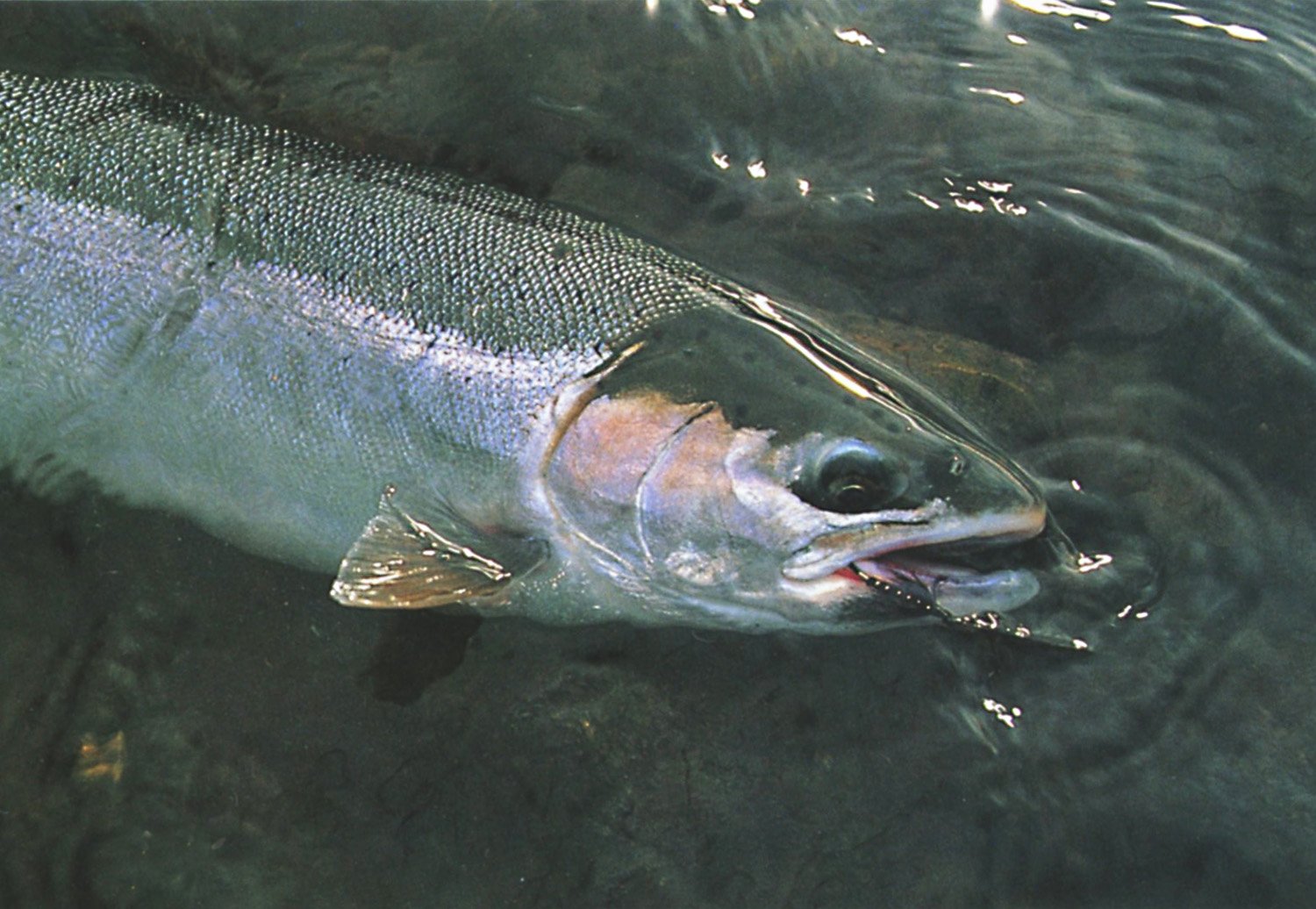
Deschutes River buck, six pounds, August
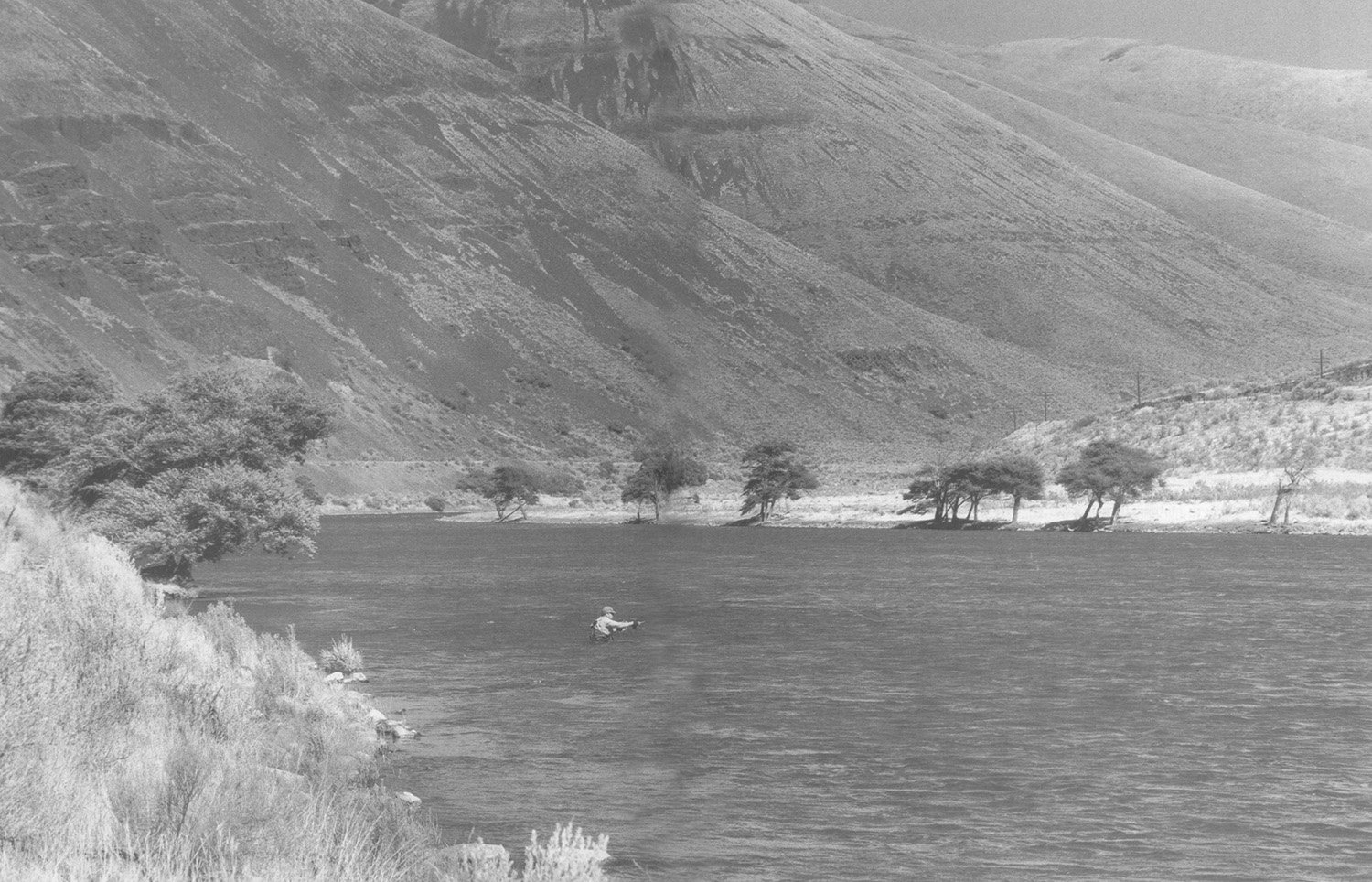
Frank Amato swings a fly through the great canyon waters of the Deschutes