Skykomish River
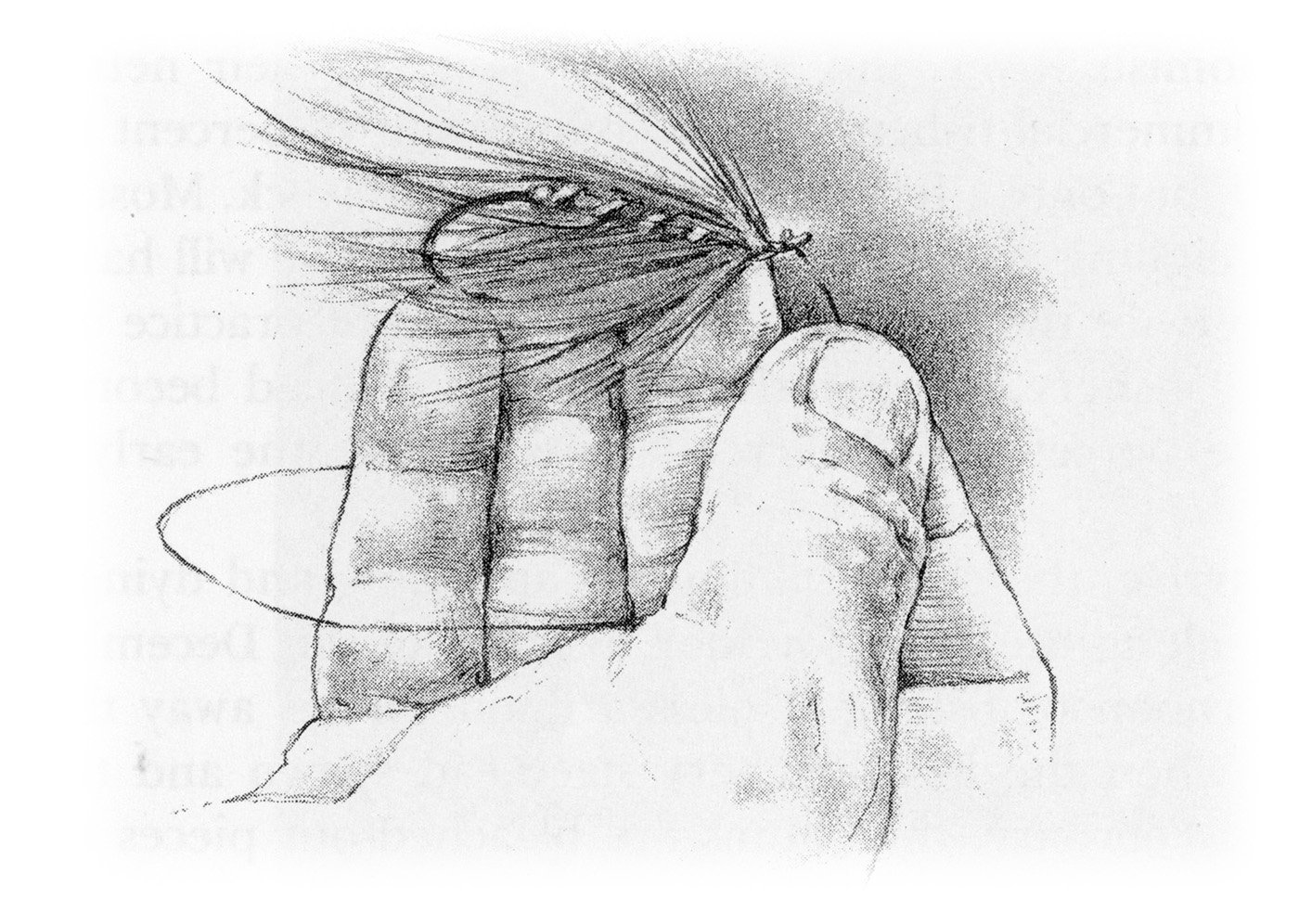
This is the complete chapter from Steelhead Fly Fishing, written by Trey Combs and originally published in 1991. Presented here in its original form.
If I could design and build a winter-steelhead fly-fishing river to suit my every fancy, I would use the eight miles of the Skykomish between Sultan and Monroe as a model. The braiding currents upriver are better left for summer steelhead and the floating line, while below flow the deep, featureless drifts so dear to gear fishermen. Between the two towns, however, is a succession of classic pools surely created for the long rod and fly. Their flats and tailouts hold shallow lies easily penetrated with sink tip lines. The footing along their edges remains so sure that presenting the fly and wading become pleasures that commingle between rises. Their steelhead are among the largest of all winter races, three-salt bucks known to have weighed more than twenty-five pounds, and yard-long hens that can run off a hundred yards of backing in a single burst. Some less-desirable traits help me appreciate these finer ones. Challenging lies invite especially long casts, while strong currents make deep wades tentative. Gear fishermen parade in drift boats, skillfully pulling plugs through the best fly drifts. Bitter winter weather dampens the keenest enthusiasm. When the river is in flood, steelhead hold in the trees, and during periods of drought they skulk about in pools too deep for my flies. I am never completely satisfied with my lot, yet on no other river can I fish a deeply sunk fly so well, a fact that always contributes to my satisfaction, whether or not I find a steelhead.
This Skykomish River that borders valley farms and the foothills of the Cascades is a small part of one great tributary of the Snohomish River. The Snoqualmie is the sister river, a wonderful winter river also, but with fly water less abundant, and the best of it less-storied.
Along the lower Snohomish River, the Tulalip Indians set their nets for the watershed's run of winter steelhead. This commercial fishery may account for fifty percent of the total harvest, as many as ten thousand steelhead, but only a few hundred will be wild stock. Most are December- and January-run hatchery steelhead weighing six or seven pounds. One in five will have spent an extra year at sea, sufficient time to grow to twice these weights. With the current practice of promoting hatchery stocks to sustain the commercial fishery, these early-returning steelhead become vitally important to sport fishermen. Less than five percent of the creel limits during the early season contain native-born steelhead.
As the first steelhead arrive, the chum salmon are spawning and dying. Their remains attract bald eagles, which congregate along the river corridor to feed, and in December one might count forty of the birds during an afternoon of fishing. Unless a flood carries away their food, the eagles remain through January, about when the first hatchery steelhead spawn and the first solid flush of native steelhead arrives. By mid-February, the chums are bleached-out pieces of cartilage shining up from the bottom of eddies, and the adult eagles have departed. The few remaining juveniles will leave shortly, most to scavenge along the coast where spring tides are exposing the rich bounty of intertidal shorelines.
During the earliest years of Washington's sport fishing, little was understood about steelhead, a steelhead "salmon" in the minds of most anglers, while "rainbow trout," the juvenile steelhead, populated every stream and were synonymous with the sport of fly fishing. Initially, winter steelhead seasons were not even set. Spring was the traditional opening of the trout season, and sometimes spawning steelhead, huge "rainbow trout," were found, first by chance but soon by design, with spoons and spinners, never by choice with flies. Our most esteemed taxonomists supported the misconceptions. In David Starr Jordan and Barton Warren Evermann's American Food and Game Fishes, anadromous steelhead trout and resident rainbow trout were listed as separate species, Salmo gairdneri and Salmo irideus. Based on this scientific knowledge, anglers were catching steelhead in winter and rainbow trout in spring. The Skykomish River became famous for producing record fish of both species.
A grain of truth did attend these perceptions, however. The Skykomish, like the Skagit and other large river systems in Washington, maintained small resident trout populations that lived in reproductive isolation. That is, the rainbow trout and the steelhead normally maintained separate genetic identities, one population never reproducing with the other. But as a practical matter, "rainbow trout" were steelhead parr and late spring smolts of six, seven, even eight inches, and a skilled wet fly angler could be expected to take his daily limit of fifty with satisfying regularity.
No history identifies the first Skykomish River angler to take a winter steelhead on a fly. The event was almost certainly an accident, like being hit by a bolt of lightning, and did not reflect the angler's genius for harnessing raw energy for his recreation. A handful of anglers, however, gave such colorful definition to the sport that finding a steelhead with a fly on a certain river became a tradition eternally bound up in their experiences. Examples of this heritage would include Jim Pray and the Eel, Bill Schaadt and the Russian, Zane Grey and the Rogue, Clarence Gordon and the North Umpqua, General Noel Money and the Stamp, and Roderick Haig-Brown at "Above Tide" on the Campbell.
To this group of associations must be added Ken McLeod and the Skykomish River. The man was a giant in our sport, often remembered as the main character in steelhead fly fishing's most romantic tale. Ken and his son, George, were driving east to the Skykomish River one January morning in 1936. The sun was coming up over the snowcapped Cascades, a splendor of red, yellow, and white. "Tie me a fly with those colors in it," Ken told his son. That evening, George used red tying thread to secure a mix of red and yellow hackle, a red wool body, and a white polar bear wing. The completed fly was named the Skykomish Sunrise. George christened the pattern with three winter steelhead from a single pool near Monroe. The day included a seventeen-pounder. The new fly became a sensation.
I knew about the Skykomish Sunrise even before I knew about the river, and many years before I actually fished there. I am certain it is the best known steelhead fly wrought from this area, so much so that it is often used as a logo for the sport, very much analogous to the Royal Coachman and trout fishing.
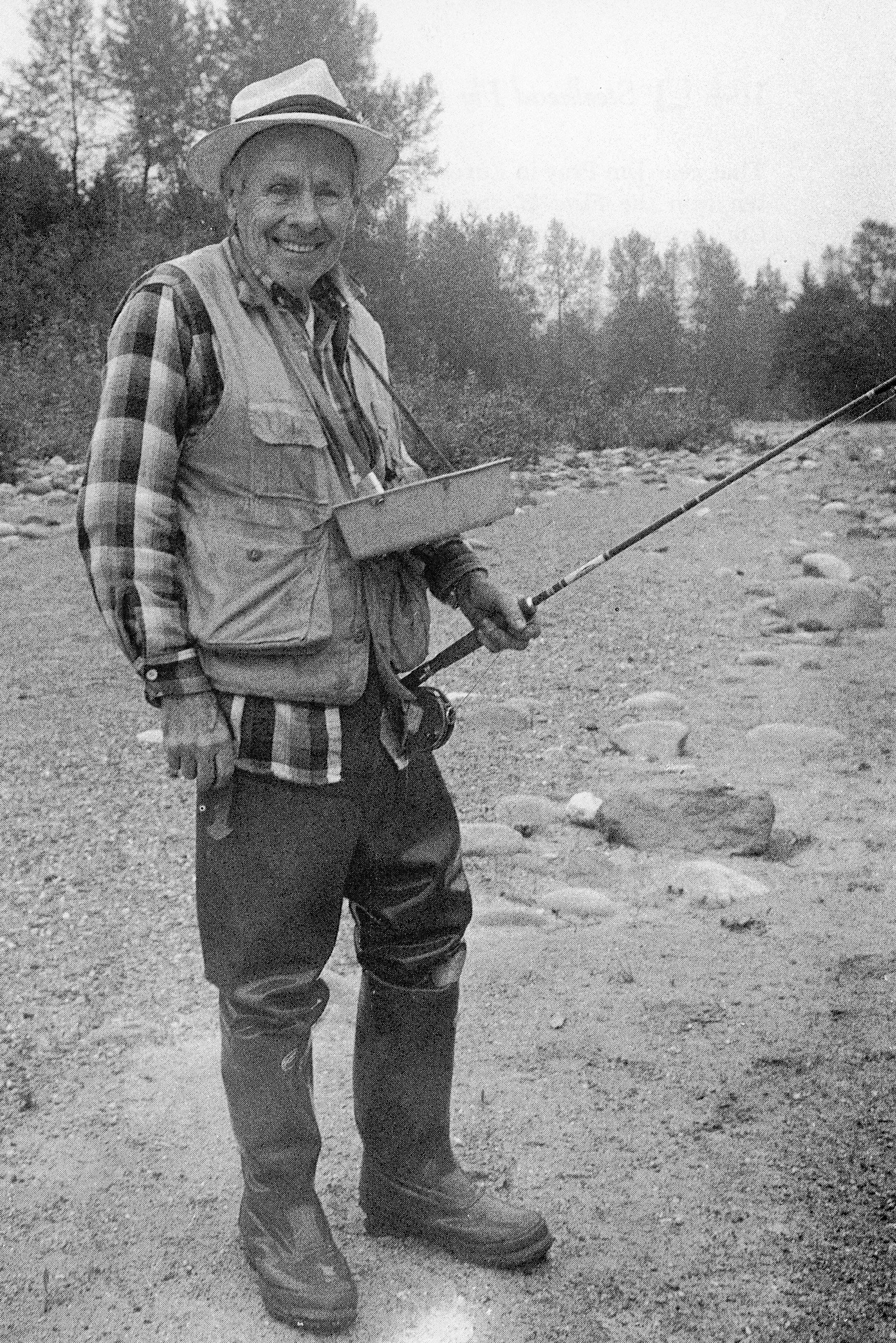
Ken McLeod on the Skykomish River. Photo Credit: Bob Arnold
The story of the Skykomish Sunrise was first told to me without dates, and this was the story I repeated to friends. Soon fact became legend, a little tale out of historical context but comforting in its charming simplicity. A half-century later, the original Sunrise remains the consummate winter fly, and continues to inspire anglers to new flights of aesthetic fancy. I tie the original with fluorescent floss and marabou, add a few strands of Krystal Flash, and still believe in its magic.
To fully appreciate the McLeod collaboration, it should be noted that in 1936, fly fishing for summer-run steelhead in Washington was in its infancy, and almost no one was fly fishing for winter fish. That year JimPray in Eureka, California, tied a fly for Walter Thoresen, calling it "Thor" when Thoresen won the Field & Stream fishing contest with an eighteen-pound Eel River steelhead caught on Christmas Day. The steelhead was remembered as much for its great size as for the time of year it was caught, the longest December of low water and benign weather anyone could remember. When Claude Krieder wrote Steelhead, a fly-fishing classic, he included a chapter called "Winter-Steelhead Tackle and Methods," a detailed account of bait-casting rods, casting reels, and salmon roe. This was his tackle of choice when he fished the Eel in winter. He does not mention fly fishing for winter steelhead anywhere in the book, regardless of the river. The same must be said of Clark C. Van Fleet's Steelhead to a Fly. When Roderick Haig-Brown wrote the original two-volume The Western Angler in 1939, he commented upon how difficult it was to take a winter steelhead on a fly. When the book was revised and published as a single-volume edition in 1947, his opinion had changed: "During the winter of 1938-39 I began to use the fly at least as frequently as the minnow and found myself doing not too badly with it. Since then I have used the fly exclusively and, as nearly as I can judge, its effectiveness is at least seventy percent that of the minnow." (Note: "Minnow" is a Devon minnow, a lure popular in England for Atlantic salmon.)
The story of the Skykomish Sunrise shows that Ken McLeod and his son George were already taking winter steelhead on flies in 1936. As far back as the mid-1920s, Ken was fly fishing with a stripping basket in order to achieve the long distances sometimes necessary to attract steelhead. He soaked braided line in melted paraffin and wiped off the excess before laying it out to dry. The result was a stiff running line that permitted long friction-free casts from his stripping basket. Of course, a running line so fine meant that some sort of radical forward taper, a shooting head, was being cast. Ken McLeod used such lines to cast wet flies and to make long drag-free floats with dry flies.
This Washington native was the outdoor editor for the Seattle Post-Intelligencer from 1930 to 1950, and a founding member of both the Washington Fly Fishing Club and the Steelhead Trout Club. He assisted in the writing of salmon legislation, helped to negotiate the United States/Canada treaty for the allocation of Fraser River sockeye stocks, and for half a century joined numerous preservation efforts on behalf of steelhead. In 1983, he was commended by the Washington State Legislature for his many contributions to the state's salmon and steelhead resources.
During the early 1950s, Ken and George assisted in the development of the original Wet Cel lines with Leon Martuch of Scientific Anglers. While fishing these lines, they placed steelhead in the annual Field & Stream fishing contest. For seven years, George held the unofficial world record for the fly, a Kispiox buck of twenty-nine pounds, two ounces caught on October 6, 1955. The fly he fished was the Skykomish Sunrise.
Until Ken McLeod's death in 1989 at age eighty-nine, he and George fished for steelhead each summer below their cabin on the North Fork of the Stillaguamish. I'm told by his friends that it was here, nearly a half-century ago, that he first cast his Purple Peril, sometimes adding extra deer hair to the wing and fishing it as a waking dry. He leaves a remarkable legacy.
March
Winter fly fishermen know in their bones that spring begins on the first day of March. The Skykomish goes to catch-and-release, an opening day for many of these anglers, and the end of the season for others, who will not bother to fish solely for the pleasure of it. Regardless of how one fishes, it is impossible not to take satisfaction in the reduced river traffic. The "new season" is two months long, spring days that alternate between winter and summer but begin with the certainty that the river is wrung dry of hatchery steelhead. Fishermen now search for fewer steelhead, but they are wild winter-run fish possessing such beauty and strength that annual vacations are devoted to finding them with a fly.
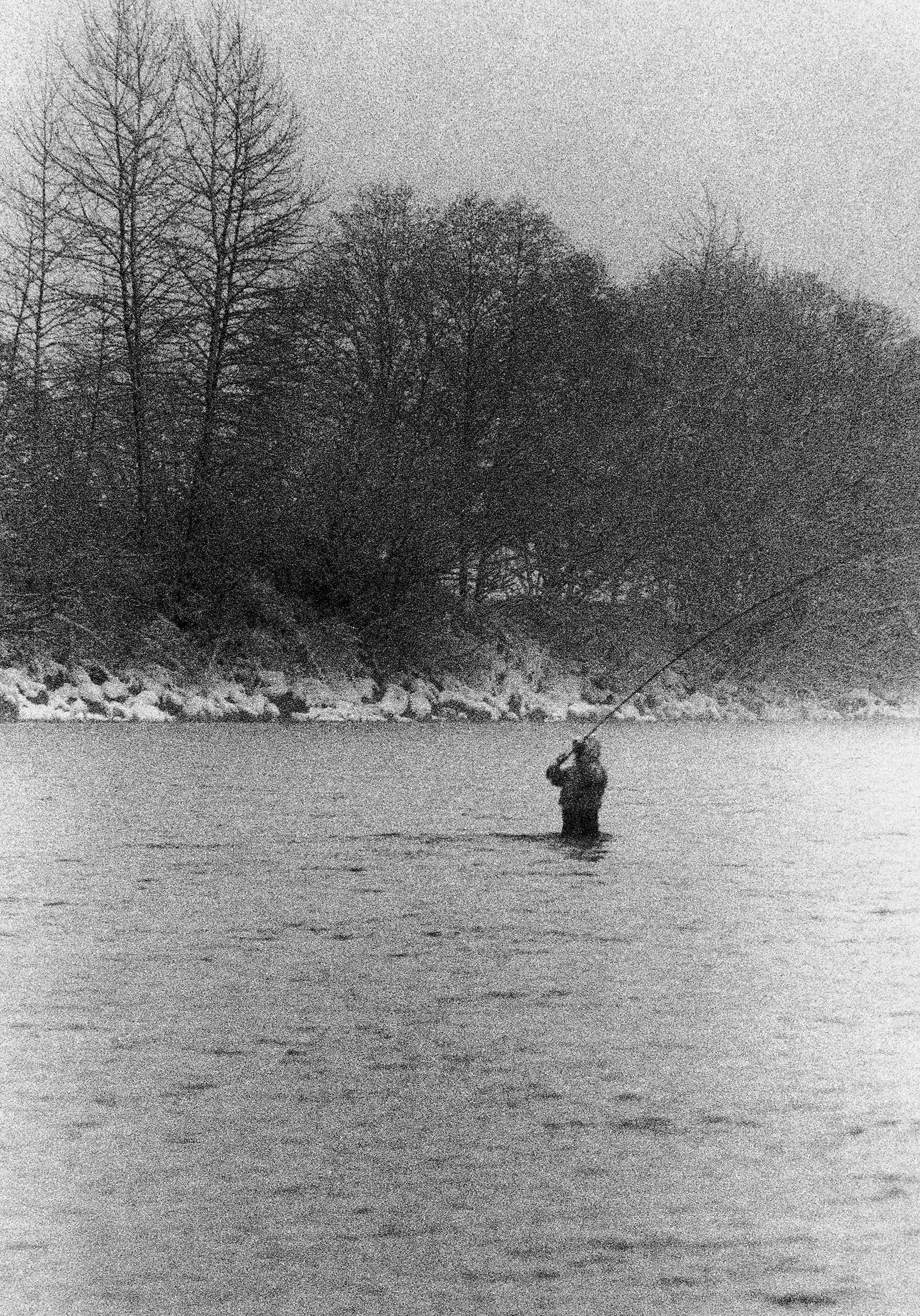
Opening of the catch and release season, March 1, 1989.
On the first day of March 1989, snow began to fall before first light, and by midmorning the storm had built to a full-blown blizzard. During the time it took me to swim a fly through a single broad swing, my spey rod grew a peak of snow along its entire length. Surface currents became slush. When my thermometer read thirty-two degrees, a foot of snow ran to the water's edge. No fish were moved, none were expected, and no practical reason for fishing remained, except that the river was a continuous shiver of excitement in its new surroundings. As I worked down the long pool, a line from Robert Service's The Cremation of Sam McGee kept me company. "There wasn't a breath in that land of death," I whispered, and was startled witless when the gravel bar at my feet exploded into twenty killdeer, their flight a din of mournful calls that I could still hear long after they had disappeared into the snowfall. "You must think you migrated in the wrong direction!" I called after them. They signaled spring. This snow, the heaviest in thirty years, wouldn't last.
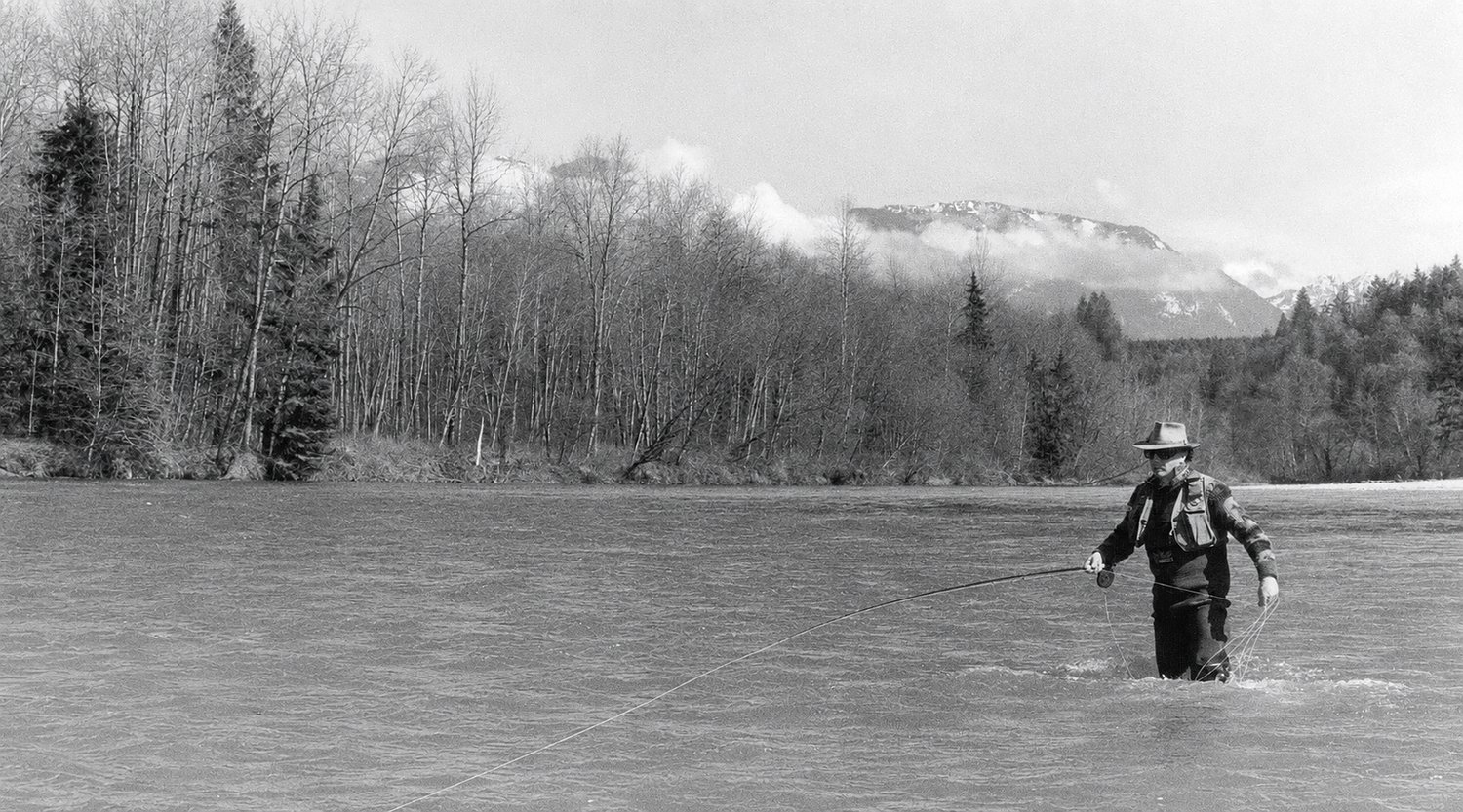
Russ Miller at the top of Two Bit.
One year later, the temperature reached almost seventy degrees, and I was shedding garments all afternoon. The river was low, clear, and ideal for fly fishing, except the steelhead were nowhere to be found. March browns were coming off the river in spiraling updrafts that four species of newly arrived swallows swept through, an aerial steeplechase that entertained me for hours. Far above their activity, swifts twinkled against the blue sky. I have seen these species drawn together many times while I was anchored in one pool or another, and I can now tell the swallows apart-the barn, violet-green, rough-winged, and the tree, by the rate of their wing beats and the adroitness of their movements. (Once, on Oregon's Molalla River, cliff swallows joined this group.) I am not an expert at such things, but one sees a lot and learns a good deal when quietly standing on the seam of two universes. On this day larger mayflies were about, grey drakes, I thought, and a scattering of small stoneflies. (The huge Pteronarcys stoneflies of "salmon fly" fame are uncommon on the Skykomish and do not hatch until early May.) The surface currents were now forty degrees, not yet warm enough to lift the parr out of their dormancy to chase after the struggling emergers or peck at my big spey flies swimming toward the beach. Late in the afternoon, I felt my first pull of the new season. "God, a steelhead!" I said
A pull is the bittersweet signal that somewhere among the currents there is life, certainly a steelhead, never a parr or a Dolly Varden or a sucker. The pull can be as simple as a pluck, as strong as a hard yank, and it may even have weight to it. It is not a hookup, however, and the whole affair is usually over in an instant. If this occurs after several fishless, pull-less days, the initial reaction is stunned disbelief, followed by disgust, evaluation, recrimination, more evaluation, and then, blissfully, the rationale that the fly and the presentation were right.
Fireman's, Thunderbird, IRS, Two-Bit, Taylor's Flat, Ben Howard, and Buck Island name the better-known waters downriver from Sultan that stitch together a full-day float for gear fishermen who cast lures, fish roe, or pull plugs. Each of these pools and most of the connecting water are systematically and thoroughly searched. No water is too shallow or too deep or too wide. The totality of the approach is not unlike the summer fly fisherman searching acres of surface currents with a floating line for a steelhead. Admittedly, in winter the lure is pretty much taken to the steelhead, and in summer the steelhead move to the lure, but the ability to cover a lot of the river is an ingredient common to both.
Winter fly fishing bears little resemblance to either approach. Most parts of the river are simply not productive for the fly. The angler floating in a boat to the few pools that fish well with a fly will spend the greater part of the day rowing past steelhead that are either on their upriver journey or are parked in lies beyond the capability of the fastest sinking lines. A better method is what Bob Arnold calls "spot fishing," and what I call the single-pool approach. In either case, it involves finding a pool that is known to hold steelhead, one that can be covered properly with a fly, ideally from bank to bank, and then fishing the water again and again until its lies are understood for water level, clarity, and time of day. As the angler learns the geography of the unseen bottom, he will understand what length and sink rate is required of his sink-tip line, and the pool will be fished more and more effectively. I believe that if only a single pool is known this well, but fished hard for the hours of first and last light, the opportunity for hooking a steelhead is considerably greater than if one is taking a day-long float and fishing hard the entire day. If several such pools are known, and can be reached by car, the chances for success are even greater, for the angler will be fishing in prime water almost constantly.
An eight-mile float on the Skykomish by anglers pulling plugs is a very, very long day. This same eight-mile float by fly fishermen is a delight, and fortunately filled with all kinds of recreational value only marginally related to getting a steelhead on the beach.
Floating a river by raft or McKenzie boat can give fly fishermen access to water they could reach in no other way. Some of the finest winter anglers I know-Harry Lemire and Jimmy Hunnicutt, for example--carry one-man rafts ("two-man" rafts in a pinch) solely to reach specific pieces of water. When that water has been fished, the raft is either broken down or thrown on top of their car, and they drive to a new piece of water. To save time, they use electric pumps that operate off the car battery.
I like a two-handed rod for this winter fishing, more so each year, and during the 1990 season I did not cast a single-hand rod even once through two months of almost constant fishing-March and April. Command of the water is the primary reason, but reduced fatigue becomes an increasingly important secondary consideration.
Les Johnson opened the season with me. He likes his Steelhead Bunnies, and normally he fishes them to the exclusion of all other patterns right through the spring months. When neither of us could find a steelhead at the top end of Two Bit (twenty-five cents is charged by the kind farmer for access to the pool), Les changed to a dark summer dressing as we started down into the soft gut of the run. He cast below me, and I told him that he was almost to where I had hooked an eleven-pound buck that could have just come over the tidal bar.
"The steelhead took directly below you!" I called. "The fly will barely complete its swing without sinking to the bottom. Don't be too anxious to strip it back." His cast was right, and the fly dead below him when the steelhead took. This is always the most difficult angle at which to securely hook a steelhead. No swing is left, and no angle is left to bring the fly naturally to one side of the mouth. Dropping a short loop can be helpful, because it gives the fish a few seconds of slack. If the steelhead does not immediately turn-and lethargic bucks often do not-the fly is at the end of its mouth. Tightening on the fly will often simply pull the fly free.
Les's steelhead had his rod bent to the cork. Just as I was sure the hold was secure, the fish was free, a loss that set our course for the days ahead. We found steelhead, and they found ways to avoid an in-the-hand release. I ran off a string of six or seven before I was able to lead one to quiet water. The frustration included a large buck hooked one Sunday evening at the bottom end of the Ben Howard Pool.
Jimmy Hunnicutt tells me that once these spring-run steelhead are driven from their shallow lies, they are not nearly so responsive to the fly. He wants to find virgin water at first light. Failing that advantage, Jimmy searches lies he suspects have not been fished for several hours. When we're together he sometimes must wave me back from standing in the very lies we are fishing. I know better, for I have hooked winter fish that were holding in little more than a foot of water, but like most anglers, I expect to wade at least to my knees when I'm fishing. Jimmy has convinced me of the importance of these very shallow lies, and now I often fish first-light water twice, once through with a shallow running tip, a twelve-foot III for fish nearly on the beach, and again with a deeper running tip, a fifteen-foot IV. Naturally, the amount of back-mend sets the running depth for either of these lines. On especially thin, slow-moving water, a floating line is useful, and I carry floating tips, too, but I rarely use them, preferring to fish the slow-sinking tips. I use this two-tip approach even if a friend is leading through first, for I do not want to risk disturbing the water by fouling the bottom or wading too deep and moving fish off that he may have missed. Jimmy and I will fish through the lie in the same manner. If I wish to give the fish a choice, I choose a fly pattern different from his, a bright fly playing to his dark fly, for example.