Golden Demon: The Origin of Steelhead Demon Flies
Golden Demon: The Origin of Steelhead Demon Flies
It should be pointed out that the name “demon” as it now applies to steelhead flies is a terminology habit peculiarly our own—and one that begins with the Golden Demon. The term’s origin, however, resembles nothing we would associate with steelhead demons. Demons and “terrors” are English and Scottish tandem-hook patterns held in particular favor for sea-trout. Their principal ingredients are a long streamer-length wing and two or three heavily tinseled hooks connected with monofilament or wire.
The Golden Demon resulted from mixing and modifying New Zealand’s British patterns. Whether it once had a tandem-hook arrangement I can’t say, but it almost certainly did have a brown mallard or like material wing and orange hackle.
The Golden Demon might have remained unknown to American anglers were it not for an internationally famous writer-angler popular with generations of school boys. Zane Grey searched the world over for his fishing and chronicled the great and small, exotic and mundane in a series of volumes, Tales of…
New Zealand’s trout fit the first category for they had, by the 1920s, captivated the imagination of anglers everywhere. Grey traveled to New Zealand in the early 1930s (probably 1933) and enjoyed such success with the Golden Demon he brought the pattern back to introduce it on his favorite American fresh water gamefish, the steelhead, and did so on his favorite domestic river, the Rogue.
Many other steelhead demons have occurred since. Two of the best were developed by C. Jim Pray, a renowned Eureka, California, fly tier during the 1930s. He introduced the Silver Demon in 1935 and said that it “outsold the Golden Demon in my shop 1,300 to 200.” Yet today the original remains the more popular. The Black Demon followed and, according to Pray, “was much favored in the Orleans district of the Klamath (River).”
The Golden Demon
Grey has long been associated with the Golden Demon, a fly with a brown wing over bright orange hackle. This was a sea trout Demon that made it way to New Zealand, a British Crown Colony. Kiwis modified the dressing to a smaller, single-hook fly for their thriving trout, browns from Scotland and rainbows from California’s Baird Hatchery on the McCloud River. Grey allegedly brought the fly back with him to be fished for North Umpqua steelhead. Save for that dressing, no other Zane Grey fly has been passed down to us."
Dressing Notes: Golden Demon (old English pattern):
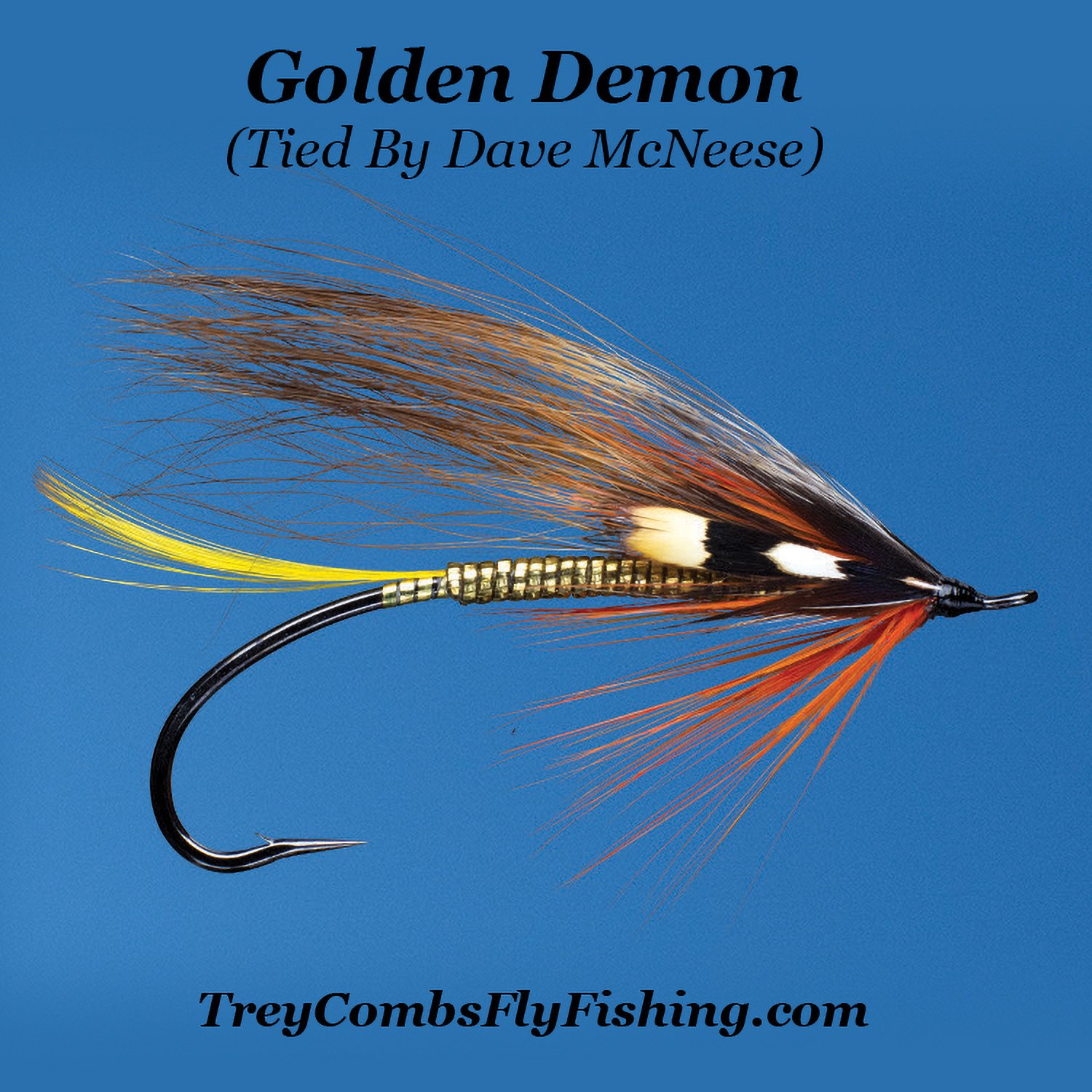
Tag: Fine flat gold tinsel. Body: Medium oval gold tinsel. Hackle: Hot orange. Wing: Dyed fiery brown polar bear or brown bear or brown bucktail. Note: When white bucktails are dyed, the natural fine brown fur takes on this dye as well. A bucktail dyed hot orange changes the brown fur to an altogether new color, a hot orange-brown color. Obviously, the same can be said for yellow and red, and especially the darker steelhead colors: black, blue and purple. The fur is generally shorter and fine and much more useful for tying steelhead flies. Cheeks: Jungle cock. Head: Black.
The fly pictured for this blog entry, comes from the vise of Dave McNeese and was featured in Flies For Atlantic Salmon & Steelhead
Sources: Trey Combs, Steelhead Fly Fishing and Flies (1976); Trey Combs, Flies for Atlantic Salmon & Steelhead (2023).
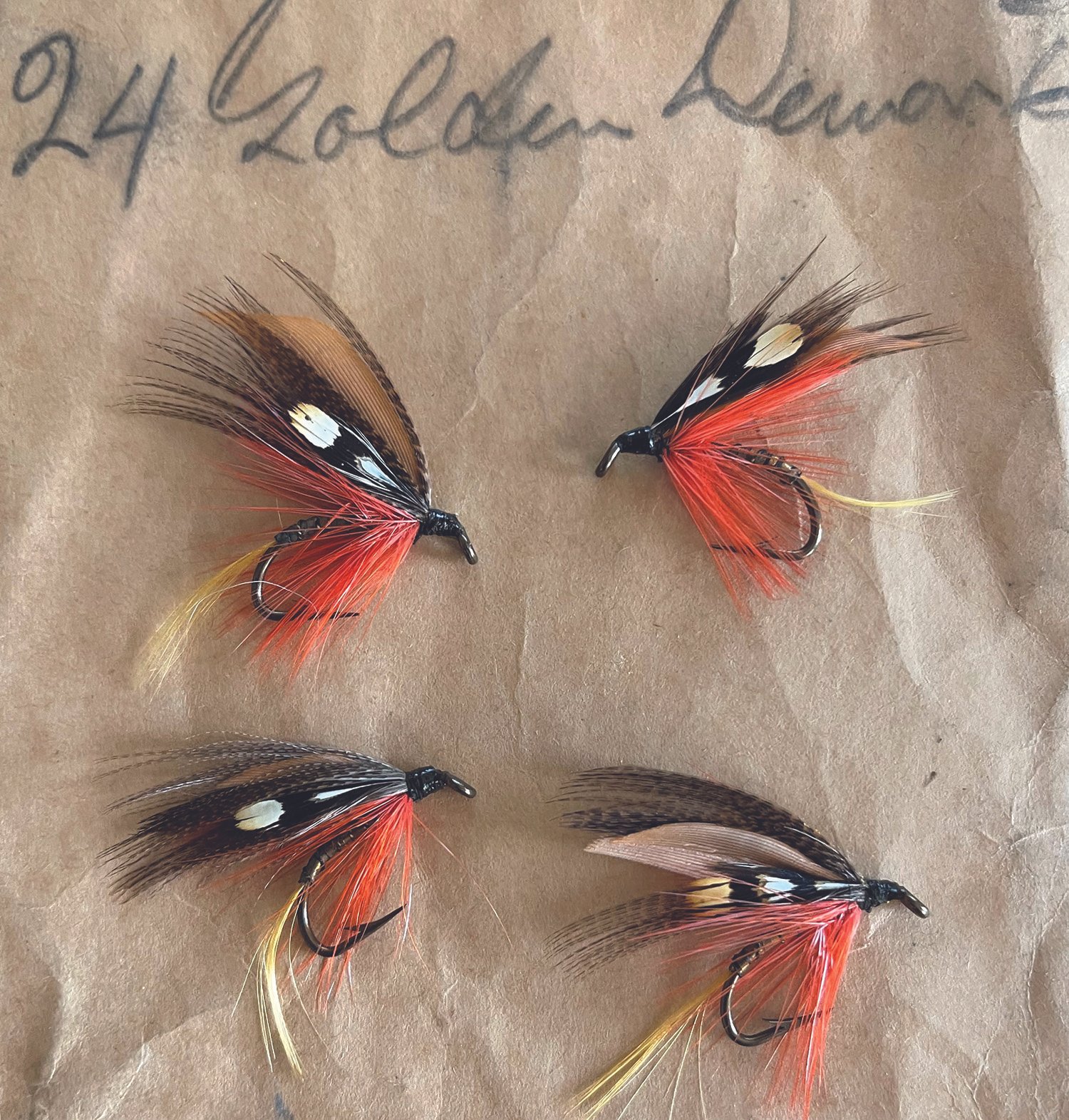
The original Golden Demon tied with bronze mallard-flank wings and a gold tinsel body was an English sea trout fly that made its way to the trout streams and lakes of New Zealand. Grey and his fishing partner Fred Burnham brought the Demon back to America and introduced it to Rogue River steelhead.