Hakan Norling’s Temple Dog
The following excerpt is from Chapter 10 of Flies For Atlantic Salmon & Steelhead by Trey Combs. In this section, Trey discusses Håkan Norling’s Temple Dog, one of the defining Scandinavian salmon flies of the modern era.
Håkan Norling - His Temple Dog Was A Seismic Shift In Fly Design
Håkan Norling tied the first Temple Dog pattern in 1985. He and Mikael Frödin, his close friend and fishing buddy, were preparing to make their annual fall trip to Sweden’s Em River, a much-anticipated break from their day jobs as guides on Norway’s legendary salmon rivers, particularly the Gaula.
Håkan said that he and Mikael and Roland Holmberg, his mutual friends, were “the original ghillie boys from Storen.” They’ve remained fast friends for more than 30 years and still try to get together annually to guide on the Gaula’s Gaulfossen.
The small Norwegian village of Storen is sited at the confluence of the Gaula and Sokna rivers to form the Storen headland. The River Em, and the neighboring Morrum, are not just Sweden’s finest Baltic salmon rivers, but among the best half-dozen salmon rivers in the world, and one of the few waters where salmon returned averaging in excess of 20 pounds.
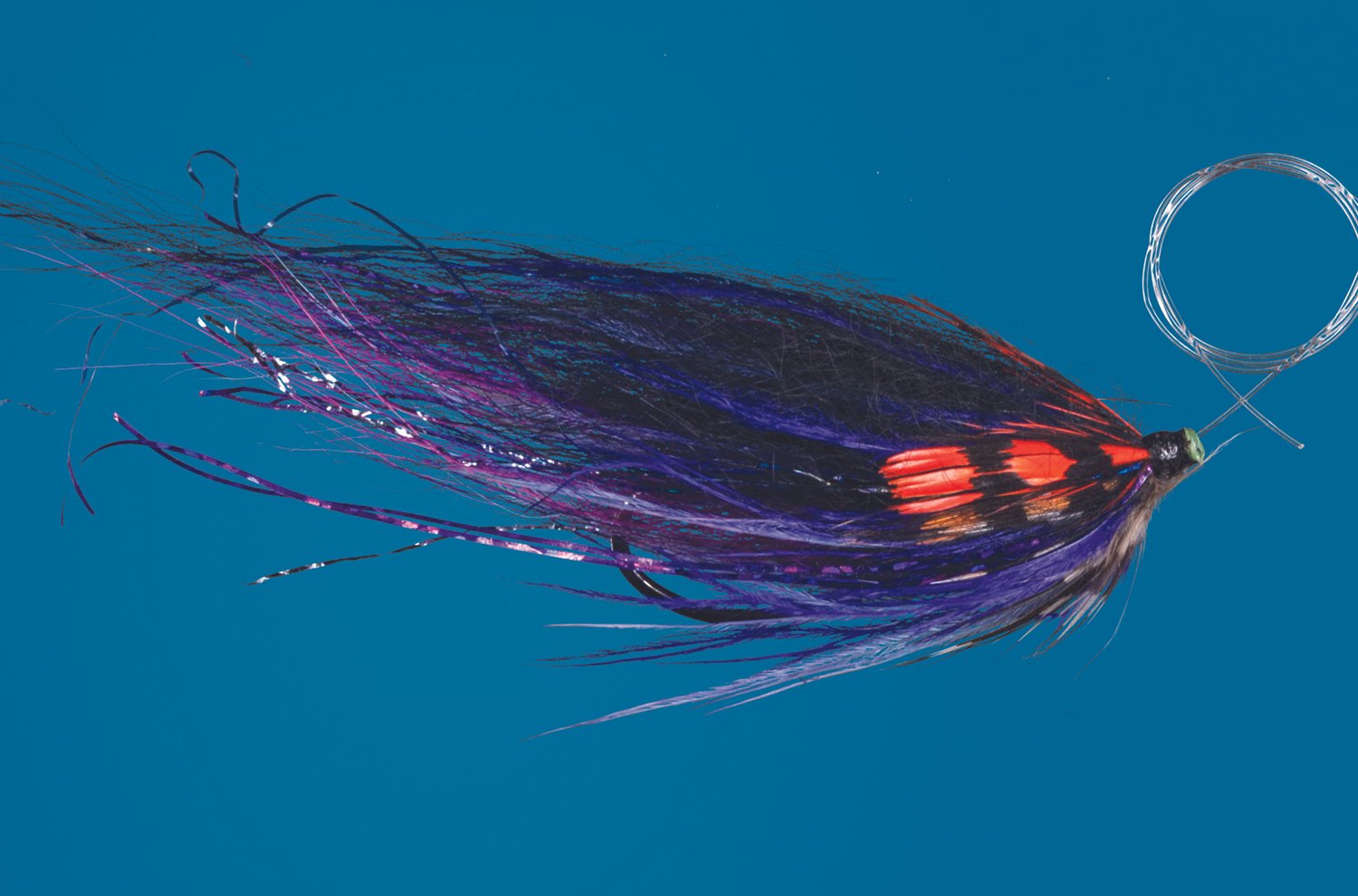
Viewed in retrospect, Norling’s Temple Dog was a seismic shift in how the fishing world looked at salmon flies. The wing has a teardrop silhouette and is tied in different sections to build volume and movement, without using a lot of material. The length of the tube is usually kept shorter than the wing if fished with a fixed hook.
During the 35 years that followed, the design and overall look of Håkan’s Temple Dog patterns and Mikael Frödin’s flies have become the template for Scandinavian salmon flies—a shape many would adopt and personalize with salmon colors that define their own sense of artistry and fishing success. The result has been an almost endless number of these flies, and Norling deservedly came to be known as “Mr. Temple Dog.”
The true genius of Håkan’s Temple Dog involves the pragmatic details in the wing’s construction. “Wing building” became an arcane science, with many strategies developed to achieve a natural, free-flowing wing.
The Genius Is in the Wing
First—and critically—Håkan ties the wing using three to four sections with the tips facing forward. The wing butts are left in place and not clipped short. The wing section is split and divided with the tying thread and brought backward; the other half section of the wing is also folded backward and tied down. Next, the formed head is covered with a couple of turns of hackle. Another wing section is tied in front of the hackle in the same way, slightly longer than the first wing. These steps are repeated until the wing is finished with a small and neat head. This is particularly important if ending with some sort of cone.
Wings are usually constructed in several colors, the approach accommodating different types of materials. One wing isn’t stacked directly on top of the wing below it, but slightly forward of the previous wing’s butts. The wing butts provide extra bulk at the base of the wing and help to create a “fat back” of the wing.
Sometimes bronze peacock herls dyed orange—its natural flash—are added for the back. Besides giving Norling the desired wing shape, the double tie-down makes it nearly impossible for the wing to pull out.
There are other strategies to augment Norling’s basic approach for tying in a long, graceful wing set off from the body. A short underwing of stiff hair tied in backward works well to lift a long wing away from the body and the hook. I prefer to put a clump of stiff fur—Scott Howell’s Steelycoon is perfect—in a dubbing loop and tie this in first. The fur, trimmed to length at the butt end before spinning, should be nearly hidden in the finished fly. Still another approach involves tying the top wing especially long, somewhat on the order of the Sunray Shadow.
Only half in jest, Norling said to me, “The Temple Dogs have probably been a more serious threat to the salmon—and have taken more fish over the years—than drift nets.”
Norling and Frödin, two of the famous young guns that included Roland Holmberg, were Swedish “salmon bums” who guided annually on Norway’s Gaula River. They fit the profile typically found in American kids who so had fishing on the brain that only ancillary activities could make up for their longings to be on a river.
This involved guiding, working in a fly shop, and tying flies commercially if supporting themselves was an issue—and then doing anything remotely fishy and outdoors. Many startup legends did all three at once; Frödin, Holmberg, and Norling certainly qualify.
Håkan recalls:
I tied the first original Temple Dog fly in 1985. I was looking for some long goat hair to make an order of Sunray Shadows and contacted Margrete Thompsen—a Swedish original master fly tier. Margrete told me she had no goat hair in stock, but she had something else that could be useful to me. She called it Tibetan jackal dog.
The hair arrived and to me it looked like crap—too short for the Sunrays. Anyway, I dyed some of the hair black and dark brown and tied the first Original Temple Dog just before my friend Michael Frödin and I went on our annual autumn trip to the River Em in Sweden. I will never forget the sight of the fly in the water. It looked like it was about to swim away with my leader! The wing and the fly had so much life, moving in a way I had never seen with any other hair we were using at that time.
The name Temple Dog itself is just something a friend of mine said when he saw a piece of hair I gave to him. To me, Temple Dog sounded like a cool name for a fly and has nothing to do with any specific breed of dog. The fur I have used has come from hides that were used by the fur trade for making fur coats in the 1970s and ’80s.
The Norwegians and the Finns had selectively bred Arctic fox on a large commercial scale for many years for the fur trade. These enormous and weird sausage-shaped animals look nothing like wild Arctic foxes. But their supersized tail fur is perfect for fly tying. First the fox tails were available only in natural gray and white. Håkan custom-dyed the colors he needed for his patterns.
The first seven Temple Dog patterns were based on classic salmon patterns with proven color combinations such as the Green Highlander, Red Sandy, Black Doctor, Silver Gray, and Dunkeld. After all, these patterns have taken fish around the globe for more than a century.
Black and Purple Temple Dog (Pictured)
Wing: Mixed magenta, purple, black fox SSS Angel Hair: Strands of Clearwater Blue, Magma Yellow. Flash: Holographic Purple Haze. Hackles: Mixed light blue and purple ostrich hackles with natural guinea fowl in front. Cheeks: Dyed-orange jungle cock or substitute. Head: Black. Håkan’s note: I call these kinds of patterns “Half-Inchers.” This fly has no body—just a tube, wing and hackles. Tie all material in front of the tungsten tube and fish it with a free-swinging hook. Cut a small piece of tubing and put it over the hook eye to make the hook go straight behind the fly.
The Digital Version: Perfect for the Fly Bench
The full chapter explores how the Temple Dog changed modern salmon flies, why Norling’s wing-building method became one of the defining innovations in Scandinavian fly tying, and provides detailed tying instructions for building the fly’s distinctive free-flowing wing. Flies For Atlantic Salmon & Steelhead is a large, oversized coffee-table-style book with a $150 retail price and a very limited print run. It is now also available as a $24.99 digital print-replica edition—perfect for the tying bench, with the ability to zoom in on fly images and study details that are difficult to see in the printed book.
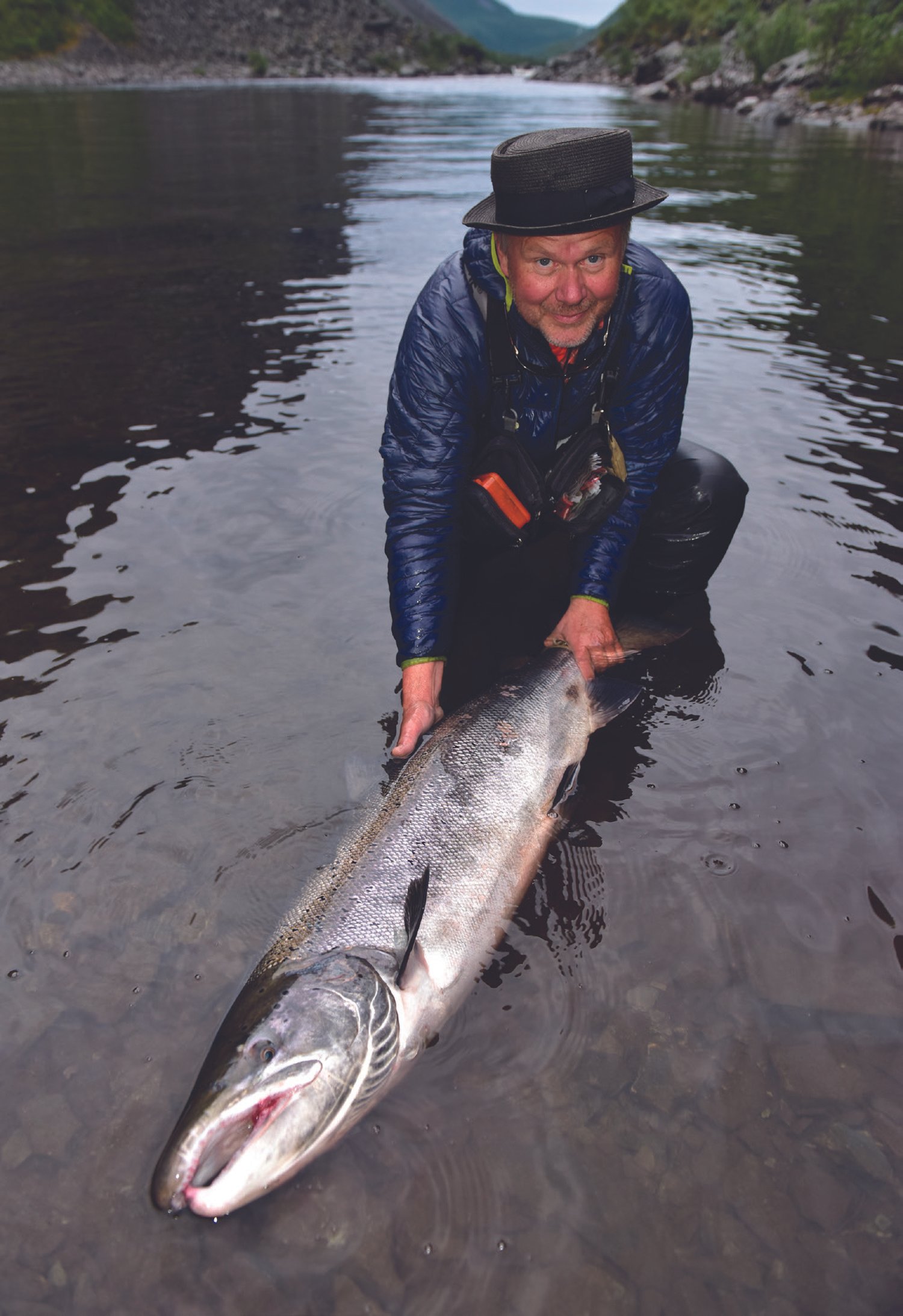
After an epic battle, Norling landed this 128-centimeter (50-inch) male salmon estimated to weigh around 25 kilograms or 55 pounds.