Thompson River Steelhead — The Ocean Migration (Pt. 3)
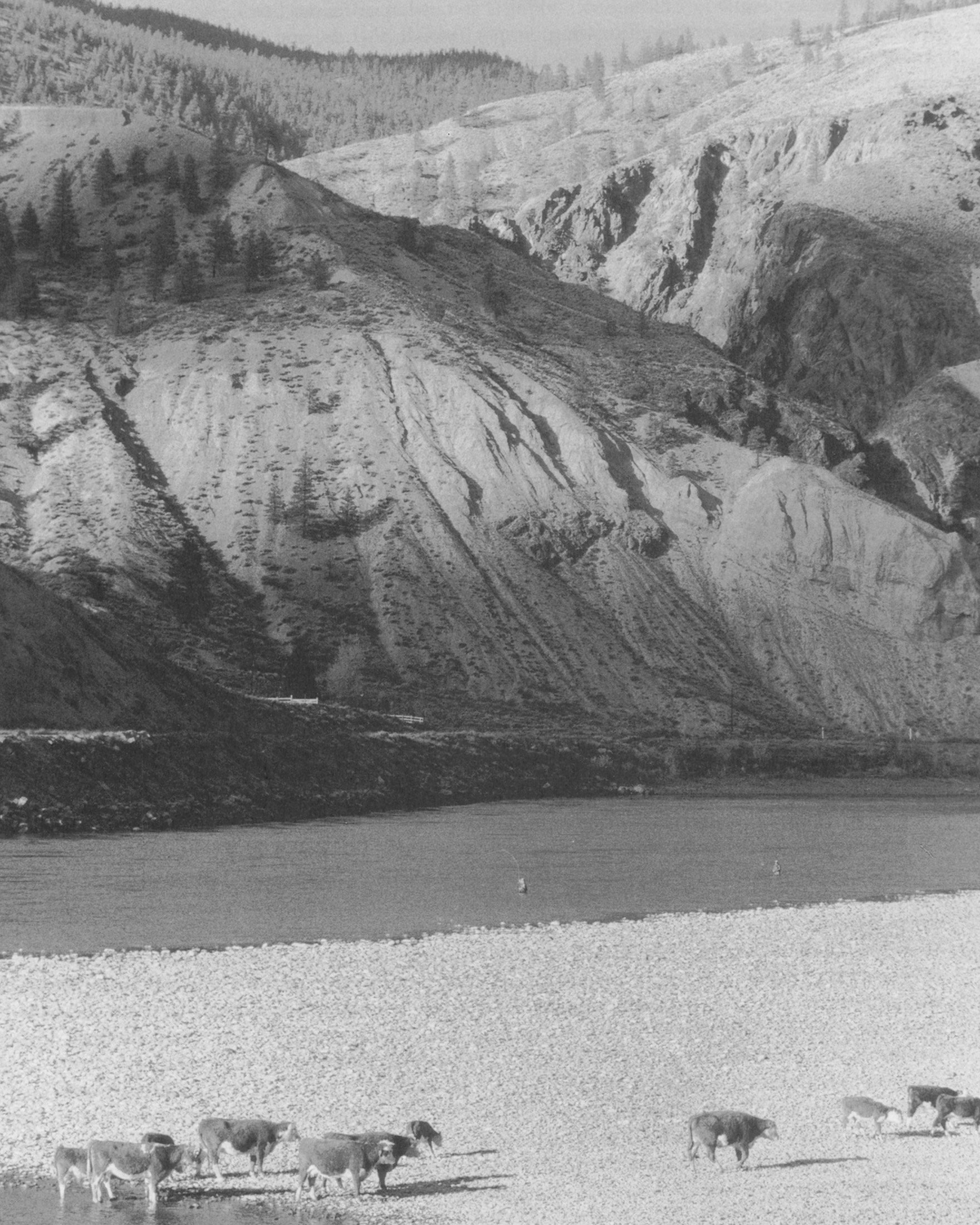
Graveyard Pool on British Columbia’s Thompson River. Photograph from Steelhead Fly Fishing (1991) by Trey Combs.
Part 3 – The Ocean Migration
I began teaching public school in Port Townsend, Washington nearly 60 years ago. The administration expected that male teachers would seek part-time jobs to boost paltry salaries. Among the male teachers, this often involved commercial fishing. That was a big business locally. We wintered a lot of migrant kids whose parents fished in Alaska during the summer and worked on their hauled-out wooden boats for much of the school year.
At its most basic, a commercial license permitted a person to take a salmon caught trolling and make a few bucks by legally selling it. But a few teachers had invested in their own gillnet boats, “bow-pickers,” with the nylon mesh net rolling from a huge reel bolted at the bow of the boat. Their season peaked financially in late summer during the huge run of sockeye salmon. These were Canadian Fraser River stocks, but by agreement each country could harvest an equal part of the run as the commercial harvest took place in their respective territorial waters.
This mutual harvest was only possible because of the way sockeye and other salmon made their way from their high seas migratory routes to a spawning migration that led to the Fraser and its many tributaries, including the Thompson River.
Salmon and steelhead stocks migrated to southwest British Columbia’s rivers by using two dramatically different routes. The first leaves the ocean and enters the Queen Charlotte Strait, moves south through Johnstone Strait, and then the Strait of Georgia, the straits forming the long passage between Vancouver Island and mainland British Columbia. The second route has steelhead and salmon following the west coast of Vancouver Island and entering the Juan de Fuca Strait, the water between Washington and the southern end of Vancouver Island.
If using this route across Washington’s north coast, sockeye will navigate their way through Washington’s San Juans, emerald islands and paradise for its residents who commute to Puget Sound cities by ferry. The sockeye fishermen set their nets off the many shorelines, with the salmon naturally concentrating as they pass between the islands and then continuing north until reaching the Fraser’s great delta waters.
One fall while cruising the San Juans in my sailboat, Shearwater, I dropped my sails and drifted along with the tide between Lopez and San Juan islands as extended family pods of American and Canadian killer whales—the stunning orcas that key on salmon—joined forces and gorged on the sockeye. The feeding melee, marked by dramatic leaps, was a mile long and must have involved at least 25 whales. I could only imagine the number of sockeye filling the passage as they bee-lined their way north toward the Fraser.
One of the gillnetters was a teacher who taught in my school. When he fished all night he’d show up the next morning a little wobbly, but a lot richer, too. I recall one day when he came to work and smugly told me that the previous night he’d caught a 25-pound steelhead. “We call those fish Canadian turkeys,” he said, referencing Thanksgiving still almost three months away.
Given the time of the year, only one river in the area could possibly explain the appearance of such a steelhead, and that river was the Thompson. I didn’t share my friend’s satisfaction over his incidental catch. That Thompson steelhead was but one of a small number caught incidentally late in the sockeye run by Americans.
The landscape changed on February 12, 1974, when Judge George Boldt for the 9th Circuit handed down a decision that granted 50% of the salmon resource to Native Americans, a restriction on what had heretofore been a common property to the citizens of the state. This ruling affected non-Indian sport and commercial fishermen, especially those individuals who worked part time at the edges of the industry. Sockeye salmon involved new closures and restrictions.
Outrage over the Boldt Decision took many forms, including legal efforts to overturn the ruling at higher court hearings. The other option was to fish illegally. Gillnetters attempted to do this under the cover of darkness and ran Juan de Fuca and San Juan Island shore waters with no running lights.
Port Townsend was on the front lines during these “Fish Wars.” The old second-generation gillnet boats were no match for the V-8-driven flat-bottomed high-speed boats the game enforcement agents used to make arrests, seize boats, and confiscate equipment.
Some local fishermen sold their boats in the depressed market and swallowed their losses. But quite a number remained defiant and retained the services of local marine architects. They had a simple request: design a fish boat that was faster than those owned by the fish cops.
The result went from the drawing board to one of the many fiberglass boat-building companies in my town—where I worked for three years to build my 40-foot cutter, Shearwater. The boats that went into production were insanely fast, half engine and half gillnet bow roller. The boats ran at close to interstate highway speeds at night with no running lights, sometimes with the fish cops in pursuit, searchlights darting back and forth as the fishermen tried to lose their pursuers in the San Juan Islands.
This was before GPS was in common use and when pure speed still ruled the waves.
The last person who told me about a giant steelhead being caught in his gillnet set for Fraser sockeye owned one of these boats. I joined him for a night when we didn’t catch enough sockeye to pay for the gas, but racing along the shoreline in total darkness while searching for the telltale searchlights of fishery enforcement officers who would put you in jail and confiscate your expensive fishing boat was more excitement than I would ever want to repeat.
But this was only one part of a post-Boldt story I would better understand and later write about with greater authority.
This Essay Is Part of a Series
Essay: Thompson River Steelhead — The River (Pt. 1)
Essay: Thompson River Steelhead — The Fisheries (Pt. 2)
Essay: Thompson River Steelhead — The Ocean Migration (Pt. 3)
Essay — Trey Combs
Trey Combs is the author of The Steelhead Trout, Fishing the High Country, Steelhead Fly Fishing and Flies, Steelhead Fly Fishing, Bluewater Fly Fishing, and Flies for Atlantic Salmon & Steelhead