A River Restored, A Pattern Preserved
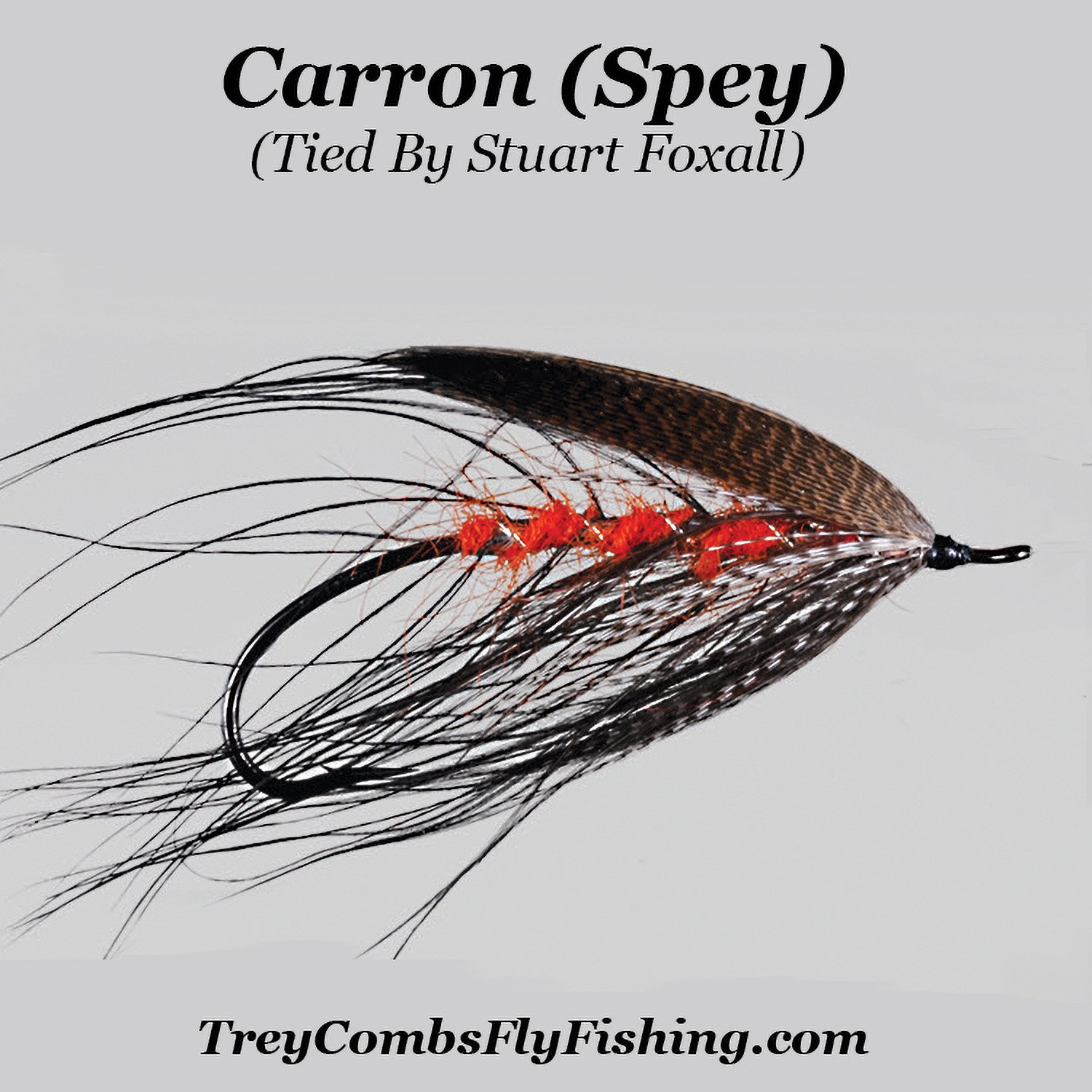
The Carron is a foundational "Old Spey Fly," a pattern built specifically for the heavy, tea-colored flows of the River Spey. Unlike the ornate, colorful Victorian salmon flies that became popular later in the 19th century, the Carron is a somber, functional pattern. It was designed to mimic the movement of shrimp or small crustaceans using long, mobile hackles that "breathe" in the current.
The fly was first brought to a wider audience by Alfred E. Knox in his 1872 work, Autumns on the Spey. Knox categorized it among the essential "Old Spey Flies" used by local ghillies and anglers long before the era of full-dress patterns.
The Designer: George “Gordie” Shanks
While Knox popularized the pattern in print, the original design is attributed to George “Gordie” Shanks. Shanks was a legendary figure on the Spey, serving for decades as the head ghillie at Gordon Castle for the Duke of Richmond and Gordon.
The Shanks family was synonymous with Spey fishing; Gordie’s father, James Shanks, was a renowned guide with a pool named after him (Shanks’s Pool) just below the Craigellachie Bridge. In Autumns on the Spey, Knox acknowledges the "Shanks" lineage as the creators of these early, effective patterns. Gordie is also widely credited with the creation of the Lady Caroline, arguably the most famous Spey fly in history.
The Standard Dressing (Knox, 1872)
According to the original description in Autumns on the Spey, the classic version of the fly is tied as follows:
Body: Orange wool, wrapped thin and tight.
Ribs: Distinct "bars" of flat silver tinsel.
Hackle: Black heron (breast feather) wound the full length of the body.
Wing: Bronze mallard, set low and flat along the hook.
Head: Black silk.
The "Spring & Autumn" Variation (Brown, 1891)
For high water or early season fishing, the pattern was often modified for better visibility. This variation was documented by Aberdeen tackle maker William Brown in the January 24, 1891, issue of The Fishing Gazette:
Body: Greenish-yellow wool (replacing the orange).
Shoulder: Two or three turns of gallina (guinea fowl) added at the head.
Note: The greenish-yellow provided better contrast in dark water, while the guinea fowl helped support the long heron hackle on larger hooks, preventing it from matting down.
About the River Carron (Combs, 2023)
Historically, the River Carron was a relatively obscure river in central Scotland. We can trace the river from Highland origins to the Carron Valley Reservoir, a scant dozen miles, and flowing from there to flow into additional lochs. The meanderings total no more than 15 miles of fishing water, all private, and permitted by Attadale, an estate of some 30,000 acres and by the Larbert and Stenhousemuir Angling Club.
The salmon caught on this fly-fishing-only river total 200 to 300 annually. Central Scotland considers the river a national treasure, and today it’s a popular angling destination. That fact is a remarkable reversal of fortune. During the post World War II years to at least 1980, the Carron was one of the world’s most polluted rivers due largely to refinery waste at Falkirk. The water was so toxic that literally nothing could live in it, and no land animals drank from it.
Though the river was privately owned, and today’s fishing privately controlled, the public became heavily engaged in its restoration. A myriad of projects more than 30 years in the making began to restore the river to a pristine state not seen in 200 years. The Carron eventually was stocked with salmon and brown trout, and, most important, the run of salmon became self-sustaining.
Fly Image
This functionality of this fly is captured beautifully in modern interpretations. The pictured fly featured for this post comes from the talented hands of master fly dresser Stuart Foxall. Take note on the bright orange body, a dressing that is featured chapter 1 (A Speyside Soliloquy) of Flies For Atlantic Salmon & Steelhead (2023).
Flies for Atlantic Salmon and Steelhead by Trey Combs is available in two formats: a limited edition, oversized hardcover first edition (restricted to 1,500 copies), and a digital print replica version designed for use at the fly bench. Both editions are available directly from the author.
Limited Edition Hardcover — $119.00 (Amazon)
Digital Edition — $24.99 (Amazon - Kindle)