The Coquihalla Series: Flies of Tommy Brayshaw
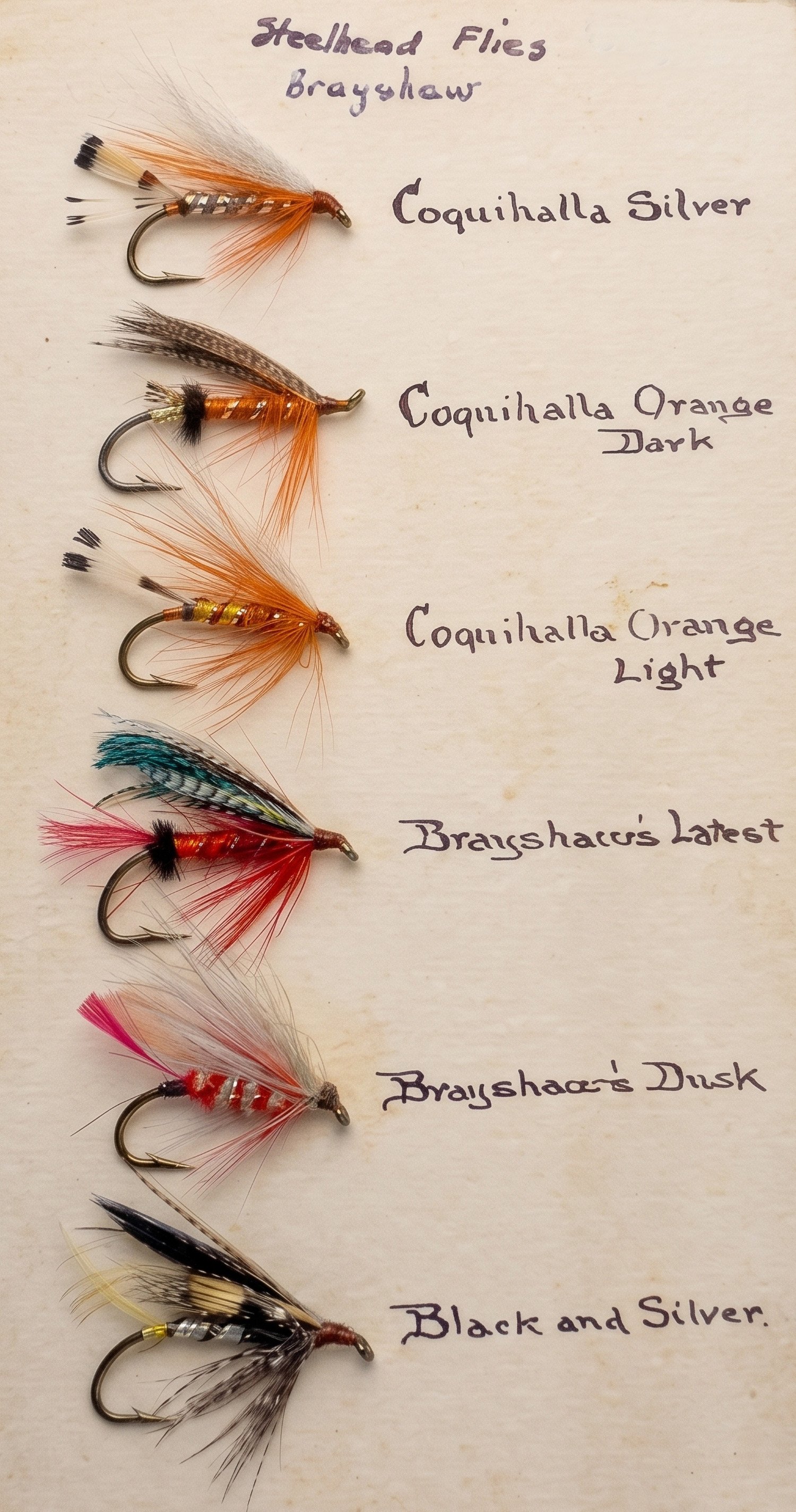
Tommy Brayshaw flies as featured at the American Museum of Fly Fishing. Desktop only: Right-click the image and open it in a new tab to view the high-resolution version. This feature is not available on mobile.
The following is an excerpt from Steelhead Fly Fishing and Flies (1976)
The Coquihalla series of steelhead flies was the inspiration of a beloved Canadian artist and angler, the late Major Thomas "Tommy"" Brayshaw. The esteem his fellow anglers felt for this gentleman was perhaps best expressed when the Federation of Fly Fishermen made him an honorary member in 1967.
Tommy Brayshaw was born in England's Yorkshire District in 1886. He started fishing almost as soon as he could hold a rod and was tying his own flies at nine, learning to do so without the aid of a vise. This gifted boy was fortunate for a time to be under the gentle tutelage of Sir Edward Grey, Fly Fishing, 1899, a man who occupied a position then much as his young charge would occupy years later half a world away.
Brayshaw emigrated to Vancouver in 1910 and worked for a financial firm but returned to England to join the Yorkshire regiment as World War 1 was breaking. At war's end he had been wounded once and promoted to Captain. After marrying in England, he soon returned to British Columbia and taught mathematics in Vernon at the Mackie School for boys. During World War II he was first a recruiting officer and later an army counselor, retiring as a Major from the Canadian Army. It was about 1946 that Tommy Brayshaw moved to Hope.
He had remained an avid fisherman during these years and now pursued three related fields, any one of which would have brought him much deserved recognition. Tommy Brayshaw was first a wonderful artist. His exquisite illustrations appeared in the single volume, 1956, publication of Roderick Haig-Brown's The Western Angler and in a number of British Columbia travel posters. His second "career" involved making wood carving of Canadian gamefish. They were perfect to the most minute detail, and some are presently displayed in the Vancouver aquarium.
Passing near Hope is a charming little Fraser River tributary with a name as musical as its dancing waters, the Coquihalla. This for the next two decades was to be the Brayshaw’s angling domain, and here he would bring his river fame by way of the esthetically faultless “Coquihalla” steelhead flies – the Coquihalla Orange and its “Dark” variation, the Coquihalla Red, and Coquihalla Silver. The Black and Silver, and Dusk were two additional Brayshaw pattern he frequently prescribed for home river steelhead.
Original Dressing Notes:
Coquihalla Silver - Tail: Golden pheasant tippet fibers. Butt: Red Floss. Body: Flat silver tinsel ribbed with medium oval silver tinsel. Hackle: Red. Wing: White over orange polar bear fur.
Coquihalla Orange Dark - Tip: Oval silver tinsel. Tail: Golden pheasant crest, and a short orange hackle tip on each side half the length of the crest fibers. Butt: Black ostrich. Body: Rear half orange floss, front half orange polar bear underfur. Rib with flat silver tinsel, overlay with narrow oval silver tinsel. Wing: Orange polar bear fur under strips of brown mallard. Topping: Golden pheasant crest. Cheeks: Jungle cock.
Coquihalla Orange Light - Tip: Two turns of narrow oval gold tinsel, orange floss. Tail: Golden pheasant crest. Butt: Black ostrich. Body: Rear half orange floss, front half orange polar bear underfur or orange wool. Rib with oval silver tinsel. Hackle: Orange. Wing: White over orange polar bear fur.
Coquihalla Red (“Latest” in image) - Tip: Narrow oval silver tinsel. Tail: "Collarette magnifique" or light red hackle tip cut short. Butt: Black ostrich. Body: Rear half orange floss, front half red polar bear underfur. Rib with oval silver tinsel. The polar bear section may need to be picked out; it should have a ragged appearance. Hackle: Red. Wing: Mallard flank over peacock sword fibers.
Brayshaw’s Dusk - Tag - Flat silver tinsel, Tail - Colorette magnifique. Body - Red and olive chenille wrapped together. Throat - Red and white hackle fibers, mixed. Wing - Polar bear
Black & Silver - Tip: Narrow oval silver tinsel. Tail: Golden pheasant crest feather. Body: Rear half flat silver tinsel, black floss for balance. Rib entire body with narrow oval silver tinsel. Hackle: Guinea. Wing: Widgeon flank or bronce mallard. Alternate wing: Strips of pheasant tail over stips of golden pheasant center tail. Topping: Golden pheasant crest. Cheeks: Jungle cock. (The Black and Silver was generally used for summer-run steelhead by its originator. It is sometimes listed as Brayshaw’s Black and White)
Additional Comments:
When I was writing Steelhead Fly Fishing and Flies in the early 1970s. I had the privilege of meeting Tommy Brayshaw. I wrote him a letter asking to meet him and see some of his flies. He invited me to his home, and I was so grateful when he presented me with six flies. I eventually donated these flies to The American Museum of Fly Fishing in Manchester, Vermont. The image you see for this blog post are the flies I donated, as presented by the museum.
The fly pattern dictionary features other flies, dresssing notes, images, and pattern histories.
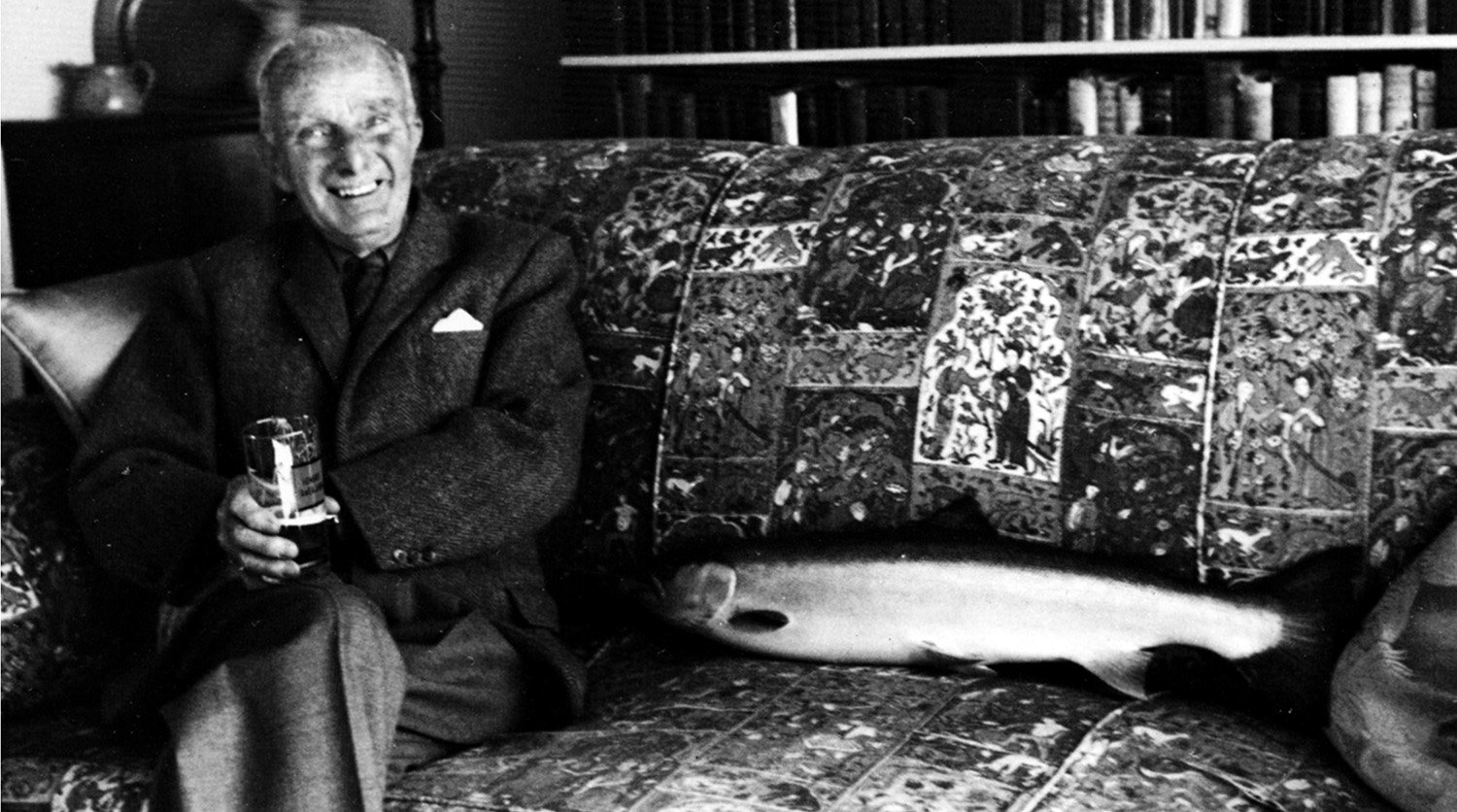
Tommy Brayshaw showed me his angling treasures and told me about steelhead one day in his Vancouver, British Columbia home. His wife brought us beer, and we dwelled on his wood carvings of Canadian game fish - Photo by Trey Combs