Blue Charm Dilemma: Silver Tag or Yellow Tip?
If you were putting together a list of the characteristics needed to be considered one of the all-time great salmon and steelhead fly patterns, being listed in the various Hardy Angling Catalogs for 70 years certainly suggests an enduring pattern that works.
Hardy Angling Publications
The Blue Charm pattern appeared in catalogs from 1898 through 1969, although its placement changed over time. Up to 1919, it was included among the Dee summer flies. Beginning in 1920, it was moved into the low-water fly section, which replaced the Dee patterns, and from 1933 onward it also appeared in the general list as a plainly dressed fly.
William Murdoch first described it in 1884. Kelson did not include it in Land & Water, but it later appeared in The Salmon Fly as a pattern he obtained from William Brown of Aberdeen. It is impossible to know whether the mistake came from Brown or Kelson, but that source is the only one to describe the fly with a claret body, perhaps because it was confused with the Logie. The dressing in Salmon Fishing follows Kelson, but because the pattern was generally understood to have a black body, that is the version given there.
So important was the Blue Charm in the various Hardy catalogs that they included a large, low-water, and small version of the fly.
Kelson’s Blue Charm
Kelson, in The Salmon Fly, wrote that the Blue Charm was obscure outside its home region. In many out-of-the-way fishing places, anglers had never heard of it. Even in England, Kelson says it was hardly known “by sight or name.” But near Aberdeen / the Dee region, it mattered. In its own neighborhood, especially in April, May, and June, Kelson says the Blue Charm had almost no equal except nearby companion patterns like the Jeannie and Logie. The “changed its costume” line from the original Kelson text likely means that some anglers thought the Blue Charm had been altered enough in appearance that they would class it differently — possibly with Irish-style flies — rather than as a local Dee/Aberdeen pattern.
Silver Tag or Yellow Tip?
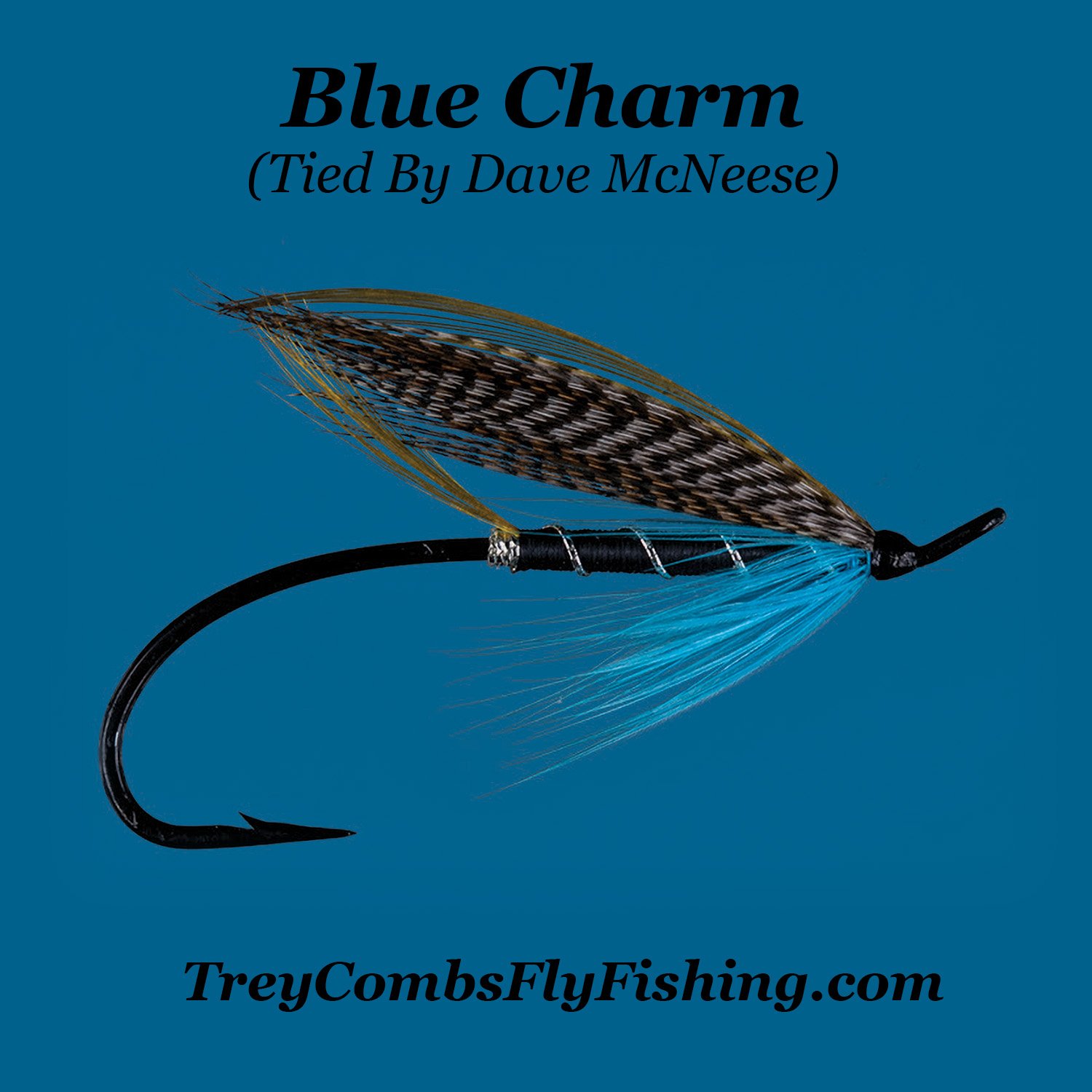
One interesting part of the Blue Charm pattern history is the yellow floss tip. A search in Google Images reveals dozens of Blue Charms — all with a yellow floss tip. But in the Hardy and Kelson dressings, it was just a tag of silver tinsel. The Blue Charm image featured in this blog posting was tied by Dave McNeese and follows the traditional dressing notes found in the Hardy Angling Publications. Included at the bottom is an image of two variant dressings with the yellow tip. It’s not clear historically who first switched to the yellow floss tip.
Various Dressing Notes
The Blue Charm — Kelson
Tag: Silver twist.
Tail: A topping.
Body: Claret silk.
Ribs: Silver tinsel, oval.
Throat: Blue hackle
Wings: Broad strips of mallard, two narrow strips of teal above, and a topping.
Head: Black wool
Note (From Kelson): A good summer fly used chiefly on the Dee, and dressed on small double hooks.
Hardy Catalog - Traditional
Tag: Silver tinsel
Tail: Topping
Body: Black floss
Ribs: Silver tinsel
Throat: Blue
Wings: Broad strips of mallard, 2 narrow strips of teal, topping
Head: Black
Hardy Catalog - Low Water (From Greased Line Fishing)
Tip: Silver wire
Tail: Crest
Body: Black floss
Ribs: Silver oval
Hackle: Light blue
Wing: Mallard, slip of teal & crest over
Hardy Catalog - Extra Small Dressing
Tail: Crest
Body: Black floss
Ribs: Oval silver
Hackle: Blue Charm
Wing: Mallard, pintail up sides
From Steelhead Fly Fishing (with the yellow tip)
Tag: Flat silver tinsel
Tip: Fluorescent yellow floss
Tail: Golden pheasant crest
Body: Black floss ribbed with flat silver tinsel
Throat: Bright blue hackle fibers
Wing: Red squirrel tail
Note: This hair-wing Blue Charm dressing from Steelhead Fly Fishing, using red squirrel tail for the wing rather than the mallard/teal/crest wing found in earlier low-water salmon versions.
Source Notes
The Hardy catalog history, including the Blue Charm’s listing from 1898–1969, its movement from the Dee summer flies to the low-water fly section, and the Hardy dressing notes, is drawn from Hardy’s Salmon Flies: Patterns from the Fly Tying Department 1883–1969. Kelson’s comments on the Blue Charm and the claret-body confusion are from The Salmon Fly. The yellow-tip variants shown here come from Flies for Atlantic Salmon & Steelhead and Steelhead Fly Fishing.
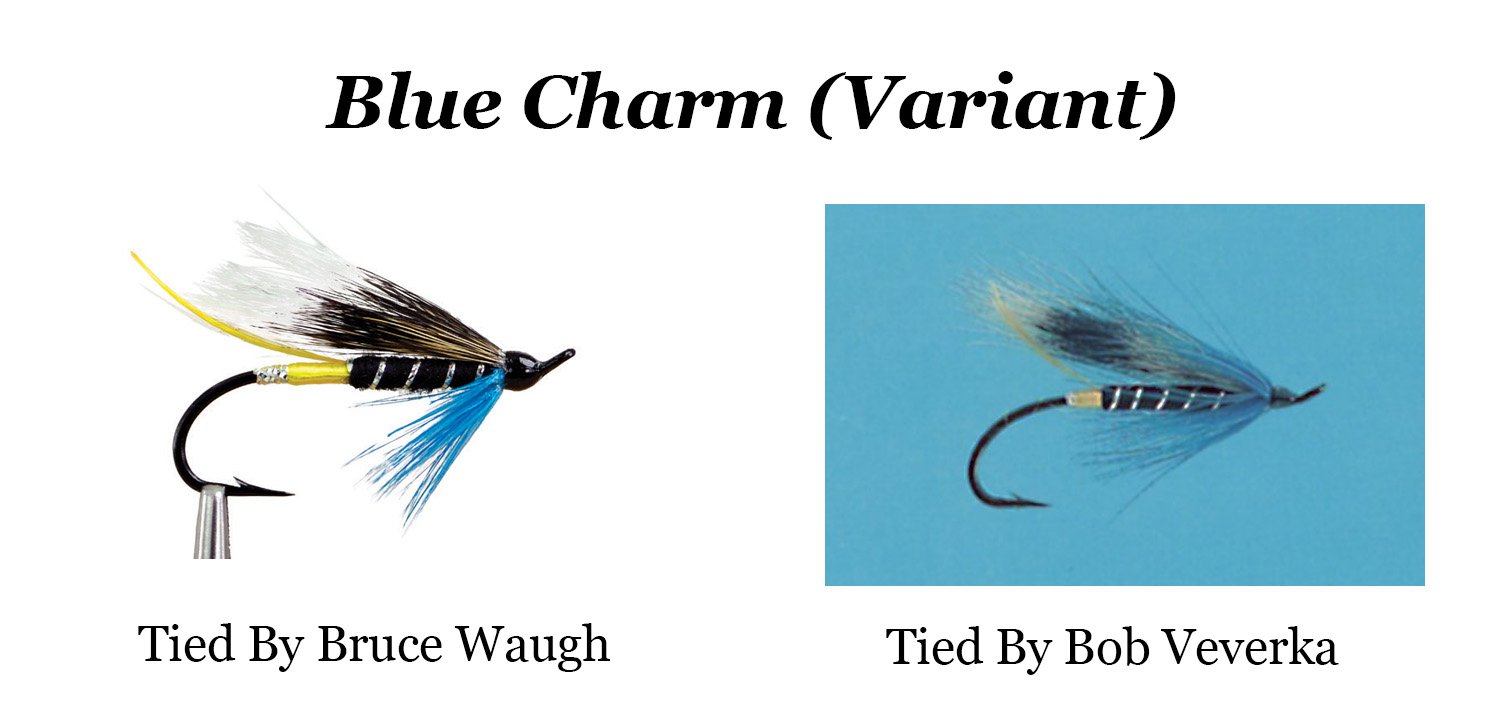
Blue Charm variants with yellow tag: On the left, from an image in Flies for Atlantic Salmon & Steelhead, is a Blue Charm from the vise of Bruce Waugh, presented by the legendary riverside shop W. W. Doak and Sons Ltd., T.R.P. On the right is a Blue Charm, also with a yellow tag, from a fly plate in Steelhead Fly Fishing, tied by Bob Veverka.