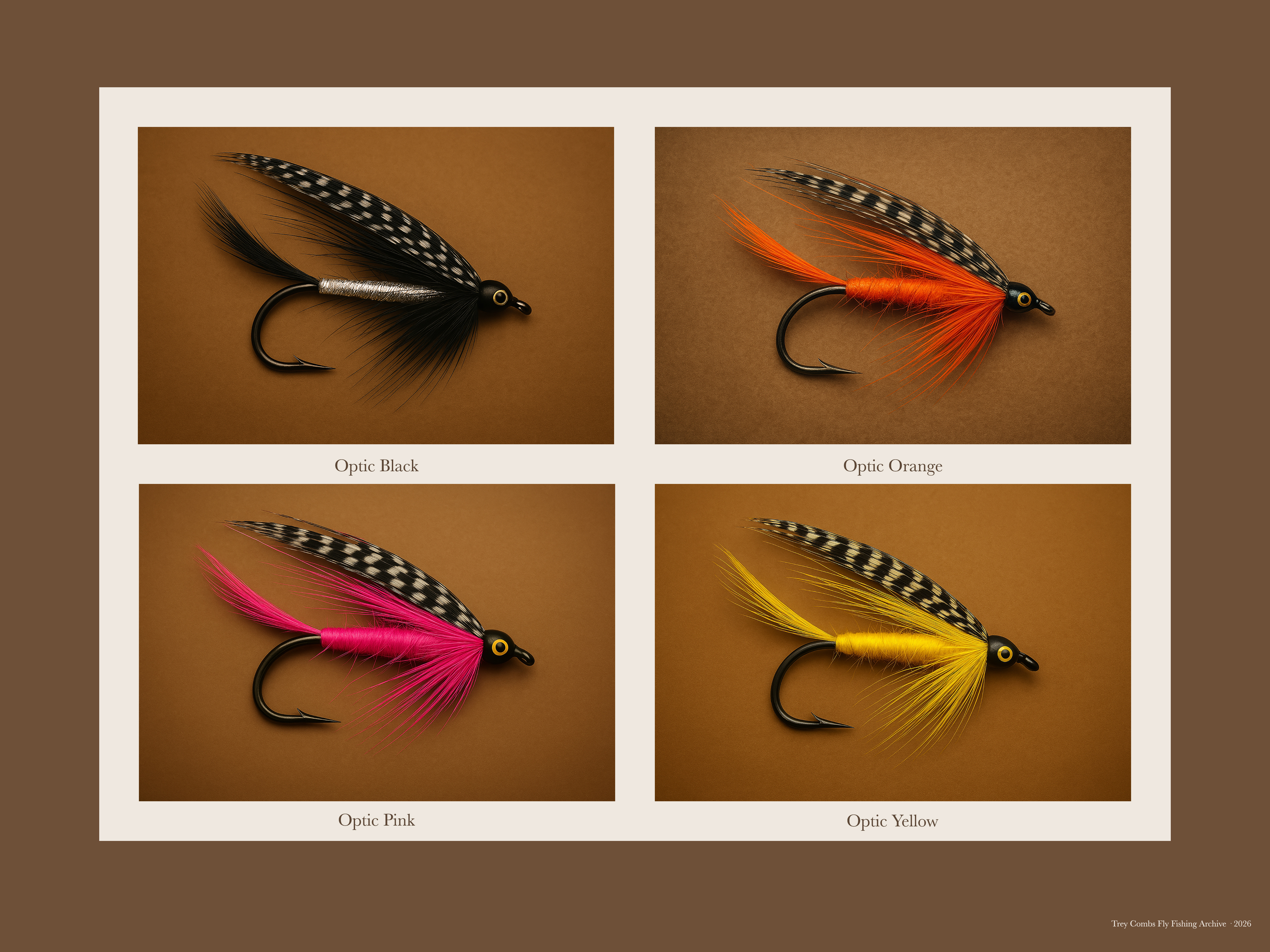
Legacy Plate #2 - Pray’s Optics
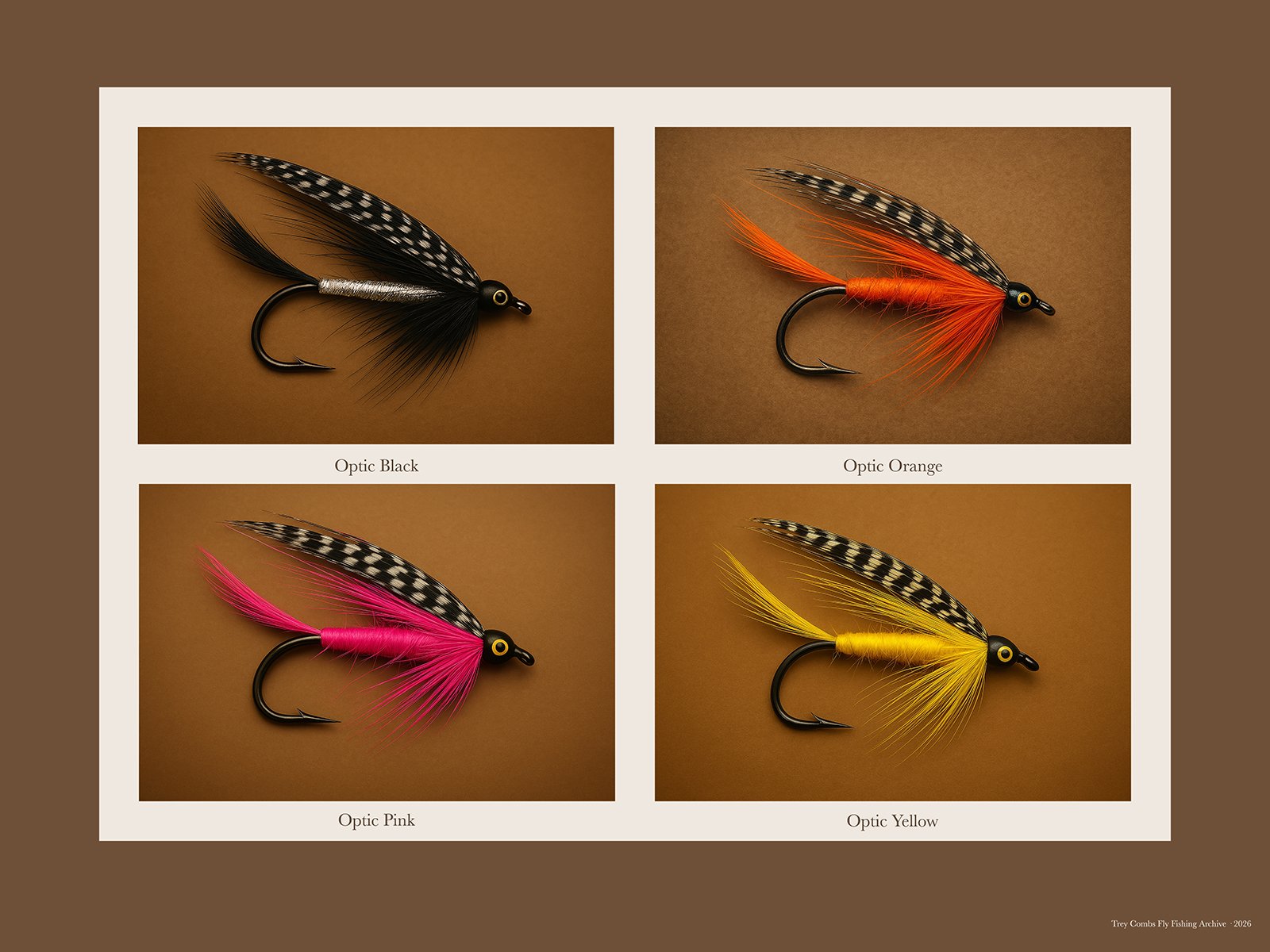
The download link to the high resolution version of this image is located at the bottom of this page.
Jim Pray’s Optic Flies – A Tribute
Among the many distinctive fly patterns developed for steelhead in the American West, few are as recognizable as the optic flies associated with Jim Pray of Eureka, California. These flies, defined by their large heads and prominent “eyes,” represent an important stage in the evolution of steelhead fly design.
In general terms, any fly with an exaggerated head or eye-like structure may be described as an optic. The idea itself was not new, but its application to steelhead flies was largely the work of Jim Pray. His original optics were built using split brass beads placed at the head of the fly—typically a ¼-inch bead for larger hooks and slightly smaller beads for lighter patterns. The result was a heavily weighted fly capable of sinking quickly in the strong winter currents of Northern California rivers.
Pray’s innovations came at a time when steelhead fly fishing was still developing as a distinct regional tradition. Born in Michigan in 1885, Pray began tying flies as a child and later moved west, eventually settling in Eureka. Over time he became one of the most respected fly tiers in the steelhead waters of California and the Pacific Northwest. His flies were used by many accomplished anglers and writers of the era, and even prominent public figures counted among his customers.
The economic hardships of the Great Depression ended Pray’s real estate career and pushed him toward fly tying as a profession. Working out of a small shop in Eureka, he produced a range of highly regarded steelhead flies, including patterns such as the Silver Demon and the Thor. His shop quickly became a gathering place for anglers—a source of both flies and local fishing knowledge.
The optic style itself emerged around 1940, developed specifically for late-season fishing on the Eel River. During the cold winter months, steelhead often held deep in heavy water, and anglers needed flies that could sink rapidly and remain visible in the current. Pray’s optics—bright, weighted, and distinctive—met that need perfectly. Though other steelhead patterns existed before them, optics represented a new generation of flies designed specifically for winter steelheading conditions.
As the flies spread in popularity, their names multiplied. Because they were first associated with the Eel River, many anglers called them Eel River Optics. Others referred to them as Owl-Eyed Optics because of the large painted eyes on the head. And since Jim Pray both invented and sold them—often for fifty cents apiece—many fishermen simply called them Pray’s Optics.
The terminology soon became confusing, as different anglers applied the names to different variations of the pattern. Flies such as the Black Optic, Orange Optic, Red Optic, Cock Robin Optic, and others all developed within this broad family of optic-style steelhead flies. Another example of anglers following Pray’s lead occurred on the upper Skagit River, where Ralph Wahl tied early optic-style flies inspired by Pray’s designs.
Pray remained a central figure in West Coast fly tying for decades. When he died in 1952, his popularity became evident in the remarkable number of friends and anglers who gathered to honor him. One obituary noted that although his small shop never brought much financial success, “Jim Pray’s wealth was in friends.”
Optic flies remain an important part of the history of Pacific Coast steelhead fishing. They reflect a period when innovative tiers like Jim Pray were experimenting with form, weight, and color to meet the challenges of powerful rivers and hard-fighting fish. Legacy Plate #2 honors that tradition and the enduring influence of Jim Pray’s work on steelhead fly design.
Sources:
Combs, Trey. Steelhead Fly Fishing and Flies. Portland, Oregon: Frank Amato Publications.
“The Jim Pray Steelhead Flies.” American Fly Fisher. The Museum of American Fly Fishing.
Legacy Plate #2 is a modern tribute to Jim Pray’s optic flies. The four patterns shown—Optic Black, Optic Orange, Optic Pink, and Optic Yellow—represent classic color variations associated with the optic style. The images are modern artistic interpretations that capture the defining elements of Pray’s designs: bold optic heads with pronounced eyes, streamlined hackle, and strong color contrasts that made the optic patterns so distinctive.
Download Information: Legacy Plate #2 is a high-resolution archival plate. Each plate includes a cream border and warm brown background and is suitable for high-quality printing and framing. Dimensions: 20” (width) × 16” (height) at 300 DPI. Click the button below to automatically download the high-resolution image.