Thompson River
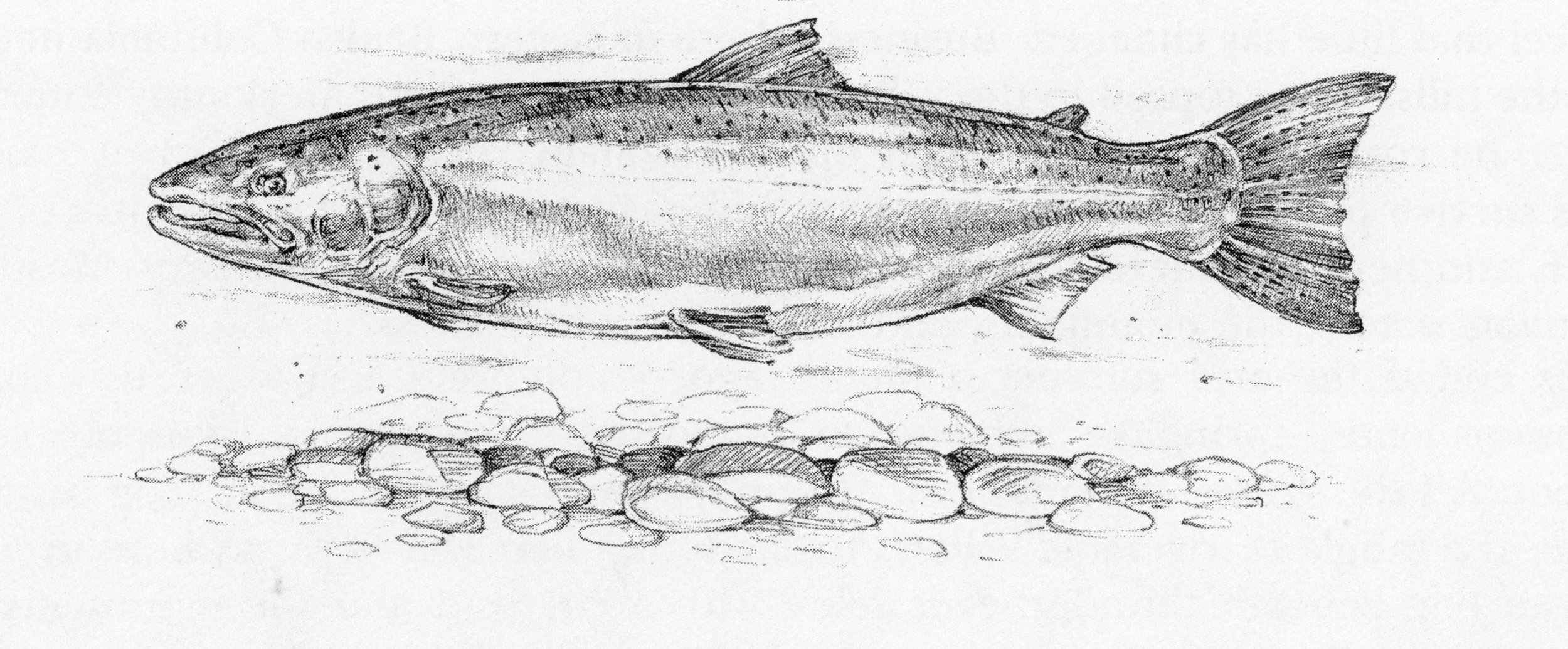
This is the complete chapter from Steelhead Fly Fishing, written by Trey Combs and originally published in 1991. It is presented here in its original form. Desktop only: Right-click any image in this essay to open it in a new tab to view the high-resolution version. This feature is not available on mobile.
At first light, the bighorn sheep come down from the foothills of Arthur's Seat, the stone mountain throne that towers above the Thompson River's Lake Pool. White rumps flashing from the mists and chukar talk signal the band's passage through the scattered ponderosa pines. At least thirty animals pause along the bench immediately above the river to pasture on yellow grasses that grow around clumps of prickly pear. As the kids frolic, the ewes pick up a deeply rutted game trail and continue toward the river. Three rams linger to test the wind, to study the river below, and this morning, to watch Don Roberts and me cast our flies for steelhead.
The hollows and swards of tender new grass along the railroad tracks are the band's destination, passing boxcars of grain continuing to seed these bottomland pockets. When only the dominant ram remains, he drops to a ledge where a second ram has been waiting, and the two take the trail that leads to the river. In ten minutes, Don and I watch one of them drinking at the tailout while keeping an eye on our progress down Lake Pool.
When I introduced my friend to this band the previous evening, the sunset was silhouetting them on a commanding ridge. "The scene is too romantic to believe," he had marveled. We thought the sheep to be spiritually akin to the river's wild steelhead, a race famous for its great size and extraordinary strength.
David Thompson, after whom the river is named, was Canada's Lewis and Clark, an intrepid explorer and brilliant geographer who surveyed western Canada and became the first European to travel the entire length of the Columbia River. He came this way in the 1800s, and today Thompson would probably feel that little has changed. Businesses here in eastern British Columbia never found enough timber on the hillsides or topsoil in the valleys to encourage more than skimpy enterprise. Some cattle are raised. The roadside fruit stands that open seasonally service backyard orchards. Tiny frontier settlements survive precariously by selling food and gas to motorists. Railroad tracks run on both sides of the river, and here and there a highway peeks into one's angling sanctuary. Mostly, however, there are the canyon waters, the mountains, and a sense of timelessness.
Fall rains ended the arid summer a month ago. Wildflowers and sagebrush sprinkled with pale yellow blossoms lend a springlike ambience to the northern desert. Early November is lush, invigorat-ing, pungent. All the senses are embraced. The days are warm, the nights long, with hoarfrost morn-ings that set the tangle of riverside willows to shedding their leaves. I was here in mid-October when the river ran oily beneath thunderheads filled with arctic cold and the mountains got a dusting of snow. On that day, the surface river was,.a tepid fifty-eight degrees. Three weeks of benign weather had nudged the temperature down only six degrees. This was, however, less a matter of concern for steelhead metabolisms than for my wading comfort. These steelhead, like more northern races, remain active when the water temperature drops into the thirties. Bob York, an old Kispiox hand who chases after steelhead nine months a year, once told me of standing on rim ice in late December and raising Thompson fish to a dry fly.
One lazy fall afternoon I sat beside the river to soak up some sun while Harry Lemire tried to put the river's steelhead into perspective. "When I'm on the Dean, I think its steelhead are the strongest," he said, "but when I'm on the Thompson, I think its steelhead are strongest."
"Ah, yes," I said, "but Thompson steelhead are larger, the typical male running at least sixteen pounds, the female only a pound or two less. Aren't steelhead of less than ten pounds extremely rare? And Harry, wasn't your largest steelhead from this river a buck of thirty-seven pounds that took you a half-mile downriver?" I recalled that two friends of ours, Jimmy Hunnicutt and Sean Gallagher, had both taken huge Thompson steelhead on dry flies.
Comparing the Thompson to the Dean is as valid as comparing chocolate to vanilla. Harry was not comparing the races so much as distinguishing their steelhead from all others He applies many stan-dards to his fly fishing, size of the fish being but one. Strength and response to surface flies are attri-butes he values more. In the end, I was happy that he dismissed my nitpicking with a wise smile.
The Thompson runs bigger than life, always a collection of superlatives when comparing steelhead stories. Certainly the vistas are grander, the river larger, and the currents more powerful than any other river in my experience except Idaho's Snake. The pools would seem too large to cover properly, too large to affect a personality and develop a following among fly fishers, but this is not so. Typically, the pools are shallow, the steelhead often choosing lies close to the beach, and if they are not disturbed, they may hold these exposed stations for hours. The best opportunity of finding such virgin water is at first light, and my willingness to rise in the dark when I'm fishing the Thompson is due only to that consideration.
Martel, Grease Hole, Rock Garden (the most treacherous water to wade in all of steelheading), John's Rock, Lake Pool, and Graveyard are but a few of the many, and each has its fly fishing faithful. There is, naturally, a strategy for fishing each, a "bucket," where the steelhead are most likely to hold, and secondary lies that must be searched confidently. The fly fisher will still be learning new approaches after a dozen trips through.
Long casts are helpful when searching for Thompson River steelhead; prodigious casts with double-handed rods are necessary when covering far distant lies. Throat-tightening caution is a fact of life for even the most audacious wader when he balances his life on huge, perfectly smooth rocks well-slimed with algae. A wading staff and stream cleats will reduce the number of times he falls in, and a few pools will call his number nearly every time. The largest steelhead lurk beyond his longest cast and dare him to wade deeper. Here the downstream-sprinting steelhead is a runaway until it has a mind to stop-and some never do. Surely fly fishermen are spooled more frequently on the Thompson than on any other steelhead river.
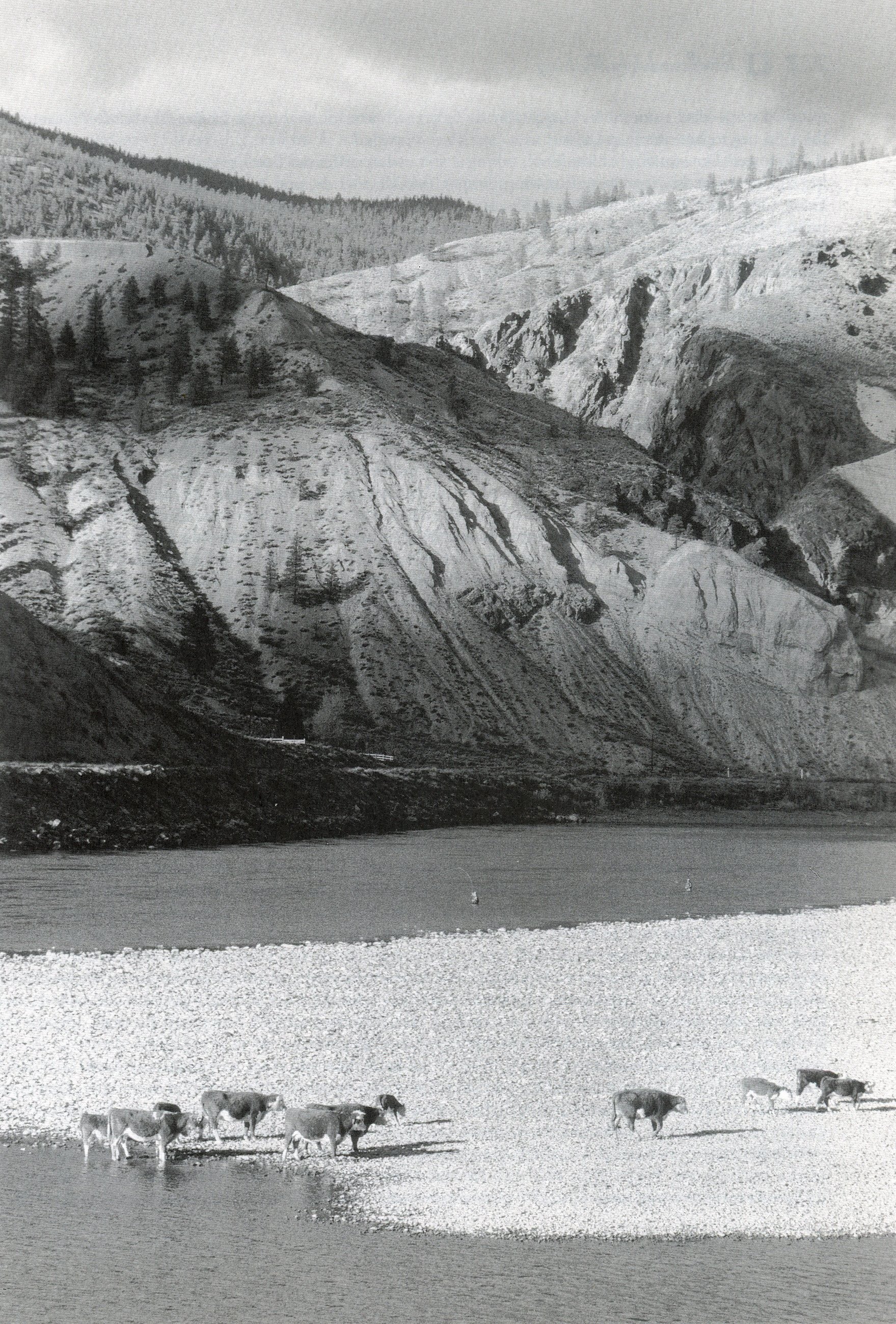
Graveyard Pool
I followed Don through Lake Pool, taking a somewhat different line by wading a little deeper, mak-ing a longer across-river cast, throwing deeper outside mends, and swinging a different fly. The 2/0 Ferry Canyon, a Randall Kaufmann tie, is a purple pattern with a flame butt that glows deeply in low light. I often go to it during periods of overcast, but particularly at dawn and dusk. We both fished floating lines, rarely mended to sink the fly, and generally were contented with a greased line ap-proach. Occasionally I changed to a waking dry, a new variation of the reliable Waller Waker.
The Thompson summer-run are so free rising and surface oriented by nature that rarely is any other approach necessary. Only when heavy angling traffic has driven them into deeper lies do I occasionally wish for a sink tip line. Because the best lies are often flats with weak currents near the shore, the fast sinking shooting head becomes very troublesome, the fly fouling the bottom on nearly every cast.
When Don could go no farther, he quietly pulled out and watched the sheep browsing in the moun-tain's deep shade. I soon stood where he had fished and only grudgingly became convinced that the pool held no steelhead. While working down, I had occasionally felt the tap, tap of parr. The day before on the pool, a sharp little strike from a fourteen-inch rainbow had for a moment fooled me into thinking steelhead. These trout are not residualized premigrant steelhead, but a resident race, on the order of Deschutes "redsides." Biologists have told me that they grow to more than five pounds, but are uncommon to more than eighteen inches. My big flies rarely find them.
We took the short hike around the "lake" of the pool, picking up the river where it narrowed and plunged by so strongly that a shallow slot of holding water invited continued investigation with our flies. Don went through with a purple Muddler, a pattern he designed for Deschutes steelhead. I followed with the big Ferry Canyon, working down the short lie until the fly was swinging across the shallow flat. I was to my last cast when a buck came up behind the fly to grab it, nearly a direct downstream take, and as I tightened, it spasmodically completed a head-and-tail rise that brought it several feet upstream. The take, typical for large bucks, helped sex the steelhead for me; the single broad stripe confirmed it.
"I just fished my fly over that spot!" Don exclaimed.
"He's not well hooked. Never turned. He'll be hooked on the end of his mouth," I said, sure that the fly was about to come away. The steelhead swam upstream until it held only a dozen feet from me.
"He doesn't know he's hooked," said Don.
"Twenty pounds. Well, maybe. I got a good look at him."
As the steelhead began to fatigue, it lost its composure and moved out into the heavy current where it no longer tried to hold an upstream station and turned to run hard downriver. I stumbled after it, and when the steelhead slowed, I pressured it from the current. The entire sequence was repeated twice again until the steelhead was near the tailout. A good run would now take it over into a cauldron of white water. I saw the buck keel over, its pectoral fin waving in distress. With most races of steelhead, this would have been the end of it. I turned the rod horizontal to the water, locked down on the reel, and began easing the steelhead toward the beach. Too late. It righted itself and dashed back out into the current. Stop it or lose it, I thought, and locked down on the reel again. The steelhead was stopped, but again I failed to bring it to shore.
"Typical Thompson steelhead! You'll have to tail it. No decent place to beach him. One last time."
Don waded in, and when the buck again grew faint with exhaustion and turned on its side, I brought it directly in front of Don and pulled it half out of the river. Don had the steelhead by the tail and quickly drew the buck back into the river. It lay nearly motionless in six inches of water.
"Smaller than I thought," I said, "Eighteen pounds." The fly hung precariously from the very end of the buck's nose. When Don held the fly for a moment, it fell away. We measured the length at thirty-seven inches; eighteen pounds was a conservative estimate for the thickly muscled trout. When Don turned the steelhead back, it darted from his grasp and disappeared into the tailout.
The railroad tracks were our trail back, a half-mile walk that sent the sheep scrambling up a hillside. They are hunted each September, full-curl rams only, an annual reduction of three or four animals from several herds in the area. A year earlier, I fished Montana's Madison River with a group of avid sheep hunters, two of whom had just returned from hunting Marco Polo sheep in Mongolia. They described for me the difficulties in securing a "grand slam," a trophy-class specimen from each of the four races of North American sheep, the Dall, Stone, Bighorn, and Desert. Though money was no object, the rare bighorn had eluded them. I thought of their frustration as a pair of hog-fat rams, their massive heads held low, bulldozed their way through the brush.
My truck was parked on the outskirts of Spences Bridge, the tiny railroad siding town, the half-boarded-up destination town for steelheaders that is located on the west side of the Thompson just below its confluence with the Nicola River. We drove to one of two restaurants still open. I stuck my head in the door. The place was empty of customers.
"Are the stream cleats okay?" I asked.
"Oh, sure!" said the waitress, as she waved us in. We took a table and ordered. "Lots of places closed." I said. "Business is down?"
"I live on the river, and it used to be that when I looked through my window all I could see was fishermen. Now all I can see is river."
"The run of steelhead has been going down, too," I said.
"I don't know about that, but I know there are a lot less fishermen."
I wanted to explain to her that the no kill regulation in force this season had discouraged many anglers, that if some bait fishermen can't hit their steelhead on the head, they don't want to bother.
"So what are you trying to tell me? That fly fishermen are snobs?" she might have asked.
What these steelhead must go through just to get to Spences Bridge fills me with admiration for the race. Consider first that they enter continental shelf waters from two directions. Some pass down the Queen Charlotte Strait between Vancouver Island and the mainland through Johnstone Strait, Discov-ery Passage, and the Strait of Georgia before entering the mouth of the Fraser, the province's largest river and most important producer of sockeye salmon. Others may choose to enter the Strait of Juan de Fuca and pass between Washington State and Vancouver Island. The first route described puts migrating steelhead in the path of Canadian gill netters. Some of the steelhead will be caught inciden-tally and reported, though not as Thompson River stock. Others will be caught and will go unreported. Whether the steelhead will fare any better by taking the southern route is hard to say. They, too, will face Canadian gill nets set for sockeye and perish in this manner. But others will be lost to American gill nets. These Thompson River steelhead will certainly go unreported, for it is unlawful for an Ameri-can commercial fisherman without aboriginal fishing rights to catch, possess, or sell any steelhead.
I live in a small town on the Olympic Peninsula. Many of our local commercial fishermen are gillnetters who fish in American waters for Canada's Fraser River sockeye. I am told about immense summer-run steelhead (the last one weighed nineteen pounds) that they sometimes find dead in their nets. Most fishermen I know will try to get away with keeping these steelhead, naturally preferring to save them for a barbecue rather than to deep-six them, an awful waste, regardless of how one views the matter. More to the point, no Puget Sound river possesses summer-run steelhead of this size, and no one seriously takes them to be anything other than Thompson River stock.
During the late 1980s, the run was estimated at "10,000 pieces," i.e., steelhead. Two thousand steelhead are subtracted from this figure to account for commercial interceptions. The great number of commercial fishing areas through which Thompson steelhead stocks pass makes this an arbitrary figure, and almost complete guesswork when American waters are factored in.
As the steelhead enter the lower Fraser, they encounter an aggressive sport fishery, and hundreds of fish become part of the Province's punch-card statistics.
More than fifty bands of Native British Columbians, mostly of the Sto:lo Nation, have aboriginal fishing rights between the Fraser's confluence with the Harrison River and Boston Bar. The gill nets set by the Indians for salmon and steelhead typically take five thousand steelhead, a staggering fifty percent of the escapement.
These interceptions-no longer "incidental"-have taken place only on the Fraser between the mouth and Lytton, the "Rafting Capital of Canada," situated at the confluence of the Thompson. At this point, if all the interceptions are added up, something like four of every five steelhead are already caught before the first Thompson River steelhead even reaches a Thompson River angler. When the anglers in the Spences Bridge area have pursued the steelhead through the sport-fishing season, ap-proximately September through December with the four-week peak generally occurring from mid-October to mid-November, about a thousand to fifteen hundred steelhead have survived to spawn.
The typical angler at Spences Bridgeis a gear fisherman. Not uncommonly, a father and son fishing together might span nearly a half-century of catch-and-kill on the Thompson. They resent that conser-vation efforts invariably begin by reducing their limit, when everyone, it seems, has already had a whack at their steelhead, a sports fish the last time they checked. In 1989, they had to give up their one-fish limit when the river went catch-and-release. The father can remember the halcyon days of his angling youth when he could kill six Thompson steelhead a day. Both will tell you that catch-and-release is a restriction, plain and simple. Only a simpleton would think otherwise. Why else do the fishery boys say that the river is restricted to catch-and-release? And, as always, it falls to those who pay for the support of the fishery, the license holders, to make the sacrifice. That's wrong. Furthermore, if an angler wishes to voluntarily practice catch and release, to embrace this ethic he has made a choice like choosing wildlife photography over hunting. Good for him. Give us back those eight thousand Thompson River steelhead and there won't be a problem.
The Native bands of the lower Fraser belong to several councils that have representation on the Indian Inland Fisheries Commission. In 1989, Ian McGregor, a senior Fisheries Branch biologist, was able to convince the Commission that a voluntary cutback of their subsistence fishery was the only hope the Province had for rebuilding Thompson steelhead stocks. This informal agreement, the first of its kind between sport and Native fishermen in British Columbia, noticeably increased the 1989 escapement.
McGregor reminded me that the Thompson steelhead was "the most fecund of any race of steelhead," tlie average female depositing more than twelve thousand eggs. He estimates that if only four thousand steelhead survive to spawn, the result will be a run of twenty-five thousand adults, a remarkable annual recovery. The catch, of course, is that four thousand steelhead must find a way to reach their spawning grounds.
Life History
Anglers and biologists alike are convinced that the "Thompson River steelhead" is actually two races: one with origins in the Nicola River, the other with origins in the tributaries of the Thompson above the Nicola, principally Deadman Creek and Bonaparte Creek.
Nicola steelhead are thought to be the slightly larger race, arriving mainly in late October, a week or two earlier than the Thompson stock. In either case, they can transit the Fraser in two weeks, and need, at most, a week more to travel the sixty miles from Lytton to Spences Bridge. However, these steelhead are notorious wanderers. Some will reach the inaccessible canyon waters of the lower Thompson and remain there the entire winter. Nicola steelhead are known to pass up the Thompson as much as seventy miles above the confluence of the two rivers and to stay for months. They may not reverse their movements and seek out the headwaters of their birth until late winter. Other steelhead may drop down into the deepest pools of the lower Thompson at the onset of winter. Also evident is that, although there are decided peaks in the runs, fresh fish will trickle into the system all fall.
Many interior rivers are known for their late run of summer steelhead, fish of October, even November. But the time needed to arrive at their spawning destination will be six weeks or more, and the steelhead's depature from salt water is actually in August or early September. Thompson steelhead may not leave salt water until October, a few even later, and they are unusual in this way. (In 1989, the Thompson run was somewhat later than usual; a test fishery on the Fraser in lat? November revealed that a run of Thompson steelhead had freshly entered. This is a time we associate with the first of the winter-run steelhead.)
Ian McGregor conducted the classic life-history study of Thompson River steelhead as the subject of his master's degree at the University of Victoria, in British Columbia. His thesis, "Freshwater Biol-ogy of Thompson River Steelhead (Salmo gairdneri) As Determined By Radio Telemetry," was com-pleted in August 1986. The study was based on samplings from two different time periods. In 1976 and 1977, 391 and 286 adults were sampled from the sport fishery, and in 1984, 257 adults were sampled during the spring spawning migration in Deadman River, the fish processed through the counting fence. The sex of the steelhead was noted. Scales were removed and the ages determined, years in fresh water and years in salt water. Each fish's length and weight were recorded. (Not all the steelhead that could be sexed could be reliably aged.)
As I studied McGregor's findings, my immediate impression was of a giant race of steelhead with a growth rate equal to any yet investigated. Specifics that help describe this race include the following: The ratio of males to females was 1:1.60, and 1:1.27 (1976 and 1977 sport fishery), and 1:2.67 (1984, Deadman River). The difference between fall and spring samplings was a six- to eight-month holdover period, a time presumably more stressful for the polygamous male. Average weights of the steelhead, fall and spring, reveal the more severe weight loss endured by surviving males.
Mean (Average Weight)
1976 female 13.86 pounds, male 17.82 pounds
1977 female 13.86 pounds, male 16.94 pounds
1984 female 11.66 pounds, male 13.20 pounds
These figures illustrate an approximate body weight loss, of fifteen percent among females and twenty-five percent among males, that took place during the fall-to-spring holdover period.
The study revealed ten different age classes in 1976, fourteen in 1977, and fifteen in 1984. Repeat spawners made up 2.0 percent, 3.5 percent, and 7.1 percent of the sampling in those years with five different age classes identified. The repeat spawning life histories in Deadman Creek (1984) included 2.2S+ (4.3 percent), 2.2Sl+ (1.2 percent), 2+.lSl+ (0.4 percent), 2+.2S+ (0.4 percent), and 3.2S+ (0.4 percent). Note that in the first and last life histories, the spawned-out steelhead returned to the ocean in the spring and then returned to the Thompson the next fall, and did not stay out an entire year. This was once thought to be atypical, but apparently it is not on the Thompson. The other age classes are more typical, with the steelhead remaining in the ocean for more than a year (1 +) before returning to spawn a second time.
McGregor found no steelhead that had previously spawned twice.
The most common ocean age for steelhead spawning for the first time was two years plus several months (.2 + ). This time in salt water was found in approximately ninety percent of all steelhead. Steelhead with an ocean age of one year or three years were rare to uncommon.
The most frequent premigrant residency was two years (about eighty to ninety percent), followed by three years (ten to twenty percent), and one year (one percent or less). These are high-growth-rate residencies typical of more southern rivers, and a reflection of the longer growing season, warmer water, and abundant feed available in this desert river. Compare these growth periods to those for parr in the colder, less fertile rivers of the Skeena drainage and lower mainland, where they more typically spend three or four years as stream residents before smolting and migrating to sea.
When I discussed this aspect of the river's juvenile steelhead with Al Caverly, a Fisheries Branch biologist in Kamloops, it was the last week of November, and the Thompson remained a relatively warm forty-two to forty-four degrees. "There are mayflies hatching," he said, "and the parr are still actively feeding. There are other rivers on the lower mainland where the temperature is near zero [Celsius]. At that temperature the parr would be dormant and no longer feeding."
When the parr do smolt, usually in June and July, such an abundance of food is in the river that some smolts feed and grow before they actually acclimate to salt water. This growth shows dramatically in a scale reading (wider annulus rings after winter), and is described as 1 +. or 2 + ., rather than 1. or 2., years of stream residency before smolting and migrating to sea.
Two facets of this steelhead's life history are most interesting: Males and females commonly have the same life history (2.2 + or 2 + .2 + ); the three-year ocean males that make up the "trophy class" of the Babine, Sustut, and Kispiox rivers are very rare in the Thompson. The two sexes, for the same age, are remarkably similar in size. I believe that the Thompson River's female steelhead are possibly as large as any in the world, and that includes those of the Kispiox. Each year a female steelhead weighing twenty-five pounds and several weighing twenty-four pounds are caught. (I heard a story of a twenty-six-pound female but have not been able to substantiate it.)
McGregor found in his sampling that the females ranged from 26 to 413/s inches and weighed from 6.8 to 24.4 pounds. The males ranged from twenty-six to forty-four inches and weighed from 7.9 to 32.l pounds. A typical Thompson River female is a 2.2 +, 2 + .2 +, or 3.2 + fish thirty-three to thirty-four inches long and weighing thirteen to fifteen pounds. A male for the same ages will average 35½ inches in length and weigh approximately seventeen pounds. The two sexes will usually range in weight from ten to eighteen and ten to twenty-four pounds, respectively.
John Cartwright, Section Head, Kamloops Division, Fisheries Branch, described the brief history of the Thompson's steelhead enhancement programs. "Headwaters have been underseeded," he said, "the result of dramatically reduced escapements." Smolts, always the offspring of wild Thompson steelhead, were stocked in upper Deadman Creek beginning in 1980. "Results were so disappointing that the program was discontinued after four years." Currently some 400,000 fry from wild Thompson stock are planted annually in the Bonaparte River, upper Spius Creek, and the Coldwater River. "We've seen a difference," was Cartwright's guarded assessment.
A couple of kilometers above the mouth of the Bonaparte River is a falls that is impassable for steelhead. In 1988, a fish ladder gave migrating steelhead access to headwaters, and steelhead have been found as much as sixty kilometers (thirty-five miles) upriver. This additional spawning area holds great promise.
Notes
Some of our finest steelhead fly fishers visit the Thompson each fall. Watching them take their pleasure on a pool with which they have grown comfortable is a special satisfaction for me. Where they enter their water, the manner in which they cover it, the fly line they employ to find their steelhead, and where they exit a pool are the sum of all their experiences, a live "how to" they freely communicate.
Among these anglers are friends and acquaintances of mine, and visiting with them is as important to me as wetting a line. A few of them are described elsewhere in this book. The chapters on Harry Lemire and Bob York provide some original thinking on the matter of Thompson River patterns. The Thompson River Rat by Ehor Boyanowksy, and the Green-Wing Bomber by Sean Gallagher are two dry flies that their inventors have found useful for their favorite river.
At one time or another I have seen every conceivable pattern work on the Thompson, from the General Practitioner and Squamish Poacher fished deep to Bombers plowing furrows across surface currents riffled only by canyon winds. The ubiquitous Muddler fished wet or waking, damp flies that include a number of caddis imitations, and a great variety of wet flies fished greased-line have all proven useful. If there is a "book" on pattern selection, it is to go on the drab and dark side, to appeal to this steelhead's "trouty" senses. Flies with black marabou wings, the General Practitioner in black, the Night Dancer, Coal Car, Ferry Canyon, and Signal Light are all fine low-light patterns.
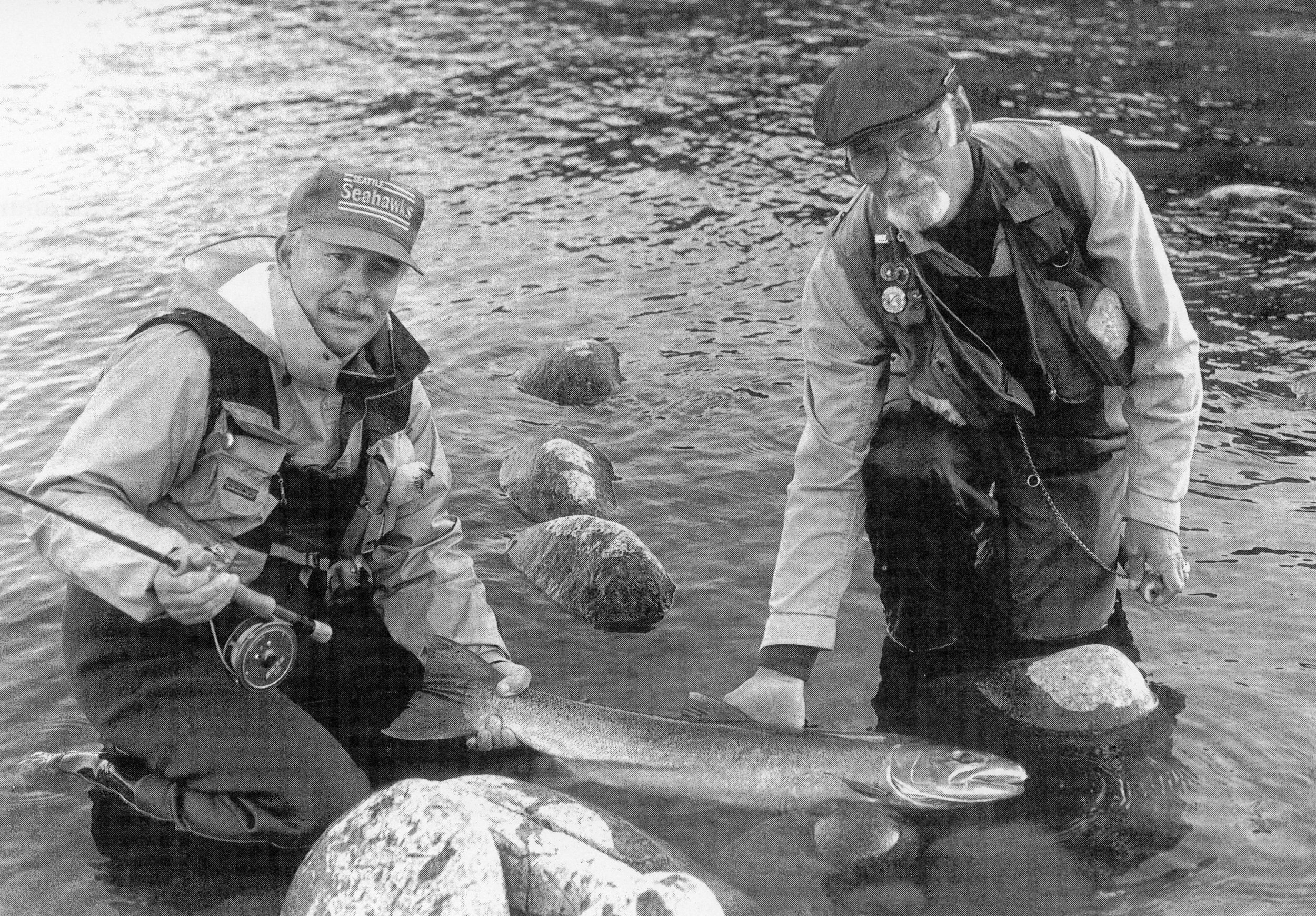
Trey Combs and Harry Lemire with a typical Thompson River buck.
The choice of rods is equally disparate, but they tend to be long. My favorite Thompson rod is a ten-foot 8-weight that controls a long belly forward-taper line with ease. This line is a lot of grains, but it carries 2/0 dubbed silhouette patterns heavy with water to lies ninety feet away.
When I wade into the Thompson, I tell myself, "If wishes were horses, beggers would ride." No part of the river is designated fly fishing only. There are no destination fly shops, and the fly-fishing heritage is best experienced by word of mouth on the gravel bars. My most optimistic expectation is for a rise a day. After all, I'm hunting for only ten to fifteen percent of the run, and on some days the river is as empty as the two motels in Spences Bridge. It is impossible not to wonder what this river would be like if the steelhead escapement were allowed to increase naturally by tenfold. The federal government's treatment of this race of steelhead, this national treasure, is pitifully shortsighted and economically wasteful. Obfuscating their way through the moral dilemma of Indians and commer-cial fishermen becoming the prime consumers of the province's steelhead is bureaucratic gridlock at its worst.
I think a lot about this sort of thing, and when my self-righteous whining begins getting the better of me, I think of Washington steelhead fly-fishing guide John Farrar.
John introduced me to a game. The rules are simple. If you had money and time in equal abundance, and could pick one different river each month, anywhere in the world, to provide the very best fishing for Salmo and Oncorhynchus in its most glamorous sea-run forms, Atlantic salmon, sea trout, steelhead, and sea-run cutthroat, what would be your twelve choices? The rivers of Norway, Scotland, Canada, and the United States get the imagination rolling. Including Argentina, with its opposite seasons, puts a nice spin on the game. Given these deceptively simple parameters, I hold that only one river stands singly and unassailably for a given month. The river is the Thompson, the month is November, and the fish, of course, is the steelhead. Raging debates attend nearly every other choice. That remains my perception of the Thompson's steelhead, a race that ranks with any other salmonid regardless of the context, a world-class resource that it is my privilege to enjoy.