Rogue River
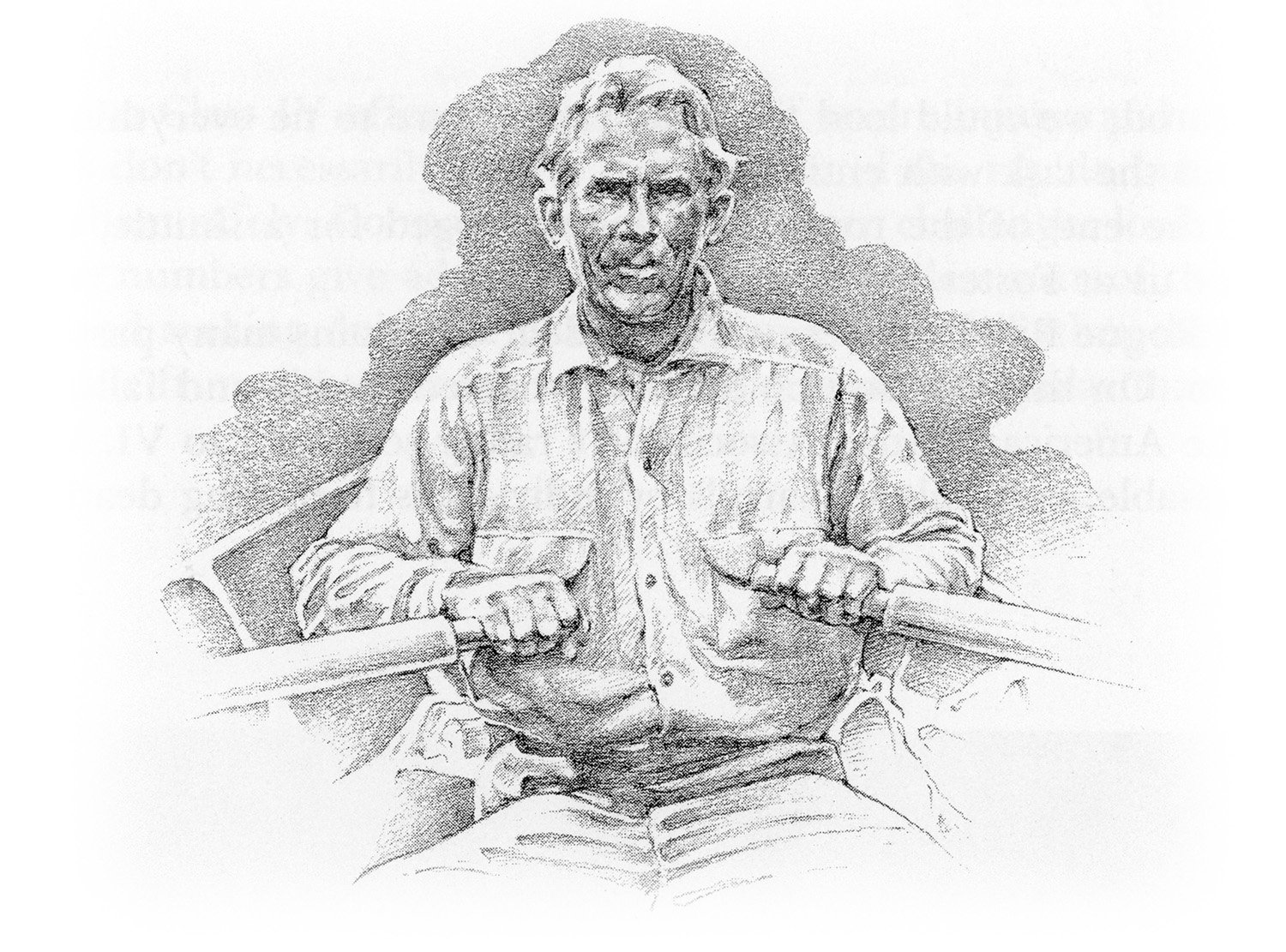
This is the complete chapter from Steelhead Fly Fishing, written by Trey Combs and originally published in 1991. It is presented here in its original form.
The elderly man approaching our McKenzie boat was an onlooker drawn by the activity that surrounded the Rogue River's Grave Creek launch. Rick Nelson and I waited our turn in what passed for a line, while ahead of us a flotilla of whitewater rafts stood by in various stages of readiness. Young guides in broad-brimmed Stetsons hastily pumped and provisioned as their clients laughed nervously and tried to help.
"Nice boat!" He ran his hand along the white ash gunwale that delineated the walnut-stained plywood hull.
Rick nodded thanks. He encourages these compliments by taking meticulous care of his boat, even waxing the sides from time to time, and I liked to tease him about that.
"Are you going to take this down the river?" The man was sincere, his rhetorical question holding only an edge of incredulity. We smiled and he shook his head.
"Look at the bottom," I said. "That sheet of plastic covering the plywood is very much like Teflon, and it's just about bulletproof." He checked the underside, and gave us a "whatever-you-say" shrug.
"Well, good luck!" He waved and wandered toward the pandemonium of the launch. If we haven't convinced him, at least we've convinced ourselves, I thought. I felt no lack of faith in Rick's ability on the oars, and I trusted the boat. I had a nearly identical boat, and the two of us had covered many river miles together.
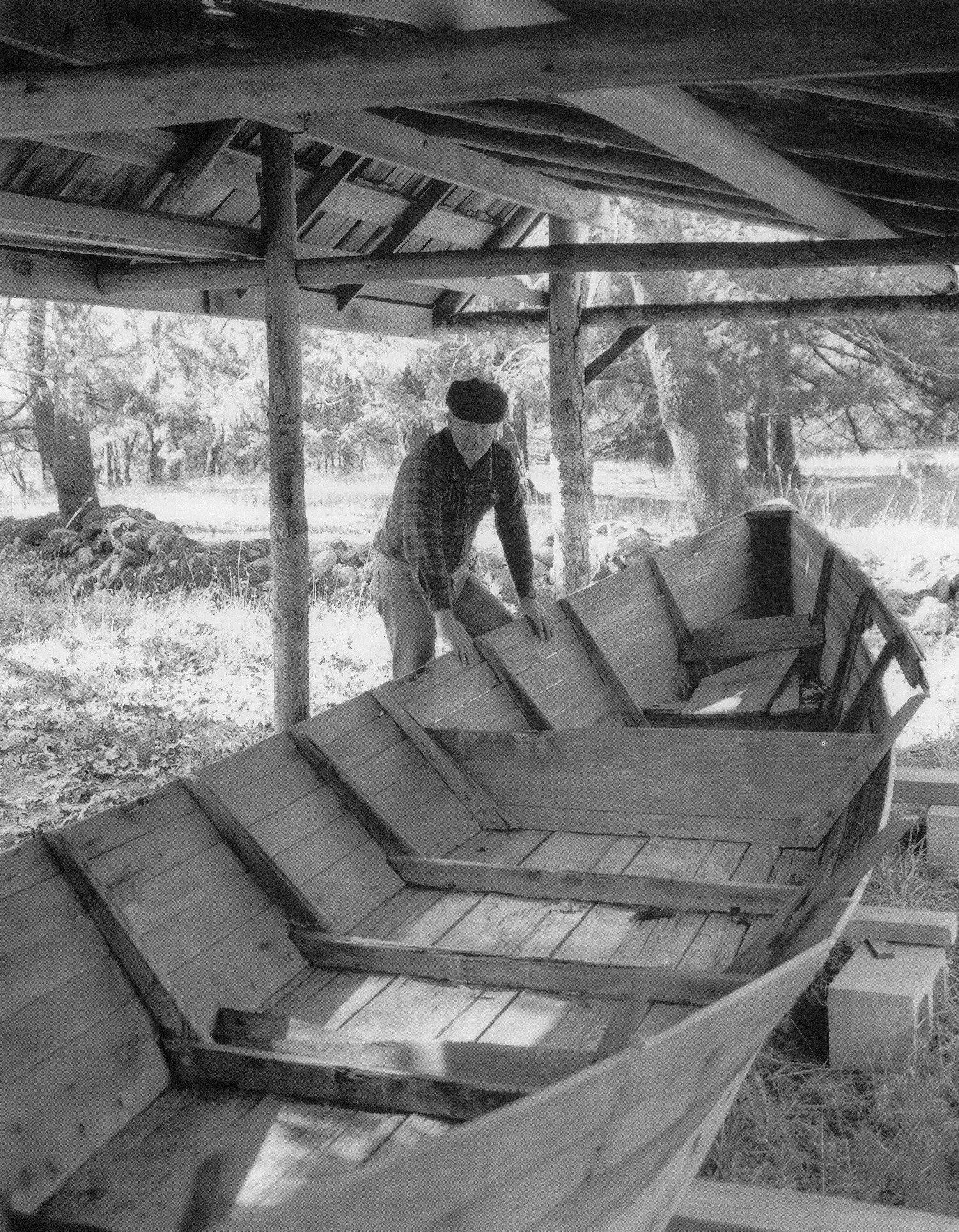
At Winkle Bar I examine one of the boats Zane Grey used to run the lower Rogue.
When our turn came at the launch, we quickly floated the boat clear of the trailer and beached it to one side. Thus cleared, we could load the boat, taking care to tie everything down. After weeks of planning, we set about the task with enthusiasm.
Grave Creek is at the end of the road. Rick had arranged for a shuttle, and my truck would be waiting downriver for us at Foster Bar.
This forty miles of Rogue River we were about to float entertains many passions. Rafting is a mania, and with good reason. On this one section are forty named rapids and falls. Many waters are Class III or Class IV on the American Canoe Association's rating scale of I to VI. While a Class I is hardly a riffle, a VI is impassable, run only in barrels by individuals harboring death wishes. A Class V is a tremendous threat to life, a Class IV offers the possibility of severe injury, and a Class III is, at least, dangerous. The numbers don't necessarily signify the violence of the rapids, but rather the degree of difficulty in negotiating them safely. Connoisseurs of whitewater challenges look for high numbers to test their skills. The same numbers give advance warning to those less sure of themselves, or to those not exotically equipped and seeking only safe passage down a river. Whether the rapids are the main attraction or not, the Rogue from Grave Creek to Foster Bar is more popular than any other comparable water in Oregon.
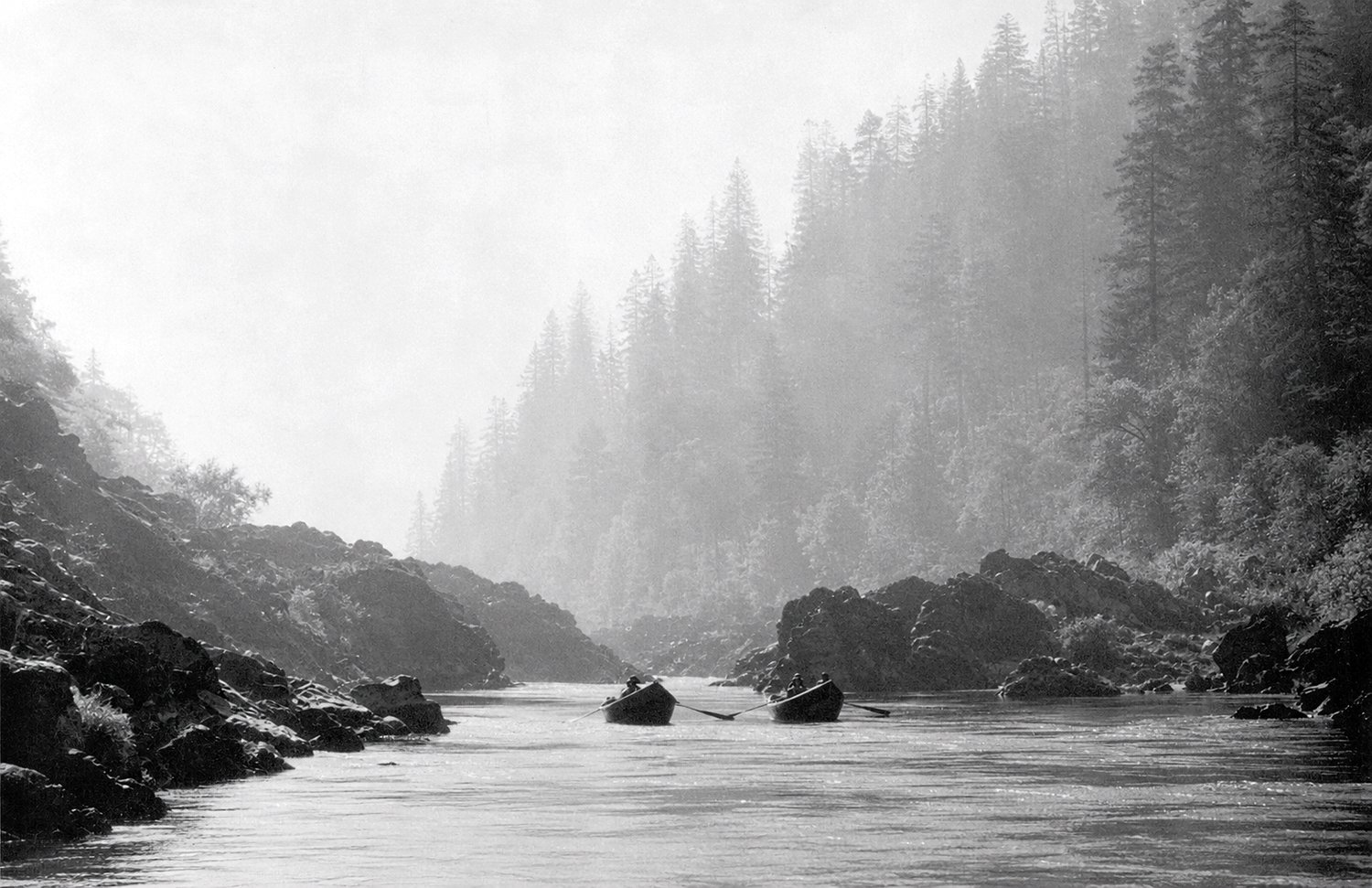
The canyon waters of the Rogue.
The Wild and Scenic Rivers Act was passed by Congress in 1968. It provided for the lasting preservation of rivers under three classifications—Wild, Scenic, and Recreational. An eighty-four-mile segment of the Rogue, from Applegate Creek near Grants Pass to Lobster Creek near Gold Beach on the coast, is designated under this act. The forty miles from Grave Creek to Foster Bar has been given a Wild River classification. This means the river must be free of impoundments, generally inaccessible, and protected in a primitive state. Backpackers gain access to the entire Wild section on the Rogue River Hikers' Trail, which begins at Grave Creek. Otherwise, access is only by boat. Either way, visiting this wild canyon water that cuts its way through the Coast Range is a wilderness experience, and many individuals need no other reason for making the visit.
There are, of course, the famous Rogue steelhead. The river and this gamefish are so nearly synonymous, so easily define each other, that the blending of mystiques has produced an image more powerful here than on any other American river. This is perhaps less true today than it was two or three generations ago, but for much of the public, steelhead first means Rogue steelhead. To a remarkable degree, that fact is the legacy of Zane Grey.
Steelhead fly fishing was in its infancy when the famous novelist first fished the Rogue in 1919. He returned to the river nearly every year, and in 1925 organized an expedition that successfully floated the river in wood skiffs through what is today the Wild and Scenic River section, Galice to Gold Beach. This adventure was described in Tales of Fresh Water Fishing (Harper and Brothers, 1928).
Today’s sophisticated angler can hardly appreciate the impact this book had on the angling public. An international following made Grey the highest-paid writer of his time. If his many world records for saltwater gamefish—and no one had more—can be considered a measure of greatness, then he was our foremost angler. He wrote volumes about his fishing adventures. One of his popular novels could be completed in a month, and many were made into movies. He was a charismatic blend of Hollywood and the Wild West, as handsome as any leading man, one of his own noble nineteenth-century characters come to life. The breast-beating hyperbole of his writing may seem embarrassingly macho today, but it captivated its generation. Grey, more than any other writer, planted steelhead in the American consciousness, and the connection between that and the Rogue River is forever fixed. His spirit lives on here with such vitality that, while visiting his old haunts, I found his presence palpable.
Our use of a wood drift boat to float the Rogue was admittedly a sentimental concession to this history. Rick knew the water well by whitewater raft, but that would not do. The wood boat demanded considerations not granted a raft. It would not ricochet easily off canyon walls. It would be nearly helpless if filled with water. Its thin plywood sides could easily admit holes.
We could not hope to copy Zane Grey's float in historically accurate detail, and that was not our goal. We could camp and fly-fish in the same places, see the autumn river much as he saw it, and hunt for steelhead with the same sense of adventure. If that engendered a certain camaraderie with his legend, then so be it.
During the winter of 1925, Zane Grey fished in the South Pacific on his motor sailing yacht and found himself thinking fondly of his time the previous year on the Rogue. Between bouts with billfish and tuna, he dreamed of a return that would include yet another adventure. This time he wanted to float the Rogue through its remote canyon waters. Grey thought no angler had ever done this before, and he was probably right. He returned to his home in Altadena, California, and spent July and August trolling for swordfish off Catalina Island. There the memory of "cool green forests, the dark shade, the thundering rapids, and the wonderful steelhead trout of the Rogue" became a sanctuary from the intense glare of the sea. He decided to make the trip.
Grey’s always considerable entourage—friends, servants, and relatives—gathered, and a mountain of gear was assembled. Although Grey was an excellent photographer himself—it was one of his many hobbies—he brought along a photographer to document the trip. He called Joe Wharton, an old friend in Grants Pass, and ordered four eighteen-foot rowboats built.
Wharton had opened the first fishing tackle store in Grants Pass, on H Street, in 1907, and it soon became a gathering place for visiting anglers. He came to write an angling column for the Rogue River Courier, sometimes published articles in Forest and Stream, and eventually gave fishing reports on the radio. He may deserve credit for attracting English and Scottish anglers to the Rogue. Certainly their use of the rod and reel was a sophisticated departure from the local custom of a long pole, a short length of line, and a fly or spinner. At Grey's urging, Wharton stocked fine quality English fishing tackle. By the 1920s, this self-styled "Sage of the Rogue," had become the most notable spokesman for the Rogue's steelhead fly fishing.
The same year Zane Grey published Tales of Fresh Water Fishing, 1928, Wharton published "Game Fish of Rogue River" in Forest and Stream in June. He wasn't bashful about the Rogue's summer-run steelhead:
“This is the run that furnishes the grandest fly fishing the angler has ever known. This is conceded to be a fact by experienced anglers who have fished all the well known trout water of the world.”
As in all fish stories, the biggest always gets away, sometimes taking part of the tackle with him. Individuals of the summer-run will weigh up to fifteen pounds with average around six- or six-and-a-half.
(These weights are unbelievable. See "Life History," at the conclusion of this chapter.)
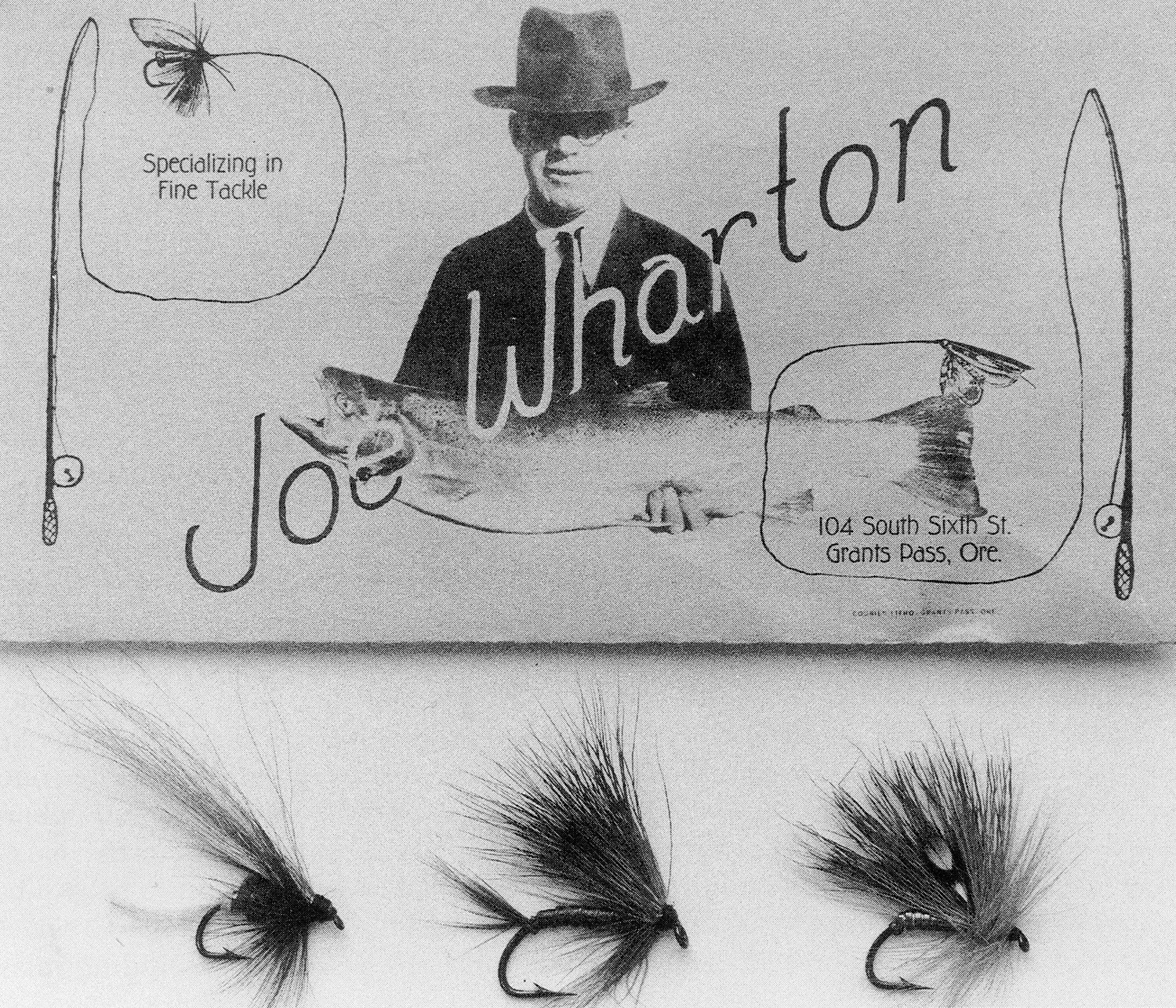
Joe Wharton pictured himself on the fly envelopes from his shop. The flies were tied by Wharton: No. 1 Special, Turkey and Red (hairwing), and Golden Demon.
Zane Grey reached Grants Pass on September 3, 1925, and finished equipping his expedition at Wharton's store. He wrote: "Wharton had secured the services of a guide and market fisherman Claude Bardon, who was born on the Rogue and depended upon it for his livelihood. Bardon said he had obtained four of the Rogue River boats, and that he did not think much of the eighteen-foot skiffs Wharton had built for me."
In fact, Bardon bluntly told Grey that the boats would never survive the trip. They were rowing skiffs, possessing squared-off transoms, and able to track well, advantages on lakes. However, they would be hard to maneuver on the Rogue, and they would come down the river stern-first, backwards, in effect. (Because river boats float downstream, with the sharp end and the rower facing downstream, they are maneuvered by rowing against the current. In this manner, they proceed downriver more slowly than the currents carrying them.) But Grey was fortunate. Wharton had found Grey's original recommendations completely unsatisfactory. The changes he had made were so complete that Grey hardly recognized the boats as those he had ordered.
Bardon arranged for four additional boats to be put at Grey's disposal. "The four boats Bardon had secured for me were of a type new to me, and certainly unique. They were about twenty-three feet long, sharp fore and aft, rising out of the water, very wide and deep, with gunwales having a marked flare, twelve inches to the foot. They looked heavy and clumsy to me, but upon trying one I found to my amaze [sic], that, empty, it rowed remarkably easy, turned round as on a pivot, and altogether delighted me." (Italics added.)
Zane Grey had taken a turn in what was the forerunner of the modern McKenzie boat.
The boats had what designers call "rocker," the fore and aft curvature of the bottom much like the two curving pieces of wood on which a cradle rocks. This curvature prevents the bow and stern from digging into the water. Also, the flat bottom had no keel, so the boats could be pivoted. This complete lack of directional stability permitted them to float comfortably downstream in any attitude, even sideways.
These craft were work boats in the coastal salmon trade. Robert Hume, the "Salmon King of Oregon," owned the lower twelve miles of the Rogue and had built the company towns of Wedderburn and Gold Beach. The Hume Company's enormous seine nets set at tidewater brought in thousands of chinook salmon. Fishermen picked out the salmon, loaded them into their two-man "Rogue River" boats, and quickly rowed the catch to the cannery at Gold Beach. With their considerable length and flared sides, the boats carried tremendous loads, easily moved when both rowing stations were employed.
The design principles of the modern McKenzie boat are identical. When these early Rogue boats were used on Oregon's McKenzie River, the upstream sharp end was squared off so that an engine could be mounted on the transom. This made it possible to motor upstream to a launch after floating downstream to fish. Today, a McKenzie boat with pointed fore and aft ends is said to have a "Rogue style."
As Rick and I began our float, he explained that Grave Creek Rapids was immediately below the launch, and that no more than a minute later we would pass over Lower Grave Creek Falls. Each was a Class III rapids.
I looked down the river, and saw that it was split by an island. "Which side do we take?" I asked.
"As soon as we launch, I'll pull hard for the left side. There isn't enough water to take the right side."
We shoved off and rowed for the south side. The rapids that had looked so inconspicuous from upstream quickly grew larger in size and sound. We were swept to the edge, where Rick held us with quick, short oar strokes. We could look down through the entire run and trace our safe route through. There was a midstream rock to avoid, and a sucking eddy before the wall at the end, where the river turned to the right in a boil of foamy rapids. When Rick was satisfied, he gave the oars a forward stroke, then feathered back lightly with little strokes for control as we raced through. We had no time for congratulations, because there was a needle to be threaded at Lower Grave Creek. Rick again carefully lined us up and eased us over the four-foot vertical drop. With a resounding splash we were past our first obstacles.
Final preparations for Zane Grey's float down the Rogue took place at the Lewis Ranch just below Galice, and approximately seven miles above Grave Creek. Bardon and his assistant, "Debb" Van Dorn, trucked the boats down from Grants Pass to complete final provisioning. Camp was set up on the banks of the Rogue, and old friends were received: Fred Burnham, Joe Wharton, Lone Angler Wiborn, and the Lewises. The roster of those making the run was filled: the two boatmen, Bardon and Debb; Romer, Grey's son; Ken and Ed, assistants from California who were now driving a truck and Grey's Lincoln to Gold Beach, which was the takeout; Captain Mitchell, a dear friend from Nova Scotia, a world-class fly caster and an experienced Atlantic salmon angler; George Takahashi, Grey's Japanese cook, a man of great good humor and astonishing resolve. Romer Grey shared a boat with Takahashi, and for the next month they would argue over rowing duties. Otherwise, each man rowed his own boat.
When the drive-around had been completed, the party of eight commanded seven boats (apparently one skiff wasn't needed), with Grey running the largest and best of the lot, a Rogue boat named 76. Though the boat was loaded without regard to weight, he was amazed to find that it drew only six inches of water. They shoved off on a misty September morning amid cheers and waves from well-wishers.
The first easy rapids, and then Chair Riffle, were passed without incident. Grey grew confident and followed Bardon and Mitchell through a more dangerous set of rapids. The other four boats were lined through. Alameda Rapids was next, and it was at the end of the road. To Grey's consternation, onlookers with cameras at the ready had gathered on both sides of the river to watch his party shoot the narrow gap of rapids.
Grey was anxious to row his own boat, but he remained prudent. At the next set of rapids he let Bardon take his heavily loaded boat through, while Captain Mitchell managed his own lighter skiff successfully. The procedure was repeated at Argo Mine Rapids, but this time Mitchell ran the skiff head-on into a cliff, badly smashing the bow. The chastened group lined the other boats down.
They continued downriver to "Rapid Number 8," an easy piece of water with a sharp turn at the bottom. Grey, managing his own craft, lost control, and the boat smashed up on a rock and remained perched there. It was leaking, and the efforts of four of the party were required to dislodge it.
"I was considerably taken aback and discomfitted, and viewed with dismay the leak in my boat."
Grey says that, now "We had smooth river and easy going for a long distance." In fact, his boat was nearly wrecked only two miles above Grave Creek Rapids. Minutes later at Grave Creek: "Soon a sullen roar greeted my ears. That sound recalled the roar of a jungle river I had once navigated from mountain plateau to the jungle level. My hair stiffened on my head, as it had many times on that wild trip." Bardon had beached his boat to hike below and scout the rapids. The party pulled their boats to the shore and waited. He returned and ordered the boats lined through, a tedious, tense, and potentially dangerous process. It was midafternoon before the last boat was through.
Immediately below them was lower Grave Creek, "a chute that was almost a sheer drop," according to Grey. The three best boatmen, Bardon, Debb, and Mitchell, would run all the boats through, while Grey and the rest of the party hiked below to get some pictures. Three boats were brought over without a hitch, and they returned upstream for a repeat, but this time Bardon struck a midchannel rock that ripped open the bottom of the boat as it went over. By the time he reached shore, the boat was nearly swamped. They switched its contents to other boats, and it was abandoned. The party resumed the float, its destination Rainie Falls, a Class VI rapids less than two miles from Grave Creek.
The Rogue River Canyon is volcanic, a creation of lava flows 140 million years ago. A greenish-black rock called serpentine extruded from deep within the earth through fault zones to become the hard and shiny bedrock channels of the Rogue. Nowhere is this more evident than at Rainie Falls.
The river is forced into a short, very narrow chute, a vertical drop of twelve feet with such dangerous hydraulics and big-water turbulence that no one dares to risk passage through unless they are in the largest raft that will fit the channel. However, on the far right side is a small side channel, a natural fish ladder, cauldron pockets strung on a stairstep no more than eight feet wide. The area immediately flanking its passage is serpentine, worn glass-smooth and slick as ice.
Rick and I brought our McKenzie to the ladder side and scouted its abrupt descent. There were no trees at the head to line from. The upstream man could only take the line around a boulder while his companion guided the boat down, pushing and pulling it here and there, hoping to avoid the worst of the rapids. We followed this plan, with me slipping and falling on the unforgiving rocks while Rick muscled out the line. There is a severe drop near the end, and we were forced to let the line run and hope for the best. The boat splashed into the quiet pool below without a scratch, more than I could say for either of us. I was glad we didn't have to repeat the process.
Grey's party landed here with six heavily loaded boats. Lining them all through proved to be a stupendous and painful labor. Several forest rangers gave them a hand, but when Grey began lining his own boat down he was on his own, holding the line directly without purchase. He badly misjudged the physics of the operation: "When my heavy boat turned into that pitway it shot down like a flash. I could not hold the rope. My feet were jerked from under me and went aloft, while the back of my neck, my shoulder and right elbow crashed down on the rock. I was almost knocked out. Fortunately, the boat lodged below, and soon the men got to it."
The boat had not suffered further damage. When the exhausted party finally made camp at Whiskey Creek, Grey summed up the prevailing attitude. "What a terrible day!" he exclaimed.
The origins of the Rogue River are found on the west-facing slopes of the Cascade Mountains, and for much of its 215-mile length it is a desert river of sagebrush and pine until it is deep within the lee of the Coast Range. Here, in fascinating transition, the lush vegetation of the foggy coast is stippled in, plant by plant, as the Rogue beats its way through the mountains. Grave Creek is still the interior, with hillsides of canyon live oak, white oak, tan oak, and manzanita, all mixed with ponderosa pine. Firs and cedars are here, too, the slopes and ridges playing favorites, holding brief stands of first one, and then the other. More often the evergreen is tucked away, the single odd neighbor in a community democratically given to many species.
As we floated downriver, I noticed how one slope was less thickly forested than another. I immediately suspected the culprit was past timber cutting practices, but Rick told me that this is a natural phenomenon. The mountain slopes on the south side of the Rogue get less direct sunshine, but they are windward slopes, receive more rain, and are forested more luxuriously. The coastal moisture-loving trees, the Douglas fir and western hemlock, make their appearance early on at these locations. Rick pointed out that some broadleaf trees actually had larger leaves on one side of the river than on the other. We discovered that far down the Rogue River Canyon the oaks remained until they were but remnant groves surviving on the little parcels of more arid ground that lay below the rain-swept mountains.
Rick pointed to shrubs growing precariously more than fifty feet up the nearly vertical canyon walls and called my attention to river debris woven into their twisted branches. "How do you think that stuff got up there?" he asked.
"The river doesn't get that high! Does it?"
"How would you account for it, then?"
I couldn't, but then I couldn't imagine a Rogue running many, many times stronger than the often violent river that was carrying us so swiftly downstream. The matter was not settled to my satisfaction until I received information from the Oregon State Game Commission and read that the river is subject to remarkable changes in level, a condition emphasized in the narrow canyons. Peak stream flows occur in January, and to a lesser degree in May, corresponding to periods of peak rainfall and melting snowpack. Extremes recorded range from 45,000 cubic feet per second (cfs) in late January 1970, to 663 cfs in late September 1963, a ratio of nearly sixty-eight to one! These remarkable differences are due to the large area drained, approximately 5,000 square miles, a basin measuring 110 miles long and 50 miles wide that includes California's Siskiyou Mountains, the headwaters of the Rogue's Applegate and Illinois rivers.
Canyon water is often poor fly water for the angler who prefers the intimacy of wading while finding his steelhead. This is particularly true of the Rogue's canyon, where much of the fishing is done from McKenzie boats. Anglers port and starboard strip line from their reels until the flies are working well below the boat. The guide backrows, slowing the boat down and working the flies through the lies, in effect doing the fishing.
"Hotshotting" flies is not a practice without appeal here. Elderly people, wives who would otherwise not fish, rank beginners, and children enjoy grand sport amid spectacular scenery. The flies are small, traditionally with a split wing for additional disturbance in the surface film, and often tied on double hooks to assure an even keel run in riffles. Experienced anglers could, of course, cast from boats in this water, but few do. Most wait for the convenience of the few open bars to do their wading.
Lodges exist along the Wild river, too, beginning with Black Bear Lodge at mile 8.8 from Grave Creek and ending with Peyton Place Lodge at mile 31, a half-dozen in all. Guided parties can travel from lodge to lodge, a convenience we did not seek, and a luxury not available to Zane Grey's party in 1925.
Tyee Rapids, Class IV, is the first serious piece of white water that Rick and I encountered. It gained its rating for the considerable maneuvering required to avoid a midchannel rock in the throat of the run, a demonic suckhole just left of center, and a rock ledge waiting at the end to dismantle your craft. "SCOUTING MANDATORY!" say the guidebooks. We were only too happy to oblige.
Rick studied the passage until he had memorized a "distance divided by strokes equals time" formula. Confident of where he would be and what he would be doing through Tyee's entire length, Rick nudged the boat back into the currents and picked his way down the rapids. I wanted to hold up a card with a "10" on it, so perfect was his performance.
Zane Grey camped at Whiskey Creek for several days. He hiked down to Tyee Bar and caught his first steelhead of 1925, "one about two pounds and the other around four." He had fished all the standard fly patterns without success; both trout were caught on a spinner. Bardon and Debb shot two blacktail bucks and satisfied the camp's need for fresh meat. They also hiked back upriver to Grave Creek and were able to repair and bring down the abandoned boat. Early on a cold September morning with the promise of rain in the air they shoved off, Grey again at the oars of 76.
"We ran two rapids, one a short dip, and the second a long shallow curve full of rocks, before we came to Tyee Bar Rapid. This was a zigzag aberration of the river, and not even Bardon had a notion of running it. We shoved, waded, pulled, and lined the boats over Tyee, with the amount of labor that gave us a foretaste of the day ahead."
Slim Pickens, Class III, was named by early miners for the extreme narrowness of the chute between a house-sized boulder that sits well right of center, and a rock outcropping on the right side of the river. The wisdom gained from a casual glance would send any sane boatman fleeing from this gap. It is so narrow that oars must be shipped, and it looks narrower still from an upstream vantage point. Water left of the midstream monolith is most inviting, but rocks are lurking there just beneath the cascade of foam. Those miners—no fools they—dynamited this chute out to its present claustrophobic dimensions. When Rick called my attention to it, I was dismayed.
"You're not going to try running through that, are you?"
"That's what the book says to do."
Rick often went left with his large whitewater raft, not caring to squeeze its bulk into the narrow chute. My question caused Rick a moment of indecision. He was pushing hard on the oars, driving us to the left, going with his instincts, when a powerful current grabbed the boat and shoved us hard to the right. Rick was no longer slowing us down by rowing upstream, no longer pointing at what he didn't want to hit, and the McKenzie, with crack-the-whip suddenness, smashed into the huge rock. We glanced off, and he laughed, the second of terror not really registering.
"Are we okay?" he asked, confident that we were. I looked along the inside chine, and then stood up, leaned over, and checked the hull.
"No, Rick, there's a hole in the boat, and water is coming in."
"No! You're kidding!"
"No, I'm not. See for yourself."
I moved aside and he peered over the seat.
"No! No! NO!" He was sitting down now, head bent low, and he was moaning his despair. Self-loathing is a by-product of such mistakes. I told him there was no immediate danger of us sinking. I assured him that the boat could be repaired, that the disgrace would be reduced to a cosmetic blemish. But he was deaf to my reassurances. In the end, a new set of rapids, and the concentration they required, prevented Rick from blaming himself to death.
Zane Grey makes no mention of Slim Pickens, and we encountered no difficulty with Horseshoe Bend Rapids. This is a series of two Class II rapids, followed at the end by a Class III, the higher rating due to an abrupt left turn the river makes, leaving one flying toward a rock wall guarded by a barely submerged boulder. My guidebook warns of this hazard. "This is a dangerous boulder and has taken several lives and many boats!"
One of those boats was part of Zane Grey's party.
Bardon's custom when he arrived at water that required scouting was to pull ashore and warn those who followed by waving a red handkerchief. This he did above what is innocently described in the guidebooks as "Rapids Number 3." The group decided that Captain Mitchell, Debb, and, of course, Bardon, should run the boats through. Eventually, six boats were safely below the rapids. Debb returned upriver to bring down the last and most heavily laden boat. The boat struck the rock in the gut of the run and flipped, spilling its contents into the river, filling with water, and wedging itself among rocks along the tailout only ten feet from shore. When Grey ran upstream he found Ken running downstream trying to rescue dozens of lemons dotting the current. Shoes, loaves of bread, cans, and assorted boxes were chased, and most of the cargo was recovered.
The boat was another matter. Bardon ordered, instructed, and coached. Logs, poles, and all the rope they could find in the remaining boats were used to lever and pry. Bit by bit, they pulled the boat apart. The stern seat was ripped out, the ring-bolt in the bow pulled out, the seams opened up, the ribs broken out. When they finished, what was left of the boat was still jammed in the rocks.
Four miles later, they camped across the river from Battle Bar, the site of a "battle" between the U.S. Cavalry and a resident band of Indians in 1856.
Colonel Kelsely's command of 545 men attacked an encampment of 200 Indians, mostly woman and children, on Battle Bar, from his north-side position. He had collapsible boats but dared not use them. Each side was reduced to shooting across the river at the other. The Indians reportedly lost twenty to thirty of their group; one soldier died. This event was the last chapter in an extraordinarily dreary relationship between Rogue River Indians and whites.
Whites first explored the Rogue River area for the Hudson Bay Company in 1825. Apparently, the Indians were hostile from this first meeting, for French trappers referred to them as Les Coquins, "the Rogues," and the river as LaRiviere aux Coquins, "The River of the Rogues." Jedediah Smith led a party of seventeen men into their lands in 1828, a decision he soon regretted. Only Smith and three companions escaped from an attack.
The Indians were pretty much left alone until the early 1850s, when the discovery of gold started a general invasion of their lands, first at Josephine Creek on the Illinois River, the major tributary of the lower Rogue, and then at Galice Creek on the Rogue itself. Skirmishes led to hostilities and vigilante justice by "volunteers," local citizens organized into a murderous ragtag militia. More than once, the army was called in to protect Indians from white citizens. On September 10, 1853, both sides signed a treaty giving to the United States the entire Rogue River Valley and to the Indians a reservation at Table Rock. This should have been the end of it, but a "volunteer" group, organized in a saloon, attacked an encampment of Indians at Little Butte Creek, killing eighteen women and children and twelve old men. Thus began the Rogue River Indian War of 1855-56. The Indians made life hell for valley settlers and paid dearly for their outrage. Faced with the prospect of combat with a thousand soldiers, Chief John and his thirty-five warriors surrendered on June 29, 1856. His revolt was the last.
About a mile below Battle Bar, the valley abruptly opens up on the north to a sloping sward of green that holds a grove of white oak. Along the beach, the river is a smooth glide, perfect steelhead water for at least a quarter of a mile, and any reasonably skilled fly fisherman can cover it all. The slopes above the river to the south are steep and blanketed with evergreens. Early in the afternoon they throw long steeples of shadow across the run as the oaks remain toasting in the bright heat of the day. Above the top end of the run, Hewitt Creek enters. Steelhead know this and may linger below the confluence to enjoy the smells. These are lovely parts, and the whole is perfection, doubly so when one is so dramatically liberated from the confining ways and tense nature of the canyon waters.
In 1925, a gold prospector owned this bar and the neighboring hillsides. He called his mining claim Winkle Bar.
Grey's party stayed for days at Battle Bar, fishing mainly camp water, but striking out occasionally to explore other riffles. No one was faring well in their collective hunt for steelhead, and Grey, in particular, was beginning to chafe over his poor luck. And now, intermittent rain and overcast adoed to his personal gloom.
One day, George Takahashi arrived back at camp with a three-pound steelhead and a broken rod. The little cook, without guile or vanity, tells a fishing story that is a perfect blend of fortitude and awe. If there is a patron saint of the big one that got away, this man is it.
My rod bent down to water. Then big steelhead come up, crack! He jump way up high. More bigges' steelhead I ever see. He jump and jump. He tuzzle like dog shakin' water off. Oh, awful big fish! He weigh twelve or fourteen pounds. He go down an' run up rapids. Make my line whistle in water. He jump out of white water, six feet up. Awful pretty! But I scared I no get him. Then he run downriver an' I run too. He jump more times. I count fourteen jumps. But he go faster down run than me. He take the line. I fall down. Break my tip. But steelhead still on. I get some line back. Lots big rock. Deep water. Me have to go slow. Steelhead make more faster run an' tear out hook. Then I feel awful sick.
Grey knew enough to believe the story and set out immediately in the rain for the very water Takahashi had left. He "tried George's way of casting as well as my own." Not a touch.
"I trudged campward through the wet willows and under the dripping alders to end my seventh unsuccessful day of fly fishing."
The next morning, a forest ranger appeared at their camp. He told the party that the big run of steelhead wasn't in yet, and that the best fishing water was actually below them at Winkle Bar, only a mile down the trail.
A couple of days later, Grey hiked up to the ridge line, picked up the trail, and walked downstream for Winkle Bar. The storm had passed through, and brilliant sunshine cheered him.
"And then up and down Winkle Bar, I fished all of one of the briefest and happiest days I ever had."
A day later, Ed returned to Winkle Bar and killed a magnificent steelhead of 8 ½ pounds. The day after that, Takahashi brought in one of nearly six pounds. The irrigation dam above Grants Pass was opened, and the lower river was badly muddied. Grey railed against the unwelcome appearance of miners, prospectors, "half-breed Indians," and a few whites who were destroying his solitude. Also, he could not find a steelhead. While he remained unfailingly gracious about his lack of "luck," it must have been wearing on his sense of pride. As the party left for the "long dreaded encounter with Mule Creek Canyon," he nurtured a single thought: "I was sorry to see the last of Winkle Bar, and resolved to get possession of that particular strip of sand and rock if such were possible."
It was. The next summer, he purchased Winkle Bar. Charles Pettinger was hired to pack a massive amount of gear to the site, using the north-side trail. The task required sixteen mules, and eight saddle horses brought in the gang from the previous year. Bardon, his father, and Debb had already been at Winkle Bar for a month, constructing a flume that would bring water down to Grey's future cabin. R. C., Grey's brother, and Loren Grey, the author's nine-year-old son, joined the group.
In the grove of oaks, they constructed a cabin that was large enough to house the immediate family. Cabins, open on one side, really tiny shacks, were built to accommodate the many guests that Grey's adventures attracted. There would be a woodshed, an outhouse, running water, and a New England style stone wall to border the little complex. Though it looked little better than a hobo camp, Winkle Bar became the most celebrated steelhead camp of its time.
Rick and I arrived at Winkle Bar late on a radiant morning, floating out of the canyon shadows to be carried unexpectedly back in time. The cabin and outbuildings looked as though they had been left by Grey the day before. Squirrels busied themselves about the stone walls, and I waited for little "Lorie" Grey to chase them for their cheeky ways. A large shed housed one of the Rogue River boats that Bardon had secured for Grey. It has fallen into disrepair, but its lapstrake lines were remarkably pleasing to the eye, the two rowing stations evident, the construction details of interest to this boat-builder. The sides just above the chine were doubled, early "rocker" panels that gave extra protection against obstructions. The log cabin was about twenty feet on a side, the roof extending over the front door and stoop. Several bunks and a woodstove appeared spartan and cheerless in the faint light. I stared inside until I grew tired of listening for voices. I sat on the stoop and looked down on the Rogue. Soon Winkle Bar would be in shade, its steelhead liberated from the bright exposure while the cabin faced into the last light of day. I could sit with Grey and watch Captain Mitchell, Romer, and George Takahashi work their flies through the sweep of Winkle Bar.
When the past had seeped into my every pore, I returned to the McKenzie boat, slipped into my waders, and gathered up my fly tackle. We had brought our boat in behind a tiny hook of the gravel bar about a third of the way down the run. So perfect was this accommodation that I wondered if it had been dug out with boats in mind. I studied the little bight of water, computed that a half-dozen of Grey's Rogue River boats would fit into it nicely, and then headed for the top end of Winkle Bar, entering the river well above the holding water.
The steelhead came to my fly, a half-pounder that jumped mightily and wrestled unequally with the force of my 5-weight rod. Another half-pounder followed the first, and another after that, as I came off the top end of the run. No steelhead was more than fourteen inches. They recklessly charged after the low-water Skunk, and so long as I didn't think that larger steelhead should be about, I was satisfied. My success gradually generated a sense of unease. I was finding only half-pounders in my sampling of Rogue River steelhead. Where were the fall fish of Rogue legend—those big steelhead that, as Joe Wharton put it, leave and "take part of the tackle?" Could my fishing in some way be selective for these smaller steelhead? Was I fishing the wrong kinds of water? Was I too early in the run? Too late? Other questions occurred, more fundamental and troubling. Was this a different Rogue from the river of Zane Grey's time? Or had the author indulged his fantasies with some artistic license? These thoughts were emotional checkpoints as I took my pleasure with the spirited little trout. I didn't regret that they weren't larger, only that my tackle wasn't lighter. A 2-weight outfit would have been ideal.
Winkle Bar is at only mile 14.9 in the forty-mile Wild section of the Rogue River. At mile 20.8 the river plunges through an extremely narrow gorge with such severe upwellings that a boat is suddenly beyond the control of the most skilled oarsman. Rick and I spun our way through Mule Creek Canyon with my hands on the gunwale and my feet on the canyon walls, our cries of alarm blending with the roar of the rapids. Zane Grey's party passed this way in a similarly graceless fashion and was equally undamaged.
Less than two miles below Mule Creek Canyon, Class IV, is Blossom Bar Rapids, Class IV, the most difficult piece of water on the Rogue. Bardon announced the rapids in this manner: “‘Blossom Bar!’ he yelled to us. ‘An’ she’s a wolf—she’s a bear cub! It’ll take all day tomorrow to drag an’ line an’ skid the boats round here.”’
Bardon's apprehension was well placed. Blossom Bar, named for the wild azaleas dotting its flanks, is a snaggle-toothed cauldron of foam and trailer-sized boulders. There is no direct line through it. In fact, one must pull from one side to the other while passing around the obstacles like some sort of fear-crazed pinball.
Rick pulled out above the rapids, and we walked to a vantage point where we could discuss the run.
"Over there a raft got caught crosswise, pinned right against the big rock," he stated.
More descriptions of agony and travail followed, a rite of purification I could have done without. Then Rick fell into contemplative silence and studied the run while I walked back to check on the boat. When he returned, we ran Blossom Bar without hesitation. I was thankful that this dangerous water had been civilized a bit since Grey's time. Otherwise we, like Bardon, would have faced the dispiriting task of lining our boat through. But we did not, and that night we drank a quiet toast to Glen Woolridge, the "Grand Old Man" of Rogue River folklore.
Grandfather Woolridge had settled a mining claim on Foots Creek of the Rogue in the late 1850s, and Woolridge was born here. He was nineteen years old in 1915, when he constructed a crude boat, and with a fellow gill-netter named Cal Allen floated from Whiskey Creek to the coast in five days, almost certainly the first people ever to make the entire trip. During the next half-century he repeated the trip hundreds, if not thousands, of times. It became his habit to clear parts of the river by placing dynamite in a sack of rocks, lighting the fuse, and lowering the sack down to the base of the rock that needed moving. Then he quickly removed himself from the scene to view the results. Rock by rock, difficult portages became challenging runs. Nowhere is his success more celebrated, and his artistry with dynamite more evident, than at Blossom Bar.
Zane Grey knew Woolridge, knew his reputation, and several times hired him to guide. When Grey stated that he was the first angler to float the Rogue to the sea, he was mindful of Woolridge's far-less-celebrated Huck Finn journey.
Once the exhausting work of lining their boats through Blossom Bar was completed, Grey's party floated on to Solitude Riffle, mile 26.8, and camped on the long bar of sand and gravel running beneath wooded benches. lvin Billings, a "native," informed the party that he had taken five steelhead from Solitude the night before, the largest going seven pounds. The prospect of fishing the long-awaited run seemed all but certain, and the anglers were greatly encouraged. On the third day, Romer caught a four-pound steelhead on a two-and-a-half-ounce Leonard, a contest accompanied by considerable merriment, because he was soon floundering with the steelhead in the river. Captain Mitchell found nine steelhead to three pounds with a small double-hook Dusty Miller. Grey's "persistent bad luck," lasted only through this day. "On the thirteenth day of my protracted spell of unrewarded fishing, late in the afternoon, I caught my first steelhead on a fly."
The fly used to bring about the change was a Golden Grouse, one of a number of English patterns the party generally fished with Hardy Brothers rods and reels. (Grey's little U.S.-built Leonard rod being a lovely exception.) Two more steelhead came to Grey's fly. All were killed, and that night's entree was fresh steelhead.
George Takahashi called to Grey across the campfire, "My goodnish! Now you be in good humor!"
Ivin Billings returned to their camp to tell them that the salmon cannery at Gold Beach would shut down on October first, and the market fishermen would then be pulling their nets from the river. He predicted the big steelhead would arrive at Solitude by October 4.
Grey writes: "On October 5, steelhead began to arrive in considerable numbers, and after that the run increased. On another fine cloudy day we caught twenty-two steelhead, seventeen of which fell to Captain Mitchell, Romer, and me. Captain beached a six-pounder, and Romer one over five. These fish were extraordinary fighters."
Solitude was the high point of the float, a realization of expectations, a time of carefree byplay among friends. Grey was finding steelhead almost at will, usually when fishing a Professor with jungle cock wings. There was some deer hunting among the tan oak groves. The party noted the sudden cerise of the fall vine maple, the golden tones of the big leaf maple along the river corridor. Now there was frost in the morning. The big fall southerly that traditionally marked the passing of summer was overdue, and when it came the Rogue would be out for days.
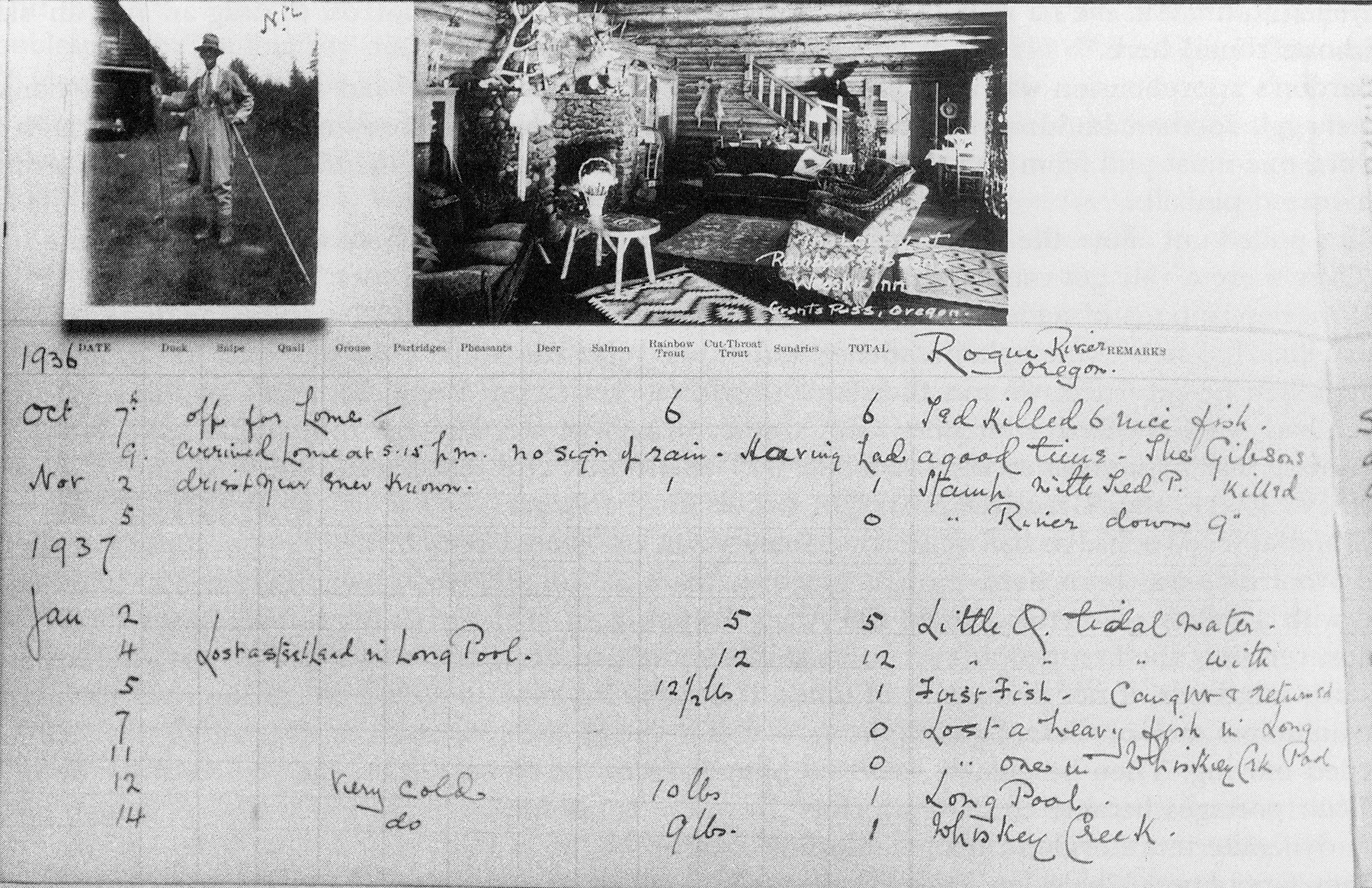
A page from General Money's gamebook following his stay at Weasku Inn. Note entry for October 9.
The decision to leave was made for them when the Rogue grew discolored, the result of an irrigation dam above Grants Pass. A couple of days later the party heard the "low distant pounding of the surf" at Gold Beach.
Rick and I would not follow Zane Grey to Gold Beach. When we reached Foster Bar, our take-out, the Rogue was flowing to the ocean rather than tumbling from the Coast Range. For the next thirty-five miles only a few Class II rapids required more than casual consideration. Grey's adventures were over at Foster Bar, too. Nevertheless, as we pulled our boat free of the river one last time, I was sad to be leaving his party. I would meet Grey, Romer, Takahashi, Bardon, and Captain Mitchell again on another float down from Grave Creek, a happy reunion with old friends, but one I knew to be several years away.
Grey's Tales of Freshwater Fishing focused national attention on the Rogue, and for the vast majority of anglers who had never seen the river or its steelhead, the Rogue could be only as Grey described it. When they sought to experience the Rogue firsthand, lodges and resorts were built from Grants Pass to deep within the wilderness.
Rainbow and Peggie Gibson sold their lodge in Big Bear, California, and purchased Weasku Inn on the Rogue in 1927. It soon attracted a celebrity crowd from the motion picture industry that included Clark Gable, Carole Lombard, Ann Sothern, Robert Sterling, David Niven, Jackie Cooper, and famous Hollywood directors and producers.
Glenn Woolridge guided President Herbert Hoover and Ginger Rogers, and both became Rogue regulars. The actress eventually bought her own ranch on the river. A famous photograph shows Rogers standing with Woolridge and holding a 6¾-pound steelhead, the largest caught that year on a fly from the Rogue. President Hoover once hired Woolridge to repeat Zane Grey's trip, and the two floated all the way to Gold Beach.
Novelist Jack London and heavyweight boxing champion Jim Jeffries came to fish the Rogue. Al Knudson of Washington steelhead fly-fishing fame moved to the Rogue in 1929 and tied flies commercially. No less a figure than the much-venerated General Noel Money of Qualicum Beach, British Columbia, made a trip to the Rogue the first week of October 1936, and stayed at Weasku Inn.
Not all anglers who came to the Rogue did so for its steelhead. Chinook salmon were a special attraction. They were an unusually robust race, were commonly found in fresh runs from spring until fall, and often exceeded thirty pounds.
At Rainbow Gibson's Weasku Inn, piers and floating salmon boards were built, and eighteen boats kept in operation for guests, who averaged ninety salmon a day. During the peak run, the boats were anchored so close together in famous Pierce Riffle that one could cross the river by walking from boat to boat.
These chinook salmon were the source of great commercial enterprise and intense disagreement between commercial factions. A famous brawl near the mouth of the Rogue between Claude Bardon, a gill-netter, or "market fisherman" as they were then known, and George Macleay, who headed up a group of seine-netters, became the basis for Zane Grey's novel, Rogue River Feud.
What was at first a conflict between seine-netters at the mouth and gill-netters in the Grants Pass area ended when commercial netting was outlawed in 1910. This law was compromised in 1913, when gill nets were again allowed. But in 1935 all commercial nets were outlawed, and the Rogue remains free of nets to this day.
No other river in the West can claim such glittering alumni as the Rogue. Today its fame rests most solidly on its extraordinary recreational value, and to a degree, this has always been so. But during the early years of steelhead fly fishing, this wild and beautiful river was the essence of our sport.
Rogue River Fly Patterns
Rogue anglers divided their river into three sections, the canyon waters of the Coast Range, a middle section through Oregon's interior valley, and an upper section with headwaters in the Cascade Mountains. By the 1950s they had come to associate small split-wing flies tied on double hooks with the lower Rogue. Guides would backrow their McKenzie boats and fish their clients' flies through the most desirable riffles. These double hooks were, of course, a British tradition, especially useful when a small hook was expected to hold a large salmon. But their value among Rogue anglers was due to the manner in which the fly fished, the double hook hardly necessary to hold trout rarely exceeding four pounds. The split wing supplied a lot of action, whether the fly was swimming subsurface or waking in the surface film, but without a double hook it was likely to lie over on one of the wings, its action spoiled. Colors were generally bright for the fresh runs of ascending steelhead. Some examples used down through the years in #8 and #10 have included the Juicy Bug, Red Ant, Old Mare, Rogue River Special, Golden Demon, and Curt Special.
Double hooks have never been popular on the middle and upper Rogue. (Today, "upper" is likely to be from Gold Ray Dam, Mile 125, to Mile 160; "middle" is still somewhat vague, but generally between the start of the canyon water, Mile 68, and the dam.) Some patterns are common to both ends of the river, but flies for the upper Rogue in #6 and #8 tend to be more somber for the temporarily residential steelhead. The single wing is tied long and reaches to the end of a long tail, a style every bit as characteristic as the compact little double-hook dressings of the lower Rogue.
Bob Pierce, a Rogue regular and former fly-shop owner from Talent, Oregon, feels the Juicy Bug, Red Ant, and Golden Demon are the most popular patterns on the lower Rogue, while the drab and "deadly Chevaney, Green-Butt Skunk, and Silver Hilton are favorites on middle and upper sections. The Girdle Bug in a variety of colors, Irish Hilton (identical to the Silver Hilton save for a tail of peacock sword fibers), Brindle Bug, and the Tiger Paw, a Joe Howell dressing recently brought down from the North Umpqua, are also much in evidence on the Rogue from Grants Pass to above Gold Ray Dam.
Life History
The Rogue steelhead divides into two discrete races, summer-run fish that enter the river from May until November, and winter-run steelhead that begin to enter the river in November. For years, anglers assumed the summer run was further divided into three subraces. There was an early "springer" run in May, June, and July, with a high proportion of adult fish weighing two to eight pounds; an enormous August run of mostly half-pounders averaging less than a pound: and a fall run that began in August and lasted until well into October that again held a high proportion of adult fish from two to eight pounds. By midwinter these three groups had all moved well upstream to mix with winter-run stocks. The adult steelhead would spawn from January to June, depending on their time of entry and racial origin.
The Oregon State Game Commission conducted an extensive study to determine the exact nature of these runs so that they could be more properly managed. Ecology and Management of Summer Steelhead in the Rogue River, Fishery Report Number 7, revealed that repeat spawning adults are often casual in their run timing, a "June" steelhead becoming July or August steelhead the next year. In one sampling, 432 maiden wild steelhead were netted from the Rogue estuary in 1969, with 103 fish from the early run June, July) and 329 from later runs (August, September). For all practical purposes, the life histories for the two periods were identical.
A total of seven life-history categories were represented. The steelhead's freshwater residency before smolting and making an initial migration to sea was typically two or three years. One year was uncommon and four years extremely rare for a single fish. The percentages of half-pounders in each sampling was remarkably similar, 97 percent and 96.6 percent respectively. The balance of fifteen steelhead from the sampling of 432 maiden steelhead consisted of fourteen with one complete year of ocean residency, and a single two-year ocean steelhead. The sampling illustrated that nearly all Rogue steelhead pass through a half-pounder stage of development.
The size of the fourteen one-year ocean steelhead ranged from 18.5 inches to 22.3 inches, the larger steelhead in this age-class generally having had a three year premigrant residency.
The single 2/2 steelhead is representative of an extremely rare age category. (At 29.1 inches it weighed approximately nine pounds.) The very largest Rogue summer-run steelhead will have this life history, for three-year ocean steelhead are unknown. The single fish makes it impossible to determine average or maximum size, but based on angling literature available on the subject, twelve pounds would be a most extraordinary Rogue summer-run steelhead, a fish rarer than a thirty-pound Kispiox steelhead. Just before driving to Grave Creek, Rick Nelson and I visited Jim Matney, a guide who lives on the Rogue near Galice. I asked him about any trophy steelhead caught that fall. "The largest I've heard about was twenty-five inches," he said.)
In a second sampling, wild steelhead were tagged on their initial upstream migration and 154 recaptured on a second run. The half-pounders averaged 14 inches on their first run, and 19.2 inches on their second, an average growth of 5.2 inches with a range of 2.5 to 8.5 inches. This is typical of all steelhead in the ocean for a similar period-two to four months. The difference, of course, is that most other races do not return to their natal rivers so prematurely.
Steelhead recaptured on their third, fourth, and fifth spawning migrations averaged 22, 25.3, and 27 inches, respectively.
The length frequencies for all samplings combined (1969 and 1970), showed that approximately sixty-five percent of the Rogue's steelhead were less than sixteen inches long. The balance (thirty-five percent) was dominated by first-spawning steelhead under twenty-two inches. Steelhead over twenty-two inches for all age groups comprised less than five percent of the entire run, and most of these fish were between twenty-two and twenty-four inches. Steelhead more than twenty-four inches made up less than one percent of the total.
The speed of the steelhead's upstream migration was directly related to their time of entry and spawning destination. Adults tagged in the estuary in June and later recaptured at Gold Ray Dam covered the 125 miles at an average daily rate of 4.5 miles. One adult reached the dam in nineteen days, an average of 6.5 miles a day. The maximum observed rate of travel was thirty-two miles in four days. Adults tagged in July, August, and September averaged about one mile per day. These later arriving steelhead also tended to spawn lower in the system. Approximately five percent of the steelhead spawned between mile 65 to 95, eighty to eighty-five percent spawned between mile 95 to 125, and twelve percent above mile 125.
The half-pounder population, over 100,000 steelhead with a male-to-female ratio of one to one, remain almost entirely in the lower fifty miles of river. The exception is a small percentage of sexually precocious males, perhaps as many as six thousand, that migrate above mile 68 to spawn with adult steelhead. An underwater census by divers suggests that immature half-pounders may begin returning to the ocean as early as November. It is suspected that the half-pounders' nonspawning migratory cycle is shorter than that of the adult steelhead.
The Rogue steelhead's annual spawning migrations take eight to nine months, leaving only three to four months at sea each year. This very short growth period is the reason why even old Rogue steelhead, the survivors of many spawning migrations, do not obtain the size other steelhead races reach for the same age.
The Rogue River of a half-century ago that inspired such high-blown praise for its large steelhead is recognized today for its abundance of steelhead that are the world's smallest. While the past and present do seem to describe two different races of steelhead, we are probably viewing the same race from opposite ends of the life-history spectrum. Zane Grey and Joe Wharton wrote in bigger-than-life terms, and their embellishments were not easily confronted in the 1920s. (The reader searches in vain for stories of days with the little half-pounders.) Perhaps more important, the river was its own unique frame of reference, and it did not suffer from the demystifying scrutiny that scientific investigations can bring to legendary reputations. Conversely, because of today's heavier angling pressure, the Rogue steelhead is less likely to survive four or five spawning migrations and reach five, six, or seven pounds. As always, the quality of our sport is a direct result of how we manage the resource.