North Fork Stillaguamish River
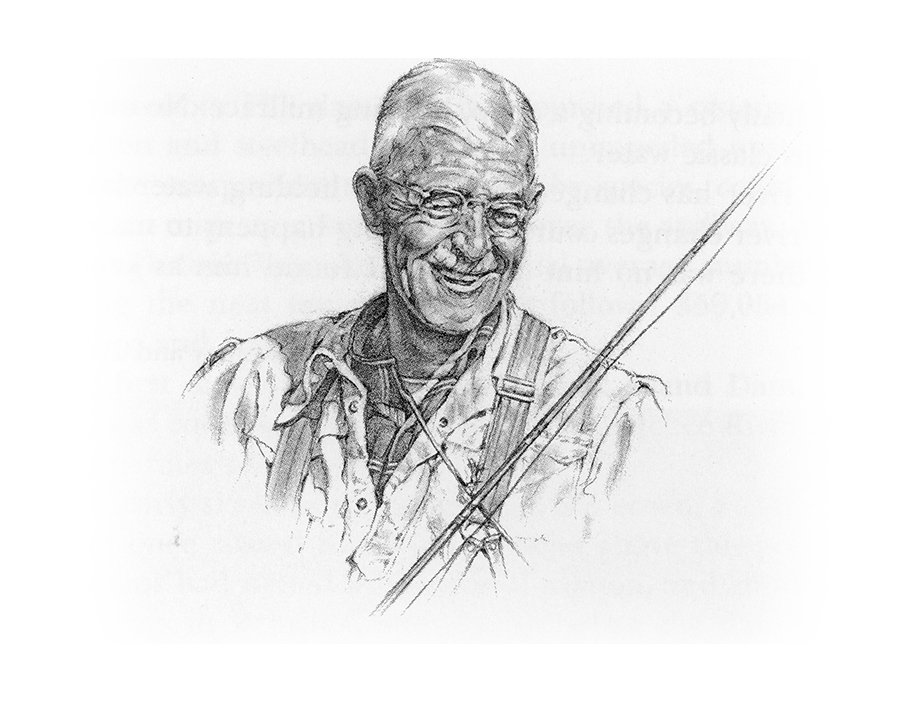
This is the complete chapter from Steelhead Fly Fishing, written by Trey Combs and originally published in 1991. It is presented here in its original form. Desktop only: Right-click any image in this essay to open it in a new tab to view the high-resolution version. This feature is not available on mobile.
When Walt Johnson paused on our wade up the long tailout, I could hear him over the sounds of the Stillaguamish. "The cabin I owned is in that grove of trees. See, to the left of the red cabin? That one belonged to Frank Headrick. Now his son owns it. Just downstream from my place was Wes Drain's."
"Didn't Al Knudson have a cabin here, too?" I asked.
"Not really. Kind of a shelter, you know, four posts and a roof. There was a picnic table and an outhouse. Al kept one of those big commercial soft drink coolers out front. Had his property next to Drain's place. Some people had lots just off the highway for trailer sites. Ralph Wahl had a trailer here for a while."
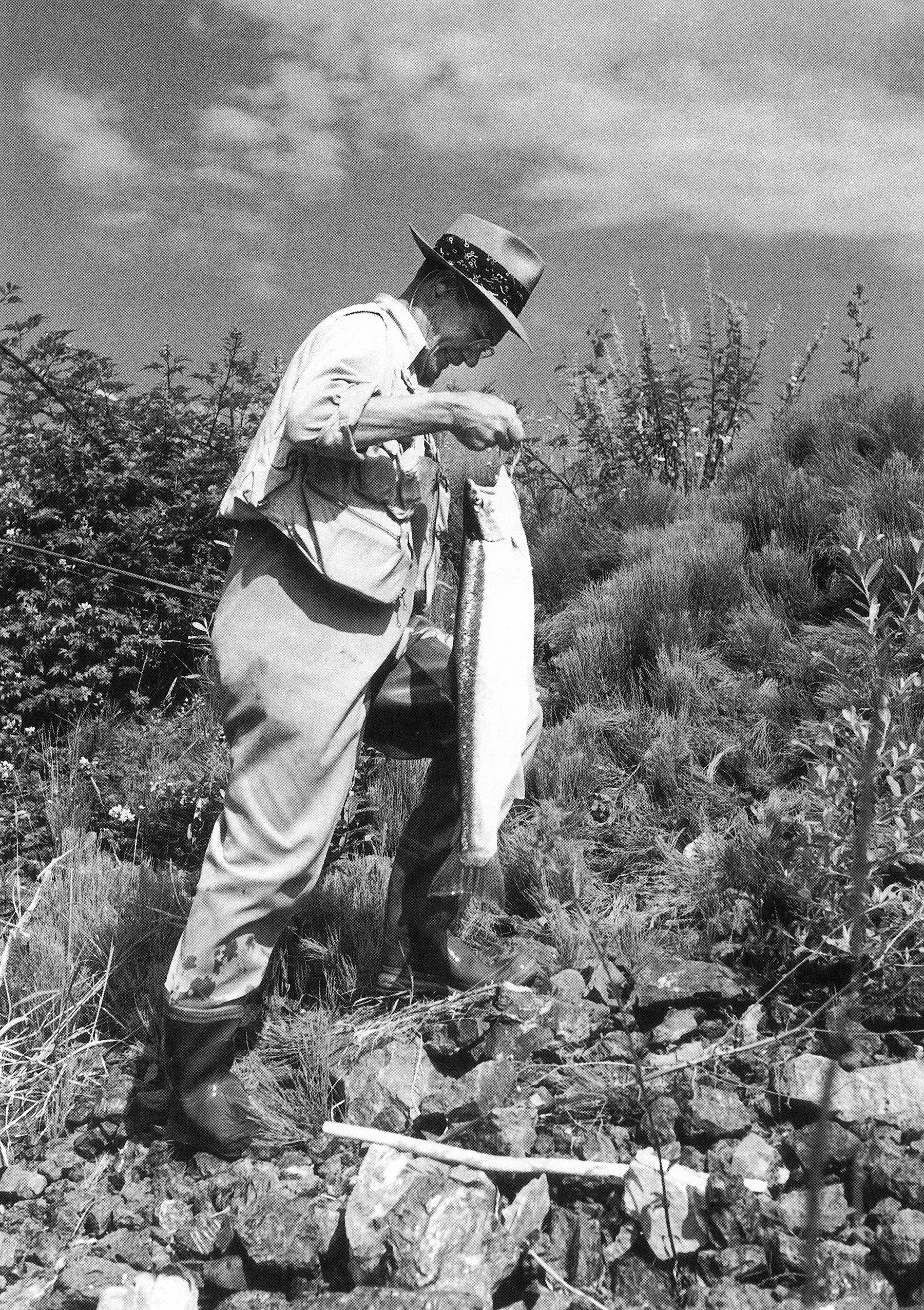
Al Knudson takes home a Deer Creek native he rose to a dry fly, July 18, 1955. Photo Credit: Ralph Wahl
"And Enos Bradner?" I said.
"Oh, Brad and Sandy Bacon owned a place upstream of Headrick's. You can't see it from here. And there was Ken and George McLeod. They had a concrete cabin just up from here on the Flats, just below the Deer Creek Riffle."
The little colony on the North Fork of the Stillaguamish River marks the birthplace of steelhead fly fishing in Washington, its many famous anglers now revered as the sport's founding fathers. Walt settled here in 1943, and he was the first. He and his friends built their summer cabins just above where the Stillaguamish makes an extremely sharp bend, the water called Elbow Hole. He told me the run had fished well in the early days. Two generations of spring freshets had cut away at the gravel bank, the sweeping bend gradually becoming a deep, hooking millrace. No one bothers to fish it today, though the lower end remains classic water.
"You can't believe how the river has changed. Most good holding water lasts five, maybe six years. Then the bottom fills up, the river changes course, something happens to make it different," said Walt. This was no complaint, and there was no hint of regret. I found him as keen as ever to understand the ways of his river.
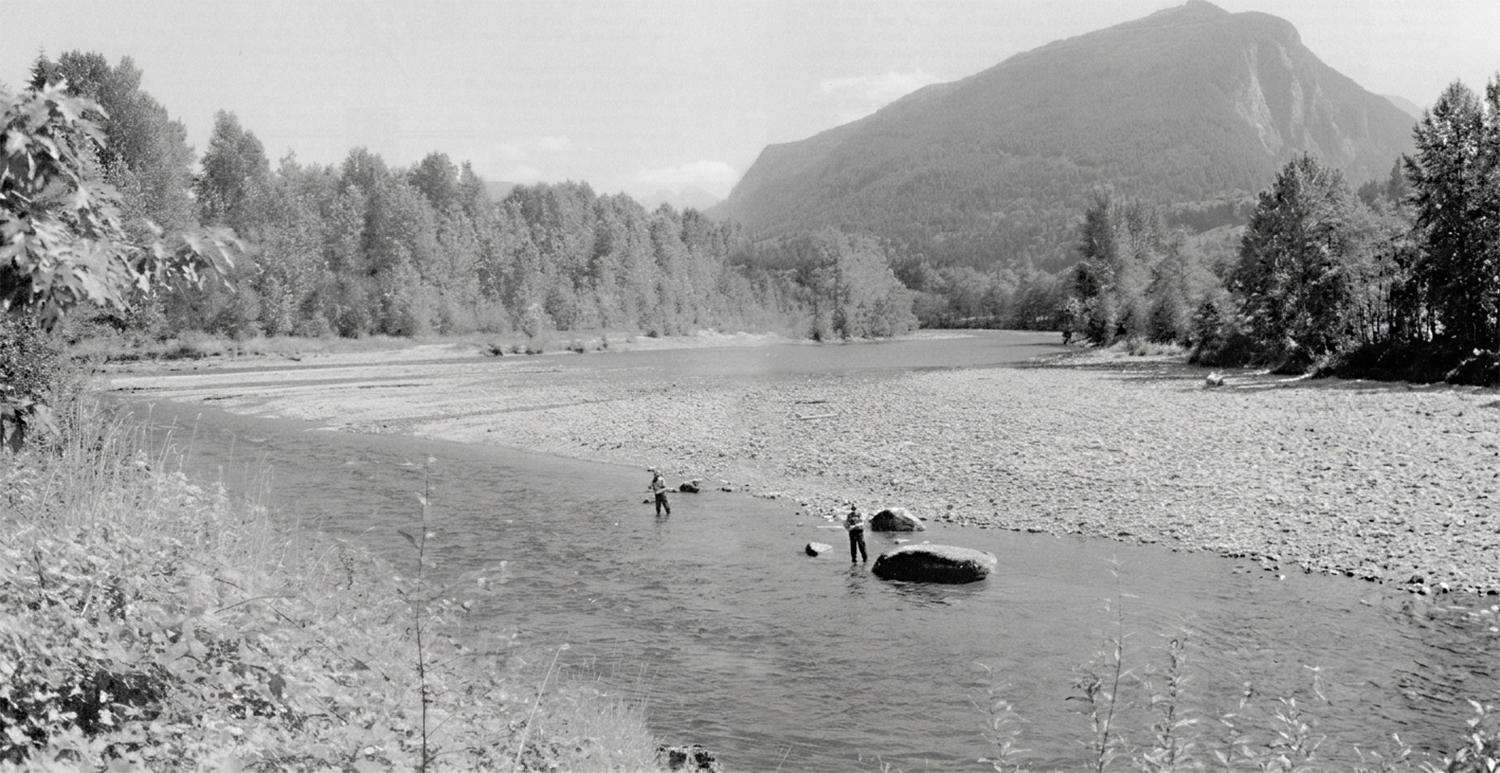
Mike Kinney and Trey Combs on the Elbow Hole.
Walt's friends also sold out. During the 1970s, the summer homes along the river were routinely burglarized. Even stoves were stolen. At the same time, some of the most elderly anglers could no longer regularly work a fly through the river's pools. They were free with stories of their river and could recount better times, claiming they had enjoyed the North Fork and her steelhead when both were at their best. This was no curmudgeonly view of the river they were leaving. For nearly two generations, they had sampled their fly water from early June until fall, and as they found the runs declining, a foreboding sense grew that their beloved Stillaguamish and her steelhead were also being burglarized. Although there was no shortage of opinions as to the reason, they knew for certain that they had always owed their fishing to Deer Creek, the principal spawning tributary for North Fork steelhead. Most suspected that logging had caused the erosion that silted in the creek and buried its spawning habitat. If true, most of the eggs and fry in the gravel were suffocating. As always, hatchery fish could mitigate the shortfall. The old-timers said, in effect, that two wrongs won't make Deer Creek right. Discouraged and disillusioned, they quit the river, until only Walt Johnson remained to cast his fly each day.
We waded to Pocket Water, where jagged midchannel boulders once could house a dozen Deer Creek steelhead. Sediment has so filled the valleys that today their peaks barely break through the river bottom, and the upper part of the pool is no longer reliable. However, the bottom remains the "pocket," a depot of shade and faint currents where steelhead collect before picking up the line of traveling water and continuing their journey.
Walt started through the pool with a delicate 4-weight, his favorite rod for summer work. He cast a Deep Purple Spey on tight loops, the fly dropping with scarcely a ripple into the gut of the pool. A sink-tip line was a concession on this June day to early-returning fish and to water still cold with spring. He did not like this approach, but he would not argue with reason. Walt said there might be time, come evening, to exercise his memory with a dry fly down Pocket. In the meantime, the years fell away as the river boiled against his waders, and each cast traced a strong arc over the cabins below.
The history of fly fishing for steelhead on the Stillaguamish River in large measure begins and ends with the history of Deer Creek, for the summer-run steelhead of this tributary were what brought fame to the river and created such folk heroes of its anglers. The reason was uncomplicated. Before disappearing into inaccessible canyon pools to wait out sexual maturation, steelhead would hold for weeks in the North Fork immediately below the Deer Creek confluence. Almost no summer-run steelhead spawned above Deer Creek, either in the main stem or its tributaries.
The Deer Creek summer-run steelhead is a highly specialized race. Curt Kraemer, a regional fish biologist for Washington's Department of Wildlife Region Four, determined from scale samples that ninety-five percent of the steelhead were three years old, having spent one year in the ocean after a premigrant residency in Deer Creek of two years (2/l). At this age they were small, four to five pounds and twenty-four to twenty-five inches. Size extremes found were nineteen and twenty-nine and a half inches, but all were still one-year ocean steelhead. The remaining five percent consisted almost entirely of premigrants that had spent three years in Deer Creek (3/l), and repeat spawning steelhead (2/lSl). The largest steelhead he examined was thirty inches and approximately ten pounds. Kraemer told me that among the native Deer Creek steelhead, "two-salt fish are extremely rare."
This small, one-year ocean race was typical of native summer-run steelhead in the short, steep gradient rivers of Puget Sound. They ascended to the extreme headwaters to spawn, periodically fed in fresh water, and rose freely to a fly.
Two aspects of this race's life history make it vulnerable to loss. Its spawning environment is fragile, the headwater trickles especially sensitive to any loss of streamside cover and to erosion. The Deer Creek steelhead is, for all practical purposes, a three-generation race in which the entire spawning generation enters the river at one time. (On other steelhead rivers there may be as many as a dozen or more life histories covering many different ages from a single generation.) Any loss of spawning habitat will immediately have a devastating effect on a large percentage of the entire race.
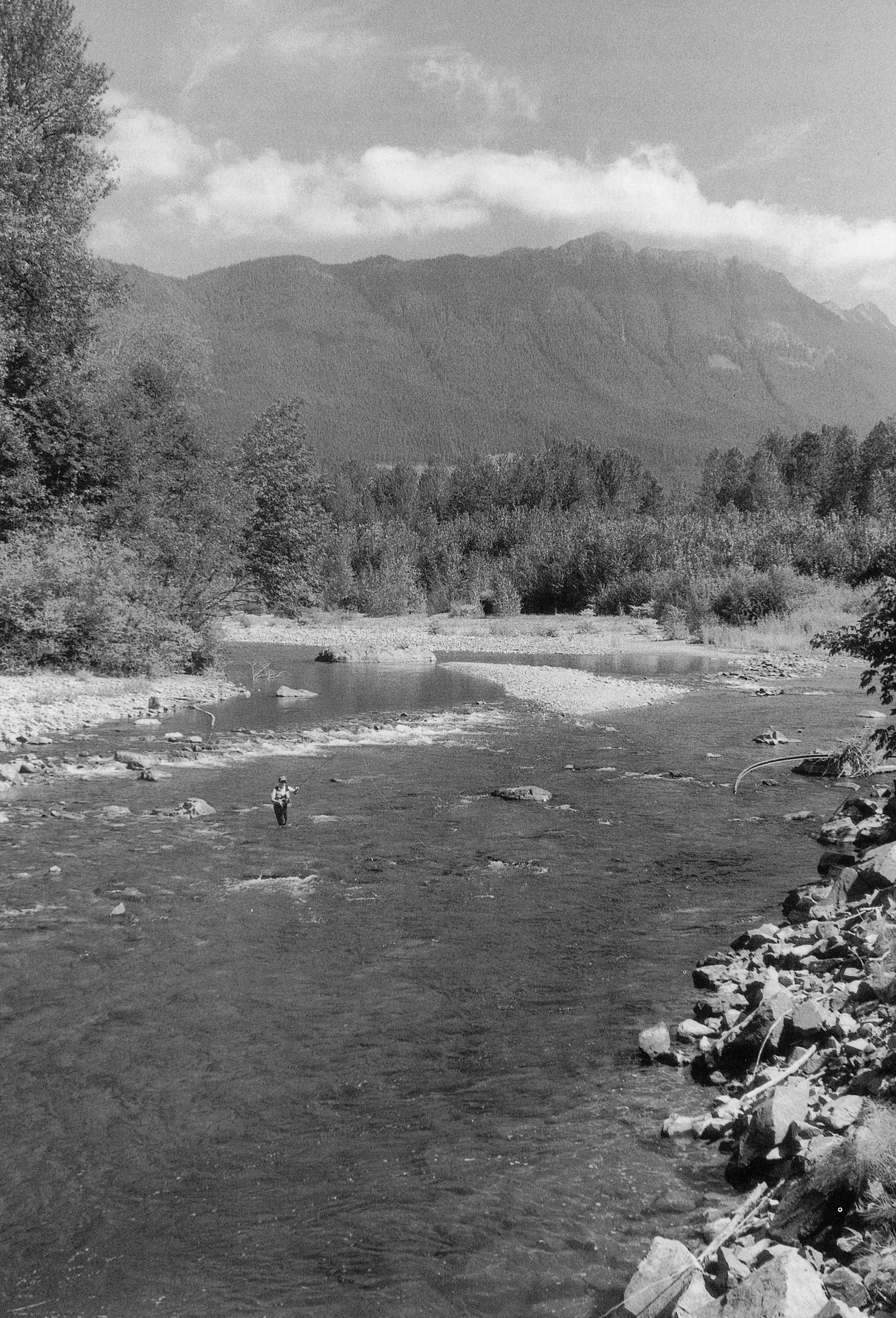
Trey Combs wakes a dry above the Deer Creek confluence.
These free-rising steelhead and their relationship with Deer Creek were well known locally when Zane Grey first visited the Stillaguamish in 1919, a trip he described in Tales of Freshwater Fishing. He was making his annual sojourn to Vancouver Island's Campbell River for tyee salmon when a Seattle stopover left him time to pursue the area's summer-run steelhead. Local fishing tackle dealers suggested Deer Creek, as did two Seattle anglers, "Hiller and Van Tassel." Accessibility, the two men promised, would be a problem. An alternate plan they encouraged involved fishing a pool at the mouth of the creek, and, yes, they would guide Grey and his party.
Grey noted that both men were bait fishermen who employed fly rods and fly reels with enameled lines, stowing the lines in canvas baskets strapped to their waists. A flip of the rod sent the sinker and a small hook baited with salmon eggs out across the pool. None of the party caught any steelhead, and Grey pressed on, more determined than ever. He hired a guide from Lake McMurray, who would take them all the way in to Deer Creek. After a harrowing trip by logging train and an arduous overnight hike, they reached their destination, "the most beautiful trout water I had ever seen," wrote Grey. Here on this remote tributary of the North Fork of the Stillaguamish, Grey hooked his first steelhead, "savage and beautiful, fight in every line of his curved body."
Nine years later, in 1927, Roderick Haig-Brown traveled from his native England to the Northwest to work in the lumber camps. This led to his first experience with steelhead, an introduction told with wry good humor in his marvelous classic, A River Never Sleeps.
It was January when I came with a rod to my first river in North America-the Pilchuck near Snohomish in Washington. My good friend Ed Dunn took me there, and we caught nothing, at least partly because neither of us knew very much about the fish we were after; but I cannot forget the day, because it was the first day and it started me thinking of steelhead-a habit I haven't grown out of yet. Two or three days later we went to the Stillaguamish, and I remember that day too, though the river was roaring down in tawny flood and I suppose we hadn't a chance to fish even if we had known all there was to know ... Soon after that I went up to work at a logging camp near Mount Vernon in Washington, first as a scaler and then as a member of the survey crew.
Bunkhouse stories were of "cougar and bear and steelhead," often told solely to impress the young immigrant.
... the steelhead talk was distant; the fish ran in June and July, which was six months away, to Deer Creek, a good many miles through the woods ... Ed Phipps told me he had gone into Deer Creek the previous July, hooked a steelhead and lost rod, reel, and line before he had time to think of moving.
Haig-Brown's first opportunity to fish Deer Creek occurred early the following June when his survey team was camped only four miles from the fabled water. Using a nine-foot casting rod and a silex reel, he fished spoons and Devon minnows and caught Dolly Varden trout to four pounds. He doubted these fish were steelhead, and he hoped they were not, for their size and spirit were a disappointment. Late on the second day, however, while working a Devon minnow through a deep pool: "There was no question of striking; he was away before I had the rod point up, taking line with a speed that made the ratchet of the reel echo back from the timber. Then he jumped three times, going away, and the sunset was gold on his side each time."
This first steelhead was free shortly after the third jump, and it set things right for him, properly fitting what he had been led to believe about steelhead. He does not elaborate on how he came to return to Deer Creek, but several weeks later he caught his first steelhead, "a fish of seven pounds."
That two of the most notable angling writers of this century both fished an obscure creek in Washington for their introduction to steelhead is a wonderful coincidence, but it was not overly significant. As Zane Grey's experiences illustrate, the "secret" of Deer Creek and the North Fork below their confluence was general knowledge among Seattle anglers by 1919. At the time, these waters didn't provide Puget Sound anglers with the best summer-run steelhead fishing, but with nearly the only such fishing. There was simply nothing else with which to compare it.
Years after Grey's and Haig-Brown's departures, when Washington fly fishermen were diligently mining other steelhead runs, Deer Creek summer steelhead still numbered in the thousands, far more than in any other of the many rivers entering Puget Sound. That makes the North Fork's conversion to a fly-only river all the more remarkable.
In 1934, the Snohomish County Sportsmen's Association proposed to the State Game Commission that one mile of the North Fork below the Deer Creek confluence, and Deer Creek in its entirety, be administered as fly-fishing only water. The proposal was accepted, followed immediately by objections from gear fishermen and valley residents. Rather than take a firm stand on the issue, the Game Commission backed down, reversed their decision, and hid behind the bureacratic convenience of closing the river to all fishing. A few fly fishermen from the Steelhead Trout Club of Seattle urged their membership to take up the cause. When more devisiveness resulted from the discussions, they broke with their club and formed the Washington Fly Fishing Club. This new organization, with Enos Bradner as its first president, immediately set in motion a series of fly-fishing-only proposals that would forever change the face of Northwest angling. After a club resolution embodying their proposals was approved by a county sports council, it was submitted to the State Game Commission and passed into law in January, 1941. The North Fork of the Stillaguamish was to be exclusively fly-only during the summer-run season, the first steelhead river ever to be so designated.
Bradner was an obscure figure who had moved from the Midwest in 1929, opened a bookstore on Capital Hill in Seattle, and developed a passion for steelhead on a fly. Other charter members in the new organization included Letcher Lambuth, an inventive bamboo rod builder, Dawn Holbrook, a professional fly tyer who would pass his skills on to many a "Stilly" regular, and Ken McLeod, the outdoor editor of the Seattle Post-Intelligencer. Against an opposition often voicing outrage-elitist and discriminatory, they said-the fledgling fly club campaigned tirelessly for continued support of the new regulation by the State Sportsmen's Council and the outdoor clubs it represented. The Washington Fly Fishing Club's victory remained tenuous for months, but this time the Game Commission remained steadfast in its support, and opposition to the ruling was gradually beaten back.
According to Steve Raymond in his book The Year of the Angler, Bradner was the first to take a steelhead from the North Fork under the new fly-only regulation, a divinely wrought ending to an often bitter struggle.
Washington Fly Fishing Club members, confident that their more enlightened sport fishing ideals would protect this unique race of summer steelhead, now set about enjoying the fruits of their labor. As Walt Johnson had pointed out to me, two principals in the struggle, Bradner and McLeod, soon had cabins on the North Fork and were his neighbors for many summers to come.
Bradner, at age fifty, became outdoor editor of the Seattle Times, a position he held until well into his seventies. He authored Northwest Angling, the bible for Washington fly fishermen, and a book I nearly memorized before my copy fell apart. When I first wrote to him in the late 1960s, he was an institution-I was in awe of the man. He carefully answered every question I posed, banging out the letters on an old typewriter. I loved him for that. His Brad's Brat is still one of the most popular of all steelhead patterns, and if I tie it sparse with red and burnt orange angora wool (or seal fur), wind the webby brown hackle as a collar, and use orange tying thread throughout, I think it is a good October Caddis dressing.
Ken McLeod is now remembered for the record-size steelhead he and his son, George, caught from the Kispiox, and for three of the most effective and enduring fly patterns in steelheading, the McLeod Ugly, the Purple Peril, and the Skykomish Sunrise. The McLeod Ugly is "ugly" only when in the company of classic low-water dressings and fly choices are being made on the basis of aesthetics rather than effectiveness. Steelhead find the dressing so attractive that hardcore steelhead fly fishers wouldn't be without a few. The Purple Peril, the original purple steelhead dressing, is now about a half-century old, and one of the ten or so patterns I always have in a variety of sizes and styles. The Skykomish Sunrise is simply the most popular steelhead fly pattern in the history of the sport, and it is often the first dressing the neophyte ties and fishes.
Walt's fly now worked through the deep holding water that marked the end of Pocket Water. No steelhead moved to the fly, and he repeated the cast again and again. When this final effort had exhausted his patience, he called up to me. "I don't know where they are anymore! The steelhead just boom through now!"
"Hatchery fish are like that!" I called back. That was true enough, an imprinting flaw too often possessed by "designer" steelhead, and these fish, bound for the Whitehorse Rearing Ponds, were typical. This particular state of affairs was something of a paradox. Walt was both an outspoken advocate of wild steelhead and the man who assisted in the first successful rearing and planting of summer-run steelhead. That occurred forty years ago, when pioneering hatchery operations for salmonids were already seen as a cheap alternative to preserving runs naturally.
By the mid-1940s, North Fork anglers had grown concerned that summer-run steelhead escapements were down. In an effort to address the problem, the Washington Fly Fishing Club formed the Summer-run Steelhead Committee and named Walt Johnson as its chairman. Two schools of thought prevailed on how the situation might be improved, and both involved artificial propagation. The first called for plants in Deer Creek. The second approach-more daring and controversial-involved planting smolts well above the Deer Creek confluence in hopes that a strong, self-supporting run of summer-run steelhead could be established there. If successful, the new run would spread out angling pressure while increasing the total escapement.
Ken and George McLeod and Enos Bradner approached Don Clark, Director of the Washington Department of Game, and proposed securing brood stock in winter with rod and reel from Deer Creek. The plan was approved and, fortunately, the steelhead failed to cooperate. Only then did it occur to the Committee that winter-run stock were also in Deer Creek, and there was no way to distinguish between the two seasonal runs. At the time, no one was even certain whether the summer-run steelhead was a genetic strain that would breed true, or if other factors caused spawning returns at various seasons. Taking no chances, Lew Garlick, the fishery biologist in charge of the project, set a weir at the mouth of Deer Creek in the summer of 1945 and trapped seventy-two adult steelhead. These were trucked to the hatchery at Arlington and placed in a holding pond until they fully matured. The fish proved to be extremely temperamental, and mortality was high. Only thirty-two survived, the eleven females producing 35,340 fertilized eggs. More than two years later, in April 1948, 22,628 young steelhead were ready for release. After dividing them into three groups for the three different release sites selected, each fish was fin-clipped and injected with a tiny celluloid tag, a code that would identify these sites. On April 10, 1948, Sandy Bacon, Enos Bradner, Wes Drain, Frank Headrick, and Walt Johnson released 4,950 steelhead smolts in Deer Creek at miles 10 and 15 from the mouth. Game Department biologists made additional releases at the mouth of Squire Creek, above the Deer Creek confluence (4,655), and at Brown's Creek, a tributary of Squire Creek (ll,764). (Seven hundred nine smolts bearing no marks of any kind were released; five hundred fifty marked Deer Creek smolts were released in Minter Creek near Tacoma, Washington, and two of these steelhead returned one year later.)
Returns were very disappointing. Anglers caught six, or perhaps seven, hatchery steelhead below the Deer Creek confluence. (Frank Headrick caught one.) These fish were either Deer Creek or Squire Creek plants, and all proved to be one-year ocean fish that averaged four to five pounds. Apparently no angling recovery was made from the nearly twelve thousand smolts planted in Brown's Creek. Surely other steelhead survived to maturity, but no angling record exists. No two-year ocean steelhead from the plants was fly-caught the next year, 1950, and no steelhead from these plants was ever caught above the confluence.
These cooperative efforts by Washington's Game Department and Seattle's Washington Fly Fishing Club did prove that the progeny of summer steelhead, raised in hatcheries and planted in rivers for life in the ocean, would return as sexually mature adults. From this standpoint, the experiment was a success, and as such, it set the tone for Washington's steelhead hatchery programs, which soon followed on the Washougal and Skagit rivers.
Walt was reeling in when Bob Arnold called to us from the far bank. We were delighted to have his company, and waded over to join him. Bob has a cabin above Deer Creek and lives there for much of each summer. He is a collector of North Fork lore, a fine writer, and the former editor of The Osprey, a newsletter published by the Steelhead Committee of the Federation of Fly Fishers. Whenever I see him on the North Fork, or the Sauk, or the Skagit, he is about to catch a steelhead, or has just caught one, his head always filled with currents by the cfs, water temperature by the season, and stream-bottom silt by the thousands of tons. This kind of bedrock thinking serves him well as he deftly threads his way through the convoluted politics of watershed management. He knows every tier in the bureacracy-federal, state, and local.
"We're going over to visit the cabins," I said. "Come join us."
We followed the river down to Drain's place and worked upstream past Knudson's property to Walt's beautifully finished log cabin, then to Headrick's cabin, and on to Bradner's, which bears the sign, "Trespassers Will Be Eaten." A short walk has covered it all. Bob knows this history because he knew the anglers. I knew most of them, too. We traded anecdotes with Walt and talked of the fly patterns they gave to the sport. I noted that these few anglers who summered on the North Fork below Deer Creek developed just about all the popular steelhead patterns for Washington. Besides the dressings by Bradner and the McLeods, I could name more than a dozen from memory, another six or eight when I included Ralph Wahl. I asked Walt what flies they liked before he and his friends developed their own "Stilly" patterns. He could recall the Orange Shrimp, Thor, and Royal Coachman. Jim Pray and his Eel River patterns guided their selections back in the early 1940s, though his optics never played well here.
Historically, the North Fork's run of Deer Creek steelhead peaked about mid-July, the odd fish appearing as early as late May, and the river holding steelhead well until September. Not very long after the river's fly-fishing-only restriction went into effect, a few stubborn souls began to press their fishing on into winter.
"Oh, Bradner thought I was crazy," said Walt. "He said, 'Why do you want to do that?"' Walt chuckled with satisfaction. "He never did fish a fly for winter steelhead." Before long, Walt, Ralph Wahl, Al Knudson, and others were also fishing the Skagit. Some great fish fell to their flies.
"There's a pool near Cicero I want to show you," said Bob.
Trustworthy pools below Deer Creek were being erased by a meandering river too often filled with silt. It was worth hunting for new water, walking the long gravel bars, casting a fly, and perhaps finding a steelhead where no angler had found one before. We joined Bob and fished away the afternoon until dark clouds blew up the valley from Puget Sound, and it started to rain. The tailout fished especially well, and I thought Walt and I had done it justice. We quit the river and left Bob to battle with a gusting wind that was <lapping his General Practitioner across the surface. He must not have lingered, for in less than an hour he had landed a sixteen-pound hatchery steelhead from the Deer Creek Riffle just upstream from Walt's house.
Deer Creek
During the winter steelhead season in 1984, Bob Arnold thought the North Fork below Deer Creek would never clear. The river ran so grey with silt that fishing was out of the question. Favored main-stem runs were actually filling up with the tons of sediment running out of Deer Creek. Disgust soon turned to concern, the loss of his fishing secondary to the calamity he imagined taking place somewhere in the Deer Creek watershed. Bob made calls to those state and federal agencies administering Deer Creek lands, an investigation that led to Al Zander, a hydrologist for the U.S. Forest Service with the Mount Baker Ranger District. The two men met in Oso and together visited Deer Creek. Zander was shocked by what he saw and set off to explore the headwaters and find the source of the massive siltation that would, he knew, be catastrophic to steelhead and salmon stocks. He discovered an enormous slide in a logged-off area at the mouth of DeForest Creek, an important tributary of Deer Creek, and land under the administration of Washington's Department of Natural Resources.
Bob Arnold sent out hundreds of flyers announcing a public meeting in Oso, and asking "What's Killing Deer Creek?" and containing the follow-up question: "Can Anything Be Done About It?" Jim Doyle, a biologist with the U.S. Forest Service, would help chair the meeting and present a slide show of the area under discussion.
The year before, Doyle had begun a comprehensive evaluation of logging's impact on the Deer Creek watershed. During the course of his survey, he discovered that the loss of streamside cover and resulting erosion had so reduced stream depth that water temperatures in summer could reach seven-ty-five degrees from top to bottom, lethal for some young steelhead and coho salmon. As a result of slash burns, entire hillsides remained sterilized and denuded during years of erosion. Slash-choked runoff creeks and washed out logging roads caused additional erosion. Almost all the spawning habitat had disappeared under tons of silt. Where there had once been thousands of steelhead, there were now approximately two hundred. Documentation was skimpy, the watershed far more vast than the name "creek" would suggest.
Doyle recorded this devastating picture of mismanagement and neglect with a thirty-five-millimeter camera, and at the public meeting in Oso put on a slide show that outraged his audience.
The Department of Natural Resources took initial responsibility for the DeForest slide, though in truth, damage to the watershed had occurred for half a century or more on lands held privately and corporately and under numerous state and federal administrations. Work began the next summer to clear the slide, using both volunteer and convict labor. When this effort proved futile, heavy earth-moving equipment was contracted, and the slide area was regraded in 1985. Rains that fall and winter eroded this work, the slide continuing to dump tons of silt into the creek each day.
The magnitude of the task and the gravity of Deer Creek's condition led to the formation of the Deer Creek Policy Group, a coalition of state and federal agencies, timber companies, private landown-ers, environmental groups, Trout Unlimited, the Federation of Fly Fishers, the Tulalip and Stillagua-mish Indian tribes, and the two counties containing the watershed.
The interagency cooperation that developed out of the Policy Group led the U.S. Forest Service to declare a moratorium on all their Deer Creek logging operations and the initiation of a comprehensive rehabilitation of the watershed. Trucks brought in enormous rock-filled wire cribs called gabion baskets to hold back erosion along the creeks. Helicopters flew in concrete "Jersey barriers" (often used as temporary freeway dividers) to retard erosion in less-accessible areas. Sediment fences and settling ponds were installed, old logging roads stabilized, and bare hillsides planted with trees. It was a start. Alec Jackson and Bob Arnold represent, respectively, the Federation of Fly Fishers and property owners on the Board of Directors of the Deer Creek Policy Group. They have established the Deer Creek Restoration Fund for private contributions to help finance the massive rehabilitation of the Deer Creek watershed. Because of the coordinated efforts of the Policy Group, all manner of funding, and the very different special interests these monies represent, have a common goal. Steelhead are but one facet of this environmental disaster.
Deer Creek has been a steelhead spawning sanctuary for half a century, and· since 1983, a thirty-inch size limit has effectively excluded them from the creel limit. Even with this protection, however, their numbers have declined as less and less spawning habitat remains viable. During the summer of 1989, I discussed the prospects for survival of the native Deer Creek steelhead with Curt Kraemer. He had conducted the pioneering life-history study on this race and knew the watershed well. "Oh, there might be two hundred adult fish in the system," he told me. I thought this figure as good as any, the same one that comes up each year. Kraemer cares deeply for these steelhead; "two hundred" contains more promise than "almost extinct."
Bob Arnold fishes the Deer Creek Riffle on a regular basis, a sampling as unscientific as any other. Several years ago, he thought the estimate of two hundred steelhead to be low. He caught twenty-five Deer Creek steelhead that summer and a like number the next year. Bob could not believe this would be possible if the overall population were so down, though this race has always concentrated in a few good pools below the confluence. When I last spoke with him about Deer Creek, it was mid-July 1989, traditionally the peak of the summer run. "I'm worried," he told me. "So far this year, no one has caught a single Deer Creek steelhead."
Walt Johnson and I were in touch all that summer, and I knew hardly a day passed without him hiking to the river and passing a couple of hours on his home pool. Early in August he called me. "I finally got one!" he exclaimed.
"Wonderful!" I said. "A hatchery steelhead?"
"No, a native Deer Creek fish. It wasn't fin-clipped. About five pounds."
We talked about his fish. I wanted to know every detail. I asked whether he had heard of any other Deer Creek steelhead. He hadn't. Neither of us wanted to discuss the terrible irony playing itself out, the last of this race being caught by the last of the North Fork's venerated regulars. I reminded Walt that my first steelhead on a fly, a Deer Creek hen, had come on the North Fork. Between my first and his last we could call into account only twenty-five years.
That September, Bob Arnold called to confirm that Walt's steelhead was the only Deer Creek native caught in the North Fork during the summer of 1989. (Several Deer Creek steelhead were caught in 1990.)
Skamania Steelhead
The Skamania Hatchery is on the North Fork of the Washougal River, a southwest Washington tributary of the Columbia River. Construction of the hatchery began as mitigation for the decline of steelhead runs above the Columbia River dams. Plants of Washougal summer-run steelhead smolts were made soon after its completion in 1956, and the first returns of adult steelhead were realized in 1960.
The native Washougal steelhead is unusually robust and thick shouldered, typically a one- or two-salt fish, though a three-salt life history is not rare. Historically, the earliest returns occurred in late winter-the much heralded "springers," fish so sea-fresh and sexually immature that they possessed great strength and dash.
As the Skamania hatchery program grew, more and more Washington rivers received hatchery plants to supplement native runs, and by the mid-l960s some twenty major rivers possessed runs of Washougal steelhead. One of these rivers was the North Fork of the Stillaguamish River.
In about 1970, Skamania hatchery personnel began selecting brood stock from returning steelhead that were, in the main, three-salt fish, females of at least thirty inches, and males of at least thirty-four inches long. On paper, at least, the concept was brilliant. Selectively breeding steelhead would, in a relatively short number of generations, produce a "super race" predisposed to spend an extra year at sea and averaging nearly twice the size of their native counterparts. The program showed such promise, and initial results seemed to be so spectacular, that Skamania steelhead became the darling of Washington's fish culturists.
However, discriminating only for size produced some undesirable side effects. For reasons of economy, brood stock were gathered over a period of a few weeks and presumably reached sexual maturity at the same time. In similar fashion, the young steelhead reached smolting age at about the same time and were released over a period of only a few weeks. Whether or not all this cultivation was inadvertently tapping into a genetically distinctive subrace is not clear. But the result of selecting steelhead from one narrow period of the year did produce a dramatic change in the overall breadth of run timing, the hatchery escapement soon becoming far more condensed than that of the native steelhead. The hatchery fish also traveled more rapidly up the river to reach the hatchery weir or the security of a few good pools below the weir. In an effort to slow the hatchery steelhead and spread their numbers more evenly through the river, biologists released smolts at staggered times and at points well below the hatchery, but this was only marginally successful. Fly fishers found that these older, larger fish favored the very deepest pools for weeks at a time, and were not easily distracted from their nearly comatose state by even the deeply sunk fly. The shallow riffles less frequently held two-salt steelhead because these smaller steelhead were being selected out of the gene pool. In fact, the one-salt steelhead, the very kind of steelhead that brought such fame to the North Fork, was genetically eliminated from the Skamania race of summer-run steelhead, a loss deeply regretted by greased-line fly fishermen.
So the Skamania steelhead, with its ponderous size and character flaws, has gradually replaced the slim, small, quick-rising Deer Creek steelhead. They are both atypical races, marvelous creatures, but only one a national treasure.
During his fifty years on the North Fork, Walt Johnson never caught a Deer Creek steelhead that made twelve pounds. Yet, he says, "They were the most graceful steelhead I've ever seen. Sometimes they came upriver so quickly th?y arrived at Elbow with sea lice still hanging on them. Then they stayed here for weeks."
Walt fished his delicate midge rods then, bamboo wands of less than two ounces, 3-weights with 5X leaders for small dry flies, and he cast upstream for drag-free floats. The stories of his days with Deer Creek steelhead stir the memory and prick the conscience like nothing else in fly fishing.