From The Archives: Sea Trout Of Tierra del Fuego
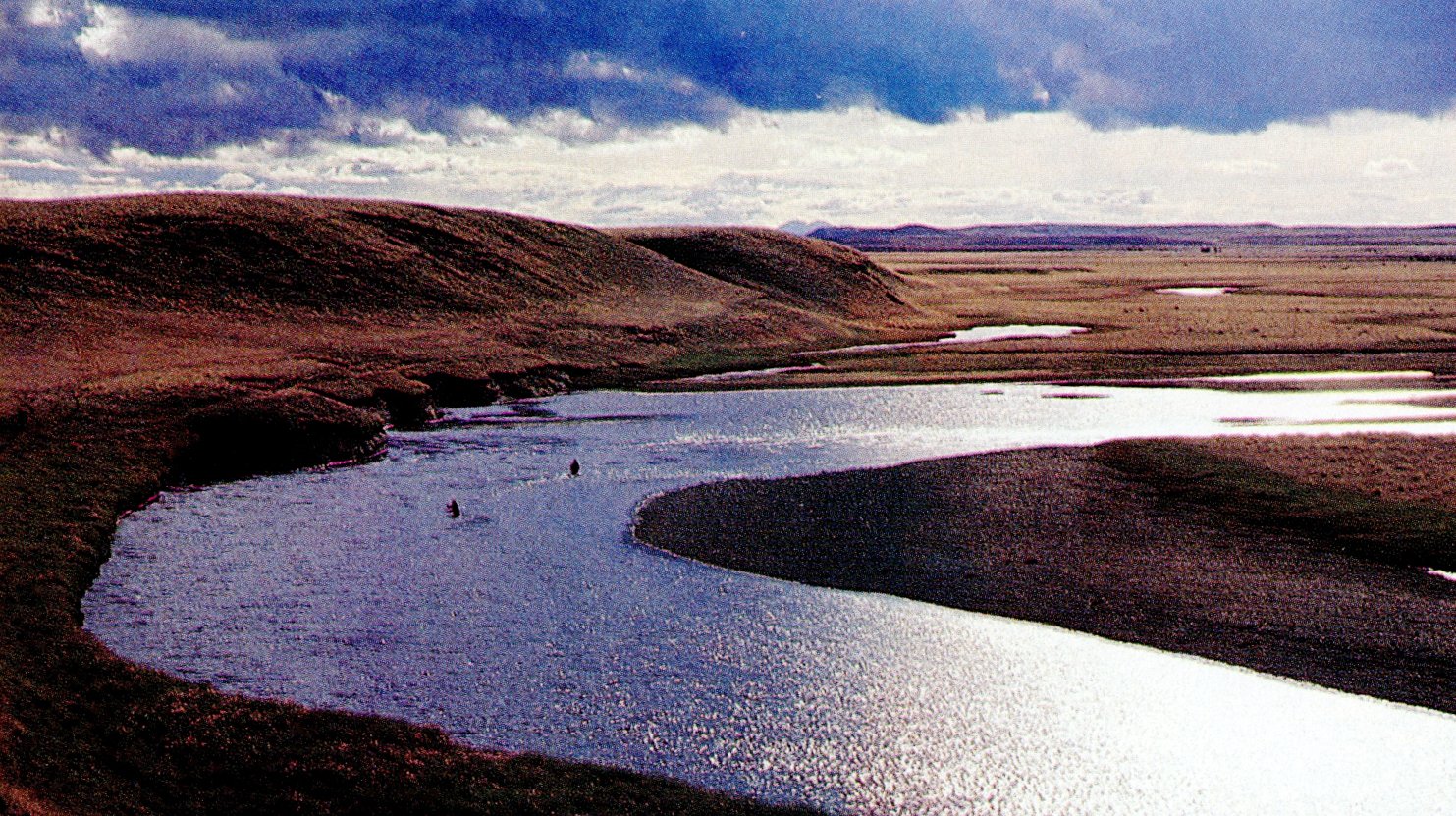
A broad bend on the Rio Grande
From the Archives presents complete vintage articles by Trey Combs in their original published form. This article appeared in the December 1988 issue of Flyfishing. On a desktop computer, right-click the original page and select “Open Image in New Tab” to view the high-resolution scan.
It was January, early in the austral summer, and the treeless hills of Tierra del Fuego were dotted with wildflowers and thousands of sheep in winter fleece. As photographer B.J. Meiggs and I bounced down the road to the estancia, Juan Lincoman kept his van out of the most perilous ruts and maintained a steady commentary in Spanish. He was a sea trout guide of local renown and there was hardly a cutbank in the Rio Grande that he did not know. He had, he told us, learned a lot in forty years of fishing here, and during the past few days he had labored to pass some of that knowledge on to me.
“Maria Bahety,” he said, as we braked to a stop before a complex of wood buildings that included “the largest sheep shearing shed in the world.” A man impeccably tailored in English tweed emerged from the office to greet us; Juan introduced us to Cesar Menendez, owner of the estancia.
“I don’t know why you wish to see my home, such a little place,” Cesar said as we followed him into the palatial house. “I actually live in Buenos Aires for most of the year.” We walked down the long marble corridors of his grandfather’s home as he recounted his family’s history. Late in the nineteenth century, Jose Menendez had emigrated from Spain and settled in the Argentine section of Tierra del Fuego. (The eastern, mountainous part of the island belongs to Chile.) He named the estancia after his French wife, Maria Bahety, and upon his death his lands were divided among his eight children, one of whom was Carlos, Cesar’s father. That fraction of the original was nearly one hundred and fifty thousand acres.
Perhaps remembering why we had come so far, he suddenly turned to me. “You are the fisherman? I do not fish. Juan is allowed to fish because he brings me trout to eat.”
“Do you recall when the brown trout were first brought here?” I asked.
“My father had in his employment an Englishman named John Goodall. He managed our meat packing plant. Keen fisherman. He had brown trout brought over from England. They were planted in the Rio Grande in the mid 1930’s. I don’t recall the exact year.”
Rainbow trout from the United States and Atlantic salmon were also planted. The salmon plants didn’t take and the rainbows survived as modest sized residents in the relatively infertile river. The brown trout were another matter. Most took to the sea, not casually or seasonally and not for estuary living, but for the Atlantic, and in that vastness they disappeared. Their annual return to the Rio Grande was soon heralded, and little wonder! The sea trout averaged nine pounds with a few more than twice that weight. How much more would become the source of angling legends bordering on the mythical.
Upon completion of the tour, we received Cesar’s blessings to press on to Gaviotero Pool and the Rio MacLennan, a great tributary of the Rio Grande. “We’ve caught sea trout there to 14 kilos,” he called out. “Good luck!”
Gaviotero Pool is named for the seagull nesting colony that occupies an island at its top end. (Gaviota means seagull in Spanish.) A long gravel bar on one side and a cutbank along the opposite side defines the fishing pool for 700 feet. I knew its angling history well.
By the late 1940’s the Rio Grande’s sea trout fishing was attracting some of Argentina’s best fly fishermen, then but a handful of sportsmen who lived mostly in Buenos Aires. Bebe Anchorena was easily the best known among this group. He was soon a regular on the Rio Grande and in the early 1950’s invited Joe Brooks to join him. They fished together at Gaviotero Pool, an experience Brooks would later relate in magazine articles and in his classic work, The Complete Book Of Fly Fishing.
Juan drove to the edge of the river, and we immediately began fishing, both of us casting fast sinking shooting heads on No. 8 weights and reaching for the opposite bank with three inch long yellow maribou muddlers. The choice of fly patterns was a departure from the dark Woolly Buggers so popular later in the season. Presentation was a simple case of casting slightly downstream, giving the fly a few seconds to sink, and slowly stripping back. Sinking leaders also helped drive the fly in the wind; it was not necessary to get the fly deep. The trout were holding close to the bank and usually dropped back with the fly to take it midstream, doing so in an extremely deliberate manner.
My first sea trout of the day came out of the water like a missile, straight up, seemingly suspended. Its struggle was vintage brown trout, a head shaking series of moves with the fish using its lateral resistance to fight the rod. Really long runs did not happen, but neither did the fish play itself out, for it continued to thrash violently even when beached. The 12-pound female was brilliant silver and white with black dots distinct under a dorsal gloss of lavender. I thought the contour very much in the massive mold of an Atlantic salmon.
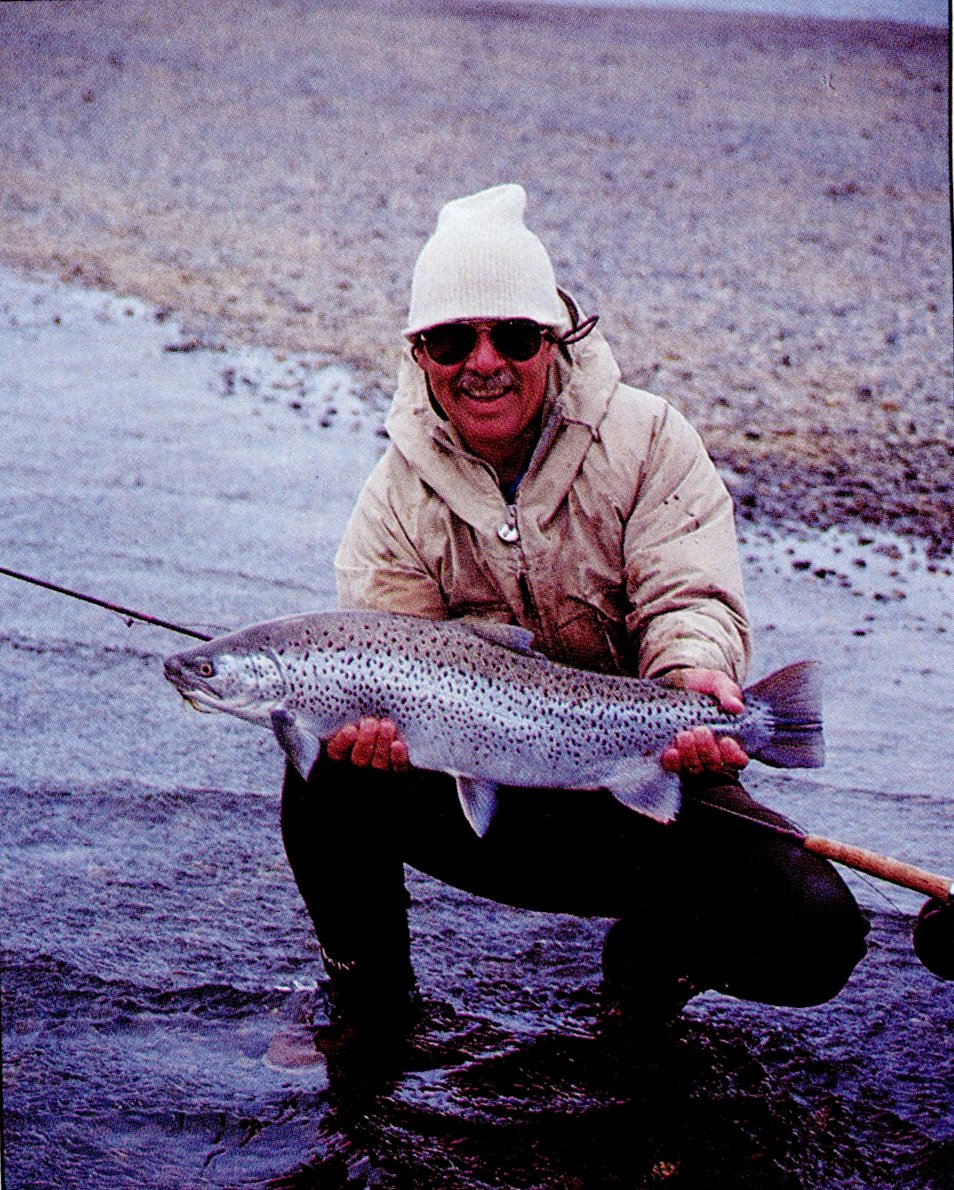
Trey Combs with a Rio Grande sea-run brown.
When we resumed fishing down through the pool Juan was again casting behind me. If I rose a trout, and in my eagerness struck it too quickly, Juan would surely make no such mistake. He had soon beached four sea trout from seven to nine pounds including a brace of males that were colored darker with coarser spots than the females. By late afternoon only little rainbows threw themselves at the fly and we quit the pool to begin the drive back to the city of Rio Grande.
The fishing week had begun at Despedida, Jorge and Jacqueline de las Carreras’ neighboring estancia that holds more than 20 miles of the upper Rio Grande. Unlike other estancia owners, who seem to take a passive view of their sea trout, the Carrerras have built a luxurious fishing lodge called Kau Tapen where guests practice catch and release.
I had been invited to stay at Kau Tapen, but my early arrival and delays in the opening of the lodge necessitated my taking a room in town. One evening, the Carrerras’ son, Fernando, who manages the lodge, joined me for dinner and spoke of their efforts to preserve and understand this most enigmatic gamefish. “We don’t really know where the fish go to spawn. Some say they go far upstream and spawn in a lake, but I don’t believe it. We don’t know how many trout are in the run, or how many are caught each year,” he said. Much to Fernando’s disgust, locals rarely release the sea trout they catch, but this does not seem to have endangered the run. Even so, poaching on estate water is not tolerated, and Despedida is a sanctuary that assures the future of these fish.
Not surprisingly, the ocean whereabouts of this searun brown is completely unknown. Fernando, however, has maintained careful lodge catch records, and how the run proceeds is fairly evident.
The sea trout first appear in the Rio Grande as early as the first week in December, and by the second week in January the lower 25 miles of river will hold fish. There is some evidence to suggest that smaller sea trout of five and six pounds may precede the main run. Fresh, sea bright fish continue to enter the river as late as early March; lodge guests successfully fish the river through April. Fish that have held in the river for weeks become residential in appearance, but they remain decidedly sea trout in character—spooky, elusive, and unpredictable.
B.J. Meiggs and I joined Kau Tapen’s head guide, Roland Holmberg, and his fellow guide, Jonas Hammarstedt, in Buenos Aires for two days of talks about these trout after our week on the Rio Grande. They were Atlantic salmon guides from Norway’s Guala, but so experienced in the ways of European sea trout that comparisons were easily made. The Rio Grande’s sea trout are arguably the largest in the world, and I had frequently caught them with a humped appearance, evidence of extremely rapid growth. Also, these trout typically have deep pink flesh. Roland believes that both characteristics can be explained by the trout’s suspected preference for the shallow coastal flats, a crustacean-rich habitat washed daily by 30 foot tides. I asked him about the curious absence of small sea trout, smolts that re-enter the parent river after a few months, a habit typical of European sea trout. The absence, he told me, isn’t total. The previous year thousands of very small sea trout had suddenly appeared in February. But save for this anomalous example, the Rio Grande sea trout may well be the most anadromous of their kind. Their size alone reminded me of two-year and three-year ocean steelhead.
I had removed a dozen or so scales from a female sea trout of 16 pounds. These were analyzed by Reg Reisenbichler, a biologist at the National Fishery Research Center, Fish and Wildlife Service, Seattle, Washington. He determined that the fish had spent two years in fresh water, then migrated to sea where it spent two more years before returning to spawn for the first time. At the time of its capture it was at the end of its eighth growing season. He was unable to determine how many times the sea trout had spawned between its fourth and eighth year. Reisenbichler reminded me that aging from scales often becomes unreliable for older trout that have previously spawned more than once. Nevertheless, this is the first such data on the sea trout of Tierra del Fuego.
Juan came to pick me up on our last day together and wore a long face. “There is much wind,” he said. Such statements are relative unless qualified; in Rio Grande, the doors open inward which saves citizens the trouble of hunting for their doors when there is “much wind.” I could only shrug; there would be no tomorrow, and we began loading our gear for the drive to Gaviotero.
When we arrived the wind had topped 70 kilometers, but it came from such a favorable quarter that my big yellow Marabou Muddler sometimes landed on the opposite bank. I was halfway down the pool when I met a rise too quickly. Juan was using a green Marabou Muddler and urged me to do likewise. “Go right back at the fish,” he motioned. I immediately hooked a trout so large it would not panic and simply maintained its mid-stream station. When the trout finally moved downstream it quartered away and continued to hold the bottom. Then, inexplicably, the fly came away. Losing fish is assuredly part of catching them, but still I was disconsolate. Juan counseled me with a pantomime of a slow motion strike. “There will be more trout today,” he promised.
A furious wind had now set up waves that made new currents of the old, and the river no longer carried a sound of its own. I didn’t expect another fish, and perhaps that was detachment enough, for the next rise unfolded perfectly. This too was a large fish, and rod pressure brought the trout to a leap above eye level.
“Seven kilos!” I called to Juan.
“Slowly, slowly!” He called back. Juan was quickly at my side and together we wearied the trout, twice bringing it from the far bank before sliding it ashore.
“No more than five days from the sea,” Juan commented. I am certain that no water could claim a more magnificent trout.
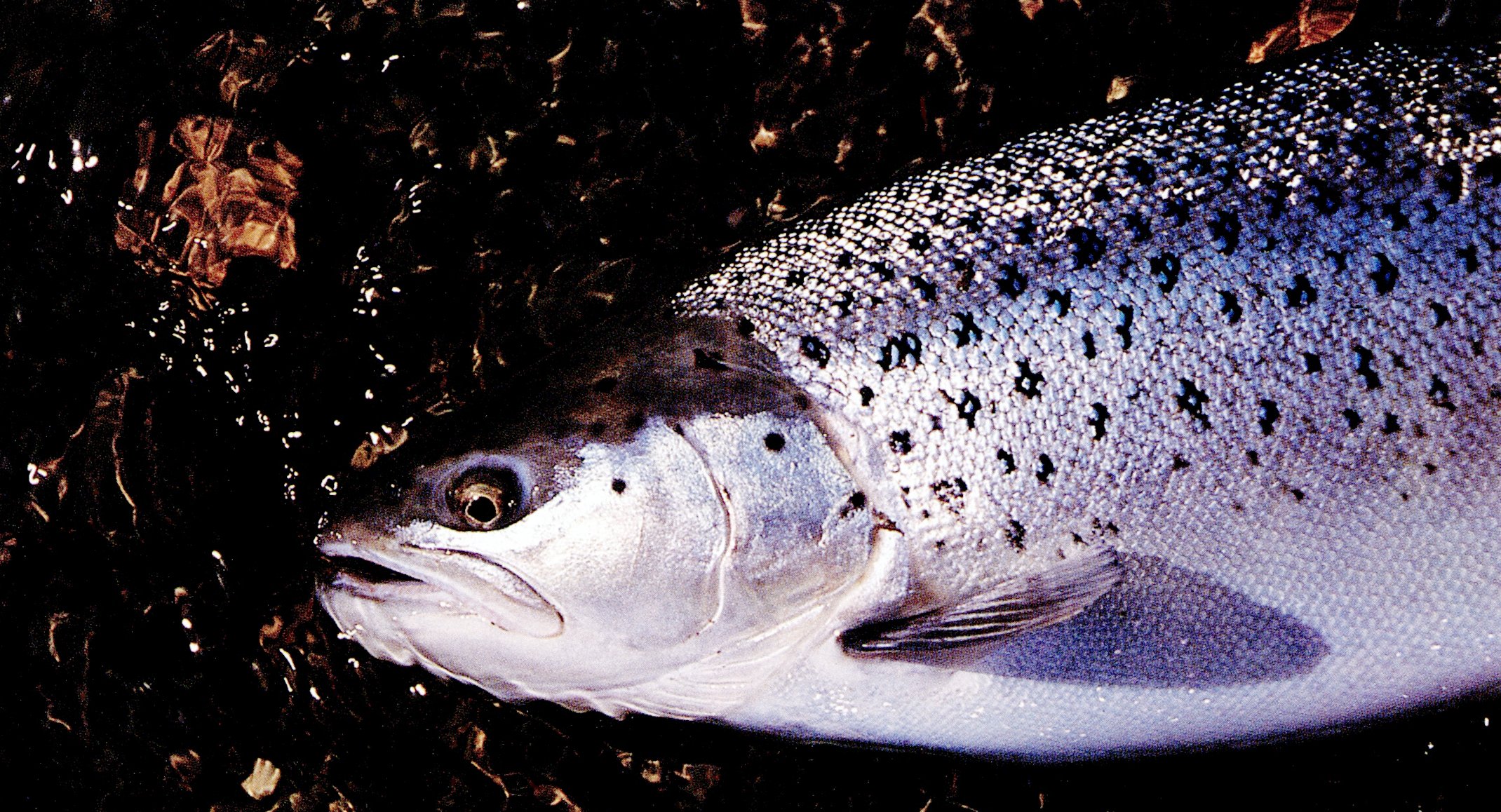
The epitome of sea-run brown.
One of us now raised and usually hooked a sea trout with every pass through the pool. When Juan beached his fourth fish, he and B.J. returned to the truck for lunch, leaving me lost in thought. Across from Gaviotero on the first line of ridges a family of guanacos watched me intently as I stole glances their way between casts. Andean condors joined the endless march of clouds across the starkly beautiful landscape. Zorros, the Fuegian foxes, hunted and played, oblivious to my presence. Magellan geese, too tough for the hungriest gaucho, were abundant on the hillsides. But it was the shore birds that most interested me. Those that I recognized from their winter plumage would soon begin an incredible journey to the artic. I would see them on the coast of Washington in April, and I would wonder if I had seen them here too.
By late afternoon, my elation mixed with stone cold weariness, I decided to make one final pass through the pool. I had barely started when I glanced downstream in time to see a geyser of water blowing off the river. For a moment I believe this is the mischief of a little tornado, but when I blink, it is gone. After thinking on the matter, I knew it can only be a sea trout. I marked the spot, and walked downstream until I was fairly certain that my cast would reach the trout’s station during the best part of the swing. On the third cast, a 10-pound female had the fly solidly. This is such perfection that I can’t—and won’t—try to improve upon it. My last five sea trout from the pool have averaged 12 pounds.
When I reached the van I asked Juan to open the bottle of San Felipe red wine to toast the occasion. Glasses were filled. “Every angler should have one such day in his life. Salud!” I say.
“May God give me a fish so big I don’t have to lie about it!” adds Juan.
“Salud!” we say in unison.