Dean River
This is the complete chapter from Steelhead Fly Fishing, written by Trey Combs and originally published in 1991. It is presented here in its original form. Desktop only: Right-click any image in this essay to open it in a new tab to view the high-resolution version. This feature is not available on mobile.
Alder Run is not a classic pool, at least not in the mold of Giant's or Rabbit or a host of other Dean River waters that possess great size and memorable character. It is distinguished by a stately row of black alders. Branches spread well above the river, but, save for dawn, the run is flooded with sunlight the entire morning. An angler presenting a fly from the gravel bar side does so with the sun to his back, and the steelhead must find that fly amid intense glare. At this time, the prospect for success is poor, and the appearance of the pool is so discouraging that the water is easily neglected.
In August, Alder begins slipping into shade by early afternoon. Hourly, the crease of dark currents sweeping against the bank grows wider, until the sun drops behind the mountain that rises from the river and leaves the pool in twilight for hours. Then the entire pool becomes holding water, and steelhead may be sought with confidence along its entire length.
John Farrar and I had spied Alder as we floated the Dean in his raft. I incorrectly thought the pool too small to support both of us and offered to fish a little run a hundred yards directly upstream. My water would still be in bright sunlight, but I wanted the pleasure of breaking it down with no regard to time and no respect to another's presence. I would take my pleasure with an eye on John as he fished Alder. I began at the upper end of my run, really too far up to expect a fish in heavy water that produced a very quick swing. If I failed to turn a steelhead, I would still be satisfied with my well-ordered approach.
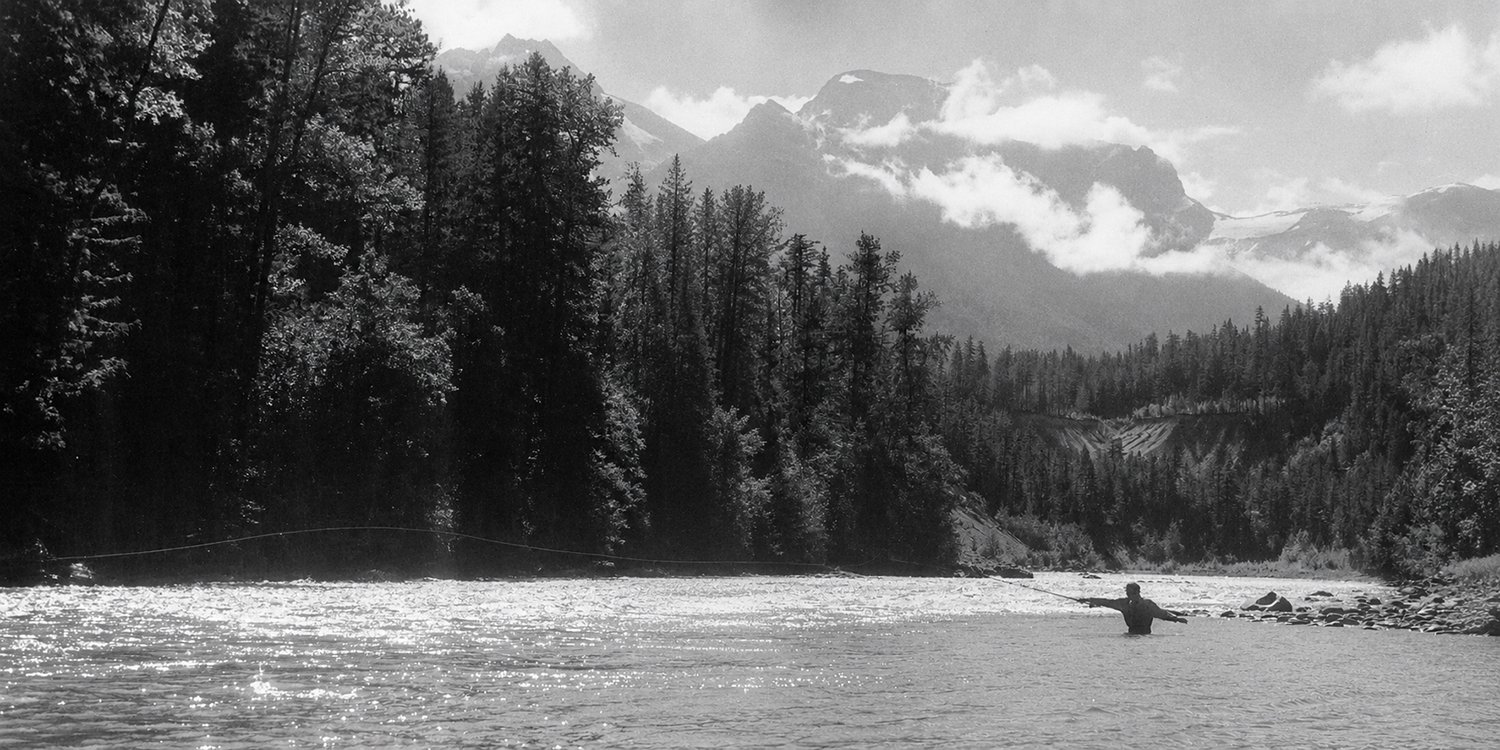
Roland Holmberg on Giants
The river was still clearing from rains early in the week and had dropped six inches during the night. We had checked the water temperature that morning and found it, at fifty-six degrees, about midway in the optimum range. A waking dry fly could locate our fish, the water's touch of murkiness helping to obscure our presence. Neither of us would fuss much with pattern selection. Dark wet flies fished greased-line are de rigueur on the Dean, more so than on most steelhead rivers, and I began casting a 1/0 Black Gnat Bucktail. This size brings to mind a large fly, but the hook was dressed sparsely, three-quarters low-water. I moved no fish, and when I began working through the pool a second time, I changed flies to satisfy my sense of thoroughness and to provide a fresh approach.
Watching John was easy. I could look over my fly and see into his water. He cast a #6 Spade with the precise timing of a metronome, each new, tight loop identical to the last, the bright pink double-taper line passing from sunshine to shade. The little fly had been tied on a Wilson dry-fly hook and dressed to swim in the surface film, a silhouette that had attracted many steelhead for him.
When I reached the end of the pool a second time, the Green-Butt Skunk had found only parr. Nowhere are these trout more voracious than on the Dean, and I changed patterns as much to discourage their attentions as to attract a steelhead. I could now crowd John without guilt; he had been through his water twice, too. After tying on a large Purple Peril, I cast only to wet the fly and immediately turned a steelhead, its tail coming out of the water as it briefly held the fly. I had tightened hastily on a slow take, and I damned my reflexes. I cast a second time, and the steelhead took the fly and just as quickly blew it away. Getting skittish, I thought.
John's yell broke my concentration and brought my head up with a snap as his steelhead somersaulted into the air. When he looked over his shoulder to catch my attention, he missed the steelhead's second jump, a leap so prodigious that I could clearly see the fish above his head. My camera was with John in the raft, and I badly wanted to document his catch, but wouldn't a double be worth remembering? I again cast to the steelhead before me and made a strong back-mend to sink the fly. As the fly drifted easily through the swing, there was a telltale pluck and then nothing. The steelhead had not moved from its station. I put my rod down, leaving it on the gravel bar pointing exactly at the fish, and ran for the raft.
John was on his knees, and for a moment I was ready to console him-until I saw the steelhead. "Did you see him jump?" he said, his voice booming with excitement. "Five times! Look! Aren't these magnificent fish? He exhausted himself! They have such character!"
"There was a leap you missed. Higher than your head!" I said as I reached for the camera. The steelhead was coming around. I would have to hurry. Looking through the viewfinder, I could barely discern pink on the buck's gill plates. Along the lateral line were only ocean silver and ocean energy. "Sixteen pounds. I've never seen a more beautiful steelhead. Not a mark on it." I wanted to study the fish. John would not hold it a second longer than necessary. The steelhead suddenly bolted from his grasp and was gone.
'I’m working on a fish. Raised it three times already," I told him as I dropped the camera off and hurried back to the upriver pool, leaving my friend content in his reverie. The rod pointed to the little vein of holding water that now did not appear so familiar. I thought through the presentation and cast so that the fly would swing slowly over the uppermost end of the suspected station. I felt the steelhead take and held the running line tightly until tension brought the rod tip down to the water, the slow-motion take complete when the steelhead picked up the current and raced downstream. John was already crossing the side channel with my camera, his delight evident in his calls of encouragement. Once the steelhead had settled down, I could move her, and the ten-pound hen was soon resting in the shallows. She had the delicate sprinkling of tiny dots that distinguish female steelhead on the Dean, regardless of their size. I suspect this is a racial characteristic, though their dazzling appearance can addle one's powers of discrimination. We were perhaps sixteen river miles from the mouth of the Dean, the steelhead only a few days from life in the ocean.
John studied her for a moment. "She was a player."
"Yes, she came to the fly four times." When I eased her into water just deep enough to support her, the fly fell out, though the barbless hook had been well into the corner of her jaw. I was holding the steelhead firmly by the wrist of her tail when she twisted convulsively from my hand and disappeared into the river. "These steelhead release themselves," I said. John was still adjusting the camera.
Jimmy Hunnicutt and Bruce McNae were a pool or two upriver. The four of us had helicoptered in from the little village of Hagensborg to Clay Bank, a pool approximately twenty miles from the ocean. Each day, we would use our two rafts to leapfrog from pool to pool, until camp water and the dry fly brought us together. Most evenings the dinner dishes were washed by midnight, and sleep came instantly.
John and I could not find another steelhead in Alder, and we set off to find more river with deeply shaded pools. We soon came upon a run that offered good holding water only at the top end. It broadened quickly into a large, shallow tailout that braided around a dozen boulders for more than a hundred yards. ,
"Let's fish this," I said, and nodded for emphasis. I saw no evidence that other anglers had come this way today. The dark currents looked incredibly fishy, the presence of steelhead was palpable.
"We should set up camp first," he replied. John was the organizer, the person who, as he said, did the "strategizing." He was also a Washington steelhead fly-fishing guide on holiday, a man whose business card listed his specialty as "The World's Waterways." I found him flamboyant and mercurial, a world-class raconteur with more than a smidgen of off-the-wall looniness. He had once been a captain in U.S. Army Intelligence, and he still spoke Hungarian and German. All these qualities made for a grand companion who would gladly spend days discussing steelhead, the history of the samba, every piece of fly fishing literature ever written, and Sioux Indian culture, alternately or all at once.
"Can't camp wait? Let's fish. Aren't we setting up a spike camp? No tents. There'll be time," I assured him. John had long since resigned himself to my compulsive nature.
"Well, give me some room," he said. We divided the small pool in half, and I began casting the Purple Peril below him. I had barely started when the fly simply stopped, sometimes a sign of a large buck. The fish shook its head before rolling on the surface and starting down the long tailout in short spurts. After a run, it would reverse itself and give me a moment to skip after it from rock to rock. Each time I thought I could get below the steelhead, it would continue on downriver. I was applying a lot of pressure and was unable to feel the steelhead give in to it.
"If this is ten pounds, it is one very strong steelhead," I said to John. I began to work close to the fish until it held below me, only thirty feet away. John tiptoed downstream and stared into the black currents.
"My God, that steelhead is huge!" he called. The fish darted upstream, fighting both the river and my rod, and in two hundred feet I had him turned on his side, exhausted.
"You have your twenty-pounder," said John.
"Oh yes, at least that much," I answered.
Jimmy Hunnicutt suddenly materialized. "It's a doe!" he exclaimed.
"Look more closely," said John. The buck was so brilliant, still so sexually immature, that its head remained small. Enormous shoulder girth made the head look even smaller. I thought the buck was very much like an Atlantic salmon in contour. I tailed the steelhead for pictures and then eased it into deeper water for the release.
Dean Channel
During the next few days, we caught a half-dozen steelhead, from ten to thirteen pounds, with fresh wounds from encounters with gill nets. Curiously, no large steelhead bore net marks. I think this was a matter of luck, for the nets do not discriminate.
We expected to see these mutilated steelhead. This was the second week of August, and the chum salmon fishery at the entrance of Dean Channel was well advanced. (No commercial netting is allowed in the channel itself.) Here, miles of gill nets are set directly in the path of steelhead bound for the Dean River. Thousands perish and are legally sold.
When a Canadian commercial fisherman sells his catch to a fish buyer, he notes the statistical area from which the fish came. Failure to do so can supposedly result in the loss of his license. This data includes steelhead; most Dean River steelhead are caught in Area 8.
While steelhead may be canned as "sea trout," "deep-sea trout," or simply as steelhead, most are sold fresh, and they occupy the same price range as coho salmon. However, George Dodman, an executive with B.C. Packers told me in 1988 of steelhead selling in Vancouver, B.C., deli markets for as much as fifteen dollars per pound.
All saltwater fish in Canada-and this includes salmon-are under the authority and management of the Department of Fisheries and Oceans, a federal department. Conversely, all freshwater fish-and this includes steelhead in their rivers-are managed by the Ministry of Environment, a provincial agency. Information gained about steelhead is not always shared between these two agencies, sometimes because of their separate natures, and sometimes by design. Beyond any internecine mixing of fishery management and fishery politics is the fact that ocean steelhead fall into a grey area and are not the direct responsibility of anyone. This is astonishing, considering the fact that more steelhead are killed incidentally in the ocean than are killed by anglers fishing in rivers.
Steelhead generally make up only a very small percentage of the total commercial take of salmonids. In Area 8, during the period when gill nets took 200,000 chum salmon, seine nets accounted for millions of sockeye and 250,000 more chums. These are staggering numbers, compared to the suspected take of 10,000 steelhead and the recorded commercial take of 2,478 in 1988. Several factors contribute to the disparity.
If only a few steelhead are found in the nets, they often end up on the galley stove, in the home canner, or in the smokehouse, and they are never recorded. This practice may be more common when the steelhead have a lower market value than the targeted salmon-sockeye (red) and chinook, for example. Off Dean Channel, some of the steelhead caught in commercial nets in June and July will be kelts, either Dean summer-runs or Bella Coola winter-runs, an April and May escapement. These fish have little or no market value as fresh fish. Also, some steelhead are likely tossed in with salmon during canning runs. Finally, an unknown number of Dean River steelhead are netted in waters other than Area 8.
Commercial fishermen are becoming increasingly sensitive about the loss of these steelhead from the sport-fishing sector. Many are themselves steelheaders, and the entire matter of net-caught steelhead has become a politically contentious issue. New netting restrictions crop up each year in an effort to save steelhead in various mixed-stock fisheries, and they are never at the convenience of the commercial fishermen. Many fishermen in the gill net and seine net fleets now make an effort to release steelhead from their nets, even when the steelhead have only a marginal chance of surviving. Seine nets, in particular, can bring in undamaged steelhead. Some fishermen will make an effort to scoop out as many steelhead as possible before stowing their catch. It is impossible to know how many of these steelhead are thus saved, or how many die after being removed from the gill nets. "The commercial boys don't tell us a thing," one provincial fishery technician told me.
Escapement figures for Dean River steelhead are general, and subject to considerable fluctuation from year to year, but may range from seven thousand to twenty-five thousand. Natural fluctuation is due to a number of factors. Spawning and hatching success and the growth of parr are enhanced by mild winters and spring runoff of sufficient moderation that spawning redds are not scoured out. The ocean environment is not static, either, and in some years, climate and available food supply contribute to highly successful returns. Beyond natural mortality, the impact of the commercial fishing industry on steelhead populations is governed by the numbers of salmon present and the resulting "open" days available to commercial fishermen. Heavy runs of salmon can (and do) coincide with low steelhead returns, with devastating results to steelhead numbers.
The Ministry of Environment must now find a solution to this vexing problem. Solutions are certainly not going to come from either the Ministry of Fisheries and Oceans or the commercial fishermen, whose unions are strong and militant. Each organization is somewhat a prisoner of the other, and neither, of course, is responsible for steelhead except for keeping track of how many come off the boats. Before any meaningful solutions are found, however, it must be understood how steelhead enter Area 8, and how they behave once they are in this area of intense commercial activity.
To that end, in 1987, the Fisheries Branch of the Ministry of Environment began a sonic tag study. I discussed the study with Jack Leggett, Section Head, Cariboo Fisheries, and Dennis Wilders, Fisheries Technician, in their office in Williams Lake, British Columbia. Both were active in the study, which was ongoing at the time of the interview in August 1988.
The study consisted of capturing steelhead in the Dean Channel and placing three-inch by half-inch stainless tubes, the sonic tags, down their throats. The steelhead were fin-clipped and released. (Anglers catching these fish were asked to kill the fish so that the tags could be returned.) The steelhead were tracked for at least twenty-four hours. The range of the nine hundred dollar tag was only two hundred meters or so, and following the fish required constant vigilance. This was exhausting work, but worth the effort, for an accurate picture of the steelhead's saltwater movements in Dean Channel emerged. The steelhead generally traveled between one hundred and three hundred feet from shore, within the upper two meters and, usually, within the upper four feet of water. The steelhead traveled at a rate of only one to two nautical miles per hour, and only in the daytime. At night, they milled around without any particular direction. The fish invariably stopped before each freshwater inlet to nose around, presumably to smell out trace elements, though different water temperatures could have been a factor. Movements in the lower river were generally steady, but not always. One signal continued from a single pool for a couple of weeks, until biologists became convinced that the fish had disgorged the sonic tag. Then the fish suddenly continued its migration; no one knows what prompted this behavior.
Using this informaton, cooperation between federal and provincial fishery agencies could modify current salmon harvest practices to reduce the incidental take of steelhead. Nets could be set at least four feet below the surface and three hundred feet from shore. Chum and sockeye are not so surface-oriented, and the change would not reduce the commercial harvest of these salmon.
The huge incidental catch of steelhead should be a grotesque violation of someone's stewardship. After all, this is the loss of a sport fishing resource that has vastly more recreational value to British Columbia than commercial value to Canada. But the net wounds serve as reminders that steelhead trespass many jurisdictions in their travels. The ocean is the dark side of their life, the mysterious source of their beauty, size, and wildness, and the reason I pursue them with such passion.
Early Angling
The Dean River is still accessible only by air and by sea. Hundreds of islands guard the outer coast of British Columbia, while the great fjords that cut deep into the mainland enforce the sense of isolation. One can observe wolves and bear walking island beaches. Virgin stands of hemlock, fir, and cedar cover much of the surrounding land. Waters still teem with fish, and the intertidal zones are impossibly rich in shellfish. In many respects, the area is little changed from when Captain George Vancouver first charted it for Great Britain two hundred years ago.
Well east of the protected "Inside Passage" is the entrance to Dean Channel, a sixty-mile-long reach that ends at Kimsquit and the entrance to the Dean River. Kimsquit is what Canadian cartographers call a "locality." It certainly isn't a village. If anything, it is a landing strip, a crossroads on the north side of the river where people and supplies are ferried in and out. During August, the place is humming.
Only thirty years ago, almost nothing was known of the Dean as a steelhead river. Before World War II, some Indian families from the Bella Coola area had ancestral fishing grounds on the Dean and would set up camps there each summer. Ultimately, the Indians became part of a Bella Coola reserve, and they currently net the Bella Coola River for both salmon and steelhead. They maintain a camp on the lower Dean below the falls, but only as a summer cultural center. Netting no longer takes place.
Logging commenced in the Dean Valley in 1961. Initially, this was on a very modest scale, but it grew dramatically when Mayo Logging began operations in 1964. The following year, a massive wooden bridge was constructed across the river just above the canyon so that heavy equipment could be taken to the south side of the Dean. A landing strip was built below the canyon, as well. Though all this was to facilitate the logging operation, the area opened up for visiting anglers, who now had easy access to both sides of the Dean. Mayo Logging shut down in 1968, but Crown Zellerbach logged the area through 1969. Mayo Logging returned to harvest logs in the area until mid-1976, when the bridge had become so battered by flood waters that it was no longer safe to use. Mayo moved upriver to log the Sakumtha and Kalone areas in early 1976, but withdrew all its heavy equipment and dismantled its buildings. Today, all that is left of those enterprises is a logging road that parallels the Dean for twenty-five miles or so, a footbridge that is a shambles, and a lot of stumps. (When I returned to the Dean in 1989, the bridge had either washed out-or been blown up.)
Dick Blewett and Bob Stewart first explored the valleys of the Bella Coola and Dean rivers with Dick Poet in his Cessna 180 floatplane during the late 1950s. They landed for the first time on the Dean River several miles upstream of the canyon in September 1957. After inflating their rubber rafts, Blewett and Stewart camped and fished their way to the takeout above the canyon. They were seeking coho salmon, and they caught many, along with the odd steelhead, little realizing that the main run of steelhead was already past them. They returned again in the fall of 1958 and 1959, always for the coho. When they returned in 1961, it was in August, the choice of time somewhat happenstance, and for the first time, they encountered the main run of Dean River steelhead.
The next year, the two men opened the first guide camp on the river, nine miles from the mouth, the site chosen because a floatplane could be landed safely there. "Camp" was some tents that housed a few anglers.
Two additional fishing camps were established on the Dean in 1965, taking advantage of the newly built landing strip. Rimarko Ranch was located a mile above tidewater, while Double Haul Enterprises built their camp on Kimsquit Bay by the mouth of the Dean. That year, an estimated 140 anglers fished the Dean.
In 1968, Daryl Hodson moved from Ocean Falls to build a fishing lodge at Mile 7.5, the old "Net Hole" of the Bella Coola Indians. That same year, forty miles up the Dean, Dick Blewett and Bob Stewart established a second camp, which could be reached only by helicopter. A competing helicopter camp opened the following year, but both closed in 1970, when the entire Dean River above Kalone Creek, Mile 21, was closed to fishing and preserved as a spawning area.
Dick Blewett sold his interest in the camp to Bob Stewart's son, Rob, in 1973. While Duncan Stewart, Rob's brother, eventually bought out his father's interests, Rob Stewart has managed the Lower Dean River Lodge since 1973. (During these years, Bob Stewart has successfully operated Stewart's Lodge on Nimpo Lake, a Canadian institution near the headwaters of the Dean River.) Today, Stewart's and Hodson's are the only two licensed lodges operating on the Dean.
In 1971, the Ministry of Environment initiated a creel census to determine the annual number of "angler days." (An angler day, or rod day, is any part of a day fished by one angler. For example, if a visiting angler fished for five days, regardless of the number of hours he fished each day, he would contribute five rod days to the annual total.) There were 937 angler days in 1971, and 2,636 by 1975. The 1989 estimate was that the Dean supports approximately five thousand angler days annually, more than three thousand of the days in August. The Ministry of Environment feels that these numbers for August are much too high and threaten the quality of the wilderness experience. I discussed this with Fisheries Branch biologists Jack Leggett and Dennis Wilders. Both expressed concern that the rapidly building number of anglers visiting the Dean each summer shows no sign of abating. "This is currently our biggest problem in managing the Dean," said Wilders. Final plans were being developed for a limited-entry system to go into effect in 1990, the first of its kind in British Columbia.
Dry Flies
Each morning, John would wake up and begin singing, a Spanish folk tune mostly, but when a cold drizzle greeted us one dawn, he switched to Christmas carols. Coffee fueled his hearty delivery, and we had all brought bags of gourmet coffee. After breakfast, John would set up the camp table, attach a vise, dig out some fly-tying materials, and fall silent. We knew he was once again working on a new steelhead dry fly.
On Anchor Pool, John and Bruce went through twice with wet flies without turning a fish before deciding to work the tail of the pool with some of the large dry flies that festooned Bruce's felt hat. He had a lot of Bombers and some Waller Wakers, the pattern that Lani Waller had recently developed for use on the Babine River. Each of them raised a good fish three times to a Waker by throwing a downstream mend, the hard-dragging fly setting up a very visible commotion. But when Bruce solidly hooked a steelhead at last light, it was to a spidery low-water wet.
John had thought hard on the matter. Some of the water he covered that evening was seventy feet out, easily within range of his ten-foot 7-weight rod. But even when holding the rod straight up and raising his arm, it was hard, in broken water, to keep the dragging fly from going under. A more buoyant, higher-riding fly was possible, but its hooking qualities could be suspect. John's fly tying was an effort to solve the problem of keeping a dry fly waking through distant lies.
Jimmy Hunnicutt and I hiked downriver to fish Rabbit, a quarter-mile-long pool between ancient stands of red cedar. Earlier in the year, he had been climbing peaks in the Andes, and he remained whippet hard and nearly as fast, even in waders with aluminum cleats. As I wheezed along after him, he talked of trout fishing near his boyhood home in North Carolina's Great Smoky Mountains and of his most memorable West Coast steelhead. Since moving to Washington ten years earlier, he had fished just about every important steelhead river worth the name, a recreation schedule he maintained throughout the year.
Two hours before dark I hooked a hen of fourteen pounds that swept up my Green-Butt Skunk on the run. She raced down from the head of the pool to jump fifty yards below the hookup, the kind of blistering run that Bill McMillan calls, "a reel meltdown." She bore no net scars, and we rejoiced in her safe release.
Jimmy is given to drab greased-line flies with roughly dubbed bodies that produce a very buggy appearance. His Blue Mole was a deadly low-water creation that had already accounted for a number of Dean steelhead. But late on this day, with the water before us a little turgid from headwater rains, I suggested a brighter fly and offered him my box. Jim chose a Midnight Sun, an orange and yellow pattern, and almost immediately hooked a large steelhead. Because of an eight-pound tippet, he played the fish carefully. When the buck was beached, we estimated its weight at twenty pounds. "That fish paid for my trip," he said.
There was no doubt where we wanted to camp the next night.
Jimmy and I returned to Anchor at last light to listen with interest as John and Bruce described their experiences with the dry fly, but we were not moved to change from the elegant wet flies we had been fishing. The conversation turned to why these steelhead struck so readily, why they were so "trouty" in their behavior while still so "ocean" in their appearance. Like most steelhead fly fishermen, we were seeking to know what relationships existed between the fauna of the steelhead's world and the artful and fanciful flies conceived in our imaginations. As theories were tossed about, caddisflies whirred in the hissing lantern light and gave a good approximation of the indigenous species. While picking them from the light for identification, a huge caddis fluttered up the side of the glass. I first thought it was a moth.
"Look! An October caddis!" said John. He held it to the light; the dirty orange body was diagnostic. Bill Bakke's October Caddis steelhead pattern was better known to me than the insect itself.
"I had no idea they were found this far north. I think of them as an Oregon caddis," I said. Then I was struck by another similarity. "You know, the Blue Mole has some of that very burnt orange in the butt section. I wonder if that is why it's so effective."
Who is to say why a steelhead strikes a fly, I thought. We try to flirt with their reasoning, and then hope that they attack our flies for noble reasons, that they take our General Practitioner for a prawn and not, God forbid, for roe. Beyond such gratuitous prejudices is the more certain relationship between the steelhead's eagerness to strike flies suggesting insects and their premigrant environment in an insect-rich river.
When we reached the Dean, I had immediately noticed thousands of nymphal skins left on rocks by emerging Pteronarcys. This was the very end of the hatch, but the next day I watched a parr chase an enormous winged adult down the river. My amusement changed to astonishment when it finally took the stonefly down. (My admiration for the parr would turn to despair when I couldn't keep them off the flies I wanted to fish, and I was reminded of this incident again and again. Fishing a Blue Charm proved especially hopeless.) That same day, John discovered a golden stone in one of the coolers. Smaller stoneflies were about, and mayflies often sprinkled down on midday runs. I became so impressed with this abundance that I regretted our lack of a field guide on stream entomology. The hatches reminded me of more southern rivers, especially those with cottonwoods and sagebrush, and I wondered if Dean steelhead reflected these differences. I suspected that they did, and on this night in the wilderness I took satisfaction in that.
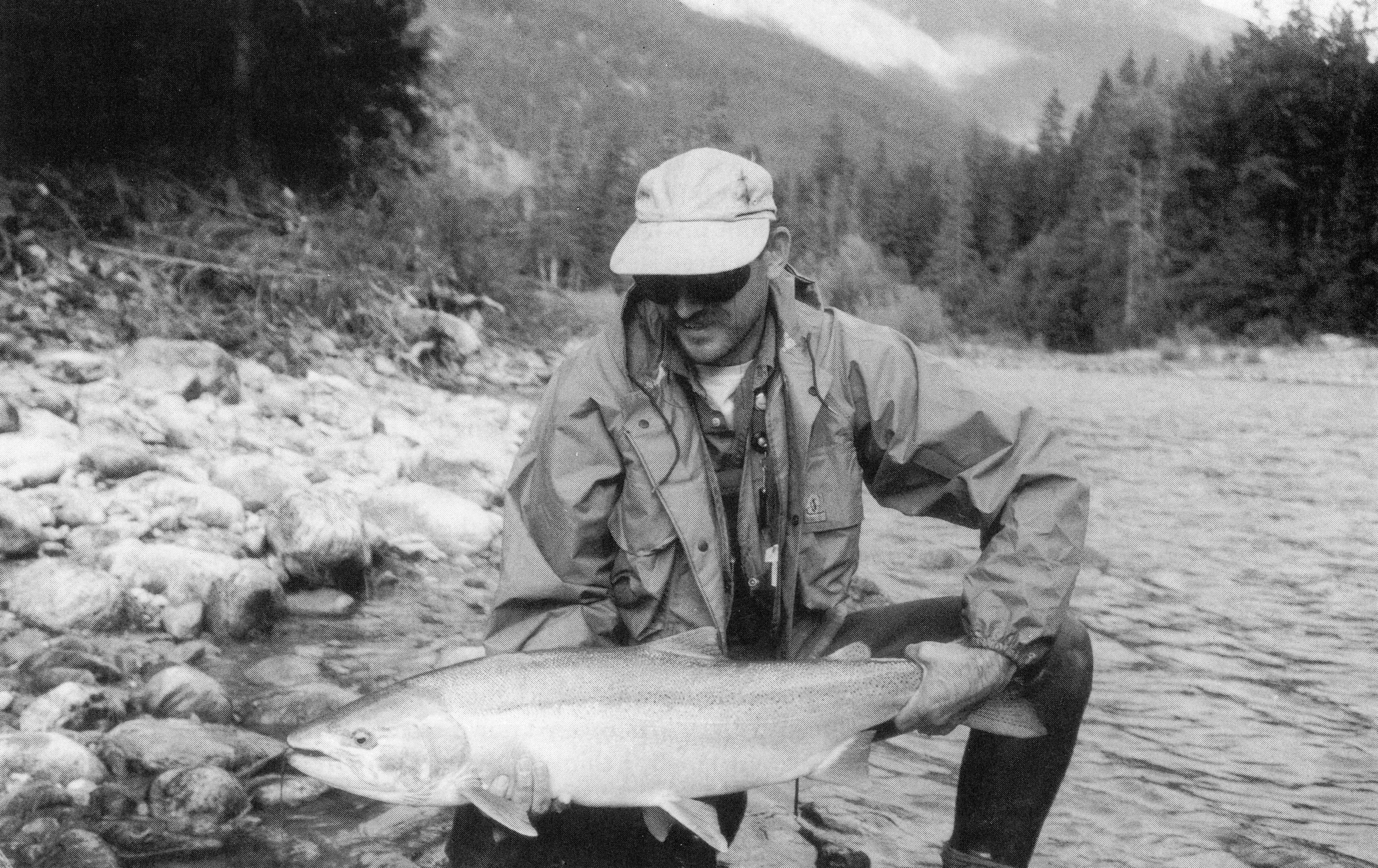
Jimmy Hunnicutt with one of his back to back 20 pound steelhead.
The next morning we moved to Rabbit and set up camp beneath the huge cedars. The abundance of good lies eliminated any anxiety over their allocation, and each of us sought a piece of water to suit his approach. Jimmy, ever restless, rowed John across the river, and the two hiked to a long slick they had glimpsed on the quick float down. Bruce McNae eyed the immense tailout and thought it had been heaven-sent; he would seek no other part of the pool during the next two days. The elbow at the head of the pool fixed my attention, and I would be happy in its turbulence, the river thundering in my ears as I drove the fly for the far side.
By midafternoon, Jimmy had beached his second steelhead of over twenty pounds and had lost another of nearly equal size, a fish that had left him with only six feet of backing on his reel. "Yeah, another twenty-pounder," he said, "larger than the first." His drawl was Tarheel deadpan, but he had the aura of a man beatified. "No, that never happened before, never back to back," he said in answer to my question. Jimmy recalled a larger Thompson steelhead that had come to his Sweet Loretta, but trying to put this day in perspective was not easy.
John had lost a steelhead right in front of camp. "High in the teens, maybe twenty pounds," we all agreed.
Bruce remained anchored at the end of the pool, a tiny figure beneath Rabbit's several mountains, and we speculated whether he was going to homestead the area. That seemed fitting, because he raised thoroughbred racehorses in Washington, described himself with convincing humility as "a farmer," and possessed the disarming equanimity of landed gentry.
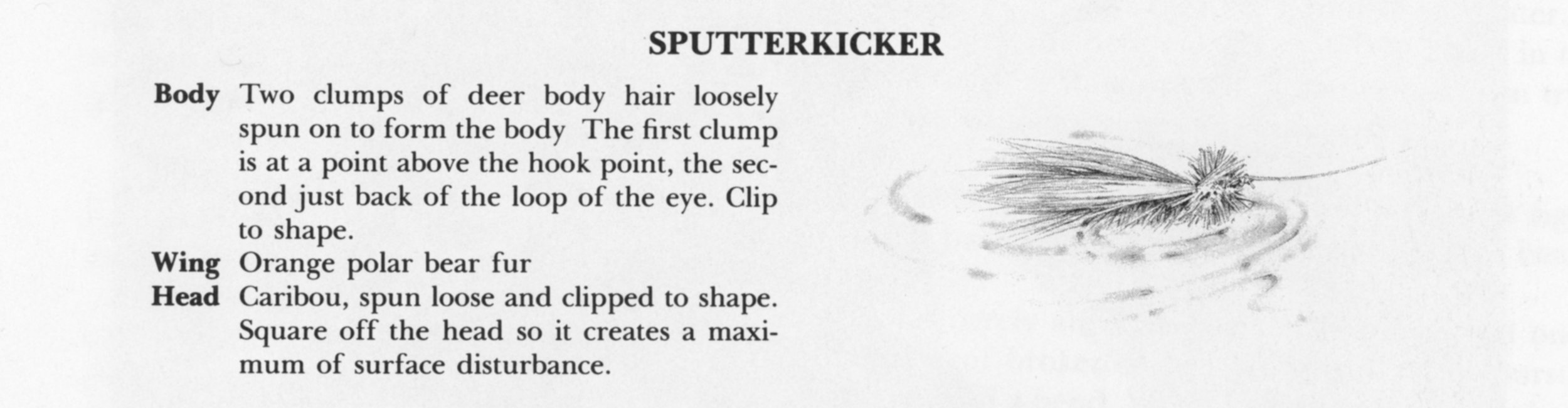
John had spent much of the day tying his new dry-fly creation. When he handed me the first example, I called it a Top Knot, for the crest of bright orange polar bear over the body of spun deer hair. But after John had tested the fly at a variety of distances and observed with satisfaction the commotion it made, he called it the Sputterkicker.
As the three of us discussed the fly, we heard occasional yells and groans from the tailout. There was no "Yahoo!" mixed in, the signal that Bruce was fast to a steelhead. "He's not being eaten by a grizzly," I said. We could discern a feverish casting stroke, but not one of self-defense "He's not drowning either," I added. We knew Bruce would happily double-haul his way over a falls. The man was that keen. His flailing, we decided, was no distress signal. The long "Yahoo!" that soon echoed up the valley turned into a kind of screaming death rattle. Bruce appeared, looking uncharacteristically frazzled.
"Those splashes aren't salmon. They're steelhead! I've been raising steelhead all afternoon on dries, on the Sputterkicker! Rose one five times!"
"How many rises did you have in all?" I asked. This set Bruce to counting back, and he was sure he could remember eighteen.
"Did you manage to hook any?"
"Twice steelhead came up and took the fly down. No splashes. No false rises. I was sure they were hooked. When I finally raised my rod-nothing. But I did hook a fish!"
"On the Sputterkicker?"
"No, on a low-water wet. A steelhead hit the fly and ran out of the pool and down the river. Never stopped. When most of my backing was gone, the fly came out."
Bruce's experiences were not unusual, the dry fly a great indicator of where a steelhead may be holding, offering a chance to follow up with a different dry, or a greased-line wet, with or without a hitch. But hooking one straightway on a dry can sometimes be a frustrating experience, and I admired Bruce's determination.
The next day, John and I were well below Rabbit. He was fishing his Sputterkicker, happy to go fishless if that was the result of his choice. He wanted time to sort out the pattern as a primary approach, not as an alternate to a failed wet fly.
Rain continued off and on throughout the day, the river now rising and showing a bit of color, but not enough to discourage John's dry-fly efforts. He raised a good fish five times without a solid take. I watched each rise, and several times the surface boiled six inches from the Sputterkicker. When the fish would not come back, I covered the lie with an Orange Charm fished with a hitch, but the steelhead was gone. I thought that would be the end of it, but John soon located another steelhead. After the fish had come to the fly twice, he called me over to watch. John made no effort to rush the fish, and he presented the dry fly by casting well across the river and executing a strong back-mend to produce a long, downriver, drag-free float. I watched him with satisfaction, for I often cast a dry fly downstream in just such a manner. John grew tense when the fly began to drag. He led the fly through the swing and was again over the fish. There was a huge boil beside the fly.
"There, did you see him?"
"Yes! I don't know what to say. The steelhead came right to the fly, but he didn't take it down. Try again."
John repeated the cast, exactly as before, and when the fly began its swing, it followed the track of the previous drift. In a blink, the steelhead lunged at the fly, its head completely out of the water. It missed, and, catlike, pounced again-and again failed to catch the deer-hair fly bouncing about in the current. Such audaciousness often leaves a steelhead cautious, as if its predatory nature has been triggered so involuntarily that it doesn't know what to make of it. I was not encouraged.
"Are you going to rest the fish?"
John's line trailed downstream. He was collecting himself, too. He shook his head and went right back at the fish. I would not have done this, and I would have been wrong. The steelhead came head-and-shoulders out of the water and crushed the fly.
"Fish on," said John. His voice, grim and intense, was barely audible. The steelhead jumped once before clearing the pool and tearing down the long run of broken water. We staggered in pursuit along the slickly cobbled shore as the fish disappeared around a bend. When I reached the bank above the river to better keep track of the steelhead, it occurred to me that John's big Hardy Perfect must be nearly emptied. "I thought about it, and dared not look at it," he would tell me that evening. John called out, asking if he could get around a tree jutting into the water. I was sure the deep currents would sweep him away. I reached for his free hand, pulled him up the bank, and we continued our mad scramble. John was below the steelhead when it finally paused to turn upstream and maintain a holding station. This was the break he needed. A few minutes later, some three hundred yards from the hookup, the eighteen-pound buck was on his side, motionless in his exhaustion. The Sputterkicker, now a fly with a past-and an auspicious beginning-was still securely fastened in the corner of his Jaw.
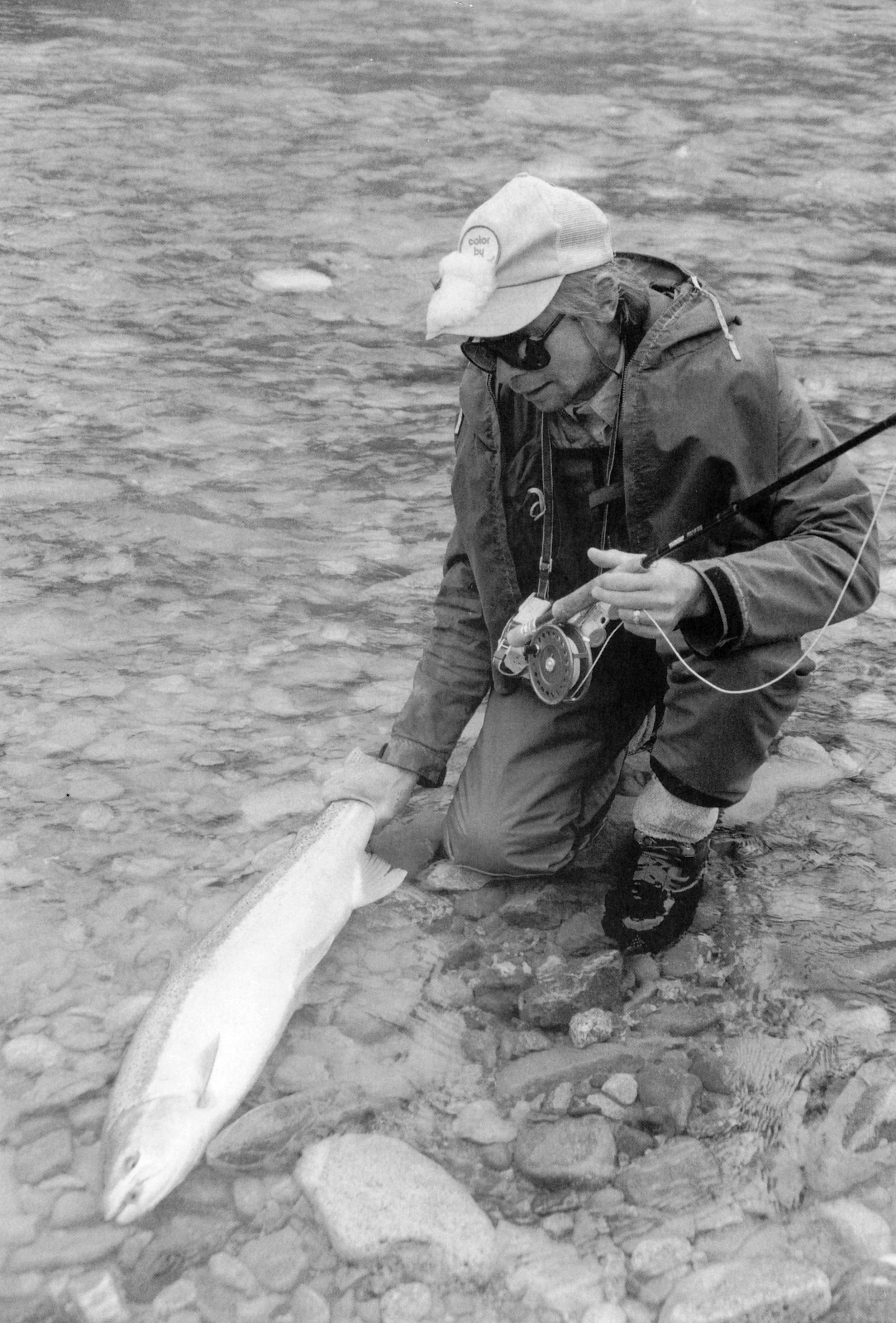
John Farrar tails an 18 pound buck that rose to his Sputterkicker.
Dean River Steelhead
The "Dean River Steelhead" is at least two very distinct races, long separated by headwater destinations. First is a spring run of steelhead bound for the Takia River, a main branch of the Dean some forty-five river miles from the ocean. These fish come through so quickly they often overrun themselves, and they may drop back downstream during the warmer periods of late summer. They are sexually immature, average eight to nine pounds, and appear greyer than mainstem Dean River steelhead. I think this race would compare very much to the springers in Washington's Kalama, Washougal, and Wind rivers. The peak of the run is usually found by gear fishermen seeking chinook salmon in June and early July along the lower two miles of the Dean. Each year, a few eighteen-pound Takia steelhead are caught. I am not aware of any scale analysis studies conducted on the race. By means of a creel census, anglers often provide fishery biologists with hard escapement data, but the Takia River is closed to angling, and save for run timing, there is no certain way to separate the two races on the lower river.
Bobby Cunningham is a carpenter and master boat builder from Kamloops who camps along the Dean just below the falls for several months each summer. I met him near Kimsquit, and we motored along the lower river in his plywood jet boat, studying the steelhead lies now filled with chum and pink salmon. For Bobby, whose steelhead fly fishing is confined mostly to the Dean and Thompson rivers, the Takia race is a breed apart, the strongest of all steelhead. "They will pop a seventeen-pound tippet like nothing," he told me. The large, early July Takia steelhead had Bobby searching for superlatives. "They still have sea lice hanging on them, and they haven't wasted any energy getting over the falls. There is nothing like them."
Few anglers have the experience to make such an emphatic racial distinction. Dean steelhead caught from below the falls at any time of the year are steelhead of legendary strength. Many fly fishermen will claim that the same fish caught from above the falls have, at worst, lost only a step, and they vie with Thompson River steelhead as the "hottest" in North America.
I believe several factors contribute to these claims. Dean steelhead possess remarkable girth, their robust shape rarely conforming to the usual weight-to-length ratio associated with summer-run steelhead found elsewhere. (At twenty-four inches, a steelhead will weigh four pounds. For each additional inch in length, add a pound. Thus, a thirty-inch steelhead is typically ten pounds.)
In their study, A Resume of the Dean River Sport Fishery: 1971-75, J. W. Leggett and D. W. Narver gave the following correlation of ocean age to mean (average) length and weight: a) 2 + ocean males were 72.6 cm and 4.9 kg (28.6 inches and 10.8 pounds); 2+ females were 71.4 cm and 3.9 kg (28 inches and 8.6 pounds); b) 3+ males were 88.8 cm and 8.9 kg (35 inches and 19.6 pounds); 3+ females were 81.5 cm and 6.8 kg (32.1 inches and 15 pounds).
My general impression of the most robust male steelhead was that their girth-to-length ratio was often as great as those typically found on the Kispiox, the generally accepted standard against which other steelhead are measured.
Several explanations could account for their robust size and strength. Great physical effort is required to overcome the falls on the lower Dean. It is impossible to imagine this not being part of a natural selection process at work. (Interestingly, the less-athletic pink and chum salmon spawn below the falls, while chinook and sockeye salmon spawn well above the falls. Biologists do not believe that Dolly Varden char are capable of passing up the falls. Below the falls they are saltwater in much of their orientation, feeding freely on chum spawn and salmonid smolts in tidewater. Upstream, these fish are strictly residential.)
The majority of Dean steelhead, as well as those steelhead that enter the Kispiox, Sustut, Babine, and Bulkley rivers, enter fresh water at approximately the same time. The Dean has a reputation as a July and August sport fishery, while the famous tributaries of the Skeena are notable for their fall fishing. The major difference, of course, is the distance the steelhead must travel before reaching water that can be fished with a fly. Dean fish are immediately available to anglers, and their condition is superb. Time spent in fresh water is a period of advancing sexual maturity. Bucks in the upstream tributaries of the Skeena are typically highly colored, and are often sluggish, despite their great size and strength. No steelhead's condition is improved by a month or more spent ascending its river.
Leggett and Narver collected scale samples from Dean River steelhead killed by anglers between June and September 1973, 1974, and 1975. The steelhead's freshwater and ocean age in years were thus determined. (Repeat spawners will be discussed later in this section and are omitted from these figures.)
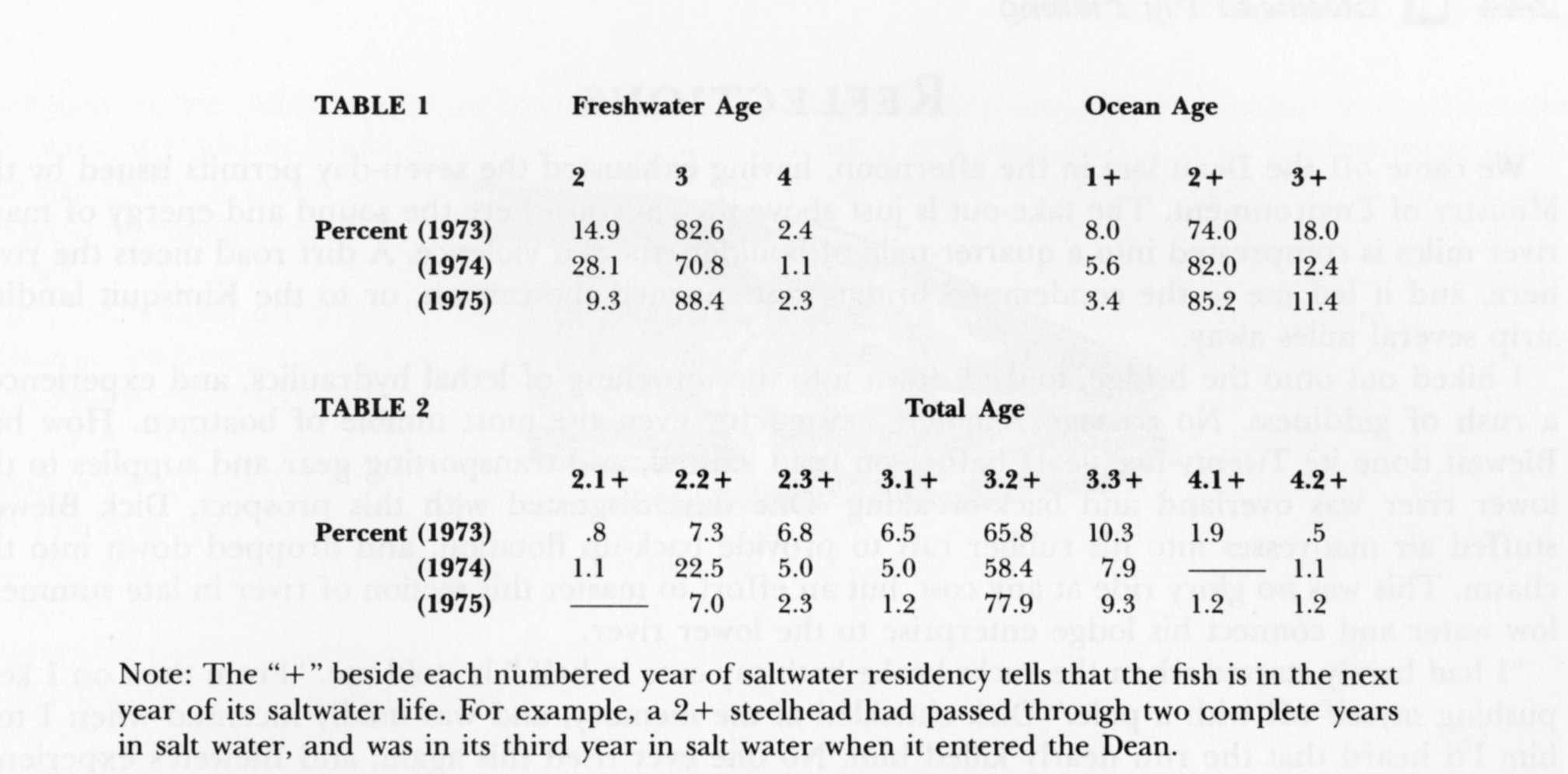
Freshwater residency is typically three years, midway between what is found among Washington and Oregon steelhead (two years) and the more northern races found in the Skeena drainage (four years). These differences do not necessarily produce different-sized smolts. I believe the longer freshwater residence of steelhead parr as one goes north is a necessary result of the slower growth rates experienced in more frigid, less fertile waters, and the shorter, temperate period of rapid growth.
If the sampling is representational, it is evident that some years show stronger runs of steelhead with longer ocean residencies. I have discussed this with numerous fly fishermen, and many are certain they have experienced this in their fishing. There are "trophy years" when, for reasons beyond our understanding, a river will have more than the usual number of large fish. I am just as certain that, within the months of total escapement, a few weeks each year offer the greatest opportunity at a trophy-size steelhead. This period is not necessarily the time of peak escapement, though I believe it is so on the Dean.
The ratio of male to female steelhead was approximately 1:1.60, even among the one-year ocean fish. There was no true run of ''jack steelhead," the sexually precocious males evident on some other rivers.
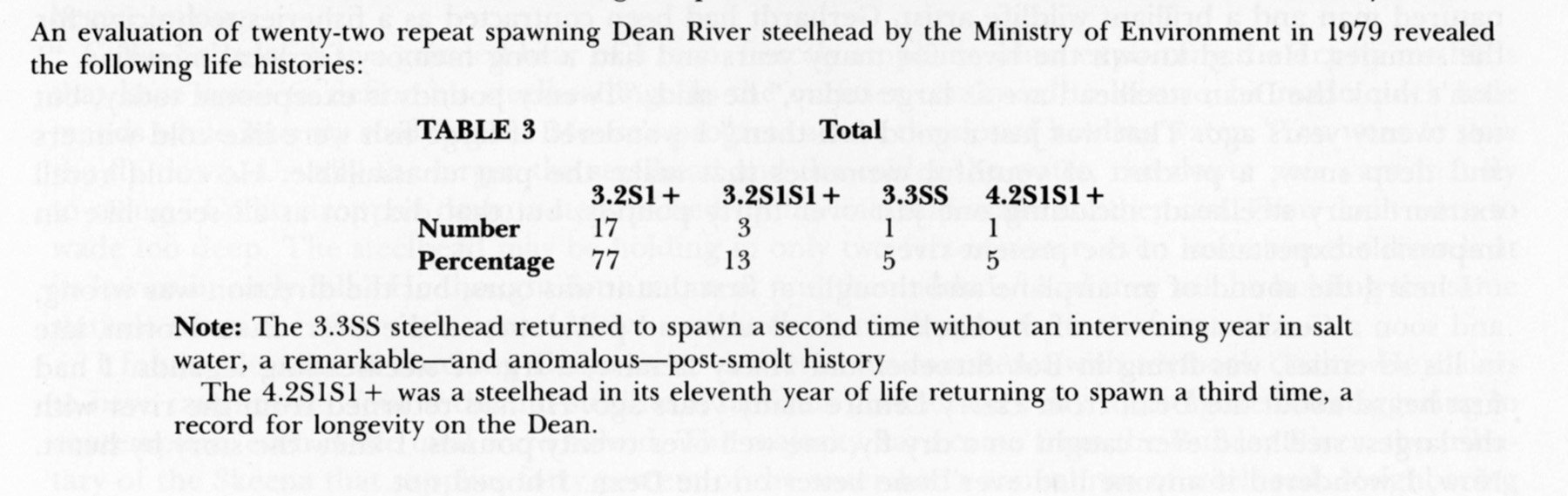
In addition to the above sampling, 100 repeat spawners were examined. They represented 11 percent of the run in 1974, and 17.9 percent in 1973. Most were of age 3.2S1S+, primarily female steelhead that had spawned after two years in salt water, spent a year in the Dean followed by a year in salt water, and were captured while in the Dean a second time, steelhead in their eighth year of life. One female steelhead was returning to spawn a fourth time, a fish at least in its ninth year.
Reflections
We came off the Dean late in the afternoon, having exhausted the seven-day permits issued by the Ministry of Environment. The take-out is just above the canyon where the sound and energy of many river miles is compressed into a quarter-mile of boulder-studded violence. A dirt road meets the river here, and it led me to the condemned bridge that spanned the canyon, or to the Kimsquit landing strip several miles away.
I hiked out onto the bridge, looked down into the upwelling of lethal hydraulics, and experienced a rush of giddiness. No passage remotely existed for even the most nimble of boatmen. How had Blewett done it? Twenty-five years before no road existed, and transporting gear and supplies to the lower river was overland and back-breaking. One day, disgusted with this prospect, Dick Blewett stuffed air mattresses into his rubber raft to provide back-up flotation, and dropped down into the chasm. This was no glory ride at any cost, but an effort to master this section of river in late summer's low water and connect his lodge enterprise to the lower river.
"I had barely started when the rocks broke both my oars in half," he told me. "From then on I kept pushing myself off with a pole." Dick chuckled at the memory, and was mildly incensed when I told him I'd heard that the run nearly killed him. No one ever tried this again, and Blewett's experience is the most enduring of all local tales.
The four of us stacked all of our gear at the take-out and camped by the river. An employee from Tony Hill's Nakia Lodge would haul our gear to the airstrip in the morning. I was tired and satisfied, my mood reflective; the wait would not be taxing.
A young man I had passed earlier in the day happened by, and we talked about Dean steelhead. I remembered him both for the Bogdan reel he was fishing and for the casts he made while standing to his armpits in the currents. He was using a very-fast-sinking shooting head spliced to a lead-core sink tip, and he had successfully dredged the bottom for several fine steelhead. Two more would come to his fly that evening, but I had no desire to follow him up the river. I had enjoyed wonderful fishing all week using only floating lines, and I broke down my rod as we spoke.
Nakia Lodge is near the landing strip, a convenience perhaps offset by its distance from the river. By means of Honda three-wheelers, guests can shuttle themselves back and forth. After days of quiet solitude, this little fleet of motorcycles should have produced culture shock, but the quicker, more competitive pace of the last few miles of river had prepared me for them.
As John Farrar and I stood on the strip, I felt detachment far out of proportion to my sense of impending departure. Upriver pools were still blotting out most of the here and now. I was more comfortable two days before, and most comfortable the day before that. I like solitude; I lose myself in it. My recreation is solitude and fishing, together, but in that order.
Gerhardt Trolitsch was looking for a conversation when he motored up on one of the three-wheelers. Weeks alone in the game cabin by the take-out made him anxious for company. A hearty, good-natured man and a brilliant wildlife artist, Gerhardt had been contracted as a fisheries technician for the summer. He had known the river for many years and had a long memory for local minutiae. "I don't think the Dean steelhead are as large today," he said. "Twenty pounds is exceptional today, but not twenty years ago. That was just a good fish then." I wondered if large fish were like cold winters and deep snow, a product of youthful memories that make the past unassailable. He could recall extraordinary steelhead, including one just over thirty pounds, but that did not at all seem like an impossible expectation of the present river.
I heard the sound of an airplane and thought at first that it was ours, but the direction was wrong, and soon a Cessna came out of the bank of rain clouds and put down on the river. Buzz Fiorini, late in his seventies, was flying in Bob Stroebel and Harry Lemire, a trio of steelheading legends. I had first heard about the Dean from Harry Lemire many years ago. He had returned from the river with the largest steelhead ever caught on a dry fly, one well over twenty pounds. I knew the story by heart. Now, I wondered if anyone had ever done better on the Dean. I hoped not.