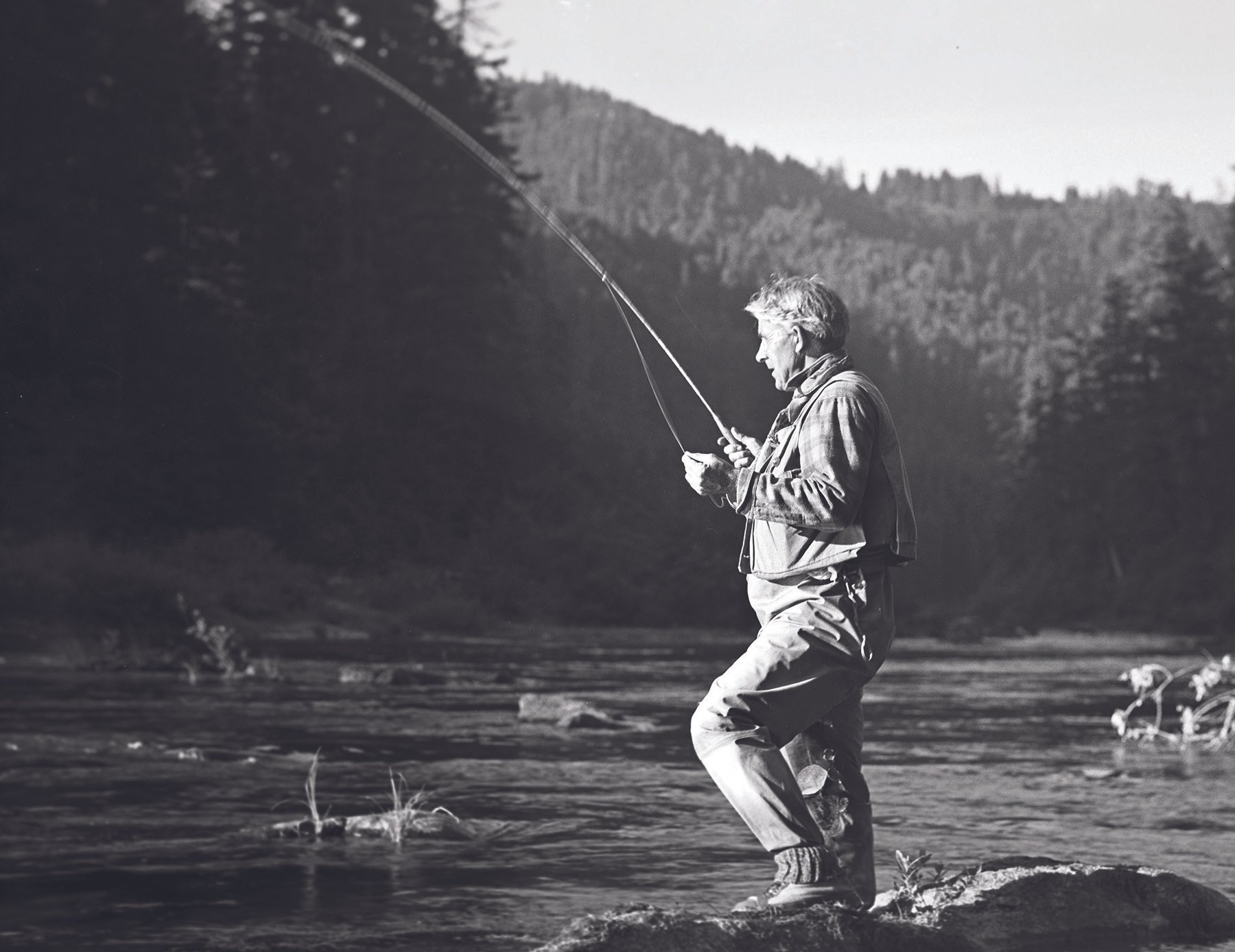
Zane Grey Spreads The Gospel: Part 1
By Trey Combs
An excerpt from Chapter 6 of Flies for Atlantic Salmon & Steelhead
Desktop only: Right-click any image in this essay to open it in a new tab to view the high-resolution version. This feature is not available on mobile.
Rocky Riffle
Fred Burnham had invited Grey and his entourage that included his brother R. C., “Lone Angler” Wiborn, a friend from university life, and the four-foot-tall camp cook George Takahashi, to meet him in Grants Pass and fish for steelhead on a prime length of fly water that Grey came to call Rocky Riffle. This would be Grey’s third trip to the Rogue and no one was more capable than Burnham to teach him to cast a fly. Burnham was a wealthy stockbroker and a gifted athlete who could skillfully cast an entire double-taper silk line line while waist deep in swirling currents.
But Grey, for all his desire to take steelhead on the fly, proved a difficult student. He was a poor caster who lacked distance and believed the steelhead were holding in water just out of his reach. Burnham had tutored Grey on casting his tip-heavy eight-ounce Kosmic rod that quickly wore his arm out. The split-cane rod had been constructed in Central Valley, New York, and was considered an American classic. Grey was partial to Hardy Brothers tackle from Alnwick, England, but he would fish whatever might advance his fly fishing, regardless of the cost.
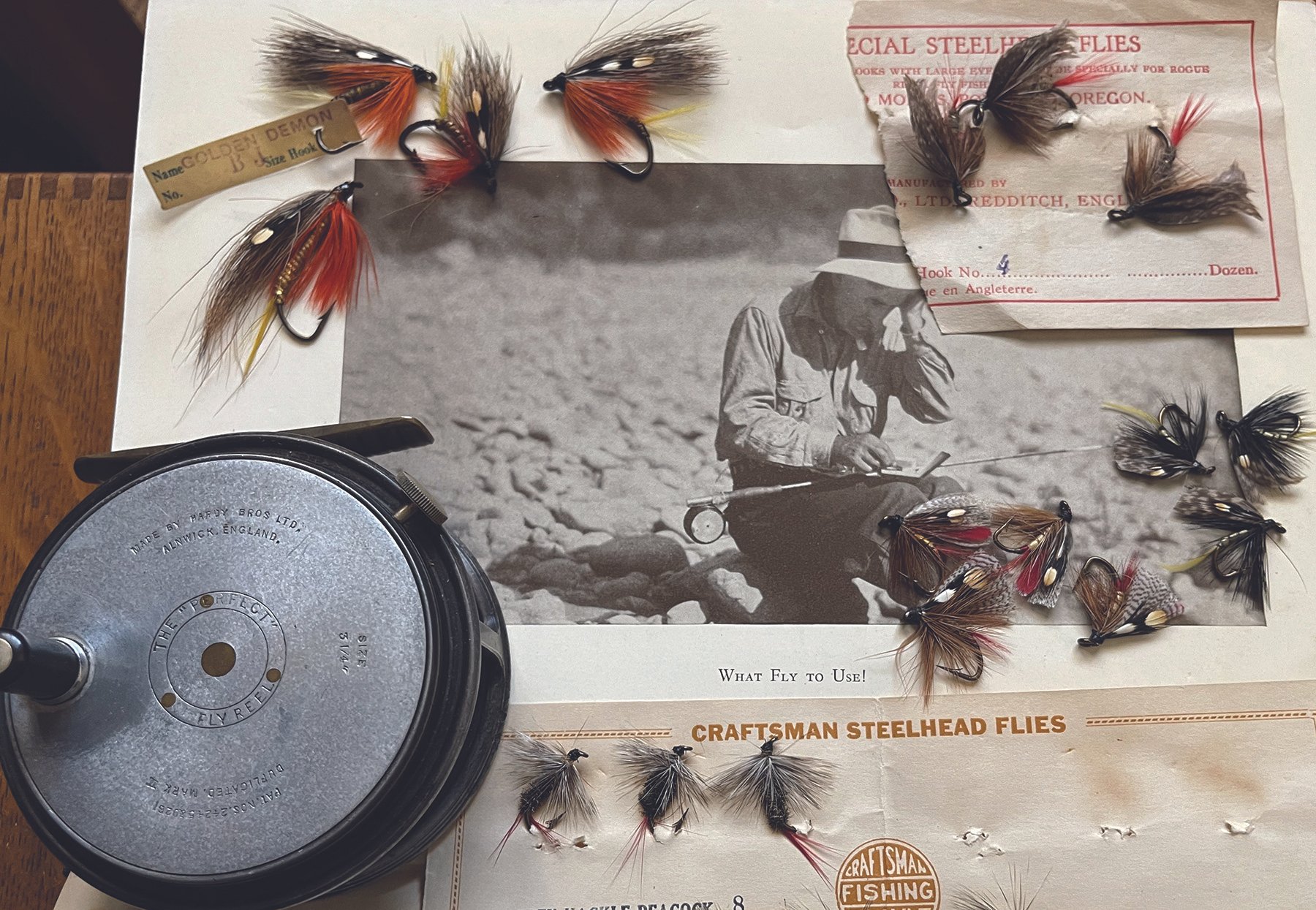
Although Grey was famous for his prowess at fighting marlin, swordfish and tuna at the stern of his lavish bluewater yachts, when he waded into the riffles of the Rogue, by his own admission he found steelhead quite confounding. The skilled casters with him all caught fish while he struggled with casting his “very old Kosmic fly-rod, nine and a half feet, eight ounces….”
Burnham was very hands-on, both when instructing Grey in how to cast and then fishing the fly. He advised:
“Wade downstream, and cast quarteringly [sic] across. Try to make your fly light first on the water. Let it float till your fly straightens out below you. Then cast again. Make a few casts over one spot, then wade down a few yards. When you get as far down the river as you want, go back and fish the water over again. Sometimes I raise steelhead on the third or fourth trip.”
Burnham wanted the fly to land first, perhaps so Grey wouldn’t need to mend, a subject he doesn’t bring up because it might confuse and add to one more thing for Grey to remember. Despite Burnham’s expert tutoring, Grey was unable to make all the parts come together. As the days pass, Grey’s failures become awkward.
Chester, “one of Mr. Lasky’s camera boys,” as Grey wrote in the chapter, had been maintaining a vigil on various rocks to get pictures of Grey fighting a steelhead hooked on fly. Grey’s writing and films based on his novels had become such a profitable, multifaceted business that he had decided to cut out the middleman by forming the Zane Grey Motion Picture Company. But after seven films he sold the business to Jesse Lasky, one of the founders of Paramount Pictures, and Chester’s boss.
Grey’s discomfort increased when brother R. C. came into camp with a “shiny fish between five to six pounds. “My first steelhead on a fly,” Romer said. “He made the best fight any small fish ever gave me.”
There’s nothing “small” about a Rogue steelhead of five to six pounds; that would be a Rogue steelhead of a lifetime today, as well as many yesterdays. Much more realistically, Grey’s “small” is semantic and leaves considerable room for interpretation.

In the summer of 1919, Zane Grey caught his first Rogue River steelhead. In Tales of Freshwater Fishing (1928), he wrote with his trademark flamboyance: “He was all muscle. He looked exactly what he was, a fish-spirit incarnate, fresh from the sea, with opal and pearl hues of such delicate loveliness that no pen or brush could portray them. brought the sea with him and had taken on the beauty of the river. He had a wild savage head, game as that of an eagle, jaws of a wolf, eyes of black jewel, full of mystic fire.”
Eight-Ounce Kosmic
Everyone but Grey was fishing H. L. Leonard split-cane fly rods; Burhnam’s shorter five and a half ounce Leonard cast like a fairy wand compared to Grey’s eight-ounce Kosmic. Hiram Leonard (1831–1907) had made the first Leonards during the mid-19th century in Bangor, Maine. Leonard had developed a beveller that could make micro-cut strips of such tolerance that a six-strip cane rod for a certain length, weight, and taper could be exactly reproduced, with nearly identical actions. Demand for the rods always exceeded supply; Leonard opened up a factory in Central Valley, New York, the same village where Grey’s Kosmic had been built. The rods would be superb for today’s fishing and for Grey’s party there was no finer rod to cast for steelhead anywhere in the world. That said, they all matched their Leonard rods with Hardy reels from England.
Zane Grey experienced a total beat-down for 10 days while hunting for a willing steelhead somewhere in Rocky Riffle. Unsophisticated locals were fishing with extremely long bamboo poles with a short length of line attached and a lure tied on the end—the steelhead yanked free of the water like a tuna being jack poled. Grey would chat with these folks while experiencing dismay over their fishing method: “One fellow informed me he caught a steelhead forty-two inches in length and a foot wide, and never weighed it. Other fishermen in the group said he’d caught one that weighed close to fourteen pounds.”
These are gigantic summer-run steelhead, clearly with three, even four years of high-seas residency. While Grey took in these stories and wore out his arm, brother R. C. brought to hand 14 steelhead, the largest weighing seven pounds. But he’d first cast a spoon just to get bloodied and feel the steelhead’s fight on a rod. Grey writes, “He hooked three great steelhead, all between twelve and fifteen pounds, and was not able to land one of them.”
After being spiritually fortified, R. C. successfully fished only the fly. But Grey was given over to self-pity and wrote:
“They had all surpassed me. Ken had caught 11 steelhead on a fly. Ed had seven to his credit. Takahashi two! And I had none. These miserable lucky fishermen undertook to teach me to catch steelhead!”
All of Grey’s well-meaning companions offered advice that made his failure only more stark and depressing. But it was left to pint-sized George Takahashi, the party’s Japanese cook, to put a fine point on Grey finding his dignity in such tatters: “You awful rotten fishermanz this trip,” he said.
Then Grey, weary from endless frustration, came down to Rocky Riffle in the morning and tied on an English salmon fly. He’d switched to a five-ounce Leonard and no doubt felt freed from the labors demanded from his heavy Kosmic. The new fly was taken immediately and when the four-pound steelhead was slid from the shallows, the curse was broken. Brother Romer bragged that his tally stood at 19 steelhead, and Grey began to happily make up the difference. When the party began packing up to leave the Rogue, and with a day remaining for the season, Grey could count 12 steelhead, his largest weighing six pounds; now Grey fished with confidence and his run of good luck more than balanced out his bad.
(Not to belabor the story of Grey’s first steelhead, but the smallest steelhead he ever reported was “four pounds.” It’s easy to imagine that this was a 20-inch half-pounder run on its first spawning migration.)
On the final day of fishing, R.C. grassed a magnificent steelhead that weighed an ounce or two over nine pounds. “He brought the sea with him and had taken on the beauty of the river,” said Grey, a benediction as lovely as any ever bestowed on a steelhead. Then the fish was killed to become one among the string of nine steelhead displayed for Grey to photograph. All these steelhead were considerably larger than “four pounds.”
When the sun had dropped behind the mountains, Zane Grey and brother R. C. began fishing the heart of Rocky Riffle. Grey had enjoyed an epic day. He was one with the river and its steelhead, his soaring confidence resting on the fly swimming at the end of his line. The last steelhead he hooked possessed remarkable endurance, its 100-yard dashes igniting his Hardy reel and taking him far below where he first raised the fish. Grey won this final battle, a steelhead R. C. weighed on his pocket scale: eight pounds. This trans-Pacific steelhead that had followed setting suns across the North Pacific from Oregon to the Aleutians and perhaps beyond to Russia’s territorial waters, would find a place on the stringer, their 10th trophy of the day.
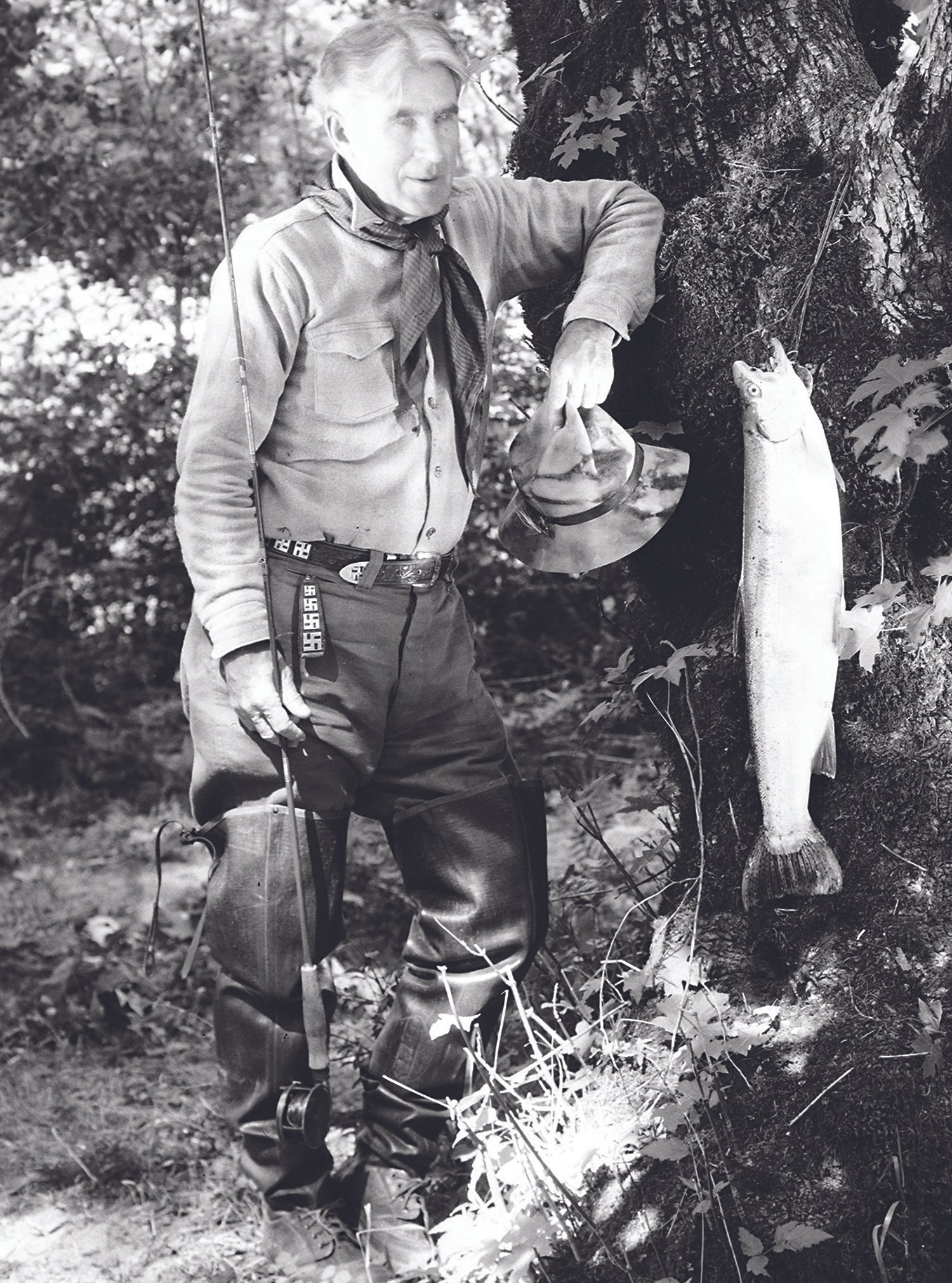
By the time Zane Grey first cast a fly on the North Umpqua, in 1932, he had a decade of experience with steelhead on the Rogue and had learned a thing or two.
Trey’s most recent book, Flies for Atlantic Salmon & Steelhead, is available directly from the author on Amazon in two formats:
Limited First Edition Hardcover — An oversized coffee-table book measuring 12.5 × 10.25 inches, with 384 pages and more than 1,000 photographs and illustrations. Bound in cloth with an embossed cover and dust jacket, this edition is limited to 1,500 copies. Available on Amazon.
Digital Reference Edition — A digital replica of the original book, preserving its page layouts, photographs, and illustrations. Ideal for viewing on a larger tablet in landscape mode, it makes a convenient reference at the fly-tying bench, keeping dressing notes and detailed fly images close at hand. Available on Amazon Kindle.