Bulkley River Steelhead: Capture Methods Matter
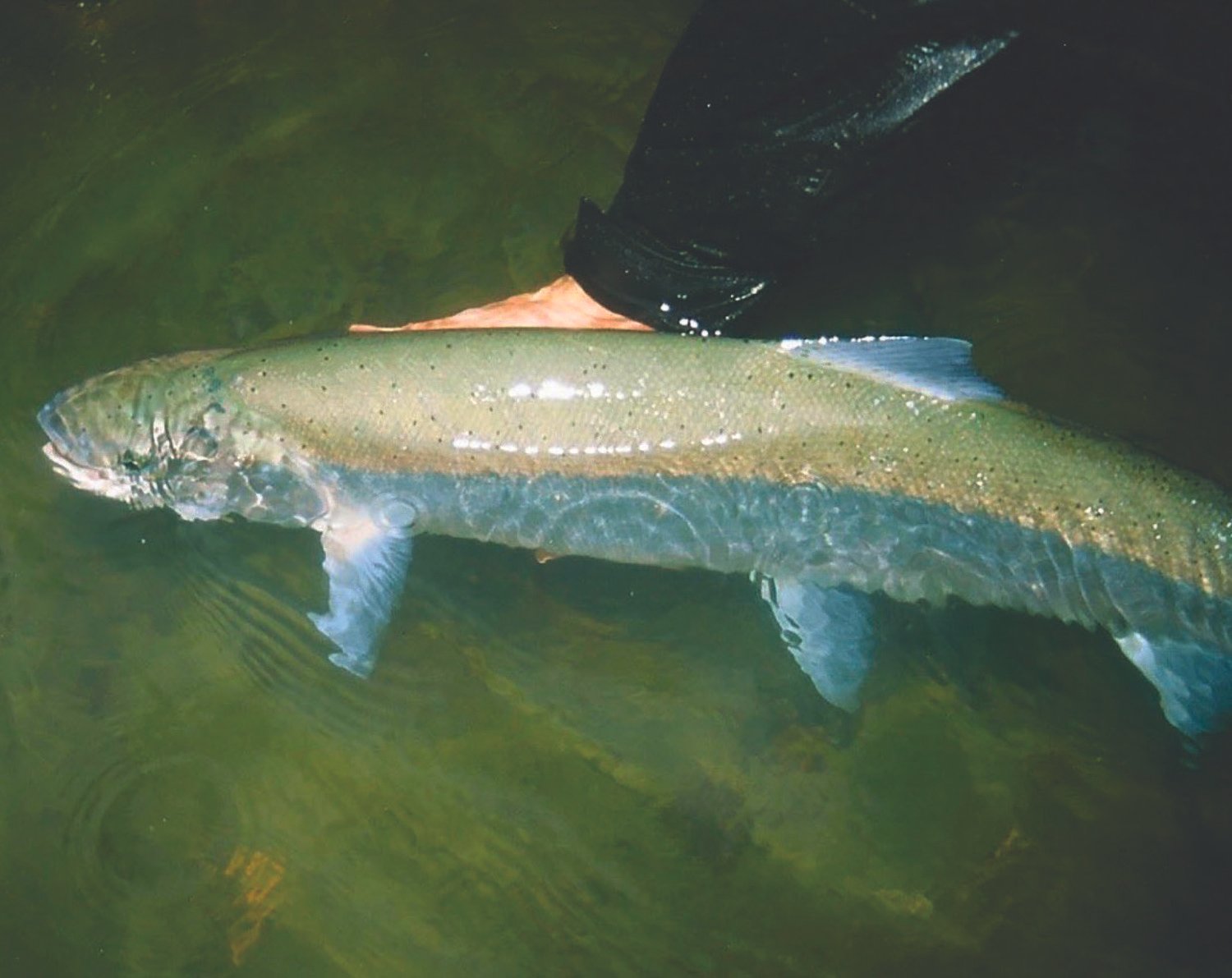
This article is a synthesis of research titled “Consequences of Fishery Gear Type and Handling Practices on Capture and Release of Wild Steelhead on the Bulkley River.” It draws on the study’s findings to present a clear, angler-focused explanation of how various capture methods impact the health of steelhead.
Catch-and-release has become part of modern steelheading, whether you’re swinging flies on a famous run or encountering fish as bycatch in other fisheries. The assumption behind it is simple: release the fish and it goes on its way, largely unaffected. But as this study on the Bulkley River shows, what happens between capture and release—gear type, handling, air exposure, and even water temperature—can shape how well that fish actually recovers and continues its migration.
This research looked at wild steelhead moving upstream to spawn and compared three common ways they’re caught: recreational angling, dip nets, and beach seines. Fish were captured using real-world methods typical of each fishery, then tracked after release using radiotelemetry. The goal wasn’t just to see whether they lived or died, but how they behaved afterward—how fast they moved, whether they dropped back, and what kind of condition they were in when released.
Injury and Capture Method
One of the clearest findings is that not all capture methods are equal, especially when it comes to injury. Nearly half of the steelhead caught with dip nets showed visible injuries—things like torn fins, net marks, or scale loss. By comparison, only a small fraction of fish caught in beach seines or by angling showed similar damage.
That difference likely comes down to how fish are handled. Dip-netted fish were often entangled, lifted, transferred, and sometimes scraped against rocks during capture. Seine-caught fish, by contrast, were corralled in water and handled more gently, while angled fish were typically hooked in the mouth and released quickly. In fact, almost all angled fish in the study were hooked cleanly in the corner of the mouth, with virtually no deep hooking.
Stress and Reflex Impairment
Injury is only part of the story. The study also measured something called the righting reflex—basically whether a fish can flip itself upright quickly after being turned over. It’s a simple but powerful indicator of stress. Fish that can’t right themselves are in rough shape.
Here again, differences were clear. Most angled fish retained this reflex, while a much higher proportion of dip-net and seine-caught fish showed impairment. This suggests that even when fish survive capture, some methods leave them temporarily compromised.
Movement After Release
Where things get especially interesting for anglers is what happens after release.
The study tracked fish movement over time and found major differences in migration rates depending on how fish were caught. Fish caught in nets (both dip nets and seines) moved much faster—often covering several kilometers per day—while angled fish moved much more slowly.
At first glance, that might seem like angling is worse, but the explanation is more about timing than damage. Net fisheries were operating lower in the river and earlier in the season, when steelhead were still actively migrating. Anglers, on the other hand, tended to catch fish later and farther upstream, when fish were already holding near spawning areas.
In other words, slower movement in angled fish doesn’t necessarily mean they were harmed—it likely reflects where they were in their migration.
Air Exposure and Water Temperature
What does point more clearly to stress are two factors that came up again and again: air exposure and water temperature.
Dip-netted fish experienced the longest air exposure—on average over 40 seconds, and sometimes much longer. Seine-caught fish were almost never exposed to air, and angled fish only briefly.
That difference mattered. For dip-netted fish, longer air exposure was linked to slower migration later on. The same was true for warmer water temperatures at the time of capture.
This is a key takeaway: even when fish survive, these stressors can have subtle but real effects on how they perform afterward. A fish that migrates more slowly may face energetic costs, delays in reaching spawning grounds, or reduced reproductive success.
Fallback Behavior
Another behavior the study documented was fallback—fish dropping downstream after being released. Nearly half of the dip-netted fish fell back below the falls within 24 hours, compared to a much smaller percentage in other groups.
Again, temperature played a role. Fish caught in warmer water were more likely to fall back. While many of these fish eventually resumed their upstream migration, some did not return, suggesting that capture stress can alter behavior in ways that may affect survival or spawning success.
Survival
When it comes to outright mortality, the results may surprise some anglers. Immediate death was rare across all methods. Only one fish in the entire study died right after release, and that fish had been caught in a dip net.
Short-term survival (over three days) was generally high:
Dip-net fish: about 88–97%
Seine fish: about 96–100%
Angled fish: somewhere between 68–100% (with uncertainty due to tracking limits)
The wide range for angled fish isn’t because they died more—it’s because many held in place and were harder to track, making it difficult to confirm survival. Based on other studies and the lack of deep hooking, the authors suggest angling mortality was likely very low.
What It Means
So the big picture is this: most fish survive catch-and-release, but survival alone doesn’t tell the whole story.
Sublethal effects—injury, stress, altered behavior—can still matter, especially in a species like steelhead that is already under pressure. The study emphasizes that capture is one of the most intense stress events a fish experiences, even if it doesn’t lead to immediate death.
For anglers, the implications are practical.
First, minimize air exposure. Even relatively short periods out of the water were linked to changes in fish behavior later on. Keeping fish in the water during unhooking and release isn’t just good ethics—it has measurable benefits.
Second, be mindful of water temperature. Warmer water amplifies stress and can affect how fish recover. This supports the idea of voluntary restraint—or even closures—during warm periods.
Third, handle fish carefully and efficiently. While angling caused the least injury in this study, poor handling could easily change that. The fact that nearly all angled fish were hooked in the mouth and released quickly is likely a big reason mortality stayed low.
Finally, it’s worth noting that not all fisheries operate under the same conditions. Dip-net and seine fisheries often deal with large numbers of fish and logistical constraints that make handling more difficult. The study suggests that gear modifications—like smaller mesh or less abrasive materials—and improved handling practices could reduce injury in those fisheries.
Final Note
In the end, this study reinforces something experienced anglers already suspect: how you catch and release a fish matters as much as whether you release it at all.
Steelhead are resilient, but they are not unaffected. A fish that swims away is not always a fish that’s unchanged. The small decisions—keeping it wet, limiting air exposure, avoiding warm water—add up. And across thousands of fish and multiple fisheries, those decisions can shape the future of the run.
— Mark Combs
Source: Twardek, W. M., Elmer, L. K., Beere, M. C., Cooke, S. J., & Danylchuk, A. J. (2019). Consequences of fishery gear type and handling practices on capture and release of wild steelhead on the Bulkley River. North American Journal of Fisheries Management, 39(2), 254–269. https://doi.org/10.1002/nafm.10267
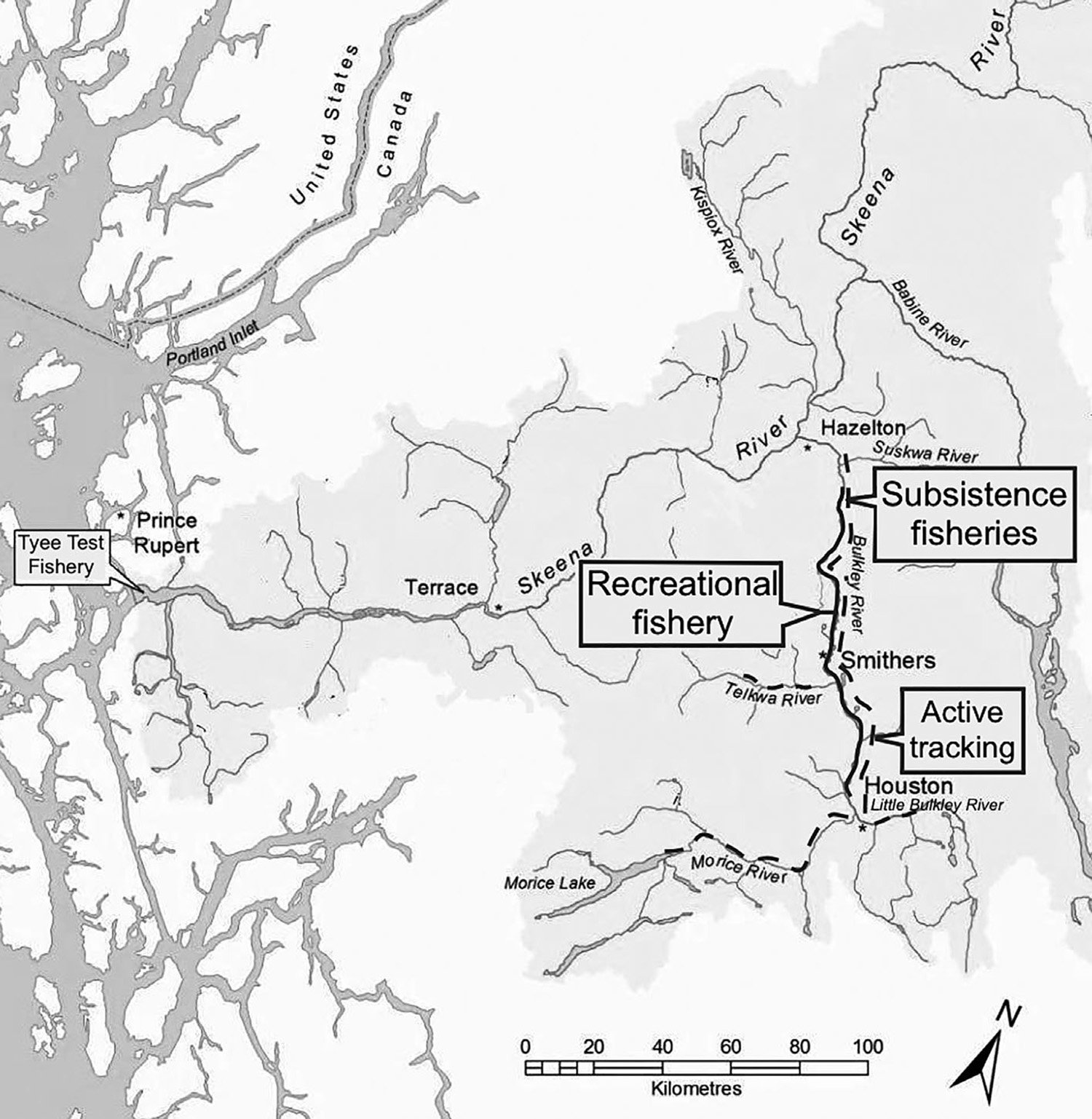
A map of the Skeena River watershed highlighting the Skeena, Bulkley, and Morice rivers and their major tributaries. The sampling locations for the subsistence and recreational fisheries are noted on the map. Active radiotelemetry tracking was completed along the dashed line. Picture sourced from www.oceanecology.ca
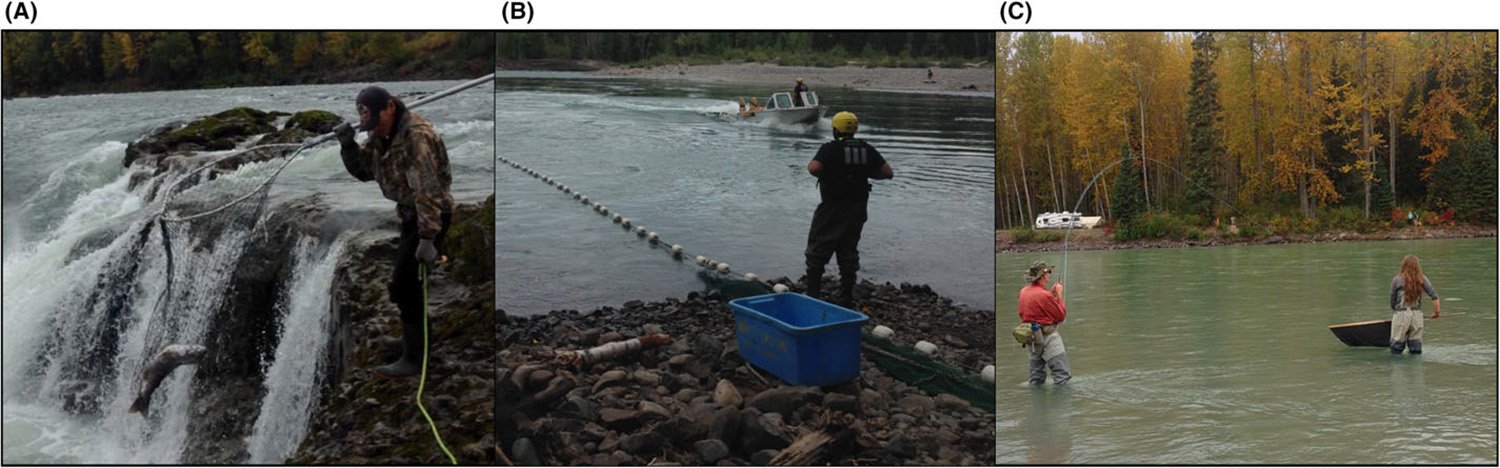
Photographs showing steelhead capture by (A) dip net, (B) beach seine, and (C) recreational angling on the Bulkley River, British Columbia. Following capture in the dip net, steelhead were transferred to a transport cradle that was carried by a runner to a sampling station, where steelhead were assessed for sex, length, and injury prior to release.